

Block for Displaced Persons and Those Deprived of Their Rights (BHE)
Block for Displaced Persons and Those Deprived of Their Rights (BHE)
1. Brief description
The “Block of Displaced Persons and the Disenfranchised” (BHE) was founded in Kiel on 8 January 1950, following the abolition of compulsory licensing for political parties, as a representative body primarily for displaced persons, and achieved spectacular results in state elections and in the 1953 federal election. Paradoxically, the BHE’s problem – which ultimately led to its gradual disappearance as a party – was precisely its success as an interest group, which had contributed significantly to the integration of displaced persons. As the material hardship faced by the displaced persons was alleviated, they turned away from the BHE and towards the ‘local’ parties. Even the merger with the small right-wing conservative German Party (DP) to form the All-German Party (GDP, later GPD) in April 1961 was unable to reverse this trend. Having already failed to regain a seat in the Bundestag in 1957, the BHE also lost ground in the federal states and had dwindled to a fringe party by the end of the 1960s. The federal party, which is said to have still had around 1,000 members in the early 1980s, has not yet been formally dissolved. From 1952 onwards, the BHE was officially known as the Gesamtdeutscher Block/BHE (GB/BHE), although the abbreviation BHE was no longer explained; however, neither this name change nor the new names GDP or GPD ever really caught on, which is why, for the sake of simplicity, the term BHE will be used throughout the following text.
2. History and Programme
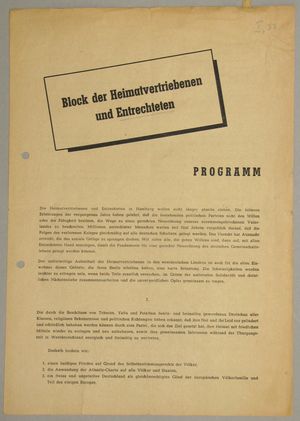
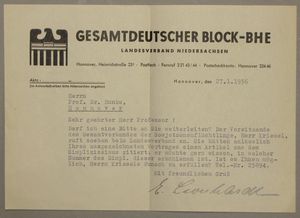
Although the BHE sought from the outset to reach out not only to displaced persons but also to other target groups, such as victims of the bombing campaign, those affected by the currency reform, or civil servants dismissed for political reasons after 1945 – all of whom were referred to in the party’s name by the addition ‘Entrechtete’ – it was, first and foremost, a party for displaced persons. This focus on their interests was the reason for the party’s initially rapid rise: Between 1950 and 1966, the BHE was briefly represented at federal level (1953–1955), but was involved in forming state governments for a much longer period: in Baden-Württemberg from 1952 to 1964, in Bavaria from 1950 to 1962, in Hesse from 1954 to 1966, in Lower Saxony from 1951 to 1963 and in Schleswig-Holstein from 1950 to 1958. A characteristic feature of the BHE was that its ranks included many former National Socialists, such as the chairs during the founding phase, Waldemar Kraft and Theodor Oberländer. In 1952, the former expressly emphasised that the BHE was the party ‘also of the former Nazis, but not of those who are still Nazis today’ (Winkler, 359). Although the BHE was not, in this respect, a far-right party, it played a central role in bringing an end to denazification measures and in the professional reintegration of individuals with Nazi ties in the early Federal Republic. The BHE’s policy was aimed not only at rapidly improving the living conditions of displaced persons, but also at securing jobs for its supporters through targeted patronage, particularly in public administration. In this respect, the BHE was able to operate successfully not least because, as a result of its predominantly interest-based political orientation, it was not automatically tied to centre-right coalitions. Particularly in Hesse and Lower Saxony, and for a short time in Bavaria too, it supported SPD-led governments, whereby its social policy demands – geared towards the redistribution of wealth from the local population to the displaced persons – formed an ideological bridge, as did the SPD’s initially hostile stance towards Adenauer’s policy towards the West. This pragmatic approach by the BHE had far-reaching consequences, particularly for post-war history in Hesse, where it was only the displaced persons’ party’s willingness to form coalitions over many years that made the SPD the structural majority party for decades. From the outset, one problem for the BHE was that it was unable to compete with the head start enjoyed by the major mainstream parties – particularly those – stemming from the former licensing requirements: In the 1953 federal election, when the party stood nationwide for the first time and entered the Bonn parliament with a (disappointing) 5.9 per cent, only 34 per cent of the displaced persons voted for the BHE. In no Federal State, not even in its strongholds of Lower Saxony, Schleswig-Holstein and Bavaria, did it reach 50 per cent. In the 1957 federal election, when the BHE narrowly failed to reach the threshold with 4.6 per cent – a result that heralded the end of the party – only 26 per cent of displaced persons voted for it; even in its strongholds, it no longer managed to exceed 35 per cent (Bavaria). The BHE’s attempt to counter this trend by presenting itself as a national, bourgeois party for all Germans (hence its renaming in 1952 to the All-German Block/BHE or GB/BHE) failed. This is all the more remarkable given that such an orientation (‘Third Force’) certainly corresponded to the self-image of many members, particularly that of the Sudeten Germans, who were significantly over-represented in the party and who, for the most part, must be counted amongst the ‘national-liberal’ or ‘völkisch’ camp – a group that was politically homeless in the early Federal Republic and predominantly organised within the Witiko League. It succeeded neither in significantly expanding its own electorate to include locals, nor in establishing itself permanently within a national bourgeois bloc alongside competing bourgeois or right-wing parties. The BHE’s participation in Adenauer’s second government (1953–1955) proved to be a mistake, as it enabled the Chancellor to split the parliamentary group in the Bundestag and thereby permanently weaken the party. Kraft and Oberländer left the BHE in 1955 and later joined the CDU. The merger of the BHE with the German Party (DP), which was also in decline, to form the All-German Party (GDP, known as the GPD from 1966) in April 1961 was, in essence, merely the meagre remnant of once-ambitious plans, which were finally consigned to the scrapheap following the party’s failure in the 1961 Bundestag election (2.8 per cent). This development was exacerbated by the fact that many former DP members soon left the GDP again, thereby reducing it once more to the remnants of the old BHE support base. By 1966, the GDP had lost all its seats in the state parliaments. Since then, the mainstream parties – the CDU, CSU and SPD – had made every effort, with considerable success, to absorb the remaining BHE supporters. Through electoral agreements, four more GDP MPs were elected to the Bundestag in 1965: Heinz Kreutzmann and the federal chairman Hermann Ahrens for the SPD, and Walter Becher and Herbert Prochazka for the CSU. However, they did not form a GDP group but were guests within the parliamentary groups through whose state lists they had been elected; with the exception of Ahrens, they later defected to their respective host parties. This course of action essentially foreshadowed the future fate of the GDP/GPD: by 1969, the party had only around 5,000 members left, meaning it had lost 45,000 (= 90 per cent) of its members within four years, predominantly to the Union parties, and to some extent also to the SPD (particularly in the Hesse regional association). In this way, a number of former National Socialists found acceptance into the mainstream parties, for example the long-standing BHE/GDP federal chairman (1958–1962) and temporary Chairman of the Witiko Federation, Frank Seiboth, who defected to the SPD in 1967 and served as State Secretary in the Hessian Ministry of Agriculture and Forestry until 1974. As for the Union parties, particular mention should be made of Erich Schellhaus, the long-serving Lower Saxony Minister for Displaced Persons, who joined the CDU in 1964.
Sources and Bibliography
- Frank Bösch: The political integration of refugees and displaced persons and their inclusion in the CDU. In: Rainer Schulze (ed.): Between Homeland and Home. German Refugees and Displaced Persons in (West) Germany 1945–2000. Osnabrück 2001 (Sources and Accounts on the History of the District of Celle 6), p. 107–125.
- Wolfgang Fischer: ‘Homeland’ Politicians? The Self-Conception and Political Action of Displaced Persons as Members of the German Bundestag from 1949 to 1974. Düsseldorf 2010 (Contributions to the History of Parliamentarism and Political Parties 157).
- Ossip K. Flechtheim (ed.): Documents on the Development of Party Politics in Germany since 1945. 9 vols. Berlin 1962–1971.
- Eike Frenzel: From the Block of Displaced Persons and the Disenfranchised to the All-German Party. The Rise and Fall of an Interest-Based Party in Lower Saxony 1950–1963. Hamburg 2008 (Series: Studies in Contemporary History 67).
- Heinz Kreutzmann (ed.): The All-German Bloc. BHE. Bonn 1957 (The Political Parties in the Federal Republic of Germany).
- Matthias Müller: The SPD and the Associations of Displaced Persons 1949–1977. Harmony, Alienation, Discord. Berlin 2012 (Politics and History 8).
- Franz Neumann: The Block of Displaced Persons and the Disenfranchised 1950–1960. A Contribution to the History and Structure of a Political Interest Party. Meisenheim/Glan 1968 (Marburg Treatises on Political Science 5).
- Daniel Schönwald: Integration through an Interest-Based Party. The Block of Displaced Persons and the Disenfranchised in Bavaria 1950–1981. Kallmünz/Opf. 2014 (Munich Historical Studies. Department of Bavarian History, XXIV).
- Michael Schwartz: Officials with a Past. The Founding Presidium of the Federal Association of Displaced Persons and the ‘Third Reich’. Munich 2013.
- Matthias Stickler: ‘East German Means All of Germany’ – Organisation, Self-Conception and Homelands Policy Objectives of the German Associations of Displaced Persons 1949–1972. Düsseldorf 2004 (Research and Sources on Contemporary History 46).
- Richard Stöss (ed.): Handbook of Political Parties. The Parties in the Federal Republic of Germany 1945–1980. Vol. 2: FDP to WAV. Opladen 1984 (Publications of the Central Institute for Scientific Research at the Free University of Berlin 39), p. 1460–1477 (GDP), pp. 1424–1459 (GB/BHE).
- Martin Virchow: The GB/BHE, a New Type of Party? In: The Parties in the Federal Republic. Studies on the Development of German Parties up to the 1953 Federal Election. Stuttgart 1955 (Publications of the Institute for Political Science 6), pp. 450–467.
- York R. Winkler: Refugee Organisations in Hesse 1945–1954. BHE – Refugee Associations – Regional Associations. Wiesbaden 1998 (Publications of the Historical Commission for Nassau 64; Research on the Integration of Refugees and Displaced Persons in Hesse after 1945 6).
Citation
Matthias Stickler: Block of Displaced Persons and Those Deprived of Their Rights (BHE). In: Online Encyclopaedia on the Culture and History of Germans in Eastern Europe, 2013. URL: ome-lexikon.uni-oldenburg.de/p32864 (as at 16 November 2020).
Terms of use for this article
Copyright © University of Oldenburg and the Federal Institute for the Culture and History of Germans in Eastern Europe (BKGE), all rights reserved. This work was produced as part of the project ‘Online Encyclopaedia on the Culture and History of Germans in Eastern Europe’ and may be reproduced and published provided the rights holders’ consent has been obtained. Please contact:
If you have any specialist comments or additions to the text, please contact the editorial team, citing relevant literature and source references.