

Institute for Eastern European Studies, Munich (Regensburg)
Institute for Eastern European Studies, Munich (Regensburg)
1. Brief description
The Munich Institute for Eastern European Studies was founded in 1952 as the successor to the Breslau Institute for Eastern European Studies; it was relocated to Regensburg in 2007 and merged in 2012 with the Institute for South-Eastern European Studies, which had also moved there. At the same time, it was renamed the Regensburg Institute for Eastern and South-Eastern European Studies (IOS).
2. Tasks
The Institute for Eastern European Studies was founded as a multidisciplinary institution. In the 1950s, history was the dominant subject; from 1963 onwards, the Institute focused primarily on economics, with departmental research for the Federal Ministry of Economics taking centre stage from the mid-1970s. In the first decade of the 21st century, there was a shift towards ‘academic’ research.
3. Organisation
The Institute for Eastern Europe was supported by the Foundation for Research into Eastern Europe, based in Munich and, from 2007, in Regensburg. Its highest governing body was the Foundation Board, with the Chair held by the Bavarian Ministry of Education and Cultural Affairs, which appointed the Director and the permanent staff. To a decreasing extent, a board of trustees supported the Institute’s academic activities.
4. History

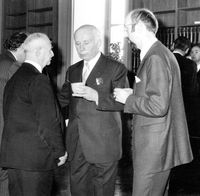
The Institute for Eastern European Studies (OEI) in Munich began its work on 1 February 1952. It was part of the wider effort to re-establish the network of institutions for Eastern European studies that had been lost with the territories in the East, in this case by building on the legacy of the Breslau Institute for Eastern European Studies. This was reflected, amongst other things, in the appointment of Hans Koch as director and in the resumption of publication of the *Jahrbücher für Geschichte Osteuropas* (*Yearbooks of Eastern European History*). In addition, the Institute served to meet the need for guidance following the erection of the Iron Curtain, in line with the consensus prevailing at the time during the Cold War. The OEI had a multidisciplinary focus and was funded equally by Bavaria and the federal government, with the Bavarian Ministry of Education and Cultural Affairs exercising control through its chairmanship of the Board of Trustees. However, the aim was not, as the predominantly Munich-based scholars on the board of trustees feared, the ‘politicisation’ of the Institute; rather, the point of contention was access to resources – the Ministry awarding research grants to ‘Bavarian’ scientists, whilst the members of the Board of Trustees sought funding for their own projects.
Under the directorship of Hans Koch (1894–1959) – who was already controversial at the time due to his activities during the ‘Third Reich’ and the war (including his involvement in the North and East German Research Association) – the Institute was essentially focused on Munich and, at the same time, on the director himself, as well as on the members of the board of trustees, who were frequently at odds with Koch, and on a circle of other researchers living in Munich at the time, many of whom shared Koch’s background in ‘German-centred’‘Eastern research’and were now facing precarious living conditions. Possible contacts with the CIA-funded broadcasters Radio Free Europe and Radio Liberty, with the Emigrants’ Institute for Research into the USSR – which was funded from the same source – and with the Federal Intelligence Service in Pullach have yet to be investigated, but the geographical and ideological proximity alone was a problem. Within tight financial constraints, the Institute’s activities focused on expanding the library, publishing the ‘Yearbooks’ and a series of monographs, awarding ‘research grants’, of which far fewer than planned could ever be funded, and on lectures, which Hans Koch – an anti-Bolshevik through and through, yet also a Ukrainianophile – usually delivered himself.
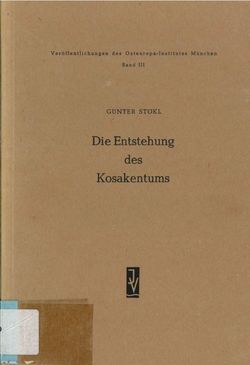
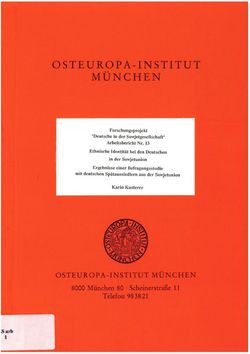
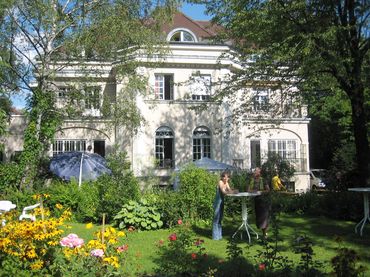
Shortly before Koch’s death, the OEI moved into a villa in the Bogenhausen district; despite its cramped layout, the layout of the rooms fostered internal academic communication and staff motivation. It was here that the major reorientation began in the 1960s.
Koch’s successor from 1960 to 1963, the Munich-based historian of Eastern Europe Georg Stadtmüller, was ousted when the forces that had long been pushing for a reorientation towards economics and society succeeded in securing the appointment of the economist Hans Raupach to the newly created Munich Chair of Economics and Society in Eastern Europe. Members of the Board of Trustees such as the economist Adolf Weber, the lawyer Reinhard Maurach and the Slavicist Erwin Koschmieder were likely also keen to see a decisive break with Koch’s anti-Bolshevik, German nationalist and Ukrainian exile networks and related topics, as these hindered the establishment of contacts with the research community, particularly in Poland and the Soviet Union. Stadtmüller himself had already promoted the transformation of the ‘Jahrbücher’ into a publication serving the German-speaking academic ‘community’ with an international focus, which was also intended to contribute to the collaborative documentation of research within German-speaking historical scholarship. However, even here he encountered a formidable rival in the form of Günter Stökl (Cologne) and, in early 1966, stepped down from the position of editor.
Under the leadership of the Prague-born, broadly educated and cosmopolitan Hans Raupach (1903–1997, Director 1963–1975), a Department of Social Economics was established, initially with two posts, which brought about a scientific resurgence. Raupach not only established, in the traditional vein, a series of books on economics, the journal *Jahrbuch der Wirtschaft Osteuropas* and the series *Gegenwartsfragen*, but, above all, by uniting the resources of the university and the OEI, he also initiated a ‘Postgraduate Programme in Eastern European Economics’ featuring a modern supervision model based on Anglo-Saxon examples and scholarships funded by the Volkswagenwerk Foundation. Its primary aim was to train academic researchers, and it ran from 1964 to 1970. From 1970 to 1979, the German Research Foundation (DFG) funded a groundbreaking research project which, with the aid of new econometric methods, modelled the economy of the Soviet Union and decisively distanced itself from the Cold War consensus, which sought to view the East solely as a command economy devoid of economic rationality. In the course of the project, collaboration took place with British and American academics; two project staff members obtained their doctorates in the USA; and the project’s staff – and later that of the Institute – became increasingly international, with the former Prague professor Jiří Sláma (1929–2020) deserving particular mention. Although under Raupach and his successors—who also came from the field of economics—there was no ‘reassessment’ of the Koch era and its links to the Nazi period and the anti-communism of the 1950s, Raupach systematically and successfully promoted dialogue with Eastern European academics and worked to dispel the reservations towards the OEI and Munich as a centre for Eastern European studies that had arisen in the communist bloc during the post-war period. The History Department, which remained under Stadtmüller’s leadership and effectively had only one post (the editorial team for the ‘Jahrbücher’ was headed by Günter Stökl), also succeeded in 1974, under the leadership of Gert Robel, in securing funding for a major research project on ‘The German press’s image of Russia, 1859–1890’.
Raupach’s reform proposals for the OEI could only be implemented in part. Nevertheless, in 1969 he appointed Heinrich Vogel (1937–2014) as managing director, who, like his successor Hermann Clement (from 1977), possessed the ability to lead. Despite all its academic successes, the Institute could not be placed on a more solid financial footing. The reasons for this were, on the one hand, the Bavarian Ministry of Education and Cultural Affairs’ attitude, which was more passive and administrative than actively proactive, and, on the other hand, the Brandt government’s new Ostpolitik. During the preparations for the Eastern Treaties, the latter developed undifferentiated and virtually unshakeable reservations towards non-university German research on Eastern Europe, which was perceived as unhelpful and, due to its budgetary funding, as being too independent.[1] Added to this was the reorganisation of research financing (1969–1973), which only permitted federal and state financing of institutes once they exceeded a de minimis threshold of 1.5 million DM. The report by the Federal Audit Office on federally funded research into Eastern Europe, presented in 1974, with its focus on departmentaland contract research, as well as on the wishes of political clients, set in motion a problematic development – perceived particularly by the dominant Economics Department – which, by the time the evaluations began in the 1990s, confronted the OEI with the same problems as other non-university institutes: They were accused of conducting too little research, and above all too little research of an ‘academic’ standard. Consequently, non-university institutes were obliged to affiliate themselves with universities as ‘affiliated institutes’; many experienced, at least temporarily, a ‘downgrading’ to ‘service’ organisations. In 1976, the OEI was transferred from the Federal Ministry of the Interior to the Ministry of Economic Affairs and received the federal contribution – usually just over 50 per cent of the institute’s budget – solely for consultancy work. Whilst this did succeed in transferring staff working on the econometrics project to permanent posts, it came at the cost of making it virtually impossible to carry out ‘basic research’.
The new director (from 1975), Günther Hedtkamp (1928–2018), Raupach’s successor to the chair, succeeded in stabilising the institute’s budget for ten years from 1979. In 1987, the Institute was allocated a specialist on Polish affairs, a post required for the preparation of expert reports. The sociologically oriented research project—conceived in 1981 following an American project and only concluded in 1994 after various follow-up projects—which involved surveying Russian-German repatriates from the Soviet Union, marked another academic success, particularly as the project leader, Barbara Dietz, became a sought-after policy adviser on issues relating to the integration of Russian-Germans and, later, on migration matters. The ‘Yearbook of the Economy of Eastern Europe’ was renamed ‘Economic Systems’ in 1988, with Richard Frensch as managing editor; it was internationalised and switched to a modern peer-review system.
The small History Department, weakened by the de facto separation from the Yearbook editorial team and headed since 1976 by Edgar Hösch, Stadtmüller’s successor to the chair, made a name for itself, amongst other things, by taking over the journal *Russia Mediaevalis*, continued to produce publications and research documentation, and, from the late 1980s onwards, undertook digital projects such as the Amburger database on foreigners in pre-revolutionary Russia and (from 2000) the Virtual Specialised Library on Eastern Europe, etc. in close co-operation with the Bavarian State Library in Munich. A number of successful research projects funded by external grants were also carried out.
After the handover of the institute’s leadership to Hedtkamp’s successor in 1989 had failed, the 1990s saw Eastern European studies once again called into question. In 2004, the federal government ceased its financing of the OEI.
In the spirit of reform policies aimed at enhancing the status of academia, the Bavarian State Government sought, at the turn of the millennium, a solution to the long-standing problems (organisational and spatial fragmentation, lack of co-operation; inadequate accommodation) facing Munich’s research institutes on Eastern Europe. The Ministry of Finance pushed for the relocation of the OEI, the South-East Institute (whose contemporary history department had been moved to Berlin) and the Institute for Eastern European Law to Regensburg – issues that were now resolved at the highest political level. The Ministry had already shown a clear preference for Regensburg back in the 1960s, when, during the founding phase of the new university, circles with a strong sense of local pride, drawing on the city’s thousand-year-old ties with the East, had sought to establish an ‘Institutum Salisburgo-Ratisbonense Slavicum’ . The fact that Eastern Europe was once again being offered as a means of ‘shaping Regensburg’s profile’ must have seemed tempting, even if the euphoria surrounding the issue was not to last long there.
The last major reorientation took place during the brief (2001–2005) directorship of Lutz Hoffmann (1934–2019), a professor emeritus from Regensburg. From his time as Director of the German Institute for Economic Research (DIW) in Berlin, Hoffmann was familiar with the issues surrounding departmental and contract research, and he initiated the institute’s consistent reorientation towards ‘academic’ research. For the History Department, this meant, for example, the discontinuation of the book series and the formal integration of the JGO editorial team into research activities.
In 2007, the three institutes mentioned moved to Regensburg, where they were initially housed in the Old Tax Office – under one roof but with a shared library. From the end of 2009, efforts were made to merge them – a process completed in 2012 – into the Institute for East and South-East European Studies as an affiliated institute of the University of Regensburg, and to pursue a successful application for Leibniz Research Alliance status. The current academic standard of the Institute’s work has been demonstrated by the individual awards of professorships to members of the Institute.
Bibliography
- Hermann Beyer-Thoma: An Overview of the History of the Institute for Eastern European Studies in Munich. In: The Institute for Eastern European Studies at the Centre for Eastern and South-Eastern European Studies, Regensburg. Regensburg 2007, pp. 15–21.
- Hans-Jürgen Bömelburg: The Institute for Eastern European Studies in Breslau 1930–1940. Scholarship, propaganda and national enemy stereotypes in the work of an interdisciplinary centre for Eastern European research in Germany. In: Michael Garleff (ed.): Between Confrontation and Compromise. Oldenburg Symposium: ‘Inter-ethnic Relations in East-Central Europe as a Historiographical Problem of the 1930s and 1940s’. Munich 1995, pp. 47–72 (= Publications of the Federal Institute for East German Culture and History, 8).
- Ray Brandon: Hans Koch. In: Alexander Pinwinkler, David Hamann, Ingo Haar, Michael Fahlbusch (eds.): Handbook of Ethnic Studies. Actors, Networks, Research Programs. 2nd fully revised and expanded edition. Berlin 2017, pp. 347–358.
- Eike Eckert: Between ‘Ostforschung’ and the History of Eastern Europe. On the Biography of the Historian Gotthold Rhode (1916–1990). Osnabrück 2012 (= Monographs of the German Historical Institute in Warsaw, 27).
- David C. Engerman: Know Your Enemy. The Rise and Fall of America’s Soviet Experts. Oxford 2009.
- Michael Fahlbusch: Science in the Service of Nazi Politics? The ‘Ethnic German Research Associations’ from 1931–1945. Baden-Baden 1999.
- Michael Frey: Before ’68. The Cold War and the New Left in the Federal Republic of Germany and the USA. Göttingen 2017 (= Contributions to the History of the 20th Century, 26).
- Andreas Kappeler: Hans Koch. (1894–1959). In: Arnold Suppan (ed.): Eastern European History in Vienna. 100 Years of Research and Teaching at the University. Innsbruck 2007, pp. 227–254.
- Thekla Kleindienst: A Test of Strength. The Policy of Détente and Research on Eastern Europe. In: Osteuropa 55, 2005, pp. 149–162.
- Thekla Kleindienst: The Development of West German Research on Eastern Europe in the Tension between Academia and Politics. Marburg 2009 (= Materials and Studies on East Central European Research, 22).
- Evgenij V. Kodin: The Munich Institute for the Study of the USSR, 1950–1972. Evropejskij centr sovetologii. Monografija [The Munich Institute for the Study of the USSR, 1950–1972. The European Centre for Soviet Studies. Monograph]. Smolensk 2017.
- Hans-Christian Petersen, Jan Kusber: Eastern European Studies between Eastern European History and Ostforschung, in: Jürgen Elvert and Jürgen Nielsen-Sikora (eds.): Cultural Studies and National Socialism. Stuttgart: Steiner, 2008, pp. 289–312 (= Historische Mitteilungen Beihefte Geschichte, 72).
- Gert Robel: The Munich Institute for Eastern European Studies. In: Erwin Oberländer (ed.): The History of Eastern Europe. On the Development of a Historical Discipline in Germany, Austria and Switzerland 1945–1990. Stuttgart 1992, pp. 281–294 (= Sources and Studies on the History of Eastern Europe, 35).
- Hans-Henning Schröder: Resubmission: Expertise on Eastern Europe. Decline, New Beginning, Open Expectations. In: Osteuropa 70, 2020, 6, pp. 121–145.
- Corinna R. Unger: Eastern European Studies in West Germany. Research into Eastern Europe and the German Research Foundation, 1945–1975. Stuttgart 2007 (= Studies on the History of the German Research Foundation, 1).
Web links
- www.ios-regensburg.de/ (Leibniz Institute for Research on Eastern and South-Eastern Europe, Regensburg)
Notes
[1] Minutes of a meeting between Heinrich Vogel and Egon Bahr on 29 September 1974 in Berlin, OEI archive, author’s deposit list No. 192, folder ‘KOA Correspondence 1974–’: ‘Memorandum on a conversation with Federal Minister Egon Bahr on 29 March 1974 in Berlin’.
Citation
Hermann Beyer-Thoma: Institute for Eastern European Studies, Munich (Regensburg). In: Online Encyclopaedia on the Culture and History of Germans in Eastern Europe, 2021. URL: ome-lexikon.uni-oldenburg.de/p43644 (as at 14 July 2021).
Terms of use for this article
Copyright © University of Oldenburg and the Federal Institute for the Culture and History of Germans in Eastern Europe (BKGE), all rights reserved. This work was produced as part of the project ‘Online Encyclopaedia on the Culture and History of Germans in Eastern Europe’ and may be reproduced and published provided the rights holders’ consent has been obtained. Please contact:
If you have any specialist comments or additions to the text, please contact the editorial team, citing relevant literature and source references.