

Institute for Eastern European Studies (OEI), Wrocław
Institute for Eastern European Studies (OEI), Wrocław
1. Brief description
During the Weimar Republic, the Institute for Eastern European Studies in Breslau/Wrocław was the most important interdisciplinary German research centre on Eastern Europe, specialising in law and economics. As a non-university institution, it was subject to very strong political influence from 1933 onwards and followed Nazi directives (expansion of ‘ethnic’ research into Eastern Europe and research into opponents; from 1941, work on the ‘Eastern Region’). Through the systematic development of a library (in 1932: 33,000 volumes and a central catalogue of all holdings in Prussian libraries relating to Eastern Europe) and a press archive (1932: analysis of 367 newspapers, journals and collections of laws), the Institute for Eastern European Studies played a significant role in German research on Eastern Europe between 1918 and 1945; its directors and staff included renowned scholars (Otto Auhagen [1869–1945], Hans Koch [1894–1959], Gotthold Rhode [1916–1990]), as well as staunch advocates of Nazi racial doctrine (once again Koch, Michael Achmeteli [1895–1963], Reinhart Maurach [1902–1976]).
2. Organisation and responsibilities
In terms of both content and organisation, the Breslau Institute for Eastern European Studies was a product of the short-lived German ‘Victory Peace’ in Eastern Europe, as agreed at Brest/Brest-Litovsk (3 March 1918). It was founded in 1918, in the wake of the peace treaty, as a private association ‘at the Friedrich-Wilhelm University and the Technical University of Bres lau’.The founding committee, comprising distinguished Breslau professors, administrative and business professionals, and led by the economist Adolf Weber (1876–1963) and influential Silesian industrialists, set out with the intention of creating, for a future Germany that ‘will have a far more eastern orientation than hitherto’, a “lasting foundation for success in global politics and the global economy”, as well as “to secure for Silesia that part of the intellectual frontier to which, by virtue of its location, its history, and its economic tasks and necessities, it can and must lay claim in the first instance.”[1]
With Germany’s defeat in 1918, these concepts collapsed and a research institution was established which was intended to ‘render useful services to the resumption of peaceful economic relations with the East and to international understanding […]’[2]. In February 1921, the organisation moved into the ‘Hotel Oderschloss’ on Breslau’s Sandinsel, which had been purchased. Organised as a private association until 1930, its activities focused on the fields of law and economics in Eastern Europe. Following a reorganisation in 1930 under pressure from the Prussian Ministry of Science, Art and Public Education (PMfWKV), the Institute was granted new statutes which stipulated the presence of representatives from the PMfWKV and the Reich Ministry of the Interior, and regulated the appointment of the Institute’s management by the PMfWKV.
The institution, now semi-governmental, came under suspicion of ‘cultural-Bolshevik activity’ in 1933 and was brought into line in 1933–34. New tasks included the expansion of research capabilities to counter Polish research on Upper Silesia, neighbouring Czechoslovakia (1937–1939) and Ukrainian topics (1939); the removal of the collections to Russia and the Soviet Union (January 1937) hampered research into this wider region. Under the leadership of Hans Koch (1 October 1937–31 March 1940), the Institute immediately became a subordinate body for National Socialist research into ‘friends’ (Ukrainians) and ‘enemies’ (Czechs, Poles, Belarusians). From 1940/41 onwards, research in Breslau focused primarily on the economic problems of the ‘Eastern Territories’.
3. History
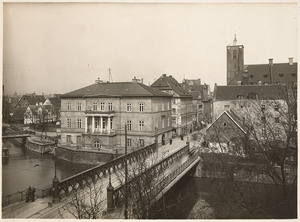
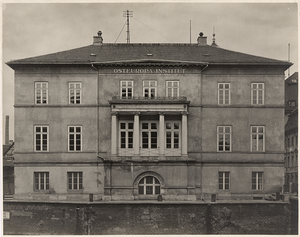
The history of the Institute for Eastern European Studies can be divided into various phases, during which – driven by financial constraints and political intervention – very different research initiatives and geographically and disciplinarily focused research focuses were pursued: a founding phase marked by the Treaty of Brest-Litovsk in 1918; a development phase characterised by numerous publications reflecting widely differing academic and political orientations, culminating in the loss of the Institute’s assets due to inflation (1919–1923); a period of consolidation with disciplinary priorities in law and economics (1924–1929), a shift in focus towards research on Russia and the Soviet Unionunder the leadership of Otto Auhagen (1930–1933), an interim phase characterised by Nazi interventions and internal disputes (1933–1937), a focus on ‘völkisch’ research into Eastern Central Europe and Ukraineunder Hans Koch (1938–1940), and a shift towards economic policy research during the Second World War. Furthermore, given the numerous personnel links with the University of Breslau – widespread employment at both the university and the Institute, and voluntary work at the Institute by university professors – the question must repeatedly be asked as to whether these were research projects undertaken by individual academics at the university or research initiatives of the Institute for Eastern European Studies.
Academically, the reputation of the Breslau Institute for Eastern European Studies in the 1920s was based primarily on its work on comparative European law with a focus on Eastern Europe, which also incorporated Soviet law of the 1920s. These were frequently published in the *Zeitschrift für Ostrecht* as well as in separate monographs.[3] In addition, the Institute produced numerous works on the new administrative and economic structures in Eastern Europe.[4]
In 1933, it was precisely these areas that came under fire from the National Socialist ‘Gleichschaltung’: research into the Soviet Union was deemed ‘cultural Bolshevism’, and Auhagen resigned from the Institute’s leadership. Key members of the Institute’s staff, such as Friedrich Schöndorf (1873–1938), a professor of international and foreign private law originally from Odessa/Odesa, the later internationally renowned Byzantinist Georg Ostrogorsky (1902–1976), and Ernst Warschauer (1889–1972), a judge at the Higher Regional Court[5], were dismissed on account of their Jewish heritage or their alleged ‘cultural Bolshevism’.[6]
The new director of the Institute for Eastern European Studies, Hans Uebersberger (1877–1962), commented on these dismissals: ‘Before the seizure of power, the next generation of scholars in the field of Eastern European history and regional studies was predominantly of Semitic origin. […] this proliferation of Judaism in my field of expertise was, in fact, accompanied by a decline in the value of scholarly output.’[7] Uebersberger called instead for the training of“German studentsfrom abroad […], because they would bring with them a knowledge of the language of their host nation” and would “more readily assimilate foreign cultures”.[8]
In fact, the Institute’s very existence was under threat between 1934 and 1937, particularly after Uebersberger left Breslau for Berlin in May 1934. The staff were at loggerheads with one another, whilst outside observers spoke of “fragmentation and a lack of clarity” in the Institute’s work.[9] On 28–29 January 1937, the library and archive holdings relating to Russia and the Soviet Union were transported to Berlin to the ‘Institute for the Scientific Study of the Soviet Union’, which was controlled by the SD and better known as the ‘Wannsee Institute’ (approximately 32,000 out of 52,000 volumes). There were several reasons for this partial dissolution: On the one hand, under National Socialism, research into Russia and the Soviet Unionwas not to be entrusted to a semi-independent Institute in the provinces, but was to remain under the direct control of authorities in Berlin. Uebersberger’s ‘boastful business shenanigans’ also contributed to the crisis.[10]
The new remit of the Institute for Eastern European Studies was defined in 1937 by the Reich Ministry of the Interior. Under the new leadership of Hans Koch, a theologian and historian with close ties to Nazi and military authorities, the focus was to shift to ‘defensive work’ against the Polish Western Institutes in Katowice, Poznań and Toruń. Only the Law and Economics departments were reorganised; a new ‘Historical-Political Department’ was established. Koch also had a particular interest in the history of the Orthodox Church and Ukraine.[11]
As director of the institute, he attracted Ukrainians in exile to the Institute for Eastern European Studies as scholarship holders, promoted the analysis of Ukrainian and Belarusian journals, and edited the journal ‘Kyrios: Quarterly Journal for the History of the Church and the Humanities in Eastern Europe’.
With Koch’s appointment, the Institute for Eastern European Studies began intensive collaboration with bodies of the NSDAP, the Wehrmacht, the Abwehr and the Silesian administration. Koch had a wide network of contacts and secured numerous commissions for the Institute for Eastern European Studies (including preparatory work for SD reports, radio series, and expert opinions for Nazi and Wehrmacht bodies). In the summer of 1939 in particular, the Institute was directly involved in political planning. According to Koch’s testimony, even during the period from 28 to 30 August, it was required to “draw up proposals in the event that Poland, subject to certain guarantees, retained possession of the Corridor, excluding Danzig”.[12] Gotthold Rhode produced brochures on ‘Polish claims to German Reich territory’, whilst Walter Kuhn (1903–1983) wrote a memorandum on ‘German villages in Central Poland’, in which he advocated shifting the future border beyond the 1914 line.[13]
With the outbreak of war, the activities of the Institute for Eastern Europe came to an abrupt halt, as almost all its research staff had already been conscripted into the Wehrmacht in 1939–40—in many cases as ‘Sonderführer’—and were involved, amongst other things, in the resettlement of so-called ‘ethnic Germans’ from Lithuania, Volhynia and Bessarabia, as well as in German nationality policy in Eastern Europe during the Second World War. From 1941 onwards, under the direction of the economist Hans-Jürgen Seraphim (1899–1962), the Institute for Eastern European Studies focused primarily on the ‘Eastern Region’ from an economic policy perspective.
The Institute and its library were destroyed in the spring of 1945, and the surviving library and archive collections were transported to the Soviet Union. Some of the former staff worked again at the Institute for Eastern European Studies in Munich in the 1950s, once more under the direction of Hans Koch.
Archival collections
The archives of the Institute for Eastern European Studies were destroyed by fire in 1945 during the fighting for Breslau.
The most comprehensive partial collections are held
- in the archives of the University of Wrocław (Archiwum Uniwersytetu Wrocławskiego, fonds S 391 Institute for Eastern European Studies 1918–1923),
- in the ‘Publikationsstelle Berlin-Dahlem’ collection at the Federal Archives,
- in the Secret State Archives of the Prussian Cultural Heritage Foundation,
- in the Moscow Special Archive (fond 1513 ‘Institute for Eastern European Studies, Breslau’ www.sonderarchiv.de/fonds/fond1513.pdf)
- and in the archives of the Institute for East and South-East European Studies in Regensburg (the estates of Hans Koch www.ios-regensburg.de/bibliothek/bestand/archive-und-nachlaesse/nachlass-koch.html and Hans Uebersberger, manuscripts of former staff members).
A monographic account of the institute’s history is still lacking.
Reports and recollections from staff members
The reports and memoirs of staff members must be treated with great caution:
- Yearbook of the Institute for Eastern European Studies. Breslau 1943 (anniversary issue marking the 25th anniversary of the Institute’s foundation, featuring reports by the respective directors).
- Reinhart Maurach: ‘From the Early Days of German Research into Eastern European Law’. In: Yearbook for Eastern European Law 8 (1967), No. 2, pp. 7–24.
- Maria Roemmich: Memoirs of the Institute for Eastern European Studies, Wrocław 1925–1945. 19 pages, typescript. Archive of the Institute for Eastern and South-Eastern European Studies in Regensburg.
- Georg Stadtmüller: Memories of the Institute for Eastern European Studies in Breslau. In: Yearbook of the Silesian Friedrich-Wilhelm University 26 (1985), pp. 211–264.
Bibliography
- Hans-Jürgen Bömelburg: The Institute for Eastern European Studies in Wrocław, 1930–1940. Scholarship, propaganda and national stereotypes in the work of an interdisciplinary centre for Eastern European studies in Germany. In: Michael Garleff (ed.): Between Confrontation and Compromise. Inter-ethnic Relations in East-Central Europe as a Historiographical Problem of the 1930s and 1940s. Munich 1995 (Publications of the Federal Institute for East German Culture and History 8), pp. 47–72 [state of research with a bibliography up to 1994].
- Thomas Ditt: The ‘Zeitschrift für Ostrecht’ (1927–1934). In: Vanessa Duss (ed.): Rechtstransfer in der Geschichte. Legal Transfer in History. Munich 2006 (Jahrbuch junge Rechtsgeschichte 1), pp. 309–321.
- Ibid.: ‘The “Stoßtrupp Faculty” in Breslau’. Law in the ‘Border Region of Silesia’ 1933–1945. Tübingen 2011 (Contributions to the Legal History of the 20th Century 67).
- Eike Eckert: Between Eastern Studies and Eastern European History. On the Biography of the Historian Gotthold Rhode (1916–1990). Osnabrück 2012 (Individual Publications of the German Historical Institute in Warsaw 27).
- Eduard Mühle: For the People and the German East. The Historian Hermann Aubin and German Research on the East. Düsseldorf 2005 (Publications of the Federal Archives 65).
Notes
[1] Memorandum by Adolf Weber, March 1918. University of Wrocław Archives, Ref. TH Breslau S 391.
[2] Memorandum from the Institute for Eastern European Studies in Breslau (1920). University of Wrocław Archives, ref. no. S 391.
[3] Ibid.: ‘Zeitschrift für Ostrecht’, pp. 309–321.
[4] For example, Otto Auhagen: *Die Bilanz des ersten Fünfjahresplanes für die Sovetwirtschaft*. Breslau 1933 (Sources and Studies/Institute for Eastern European Studies in Breslau, Economic Section 12).
[5] Estate held at the Leo Baeck Institute, Ernst Warschauer Collection.
[6] On this subject, also with regard to the lawyers at the Institute for Eastern European Studies, see Ditt: ‘Stoßtruppfakultät Breslau’, pp. 147–179.
[7] Uebersberger memorandum, January/February 1935. Archive of the University of Wrocław, Ref. No. S 392.
[8] Uebersberger’s memorandum, January/February 1935. University of Wrocław Archives, Ref. S 392.
[9] For further details with supporting evidence, see Bömelburg: The Institute for Eastern European Studies in Breslau, pp. 47–72, particularly pp. 54–62.
[10] On Uebersberger, see Walter Leitsch and Manfred Stoy: *The Seminar for Eastern European History at the University of Vienna 1907–1948*. Vienna 1983 (Vienna Archive for the History of the Slavs and Eastern Europe 11), p. 172.
[11] See Ray Brandon: ‘Hans Koch’. In: Ingo Haar, Michael Fahlbusch (eds.): *Handbook of Ethnic Studies*. People – Institutions – Research Programs – Foundations. Munich 2008, pp. 324–334.
[12] Hans Koch, 1 October 1937 to 31 March 1942. In: Yearbook of the Institute for Eastern European Studies (1943), p. 42.
[13] The documents are held at the Federal Archives, ref. R 153, Berlin-Dahlem Publications Office, nos. 781 ‘Poland Propaganda’ and 289 (Kuhn’s memorandum of 5 September 1939).
Citation
Hans-Jürgen Bömelburg: Institute for Eastern European Studies (OEI), Wrocław. In: Online Encyclopaedia on the Culture and History of Germans in Eastern Europe, 2014. URL: ome-lexikon.uni-oldenburg.de/p32794 (as at 1 March 2021).
Terms of use for this article
Copyright © University of Oldenburg and the Federal Institute for the Culture and History of Germans in Eastern Europe (BKGE), all rights reserved. This work was produced as part of the project ‘Online Encyclopaedia on the Culture and History of Germans in Eastern Europe’ and may be reproduced and published provided the rights holders’ consent has been obtained. Please contact:
If you have any specialist comments or additions to the text, please contact the editorial team, citing relevant literature and source references.