

Ethnic Germans
Ethnic Germans
Term
The term ‘Volksdeutsche’, used to describe people who belonged to the German nation but did not live in the German Reich, entered the German language in the 1920s. Like other compound words containing ‘Volk’, it became a frequently used term in political vocabulary during the Nazi era and a central concept in ideology and propaganda.
In the 19th century and even at the beginning of the 20th century, the term ‘Volksdeutsche’ was not in common use. For instance, there is no corresponding entry in volume 12/2 of the *German Wörterbuch*, published in 1951, whose articles were presumably written in the 1910s. It merely lists the noun ‘Volksdeutsch’, attributed to Ernst Moritz Arndt (1769–1860), which he used to describe the language of the ‘common people’.[1] In the sense of‘dialect’, this word was also used, for example, in the book by Franz Joseph Stalder (1757–1830), *Die Landessprachen der Schweiz* (The Regional Languages of Switzerland ), published in 1819.[2]
The term ‘Volksdeutsche’, on the other hand, was used to refer to those who, according to a ‘nationalist’ understanding, were regarded as ‘Germans abroad’, but who in fact held the citizenship of the respective country and, for the most part, remained loyal to it. Initially used mostly as an adjective, the term came into sporadic use from the 1920s onwards and became more widespread from the 1930s onwards. In the *Großer Brockhaus*, the term was first recorded in the 15th edition of 1934, where it was introduced as ‘a more recent term for members of the German people (citizens of the German Reich of German descent and Germans abroad holding foreign citizenship)’.[3] This definition is noteworthy in that it does not correspond to those found in later Brockhaus encyclopaedias from the period ofthe ‘Third Reich’: According to the *Neues Brockhaus*, published in 1938, ‘Volksdeutsche’ referred to ‘Germans abroad who are not citizens of the Reich ’.[4] And the 1940 Taschen-Brockhaus on Current Affairs stated that this category included “in particular those nationals of foreign states who are of German or related descent, who speak the German language and who voluntarily identify with the German national and cultural community”. The term ‘German national’ encompassed both these individuals and German nationals, according to the further explanation provided in 1940.[5] This definition was consistent with the official terminology used by the National Socialist state, as laid down on 29 March 1939 in a circular issued by the Reich Ministry of the Interior. This circular stated: “Germans living outside the Reich also belong to the German nation. Possession of a foreign nationality does not alter one’s affiliation to the German nation. Germans of foreign nationality are designated as ‘ethnic Germans’.”[6]
The great – and, during the Second World War, ever-increasing – significance of the term for National Socialist policy and propaganda is also evident from the length of the relevant encyclopaedia entries. Whilst the entry had previously been dealt with in just a few lines, the explanations of ‘Volksdeutsche’ and‘Auslandsdeutsche’in the reference works published by Brockhaus-Verlag in 1942 and 1943 spanned several columns. These celebrated, amongst other things, the ‘successes’ of the Nazi ‘ethnicpolicy’in relation to the ‘return’ of‘ethnic Germans’to the Reich, and the crucial significance of the ‘campaign against the Soviet Union’for the ‘fate’ of the ‘ethnic Germans’ living there.[7]
After the end of the ‘Third Reich’, the term was initially removed from the 1947 edition of the Duden – like the vast majority of words associated with the National Socialist ‘ethnic policy’ – was initially removed, but was then reintroduced into the Dictionary of the German Language in 1954. It was not until the 1991 edition that the term was identified as a National Socialist concept.[8]
The 16th edition of the *Großer Brockhaus* from 1957 also included the entry. It stated that ‘Volksdeutsche’ referred to ‘residents of German origin living in linguistic enclaves or scattered settlements in countries outside the borders of the German Reich of 1937 and Austria’. The encyclopaedia did not address the ideological connotations of the term during the ‘Third Reich’, but emphasised: ‘Under the National Socialist regime, many Volksdeutsche were granted German citizenship through resettlement.’[9] It was not until later editions that the term was identified as a ‘Nat[ional] Soc[ialist] term’.[10]
Support, Use
During the Weimar Republic, the term was primarily promoted by interest groups such as the ‘Association for German Culture Abroad’. Its periodicals bore titles such as *Deutsche Welt. Aus volksdeutschem Kultur- und Geistesleben* or *Der Volksdeutsche*.
As an analysis of the Reichstag minutes shows, during the Weimar Republic the term ‘Volksdeutsche’ was used by the National Socialists and other völkisch groups – albeit rarely – but nevertheless significantly more frequently than by the other parties. From 1933 onwards – and increasingly from 1938/39 – the term became a central concept in National Socialist ethnic, racial and resettlement policiesand consequently came into widespread use.
Apart from its (critical and detached) use as a source term in relation to the history of National Socialism and its use by associations of displaced persons, the term ‘Volksdeutsche’ has hardly been used in Germany since the end of the Second World War. In Austria, by contrast, the term was initially widespread after 1945 as a designation for refugees and displaced persons whose mother tongue was German, but is now used only rarely.
Foreign-language equivalents, translations, loanwords
English: ethnic Germans or Germans of foreign nationality; French: les Allemands ethniques or les Allemands de souche; Dutch: Volksduitse; Norwegian: Folketyskere; Swedish: Folktyskar; Polish (pl.) etniczni Niemcy or folksdojcze; Russian фольксдойче (transliterated as fol’ksdojče)
As a technical term, ‘Volksdeutsche’ is also used untranslated in many languages – particularly in an academic context.
2. Definition
The term ‘ethnic Germans’ was used (primarily during the Nazi era) to refer to people living outside Germany, Austria and Switzerland – particularly in Central-Eastern, Eastern and South-Eastern Europe – who held foreign nationality and who, on the basis of their ancestry, ‘race’, language and/or culture or customs, regarded themselves as members of the‘German people’or were regarded as such. The term‘Germans abroad’– which also carried ‘ethno-nationalist’ Nazi connotations – referred, by contrast, to German nationals living abroad.
3. Historical overview
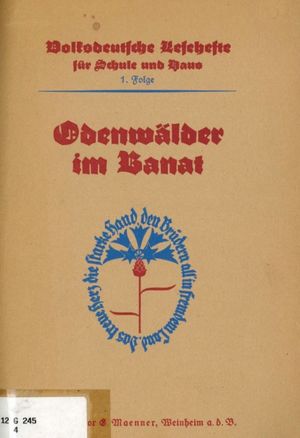
Although, following the territorial cessions resulting from the Treaty of Versailles, the situation of German minorities in Eastern Europe had already frequently been the subject of public debate during the Weimar Republic – and calls for border revisions were often made with reference to the ‘lost’ Germans – the term ‘Volksdeutsche’ was rarely used in this context. This changed during the Nazi era. Members of the‘German people’living outside the Reich’s borders were now increasingly referred to as ‘Volksdeutsche’ in the press and in propaganda. Even though it ultimately remained unclear exactly who was a ‘Volksdeutscher’ and how, for example, the criterion of ‘culture’ could be defined, this group was accorded special significance within National Socialist ethnic and racial ideology. Restrictions on, for example, ‘Volksdeutscher’ cultural and community life, the press and the scope for economic and political activity by the governments of states in which a German minority lived were exploited by the Nazi regime to stir up ethnic conflicts and to present itself as a protective power and guardian of the ‘ethnic Germans’. Citing discrimination and the alleged threat to the ‘ethnic Germans’, political and territorial demands were made against other states. Under the influence of National Socialist policy and propaganda, many ‘ethnic Germans’ became radicalised in the course of the 1930s. One consequence of this was a growing identification with ‘German ethnicity’ and the (Nazi) German Reich, as well as a dwindling loyalty to the state in which the ‘ethnic Germans’ lived.
In many places, parties and associations with close ties to National Socialism were formed, such as the ‘Young German Party’ in Poland, the ‘Sudeten German Party’ in Czechoslovakia, the ‘People’s League of Germans in Hungary’, the ‘German-Swabian Cultural Association’ in Yugoslavia, and the ‘Ethnic German Movement’ in Luxembourg. These groups were usually able to prevail over ‘ethnic German’ organisations of a different political and ideological orientation and presented themselves as the mouthpiece of the German ethnic group. During the Second World War, they frequently assisted in the recruitment of ‘ethnic Germans’ for the Waffen-SS or otherwise participated in the Nazi policy of expansion and occupation. Militias such as the ‘Ethnic German Self-Defence’ in Poland and Ukraine supported the SS and the Gestapo in many parts of the occupied territories and were, moreover, themselves involved in acts of terror and murder against members of the majority population as well as against Jews. Many ‘ethnic Germans’ willingly placed themselves at the service of the Nazi state – indeed, the Waffen-SS and the concentration camp guard units had a relatively high proportion of ‘ethnic Germans’ among their ranks.
As a result of the Nazi policy of expansion from 1938/39 onwards, many ‘ethnic Germans’ became‘Reich Germans’, as numerous territories with a high proportion of people of German descent were occupied or annexed by the German Reich. ‘Ethnic Germans’ were also resettled within the Reich or into the occupied or ‘annexed’ territories. This latter population transfer, which affected, for example, the‘Baltic Germans’ and the‘Volhynian Germans’, took place within the context of the Nazi ‘ethnic’ and‘Germanisation’ policies, through which foreign territories, in particular the annexed western Poland, were to be incorporated into the German sphere of influence. Residents deemed non-German were terrorised and forcibly expelled from the ‘settlement areas’. From October 1939 onwards, Heinrich Himmler (1900–1945) was responsible for this forced population displacement.
Although, following the territorial cessions resulting from the Treaty of Versailles, the situation of German minorities in Eastern Europe had already been a frequent topic of public debate during the Weimar Republic – and calls for border revisions were often made with reference to the ‘lost’ Germans – the term ‘Volksdeutsche’ was, however, rarely used in this context. This changed during the Nazi era. Members of the ‘German people’ living outside the Reich’s borders were now increasingly referred to as ‘Volksdeutsche’ in the press and in propaganda. Even though it ultimately remained unclear exactly who was a ‘Volksdeutscher’ and how, for example, the criterion of ‘culture’ could be defined, this group was accorded special significance within Nazi ethnic and racial ideology. The Nazi regime presented itself as their advocate and protector. Restrictions on, for example, the ‘ethnic German’ cultural and community life, the press, and the scope for economic and political activity imposed by the governments of states in which a German minority lived were exploited by the Nazi regime to stir up ethnic conflicts and to present itself as the protective power of the ‘ethnic Germans’. Citing discrimination and the alleged threat to the ‘ethnic Germans’, political and territorial demands were made of other states. Under the influence of National Socialist policy and propaganda, many ‘ethnic Germans’ became radicalised in the course of the 1930s. One consequence of this was a growing identification with ‘German ethnicity’ and the (Nazi) German Reich, as well as a dwindling loyalty to the state in which the ‘ethnic Germans’ lived.
In many places, parties and associations with close ties to National Socialism were formed, such as the ‘Young German Party’ in Poland, the ‘Sudeten German Party’ in Czechoslovakia, the ‘People’s League of Germans in Hungary’, the ‘German-Swabian Cultural Association’ in Yugoslavia, and the ‘Ethnic German Movement’ in Luxembourg. These groups were usually able to prevail over ‘ethnic German’ organisations of a different political and ideological orientation and presented themselves as the mouthpiece of the German ethnic group. During the Second World War, they frequently assisted in the recruitment of ‘ethnic Germans’ for the Waffen-SS or otherwise participated in the Nazi policy of expansion and occupation. Militias such as the ‘Ethnic German Self-Defence’ in Poland and Ukraine supported the SS and the Gestapo in many parts of the occupied territories and were, moreover, themselves involved in acts of terror and murder against members of the majority population as well as against Jews. Many ‘ethnic Germans’ willingly placed themselves at the service of the Nazi state – indeed, the Waffen-SS and the concentration camp guard units had a relatively high proportion of ‘ethnic Germans’ among their ranks.
As a result of the Nazi policy of expansion from 1938/39 onwards, many ‘ethnic Germans’ became ‘Reich Germans’, as numerous territories with a high proportion of people of German descent were occupied or annexed by the German Reich. ‘Ethnic Germans’ were also resettled within the Reich or into the occupied or ‘annexed’ territories. This latter population transfer, which affected, for example, the ‘Baltic Germans’ and the ‘Volhynian Germans’, took place within the context of the Nazi ‘ethnic’ and ‘Germanisation’ policies, through which foreign territories, in particular the annexed western Poland, were to be incorporated into the German sphere of influence. Residents deemed non-German were terrorised and forcibly expelled from the ‘settlement areas’. From October 1939 onwards, Heinrich Himmler (1900–1945) was responsible for this forced population displacement; he served as ‘Reich Commissioner for the Consolidation ofGerman Ethnicity’and established a separate SS headquarters for this task. The‘Volksdeutsche Mittelstelle’was entrusted with the racially-based classification of ‘ethnic Germans’ in the ‘German People’s List’, as well as with the organisation and implementation of the resettlement policy. The previous policy of supporting German minorities abroad had now – following a complete U-turn – been replaced by a resettlement policy under the slogan ‘Home to the Reich!’.
In the course of the war, concepts for German settlement and domination of the occupied Soviet territories were devised – and in some cases put into practice – through the‘General Plan East’and the ‘General Resettlement Plan’. In many cases, ‘ethnic Germans’ were forced to endure long periods in camps run bythe ‘Volksdeutsche Mittelstelle’(Central Office for Ethnic Germans) or to work in the armaments industry in the German Reich, as the planned and promised resettlement could not be realised, or only at a later date, or because those affected were deemed ‘ineligible’ for resettlement in the East on the basis of racial ideology. This often led to dissatisfaction and disappointment. Furthermore, the complete integration into the ‘Volksgemeinschaft’ promised by the National Socialists often failed to materialise – partly because ‘Ethnic Germans’ were frequently disparagingly referred to and treated by‘Reich Germans’as ‘Russians’, ‘Poles’ or ‘Romanians’.
The number of people who were regarded as ‘ethnic Germans’ in the National Socialists ’ sense varied and depended on subjective classification criteria. Contemporary publications cite the following figures for ‘ethnic Germans’ who ‘returned to the Reich’ through annexation or occupation and through resettlement :
Landvolk im Werden (1941)[11]
| Der Neue Brockhaus (1942)[12] | *Der Volks-Brockhaus* (1943)[13] | |
|---|---|---|---|
| through annexation or occupation | |||
| Austria | 6.5 million | 6.4 million | |
| Sudetenland | 3.3 million | 3.1 million | |
| Protectorate of Bohemia and Moravia | 200,000 | 200,000 | |
| Danzig | 400,000 | 400,000 | |
| Memel region | 120,000 | 143,000 | |
| Vistula and Vistula River region | over 1 million | over 1 million | |
| Eupen and Malmedy | 60,000 | 50,000 | |
| Luxembourg | 280,000 | 280,000 | |
| Alsace and Lorraine | 1.6 million | 1.6 million | |
| Slovenia (“Southern Styria”/“Upper Carniola”) | no figures given | no figures given | |
| through resettlement | |||
| Estonia | 13,000 | 21,400 | 21,400 |
| Latvia | 51,000 | 57,200 | 57,200 |
| Lithuania | 45,000–50,000 | 47,500 | 47,500 |
| Narew region and General Government | 38,500 | not mentioned | Not mentioned |
| Volhynia and Eastern Galicia | 120,200 | 128,000 | 128,000 |
| Bessarabia | 92,700 | 93,500 | 93,500 |
| Buchenland | 97,000 | 96,800 | 96,800 |
| Dobruja | 14,500 | 14,000 | 14,000 |
| Bolzano, Trento, Udine | South Tyrol: over 200,000[14] | no figures given | 220,000 |
| GottscheeThe region | not mentioned | not mentioned | 14,000 |
Furthermore, the number of ‘ethnic Germans’ who remained in their respective countries (including those living outside Europe who were regarded as belonging to the ‘German people’) was estimated at the time as follows:
Der Neue Brockhaus (1942)[15] | The Volks-Brockhaus (1943)[16] | |
over 1 million | 950,000 | |
150,000 | 150,000 | |
Romania (in particular Transylvanian Saxons and Banat Swabians) | 550,000 | 550,000 |
700,000 | 700,000 | |
Denmark | 40,000 | 40,000 |
1.5 million | 1.6 million | |
USA | at least 25 million | 25 million |
Canada | 550,000 | 550,000 |
Brazil | 750,000 | 800,000 |
Argentina | 250,000 | 230,000 |
Chile | 35,000 | 35,000 |
Paraguay | 10,000 | over 10,000 |
Union of South Africa | 40,000 | 40,000 |
German South West Africa | 14,000 | not mentioned |
Australia | 50,000 | 50,000 |
Mexico | 8,000 | 8,000 |
Guatemala | 3,000 | 3,000 |
Palestine | 2,000 | 2,000 |
Research indicates that the number of ‘ethnic Germans’ resettled ‘within the territory under German rule and influence during the Second World War’ is put at ‘more than one million people’.[17]
After the end of the war, the ‘ethnic Germans’ who had remained in their countries or were outside German borders were often arrested, dispossessed, expelled and/or deported. It was not uncommon for them to be held accountable by members of the majority society as a deputy for the destruction and atrocities committed by Germans. Those ‘ethnic Germans’ who were within the territory of the Federal Republic, or who had fled there or been expelled there, were regarded, under the Federal Displaced Persons and Refugees Act of 1953, as legally equivalent to‘Reichsdeutsche’in terms of state support benefits. The term ‘Volksdeutsche’, which had become tainted during the Nazi era, was rarely used in Germany after 1945 and was mostly replaced by euphemisms such as ‘German ethnic groups’or ‘German minorities’.In Austria, by contrast, it was used after the Second World War to refer to German-speaking refugees, but is now hardly ever used, even by associations of displaced persons. In 2014, for example, the ‘Association of Ethnic German Regional Associations in Austria’ changed its name to the ‘Association of German Regional Associations of Former Austria in Austria’.
Bibliography
- Doris L. Bergen: The Nazi Concept of ‘Volksdeutsche’ and the Exacerbation of Anti-Semitism in Eastern Europe, 1939–45. In: Journal of Contemporary History 29 (1994), pp. 569–582.
- Meir Buchsweiler: Volksdeutsche in Ukraine on the Eve and at the Outbreak of the Second World War – a Case of Divided Loyalty? Gerlingen 1984.
- Maria Fiebrandt: Selection for the Settler Society. The Inclusion of ‘Volksdeutsche’ in Nazi Hereditary Health Policy in the Context of the Resettlements 1939–1945. Göttingen 2014.
- Isabel Heinemann: ‘Ethnic Germans’ Resettlers in Germany and in German-occupied territories during the Second World War. In: Klaus J. Bade: Encyclopaedia of Migration in Europe. From the 17th Century to the Present Day. Paderborn et al. ²2008, pp. 1081–1087.
- Jerzy Kochanowski, Maike Sach (eds.): The ‘Ethnic Germans’ in Poland, France, Hungary and Czechoslovakia. Myth and Reality. Osnabrück 2006.
- Valdis O. Lumans: Himmler’s Auxiliaries. The ‘Volksdeutsche Mittelstelle’ and the German National Minorities of Europe, 1933–1945. Chapel Hill/London 1993.
- Ralph Melville, Jiří Pešek, Claus Scharf (eds.): Forced Migrations in Central and Eastern Europe. International Law – Concepts – Practice (1938–1950). Mainz 2007.
- K. Molly O’Donnell, Renate Bridenthal, Nancy Reagin (eds.): The Heimat Abroad: The Boundaries of Germanness. Ann Arbor 2005.
- ‘Volksdeutsch’, ‘Volksdeutscher’. In: Cornelia Schmitz-Berning: Vocabulary of National Socialism. Berlin/New York, 2nd ed. 2007, pp. 650–652.
Web link
- Federal Constitutional Court on the question ‘Who is a “member of the German people”?’, BVerfG, 1 BvR 546/04 of 20 April 2007, paragraphs 1–33
Notes
[1] Volksdeutsch. In: Jacob Grimm, Wilhelm Grimm (eds.): German Dictionary. Vol. 12/2: Vesche–Vulkanisch. Leipzig 1951, col. 477.
[2] Franz Joseph Stalder: The Regional Languages of Switzerland or Swiss Dialectology, illuminated by critical linguistic observations. Aarau 1819, p. VII.
[3] Volksdeutsch. In: The Great Brockhaus. Encyclopaedia of Knowledge in Twenty Volumes. Vol. 19: Tou–Wam. Leipzig ¹⁵1934, p. 656.
[4] Volksdeutsche. In: The New Brockhaus. Encyclopaedia in four volumes and an atlas. Vol. 4: S–Z. Leipzig 1938, p. 607.
[5] Volksdeutsche. In: Taschen-Brockhaus zum Zeitgeschehen. Leipzig 1940, p. 267.
[6] Quoted from: Wilhelm Stuckart/Rolf Schiedermair: Racial and Hereditary Policy in Reich Legislation. Leipzig ³1942, p. 18.
[7] German people. In: *Der Volks-Brockhaus*. A general encyclopaedia for everyone. Leipzig, 10th ed., 1943, pp. 140ff. (Quote: p. 141); Ethnic Germans. In: *Der Neue Brockhaus*. Encyclopaedia in four volumes and an atlas. Vol. 4: S–Z. Leipzig, 2nd ed., 1942, pp. 607ff.
[8] Cf. Senya Müller: Language Dictionaries under National Socialism. The ideological influence on Duden, Sprach-Brockhaus and other reference works during the ‘Third Reich’. Stuttgart 1994, pp. 144–146.
[9] Volksdeutsche. In: Der Große Brockhaus. Vol. 12: Unk–Zz. Wiesbaden, 16th ed., 1957, p. 237.
[10] Volksdeutsche. In: Brockhaus. Encyclopaedia in 30 volumes. Vol. 29: Verti–Wety. Leipzig/Mannheim ²¹2006, p. 200.
[11] Cf. Konrad Meyer: Landvolk im Werden. Berlin 1941, table between pp. 96 and 97.
[12] Cf. Volksdeutsche (note 7), p. 607.
[13] See *German Volk* (note 7), p. 141.
[14] The figures quoted for South Tyrol refer to the number of people who had ‘opted’ for the German Reich. Of these, however, only a third had been resettled by the time of Mussolini’s fall.
[15] See *Volksdeutsche* (note 7), p. 607ff.
[16] See *German Volk* (note 7), pp. 141ff.
[17] Wolfgang Benz: ‘Double Victims of Nazi Population Policy: The Forced Migration of Volksdeutsche’. In: Melville/Pešek/Scharf (eds.): *Forced Migrations*, pp. 247–258, here: p. 249; similarly, see Isabel Heinemann: ‘German Blood’. The SS Race Experts and the Ethnic Germans. In: Kochanowski/Sach (eds.): ‘Ethnic Germans’, pp. 163–182, here: p. 169.
Citation
Jörn Retterath: Volksdeutsche. In: Online Encyclopaedia on the Culture and History of Germans in Eastern Europe, 2021. URL: ome-lexikon.uni-oldenburg.de/p32754.html (accessed 14 February 2022).
Terms of use for this article
Copyright © University of Oldenburg and the Federal Institute for the Culture and History of Germans in Eastern Europe (BKGE), all rights reserved. This work was produced as part of the project ‘Online Encyclopaedia on the Culture and History of Germans in Eastern Europe’ and may be reproduced and published provided the rights holders’ consent has been obtained. Please contact:
If you have any specialist comments or additions to the text, please contact the editorial team, citing relevant literature and source references.