

The Baltic States
The Baltic States
Etymology
The term ‘Baltic States’ is derived from the Latin ‘Baltia’ and, like ‘Baltic’, traces its origins to the phrase ‘Mare balticum’, meaning the Baltic Sea. From around 1600, it was used in most European languages to refer to the land and people of the region; by the end of the 18th century, it had been adopted from Russian by the then ruling Tsarist Empire to denote the Baltic provinces of Estland, Livonia and Courland. In the 19th century, the Germans living there used the noun ‘Balten’. ‘Baltikum’ became established as a collective term for the German-occupied territory during the First World War. Following the establishment of independent states in 1918 by the Estonians, Latvians and Lithuanians, the Baltic Germans – who until then had formed the dominant upper class – called themselves “Deutschbalten” (in the 1930s, “Baltendeutsche”). Since then, Estonians, Latvians and Lithuanians have often referred to themselves as “Balts”, in line with international usage (The Baltic States, Les États baltes). Today, the term ‘the Baltic region’ is understood in a broader sense to refer to the three ‘Baltic States’— Estonia (Eesti), Latvia (Latvia) and Lithuania (Lietuva)—although it is disputed whether there is a shared sense of a ‘Baltic identity’.
From a linguistic perspective, within the Indo-European language family, the term ‘Baltic’ denotes the closer kinship of Latvian and Lithuanian with the extinct Prussian (Old Prussian) compared to the Finno-Ugric languages Livonian and Estonian.
Location
The Baltic States are situated in the region roughly between 60° and 54° north latitude and 28° and 21° east longitude.
Topography
The Baltic region is characterised by the Baltic Ridge, bounded to the north by terminal moraines and to the south by flat sandy plains. Low-lying bays extend into it from the Baltic Sea. From Courland (Kurzeme) eastwards, post-glacial land uplift has created distinctive cliffs and beach ridges. This limestone formation, known as ‘glint’, drops steeply into the sea in places along the Estonian coast, at depths of over 50 metres. The ground moraines and terminal moraines to the south, with hilly landscapes reaching heights of over 300 metres, allow for more productive land use. Sedimentation and silting have led to the formation of fens and raised bogs. These cover almost 20 per cent of the land area in Estonia and up to eight per cent in Latvia, whereas in Lithuania they account for only two per cent.
Between the Curonian-Lithuanian terminal moraine and the Suwalki (Suvalkija) ridge lies the Lithuanian settlement area, divided into numerous small landscapes, open to the east and south-east towards the plains and forested areas of Belarus. Lower Lithuania (Žemaiten) in the north-west is a wooded, hilly region with numerous lakes, which, beyond the Memel (Nemunas) in the south, gives way to the forested areas of Suvalkija. To the east of Žemaiten lies the Central Lithuanian Plain with heavy, damp soils. In the region of the Baltic Ridge lies Eastern Lithuania, comprising Upper Lithuania (Aukštaiten) and the centre of Vilnius.
As the eastern fringes of the Baltic Sea and the western foothills of the Russian plains, the Baltic states – particularly Lithuania – are characterised by a west-east climatic gradient. The coastal region, influenced by the Baltic Sea, stores heat in summer and releases it again in winter, resulting in maximum temperatures not being reached until August and the sharpest drop in temperature occurring in February. Noteworthy features here include a south-to-north decrease in temperature that intensifies towards the interior, as well as a west-to-east transition from a maritime to a continental climate. The Baltic Sea freezes over for more than 50 days each year fromKurzeme northwards; the probability of ice formation along the coast from the Gulf of Riga northwards is 100 per cent.
Historical Geography
Since the Middle Ages, the borders in the Baltic region have often changed in line with shifting patterns of rule. Border shifts occurred primarily during the process of state formation, when, in 1917, the Russian governorates of Estonia and Livonia became independent administrative units. Estonia and Latvia retained their borders following the Wars of Independence of 1918–1920, with Latgale (Latgale) – the former Polish Livonia – being incorporated into Latvia; its population differed from the predominantly Protestant Latvians and Estonians in that they were Catholic. Among the Catholic Lithuanians, the close ties with Poland gave way after the First World War to deep hostility, exacerbated by Poland’s annexation of the area around the historic capital of Vilnius. The Memel region (Klaipėda), which had until then been German, was incorporated into Lithuania as an autonomous region.
Settlement patterns
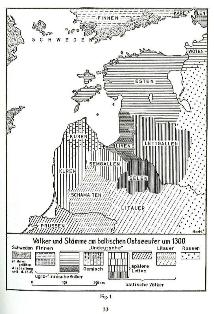
Peoples and tribes around 1300 [Map:
Johansen/Mühlen: German and Un-
German in the medieval and early periods,
Reval in the modern period, 1973, p. 33].

The Baltic states have a relatively small land area; their population density is very low due to the small number of inhabitants. A large proportion of the population of Estonia and Latvia lives in the capital cities. Reval/Tallinn, with just under 400,000 inhabitants, and Riga/Rīga, with approximately 750,000 inhabitants, account for the majority of the population. Vilnius, with a population of around 575,000, is followed by the second-largest city, Kaunas, which has a population of just under 500,000. The nationwide settlement pattern in Lithuania is characterised by larger medium-sized towns (up to 100,000 inhabitants) as well as numerous small towns, and is thus far more balanced than in the other two, more sparsely populated Baltic states. Whilst the rural settlement pattern in Lithuania is characterised primarily by small clustered settlements, isolated farmsteads predominate in Estonia and Latvia.[1]
Middle Ages
As late as the 12th century, the Finno-Ugric Finns, Estonians and Livonians, as well as the Baltic Latvian tribes and those of the Lithuanians and Prussians, were unable to form a state organisation spanning multiple tribes. They lost their independence at the turn of the 13th century as a result of the combined influence of commercial, ecclesiastical and state forces in the Baltic region, in connection with the Sword Mission.
The colonisation of Old Livonia was carried out by missionaries and Low German merchants; military protection was provided by the Order of the Sword Brothers and the German Order. Albert von Buxhoeveden (c. 1165–1229), a canon of Bremen’s cathedral who was consecrated Bishop of Livonia in 1199, founded the city of Riga in 1201. He linked his missionary work to the German monarchy and the Pope, who consecrated Livonia as ‘Terra Mariana’ (Land of Mary) to the Virgin Mary. To the north, the Order of the Sword Brothers founded the city of Reval in 1230 with German merchants from Gotland. As an independent knightly guild alongside the bishop and his knightly vassals, it claimed a third of the conquered land. Although the Livonian branch of the Order was subordinate to the bishop, as a spiritual order of knights it was obliged to obey the Pope, which led to constant conflicts.

Political map of the Baltic region in the
Middle Ages, c. 1260 [Wikimedia Commons]. Map: MapMaster,
Attilos,NorthNorthWest/CC BY-SA 3.0
Following the acquisition of Danish Estonia in 1346, rather than a unified state, the so-called ‘Livonian Confederation’ emerged, comprising five ecclesiastical territories, the largest of which was that of the German Order. Their relationship resembled a state of perpetual civil war, from which the knighthoods emerged as the true victors. From around 1420, they participated in the general provincial assemblies – the most important body of the Old Livonian Confederation – where, from the end of the 15th century, Riga, Reval and Dorpat/Tartu were also represented, their citizens organised into guilds. As a loose confederation of ecclesiastical and secular territories, Old Livonia resembled the Holy Roman Empire of the German Nation. Unlike in Prussia, only a few German peasants migrated to the Baltic region. The originally free Estonian and Latvian rural inhabitants were forced into servitude by the end of the 14th century. The Teutonic Order and the landowners dominated the countryside, whilst the towns were shaped by bishoprics and monasteries, Hanseatic merchants and German craftsmen.
Lithuania in the Middle Ages
Owing to its status as an independent state in the Middle Ages, Lithuania’s historical development from the 13th century onwards differed from that of the northern Baltic countries. The Estonian-, Livonian- and Latvian-speaking regions came under German rule and became part of the Baltic region, which was characterised by Latin and Low German influences. The Grand Duchy of Lithuania, by contrast, as an independent political entity, spanned the confessional divide between the Eastern and Western Churches as well as the linguistic boundaries between the East Slavs and the Baltic Lithuanians. From the end of the 13th century, Lithuania developed into a feared adversary of the German Order, whose attempts at conquest, however, failed. As a multi-ethnic state, Lithuania was ruled from the end of the 13th century by the pagan Gediminid dynasty. On the one hand, paganism enabled the country to follow a unique path whilst preserving its ethno-cultural identity; on the other hand, it prevented the modernisation of society.
The Grand Duchy of Lithuania held its ground against threats from the German Order and the Grand Duchy of Moscow, as well as from Poland, with which it had been linked through various unions since 1385. It comprised an ethnically and linguistically diverse population of Eastern Slavs, Lithuanians, Poles and Jews, as well as smaller groups of Germans and Tatars, and allowed different religious communities to coexist, such as the Orthodox and Catholics, and, from 1596, the Uniates, several Protestant denominations, Jewish followers of the Torah and Muslim Tatars. Religious persecution was virtually unknown in Lithuania until the beginning of the 18th century.
The Lithuanians initially had no written language of their own; alongside Latin, German and, later, Polish, a West Russian chancery language was used. The upper echelons of the Lithuanian nobility initially intermingled to some extent with the East Slavs, and from 1387 onwards increasingly assimilated linguistically and culturally with the Poles. Nevertheless, even after the Real Union with Poland in 1569, the Lithuanian nation persisted alongside the Polish one. When the Grand Duchy, along with large parts of the Kingdom of Poland, came under Russian rule as a result of the partitions of 1772, 1793 and 1795, as well as by the Congress of Vienna in 1815, the Russian central government was unable to completely eradicate the ethnic, social, economic and religious distinctiveness of the region.
The Hanseatic League
Whilst Lithuania had only indirect links with the Hanseatic League, Livonia became an integral part of the Hanseatic economic system as early as the 13th century. This was reflected in the prosperity of the larger Baltic cities and in the adoption of legal norms from Lübeck, Gotland and Hamburg. This laid the foundations for a tradition of civic forms of organisation, legal concepts and elements of architectural culture. Riga developed into a hub for East-West trade. For the first time, the twelve Baltic Hanseatic cities assumed an economic intermediary role between Central and Eastern Europe. It is not least thanks to them that Livonia, by the end of the Middle Ages, was a region characterised by Western culture and state independence (with a German elite exercising dominance over Estonian, Livonian and Latvian peasants).
Modern times

*Livoniae nova Descriptio*. Abraham Ortelius: *
* *Theatrum Orbis Terrarum*. Antwerp 1573–
, 1598.
Resistance against Tsar Ivan IV (1547–1584) finally collapsed during the war of 1558–1562. Following the Teutonic Order’s defeat in 1560, Reval submitted to Protestant Sweden. Livonia and, later, Riga paid homage to Catholic Poland–Lithuania under Sigismund II Augustus (1520–1572); the island of Ösel (Saaremaa) became Danish. Under the last Master of the Order, Gotthard Kettler (1517–1587), the secular Duchy of Courland was formed in 1561 from the provinces of Courland and Semigallia, situated on theDaugava River, and remained under Polish suzerainty until 1795.
The Reformation
The downfall of the Teutonic Order was, amongst other things, a consequence of the Lutheran Reformation, which spread early on via the ‘Hanseatic network’ of towns. This encouraged the study of the Bible and preaching in the vernacular. German clergy translated the Bible, and the first Estonian and Latvian grammars and dictionaries were produced. The transition from the Middle Ages to the modern era, marked in part by the Reformation, was of considerable significance for cultural and educational endeavours as a whole, thanks to the expansion of the Estonian, Latvian and Lithuanian primary school systems. A culture of literacy and the literacy of the rural population distinguished the Baltic region from neighbouring Russian regions right up to modern times and were prerequisites for the emergence of national movements. The community movement of the Moravian Church played an important role in this, through which Estonian and Latvian religious literature was disseminated. Under Swedish sovereignty, numerous buildings in the Renaissance and Baroque styles were erected. Under the Dukes Kettler and Biron, Courland developed into an independent aristocratic republic, whose Baroque culture reached its zenith in the palaces of Mitau/Jelgava and Ruhenthal/Rundāle.
In Poland–Lithuania, the fragmentation into three Reformation denominations led to the collapse of Protestantism when the monarchy and the Catholic Church launched a Counter-Reformation offensive, through which they, in turn, promoted the school system, higher education and the national languages. In the long term, however, the return to Catholicism slowed down the modernisation of ethnic Lithuania and Latgale compared with Livonia. The close ties with Poland set Lithuania on a different path from Livonia, for which the terms ‘continentalism’ and ‘Catholicism’ have been coined for Lithuania, and ‘maritimism’ and ‘Protestantism’ for Livonia.[2]
18th century
Under Catherine II (1762–1796), the legal and social situation of Estonian and Latvian peasants deteriorated from hereditary subjection to serfdom with hardly any restrictions. Alongside Pietism, the Enlightenment – which spread from Berlin and East Prussia to the Baltic provinces, where it found many supporters amongst the nobility and literary figures – proved particularly significant for inter-ethnic relations. Among them were August Wilhelm Hupel (1737–1819), whose periodicals laid the foundations for the Estonian and Latvian publishing industries, and, even more so, Garlieb Merkel (1769–1850) with his sensational treatise *Die Letten* (*The Latvians*), in which he starkly depicted the plight of the Latvian rural population and put forward moral and political demands.[3]
During the Great Northern War (1700‒1721), the Baltic region was completely devastated, and the population fell by half. In the summer of 1710, Tsar Peter I (1672–1725) guaranteed the city of Riga its political and social order; Livonia and Estonia became autonomous Russian governorates, as did Courland by the end of the century. On the basis of the Privilegium Sigismundi Augusti of 1561, Peter I granted, in the so-called Capitulations, freedom of worship in accordance with the Augsburg Confession, the safeguarding of the Evangelical Lutheran regional church, and the confirmation of German estates-based self-government with a German judicial system. These were long regarded in German-Baltic historical scholarship as ‘treaties of a constitutional nature in the sense of the earlier medieval estates-based constitutional law’[4] , shaped the political and social situation in Livonia, Estonia and Courland for over two centuries.
19th century
The transformation of the agrarian economic system brought about by the Baltic agrarian reforms laid the foundations for the national emancipation of the Estonians and Latvians. Between 1816 and 1819, the knighthoods relinquished their rights over the peasants as individuals, but retained their rights over the land itself. Under the Agricultural Act of 1849, tenants were able to acquire land as partners of the landowners using public loans; corvée labour was replaced by cash rent, with the political aim of creating an economically independent class of peasant landowners. However, the peasants, who had become self-sufficient, were not given a say in the political leadership of the state; whilst the transition to cash rents and the sale of peasant land shattered the estate-based order economically, it cemented it politically.
With the freedom of movement following the emancipation of the peasants, new sectors of employment could be tapped into and local limitations overcome through urbanisation. This was because the abolition of serfdom freed up labour for large enterprises in the cities, with railway construction acting as the driving force behind industrialisation from the middle of the century onwards. With the industrial economy fully developed by 1914, the Baltic provinces took on a pioneering role in the Tsarist Empire. Ports and major cities favoured this development here compared with Lithuania, where the metal industry only began to grow in the 1890s and urbanisation was not a decisive factor in the predominantly agricultural governorates.
Among Estonians and Latvians, the high level of literacy was of decisive importance for the process of social and political differentiation. Whilst in 1897 only 30 per cent of the population in the provinces within Russia could read, the figure in Estonia and Livonia was over 90 per cent. The national movement began as a cultural and educational movement. The Russian administration attempted to exploit the Baltic national aspirations for its own policy of Pan-Slavic nationalism. The new Russian presence since the early 1880s found visible expression in the construction of the Orthodox cathedral on Toompea Hill in Reval. As the culmination of the state’s unification policy, the entire school and higher education system was Russified between 1887 and 1890.
In Lithuania, serfdom was not abolished until the Russian Emancipation of the Peasants in 1861. The national awakening there was directed against the Great Russians, the Belarusians in the eastern settlement areas, and the former Polish upper class comprising large landowners and the urban nobility. The impetus came from the University of Vilnius, which had reopened in 1803 and served as the birthplace and nurturing ground of the ‘Lithuanian movement’. Lithuanian peasants also took part on a large scale in the Polish Uprising of 1863–64. The subsequent policy of repression included reprisals against the Catholic Church and a ban on the printing of Lithuanian publications in the Latin script, which was circumvented by the illegal smuggling of writings from East Prussia by so-called ‘book carriers’. Unlike in Lithuanian territory, there was no settlement of Russian colonists in the Baltic provinces. Priests’ seminaries became important centres of resistance and places where the Lithuanian language was preserved. In the confrontation with the Russian Orthodox Church and the Slavophile Party, religion and nationalism formed a close symbiosis here, in contrast to the situation in Estonia and Latvia. The community of life with the Poles dissolved; in open conflict, the ‘Litwomans’ now demanded national equality for the Lithuanians in the face of attempts at Polonisation.
20th century
During the revolutionary unrest of 1905–06, numerous manor houses in the Baltic provinces were destroyed and German-Baltic nobles and pastors were murdered, leading to harsh punitive measures. Among the consequences of the revolution were concessions regarding education in the mother tongue. Over the following decade, a civil society developed amongst the Baltic peoples. In Lithuania, the unrest had an anti-Russian rather than an anti-clerical character; the Russian punitive expeditions were less severe here than in the Baltic provinces. Following the transformation of the tsarist autocracy into a constitutional monarchy, with the State Duma serving as the representative body of the people, Baltic politicians were able to participate in the legislature. Although demands for autonomy could not be enforced, their activities nevertheless formed an important precursor to the era of independence, serving as a ‘pre-school of parliamentary experience’.[5]
The First World War and the Founding of Nations
At the start of the First World War, the national political demands of the Estonians, Latvians and Lithuanians were limited to autonomy with administrative unification based on ethnic principles. As early as 1915, German troops had conquered the entire territory inhabited by Lithuanians. The occupation of Libau/Liepāja and Mitau resulted in the flight of three-fifths of the population of Courland; in total, over a third of the Latvian people were uprooted. Lithuanian and Latvian refugees formed aid committees in Russia as national gathering points, and this led to the formation of the first all-Latvian military units in Russia, which were deployed on the Daugava Front.
Following the fall of the tsarist regime in the February Revolution of 1917, a demonstration march of 40,000 Estonians to the seat of the Provisional Government in Petrograd at the end of March 1917 demanded the unification of the Estonian settlement area, whereupon the Governorate of Estonia, Northern Livonia and the islands were merged into a single administrative unit. Following the October Revolution, a so-called ‘Rescue Committee’ led by Konstantin Päts (1874–1956) was able to proclaim an independent free state immediately before the occupation of Reval by German troops on 24 February 1918; although this was not recognised by the German occupying power, it has since been regarded as the founding date of the Republic of Estonia. The Latvians did not demand full self-determination until after the capture of Riga by German troops in September 1917. On 18 November 1918, a Latvian People’s Council solemnly proclaimed an independent, democratic Latvia at the municipal theatre in Riga. In September 1917, Lithuanian politicians in Vilnius called for the formation of an independent democratic state. Following internal disputes over unification with Germany and the proclamation of the restoration of the state with Vilnius as its capital in December 1917, Duke Wilhelm von Urach (1864–1928) was elected King of Lithuania in July 1918. In November, the decision to establish a constitutional monarchy was revoked and Augustinas Voldemaras (1883–1942) was appointed Prime Minister under a democratic constitution.
War of Independence
In the fight against the Red Army, which regarded the Baltic states as a bridgehead from which to advance the ‘world revolution’, the Estonians succeeded within a year in driving its troops, which had advanced far into the country, out of the land. In Latvia, the ‘Baltic National Guard’, alongside the ‘Iron Brigade’ made up of German volunteers, was forced to evacuate Riga on 2 February 1919 and retreat via Mitau to Liepāja. On 16 April 1919, their shock troops overthrew the Ulmanis government in the so-called ‘Libau Putsch’; Riga was recaptured on 22 May 1919. Estonian troops continued their offensive in northern Latvia and, on 22–23 June 1919, defeated the Landeswehr at the Battle of Wenden/Cēsis, an event in which deep-rooted historical resentments came to the fore. The Estonians regarded their victory over the so-called ‘Baltic Barons’ as retribution for 700 years of injustice. The Lithuanian army, which had only recently been established, managed to liberate the whole of Lithuanian territory by the end of the summer of 1919. The demands for political unity made by Poland, its historic partner nation, led to the complete estrangement of the two nations that had once been so closely linked.
Under the Treaty of Dorpat (2 February 1920), Estonia received thePetseri region from the RSFSR, along with a compensation payment of 15 million gold roubles. The conclusion of this treaty brought both states their first recognition under international law. During its offensive to liberate Latgale, Latvia received support from Poland, which, due to tensions with Lithuania, was keen to maintain good relations with Latvia. Immediately before the decisive turning point in the Polish–Soviet War, the Treaty of Riga was signed on 1 August 1920, in accordance with the terms of the Treaty of Dorpat. Latgale, which had been separated from Livonia since 1629, was now reunited with the rest of the Latvian territories. The Lithuanian-Soviet peace negotiations led to the signing of the treaty in Moscow on 12 July 1920, modelled on the Treaty of Dorpat.
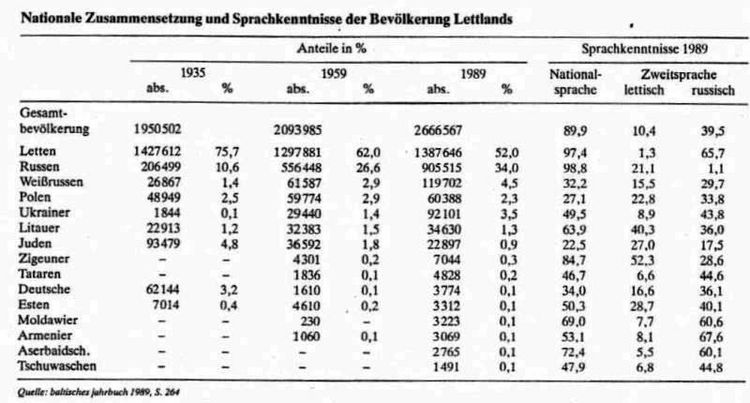
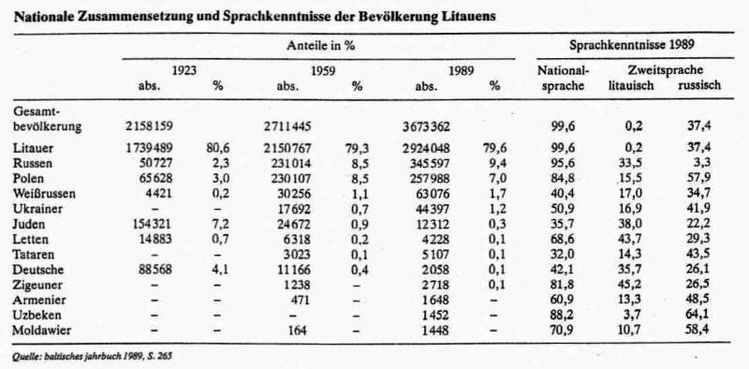
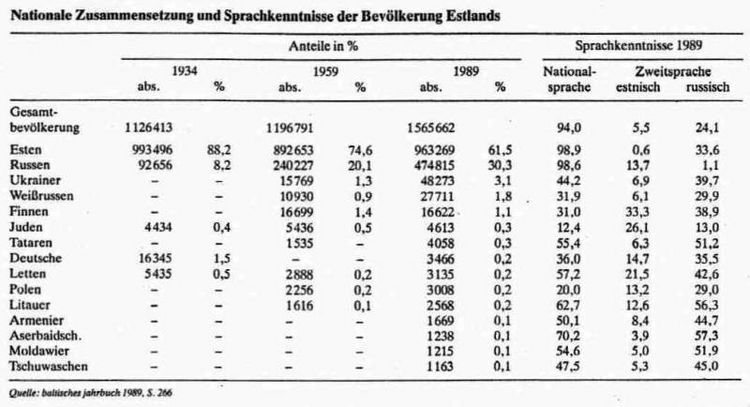
Legislation on minorities
The minority policies of the Baltic states served as a model. The Lithuanian Constitution of 1922 granted extensive rights of autonomy to minorities, although these were increasingly curtailed by the national chauvinism that soon took hold. In Latvia, a law on school autonomy passed on 8 August 1919 declared the entire school system of the national minorities to be autonomous. Under the overall supervision of the state Ministry of Education, special ‘ministries of education’ were established for each minority, whose heads administered their school systems independently and had the right to attend cabinet meetings on all matters concerning their cultural life.
The Estonian “Act on the Cultural Self-Government of National Minorities” of 2 February 1925 granted all minorities that could demonstrate more than 3,000 voluntary entries in a national register the opportunity to constitute themselves as public-law bodies. The bodies of cultural self-government were authorised to issue binding regulations, appoint their own officials and teachers, and levy taxes independently; in doing so, the state transferred significant sovereign powers to the cultural self-governments of the national minorities, whose duty of loyalty was expressly emphasised. This exemplary, liberal Cultural Autonomy Act was described as a “calling card to the Western world”.[6]
Authoritarian governments
Lithuania was the first of the Baltic republics to abandon its democratic, parliamentary foundations when, in 1926, the army occupied the parliament in a coup d’état and declared a state of war. A presidential regime was established under Antanas Smetona (1874–1944) as President and Augustinas Voldemaras as Prime Minister. Under the new constitution of 15 May 1928, the President became the de facto legislative body, replacing the National Assembly. By virtue of the state of war, Voldemaras was able to lead a dictatorial government until Smetona had him arrested in September 1929. Following a failed coup attempt, political parties were completely banned in 1935. Although the presidential regime was granted a degree of legal recognition under the constitution of February 1938, its authoritarian elements gave it the character of a dictatorial one-party state. Smetona, who presented himself as the ‘leader of the people’, drew on the tradition of the old Grand Duchy of Lithuania as a great power.
In March 1932, the Estonian Parliament adopted a constitutional amendment to strengthen presidential powers; although this was rejected in a referendum in August, it was taken up by the anti-democratic movement of the so-called ‘freedom fighters’ and passed once again in October 1933. With the President as the key figure, the extreme parliamentary system of the 1920 Constitution was transformed into the opposite: an almost absolute presidential constitution. On 12 March 1934, Konstantin Päts declared a state of emergency and banned the ‘freedom fighters’. In the autumn, Estonia’s democratic period came to an end, and the so-called ‘Era of Silence’ began with a three-year state of emergency. Under the new constitution, Päts ruled by decree; in March 1935, the political parties were dissolved and replaced by a new unified organisation and professional interest groups. A newly convened Constituent Assembly ratified the presidential constitution, which came into force on 1 January 1938.
In Latvia, too, various groups sought to replace the existing order with a fascist one modelled on the German and Italian examples. In response, Prime Minister Kārlis Ulmanis (1877–1942) declared a state of emergency on 15 March 1934 and, by bypassing parliament, the abolition of political parties and the suspension of the constitution, he concentrated legislative power and the offices of Prime Minister and President in his own person. Ulmanis ideologically promoted the ‘Führer principle’, adopted from National Socialism, using pseudo-historical references. The concentration of power in a single hand developed into a dictatorship that reshaped all areas of public life in accordance with the ‘Führer principle’.
Loss of independence
In August/September 1939, the secret additional protocols to the Hitler–Stalin Pact and the German–Soviet Treaty of Friendship and Border Demarcation established the division into spheres of interest that proved decisive for the very existence of the Baltic states. The ‘territorial reorganisation’ within its sphere of influence, which was granted to the Soviet Union in these protocols, was immediately set in motion through mutual assistance pacts and treaties granting the use of military bases, which were enforced by ultimatums, with Estonia (28 September), Latvia (5 October) and Lithuania (11 October). In mid-July 1940, parliamentary elections were held along Soviet lines; following a similar procedure, the members of parliament declared the Baltic states to be socialist Soviet republics and, in early August, submitted proposals to the Supreme Soviet in Moscow for their ‘incorporation’ into the Soviet Union. This was not a voluntary union based on a treaty, but a forcible appropriation of foreign territory, i.e. an annexation prohibited under international law.[7] Consequently, the status of the Baltic Soviet republics under international law differed fundamentally from that of the other Union republics.
In the course of the mass deportations of June 1941, approximately 11,000 people from Estonia, 16,000 from Latvia and 21,000 (according to some sources, 34,000) from Lithuania were deported to the interior of the Soviet Union. Including the deportations that had already begun in August 1940, a large proportion of the political, military and economic elites of the Baltic peoples had thus been deported by July 1941.
With the German occupation in the summer of 1941, only the forms of tyranny changed in the Baltic states. Estonia, Latvia, Lithuania and Belarus were grouped together by the new occupying power to form the ‘Reichskommissariat Ostland’, meaning they were granted neither special administrative status nor political autonomy. The long-term aim of transforming the Baltic region into a German territory was to be achieved through the ‘Germanisation of racially favourable elements’, the colonisation of Germanic peoples, and the resettlement and extermination of ‘undesirable’ ethnic groups. The Jewish population was the hardest hit. With unprecedented brutality, they were almost entirely murdered in Riga and Vilnius, together with numerous deportees from other occupied territories. Partly with the help of Lithuanian collaborators, almost 90 per cent of Lithuania’s Jewish minority – which in 1941 still numbered 230,000 people – were killed. An estimated 1,000 Jews were killed in Estonia and 66,000 in Latvia.
With the reoccupation of the Baltic states by the Red Army in 1944–45, a far-reaching process of Sovietisation, accompanied by terror, began in all areas; this could not even be halted by the partisan struggle. In the cultural sphere, the motto was ‘national in form, socialist in content’, and the national languages, literatures and customs were officially promoted. However, this cultural work, directed by the Communist Party, was intended to serve the creation of a ‘unified multinational Soviet culture’, so that the peoples of the Baltic states had to defend their ethnic autonomy against the ideal of the ‘Soviet man’. A brief period of thaw following Stalin’s death in 1953 was followed by a period of stagnation from 1964 to 1984, characterised by increasing centralisation.
The ‘Singing Revolution’
The reform policy introduced by Mikhail Gorbachev (born 1931) in 1985 under the guiding principles of glasnost and perestroika was welcomed more unanimously in the Baltic states than anywhere else in the Soviet Union. The importance of environmental issues became apparent in 1987 during the protests against the large-scale phosphate mining project planned by the central government in Moscow for north-eastern Estonia, the implementation of which would have resulted in an environmental disaster and the forced migration of Russian workers. Resistance to large-scale industrial projects also arose in Latvia regarding the planned construction of a further power station on theDaugava, and in Lithuania against the construction of a third nuclear power station at Ignalina.
Following demonstrations on Independence Days and in memory of the victims of Stalinism, so-called ‘People’s Fronts’ were formed in all three Baltic republics in October 1988 as cross-ethnic movements seeking to achieve autonomy, initially still within a renewed Soviet Union. Unlike comparable ‘round tables’ in other countries undergoing political upheaval, the People’s Fronts were well-organised mass movements with links extending right into the ranks of Communist Party members. They made their presence felt through mass rallies such as the song festivals or the impressive human chain, in which, on 23 August 1989, around one million participants linked the capitals of Reval, Riga and Vilnius in a joint protest against the Hitler–Stalin Pact, concluded 50 years earlier, and its consequences.
On 16 November 1988, the Supreme Soviet in Reval adopted a declaration of sovereignty affirming the supremacy of the laws of the Estonian Soviet Socialist Republic (ESSR) within its territory. In May/July 1989, Lithuania and Latvia followed suit with similar declarations. Realising that the democratisation of society could not be achieved with Moscow’s support, the People’s Fronts now sought full state independence. On 11 March 1990, Lithuania declared the restoration of the independent democratic republic, invoking the 1918 Declaration of Independence, and largely reinstated the 1938 Constitution. The ensuing standoff with Moscow ranged from displays of power in the form of tank parades to repressive measures, most notably a crippling economic blockade.
As at the start of perestroika, the Baltic republics again played a pioneering role for the democratic movement in the Soviet Union during this phase. In the shadow of the Gulf War, the situation escalated as Moscow sought to destabilise the Baltic states through targeted measures. This was prevented by non-violent resistance, by democratic forces within Russia itself, and by vigorous protest in Western countries. The support of the Speaker of the Russian Parliament, Boris Yeltsin (1931–2007), who, during the military operation against the Lithuanian population on 13 January 1991, promised his Baltic counterparts his support at a crisis meeting in Reval.
The return to the era of independence – and, in Lithuania, to its former historical significance – took place against a backdrop of a strong sense of belonging to Western Europe. In their renewed ‘national awakening’, all three nations strove to rediscover these roots, which had been buried for decades. When, during the Moscow coup in August 1991, Soviet tank columns were mobilised and the citizens of the Baltic states reinforced their barricades, the Estonian Parliament followed Lithuania’s example and adopted the Declaration of Independence on 20 August. The following day, Latvia also officially declared its independence from the Soviet Union.
The Baltic states, which have been democratically governed and market-oriented since the 1990s, have enjoyed security guarantees as NATO members since 29 March 2004. This fact, and above all the significant proportion of Russian-speaking residents in Estonia and Latvia, formed the basis for Russia’s attempts at interference. Full membership of the EU since 1 May 2004 is regarded as a ‘return to Europe’ and has reintegrated the Baltic states into Europe.
Population
Population trends in the Baltic states (excluding new immigration) during and after the Second World War[8]
Estonia | Latvia | Lithuania | |
Population as at mid-October 1939 (Lithuania: including the Vilnius region, excluding the Memel region) | 1,130,000 | 2,000,000 | 2,950,000 |
Emigration from November 1939 to May 1941 (including the Baltic Germans) | -20,000 | -70,000 | -50,000 |
Soviet deportations and executions 1940–41 | -15,000 | -35,000 | -35,000 |
Mobilisation for the Soviet Army in 1941 and 1944–45 | -35,000 | -20,000 | -60,000 |
Flight to the Soviet Union in 1941 | -30,000 | -40,000 | -20,000 |
Executions and deportations under German rule 1941–1944 (including around 250,000 Jews) | -10,000 | -90,000 | -200,000 |
Forced labourers deported to Germany 1941–1944 | -15,000 | -35,000 | -75,000 |
Killed in action whilst serving on the German side | -15,000 | -40,000 | -10,000 |
Soviet executions and deportations in 1944–45 | -30,000 | -70,000 | -50,000 |
Flight to the West 1942–1945 (mainly via Scandinavia) | -60,000 | -100,000 | -50,000 |
Return to Germany of deported forced labourers in 1945 | +5,000 | +10,000 | +20,000 |
Return from the Soviet Union and the Soviet Army in 1944/45 | +20,000 | +20,000 | +20,000 |
Emigration to Poland | - | - | -150,000 |
Population changes due to territorial gains and losses 1940–1945 (Estonia and Latvia: loss of strips of territory to the Russian Soviet Republic; Lithuania: gain of some Belarusian territories and the Memel region) | -70,000 | -50,000 | +125,000 |
other losses | -5,000 | -80,000 | -15,000 |
Population at the end of 1945 | 850,000 | 1,400,000 | 2,400,000 |
Soviet deportations 1946–1953 | -80,000 | -100,000 | -260,000 |
Victims of the partisan war | -15,000 | -25,000 | -50,000 |
Return from the Soviet Union or the Soviet Army after 1945 | +100,000 | +100,000 | +40,000 |
Immigration of Russians, Belarusians and Ukrainians | +230,000 | +535,000 | +160,000 |
Net birth surplus | +70,000 | +100,000 | +350,000 |
Population at the start of 1955 | 1,155,000 | 2,010,000 | 2,640,00 |
Economy
Lithuania was not a riverine region like Old Livonia; even the Memel did not attract trade in the same way as the Daugava. Long-distance trade extended as far as Grodno/Hrodna and Vilnius, and scarcely touched the Lithuanian countryside north of the Memel. Lacking a major river system, the Daugava was at least used for rafting; the Livonian Aa (Gauja), as the main river of Southern Livonia, was navigable as far as Volmar/Valmiera in the Middle Ages. The waterway connected via Lake Peipus (Peipsi järv), Lake Pskov (Pihkva järv) and the Narva River (Narva jõgi) to Pskov and Narva, and thus to the overland route to Novgorod.Pskov and Narva, and thus the overland route to Novgorod.
Following the implementation of socially and economically successful agricultural reforms, all three Baltic states had to overcome the consequences of the First World War and intensify agricultural production. Self-sufficiency was achieved in grain production. Consumer co-operatives established retail chains, and producer co-operatives gained in importance. Credit co-operatives were formed, with state and agricultural banks acting as financiers, to fund necessary innovations. In Estonia, thanks to war reparations, the country’s main natural resource—its oil shale deposits—was developed. Exports of the oil, petrol and asphalt derived from these deposits brought increasing amounts of foreign capital into the country. Between 1929 and 1939, oil production increased sixteen-fold, whilst raw material production tripled.
The Baltic states’ main foreign trade partners were Germany and Great Britain, with a growing dependence on exports to Nazi Germany. Intra-Baltic trade played a minor role, and a customs union was never established. The granting of licences under the foreign exchange control system led to a kind of monopolisation of imports in the early 1930s. The support and protection measures made it clear that a ‘middle ground between a capitalist private economy and an interventionist state economy was being increasingly abandoned in favour of the latter’.[9] The Baltic states succeeded in achieving a limited but growing integration of their overall economy with the European market; however, this integration was not spared the strain of the post-war depression of the early 1920s, economic fluctuations, the Great Depression and the pressure arising from the Third Reich’s foreign trade policy.
Religion
When people converted to Christianity, the old folk beliefs persisted for a long time in village communities. Although Estonian, Latvian and Lithuanian peasants adopted the cult of the saints, they adapted it to their own folk traditions. Pagan rites were maintained in village cemeteries, and ancient sacred sites (springs, groves, trees, the snake) continued to be venerated. However, with Christianisation came a cultural transfer in the form of new technologies, books and Western European art, with Livonia being influenced more by the Germans, and Lithuania by the Poles and Russians. Universities played a key role in this, as they were attended by graduates from the Baltic region. Livonians studied mainly in Leipzig and Rostock, whilst Lithuanians had been studying in Kraków since the end of the 14th century. Following the Reformation, students attended the universities of Wittenberg and Königsberg, and, in isolated cases, Italian universities as well. In the 15th century, there was a considerable influx of clergy, lawyers, doctors, artists and architects, who, even during shorter stays, contributed to the spread of Western European culture.
Education
Important cultural centres included the churches in Riga and Vilnius, as well as the monasteries founded by the Franciscan and Dominican monastic orders, of which there were around 30 in Livonia at the start of the Reformation. Cultural life flourished particularly in the cities of Riga, Reval, Dorpat, Vilnius and Kaunas, with cathedral schools playing an important role from the 13th century onwards. Higher education, however, remained restricted to the upper classes, who, in addition to Latin, used mainly Low German in Livonia and Church Slavonic (Old Belarusian) in Lithuania, and from the mid-16th century onwards also the Polish language. The educated classes in Livonia were of German origin, whilst in Lithuania they were also of Italian and Polish descent. It was not until the 16th century that Estonians, Latvians and Lithuanians began to appear increasingly among them.
The rural milieu of the peasants – and, in Lithuania, also that of small landowners – retained its role as the guardian of cultural traditions, language and customs. Their rural way of life was characterised by a settled existence, difficulties in adopting Christianity, social barriers between rural and urban dwellers, and, in Livonia, additionally by ethnic divisions. With the stronger influence of folk beliefs, urban cultural elements found only slow acceptance in the countryside, and the ethnic distinctiveness of the Estonian and Latvian populations was preserved here just as it was amongst the Lithuanian upper classes.
Language/Literature
In the former Teutonic Order territories of Estonia, Livonia and Courland, as well as in northern East Prussia, German Protestant-Lutheran literature shaped the emerging written languages. The Estonian and Latvian literary languages found their way into European literature via German, whilst the Lithuanian literary language did so via Polish. The authors of Old Lithuanian literature, who had grown up bilingual, used Lithuanian as their everyday language and Polish or Latin as their written language. In his 13th-century Livonian Chronicle, the priest Heinrich von Lettland (d. c. 1259) described the conquest and Christianisation of the Livonians, Estonians and Latvians from the perspective of the Church of Riga. In the Livonian Rhymed Chronicle, the perspective of the ruling new powers predominates. Lithuanian chronicles deal with the foundation of the Lithuanian Empire and the issue of lineage, which was intended to protect the ruling families from claims made by Moscow and Poland. Overall, these works—whether produced by the Order or by the Lithuanians—are often written in a highly propagandistic and polemical style. It was only with the spread of literacy, university-level knowledge and the dissemination of humanist ideas that authors began to break free from the official viewpoint. Criticism of local conditions is found in Lithuanian treatises written after 1520, and in particular in the *Chronica der Provinz Lyfflandt* (1578) by Balthasar Russow (1536–1600).
Architecture
The first stone building erected in Livonia was the Romanesque fortified church at Uexküll/Ikšķile, construction of which began after 1180. The earliest surviving works of art in Estonia are the limestone sculptures in the church at Wolde/Waljal on the island of Ösel (Saaremaa), completed in the 13th century. The terracotta figures from St John’s Church (Jaani kirik) in Dorpat date from the 14th century; of these, a total of over 425 head sculptures, seated figures and bas-reliefs have survived to this day. As pieces of individual character, they rank among the most significant examples of medieval sculpture and terracotta art. The largest sacred building in Old Livonia was Tartu Cathedral, with its ambulatory choir added at the end of the 14th century. St Nicholas’s and St Olaf’s Churches in Reval, as ‘Ecclesiae mercatoriae’ (merchant’s churches), had short and wide naves and, in their original form, a massive, fortress-like west tower modelled on the Westphalian style.
In the 13th and 14th centuries, over 150 stone castles were built in Livonia, and in Lithuania around 20 by the end of the 16th century. Stone architecture dominated the towns of Livonia, whilst timber construction prevailed in the Lithuanian towns until the 15th century. Apart from the churches, the most magnificent urban buildings were the town halls and guildhalls, as well as the city walls of Riga and Reval, which were equipped with numerous defensive towers. Influences from local building traditions can be seen from an early stage in the architecture of manor houses, which, until the mid-18th century, generally differed from farmhouses only in their size.
Among Reval’s finest artistic treasures are the pew side panels in the Town Hall, carved in the 15th century, and the painted wings of the altar in St Nicholas’ Church, created between 1478 and 1482 by Hermen Rode of Lübeck (1485–1504) in St Nicholas’ Church. His contemporary, Bernt Notke (1440–1517), created his ‘Dance of Death’ in 1463, of which the first 13 figures are preserved there today. Estonia’s most significant medieval artist was the portraitist Michel Sittow (1469–1525/26), who, after spending time in Western and Northern Europe, returned to his home town of Reval in 1518. During the iconoclasm of the Reformation in 1524, many works of sacred art were destroyed, particularly in Reval, Dorpat and Pernau/Pärnu.
Universities
The University of Dorpat, founded in 1632 by Gustav Adolf (1594–1632), became a focal point for Baltic-German cultural relations following its re-establishment in the 19th century. As a ‘German’ institution of higher education, it was able to play a distinct mediating role under its own management and with academic autonomy. State administration – rather than the nobility-led governance originally envisaged – had a positive effect during the liberal 1860s, but proved detrimental following the massive intervention from 1890 onwards, when the university was fully Russified. In its heyday, the natural sciences, medicine, theology and legal history produced achievements whose influence extended far into Russia. Among the most significant researchers were the future Admiral Ferdinand von Wrangell (1796‒1870), the astronomer Wilhelm Struve (1793–1864) and the biologist and discoverer of the egg cell, Karl Ernst von Baer (1792–1876). The University of Dorpat, like the Polytechnic Institute established in 1862 on the initiative of Riga merchants, with the future founder of the Soviet space programme, Friedrich Zander (1887‒1933) and the chemist and later Nobel laureate Wilhelm Ostwald (1853‒1932), became a significant bridge for the knowledge transfer between East and West through close academic exchanges with German universities.
The University of Vilnius, which emerged from a Jesuit college in 1579, developed into a centre of scientific and educational work in Lithuania. In the 18th century, those who taught here included the botanist and revolutionary Georg Forster (1754‒1794), Ernst Gottfried Groddeck (1762–1825) wrote the first handbook on Greek literature in Europe and counted the Polish national poet Adam Mickiewicz (1798‒1855) and the historian Ignacy Lelewel (1786‒1861). As a result of the Polish occupation, the Lithuanian University of Kaunas was founded in 1922, where the writer Vincas Kreve-Mickevičius (1882–1954) taught as a social scientist.
Bibliography
All three Baltic countries developed a literary output that was outstanding by European standards, in which epic literature and poetry alike held a firm place. Among the most significant authors of all ethnic groups, who engaged in mutual cultural exchange, are, in Estonia, Anton Hansen Tammsaare (1878–1940), Jaan Kross (1920–2007) and Viivi Luik (born 1946); in Latvia, Rūdolfs Blaumanis (1862–1908), Rainis (Jānis Pliekšāns, 1865–1929) and Zenta Maurina (1897–1978); in Lithuania, Kristijonas Donelaitis (1714–1780), Maironis (Jonas Mačiulis, 1862–1932) and Ieva Simonaitytė (1897–1978), as well as the Jewish writers Mathias Straschun (1817–1885), Selig Schachnowitz (1874–1952), Abraham Sutzkever (1913–2010) and Grigori Kanowitsch (born 1929), the Russian Irina Saburova (1907–1979) and the Baltic Germans Theodor Hermann Pantenius (1843–1915), Werner Bergengruen (1893–1964), Gertrud von den Brincken (1892–1982) and Siegfried von Vegesack (1881–1974).
5. Discourses/Controversies
In the 20th century, there was an intense debate in historiography regarding the assessment of 19th-century Baltic history. From the Soviet-Latvian perspective, German-Baltic dominance was denounced using the terms ‘Kulturträgertum’ and ‘Apologetentum’, which soon became established in academic discourse; the German-Baltic nobility, together with the Russian nobility, had formed an ‘oligarchic opposition’ to innovation, and the ruling class had, above all, feared socio-economic change. Reinhard Wittram countered the thesis that the Baltic nobility’s interests were aligned with Russian autocracy by explaining the position of the Germans in the Baltic provinces primarily in terms of their numerical weakness.[10] This confrontation, which was at times intense, has been overcome by more recent studies on Russification and reform policy, as it has become clear that, alongside the formula of ‘holding out’ and ‘standing firm’ once coined by Carl Schirren (1826–1910), there has always been dissent and even opposition within the Baltic Germans. In dialogue with more recent Estonian research into agricultural history[11], it has become apparent that neither ‘welfare’ alone nor, for example, systematic ‘oppression’ can any longer provide a viable interpretative framework for the policies of the knighthood.[12]
In historical research, the efforts made at that time to assimilate non-Russian ethnic groups within the Tsarist Empire into Russian society across a wide range of areas are now assessed in a more nuanced manner. For contrary to the view—advocated primarily by German-Baltic historians—of a consistent policy of Russification, there was neither a coherent, uniform concept of Russification, nor did the Russificationproceeded in a linear and continuous manner. The policy of ethnic integration can also be regarded as part of a necessary modernisation of the state as a whole.[13]
Bibliography
- Céline Bayou, Matthieu Chillaud (eds.): The Baltic States in Transition: The Return to Europe. Brussels et al. 2012 (Geopolitics and Conflict Resolution 13).
- Michael Garleff: The Baltic States. Estonia, Latvia, Lithuania from the Middle Ages to the Present Day. Regensburg 2001 (Eastern and South-Eastern Europe, History of Countries and Peoples).
- Anders Henriksson: Vassals and Citizens. The Baltic Germans in Constitutional Russia, 1905–1914. Marburg 2009 (Materials and Studies on East Central European Research 21).
- John Hiden, Patrick Salmon: The Baltic Nations and Europe. Estonia, Latvia and Lithuania in the Twentieth Century. London, New York 1991.
- Tālavs Jundzis (ed.): The Baltic States at Historical Crossroads. Political, economic and legal problems and opportunities in the context of international cooperation at the beginning of the 21st century. 2nd, revised and expanded edition, Riga 2001.
- Andres Kasekamp: A History of the Baltic States. Houndmills, Basingstoke, Hampshire 2010 (Palgrave Essential Histories).
- Zigmantas Kiaupa, Ain Mäesalu, Ago Pajur, Gvido Straube: The History of the Baltic Countries. 3rd, revised edition, Tallinn 2002.
- Boris Meissner (ed.): The Baltic Nations. Estonia, Latvia, Lithuania. 2nd, expanded edition, Cologne 1991 (Nationality and Regional Problems in Eastern Europe 4).
- Olaf Mertelsmann (ed.): The Sovietisation of the Baltic States, 1940‒1956. Tartu 2003.
- Romuald J. Misiunas, Rein Taagepera: The Baltic States: Years of Dependence 1940‒1990. Berkeley 1993.
- Gert von Pistohlkors (ed.): The Baltic States. Berlin 1994 (German History in Eastern Europe).
- Wilfried Schlau (ed.): A Thousand Years of Neighbourhood. The Peoples of the Baltic Region and the Germans. Munich 1995.
- Graham Smith (ed.): The Baltic States. The national self-determination of Estonia, Latvia and Lithuania. Basingstoke, Hampshire et al. 1996.
- Ralph Tuchtenhagen: History of the Baltic States. Munich 2005 (C. H. Beck Wissen 2355).
Bibliographies and periodicals
- Baltic Bibliography (1953–1993, published annually in the *Zeitschrift für Ostforschung*, thereafter as separate volumes: Paul Kaegbein [ed.]: *Baltic Bibliography. Literature on Estonia, Latvia and Lithuania*, 1994. With supplements [Bibliographies on the History and Geography of East Central Europe, No. 16]. Marburg 1995; Baltic Bibliography 1995 [No. 19] Marburg 1996; Baltic Bibliography 1996 [No. 21], Marburg 1997; Baltic Bibliography 1997 [No. 22], Marburg 1998; Baltic Bibliography 1998 [No. 24] Marburg 2000; Baltic Bibliography 1999 [No. 28] Marburg 2002; Baltic Bibliography 2000 [No. 35] Marburg 2005).
- Baltische Hefte. Quarterly journal on contemporary issues, culture and scholarship in the Baltic region, Hanover-Döhren (1 [1954]–21 [1975/1977]).
- Baltische Rundschau, Vilnius (1994–present)
- Commentationes Balticae. Yearbook of the Baltic Research Institute, Bonn (1953–1964/1966).
- Research on Baltic History, Tartu (2006–present)
- Yearbook of Baltic German Culture, Lüneburg (Vol. 1 [1954] 1953 onwards)
- Journal of Baltic Studies, USA (1970–)
- Latvijas vēstures institūta žurnāls [Journal of the Latvian Institute of History], Riga (1936–1940, 1991 onwards)
- Nordost archive N. F., Lüneburg (1992 onwards)
- Journal of East Central European Research, Marburg (1994 onwards [1952–1994: Journal of Eastern Studies]).
- Renate Wittram-Hoffmann: *Baltische Monatsschrift* (*Baltische Monatshefte*). Index 1859–1939. Marburg/L. 1973 (Scientific Contributions to the History and Regional Studies of East-Central Europe 92).
Web links
- bbld.de/GND1213381010 (BBLD – Baltic Biographical Lexicon Digital. A digitisation project of the Baltic Historical Commission)
- www.balt-hiko.de/online-publikationen/baltisches-rechtsw%C3%B6rterbuch/ (Hermann Blaese † [ed.], Otto-Heinrich Elias, Alfred Schönfeldt [eds.]: Baltic Legal Dictionary 1710‒1940. Online publication by the Baltic Historical Commission)
- www.academiabaltica.de/ (Academia Baltica, Lübeck)
- www.carl-schirren-gesellschaft.de/ (Carl Schirren Society, Lüneburg)
- www.dbgg.de/ (German-Baltic Genealogical Society e. V.)
- www.deutsch-balten.de/ (German-Baltic Society e. V.)
Notes
[1] Harald Standl: The Baltic States – a brief overview of regional studies. In: Ost-West. Europäische Perspektiven 7 (2006), No. 1, pp. 3–8, table on p. 7.
[2] Carsten Goehrke: The Baltic States at a Crossroads of European History: A Retrospective. In: Carsten Goehrke, Jürgen v. Ungern-Sternberg (eds.): The Baltic States at the Crossroads of Developments. Past and Present. Basel 2002 (Texts and Studies 4), pp. 179–193, here p. 181.
[3] Garlieb Merkel: The Latvians, Particularly in Livonia, at the End of the Philosophical Century. Based on the 1796 Leipzig edition edited by Thomas Taterka. Wedemark 1998 (Contributions to Baltic History 17).
[4] Reinhard Wittram: Baltic History. The Baltic States of Livonia, Estonia and Courland 1180–1918. Outlines and Perspectives. Darmstadt 1973, p. 133.
[5] Georg v. Rauch: History of the Baltic States. Munich 1990, p. 27.
[6] Hans Rothfels: The Baltic States as a Problem of International Politics. In: Hans Rothfels: Reflections on Contemporary History. 2nd, revised edition, Göttingen 1963, pp. 217–235, here p. 223; Cornelius Hasselblatt: Minority Policy in Estonia. Legal Development and Legal Reality 1918–1995. Hamburg 1996 (Bibliotheca Baltica), p. 58; Rauch: History (as in note 5), p. 138.
[7] Boris Meissner: The Soviet Union, the Baltic States and International Law. Cologne 1956.
[8] Source: Helmut Meyer: History of the Baltic States. In: Geschichte 1989, No. 3, p. 37.
[9] Gert von Pistohlkors: Estonia, Latvia, Lithuania 1920–1940. In: Handbook of European Economic and Social History. Vol. 6. Stuttgart 1987, pp. 729–768, here p. 762.
[10] Reinhard Wittram: Methodological and Historical-Theoretical Reflections on Problems in Baltic Historical Research. In: Zeitschrift für Ostforschung 20 (1971), pp. 601–640.
[11] Juhan Kahk: Peasants and Barons in the Baltic Region. An Attempt at a Historical-Phenomenological Study on the Subject of ‘Manorial Rule in the Baltic Provinces’. Tallinn 1999.
[12] Gert v. Pistohlkors: The Position of the Germans in the History of the Estonians, Latvians and Lithuanians. In: Nordost-Archiv N.F. 1 (1992), pp. 89–122, here p. 116.
[13] Cf. the literature review by Gert v. Pistohlkors: ‘Russification’ in the Baltic Provinces and in Finland in the 19th and early 20th centuries. In: Zeitschrift für Ostforschung 33 (1984), pp. 592–606; most recently Gert v. Pistohlkors: The Baltic Provinces as a ‘Western Periphery’ of the Russian Empire. In memory of the American historian Edward Carl Thaden (1928–2008). In: Jahrbuch des baltischen Deutschtums 60: 2013 (2012), pp. 226–244.
Citation
Michael Garleff: The Baltic States. In: Online Encyclopaedia on the Culture and History of Germans in Eastern Europe, 2013. URL: ome-lexikon.uni-oldenburg.de/54111.html (accessed 9 November 2020).
Terms of use for this article
Copyright © University of Oldenburg and the Federal Institute for the Culture and History of Germans in Eastern Europe (BKGE), all rights reserved. This work was produced as part of the project ‘Online Encyclopaedia on the Culture and History of Germans in Eastern Europe’ and may be reproduced and published provided the rights holders’ consent has been obtained. Please contact:
If you have any specialist comments or additions to the text, please contact the editorial team, citing relevant literature and source references.