

Saint Petersburg/Saint-Pétersbourg/Leningrad
Saint Petersburg/Saint-Pétersbourg/Leningrad
Latin name
Petropolis – commonly used, for example, in the Latin publications of the St Petersburg Academy of Sciences during the 18th and 19th centuries.
Etymology
The city was named in 1703 not after its founder, Tsar Peter I (the Great, 1672–1725), but after the Apostle Simon Peter. With the outbreak of the First World War, the city was renamed Petrograd – literally ‘Peter’s City’ – on 18 August 1914, because the previous name sounded too ‘German’. Following Lenin’s death in 1924, the city became Leningrad on 26 January 1924. After the collapse of the Soviet Union, it regained its original name following a referendum on 6 September 1991. In contrast, the surrounding administrative region (federal subject), Leningrad Oblast (Russian: Leningradskaya Oblast’), retained its old name following a resolution by the local regional Soviet.
Location
St Petersburg is situated at 59° 56′ north latitude and 30° 16′ east longitude, at the mouth ofthe Neva where it flows into the Gulf of Finland and, consequently, into the Baltic Sea.
Topography
Originally built in a densely wooded, rocky marshland, the town consists of 42 islands; there were originally more, but many of the connecting channels have since been filled in. Due to its location just a few metres above sea level, the town is constantly at risk of flooding.
Region
St Petersburg is situated in north-western Russia and is regarded as the country’s gateway not only to the Baltic Sea, but also tothegeographically ill-defined‘Russkij sever’, the ‘Russian North’, stretching as far as the White Sea.
Political and administrative affiliation
Saint Petersburg is a federal subject of the Russian Federation. The city is the administrative centre of the North-West Federal District (Severo-zapadnyj federal’nyj okrug). Since 2008, it has been the seat of the Constitutional Court of Russia.
Common symbolism
The town’s coat of arms depicts two silver anchors, inverted and crossed, on a red field, surmounted vertically by a golden sceptre. A golden tsar’s crown is perched atop the shield; behind it, two Russian imperial sceptres are crossed, each with the Russian double-headed eagle as its pommel. The blue ribbon of the Order of St Andrew encircles the shield. The two anchors also feature on the town’s flag.
Common and historical nicknames
Even when the city was called Leningrad, its inhabitants referred to it as ‘Piter’; after 1991, it was not uncommon for it to be called ‘Leningrad’. In recognition of its achievements and the plight of its inhabitants during the German siege in the Second World War, it was awarded the title ‘City of Heroes’ on 1 May 1945.
Foundation of the town during the Great Northern War
Peter the Great conquered the Neva Delta region from Sweden at the start of the Great Northern War (1700–1721) and, in 1703, had a fortress – the Peter and Paul Fortress – and a shipyard, known as the Admiralty. Consequently, after 1703, Saint Petersburg succeeded Arkhangelsk as Russia’s most important port city, as it remained ice-free for much longer than the city on the White Sea. However, using the estuary as a harbour proved to be no easy task: the Neva, which rises in Lake Ladoga, is a short river at 40 kilometres, flows comparatively fast and carries a great deal of sediment. Shallow waters, silting and the risk of flooding were, and remain, problems for the harbour and the city.
As early as the year the city was founded, the first large merchant ship entered Saint Petersburg. The Great Northern War initially hampered the development of trade: In the summer of 1704, a Swedish flotilla bombarded the Kronchlot fortress, which was under construction on Kotlin, prompting the Tsar to order shortly afterwards that the entire island, situated off the coast of the city, be fortified and developed into a military and commercial port; in 1723, it became Kronstadt (Kronstadt). In Saint Petersburg, inland and maritime trade began to take off slowly, in the shadow of the war and with the support of Peter I. The relocation of the court and central government and administrative authorities to the city in 1712, which was accompanied by a significant concentration of military forces, contributed to the development of Saint Petersburg just as much as the nascent development of the north-western Russian river network via a system of canals, for which numerous hydraulic engineers were recruited.
Economic Growth and Naval Armament in the 18th and 19th Centuries
The rapidly growing capital, whose inhabitants Peter had initially ordered to settle on theNeva, but who soon began to arrive of their own accord, needed, amongst other things, food and building materials; both were transported into the city by river and sea. In 1722, the first year after the end of the Great Northern War, more than a hundred foreign ships entered Saint Petersburg, 35 of them from English ports and 22 from the Netherlands; even before that, however, the North German ports led the way, with twelve ships from Lübeck alone. Raw materials and semi-finished products, particularly iron, dominated exports from the port of St Petersburg in the 18th century, whilst finished and luxury goods – not least for the needs of the court – characterised imports.
Although the proportion of Russian merchant ships was to grow significantly over the following decades in the cities around the Baltic Sea, Baltic trade and the handling of goods in St Petersburg were characterised by English dominance, and not only in the 18th century. The Russian Navy’s Baltic Fleet, however, was successfully established. The Admiralty built ships that proved their seaworthiness in the wars with Sweden. The fortress island of Kronstadt in the Gulf of Finland became, in many respects, the gateway to St Petersburg: Customs duties were already being levied here on incoming ships in the 18th century, and it was here that the large English and Dutch merchant ships, in particular, were required to drop anchor so as not to obstruct the busy shipping traffic on the Neva. From Kronstadt, goods were unloaded onto cargo ships at the ‘Strelka’, the tip of Vasilyevsky Island (Vasil’evskij Ostrov), facing the Great Neva. The city’s first stock exchange also sprang up here amongst the warehouses. By 1840, it had become apparent that the old Admiralty no longer met the requirements of the main shipyard for a fleet operating worldwide. Gradually, the shipyard was converted into the Ministry of the Navy and the administrative headquarters of the naval fleet, whilst the new shipyard was relocated out of the city, where it remains in operation to this day as a shipyard for new builds and ship repairs. Admittedly, the new shipyard was also close to the city centre. Sailors and shipyard workers were just as ubiquitous in the city as the labourers on the barges (small unpowered cargo vessels) and transport ships that supplied the metropolis via the canals. Places such as the famous Hay Market (Sennaya Ploshchad) could be supplied with food via the Fontanka, a tributary of the Neva. In a district such as New Holland, which emerged in the 18th century between the Kryukov and Admiralty Canals, there was not only a small shipyard for river vessels, but it also became the Admiralty’s central storage site for shipbuilding timber.
Political conflicts in the 19th and 20th centuries

In the 19th century, Saint Petersburg became a key centre of political conflict within the Tsarist Empire. During the Decembrist Uprising in December 1825, aristocratic conspirators attempted a revolt with the aim of introducing a constitution in Russia. In 1881, the terrorist organisation ‘People’s Will’ assassinated Tsar Alexander II (1818–1881) in an attempt to spark a revolution – initially without immediate success.
From the turn of the 19th to the 20th century, workers, sailors and soldiers also became increasingly involved in the politicisation of city life, which was initially driven by economic factors. During the Russian Revolution of 1905, they were among the victims of the so-called ‘Bloody Sunday’ in St Petersburg during the march on the Winter Palace on 9 January. The sailors had experienced first-hand the defeats of the Russo-Japanese War of 1904–05 and the First World War, and, as a mutinous fleet, were among the groups that forced Tsar Nicholas II (1868–1918) to abdicate. In October 1917, they helped secure the success of the Bolshevik coup by joining the Red Guards and, in early 1918, by dissolving Russia’s elected Constituent Assembly in the Tauride Palace. Many, however, felt that their vision of a revolution had not been realised, and so, at the beginning of 1921, the sailors of Kronstadt – who had repelled the counter-revolutionary ‘White’ offensive against Petrograd during the civil war of 1918–1919 – rose up to enforce the principle of the soviets. It was only after their defeat that the Bolsheviks gained complete control of the city.
During the Second World War, the Red Army managed to hold Kronstadt against advancing German naval forces. In doing so, it protected Leningrad from German attacks from the sea during the deadly, almost 900-day blockade by German troops and their allies, which lasted from September 1941 until January 1944.
Economic development in the 20th century
Having lost its political significance in the wake of the October Revolution, Leningrad struggled to revive its tradition as a trading port. Signs of this had already become apparent before the First World War, when the city’s share of Russian exports by sea had fallen from 38 per cent in 1832 to 15 per cent in 1902. Competition from Odessa/Odesa and Riga/Rīga, for example, as well as the expansion of the railway network, had contributed to this. After 1945, the ports of the Baltic Soviet republics of Estonia, Latvia and Lithuania, and of the Kaliningrad region, were geared towards the centrally planned economy of the Soviet Union, thereby coming into partial competition with Leningrad.
It was only after the Second World War that the necessary expansion of the city came to include not only residential areas but also new harbour districts. Since the 1966 master plan, new seaside districts had been planned to the west of Vasilyevsky Island; these were to be flood-proof and, together with a new harbour, present a modern face of socialist Leningrad. As a result, a passenger port for cruise ships was inaugurated in 1982. It was subsequently expanded to include container terminals by 2008. Following the collapse of the Soviet Union, the independence of the Baltic states and, ultimately, their integration into the European Union, St Petersburg has regained its importance for Russia as a port. Today, the ‘Seaport of Saint Petersburg’ is the largest of the ports on the Gulf of Finland, but is situated separately from the historic city centre.
In a sense, this city, shaped by the water, is now characterised by the absence of the port, even though numerous street names in the centre still serve as a reminder of its maritime past. Of St Petersburg’s nearly five million inhabitants, only a few tens of thousands are employed in the port sector itself. Maritime trade and the navy, of course, remain an integral part of the city’s and its inhabitants’ self-image. The celebrations for ‘Fleet Day’, observed every year at the end of July, are particularly lavish in St Petersburg, evoking the tradition of Russia’s presence on the Baltic Sea – from the time of Peter the Great and the city’s early days, through the Soviet era, right up to the present day.
Population
Since its foundation in 1703, St Petersburg has been a multi-ethnic, multi-religious and multi-denominational city. It was not only Russians, who were sent there in the city’s early years, who settled here, but initially, and above all, Finno-Ugric peoples from the surrounding area. As the city grew, numerous craftsmen, day labourers and merchants flocked to St Petersburg, as did people required for the civil service and those serving in the city’s garrisons. From the very beginning, Germans played a significant role: they had been moving to St Petersburg from the German Empire since Peter I’s great recruitment manifesto of 1702. Furthermore, following the Treaty of Nystad (1721), numerous German Balts migrated to the capital from the provinces of Livonia and Estonia – which had been annexed by Russia during the Great Northern War – and came to hold important positions in administration, academia, the arts and music, as well as in the crafts.[1]
During the reign of Peter the Great, it was primarily craftsmen who settled in the imperial capital; they were able to meet the nobility’s growing demand for luxury clothing, furniture and furnishings, or practised trades that were not yet represented in Russia at that time (e.g. watchmakers). By 1720, 13 per cent of all craftsmen organised into guilds were foreigners, whilst the proportion of foreigners (inozemcy) in the city’s total population stood at seven per cent. Records for the entire reign of Peter I show the names of 172 Dutchmen, 138 Germans (84 of whom were from Hamburg and 10 from Lübeck) and 92 Englishmen.
In the 19th century, increasing numbers of workers from rural backgrounds arrived in the metropolis on the Neva from across the Russian Empire. Thus, both before and after the 1917 Revolution, the city was home not only to Russians but also to Ukrainians, Germans, Estonians, Latvians, Poles, Lithuanians, Jews and other ethnic groups from Russia and the Soviet Union. Interestingly, more detailed figures exist for the period before the First World War:
| 1869 | 1910 | |
| Russians | 555,000 | 1,568,000 |
| Belarusians | 3,000 | 70,000 |
| Ukrainians | 500 | 17,000 |
| Jews | 6,700 | 35,100 |
| Estonians | 4,000 | 23,400 |
| Latvians | 2,800 | 18,500 |
| Finns | 18,000 | 18,000 |
| Swedes | 5,100 | 3,000 |
| Poland | 17,400 | 65,000 |
| Lithuanians | 600 | 11,500 |
| Germans | 42,500 | 43,200 |
| French | 3,100 | 3,700 |
| English | 2,100 | 2,200 |
| Tatars | 2,000 | 7,300 |
| Others | 4,200 | 17,800 |
| Total | 667,000 | 1,905,600[2] |
Among the foreigners in the city, Germans made up the largest proportion by number until the First World War. In the 18th century, they lived mainly on the Admiralty side of the Neva, but also on the opposite bank, Vasilyevsky Island. In both districts, separate cemeteries were allocated to foreign – that is, non-Orthodox – denominations, given the number of believers. In 1789, some 18,000 Germans are said to have lived in Saint Petersburg, accounting for around 8 per cent of the population. By 1818, the figure had risen to 24,000 Germans. In the censuses of the following decades and in the exceptionally well-documented census of 1897, respondents were asked about their mother tongue; consequently, the statistics did not distinguish between Germans and German-speaking Jews, Finns, Estonians or Latvians. Whilst the absolute number remained roughly the same at around 50,000 German-speaking residents, their proportion of the city’s rapidly growing population fell to around 2.6 per cent by the 1910 census. Around a third of all foreigners in Saint Petersburg were citizens of the German Empire up until the turn of the century, but their numbers had fallen by 1910, amounting to only around 1,600 people. The proportion of Germans from the Baltic provinces also declined, from around 10,000 in 1869 to about 6,000 in 1910.
The First World War and the Revolution marked a great exodus for the Germans of St Petersburg. In Soviet Leningrad, forms of organisation based on religious or even ethnic principles were not in line with Bolshevik policy. As for the period following the Second World War, one can speak of a history of the Germans in Petrograd/Leningrad only to a very limited extent. Following the German invasion of the Soviet Union and the siege of Leningrad, which brought immeasurable suffering to the city’s inhabitants, it was virtually impossible to emphasise German identity or places of remembrance associated with Germany. The few Leningrad Germans still living in the city had been deported either before or immediately after the siege.
The Germans of St Petersburg in the broader sense also include the inhabitants of the predominantly rural colonies surrounding the city. They had responded to Catherine II’s (1729–1796) recruitment manifesto of 1762, but in terms of structure and culture they were more comparable to other German colonists in the Tsarist Empire and had little connection to the urban life of the bustling metropolis.
The city’s total population figures for the 18th century are based on estimates made in historiography. Notable features include St Petersburg’s strong growth during the industrialisation period, the number of refugees in the city during the First World War, the losses resulting from the Revolution (1917) and the Civil War (until 1922), as well as the effects of the regional reorganisation in 2002.
| Year | Population (town) |
| 1725 | 75,000 |
| 1750 | 150,000 |
| 1800 | 300,000 |
| 1846 | 336,000 |
| 1869 | 667,000 |
| 1897 | 1,264,900 |
| 1910 | 1,905,000 |
| 1915 | 2,318,600 |
| 1920 | 722,000 |
| 1936 | 2,739,800 |
| 1944 | 2,559,000 |
| 1959 | 2,899,955 (including suburbs: 3,321,196) |
| 1989 | 4,460,424 (including suburbs: 5,023,506) |
| 2002 | 4,661,219 |
| 2010 | 4,879,566[3] |
Germans in business and society
Tsarina Anna Ivanovna (1693–1740), driven by her passion for hunting, recruited hunters and forestry experts, primarily from Saxony. During her reign (1730–1740), which Russian historiography has characterised negatively as a period of ‘German rule’, Andrej Ivanovič (Heinrich Johann Friedrich) Ostermann (1687–1747), the canal-building expert Burkhard Christoph von Münnich (1683–1767), and the Courland nobleman Ernst Johann von Biron (1690–1772) rose to prominence as the Empress’s favourites. Such a strong position held by German-speaking favourites at court was to remain a one-off. Furthermore, during the second half of the 18th century, the importance of German-speaking specialists at court declined as French court culture became firmly established. This did not alter the fact that Germans from the Empire and the Baltic region pursued careers and were strongly represented at court, in the city’s guard regiments and within the administrative apparatus. Georg Ludwig Graf von Cancrin (1774–1845), for example, who was born in Hanau, served as Russian Minister of Finance from 1823 to 1844 (and married into the Russian aristocracy). Konstantin Alexander Karl Wilhelm Christoph von Benckendorff from Reval/Tallinn (1781–1844) rose through the ranks as a general to become head of the secret police, founded in 1826 as the ‘Third Department of His Imperial Majesty’s Private Chancellery’. Such careers were by no means uncommon, even during the period of heightened Russian nationalism from the 1870s onwards. It was not until the run-up to the First World War that public accusations of possible disloyalty towards this group of people began to be voiced. This also applied to members of the Tsar’s family who had married into the family from Germany and who, in the history of the Russian Empire since the time of Peter I, had at times attained pre-eminent importance; foremost among them was Princess Sophie Friederike of Anhalt-Zerbst, who, as Catherine II (the Great), reigned over Russia for 34 years.
Germans were disproportionately represented in the city’s upper classes: in 1897, one third of Germans belonged to the nobility and to the legal category of so-called ‘honorary citizens’. A further third were counted amongst the broad middle class, the ‘meščanstvo’;[4] these were primarily craftsmen and small traders. The final third belonged to the group of domestic servants (including governesses and teachers) and to the urban lower classes. The Germans’ level of education was above average, as was, consequently, their representation in the professions, in art history, in education, healthcare and medicine.
In the first half of the 19th century, for example, the Stieglitz family’s banking house was a leading institution. Ludwig Stieglitz (1779–1843), who had emigrated from Arolsen in Hesse in 1803, rose to become court banker and succeeded in placing Russian bonds with banks in London and Amsterdam. He held shares in numerous companies, including the St Petersburg–Lübeck Steamship Company. Between 1840 and 1850, the Stieglitz banking house financed the construction of the railway line from St Petersburg to Moscow/Moskva. Ludwig’s son, Alexander Baron Stieglitz (1814–1884), rose to become head of the Russian Imperial State Bank and was active as a patron of the arts. The Berlin-based firm ‘Siemens und Halske [Russian: Galske]’ occupied a special place in St Petersburg’s industrial landscape: in the mid-19th century, the Siemens brothers began constructing the telegraph network in Russia. The company’s representative in Saint Petersburg was Carl von Siemens (1929–1906), who took Russian citizenship and was elevated to the hereditary nobility. Under his leadership, a whole series of telegraph lines were installed, including the Saint Petersburg–Kronstadt line (the world’s first undersea cable was laid for this project). In 1883, this company supplied electric lighting to Nevsky Prospect, then to the Winter Palace, the Conservatoire and other buildings.
However, middle-class German tradespeople were also able to establish a strong position for themselves through specialisation. Their craft businesses were concentrated, on the one hand, in the areas where most Germans lived, but depending on the trade, they were also represented throughout the city. This applied in particular to butchers’ shops and sausage-making workshops, and to a large extent to the baking trade, which, admittedly, came under pressure from Russian bakery chains in the second half of the 19th century. The four largest breweries in the metropolis were in German hands during the second half of the 19th century. On Nevsky Prospect, which developed into a magnificent urban boulevard and promenade at the turn of the 19th to the 20th century, one in four shops was still German-owned at that time. Watches and jewellery, stationery and tools, gramophones and shoes were sold to a wealthy clientele.
Members of the upper classes, who became part of the imperial nobility of the German Empire, assimilated more quickly than the craftsmen, who were predominantly organised into guilds. In 1869, more than 3,000 Germans declared Russian to be their mother tongue. Germans very often entered into mixed-ethnic and mixed-denominational marriages, and so those who had recently risen to the nobility, in particular, assimilated very quickly.
The 19th century was a golden age not only for German clubs and societies. Towards the end of the 18th century, for example, the ‘German Merchants’ Society for Balls’ was founded, whose membership was open not only to Germans but also to other ‘dance enthusiasts’. From the turn of the 19th century, the ‘Palme’ society dedicated itself to the aim of providing assistance to German craftsmen from the so-called Baltic provinces of the Russian Empire. Recreation, socialising and education were intended to protect members from the temptations of the capital. The ‘German Club’, founded in 1772 and which existed until 1914, was highly regarded; membership of this exclusively male club was also a matter of prestige for Russian nobles. Of course, it was just as important for German and Russian nobles to be members of the ‘English Club’. With the antagonism between Germans and Russians during the First World War, most associations were banned, as was the use of the German language as a means of communication, both spoken and written. Only a few associations, such as the long-established ‘German Medical Society’, continued to hold events even after the October Revolution, right into the 1920s; however, these were gradually banned.
History of Religion and the Church
From the very beginning, St Petersburg was a city characterised by Orthodoxy as the predominant denomination. In 1713, the Alexander Nevsky Monastery (Aleksandro-Nevskaya Lavra) was established as a spiritual centre of the highest order, and in 1724 the relics of Saint Alexander Nevsky were transferred there. The Metropolitan of St Petersburg took up residence there. Other significant church buildings include the Church of St Nicholas the Navigator (Nikol’skij morskoj sobor), St Isaac’s Cathedral (Isaakevskij sobor) on Senate Square, and Kazan Cathedral (Kazanskij sobor) on Nevsky Prospect, have shaped the cityscape since the 18th century. But just as the population was multi-ethnic in composition, so too was it religiously heterogeneous. As early as the first few decades of the city’s existence, communities of other Christian denominations began to form; following the Partitions of Poland, Jewish communities also emerged, which differed greatly in terms of language and rites; and finally, in the second half of the 19th century, Muslim communities appeared as well. The St Petersburg Mosque, financed by the Emir of Bukhara, was the largest mosque in Europe when it opened in 1913.

Since the 18th century, Protestants in Saint Petersburg had had nine churches at their disposal, six of which were reserved for Germans, whilst the other three were attended jointly by Latvians and Estonians. The largest of the congregations is the St Peter’s Congregation, with a church on Nevsky Prospekt (built between 1833 and 1838 by Alexander Brüllow) that replaced an earlier building and had a capacity of 3,000. This congregation included the Protestant relatives of the imperial family, the German-Baltic nobility and numerous leading merchants. Following the October Revolution, the church was nationalised as part of the anti-religious policy, converted in 1937 and used as a swimming pool from 1962 onwards. Since 1993, it has been the cathedral of the Evangelical Lutheran Church in Russia, Ukraine, Kazakhstan and Central Asia, and the church of the German Evangelical Lutheran parishes of St Anne’s and St Peter’s.
Administration
From the very beginning, St Petersburg was headed by a Governor-General. Today, the city is a federal subject in its own right, which, since 2002 when a number of areas were incorporated into it, has been divided into 18 city districts known as ‘raions’, which are in turn subdivided into a total of 111 administrative units at the next level. As part of Peter I’s municipal reform, a magistrate was established, though its primary function was tax collection. It was not until Alexander II’s municipal reform of 1870 that self-government was introduced; responsibility for municipal affairs was transferred to a city duma elected on the basis of the census principle. After 1917, a formal administrative structure was established in accordance with the council principle.
Architecture and urban development
In the 18th century, the city became a royal residence featuring magnificent buildings such as the Winter Palace. The nobility, too, erected numerous palaces in the Baroque and, later, the Neoclassical styles on the banks of the Great Neva, as well as along the ‘grand avenues’, such as Nevsky Prospekt. Together with the ring of summer residences belonging to the rulers of the Empire surrounding the city (Tsarskoye Selo, Peterhof, Pavlovsk, Gatchina, Oranienbaum), they form a unique architectural ensemble whose prominence remained unchallenged even during the Soviet era.
However, industrialisation, amongst other factors, transformed the Empire’s foremost city into one inhabited by workers, soldiers and sailors. The magnificent façades of the palaces and administrative buildings lining the rivers and canals were increasingly joined by mass housing estates, shipyards of varying sizes and industrial enterprises. Water pollution became a problem during the second half of the 19th century for a population which, until around 1900, drew its water from the Neva and discharged its sewage into the river system.
Cultural institutions, education and science
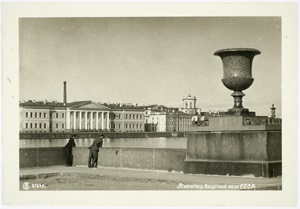
Due to its status as the capital after 1712, St Petersburg became home to important cultural and educational institutions. With the founding of the Academy of Sciences in 1725 – conceived by Peter I and opened under Catherine I – numerous eminent scholars from German-speaking regions came to the city.[5] The famous naturalist Johann Georg Gmelin (1709–1755), originally from Tübingen, and the eminent historian Gerhard Friedrich Müller (1705–1783), born in Herford, Westphalia, are prime examples of this. In 1727, the first typesetters and printers from the German states travelled to St Petersburg, where they expanded the academic printing works. The German and Swiss scholars soon trained a new generation of Russian academics, but retained a significant position in the city’s academic life throughout the 18th and early 19th centuries. German-speaking tutors and private schools prepared, above all, the sons of the nobility for university studies and civil service.
Alongside the Academy of Sciences with its historic buildings on the Neva, Peter I’s Kunstkammer is also worth mentioning, as is the Academy of Arts, founded in 1755. In addition to a university affiliated with the Academy, which was not particularly thriving, an imperial teacher-training institute had existed since 1787, and an independent university was established in 1819. During the 19th century, a whole series of technical and medical Institutes were established, which were expanded upon during the Soviet era and, after 1991, some of which were granted university status. In the 19th century, the city attracted numerous German-Baltic students who wished to pursue careers within the imperial administration. St Petersburg remains a city of students to this day.
There is a historically established landscape of leading cultural institutions: These include the National Library, founded in 1795, and the first building of the Mariinsky Theatre, constructed during the reign (1742–1761) of Elizabeth (1709–1761). In the 19th century, German theatre companies also performed on the city’s stages and at the Small Opera House on a temporary basis. The Hermitage (Ėrmitaž), the art collection founded during the reign of Catherine II, which today comprises the Old and New Hermitage as well as the entire Winter Palace, and theState Russian Museum (Gosudarstvennyj Russkij muzej) in St Michael’s Palace house collections of international renown.
The first German school, which gained considerable renown in the 18th and 19th centuries, was established as part of the St Peter’s parish. In 1912, the St Peter’s School had around 1,600 pupils, of whom about 25 per cent were Russian. Until then, it had been partly funded by the German Lutheran congregation of the nearby St Peter’s Church. As tensions between Russia and Germany escalated at the start of the First World War, the school’s language of instruction was forcibly changed from German to Russian. Although the German language remained one of the school’s key focuses, numerous teachers and pupils were forced to leave the school as a result of the change. During the Soviet era, the Petrischule was renamed, but it regained its historic name in 1996. Today, it has around 500 pupils. The Petrischule became the starting point for a diverse and extensive German-speaking school system comprising primary and secondary schools, which largely disappeared following the October Revolution.
German-language press
The German-language *Sankt Petersburgische Zeitung* is the oldest newspaper in St Petersburg and the second oldest in the whole of Russia (after the *Vedemosti*); it was founded as a weekly. From 1831 onwards, it was published as a daily newspaper. Until 1874, it was owned by the Russian Academy of Sciences, and thereafter by the Ministry of Public Education. Both institutions leased out the newspaper: under the editorship (1852–1874) of Court Councillor Friedrich Clemens Meyer von Waldeck (1824–1899), the newspaper was modernised. In 1878, it was leased to the German-Baltic journalist Paul von Kügelgen (1843–1904). The newspaper now became the leading German-language publication for the educated classes in the Baltic region. After his death, his sons Paul Siegwart von Kügelgen (1875–1952) and Carlo von Kügelgen (1876–1945) continued to run the paper.
At the turn of the year 1914/1915, the Sankt Petersburgische Zeitung ceased publication. Among its rival newspapers in the late 19th century was the Sankt Petersburger Herold. The St. Petersburgische Zeitung has been published monthly since 1991 with a circulation of around 7,000 copies. It is a bilingual publication aimed at tourists, businesspeople, Russian-Germans and St Petersburg residents with an interest in Germany.
Culture of memory and remembrance
In the culture of memory and remembrance, suffering and oppression are, on the one hand, associated with the Germans. The siege by German troops and their allies, which lasted almost 900 days during the Second World War, is a central part of this remembrance, yet has not yet found a fitting place in the city’s museum landscape.
The memory of the Germans of St Petersburg, by contrast, is predominantly positive. Their contributions to the Russian Empire, in the economy and society is honoured, as reflected, for example, in the re-consecration of St Peter’s Church on Nevsky Prospekt and St Anne’s Church on Kirochnaya Street, where there is also space for thematically relevant temporary exhibitions. Having been erased from the city’s history during the Soviet era, particularly after the Second World War, the Germans made a return, as it were, in the wake of the rich literary output marking the city’s 300th anniversary. Since the 1990s, academic conferences on ‘Germans in St Petersburg’ have been held regularly, organised by Russian academics. They are thus integrated into a broader imperial narrative about Saint Petersburg, which, on the one hand, emphasises the city’s multi-ethnic and multi-confessional past, whilst at the same time reinforcing the tendency to incorporate everything that has contributed to Russia’s grandeur into an all-Russian national narrative. This also includes the city’s ethnic groups, whose historic centre has been a UNESCO World Heritage Site since 1990.
Bibliography
- Pëtr E. Bucharkin (ed.): Triveka Sankt-Peterburga. Ėnciklopedija v trechtomach [Three Centuries of St Petersburg. An Encyclopaedia in Three Volumes]. St Petersburg 2001 onwards.
- Margarete Busch: Germans in St Petersburg 1865–1914. Identity and Integration. Essen 1995.
- Irina B. Čerkaz’janova: Leningradskie nemcy. Cud’ba voennych pokolenij [Germans in Leningrad. The Fate of the War Generations]. St Petersburg 2011.
- Dittmar Dahlmann, Klaus Heller, Tamara Igumnova, Yuri A. Petrov, Kai Reschke (eds.): ‘A Great Future: Germans in Russia’s Economy’. Exhibition catalogue, German and Russian editions. Berlin 2000.
- Erich Donnert: St Petersburg. A Cultural History. Cologne et al. 2002.
- Jörg Ganzenmüller: Leningrad under Siege 1941–1944. A City in the Strategies of Attackers and Defenders. Paderborn 2005.
- Peter Hoffmann: St Petersburg. City and Port in the 18th Century. Berlin 2003.
- Natalija V. Juchneva: The Ethnic Composition and Ethno-Social Structure of the Population of St Petersburg. Second half of the 19th – early 20th centuries. Statistical analysis [Ethnic Composition and Ethno-Social Structure of the Population of St Petersburg. Second half of the 19th century – beginning of the 20th century. Statistical Analysis]. Leningrad 1984.
- Valentin M. Koval’čuk (ed.): Saint Petersburg. 300 Years of History [Saint Petersburg. 300 Years of History]. Saint Petersburg 2003.
- Jan Kusber: A Brief History of St Petersburg. Regensburg 2009.
- W. Bruce Lincoln: *Sunlight at Midnight: St Petersburg and the Rise of Modern Russia*. New York 2002.
- Ute Schneider: The St Petersburg Newspaper in the Years 1888–1913. A Source on the Book and Library Sector in St Petersburg at the Turn of the Century. In: Gutenberg Yearbook 1988, pp. 359–377.
- Karl Schlögel, Frithjof Benjamin Schenk, Markus Ackeret (eds.): St Petersburg. Scenes from a City’s History. Frankfurt am Main 2007.
- Karl Schlögel: St Petersburg. The Laboratory of Modernity 1909–1921. 3rd ed. Frankfurt am Main 2009.
Web link
- www.herder-institut.de/bildkatalog/index/index?tree[Orte]=27679&with_picture=0&newperspective=thumbnails (Images of Saint Petersburg/Sankt-Peterburg in the Herder Institute’s image archive, Marburg)
Notes
[1] See also the following: Gerd Stricker (ed.): Russia. Berlin 1997 (German History in Eastern Europe), pp. 36–42; Kusber: A Brief History, pp. 16–25.
[2] Revunenkova et al. (eds.): Mnogonacional’nyj Peterburg. Istorija, Religija [Multinational St Petersburg. History, Religion]. St Petersburg 2002, pp. 26ff.
[3] 2010 census at: www.gks.ru/free_doc/new_site/perepis2010/croc/Documents/Vol1/pub-01-05.pdf (accessed 2 November 2014); for (approximate) figures for the 18th and 19th centuries, see Semenova: *Byt’ i naselenie Sankt-Peterburga (XVIII vek)* [Everyday Life and the Population of St Petersburg (18th Century)]. Moscow, St Petersburg 1998, pp. 36–49 and passim; Revunenkova et al. (eds.): *Mnogonacional’nyj Peterburg* [Multinational St Petersburg] (note 2), p. 23, 56, 183–185. For the 20th century, see: Thomas Bohn: St. Petersburg/Leningrad – A Peasant Metropolis and Industrial City. In: Helmuth Hubel, Joachim von Puttkamer, Ulrich Steltner (eds.): A European Russia or Russia in Europe? – 300 Years of St Petersburg. Baden-Baden 2004 (Jena Contributions to Political Science 9), pp. 125–140, here pp. 127f.
[4] Revunenkova (ed.): *Mnogonacional’nyj Peterburg* [Multinational St Petersburg] (note 2), pp. 84–88.
[5] See, for example, Peer Hempel: German-speaking physicists in old St Petersburg. Georg Parrot, Emil Lenz and Moritz Jacobi in the context of science and politics. Munich 1999 (Publications of the Federal Institute for East German Culture and History 14).
Citation
Jan Kusber: Saint Petersburg/Saint-Peterburg. In: Online Encyclopaedia on the Culture and History of Germans in Eastern Europe, 2015. URL: ome-lexikon.uni-oldenburg.de/p32260 (as at 18 March 2015).
Terms of use for this article
Copyright © University of Oldenburg and the Federal Institute for the Culture and History of Germans in Eastern Europe (BKGE), all rights reserved. This work was produced as part of the project ‘Online Encyclopaedia on the Culture and History of Germans in Eastern Europe’ and may be reproduced and published provided the rights holders’ consent has been obtained. Please contact:
If you have any specialist comments or additions to the text, please contact the editorial team, citing relevant literature and source references.