

Moscow/Moskva
Moscow/Moskva
Location
Moscow is situated in the centre of the European part of the Russian Federation, between the Oka and Volga rivers (55° 45″ north latitude, 37° 37″ east longitude).
General History
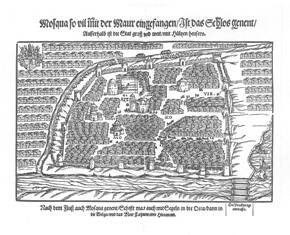
Map of the city of Moscow dating from 1517.
[Sigmund von Herbertstein: *Description of Moscow
, the capital of Russia, together with the Muscovite
territory*, 1557, selected and introduced by B. Picard,
Graz et al., 1966.]

Moscow was first mentioned in writing in 1147, when Prince Yuri Dolgoruky had a fortress built on the banks of the River Moskva. In 1237–1238, Moscow was sacked by the troops of Khan Batu. From the second half of the 13th century, it was the centre of the independent Principality of Moscow. In 1326, the seat of the Metropolitans of the Russian Orthodox Church was moved to Moscow. Under Prince Dmitry Donskoy, it became a centre for organising the struggle against the yoke of the Golden Horde. From the 14th century until the first half of the 15th century, Moscow developed into a major trading centre of Russia, attracting merchants from Western Europe. It became the capital of the Russian state at the end of the 15th century, during the reign of Ivan the Great (1462–1505). Following the relocation of the capital of the Russian state to Saint Petersburg (1712), Moscow retained its status as the country’s economic and cultural centre. From 1918, it was the capital of the RSFSR, and from 1922, of the USSR.
The origins and development of the German colony up to the mid-19th century
The first settlements of foreigners in Moscow were established at the end of the 15th century under the reign of Tsar Ivan III (1462–1505). These so-called colonies were home mainly to foreign master craftsmen, merchants and military specialists. Under Vasily III (1505–1533), a special suburb in Zamoskvorechye was also established for foreign military personnel, which was given the name ‘Nalej’ or ‘Nalejka’. The Tsar’s personal bodyguard, consisting of Lithuanians, Poles and Germans, was stationed there.[1] The first settlement of foreigners to be relocated entirely outside the city limits of Moscow was established in the 1560s under Ivan IV, known as ‘the Terrible’ (1533–1584), when, in the wake of the Livonian War (1558–1583), there was an increased influx into Moscow of prisoners of war from the Baltic region and also of foreigners who had been taken into the Tsar’s service.[2] At that time, small military units were formed, led by captains and organised according to national origin (Danes, Scots, Germans, Swedes, etc.). The foreigners were allocated a specific area on the opposite bank of the Yauza River, which came to be known as the ‘Foreigners’ Quarter’ (Inozemskaya) or the ‘German Suburb’ (Nemeckaya sloboda). The suburb was established in the Zamoskvoreč’e district, just two versts from the Kremlin. By the end of the 1570s, some 4,000 people were already living in the German Suburb. The adjective ‘German’ in the name of the suburb did not refer specifically to people of German origin, but to all foreigners.[3] In the winter of 1578, the German Suburb was plundered by the Tsar’s oprichniki; the houses and churches were destroyed and some of its inhabitants (around 400 people) were killed. The destruction of the suburb was linked to setbacks on the Livonian front, but also to suspected spies in the suburb. Under Boris Godunov (1598–1605), the number of Germans and other Europeans in the Moscow armed forces stood at 2,500. During the ‘Time of Troubles’ (1598–1613), German ‘soldiers’ took part in hostilities, fighting on the side of both the government forces and the ‘usurpers’. In 1610, the new foreigners’ suburb was destroyed by fire during the Polish attack on Moscow. During this period, the number of German soldiers fell sharply. Some of them were killed in action, whilst others left Russia because their pay had not been settled. Despite all the turmoil, some of the Germans remained in the Russian capital.
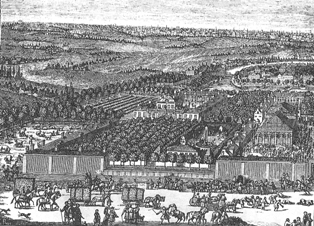
View of F. Golovin’s estate in the Lefortovo district (
) and the German Suburb. [Engraving by A.
Shoonebeck, 1705. *Moskovskie nemcy – četyre veka s
Rossiej*, Moscow 1999]

From the 1630s onwards, the number of foreigners, particularly Germans, increased; they had been invited on the initiative of Patriarch Filaret, the father of Tsar Mikhail Fedorovich (1613–1645). With the establishment of new foreign troops, in which German military officers held command posts, the Moscow authorities began to recruit soldiers on a contractual basis from ‘German lands’ (1631–1634). On 4 October 1652, Alexei Mikhailovich (1645–1676), the father of Peter I, ordered all those of Western European origin to be resettled outside the city limits of Moscow into the former foreigners’ suburb; which was now known as the ‘New German Quarter’ or simply the ‘German Quarter’. The reign of Peter I (1682–1725) was characterised, as far as the German Suburb was concerned, less by an influx of “foreign servants” than by a noticeable increase in the number of master craftsmen and members of other professions. Peter I’s manifesto of 16 April 1702 played an important role in this, inviting foreigners to Russia for both public service and private enterprise. The manifesto guaranteed foreigners freedom of religion and the right to enter and leave the Russian state freely.[4] From 1719 onwards, the inhabitants of the German Suburb were officially included in Moscow’s total population. From the mid-18th century, members of the foreign intelligentsia (teachers, doctors, technical specialists, etc.) moved from the German Suburb to various districts of Moscow. Towards the end of the 18th century, the area of the German Suburb gradually transformed into an aristocratic district of Moscow, inhabited not only by foreign master craftsmen of various nationalities, but also by Russian merchants and nobles. By 1840, the number of German-speaking residents in Moscow had already exceeded 5,000. This represented 1.5 per cent of the total population of the old capital.
Population (19th/20th centuries)
According to the 1882 Moscow census, the city had a population of 753,500, and only slightly more than a quarter (26.2 per cent) of these were people born in Moscow. According to the first All-Russian Census (January 1897), 1,038,600 people lived in Moscow, of whom only 272,600 were native to the city. According to the municipal census of 31 January 1902, 1,175,000 people lived in Moscow; according to the census in February 1907, the figure was 1,346,000, and the census of 6 March 1912 recorded as many as 1,618,000 people. In November 1915, Moscow’s population reached 1,984,000 (by which time it already ranked sixth amongst European cities). At the beginning of the 1870s, Moscow’s population was relatively homogeneous in terms of ethnicity: the central authorities made every effort to prevent ‘foreigners’ (inorodcy) from entering Moscow. According to the 1871 census, 95.6 per cent of the city’s population were Russians, whilst the proportion of all other nationalities amounted to just 4.4 per cent. Of the non-Russian population, the largest group (1.8 per cent) were Germans; 0.9 per cent were Jews, 0.6 per cent Poles, 0.3 per cent French, 0.2 per cent Tatars and 0.1 per cent Armenians. According to the censuses of 1882–1912, the percentage of Russians in the city’s population remained, as before, at just over 95 per cent. The 1897 census revealed an influx of Ukrainians and Belarusians, but their numbers had fallen considerably by 1912 due to rapid assimilation. According to the 1912 census, too, Germans remained in second place, although their percentage of the capital’s population was steadily declining. Poles were in third place, Tatars in fourth, and Jews in fifth.
Table 1[5]
Population structure of Moscow 1871–1939 by nationality (as a percentage of the total population) | ||||||||||
Nationalities | 1871 | 1882 | 1897 | 1902 | 1912 | 1920 | ||||
Russians | 95.6 | 94.5 | 95.0 | 95.3 | 95.2[6] | 84.8 | ||||
Ukrainians | no data | No data | 0.4 | 0.1 | 0.2 | 0.2 | ||||
Belarusians | No data | No data | 0.1 | 0.0 | - | 0.3 | ||||
German | 1.82 | 2.01 | 1.7[7] | 1.62 | 1.3[8] | 0.6 | ||||
Jews | 0.94 | 1.6 | 0.5 | 0.4 | 0.4 | 2.7 | ||||
Poland | 0.6 | 0.6 | 0.9 | 0.9 | 1.1 | 1.4 | ||||
French | 0.34 | 0.3 | 0.2 | 0.2 | 0.2 | 0.0 | ||||
Tatars | 0.15 | 0.2 | 0.4 | 0.5 | 0.6 | 0.2 | ||||
Armenians | 0.1 | 0.1 | 0.2 | 0.2 | 0.2 | 0.2 | ||||
Latvians | 0.03 | 0.0 | 0.0 | 0.0 | 0.2 | 0.9 | ||||
Other | 0.4 | 0.7 | 0.6 | 0.8 | 0.8 | 8.7[9] | ||||
Nationalities | 1923 | 1926 | 1933 | 1937 | 1939 | |||||
Russians | 87.2 | 87.8 | 87.5 | 87.4 | 87.4 | |||||
Ukrainians | 0.4 | 0.8 | 1.5 | 1.8 | 2.2 | |||||
Belarusians | 0.2 | 0.7 | 0.6 | 0.6 | 0.6 | |||||
German | 0.5 | 0.4 | 0.3 | 0.3 | 0.2 | |||||
Jews | 5.6 | 6.5 | 6.6 | 6.2 | 6.0 | |||||
Poland | 1.2 | 0.9 | 0.6 | 0.5 | 0.3 | |||||
French | 0.0 | 0.0 | 0.0 | No data | No data | |||||
Tatars | 0.8 | 0.9 | 1.0 | 1.3 | 1.4 | |||||
Armenians | 0.3 | 0.3 | 0.3 | 0.4 | 0.3 | |||||
Latvia | 0.6 | 0.5 | 0.4 | 0.3 | 0.2 | |||||
Other | 3.2 | 1.2 | 1.2 | 1.2 | 1.4 | |||||
The October Revolution of 1917 marked a turning point in the history of the Russian state. Owing to emigration, deportation, conscription into the army and participation in the civil war, the number of Germans in Moscow fell to less than a third of its pre-war level. Whilst some 20,000 Russian citizens of German descent had lived in the city before the First World War, the 1926 census recorded only 8,600.
Religious composition of the German-speaking population
According to the 1882 census, Moscow’s Orthodox population accounted for almost 94 per cent of the total population; the other religious communities accounted for just 6 per cent. Among the Germans, Protestants (Lutherans and Reformed) were in the majority throughout the entire period under review. Whilst their proportion stood at 86.8 per cent in 1871, by 1902 it had risen to 89.4 per cent (see Table 2). At the same time, the proportion of German Catholics fell slightly from 9.4 per cent (1871) to 7.1 per cent (1902). The proportion of Orthodox Germans fell by almost half, from 3.8 per cent (1871) to 1.97 per cent (1902).
Table 2[10]
German-speaking population by denomination, 1871–1902 | ||||||
Year | Protestants | Roman Catholics | Orthodox | |||
Absolute | as a percentage | Absolute | as a percentage | absolute | as a percentage | |
1871 | 9,099 | 86.8 | 990 | 9.4 | 396 | 3.8 |
1,897 | 15,403 | 88.7 | 1,201 | 6.9 | 417 | 2.4 |
1,902 | 15,810 | 89.4 | 1,259 | 7.1 | 349 | 1.97 |
Stand layout
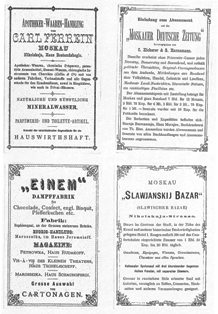
German-language advertising in Moscow
at the end of the 19th century.
[P. Grossman, J. Knöbel: Guide to
Moscow and the Surrounding Area, Moscow 1882.]

According to the social classification of the Germans in Moscow (based on the 1871 census), the proportion of the aristocratic upper class in 1871 was 14.6 per cent. Of these, 6.3 per cent belonged to the hereditary nobility. In Moscow, which was regarded as the country’s most important commercial centre, the proportion of the non-noble upper class – comprising merchants and honorary citizens – was significantly higher (17.7 per cent) amongst the German community in Moscow than in St Petersburg, where it stood at only 10.3 per cent. At one-fifth, the proportion of the German middle class – the so-called petty bourgeoisie or urban middle class – was very high. If one examines the social structure of the German-speaking community in relation to the total population of Moscow (according to the 1897 census), it becomes apparent that the German-speaking nobility (5.4 per cent), honorary citizens (5.43 per cent) and merchants (5.12 per cent) were relatively well represented amongst the upper echelons of Moscow society.
Table 3[11]
Proportion of German-speaking residents in all social classes within the total population of Moscow in 1897 | ||||||||
Hereditary nobility | Personal nobility | Honorary citizens | Merchants | |||||
abs. | as a % | abs. | as a percentage | abs. | in % | abs. | as a percentage | |
German | 822 | 2.36 | 997 | 3.04 | 1,145 | 5.43 | 989 | 5.12 |
Total population | 34,780 | 100 | 32,762 | 100 | 21,101 | 100 | 19,307 | 100 |
townspeople | Peasants | Foreigners | Total | |||||
abs. | as a % | abs. | as a percentage | abs. | in % | abs. | as a percentage | |
German | 5,815 | 2.6 | 1,006 | 0.16 | 6,093 | 45.7 | 17,358 | 1.78 |
Total population | 218,104 | 100 | 614,459 | 100 | 13,318 | 100 | 978,537 | 10 |
Educational and occupational structure
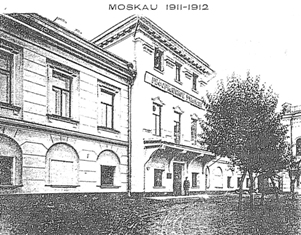
The Reformed School building (1911–1912). *
* [*Moskovskie nemcy – četyre veka s
Rossiej*, Moscow 1999]

At the time of the 1897 census, 57.1 per cent of Moscow’s population could read and write. The proportion of literate people amongst Moscow’s German-speaking population was over 88 per cent. According to the 1897 census, the largest groups within the German-speaking diaspora were employed in the manufacturing sector (26.4 per cent), the trade and finance sector (21.0 per cent) and the liberal professions (14.8 per cent). A fairly large proportion of people were self-employed (14.8%) or lived off their investment income (8.8%). The German-speaking diaspora in Moscow was disproportionately well represented in fields such as medicine, science, the arts, education and teaching.
Church
As part of the establishment of permanent settlements for foreigners, the first Lutheran congregation in Russia was founded in Moscow, with its origins dating back to 1559. Lutheran parish life in Moscow took its final form in 1576 during the reign of Ivan IV (1533–1584) with the construction of the city’s first Lutheran church. In the mid-1630s, this church was named St Michael’s in honour of Tsar Mikhail Fedorovich’s patron saint. In the early 1640s, officers built their own church in the Petrovka Street area, which shortly afterwards was named St Peter and Paul’s Church. In November 1904, the new St John’s congregation was founded.
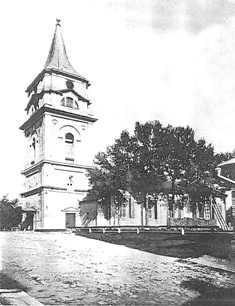
The Evangelical Lutheran St Michael’s Church.
[G. Stricker (ed.): Russia. Berlin
, 1997 (German History in the
East of Europe)].

The pastors of the city’s Protestant parishes were outstanding figures who left a significant mark not only on the history of Moscow but also on Russian intellectual life as a whole. For example, in 1565 Johann Wettermann systematised and catalogued Tsar Ivan IV’s famous library, whilst Johann Gregorii founded the first Russian theatre P.p. for Tsar Alexei Mikhailovich. Pastor Ernst Glück became renowned for the grammar school he founded in 1703 and for his translations of the Bible into Latvian (1685–1689) and Russian (1699–1705). Provost Benjamin Heidecke distinguished himself not only as a translator and author of textbooks, but also as the editor of the journals *Russischer Merkur* (Riga) and *Konstantinopel und St. Petersburg, der Orient und der Norden* (St Petersburg), which were very popular in educated Russian circles. Senior Pastor Heinrich von Dieckhoff was instrumental in establishing the first schools for deaf-mute (1860) and blind (1882) children in Russia.[12] The dissolution of the German colony in Moscow, as well as the Protestant congregation at its heart, began with the decree on the separation of church and state of 23 January 1918, which laid the foundations for widespread discrimination against believers in the USSR. Not only were the plots of land, church and school buildings and vicarages belonging to the Protestant congregations in Moscow declared state property, but so too were the charitable institutions. Fearing state persecution, some members of the congregation stopped attending services or even becoming involved in church life. According to the financial report of the Petri-Pauli Church, there were only 1,642 registered Lutherans left in 1928. The repression against German pastors in Moscow, which began in the mid-1930s, led not only to the closure of the Evangelical Lutheran churches in the Russian capital, but also to the complete dissolution of their congregations. In 1991, the Evangelical Lutheran Petri-Pauli congregation in Moscow was re-established.
Society
Immediately after the outbreak of hostilities against Germany in the First World War, the Russian authorities placed the German population living on their territory under special surveillance. The anti-German campaigns were not limited to political repression, but also included discrimination on the grounds of language and religion, a de facto ban on cultural, educational and economic activities, expropriations based on nationality, and so on. These measures were directed not only against nationals of the enemy states, Germany and Austria-Hungary, but also against Russian citizens of German descent.
In 1915, a large-scale campaign of the ‘struggle against German supremacy’ was launched in Moscow, in the course of which the Germans of Moscow were removed from the representative bodies of the business community. Shortly afterwards, most German companies were placed under government control. Numerous cases have been recorded in which Germans living in Moscow, including those with Russian citizenship, were arrested or deported solely on the basis of a mere suspicion of espionage.

Public gathering before the pogrom (28 May 1915) at the
Minin-Pozharsky Monument on Red Square.
[S. A. Ryabichenko: Tri dnja iz žizni neizvestnoj Moskvy.
Pogromy 1915 g, Moscow 2000]
Inspired by decisions from higher authorities, fuelled by regular anti-German outbursts in the press and encouraged by representatives of the local administration, residents of Moscow gathered in mobs from 27 to 29 May 1915 and ransacked the city’s German shops and factories – according to various sources, 732 premises: shops, warehouses, offices and even private homes. The damage to property amounted to over 50 million roubles. The pogroms, looting and arson in the city were only brought to a halt with the help of regular troops, who arrived in Moscow on the morning of 29 May.
The pogroms of May 1915 accelerated the process of liquidation of German commercial and industrial enterprises in the city and throughout the governorate. Only a handful of German companies managed to survive the war years. At the same time, the vast majority of their owners, managers and technical staff were forced to leave Moscow.
The final chapter in the centuries-long history of the German colony in Moscow was written by the Special Decree of the State Defence Committee of the USSR on the deportation of citizens of German nationality from Moscow and the Moscow region, dated 6 September 1941.[13] By 19 September 1941, of the 5,500 Muscovites of German descent tracked down by the NKVD (political immigrants were not included in this figure), 3,524 were deported in three convoys to the Karaganda region (Kazakh SSR).[14]
Bibliography
- Victor Dönninghaus: The Germans in Moscow Society: Symbiosis and Conflicts (1494–1941). Munich 2002 (Publications of the Federal Institute for Culture and History of the Germans in Eastern Europe 18).
- Vera A. Kovrigina: Nemeckaja sloboda Moskvy i ee žiteli v konce XVII – pervoj četverti XVIII veka [The German Suburb of Moscow and its Inhabitants from the End of the 17th to the First Quarter of the 18th Century]. Moscow 1998.
- Erich Franz Sommer: The Germans in Moscow and St Petersburg. In: Boris Meissner, Helmut Neubauer, Alfred Eisfeld (eds.): The Russian Germans. Yesterday and Today. Cologne 1992 (Nationality and Regional Problems in Eastern Europe 6), pp. 127–141.
Notes
[1] Sigismund von Herberstein: Description of Moscow, the Capital of Russia, together with the Muscovite Territory, 1557. Selection and introduction by B. Picard. Graz et al. 1966, pp. 167ff.
[2] Conrad Bussow: The Time of Troubles. A Muscovite Chronicle of the Years 1584 to 1613. Berlin, Leipzig 1991, pp. 33ff.; Sommer: The Germans in Moscow and St Petersburg, pp. 128ff.
[3] Ju. P. Miklaševskaja, M. S. Cepljaeva (eds.): Lefortovo. A German Settlement in Moscow. Moscow 1995, p. 9.
[4] Margarete Busch: Germans in St Petersburg 1865–1914. Identity and Integration. Essen 1995, p. 17.
[5] I. N. Gavrilova: Demografičeskaja istorija Moskvy [The Demographic History of Moscow]. Moscow 1997, pp. 277ff.; M. Ja. Vydro: The Population of Moscow (based on the censuses of 1871–1970). Moscow 1976, p. 30.
[6] Belarusians are included in the Russian population figures for 1912.
[7] It appears that the population of the Moscow suburbs was included in this calculation (1.8 per cent according to our figures).
[8] The calculations were apparently carried out with regard to the total population, including the Moscow suburbs. According to my own calculations, the proportion of the German-speaking population in the urban outskirts in 1912 was approximately 1.96 per cent.
[9] This mainly includes people who did not specify their nationality.
[10] Calculated on the basis of: *Statističeskie svedenija o žiteljach g. Moskvy po perepisi 12 dekabrja 1871 goda* [Statistical data on the inhabitants of Moscow according to the census of 12 December 1871]. Moscow 1874, pp. 35–47; First General Census of the Population of the Russian Empire, 1897, vol. XXIV. City of Moscow. Volume 2, Part 2 [The First All-Russian Census of 1897. Vol. 24: The City of Moscow. Part 2]. Moscow 1904, pp. 66–69; The 1882 Moscow Census. Issue III [The 1882 Moscow Census. Issue 3]. Moscow 1885, pp. 222–225.
[11] Calculated from: Pervaja Vseobščaja perepis’ (note 10), pp. 246ff.
[12] Dönninghaus: The Germans, pp. 146ff.
[13] “Mobilise the Germans into labour columns… I. Stalin”. Sbornik dokumentov (1940-e gody) [“Mobilise the Germans into labour columns… I. Stalin”. Collected Documents (1940s)]. Compiled by N. F. Bugaj. Moscow 1998, p. 26.
[14] Alfred Eisfeld, Victor Herdt (eds.): Deportation, Special Settlement, Labour Army: Germans in the Soviet Union 1941 to 1956. Cologne 1996 (Publication of the Göttingen Working Group 453), p. 86.
Citation
Victor Dönninghaus: Moscow/Moskva. In: Online Encyclopaedia on the Culture and History of Germans in Eastern Europe, 2012. URL: ome-lexikon.uni-oldenburg.de/54335.html (as at 12 May 2015).
Terms of use for this article
Copyright © University of Oldenburg and the Federal Institute for the Culture and History of Germans in Eastern Europe (BKGE), all rights reserved. This work was produced as part of the project ‘Online Encyclopaedia on the Culture and History of Germans in Eastern Europe’ and may be reproduced and published provided the rights holders’ consent has been obtained. Please contact:
If you have any specialist comments or additions to the text, please contact the editorial team, citing relevant literature and source references.