

Odessa/Odesa
Odessa/Odesa
Etymology
The origin of the city’s name can be traced back to the Greek settlement of Odessos, which is thought to have been situated near the Bulgarian city of Varna. Another theory attributes the city’s name to the problems with the drinking water supply during its early days. According to this account, the city’s founder, Tsarina Catherine the Great (1729–1796), ordered that the French expression ‘assez d’eau’ (enough water) be read backwards and that the city be named accordingly.[1] The British writer Shirley Brooks, however, writes: “Her Majesty deigned to name the place ‘Au dessus’, but it has since taken on a more Italian-sounding name.”[2]
Topography
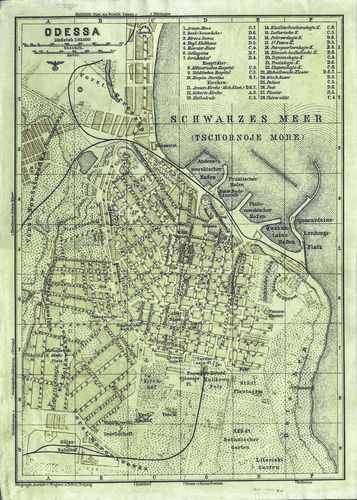
Odessa lies on the bay of the same name (Odesskyj zaliv) in the Black Sea. Large parts of the city are situated on a high plateau, which lies some 40 metres above sea level. The city is surrounded by a dry steppe landscape. The main source of water is the Dniester (an aqueduct approximately 40 km long).
Political and administrative affiliation
Ukraine. Odessa is the capital of the Odessa Oblast (Odess’ka oblast’) and the seat of the regional administration. The city is currently divided into four districts (Primorskyj, Kiïvs’kyj, Malinovs’kyj and Surovs’kyj).
Common symbolism
Common or historical nicknames
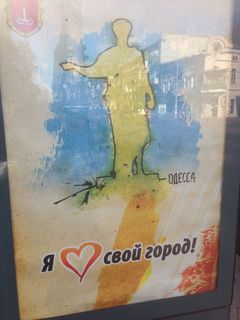
Odessa is not just the name of a city; it also embodies a myth that brings expectations and imaginings to life.[3] Its numerous nicknames are an expression of the city’s very special ‘cosmopolitan localism’[4], its significance for the Russian Empire, or they refer to its inhabitants or its geographical location: ‘Odessa-Mama’, ‘Palmyra of the South’ (an allusion to Saint Petersburg as the ‘Palmyra of the North’), ‘Pearl by the Sea’, ‘Russian Italy’, ‘Russia’s most liberal city’, ‘Capital of Southern Russia’, ‘Best City of New Russia’, ‘Most Beautiful Pearl in the Russian Crown’, ‘Cheerful Capital on the Black Sea’, ‘Southern Gateway to Europe’ (a reference to Saint Petersburg/Leningrad as the ‘Gateway to Europe’), ‘Golden City’, ‘City of Speculators and Musicians’, ‘Capital of Yiddish and Hebrew Literature’. After the Second World War, Odessa was awarded the honorary title of ‘City of Heroes’.
Origins
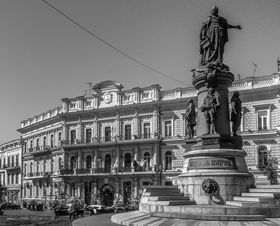
Odessa was founded at the end of the 18th century (1794) by Tsarina Catherine the Great, along with other towns in the region, to underpin the Tsarist Empire’s claim to the New Russian territories on the Black Sea, which had previously been wrested from the Ottoman Empire during the so-called Turkish Wars. Initially, the name of the conquered Ottoman fortress, Chadžibej (Turkish: Hacıbey), was retained; the name Odessa was first used in January 1795. Excavations have provided evidence that a Greek settlement had once stood on the site of the city. In its early years, the city was characterised in particular by foreigners, who rendered great services to its rapid development and whose presence is still evident in the cityscape today through monuments and street names. Catherine, who was of German descent, appointed the Spanish-born José de Ribas (1749–1800), who was born in Naples, as governor; together with the Dutch architect and engineer Frans de Wollant (1752–1818) laid the foundations for the rise of the ‘Pearl of the Sea’.
“Golden Age”
With the accession of Tsar Alexander I (1777–1825) in 1801, Odessa’s ‘Golden Age’ began. The city owes its rise in particular to the French Duke Armand Emmanuel des Plessis, Duke of Richelieu (1766–1822), who guided Odessa’s fortunes from 1803 to 1814. De Richelieu secured numerous concessions and financial support for the city; the importance of the port and trade (particularly the grain trade) grew, and Odessa was able to prevail over its rivals Chersson/Cherson, Očakiv and Mykolajiu/Mykolaïv. The city effectively became the administrative centre of New Russia. The city’s leader permitted all denominations to erect religious buildings, thereby contributing significantly to the climate of tolerance in Odessa. Odessa was regarded as particularly European and thus became increasingly popular amongst the local upper classes of the Tsarist Empire as the ‘Russian Italy’. During the tenure of Mikhail Vorontsov (1782–1856) from 1823 to 1846, Odessa – which by 1850 was the wealthiest city in the Russian Empire – underwent impressive development, particularly in economic terms.
‘The Silver Age’
The city’s ‘Silver Age’ began around 1860 with the major reforms of Alexander II (1818–1881). The new liberal way of life and mindset in Russia seemed to render Odessa superfluous. On the other hand, following the emancipation of the serfs, more and more people flocked to the mythical ‘Golden City’, yet there was little demand for their labour during the economic crisis that followed the Crimean War (1853–1856). Thus, Odessa found itself confronted with widespread poverty for the first time.
20th century
During the revolutionary upheavals of 1905, Odessa was also the scene of clashes between opponents and supporters of the old order. The mutiny by the crew of the armoured cruiser Potemkin, which was moored in the port of Odessa, is well known. Amidst the turmoil of the First World War, the October Revolution and the Civil War, the city endured several changes of power and suffered a significant decline in population before the Red Army was able to prevail in 1920 and Odessa became part of the Ukrainian Soviet Socialist Republic.
Following the German invasion of the Soviet Union in June 1941, the city was successfully defended for 73 days, from August to October. The German-Romanian occupation began on 16 October 1941 and ended on 10 April 1944. Odessa was part of the Romanian administrative region of Transnistria and was intended to become part of Romania in the long term. The Romanian occupation regime was therefore comparatively lenient towards the non-Jewish population (schools, universities and theatres remained open). War damage in Odessa was not as devastating as in other Ukrainian cities. Following the occupation, the city served as the regional administrative centre of the Ukrainian Soviet Republic and has belonged to Ukraine since the break-up of the Soviet Union in 1991. During the years of transition, the city underwent political, economic and social reorganisation. It has been twinned with Regensburg since 1990.
Economy and Transport
Odessa is, above all, a trading city. Its rise was largely due to the grain trade, which remained firmly in Greek hands until around 1860. With increasing poverty in the second half of the 19th century, the cliché of the ‘accidental city’ began to circulate, coined by envious voices in the region and the Russian capital. Odessa, it was claimed, had been artificially conjured out of thin air and owed its rise solely to favourable circumstances, such as its status as a free port (until 1859). The city was said to lack substance; it lived at the expense of others and should finally become ‘truly Russian’. The connection to the railway network (1865) was slow to materialise and ultimately failed to bring about the hoped-for economic revival.
Odess’s seaport is the largest in Ukraine and remains a major employer to this day. In recent years, many unprofitable industrial enterprises have had to close, which, on the other hand, has had a positive impact on the environment – particularly water quality – and thus on Odessa’s status as one of Ukraine’s most important tourist centres and one of its leading health resorts.
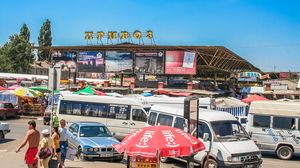
Alongside the accommodation and catering sectors, the retail sector in particular plays a major role: The ‘Seventh Kilometre’ on the outskirts of the city is one of the largest markets in Eastern Europe; the ‘Privoz’ food market has been situated in the city centre since the late 18th century; and the streets around the ‘Old Horse Market’ are transformed into a huge flea market at weekends; the ‘New Market’ is one of the oldest in the city. In spring 2013, the European Commission gave the go-ahead for the payment of funding to extend the Odessa–Brody pipeline as far as Płock in Poland.
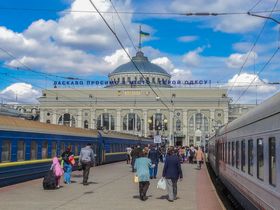
As well as its imposing railway station, Odessa has an international coach station and a small airport. The local public transport network is well developed. As in all major cities of the former Soviet Union, private shared taxis (maršrutki) play a significant role as a means of local transport.
Society and Demographic Trends
Armenians, Bulgarians, Germans, English, French, Greeks, Dutch, Italians, Moldovans, Spaniards and Turks, in particular, heeded the Tsar’s call to settle in the new city in the south of Russia. Above all, however, Odessa held great appeal for Jews, who enjoyed freedom of settlement and equal rights here. Even runaway serfs were able to settle here legally. Particularly in the city’s early years, it was strongly shaped by foreigners, whose residential areas could once be identified by the (now partly renamed) street names. For instance, ulica Remeslennaja (Craftsmen’s Street) owed its name to the German craftsmen who lived there. Lustdorfskaya doroga (Lustdorf Road), one of the city’s longest streets, leads to the former German settlement of the same name. The legendary Moldavian quarter is still known today as Moldavanka.
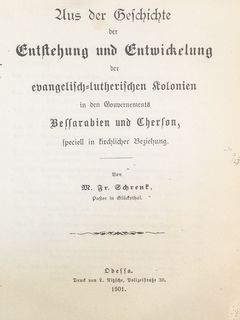
The first German settlers, who had heeded the call of Catherine II and Alexander I to settle in New Russia, arrived in the Odessa area in 1803. By 1804, there were 51 German craftsmen in Odessa, working in 17 different trades. The German settlers came mainly from Saxony, Prussia, Bavaria and Württemberg, as evidenced by the names of their settlements, of which there were around 500 in the Odessa region: Stuttgart, Reutlingen, Tübingen and Schwieberdingen.[5] The most distinctive feature of the German presence was the ‘artisans’ colony’, which was initially governed by its own laws and administered independently. The long-serving mayor, Duke de Richelieu, wrote that in no other country in the world was there such a large number of people from different nations living in such a confined space. This ethnic diversity contributed significantly to the city’s tolerance and rise, but also made it a target for criticism from Russian nationalist forces, who repeatedly launched attacks against the ‘most liberal Russian city’. By the mid-19th century, street signs were in Russian and Italian (the most widely spoken languages). The 1897 census recorded 55 languages. Around 1900, roughly half of the city’s population was Russian-speaking.[6]
In the year following its foundation, the city had a population of just under 2,500. This figure rose to 35,000 by 1815 and to around 115,000 by 1861. By the time of the First World War, Odessa was home to some 630,000 people.[7] Towards the end of the 19th century, there were around 10,000 Germans among the city’s inhabitants (just under 3 per cent of the total population).[8]
The waves of emigration following the 1917 Revolution, the Second World War, forced resettlements, the Holocaust and the emigration of numerous remaining Jewish residents of the city since the 1970s – primarily to the USA and, from 1991, to Germany – have probably irreversibly altered the demographic structure. Following the German invasion of the Soviet Union in 1941, the Germans were also deported from Odessa; of the few Germans who remained in the city, many left the region for Germany during the war. Since 1973, more than one million people have lived in Odessa. This figure has remained largely constant to this day. The majority are (Russian-speaking) Ukrainians, who moved to the city in increasing numbers from rural regions after 1945 and, as they adapted to urban life, switched to speaking Russian (around two-thirds), and Russians (around one-third). Today, the proportion of the city’s other ethnic groups, including Germans, is negligible. In 2001, around 950 residents identified as German, of whom around 100 stated that German was their mother tongue. The overwhelming majority cited Russian as their mother tongue (over 80 per cent).[9]
The Odessa dialect of Russian
The multi-ethnic character of ‘Babylon on the Black Sea’ led to a linguistic diversity that was unique in Russia at the time. In the mid-18th century, one could hear the locals speaking “Russian, English, Italian, German, Yiddish, Tatar, Polish, Turkish, Greek, Bulgarian, Armenian, Moldavian, Hungarian, Dalmatian, French, Swedish, Spanish and several other languages.”[10] Under the influence of this linguistic diversity, “an enchanting variant of theRussian language”thus emerged in the city, one that “has never failed to stir the imagination.” Opinions range from “passionate declarations of love [...] to condemnations of the detestable ‘Odessisms’, which are destructive to the Russian language ”.[11] In 1930, the writer Vladimir Žabotinski (Jabotinsky; 1880–1940) responded to the accusation that the city’s lingua franca was a ‘corrupted’ form of Russian by stating that, firstly, it was not corrupted and, secondly, it was not Russian at all. This language, he argued, demonstrated that the people of Odessa simply think differently from their friendly neighbours, the Russians and Ukrainians. Nowadays, however, Odessa Russian is “an endangered linguistic variety.”[12]
History of religion
Today, the majority of the inhabitants belong to various Orthodox Christian denominations. Some religious and ethnic minorities (e.g. Jews, Germans, Muslims, Bulgarians, Armenians and Greeks) have their own cultural and religious centres. The first German church was built as early as 1804 in Gross Liebenthal (now Velikodolinskoe), 20 km away, to serve the surrounding Protestant settlements such as Lustdorf, Alexanderhilf, Neuburg and Freudenthal. In Odessa itself, a Lutheran church was built in 1827. The first German pastor was Johann Heinrich Christian Pfersdorf from Thuringia, who served from 1803 to 1811.
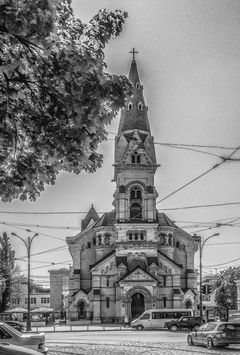
The city’s German landmark is St Paul’s Church, built in the Neo-Romanesque style by the architect Hermann Scheurembrandt and consecrated in 1897. The church was closed in 1937 and fell into disrepair. The last pastor, Karl Vogel (in post since 1933), was shot by the NKVD in the same year. Although the citizens of Odessa managed to prevent the planned demolition of the church in 1966, the building burnt down completely in 1976. In 2005, reconstruction began with funding from Germany, primarily from Bavaria. The largest bell, for instance, was donated by the twin city of Regensburg. The church has been open again since 2010. A diaconal social centre is attached to it.
Jewish history
A Jewish gravestone bearing the date 1770 suggests that Jews were already settled in the region before the town was actually founded. In 1795, there were 250 Jewish residents in the town.[13] In the years that followed, Jews emigrated to the Black Sea region, primarily from Volhynia, Podolia and Lithuania; later, Jews from Germany and Galicia arrived in Odessa, particularly from the Galician town of Brody, after which one of the largest synagogues was named in 1841. At that time, there were already around 12,000 Jews living in the city.[14] Owing to the difficulties of settling in the major cities of Saint Petersburg and Moscow/Moskva, Odessa was a magnet for secular and educated Jews from across the Tsarist Empire. Thanks to the liberal atmosphere in the city, they enjoyed extensive rights and played an active role in the city’s affairs. Jews were primarily active in the medical sector, in trade and banking, or as lawyers. However, the oft-cited cliché of the city’s wealthy Jewish upper class does not correspond to the facts. Most Jews belonged to the urban middle class, and a third lived in poverty. By the end of the 19th century, Odessa was to become one of the centres of the Zionist movement (in particular the ‘Palestine Committee’ led by Leon Pinsker [1821–1891]), which attracted an ever-growing following in the face of increasing anti-Jewish sentiment, culminating in pogroms. By 1900, more than one in three inhabitants of Odessa was Jewish. This proportion had almost doubled since 1854.[15]
As early as 1826, the first Russian-Jewish school was founded, which, under its headmaster Basilius Stern (1798–1853), enjoyed a high reputation not only in New Russia. A girls’ school followed in 1835, and by the mid-19th century there were around 70 Jewish educational institutions in Odessa. Today, there are once again six schools offering regular lessons. Jewish pupils also attended state schools and grammar schools, not least the prestigious Richelieu Lyceum, where in 1902 almost 10 per cent of the pupils were of Jewish origin.
(see also ‘Science’ below)
The first synagogue was built immediately after the town was founded at the end of the 18th century. Since 1859, the Main Synagogue has stood on the site; after being repurposed as a natural history museum and a gymnasium during the Soviet era, it has been used once again as a place of worship and a community centre since 1997. At the beginning of the 20th century, Odessa had around 70 synagogues and smaller places of worship. By the early 1990s, only one synagogue remained in use.
The city is of central importance to Jewish culture and scholarship. (See also ‘Literature, Music, Film’ below.)
In the wake of Alexander II’s liberal reforms in the 1860s, the city’s Jewish community increasingly shifted from Yiddish and German to Russian, thereby contributing significantly to strengthening the Russian character of the city – which was characterised by its foreign population – and, not least, of the community itself. Charitable institutions founded by Jews, which were open to all citizens, played a major role in social cohesion.
However, coexistence between Jews and the rest of the population was not without tension in Odessa either: the city was the scene of the first pogrom in Russia (1821), which was followed by seven more in Odessa, the largest of which took place in October 1905, claiming 299 victims over four days. During the Second World War, the ‘self-defence units’ – recruited from members of the German minority – actively participated in the extermination of their Jewish fellow citizens. On 19 October 1941, the German occupiers and their Romanian allies burned to death some 25,000 Odessans of Jewish nationality, to whom a memorial now stands as a tribute. In the wake of a reprisal for an attack on the occupiers (67 dead), thousands of Jews were murdered; thousands more died in the Odessa ghetto, and a far greater number were deported to the extermination camps.[16] The Jewish community of Odessa never recovered from these atrocities; the Jewish proportion of the total population is now negligible, partly due to the emigration of many of the city’s remaining Jews.
Special cultural institutions
The city’s most important cultural institution and architectural landmark is the opera house, designed by Ferdinand Fellner (1847–1916) and opened in 1887. Also worth mentioning are the Russian and Ukrainian theatres, the Philharmonic Hall housed in the New Stock Exchange (built at the end of the 19th century), the Musical Comedy Theatre, and the numerous museums, in particular the Literary Museum, the Museum of Local History and the Archaeological Museum, which was founded as early as 1825. German residents ran several cultural centres; one of these gave rise to what is now the Academy of Music, situated directly opposite St Paul’s Church. Today, the centre of German culture and language is the Bavarian House. Café Liebmann, named after its first owner, the Saxon confectioner Bernhard Liebmann, was a popular meeting place for artists and intellectuals in Odessa. The Jewish cultural centre ‘Beit Grand’ and the International Jewish Community Centre ‘Migdal’ are the main focal points of Jewish life in the city.
Science
Odessa is one of Ukraine’s most important centres of learning. The New Russian University emerged from the Richelieu Lyceum in 1865. Some of the most renowned professors at the New Russian University – the predecessor of the city’s most important university today, Menchikov State University – were of German descent, such as the well-known German-Baltic historian Ernst von Stern (1859–1924). There is also a large polytechnic university, as well as smaller institutions for training lawyers, doctors, economists, administrative specialists and marine scientists. A Jewish university was established in 2007.
Architecture and Urban Development
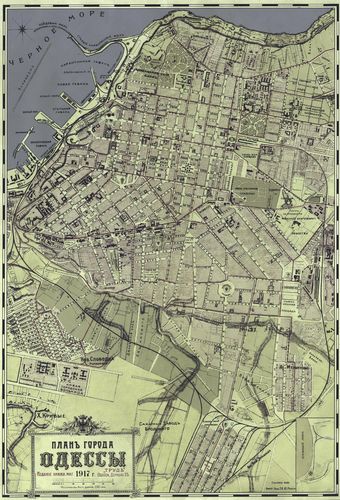
The regular layout of the streets in the centre of the city is reminiscent of the then capital, Saint Petersburg. The buildings in old Odessa were initially constructed in the Empire style, and later predominantly in the Neoclassical style. The German Karl Desmet founded the Botanical Garden (1822). The city owes its European character not least to German architects such as Hermann Scheurembrandt, Waldemar Kundert and Paul Ulrich Klein. The damage caused by Soviet urban planning in Odessa was very limited, particularly in the city centre, which had been largely spared from war damage. The buildings erected in the socialist style after 1917, such as residential estates (in particular the ‘Khrushchevys’, named after Party leader Nikita Sergeyevich Khrushchev [Nikita Khrushchev, 1894–1971] ), or sanatoriums, blended into the cityscape and today often exude a nostalgic charm. Since 1991, the city’s architectural aesthetic has been changing due to numerous new buildings, such as the luxury shopping centre Sady pobedy ( Gardens of Victory) on 10 April Square, which are being erected without regard for the established cityscape.
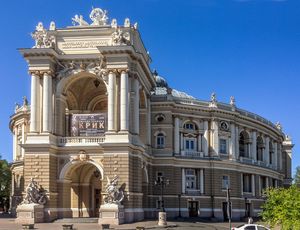
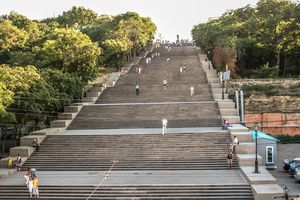
Alongside the magnificent opera house, built in the Neo-Baroque style, the city’s landmark is the Potemkin Stairs, constructed between 1837 and 1841, which lead up from the harbour to the city centre. Among the city’s best-known buildings is also the arcade in the centre, built between 1898 and 1899 by the local architect Lev L’vovič Vlodek (1842–presumably 1918). The Russian Orthodox Cathedral of the Transfiguration (Spaso-Preobrazhensky Cathedral), which was destroyed by the communist authorities in 1936, has been restored to its former glory since 2010.
Literature, music, film
The city is of far-reaching significance, particularly for Russian and Jewish literature. It is often virtually impossible – and arguably not even meaningful – to distinguish between the two, insofar as Jewish authors wrote in Russian. The world-famous literary duo of Ilya Arnoldovich Il’f (Ilya Ilf, 1897–1937) and Yevgeny Petrov (a pseudonym for Yevgeny Petrovich Kataev – Yevgeny Petrov, 1903–1942) ( works include *The Twelve Chairs* and *The Golden Calf*). Il’f (whose real name was Iechiel Leib Fainsilberg) was Jewish and Petrov was Russian, and it has not yet been possible to determine which parts of their joint works were written by which author.
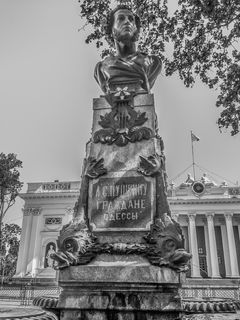
The great Russian poet Aleksandr Sergeyevich Pushkin (Alexander Pushkin, 1799–1837) lived in Odessa in 1823–24, albeit not entirely of his own volition at first: Like the Polish ‘prince of poets’ Adam Mickiewicz (1798–1855) a year later, he had been exiled to the ‘dusty south’ and began work here on his masterpiece, Eugene Onegin. The writers Anna Andreevna Akhmatova (Anna Akhmatova, 1889–1966) and Vera Mikhailovna Inber (1890–1972) were born in Odessa. Osip Aronovich Rabinovich (1817–1869) published the first Russian-language Jewish newspaper in Odessa (Rassvet, 1860–1861). With his novel *Kaleidoscope*, he established theRussian-Jewish literary tradition. In 1879, Yakov Petrovich Polonsky (1819–1898) described his impressions of Odessa in the novel *Deševij Gorod* (*The Cheap City*). The young Maksim Gor’kij (Maxim Gorky, 1868–1936) stopped off in Odessa in 1891 whilst travelling through Russia, where he found work as a porter in the harbour. In his short story *Čelkaš* (1895 ), he painted an authentic picture of the difficult working conditions in the port of Odessa.
The city came to occupy a central place in Russian-language literature at the start of the 20th century. Aleksandr Ivanovich Kuprin (Alexander Kuprin, 1870–1938) depicted Odessa time and again in his short stories. The stories set in Odessa by the Odessan Isaak Emmanuilovich Babel (Isaak Babel, 1894–1940) hold great significance for the city’s literary heritage. Odessa also occupies a firm place in the life of the Nobel Prize winner Ivan Alekseevich Bunin (Ivan Bunin, 1870–1953). Konstantin Georgievich Paustovsky (Konstantin Paustovsky, 1892–1962) created a literary monument to Odessa in his novel *The Time of Great Expectations* (1958). Key figures of the ‘Odessa School’ included, for example, Valentin Petrovich Katayev (Valentin Katayev, 1897–1986) and Yuri Karlovich Olesha (Yuri Olesha, 1899–1960). The children’s author Kornei Ivanovich Chukovsky (Kornei Chukovsky, 1882–1962; author of *Doctor Aibolit*, amongst others) grew up in Odessa and spent his youth there.
The definitive novel set in Odessa is undoubtedly *Pjatero* (*The Five*), published in 1936 whilst the author was in exile in France, by the Zionist activist Vladimir Evgen’evich Žabotinskij (Vladimir Jabotinsky); it is a swan song to the old Odessa, which was already a thing of the past even then.[17] Other significant Jewish authors who were active in Odessa include Semën Grigor’evich Frug (1860–1916) and Mordechaj Ben-Ammi (1854–1932). In particular, the prose writer and playwright Semën Solomonovič Juškevič (1868–1927) popularised the‘Jewish theme’ and, like Isaak Babel, spread the language of the city (see above, ‘Odessa Russian’) throughout the country. The‘Jewish Chekhov’, Scholem Aleichem (1859–1916), and Mendele Moicher Sforim (1836–1917), who both lived in Odessa, made significant contributions to the establishment of Yiddish as a literary language. The Israeli national poet and a classic of Hebrew poetry, Chaim Nachman Bialik (1873–1934), is also closely associated with Odessa; his first collection (1902) and his first complete works (1908) were published here. The poet and translator Saul Černichovskij (Saul Tschernichowski, 1875–1943), who wrote in Hebrew, also began his literary career in Odessa. Semën Markovič Dubnov (Simon Dubnow, 1860–1941) wrote some of his most important works on Jewish history in Odessa around 1900. Leonid Osipovich Utesov (Leonid Utesov, 1895–1982), the ‘King of Soviet Jazz’, was born in Odessa. The world-famous violin virtuosos David Fëdorovič Ojstrach (David Oistrach, 1908–1974) and Igor’ Davidovič Ojstrach (Igor Oistrach) also hailed from Odessa.
The city has been and continues to be celebrated time and again in song by numerous performers, most notably Leonid Utësov (whose monument stands in the city centre). One of the best-known songs is the often-covered chanson ‘Ah, Odessa, Pearl of the Sea’ by Modest Yefimovich Tabachnikov (1913–1977), written in 1936. The city’s anthem is the ‘Song of Odessa’ from the operetta *The White Acacia* by Maksim Isaakovich Dunayevsky.
Odessa gained worldwide fame through Sergei Mikhailovich Eizenstein’s (Sergei Eisenstein, 1898–1948) 1925 silent film *Battleship Potemkin*. The 1938 novel *Zelenij furgon* (*The Green Van*) by Aleksandr Vladimirovič Kozačinskij (1903–1943), set in Odessa, was adapted for the screen twice by the Odessa Film Studios (in 1959 and 1983). Erwin Geschonneck (1906–2008) performed at the German Theater, which operated from 1934 to 1939. More recently, the two-part musical comedy *Primorski bul’var* ( Boulevard by the Sea; 1988) by director Aleksandr Nikolaevič Polynnikov was produced.
Culture of memory and remembrance
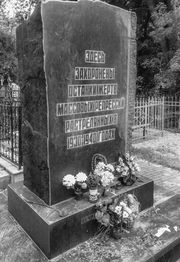
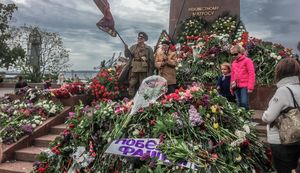
The city’s foundation day has been celebrated on 2 September with numerous events since 1844. Odessa thus established a tradition in Russia. Key commemorative days are Victory Day on 9 May and the City’s Liberation Day on 10 April, both of which mark the events of 1945. No space could be found in the city centre for the memorial to the victims of the repressions of the 1930s and 1940s . It attracts little attention at Cemetery No. 2. On the 200th anniversary of the city’s foundation in 1994, most streets in the centre were given back their pre-revolutionary names. The grand boulevard in the centre now bears the name of the first governor, de Ribas. Some old monuments or commemorative plaques have been replaced by new ones, with Russian-language ones being replaced by Ukrainian-language ones. Since 2002, the ‘Migdal Schoraschim’ museum, opened by the Jewish community, has been dedicated to the city’s Jewish history; the murder of the Jews during the Second World War is documented in the ‘Holocaust Museum’.
4. Discourses/Controversies
The origins, development and culture of Odessa are closely linked to Russia. After a quarter of a century as part of Ukraine, Odessa remains a Russian-speaking city, even though Ukrainian has gained some ground in recent years and ethnic (Russian-speaking) Ukrainians now form the majority. Nevertheless, Odessa is not a Russian city, and a stronger sense of belonging to Ukraine has developed here than in the east of the country or in Crimea. Consequently, the balance of power between pro-Ukrainian and pro-Russian forces in Odessa is more evenly distributed than in western oreastern Ukraine or the capital, Kyiv, which creates a dangerous potential for conflict. In the wake of the political crisis in Ukraine in 2013–2014, the city initially remained calm for a long time. It seemed as though the urban identity of the ‘Cheerful Capital on the Black Sea’ overshadowed the Russian-Ukrainian divide. On 2 May 2014, however, according to official reports, around 50 people lost their lives in clashes between the two sides, most of them in the fire at the Trade Union House on Schnepfenfeld, not far from the main railway station. The exact circumstances of this disaster, as well as the causes of death of many of the victims, have not yet been clarified.[18] Currently, the Russian side is exploiting the city’s former affiliation with New Russia to call into question Odessa’s continued existence within Ukraine.
Bibliography
- Dorotei Atlas: *Staraja Odessa: ee druz’ja i nedrugi* [Old Odessa: Its Friends and Enemies]. Odessa 1911 [Reprinted Odessa 1992].
- Boris A. Edel’man: Prošloe i nastojaščee Odessy [The Past and Present of Odessa]. Odessa 2012.
- Viktor Rafailovich Fajtel’berg-Blank, Tat’jana Nikolaevna Kolesničenko: Serebrjanyj vek južnoj palmiry [The Silver Age of the Palmyra of the South]. 2 vols. Odessa 2007.
- Viktor Rafailovich Fajtel’berg-Blank, Tat’jana Nikolaevna Kolesničenko: Odessa in the Era of the Leninist and Stalinist Dictatorships. Odessa 2008.
- Viktor Rafailovich Fajtel’berg-Blank, Boris Nikolaevich Razumnyj: Odessa during the Great Patriotic War [Odessa during the Great Patriotic War (= the Second World War)]. Odessa 2009.
- Oleg Gubar’: Essays on the Early History of the Jews of Odessa. Odessa 2013.
- Guido Hausmann: The University and Urban Society in Odessa, 1865–1917: Social and National Self-Organisation on the Periphery of the Tsarist Empire. Stuttgart 1995 (Sources and Studies on the History of Eastern Europe 49).
- Patricia Herlihy: *Odessa. A History, 1794–1914*. Cambridge, Massachusetts 1986.
- Vera Kalmykova, Vadim [Gerševič] Perel’muter: Odessa – Moscow – Odessa. A south-westerly wind in Russian literature. Moscow 2014.
- Ė[l’vira] G[ermanovna] Plesskaja-Zebol’d: The Germans of Odessa: 1803–1920. Odessa 1999.
- Aleksandr Rapoport (ed.). Odessa in Russian Poetry. Moscow 2012.
- Aleksandr de-Ribas: Staraja Odessa – istoričeskie očerki i vospominanija [Old Odessa – Historical Sketches and Memoirs]. Odessa 1990 [reprint of the first edition of 1913].
- Ė[l’vira] Plesskaja-Zebol’d: Kak ostat’sja verujuščim v period peremen [On Remaining a Believer in Times of Change]. In: Klaus-Jürgen Röpke (ed.): St Paul’s Church, Odessa. Church, Congregation, Faith, Partners. Lindenberg 2010, pp. 72–95.
Web links
- www.beit-grand.odessa.ua/ (Beit Grand Jewish Cultural Centre – information on Jewish life in Odessa, theatre, nursery, youth club, language courses. Information in Russian)
- www.migdal.ru/ (‘Migdal’ Jewish Community Centre – theatre, museum, activities for children and young people, guided tours of Jewish Odessa. Information in Russian and English)
- opera.odessa.ua/ (Odessa State Opera. Information in Ukrainian, Russian and English)
- www.bayernhaus.com.ua/ (Bavarian House Odessa – language courses and language services, cultural events. Information in Russian and German)
- diakonia.od.ua/ (Diaconal Centre of St Paul’s Church in Odessa. Information in Russian. German version in preparation.)
Notes
[1] Eduard Edin: Assedo. Literaturnyj Pejzaž [Literary Landscape]. In: Slovo/Word 47 (2005). URL: magazines.gorky.media/slovo/2005/47/assedo.html (accessed 16 August 2021).
[2] Shirley Brooks et al.: Southern Russia and the Turkish Danube Countries in Travel Accounts. Leipzig 1854, p. 97.
[3] Jan Paul Hinrichs: De mythe van Odessa [The Myth of Odessa]. Amsterdam 2011.
[4] Tanya Richardson: *Kaleidoscopic Odessa. History and place in contemporary Ukraine*. Toronto et al. 2012, p. 17.
[5] Klaus-Jürgen Röpke: Ne bojsja, maloe stado [Fear Not, Little Flock]. In: Ibid. (ed.): Cerkov Sv. Pavla Odessa. Cerkov, Obščina, Vera, Partnery [St Paul’s Church in Odessa. Church, Congregation, Faith, Partners]. Lindenberg 2010, pp. 50–71, here pp. 50f.
[6] Herlihy: Odessa, p. 242.
[7] Herlihy: Odessa, p. 234.
[8] Herlihy: Odessa, p. 242.
[9] Evgenij Mikolajovič Stepanov: Rosijs’ke Movlennja Odesi [The Russian Language of Odessa]. Odessa 2004, p. 61.
[10] Johann Georg Kohl: Travels in Southern Russia. Dresden and Leipzig 1841, p. 56.
[11] Lev Zybatov: The Language of Odessa and of ‘Little Odessa’ (New York, Brighton Beach). In: Ibid. (ed.): Language Change in Slavic. The Slavic Languages on the Threshold of the 21st Century. An International Handbook, Part 1. Frankfurt am Main 2000 (Linguistics International 4), pp. 941–958, here p. 941.
[12] Zybatov: The Language of Odessa (note 10), p. 953.
[13] Herlihy: Odessa, p. 251.
[14] Kohl: Travels (note 9), p. 51.
[15] Herlihy: Odessa, p. 251.
[16] Foundation ‘Memorial to the Murdered Jews of Europe’. Memorials portal on places of remembrance in Europe: Odessa. URL: www.memorialmuseums.org/denkmaeler/view/820/J%C3%BCdisches-Museum-Odessa-%C2%BBMigdal-Schoraschim%C2%AB (accessed 16 August 2021).
[17] Vladimir Žabotinski: Pjatero [The Five]. Kharkiv 2011. German edition: Vladimir Jabotinsky: The Five. Novel. Translated from the Russian by Ganna-Maria Braungardt and Jekatherina Lebedewa. Berlin 2012 (Die andere Bibliothek 336).
[18] Dumskaya.net: Pričiny smerti bol’še poloviny pogibšich v Dome profsojusov do sich por neizvestny [The cause of death of more than half of the victims in the Trade Union House remains unclear], 22 May 2014. URL: dumskaya.net/news/prichiny-smerti-bolshe-poloviny-pogibshih-v-dome-035963/ (accessed: 7 June 2014).
Citation
Kai Witzlack-Makarevich: Odessa/Odesa. In: Online Encyclopaedia on the Culture and History of Germans in Eastern Europe, 2014. URL: ome-lexikon.uni-oldenburg.de/p32498 (accessed 10 October 2022).
Terms of use for this article
Copyright © University of Oldenburg and the Federal Institute for the Culture and History of Germans in Eastern Europe (BKGE), all rights reserved. This work was produced as part of the project ‘Online Encyclopaedia on the Culture and History of Germans in Eastern Europe’ and may be reproduced and published provided the rights holders’ consent has been obtained. Please contact:
If you have any specialist comments or additions to the text, please contact the editorial team, citing relevant literature and source references.