

Riga/Rīga
Riga/Rīga

Etymology
The name Riga dates back to the city’s foundation on the banks of the Riege stream (Rīdzene), which once flowed into theDaugava here but has since been filled in and can now only be traced along the course of the road.
The phrase ‘Riga rigat gentes’ (≈ Riga waters/fertilises the peoples), which later came into common use, is taken from the chronicle of Henry of Latvia (d. c. 1259), was minted on a commemorative medal for the city’s 700th anniversary in 1901, recommended as a motto by the director of the city library, Nicolaus Busch (1864–1933). It emphasises the city’s multi-ethnic character.
Topography
The Old Town lies 16 km from the Baltic Sea on the lower reaches of the Daugava, on both banks of the river, whilst the northern suburbs extend as far as the Gulf of Riga. The sparsely populated southern and western hinterland features extensive moors and marshes. The landscape around Riga, shaped by the last Ice Age, is characterised by numerous small lakes; to the east and north of the Old Town, there were still large sand dunes as late as the end of the 19th century.
Political and administrative affiliation
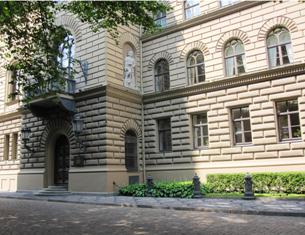
Former Livonian House of Knights, seat of the Saeima(
) since 1919. [Photo: E. Garleff]

Since 1919, Riga has been the capital of the State of Latvia, from 1940 to 1991 the capital of the Latvian Soviet Socialist Republic; today, the city is the political, economic and cultural centre of the country, housing the office of the President, state and local authorities – including the ministries – the Parliament (Saeima) and foreign diplomatic missions. As the largest city in the Baltic region, Riga comprises three city districts (rajons) and three suburbs (priekšpilsētas). The university, as the largest academic centre in the Baltic region with 17,000 students, 13 Schools and over 20 research institutes, works in close co-operation with the international academic community (e.g. through ERASMUS programmes). The Evangelical Lutheran Church of Latvia (LatvijasEvaņģēliski LuteriskāBaznīca), Latvia’s largest religious community in terms of membership, is led by an archbishop in Riga. Since 2007, this has comprised the Archdiocese of Riga – which encompasses seven deaneries and has Riga Cathedral as its parish church – alongside the dioceses of Daugavpils and Liepāja. Riga is also home to the country’s only Catholic seminary.
Common symbolism
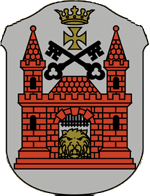
The Riga City Coat of Arms
The Riga City Coat of Arms depicts, on a silver background, an open gate between two towers as a symbol of the city’s charter, with a golden lion’s head beneath the gate. Two crossed black keys above the gate symbolise the Pope’s patronage, whilst the golden crown above them signifies subordination to the bishop. The large coat of arms is supported by two golden lions on a grey console. In 1656, Riga was granted the right to bear the Swedish crown in its coat of arms, which was confirmed in 1788 by Catherine II (1729–1796), confirmed in 1788 by Catherine II (1729–1796), in 1925 by the President of Latvia, in 1967 by the Soviet authorities, and again in 1988 by the President. On Riga’s 1937 flag, the coat of arms appears on two horizontal stripes, one light blue and one white.
Middle Ages
There was a Liv settlement on the right bank of the Daugava until merchants from Gotland established trade links here towards the end of the 12th century. After several failed attempts to found a town, Bishop Albert of Bekeshovede (Buxhoeveden, c. 1165–1229) from Bremen founded the city of Riga in 1201 as a bishopric, a base for colonisation and a trading centre. Riga developed into the capital of Livonia (Vidzeme).

Monument to Bishop Albert at the ‘
’ in Riga Cathedral.
After its foundation, Riga was the seat of the bishop; from 1255, it became the seat of the archbishop and the Master of the Order. The merchants who settled there soon gained influence: in 1225, the Riga Council elected the town bailiff, a post previously appointed by the bishop. In 1211, the city was granted Gotlandic law; in 1294/97, Hamburg law; and in 1350, its own Riga municipal law, complete with a council constitution and guilds for merchants and craftsmen. From 1282, as a member of the Hanseatic League, Riga became a force to be reckoned with within the so-called Livonian Confederation, comprising five German ecclesiastical territories: the Archdiocese of Riga, the dioceses of Dorpat, Ösel-Wiek and Courland, and the territory of the Teutonic Order. Its Livonian branch, led by a Landmaster and directly subordinate to the Grand Master, competed with the Archbishop as an independent ecclesiastical organisation. During their numerous conflicts, some of which were fought with arms, the bishops sought protection from foreign powers (e.g. Denmark) or from the German Emperor. From 1492 onwards, the Archbishop of Riga recognised the German Order as Livonia’s protector and, amongst other things, took part in the Battle of Lake Smolina in 1502 against the Russians with his own military contingent.
Modern times

Riga in the 16th century [A. Saur: Theatrum Urbium.
A True Depiction and Brief Description
of almost all the prominent and renowned
towns, castles and monasteries [...], Frankfurt 1610].
With the introduction of the Reformation in 1522, the power of the archbishops came to an end. After the Livonian Confederation had disintegrated as a result of the Livonian War (1558–1561), Riga initially remained independent as a free imperial city of the Holy Roman Empire. When assistance from the Holy Roman Empire failed to materialise during renewed Russian attacks, the city paid homage to the Polish King Stefan Báthory (1522–1586) in 1581 and became the seat of the starost. During the 40-year period of Polish-Lithuanian rule, the citizens resisted the Polish Crown’s attempts at recatholisation, which led to social unrest. In 1621, King Gustav II Adolf captured the city of Riga as part of his intervention in the Thirty Years’ War; his successors subsequently reinforced its defences due to its strategic importance. During the Russo-Swedish War of 1656–1658, Riga withstood a Russian siege and remained the second-largest city in the Swedish Empire, enjoying a high degree of self-government, until the early 18th century.
Following further sieges by Russian (1656) and Saxon-Polish troops (1700), Riga was forced to surrender to Russian forces on 4 July 1710 during the Great Northern War, due to the plague and a famine in the city. During the negotiations over the terms of surrender in the summer of 1710, Tsar Peter I (1672–1725) agreed to all demands, thereby allowing Riga to retain its political and social order. As part of the new great power, from 1796 it served as the capital of the Livonia Governorate, one of the three Baltic governorates of the Tsarist Empire. By the end of the 19th century, Riga had been developed into one of Russia’s most important ports, and its population increased tenfold between 1850 and 1900. From the Middle Ages onwards, the city also comprised an extensive patrimonial territory as well as larger estates, some of which were situated at a considerable distance.
19th century
During the Industrial Revolution, Riga developed from a provincial town into a modern city.

Riga before the First World War, a postcard by ‘
’. [R. Adolphi Archive]
The constitution initially remained based on the estates and the aristocracy, with the Council or Magistrate – acting as both the administrative authority and the court – consisting of four mayors and 16 councillors (eight lawyers and eight merchants) and being supplemented by co-optation. The merchants were represented in the Great Guild or St Mary’s Guild, whilst the master craftsmen belonging to the guilds were represented in the Small Guild or St John’s Guild; each was led by a council of elders. Their representatives were primarily involved in the administration of the city’s finances. In 1865, the 20 councillors, 783 citizens of the Great Guild and 886 of the Small Guild, accounted for only 1.8 per cent of Riga’s population. Several reform plans, supported mainly by the German-Baltic liberal press (Baltische Monatsschrift, Rigaer Zeitung) from the 1860s onwards, were thwarted by the Russian government, which enacted a new municipal code in 1877. Through elections based on three tax classes, Latvians were now able to participate actively in municipal politics for the first time, although in 1878 only two of the 72 city councillors were Latvian and four were Russian. In 1892, a new municipal ordinance abolished the three-class suffrage system and granted the Russian governor considerable influence in the context of the general Russification measures.[1] From 1901, the German-Baltic mayor, George Armitstead (1847–1912), rendered outstanding services to Riga’s infrastructure, education system and social welfare, a fact commemorated today by a monument.
20th century
The First World War brought Riga’s development to an abrupt halt when around 200,000 inhabitants were evacuated to central Russia for the war effort. Following its capture by German troops in September 1917, the independent Republic of Latvia was proclaimed in Riga on 18 November 1918. Its parliamentary government, led by Kārlis Ulmanis (1877–1942), was only able to establish itself after fighting against Bolshevik and White Russian troops, as well as the German-Baltic Landeswehr and the German Freikorps, during the course of 1919. The Treaty of Riga brought the Polish–Soviet War to an end on 18 March 1921.
During the interwar period, Latvia’s national minorities exercised their rights to cultural autonomy and, thanks to school autonomy (1919), were able to organise their entire education system largely independently (e.g. the Herder Institute as a private German university). In the Riga City Council and, above all, in parliament (the Saeima), the German-Baltic minority politician Paul Schiemann (1876–1944) made his mark; a commemorative plaque on the former building of the *Rigaer Rundschau*, which he headed, commemorates him. The minorities faced restrictions through the expropriation of churches and, from 1934, through economic measures imposed by the authoritarian Ulmanis regime.
As a direct consequence of the Hitler–Stalin Pact, the Baltic Germans were resettled to West Prussia and the so-called Warthegau in the autumn of 1939. Following the occupation of Riga by Soviet troops in June 1940, the first deportations of the Latvian population took place. German troops captured the city on 1 July 1941; from 1941 to 1944, it served as the administrative centre of the General Commissioner for the General District of Latvia and as the centre of the Reichskommissariat Ostland. The Jewish population (approximately 44,000 people in 1933) was interned in the Riga ghetto from July 1941 until 1943, together with Jews deported from the German Reich; most of whom were murdered or deported to concentration camps such as the so-called Salaspils Labour and Education Camp or the Riga-Kaiserwald concentration camp in the former villa suburb of Mežaparks. The fighting in 1944 caused severe damage to Riga’s Old Town (Vecrīga). Following the renewed Soviet occupation of Latvia, Riga became the capital of the Latvian Soviet Socialist Republic.
In the context of perestroika and glasnost, Riga developed into the centre of the Latvian independence movement. In 1990, the Saeima declared the restoration of independence. Following the temporary occupation of the parliament building by Soviet military units, the Soviet Union recognised Latvia’s independence on 21 August 1991. Riga once again became the capital of a sovereign Latvian state.
Population
Ethnic composition of Riga by spoken language, 1867 to 1913[2]
| Nationality by language | 1867 | 1881 | 1897 | 1913 |
| German | 43,980 (42.9%) | 66,775 (39.4%) | 65,332 (25.5%) | 80,823 (15.9%) |
| Latvians | 24,199 (23.6%) | 49,974 (29.5%) | 106,541 (41.7%) | 205,204 (40.4%) |
| Russians | 25,772 (25.1%) | 31,976 (18.9%) | 43,338 (16.9%) | 110,620 (21.8%) |
| Jews | 5,254 (5.1%) | 14,222 (8.4%) | 16,521 (6.5%) | 21,771 (4.3%) |
| Poles | (–) | 3,197 (1.9%) | 12,869 (5.0%) | 36,868 (7.2%) |
| Other | 3,385 (3.3%) | 3,176 (1.9%) | 11,278 (4.4%) | 52,190 (10.4%) |
| Total | 102,590 (100%) | 169,320 (100%) | 255,879 (100%) | 507,476 (100%) |
Whilst in 1867 the Baltic Germans still accounted for approximately 43 per cent of the total population, the ethnic composition changed fundamentally by 1913, when approximately 40 per cent of the town’s inhabitants were Latvians and only just under 17 per cent were Baltic Germans.[3] This reversal of the previous situation was due, amongst other things, to the fact that, with the abolition of compulsory guild membership in the towns and the introduction of the Russian municipal code in 1877–78, property-owning Latvians in the towns were also granted a limited right to vote in local elections - In 1892, the three-class suffrage system was finally abolished. In Riga, however, the Baltic Germans retained a majority in the city council until 1913 (51 out of 80 seats).
Today, Riga is the most populous city in the Baltic region, although its population has been declining since 1990 as a result of the emigration of Russian-speaking sections of the population, migration to Western Europe and low birth rates. In 2009, Latvians accounted for 42.3 per cent of the city’s population, whilst 41.3 per cent were Russians, 4.3 per cent Belarusians and 3.9 per cent Ukrainians; in addition, 2.0 per cent were Poles and 6.2 per cent belonged to other ethnic groups. At the start of 2011, Riga had a population of 703,581 within an area of 307.17 km², giving a population density of 2,290.53 inhabitants per km². The metropolitan area has a population of 882,000.
Economy
Riga had been consolidating its position as the most important port city in the Baltic region since the 17th century. At times accounting for a third of Sweden’s total imports and exports, it developed into the largest city in the Swedish Empire. In the late 16th and 17th centuries, exports (flax, hemp and their seeds) increased, and the city became the banker of Lithuania and White Ruthenia through the associated lending business.
In 1879, with 145 factories and over 12,000 workers, Riga ranked third in the Tsarist Empire in terms of workforce and fourth in terms of production volume. The fivefold increase in Riga’s population in just one and a half generations was primarily driven by migration from the countryside and signalled an enormous process of urbanisation in a region that had, until then, been predominantly rural region.
Education and Science
In the context of industrialisation, merchants from Riga founded a Polytechnic Institute in 1862, complete with a preparatory school and a commercial department comprising several Schools – the likes of which did not yet exist as technical training institutions in Russia. Owing to the rapid pace of industrialisation, the institute primarily trained mechanical engineers, including Friedrich Zander (1887–1933), the founder of the Soviet space programme. The boom in railway construction fostered the training of engineers and chemists, particularly during the teaching career of the future Nobel laureate Wilhelm Ostwald (1853–1932). With the chemist Paul Walden (1863–1957) and the economist Karl August Lieventhal (1844–1900), two Latvians served as directors of the Riga Polytechnic even before the First World War; the institution reached its highest student numbers in 1913/14, with 2,088 students. In 1915, it was evacuated to Moscow/Moskva, and in October 1918 it was briefly reopened in Riga under German occupation. In 1919, it was transformed into the University of Latvia (Latvijas Universitāte), with 13 Schools and approximately 23,800 students, making it the largest university in Latvia. In 1958, Riga Technical University (Rīgas Tehniskā universitāte) was founded.
Architecture, museums
Riga’s city centre was inscribed on the UNESCO World Heritage List in 1997, primarily due to the diversity of its Art Nouveau architecture. However, plans for further urban development on the left bank of the Daugava River mean there is a risk that Riga could be placed on the Red List of World Heritage Sites in Danger.
In terms of urban layout, Riga comprises the medieval core, a semicircle of boulevards surrounding the Old Town, and the New Town with its grid-patterned streets. The Old Town, situated as the geographical centre on the right bank of the Daugava, has retained its fortified character despite the demolition of its fortifications (1857–1863). The open spaces created after the demolition of the city walls were transformed into a city park with a canal (Pilsētas kanāls), which today separates the Old Town from the New Town.
The centre of the Old Town is the Market Square (Rātslaukums) with the Town Hall (Rīgas rātsnams) and the House of the Blackheads (Melngalvju nams), which was rebuilt in 1999 after being destroyed during the war and the ruins subsequently blown up. The original Gothic building, with its Dutch Renaissance-style façade, dates from 1334 and served as a meeting place for the Blackheads’ guild from 1477 onwards. A statue of Roland stands on the square in front of the building.
The foundation stone of Riga Cathedral (Rīgas Doms) was laid in 1211 by Bishop Albert; the organ, built at the end of the 19th century, is one of the largest in the world. The tower of St Peter’s Church (Svētā Pētera baznīca), first mentioned in 1209, was destroyed and rebuilt several times, most recently during the Second World War. St James’s Church (Svētā Jēkaba katedrāle), dating from 1225, is now Riga’s Catholic cathedral.

Small (St John’s) Guild, rebuilt
, 19th century [Photo: E. Garleff]
Riga Castle (Rīgas pils), built from 1330 onwards as a fortress for the Order of the Sword Brothers, serves as the seat of the President. The House of Knights, built in 1867 in the Florentine style, has housed the Saeima since 1919. Other historic monuments include the Riga Stock Exchange (Rīgas Birža) dating from 1852, the Convent Courtyard (Konventa sēta), dating back to the 13th century; the ‘Three Brothers’ (Trīsbraļi) complex, built between the 15th and 17th centuries; the Swedish Gate (Zviedru vārti); the houses of the Small Guild (Mazā Ģilde) and the Great Guild (Lielā Ģilde), the Mentzendorff House (Mencendorfa nams) dating from 1695, and the Dannenstern House (Dannenšterna nams). The Freedom Monument (Brīvības piemineklis), erected in 1935 between the Old Town and the New Town, features a female allegory of freedom atop a 19-metre-high obelisk, with historical events depicted in bas-reliefs on its sides.
The New Town is home to numerous buildings with Art Nouveau façades, particularly on Elizabetes and Alberta iela, featuring works by Mikhail Eisenstein (1867–1921). The first Latvian to join the teaching staff at the Polytechnic was Eižens Laube (1880–1967), who, together with other Latvian and German architects, created the finest buildings of the national Romanticism movement that gained prominence after the turn of the century. The distinctive character of Riga Art Nouveau lies in the fusion of Latvian and German elements, achieved by combining Latvian timber architecture with influences from Germany and Austria.[4] Numerous examples of this architectural style, which was particularly widespread in the last decade before the First World War, have survived to this day as a shared cultural heritage. At the turn of the century, numerous prestigious buildings were erected in the green belt surrounding the Old Town. Between 1876 and 1884, the Orthodox Cathedral (Kristus Piedzimšanas pareizticīgo katedrāle) was built in the Neo-Byzantine style. In the southern districtof Maskavas forštate(Moscow Suburb) are the former Zeppelin Halls of the Central Market (Centrāltirgus), the Palace of Culture (Zinātņu akadēmijas augstceltne), the Classicist Protestant Church of Jesus (JēzusLuterāņu baznīca) – Latvia’s largest wooden church – and the ruins of the synagogue near the former ghetto.

Detail of an Art Nouveau façade on Elizabetes iela
10b, built by M. Eisenstein in 1903.
[Photo: M. Bogade]
Riga’s art museums include the Museum of Foreign Art (Ārzemju mākslas muzejs), housed in the former Stock Exchange building, and the Latvian National Art Museum (Nacionālais mākslas muzejs). The Latvian War Museum (Kara muzejs) is situated in the Powder Tower (Pulvertornis) dating from 1650, a remnant of the city’s former fortifications. The Museum of Latvian Jews (Muzejs Ebreji Latvijā) illustrates the history of Riga’s Jewish community from the 18th century to 1941, whilst the Latvian History Museum (Vēstures muzejs) in Riga Castle is dedicated to the country’s history. The present-day Riga Museum of City History and Maritime History (Rīgas vēstures unkuģniecības muzejs) has its origins in the private collection of the Riga doctor Nikolai von Himsel (1729–1764) and to the Cathedral Museum, established in 1890 with the assistance of the Society for History and Archaeology.[5] It is thus one of the oldest museums in Europe, and Riga was named ‘European Capital of Culture 2014’.
Riga boasts a number of public parks, the oldest and largest of which is the Wöhrmann Garden (Vērmanes dārzs) in the city centre, laid out in 1814. The wooden houses that had stood here had been burnt down for fear of a Napoleonic siege. The moat along the former city fortifications is flanked by the so-called Bastei Hill, forming a park approximately three kilometres long (Kanālmalas apstādījumi). Kronvalda Park (Kronvalda parks) was created on land gifted to the German Shooting Club by Tsar Alexander II. The grounds of the Esplanade (Esplanāde) are situated near the Orthodox Cathedral. The garden city of Mežaparks is a villa suburb built in the early 20th century in the woods north of the city, featuring several woodland cemeteries such as the Brothers’ Cemetery (Brāļu kapi), which serves as a military cemetery.
Theatre, music
The Latvian National Opera (Nacionālā opera) has been housed in the neoclassical building of the former German Theatre since 1919. One of the country’s largest theatres is the Latvian National Theatre (Nacionālaisteātris), founded in 1919. The Riga Russian Theatre (Mihaila Čehova Rīgas Krievu teātris) has been operating since 1883 and is Latvia’s oldest professional drama theatre.
From the 17th century onwards, Riga developed into the most important musical centre in the Baltic region. In 1760, the Riga Music Society was founded, comprising private orchestras such as that of the German-Baltic Baron Otto Hermann von Vietinghoff (1722–1792), from which the orchestra of the opera house, founded in 1782, was formed. Among others, Johann Valentin Meder (1649–1719), Johann Gottfried Müthel (1728–1788) and Georg Michael Telemann (1748–1831) were active in Riga. In the 19th century, two musical traditions existed in parallel: German art music and the folk song repertoire further developed by the Latvians. From 1837 to 1839, Richard Wagner (1813–1883) worked as Kapellmeister at the opera house, which had attained international standing. Today, classical concerts are also held at the House of the Blackheads and the Great Guild Hall.
In 1873, the tradition of the Latvian Song Festivals was established in Riga; in 2003, the joint song festivals of the three Baltic states were inscribed on the UNESCO List of Masterpieces of the Oral and Intangible Heritage of Humanity.
Bibliography
The priest Heinrich of Latvia (d. c. 1259) wrote the *Chronicon Livoniae* between 1224 and 1227; it is the most important source on the early history of missionary work in the Baltic region. In it, he described the conquest and Christianisation of the Livonians, Estonians and Latvians from the perspective of the Church of Riga.

The monument to J. G. Herder at
Herder Square in Riga was erected in
1864 and restored after the
Second World War
[Photo: E. Garleff],
From the 18th century onwards, Riga developed into an important centre for publishing, where, amongst others, Johann Friedrich Hartknoch (1744–1789) printed the literature of the German Enlightenment and Johann Gottfried Herder (1744–1803) secured a post at the Cathedral School; Herder taught and preached in Riga from 1764 to 1769; his monument now stands to the side of the cathedral. Among Riga’s most significant authors are numerous Latvians such as Rūdolfs Blaumanis (1863–1908), who also wrote some of his works in German, the folklorist and writer Krišjānis Barons (1835–1923) and the politician and writer Jānis Rainis (1865–1929), to whom the city has dedicated monuments. However, the ethnic minorities living in Riga also produced significant literary works, such as Irina Saburowa (1907–1979) with her novel set in Riga, and several German-Baltic authors born in Riga, such as Werner Bergengruen (1892–1964), Bruno Goetz (1885–1954), Korfiz Holm (1872–1942), Manfred Kyber (1880–1933), Walter Pogge van Ranken (1913–1982) and Sigismund von Radecki (1891–1970); Monika Hunnius (1858–1934), Johann Reinhold von Lenz (1778–1854) and Garlieb Merkel (1769–1850) died in or near Riga.[6]
Current Latvian-German co-operation
Since 1992, Domus Rigensis has been developing the German-Baltic-Latvian Centre (Latviešu-Vācbaltu Centrs) as a meeting place for Latvians and Germans, organising numerous activities to preserve the shared cultural heritage of the city of Riga. In co-operation, in particular, with the German-Baltic Cultural Association of the Carl Schirren Society (Lüneburg)[7] and the German-Baltic Society (Darmstadt), lectures, exhibitions, documentation of former workplaces of well-known German-Balts, and publications provide both current and former residents of Riga and their descendants with insights into their shared history.[8] In addition, the office at the Mentzendorff-Haus also provides advice and information to other visitors to Riga.
4. Discourses/Controversies
With her methodological approach to the history of inter-ethnic interdependence, Ulrike von Hirschhausen helped to overcome a long-standing ‘ethnocentric narrative’. According to her, urbanisation, industrialisation and nation-building brought about a political, social and cultural mobilisation of urban society, which caused Riga to fragment into an ‘ethnically segmented city’ in the decades leading up to 1914.[9] Moving beyond the previously nationally oriented historiography—which interpreted Latvian history as a ‘passion narrative’ and German-Baltic history as a loss of cultural leadership —the author examines the ethnic groups in terms of their ‘mutual interdependence, dependence and interaction’. During the First World War, the ‘highly differentiated public sphere’ of these diverse ethnic milieus in Riga collapsed abruptly, after the multi-ethnic structure had previously mobilised and polarised urban society in equal measure. For the ‘politicisation of ethnicity’ on the one hand and the ‘ethnicisation of culture’ on the other had, since the 1860s, brought about a pronounced ‘ethnic segmentation of urban society’, culminating in the violent events of the 1905 Revolution. The challenges posed by this multi-ethnicity led, on the one hand, to progressive local politics in Riga, including, amongst other things, the tradition of estate-based self-government with the Tsarist Empire’s first municipal social insurance scheme in 1908. On the other hand, a diverse landscape of associations developed, comprising some 700 clubs on the eve of the First World War. However, due to the simultaneous polarisation, “neither the common good nor culture, nor professional nor sporting interests […] have been able, since the turn of the century, to unite where ethnicity divided”. The author’s call to balance the genuine German influence – which has hitherto been particularly emphasised – with that of the Latvians and Russians has, however, not gone unchallenged.[10]
A Latvian controversy erupted over the Latvian Occupation Museum (Latvijas Okupācijas muzejs), which opened in 1993 in the former building of the Museum of the Red Latvian Riflemen, established in 1970, with an exhibition on the first year of the Soviet occupation. The choice of this particular location as an ‘ironic repurposing’ sparked fierce debates, in which some welcomed the new content but wanted to demolish the black building in the centre of the historic old town, whilst others opposed the new content and sought to preserve the building in its original form.[11] Ultimately, the concept prevailed of interpreting, under the term ‘occupation’, the political, economic and social upheavals of the years 1939–1991 as the consequences of repressive Soviet and Nazi occupation policies at this very site. With a permanent exhibition and two to three temporary exhibitions each year, the Occupation Museum has since become one of the most visited museums in Riga.
Bibliography
- Carl-Schirren-Gesellschaft Lüneburg (ed.): 800 Years – Our Shared Riga. Essays by German-Baltic authors to mark the 800th anniversary of the city of Riga in 2001. Lüneburg 2001.
- Friedrich Benninghoven: The Founding of Riga and the Early Hanseatic Merchant. Hamburg 1961 (Northern and Eastern European Historical Studies 3).
- Andreas Fülberth: Tallinn – Riga – Kaunas. Their Development into Modern Capitals, 1920–1940. Cologne et al. 2005 (The Baltic States in History and the Present 2).
- Bernhard Hollander: Riga in the 19th Century. A Retrospective. Riga 1926 (reprinted by Hannover-Döhren 1970).
- Andrejs Holcmanis: Vecrīga – pilsētbūvniecisks ansamblis [Old Riga – an urban ensemble]. Riga 1992 (Monuments of Latvian Architecture and Art 213).
- Jānis Krastiņš: Art Nouveau in Riga’s Architecture. Michelstadt 1992.
- Jānis Lejnieks: Rīga, kuras nav [A Riga That Does Not Exist]. Riga 1998 (Monuments of Latvian Architecture and Art).
- Jānis Lejnieks: Rīgas arhitektūra [The Architecture of Riga]. Riga 1989.
- C[onstantin] Mettig: History of the City of Riga. Riga 1897 (reprinted in Hannover-Döhren 1980).
- Eduard Mühle, Norbert Angermann (eds.): Riga in the Process of Modernisation. Studies on the Transformation of a Baltic Metropolis in the 19th and Early 20th Centuries. Marburg 2004 (Conferences on East Central European Research 21).
- Erwin Oberländer, Kristine Wohlfart (eds.): Riga. Portrait of a Multiethnic City on the Edge of the Tsarist Empire 1857–1914. Paderborn et al. 2004.
- Rīga sociālisma laikmetā 1917–1975 [Riga in the Age of Socialism]. Riga 1980.
- Marģers Vestermanis: Jews in Riga. Tracing the Lives and Work of a Murdered Minority. A Historical Guide. 3rd, revised and expanded edition in German. Bremen 1995.
- Anja Wilhelmi (ed.): 300 Years of Culture(s) in Riga. A City in Europe. Lüneburg 2003 (Nordost-Archive N. F. 11, 2002)
- Reinhard Wittram: On the History of Riga. Fates and Problems: A Retrospective on 750 Years of the City’s History 1201–1951 (lecture). Bovenden [1951].
Web links
- www.domus-rigensis.eu (multilingual website of the German-Baltic-Latvian Centre)
- www.balt-hiko.de (Baltic Historical Commission)
- https://www.difmoe.eu/search?collections=vc:5d32e582-9792-443d-919d-17bfe30205eb (Riga Digitalis on the Digital Forum for Central and Eastern Europe)
- www.herder-institut.de/bildkatalog/wikidata/Q1773 (Images of Riga/Rīga in the image archive of the Herder Institute, Marburg)
Notes
[1] Wilhelm Lenz [Sr.]: The Development of Riga into a Major City. Kitzingen/M., 1954 (Marburg Eastern Studies 2).
[2] According to Ulrike von Hirschhausen: The Limits of Common Ground. Germans, Latvians, Russians and Jews in Riga 1860–1914 (Critical Studies in History 172). Göttingen 2006, pp. 57, 58.
[3] More precise figures can be found in Mark R. Hatlie: Population Shifts in Riga during the World War and Civil War 1914–1919. In: Heinrich Wittram (ed.): Ethnic Change in the Baltic States between 1850 and 1950. Lüneburg 2005 (Baltic Seminars 11), pp. 53–80, here pp. 54–71.
[4] Jānis Krastiņš: Connections between Latvia and the Germans in the fields of fine art and architecture. In: Wilfried Schlau (ed.): A Thousand Years of Neighbourhood. The Peoples of the Baltic Region and the Germans. Munich 1995, pp. 271–278, here p. 276.
[5] Ilona Galvanovska, Alnis Mitris, Ilgvars Gradovskis: Rigas Vēstures un kugniecības Muzejs [The Riga Museum of History and Shipping]. Rostock 1992; Margit Romang, Ilona Celmiņa (eds.): The Cathedral Museum in Riga – A House for Science and Art/Doma Muzejs Rīgā – Templis Zinātnei un Mākslai. Marburg 2001, p. XVI.
[6] Cf. Gero von Wilpert: History of German-Baltic Literature. Munich 2005; May Redlich: Encyclopaedia of German-Baltic Literature. A Bibliography. Cologne 1989.
[7] Michael Garleff: Domus Rigensis – Carl Schirren Society. Aspects of academic collaboration. In: Yearbook online 2 (2011). www.carl-schirren-gesellschaft.de/JO-Inhalt.htm (accessed 21 May 2012).
[8] For example, on 11 June 1994, by erecting a plaque on the building of the former *Rigaer Rundschau*, of which P. Schiemann was editor-in-chief, or the additionally illustrated translation of the novel by Zigfrīds fon Fēgezaks/Siegfried von Vegesack: Senči un Pēcteči. Piezīmes no Senās Livonijas vēstuļu Lādes 1689–1887 [Ancestors and Descendants. Notes from an Old Livonian Letter Box]. Riga 2011.
[9] Ulrike von Hirschhausen: The Limits of Common Ground. Germans, Latvians, Russians and Jews in Riga 1860–1914. Göttingen 2006 (Critical Studies in History 172), p. 12.
[10] Review by Axel von Campenhausen. In: Yearbook of Baltic German Culture 55:2008 (2007), pp. 257–266, here p. 266.
[11] Valters Nollendorfs: The Latvian Occupation Museum before and after the refurbishment. In: Baltica 1 (2011), pp. 4–23, here p. 7.
Citation
Michael Garleff: Riga/Rīga. In: Online Encyclopaedia on the Culture and History of Germans in Eastern Europe, 2012. URL: ome-lexikon.uni-oldenburg.de/p32234 (accessed 30 July 2021).
Terms of use for this article
Copyright © University of Oldenburg and the Federal Institute for the Culture and History of Germans in Eastern Europe (BKGE), all rights reserved. This work was produced as part of the project ‘Online Encyclopaedia on the Culture and History of Germans in Eastern Europe’ and may be reproduced and published provided the rights holders’ consent has been obtained. Please contact:
If you have any specialist comments or additions to the text, please contact the editorial team, citing relevant literature and source references.