

German Order
German Order
1. Official name
Order of the Brothers and Sisters of the German House of St Mary in Jerusalem (Ordo fratrum domus Sanctae Mariae Teutonicorum Ierosolimitanorum). Abbreviation: Teutonic Order (1839–1929: Teutonic Order of Knights).
2. Brief description
Founded in 1190. Its headquarters have changed frequently; since 1809, it has been based in Vienna. Functions: Initially, it was a field hospital; shortly afterwards, it was transformed into an order of knights whilst continuing to provide hospital services. Today, it carries out pastoral, charitable and academic work. Organisation: It has always been governed by the General Chapter and the Grand Master; these have been joined by a committee of regional superiors (now the General Council) as well as provincial superiors.
Foundation and Development in the Holy Land
The German Order emerged in the context of the Crusades. Characteristic of the period were such contrasting phenomena as the establishment of new orders of knights, which came to possess their own territories, and of mendicant orders, which rejected both private and monastic property. The largest orders of knights were the Knights Templar and the Knights Hospitaller; the latter were founded after 1080 as a brotherhood of hospitaliers, but six decades later also took up the fight against the pagans alongside the Knights Templar, who had been founded in 1120. Jerusalem was the centre for both. Around the same time as the Templars were founded, there was also a German hospital there, which primarily looked after pilgrims and warriors who did not speak the vernacular; it came to an end with the loss of Jerusalem to the Christians in 1187.
This sent a signal throughout Europe. Germans took part in large numbers for the first time in the subsequent Third Crusade. Low Germans and Flemings chose the sea route, whilst the rest took the land route. The seafarers arrived in 1189 at the port city of Acre, which fell after a long siege. To combat the camp epidemics in the unfamiliar climate, citizens of Bremen and Lübeck set up a tent hospital in 1190 using the sails of their cogs. A civic hospital brotherhood was formed, much like the Knights Hospitaller had been a good century earlier. They, too, saw their ideal goal in Jerusalem, which still had to be conquered and which they incorporated into their name: this marked the birth of the German Order.
The background to the Third Crusade never entirely faded from the Order’s consciousness: the ideology of Jerusalem, hospitality and the link with the Staufer concept of the Empire continued to shape it to a greater or lesser extent for centuries. Following the conquest of Acre in 1191, the Order was granted a house in the city, where it built a hospital, a chapel and dwellings. The German-speaking members, in particular, felt drawn to the place. Duke Frederick of Swabia, son of Emperor Frederick I (1122–1190), who had died on the Crusade, bestowed his favour upon the new foundation. The close ties to the Staufer imperial house proved decisive for the decades that followed. As part of Henry VI’s (1165–1197) Mediterranean policy, the German Hospital was transformed into a knightly order in 1198: the Knights Templar and the Knights Hospitaller served as models, with chivalry and nursing forming the equal cornerstones of this new order. Papal recognition had consistently followed each stage of development, and three decades after the founding of the Tent Hospital, the German Order attained full equality with those two great orders of knights – it had become a political force to be reckoned with in the Holy Land.
This is particularly evident during the reign of Grand Master Hermann von Salza (1209–1239), one of the most significant diplomats of the 13th century. A multitude of privileges and donations of property date from this period. Members of the nobility and the bourgeoisie joined the Order; they also donated their estates to it – whether as a token of gratitude for the care received in the Holy Land, to support the Order’s activities there, to assist the Order’s hospitals within the Empire, or with a view to their future salvation.
Spread across Europe
Around 1200, the Order acquired estates in southern Styria (in present-day Slovenia), Thuringia and South Tyrol; Prague and Vienna followed shortly afterwards, along with estates in Hesse, Franconia and Bavaria, as well as territories in Greece and in what is now the Burzenland region of Romania. Around 1220, the first settlements were established in what is now Belgium and the Netherlands, followed a few years later by settlements in what is now Switzerland and France. In 1230, the Order made its entry into Prussia and Spain, and in 1237 into Livonia. New knights and priest-brothers joined the Order, particularly from the German-speaking regions of the Empire. Whilst in the early decades it appeared as though the Order was developing into a Staufian-Thuringian house order with its spiritual centre in the Holy Land and another in Marburg at the tomb of St Elizabeth—whose brother-in-law, Conrad of Thuringia, later even became Grand Master (1239–1240), achieved her canonisation in 1235 and established close ties with the Order, the young corporation expanded beyond this during the period of severe conflict between the Church and the Empire following the death of Hermann von Salza in 1239.
This was aided by the Order’s independent political strategy, aimed at establishing a sovereign territory. The attempt in the Hungarian region of Burzenland (1211–1225) failed, but new opportunities arose in the Holy Land around Montfort Castle, as well as on the Baltic Sea. The Order wavered between these two poles. Jerusalem formed the spiritual centre of the Christian world, even though it had been lost to Christendom for good since 1244. Even after the loss of all its settlements in the Holy Land in 1291, a powerful faction within the Order insisted on remaining in the Mediterranean region, much like the Knights of St John and the Knights Templar. Yet it was precisely the violent destruction of the Templars, motivated by financial and political considerations, that helped the Prussian faction within the German Order to victory: in 1309, Siegfried von Feuchtwangen (1303–1311) moved the Grand Master’s seat from Venice to Marienburg.
Territorial development in Prussia and Livonia (now Estonia and Latvia)
Over the course of eight decades, the Order had managed to establish its core territory on the Baltic Sea. Called upon as an auxiliary force by the regional princes of Masovia and Silesia – who were vying for supremacy in a fractured Poland – against the Baltic Prussians, the Order succeeded in defeating and subjugating them in a struggle lasting five decades. Almost simultaneously, in 1237, it took over the remnants of the Livonian Order of the Sword and, with them, the line of advance against the Russian city of Novgorod. The defeat at the Battle on the Ice of Lake Peipus in 1242 against Alexander Nevsky (c. 1220–1263) halted the advance and established a border that would remain in place for over 300 years.
In Prussia, this was followed by missionary work carried out by the Dominicans and Franciscans, the settlement of German peasants and the founding of many towns. Revenue from its subjects and an extensive self-sufficient economy enabled the German Order to generate large production surpluses, particularly in grain, amber and forest products, with which it conducted extensive trade of its own. In doing so, it benefited from the Hanseatic League’s trading system, whose privileges it also enjoyed. For example, it had its own commercial agents in Bruges, through whom it was connected to the markets of Western Europe.
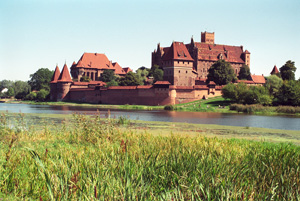
Marienburg (Photo: 1999) [Herder Institute, Marburg,
Image Archive, Inv. No. 132341].
This development was made possible by Prussia’s location outside the Empire; the Order enjoyed full sovereignty. As a state, like its neighbours, it thought in similar terms and, following the extinction of the ducal house of Pomerelia and the ensuing succession struggles, seized the opportunity in 1308/09 to conquer the territory, with Gdańsk as its central city. This led to a lasting conflict with Poland, which also laid claim to Pomerelia. This conquest and the relocation of the Grand Master’s seat to Marienburg made it clear throughout Europe that a state worthy of respect had emerged here; it grew ever stronger during the 14th century. It was led by an Order that was increasingly turning its back on the bourgeoisie and emphasising the knighthood, with hospitality taking a back seat to the fight against the pagans.
Consequently, a concept of the Order and the state emerged that was increasingly shaped by the aristocratic-chivalric approach, much as in Burgundy. In the 14th century, both countries were regarded as bastions of European chivalry – a phenomenon that was certainly ideological in nature, but also reflected the social background of the ruling classes in both states. Added to this was the fact that – alongside events in Spain – it was from Prussia that the most significant crusades of the 14th century for Europe were waged after the original crusading ideal had faded. The endeavour to link Prussia and the Order’s territories in Livonia territorially, and the paganism of the Lithuanians living between them, made Prussia the centre of crusades from across Western Europe. The 14th century marked the heyday of the Prussian Order state, both internally and externally.
This Prussian development could not be replicated in Livonia. Although the German Order, upon taking over the legacy of the Order of the Sword Brothers, attempted to shake off its subordination to the (Arch)Bishop of Riga/Rīga, it never succeeded in establishing itself as the dominant sovereign in foreign affairs. Livonia remained a country divided into four diocesan territories and the Order’s territory, with a very powerful city (Riga) acting as an additional factor of power, even though the Order was the most militarily powerful entity in the country. Although it was able to purchase the northern part of the country, Estonia, from Denmark in 1346, this did not enable it to achieve supremacy in the country. Nor did it succeed in establishing a significant southern link to Prussia, as the Lithuanian Samogitians never submitted to its rule on a permanent basis.
Developments in the German Holy Roman Empire
The relocation of the Grand Master’s seat meant that the Mediterranean region had been pushed from the centre of the Order’s existence to the periphery. Distance carries with it the risk of alienation, with the result that by the mid-16th century, apart from a few estates in central Italy, the Order had lost all its Mediterranean holdings – from the Turks to the Curia, there were many who were only too happy to enrich themselves at the Order’s expense, and, in some cases, poor administration did the rest. The French possessions had already been lost earlier. The result of those losses in the Mediterranean region was a steady increase in power north of the Alps. This was the heartland of the German Holy Roman Empire, where the Order had been able to acquire extensive holdings since the beginning of the 13th century. Houses, meadows, fields, vineyards, woodland, as well as existing hospitals and churches, had been entrusted to it. Nursing, pastoral care and agriculture were its tasks; the real estate holdings yielded rents and leasehold payments. On the one hand, it was a typical staging post where the resources for the fronts against the pagans were generated; yet pastoral care and hospitality already had an immediate impact locally.
On the other hand, the Order’s branch within the Empire must not be viewed solely in the context of the struggle against the pagans, but must be regarded as an entity in its own right. The estates originated largely from supporters of the House of Staufen. In this regard, we can identify different groups of donors. On the one hand, there was the higher nobility, which donated extensive estates. On the other hand, there were lesser nobles and ministerials who bequeathed estates to the Order in their home regions. This often took place on the occasion of their entry into the Order, so that the donations simultaneously served to provide for the new brothers. Consequently, a close connection between the donor family and the Order was maintained; they resided in the immediate vicinity of the Order’s commandery and, in some cases, continued to make use of it: the Order became a home for the (primarily lower) nobility. Whilst the Grand Master, residing in Prussia from the 15th century onwards, argued that the Teutonic Order was the ‘hospital’ of the German nobility and, as such, had to be preserved to provide for an entire social class, the foundations for this had already been laid during its expansion throughout the Empire in the 13th century. The Order’s branch within the Empire thrived on the region and for the region; it was an integral part of the society surrounding it, as well as a member of the Imperial Church, much like the monasteries and cathedral chapters.
This situation also explains the virtual absence of non-German members of the Order, whom we can only trace on the fringes of its sphere of influence, for example in Lombardy. This gave rise to the false impression that the Order had admitted only Germans – a stubbornly persistent cliché; the restriction to German nationals did not occur until the 15th century, when the economic crisis hit the lower nobility particularly hard, prompting them to seek to better secure their own livelihood in this way.
The Order’s holdings within the Empire grew rapidly from the beginning of the 13th century; surpluses enabled purchases, whilst barter transactions rounded off the holdings. Naturally, in a developed landscape of old settlements, these holdings remained scattered, unlike what was possible in the Holy Land, Prussia or Livonia. Nevertheless, larger complexes emerged which were administered as a single unit under the leadership of a commander, known as commanderies. Several such commanderies were grouped together to form bailiwicks under the leadership of a provincial commander. There were twelve such bailiwicks within the Empire: Austria, Bolzano, Alsace-Burgundy, Lorraine, Franconia, Marburg, Thuringia, Saxony, Westphalia, Koblenz, Utrecht and Biesen. Above them stood the Provincial Master; in Prussia, following the relocation of the Grand Master, his office merged with that of the Provincial Master, whilst in the Empire he bore the title of German Master. The Bailiwick of Bohemia was directly subordinate to the supreme territorial commander in Prussia.
The bailiwicks varied in size and function. Franconia formed the heart of the Order. Austria and Bolzano played important roles as transport hubs on the routes to the Mediterranean, but their significance declined following the relocation of the Order’s headquarters. By contrast, the bailiwicks of Thuringia and Saxony held the highest rank – primarily because they supplied recruits for Prussia alongside Bohemia – followed later by Franconia; for Livonia, it was the bailiwick of Westphalia. This explains the high proportion of brothers from central Germany in Prussia and those from the Low Countries in Livonia. Marburg remained a bailiwick with a strong religious character due to the tomb of St Elizabeth, the Order’s patron saint alongside Mary and St George. The Order’s provinces along the Rhine gained in importance for the recruitment of new members, particularly in the 14th and 15th centuries: Alsace, Koblenz and the less significant Lorraine. This gave rise to strong Rhenish factions in both Prussia and Livonia, as well as disputes over leadership within the respective branches of the Order. Biesen and Utrecht were situated more on the periphery. However, there were no strict boundaries between the spheres of influence of a bailiwick or, within a bailiwick, between the various commanderies. It was therefore only natural that the Order’s bailiwicks straddled both territorial and diocesan boundaries. Although the Order was exempt – that is to say, it was directly subject to the Pope – this applied only to it as an Order. Where it administered parishes, the local bishop was responsible for ecclesiastical matters. Such exemption – a separation from direct territorial and ecclesiastical subordination – always harboured the seeds of conflict with the territorial princes, the local bishops and the major towns. The major processes of territorialisation in the early modern period consequently bound the German Order ever more closely to the obligations of the provincial estates or within the city. Whilst this did result in the protection and patronage of the provincial or city lord being extended to the Order as well, the main focus was on the services and levies for which the Order was called upon. Thus, in 1494, the Grand Master became an Imperial Prince, even though the papal privilege of the 13th century stood in the way of this. For the bailiwicks and commanderies, this development proved problematic: locally, they were caught up in the territorialisation process driven by the regional princes; the Land Commander demanded levies at the bailiwick level, the Grand Master of the Teutonic Order for duties within the Empire, and the High Master for Prussia. This led to an increasingly burdensome multiple tax burden, which helps to explain many of the problems of the 15th and 16th centuries.
Developments from the 14th century to the beginning of the 16th century
This was preceded by events that are collectively referred to as the late medieval agricultural crisis. The wave of the Black Death in the mid-14th century only ceased to have its catastrophic effects in Eastern Europe, which is why that region experienced a period of great economic and political prosperity, for example in Prussia. For the German Holy Roman Empire, this meant a significant decline in agricultural production. This hit the lower nobility particularly hard, as their livelihood depended on land ownership and its yields. As the structure of the Order was no different, events unfolded in a similar manner. In some places, however, it was possible to develop what might be described as early mercantilist approaches – such as restructuring the economic system and shifting the focus of production – which were to prove forward-looking. It is therefore understandable that, faced with a general decline in income, the Order adopted a restrictive approach to the admission of new brothers. From the end of the 14th to the beginning of the 16th century, the number of members fell to around a quarter, which had the same effect on the Order’s recruitment base throughout the Empire as it did in Prussia and Livonia. This was accompanied by a narrowing of the Order’s social base. The bourgeoisie lost all possibility of access, with the exception of the clerical branch, whose importance was increasingly marginalised. The Teutonic Order became the ‘hospital of the German nobility’; the miles supplanted the monachus both in the Order’s external image and in its internal consciousness. Whilst the Reformation did contribute to this development, it was not the decisive turning point. The turning point in the Baltic region occurred for territorial reasons.

The Teutonic Order’s territory of Prussia in the second half of the
14th century (© Bernhart Jähnig: Lectures and
Research on the History of the Prussian Lands and the
Teutonic Order in the Middle Ages, Münster 2011, p. 75).
From the 14th century onwards, the balance of power in Europe shifted from west to east. France and England became embroiled in the Hundred Years’ War, whilst leadership of the Holy Roman Empire passed to the House of Luxembourg, albeit in their capacity as Kings of Bohemia. It was the era of the great rulers in Eastern Central Europe: Louis I of Anjou in Hungary, Charles IV in Bohemia and as German Emperor, and Casimir I in Poland; the State of the Teutonic Order in Prussia under Grand Master Winrich von Kniprode (1352–1382) may also be counted among them, as may Queen Margaret of Denmark, Norway and Sweden (1353–1412). These empires looked eastwards, most clearly evident in the Kalmar Union of the Nordic kingdoms (1397) and in the Union of Poland and Lithuania (1385). Consequently, however, the Order in Prussia was bound in the long run to fall victim to a strategy of encirclement, which it was unable to break through by means of territorial expansion, such as the conquest of Gotland in 1398 or the purchase of the Neumark in 1402; from then on, all Prussian measures of a political and military nature were regarded as defensive measures.
Added to this was a further development within the Order’s state. The internal constitution of towns and territories underwent a transformation as broader sections of the population demanded a share in governance. There were also artisans’ uprisings in the towns and demands for a say from the estates in Prussia. Particularly following the first major military conflict with Poland–Lithuania – the Battle of Tannenberg in 1410, which proved catastrophic for the Order – it needed the country’s help: Although the First Peace of Toruń (1411) had largely left it in possession of its territory, it demanded immense sums of money which it could not raise on its own. Within the Order, conservative views became increasingly entrenched, whilst the estates made ever more progressive demands, so that the often violent conflicts led, in 1454, to the estates’ defection from their sovereign and a 13-year war. The Second Peace of Toruń (1466) resulted in the partition of Prussia and the subjugation of the western part – including Marienburg and the Diocese of Ermland – to the Polish king. Sovereignty gradually shifted from the corporate rule of the Order to the personal princely rule of the Grand Master, so that the events of 1525 seem almost inevitable: Grand Master Albrecht of Brandenburg-Ansbach (1490–1568), following a fruitless war, submitted to the King of Poland as Duke of Prussia, laid aside the Order’s mantle and utilised the introduction of the Reformation to stabilise his rule.
When the Livonian system of government collapsed, the local Landmaster, Gotthard Ketteler, followed Albrecht’s example in 1561/62. He received the southern remnant of the Order’s territory as the Duchy of Courland from Poland as a fief, whilst Sweden and Poland divided the rest between them; Moscow/Moskva, Denmark and Prussia also still had a foothold in the country. As a result, the Order lost the territories in which it had established a highly effective rule that has continued to shape the country to this day.
Against the backdrop of the tendencies towards territorialisation on the part of the Order’s three highest regional leaders – the Grand Master in Prussia, the Livonian Landmaster and the German Master – the Order’s largely independent development within the Empire becomes understandable; this trend culminated in the acceptance of the title of Imperial Prince and, consequently, participation in the Imperial Diet of 1494 – the Order had fully integrated itself into the development of the Imperial Estates. This is hardly surprising given the brothers’ origins; they did not differ from the way of thinking of their peers. A similar observation can be made regarding the priest-brothers within their own sphere. The surviving literary works clearly demonstrate their integration into the contemporary mindset. Thus, we cannot speak of a cultural sphere specific to the Teutonic Order within the Empire, unlike, for example, in Prussia. Whilst there were certainly some outstanding poets within the Order – almost always Order priests – there was no specific Teutonic Order literature within the Empire, in contrast to Prussia. The same applies to the field of architecture. The debate, centred on Prussian buildings, regarding a specific ‘Teutonic Order castle type’ lacks any basis whatsoever, both in the Mediterranean region and within the Empire. It is not that the Order had no castles there, but it acquired them as donations and merely continued to build; when erecting new structures, it adapted entirely to local and regional conditions. This applies equally to its town houses and to its churches. In Prussia, this development took a different course and led to outstanding achievements in architecture, painting and poetry, as well as in courtly life at the Grand Master’s seat. In Livonia, parallels have been preserved, particularly in architecture; overall, however, the evidence is not as abundant as in Prussia.
The modern order in the Holy Roman Empire of the German Nation
The events in Prussia in 1525 had presented the Order with new challenges within the Empire, including with regard to its internal structure. The Grand Master of Germany, Walter von Cronberg (1526–1543), emerged victorious in the power struggle for leadership of the remaining parts of the Order against the Livonian Landmaster, Wolter von Plettenberg: The Emperor and the Pope recognised the Grand Master of the Teutonic Order as administrator of the Grand Master’s office in Prussia, though gaining recognition within the Order itself proved more difficult. Four bailiwicks within the Empire had been directly subordinate to the Grand Master: Alsace-Burgundy, Austria, Koblenz and Bolzano. They submitted to the Grand Master of Germany only with great reluctance, as they realised that complete autonomy would make them victims of the territorial powers. Added to this was the issue of religious affiliation. The new Protestant sovereign states and towns had gained a position that was, in some cases, very secure through secularisation and the acquisition of ecclesiastical sovereignty. For reasons of canon law, the Order’s priests had never been able to become ‘parish priests’ and had therefore, in large numbers, embraced the new doctrine and left the Order – although religious considerations also played a part for many. Whilst 68 per cent of the brothers of the Bailiwick of Franconia and the Grand Master’s Commandery were still priests in 1513, by 1577 this figure had fallen to just six per cent, or, in absolute terms, two. The situation was different for the knights. Unlike the sovereign, the nobility did not experience any change in their fundamental social position as a result of the Reformation. Consequently, irrespective of any denominational choice – in which they usually followed the sovereign – they had an interest in preserving the Order as a provider of livelihoods. Consequently, there was no secularisation of the Order’s estates, though many of its knights did change their religious affiliation; after some initial difficulties, this led to a formal tri-confessional structure within the Order. Catholics, Lutherans and Calvinists were members of the Order on an equal footing. The bailiwicks of Thuringia, Saxony and Utrecht were Protestant; Hesse was even tri-confessional, whilst the remaining bailiwicks remained Catholic. The Grand Master was always a Catholic. Thus, for almost three centuries, the concept of providing for its members served as a unifying force within the Order, transcending all denominational differences. This tri-confessional structure makes the Order unique in the history of the Holy Roman Empire.
The Order’s capacity for political action had been considerably diminished by the loss of Prussia in 1525 and Livonia in 1561. Two main features can be identified for the period that followed. Firstly, there was the constant attempt to regain Prussia and Livonia. Although the Order secured the necessary legal title against Duke Albrecht in Prussia and against Poland before the Imperial Chamber Court in 1532, it lacked the means to enforce it. This focus on the past, driven by efforts at recovery, remained a constant feature of the Order’s history until the beginning of the 19th century. At the same time, however, the present also required a forward-looking spiritual foundation. The revised Rule, which in the mid-15th century in Prussia had been formally traced back to the Order’s founding period, was in need of renewal. Grand Master Maximilian of Austria implemented this in 1606. The struggle against the pagans was invoked as the Order’s raison d’être, taking the contemporary form of the war against the Turks. This was in line with the interests of the Empire under Habsburg rule. The provision of priests was also promoted through the establishment of seminaries, as the Order still required more priests than it possessed, both for its own needs and to staff the many parishes under its control. This consolidation came at a price. The Order was unable to achieve within the Empire the sovereign, state-like position it had held in the Middle Ages. It required the strong support of the Imperial House. From the end of the 16th century onwards, the office of Grand Master remained a secondary title within the House of Habsburg or houses closely related to it, such as the Wittelsbachs or the Palatinate-Neuburgs. Consequently, this office acquired a more prestigious status than before, particularly as it was often combined with other offices, as in the case of Charles of Austria (1619–1624), who was also Bishop of Breslau/Wrocław, Leopold Wilhelm of Austria (1642–1662), Bishop of Olomouc and Breslau, or Franz Ludwig of Palatinate-Neuburg (1694–1732), Bishop of Breslau. For the war against the Turks, a separate regiment was established through a collaboration between the Imperial House, the Palatinate-Neuburg family—who were related by marriage and ruled in Bavaria—and the German Order, which was also under Palatinate-Neuburg leadership; this later became known as the ‘Regiment of the Grand Master and German Master’, whose military tradition lives on in Austria to this day.
During the Thirty Years’ War, the Grand Master had received the Freudenthal estate, situated in Austrian Silesia, as compensation for a loan granted by his imperial brother; this estate was expanded through further acquisitions and remained a key source of income for the Order’s leadership well into the 20th century. Added to this were previously expropriated estates in Troppau/Opava, with the result that a new centre of the Order’s activities developed there, particularly in the 19th century.
For Napoleon’s seizure, particularly of ecclesiastical property, prompted the German princes allied with him to enrich themselves once more at the expense of church estates – a second major wave of secularisation swept through Germany. From 1809 onwards, the Order existed only in the Habsburg hereditary lands and could count itself fortunate to retain those areas in Austrian Silesia which at least secured a livelihood for the Grand Master.
The Order in the 19th–21st centuries
It was not until 1839 that a new legal basis was established with the assistance of the State Chancellor, Prince Metternich (1773–1859). Revolution, industrialisation, pauperism and the Balkan Wars are the key terms that characterise Austria’s development in the 19th century. In keeping with its chivalrous and charitable tradition, the Order broke new ground. The Order’s sisterhood, which had ceased to exist as early as the Middle Ages, was re-established, and the sisters soon earned an outstanding reputation in all charitable and educational fields. To improve the training of priests, the Grand Master established priestly convents in Lana near Merano and in Troppau, with the aim of renewing a sense of fraternal community as a fundamental theological force. The plight of the wounded following the Battle of Solferino in 1859, which led to the Geneva Convention of 1864 and the founding of the Red Cross, prompted the Order, from 1865 onwards, to develop field hospitals, which rendered great service during Austria’swars. The necessary funds were raised through the establishment of two organisations: the Honorary Knights and the Marianers. Laypeople were granted the Order’s habit or a special cross, in return for which they supported the hospital system with substantial sums. The Order’s main areas of focus were now Austrian Silesia and South Tyrol. Parish pastoral care, school and educational work, and hospital service formed the main areas of activity for priests and nuns, whilst the Knights continually expanded the field medical services in both war and peace, whilst themselves serving the Habsburg state as officers or diplomats. In this way, under the guidance of the Archdukes, such a close bond developed between the Order and the monarchy that, following the political collapse at the end of the First World War, it proved difficult to separate the Order, as a spiritual institution, from the bankruptcy estate of the Danube Monarchy. On the basis of proof of its autonomy under canon law, it was recognised by the Republic of Austria, the Republic of Czechoslovakia and the Kingdom of Serbs, Croats and Slovenes (Yugoslavia) as new states, as well as by the Kingdom of Italy. Archduke Eugen (1894–1923) resigned as Grand Master, paving the way for priestly leadership – the new beginning as a purely ecclesiastical and clerical institution, with a branch of brothers and a branch of sisters under the general leadership of priests, had been successfully achieved.
The 19th century was increasingly characterised by the rivalry between Prussia and Austria within the territory of the former Holy Roman Empire, as both powers laid claim to leadership. It was only Prussia’s military victories that resolved the situation. The new German Empire, founded in 1871, was oriented towards a ‘Small German’ Prussian model and thus required a completely different line of tradition from that offered by the medieval Empire and its Habsburg successor state. Consequently, attention turned to the origins of its name, and a state tradition was constructed that was as inaccurate as it was deeply ingrained in the public consciousness – and which, to some extent, remains effective to this day: the medieval past of the German Order was called upon to serve this purpose to a great extent. As early as the Wars of Liberation against Napoleon, which originated on Prussian soil, the foundation of the Iron Cross in 1813 had drawn upon the Order’s cross. For, with the dissolution of the Order by Napoleon, the Order’s opposition to Brandenburg-Prussia had been eliminated; the medieval past of the Order-state of Prussia was up for the taking, and the Prussian Kingdom made use of it. Writers and poets such as Joseph von Eichendorff (1788–1853) and Gustav Freytag (1816–1895) followed suit, as did the historians, most notably in the mid-19th century through the strong ‘blood and soil’ rhetoric of the Berlin court historian Heinrich von Treitschke (1834–1896). Marienburg became a symbol of a new Prussian-German nationalism. The 19th century created a ‘tradition’ in Prussia that did not correspond to historical reality, yet persisted in the general consciousness of Germany, continuing through the German Empire into the Weimar Republic and the Nazi era, and in some respects right up to the present day. This is evident in the terminology used, in the use of the Order’s emblems, and even in historiography; however, the ambiguity of the Nazi treatment of the Order’s past and its existing form surpassed anything that had gone before. The history of the Teutonic Order in Prussia during the Middle Ages is a typical example of a contemporary, politically motivated misuse of the past; a renewed engagement with these issues only began after the Second World War, and even then very cautiously.
What is interesting about this process is that a similar shift in perception took place in Poland, albeit with the opposite outcome: Poland, which was divided with Brandenburg-Prussia, viewed the tradition of the Teutonic Order in a highly negative light and thus turned against its contemporary enemy in the historical sphere – the Kingdom of Prussia, which, moreover, counted the Order’s former territories as part of its own state. ‘Krzyżak’ (= Crusader) became a highly pejorative term for Germans in Poland. This Prussian–Polish antagonism, which developed into a German–Polish antagonism following the founding of the German Empire under Prussian leadership in 1871, remains politically relevant to some extent even today; it has only recently been subjected to a more objective analysis in historical scholarship.
The two world wars did not leave the German Order unscathed. The purely ecclesiastical Order, which emerged from the collapse of the Habsburg Monarchy, managed to rebuild itself despite all the problems it faced both internally and externally. Its legal headquarters remained in Vienna, whilst its economic centre of gravity lay in Czechoslovakia; its priestly, charitable and educational activities also extended to Yugoslavia and Italy (South Tyrol). However, the ‘Anschluss’ of Austria and the occupation of Czechoslovakia by the National Socialist German Reich brought this to an abrupt end. Although National Socialism adopted certain Prussian traditions, it by no means adopted them all. As regards the German Order, it had its own plans: it wanted to create its own ‘German Order’. Ultimately, it saw the SS as fulfilling this role. The actual ecclesiastical Order stood in its way. It was swept aside in Austria in 1938 and in Czechoslovakia in 1939. What followed – such as the Nazi ‘Order castles’ – had nothing to do with the actual Teutonic Order. In Yugoslavia and Italy, the brothers and sisters of the Order suffered because of their close identification with German culture.
After the Second World War, most members of the Order were expelled from Czechoslovakia and went to the West, where a painstaking process of rebuilding began. The Republic of Austria returned the former properties; in South Tyrol, the Order had survived Fascism largely unscathed. In the newly emerging Federal Republic of Germany, many brothers and sisters gathered as refugees and became involved as pastoral carers and in all charitable and educational fields. However, with the loss of the large estates in former Austrian Silesia, the last significant source of support had now been lost. The present-day Czech Republic, too, refuses to return the properties confiscated by the Nazis. In Slovenia, the process of restitution is getting off to a slow start. A defining feature that endures is, not least, the Order’s tradition stretching back over 800 years.
In keeping with this tradition, under the leadership of Father Dr Marian Tumler as Grand Master (1948–1970), the Order was re-established in its original tripartite form: Brothers, Sisters and Familiars under a common leadership. This tripartite structure within a single Order is a distinctive feature, as male and female congregations are otherwise separate. The branch of Familiars is also an institution under papal law: it consists of laypeople active in professional life and secular priests who are willing and able to effectively promote the Order’s mission. These tasks are of a social, charitable and pastoral nature; in addition, there is the promotion of scholarship through the critical examination of the Order’s own history within a pan-European framework. Today, this work is carried out to varying degrees in Austria, Italy, Slovenia, the Czech Republic, Slovakia, the Federal Republic of Germany and Belgium.
Balance sheet
Any assessment of the German Order’s history, spanning over 800 years, can only be made in the context of the respective era and its prevailing ways of thinking. In the Middle Ages, the Order’s self-image was defined by the union of the cross and the sword; the struggle against the pagans and hospitality, subjugation and missionary work, territorial expansion and settlement, political conflict and charity were all united in the dual role of knight and monk. The subjugation of Prussia, leading to the formation of a state of its own and the development of a new, German-influenced Christian people known as the ‘Prussians’, is a lasting outcome that continues to shape that region to this day. To a lesser extent, this also applies to Livonia, even though in both regions indigenous development was slowed down and, in some cases, brought to an end. Both Prussia and Livonia have thus been integrated, right up to the present day, into the Central European cultural sphere shaped by Roman Christianity, including its Protestant developments. In the modern era, the Order became increasingly integrated into general political and ecclesiastical developments; its military and spiritualand charitable endeavours formed part of a broader plan developed outside the Order, be it its contribution to the Wars against the Turks or its role as a bastion of Catholicism in a Protestant environment – it became an object of history. This role as an object went so far that its past became the subject of political objectives pursued by its opponents, without it being able to defend itself against this. Yet for over 800 years it has been part of the development of Eastern Europe.
Bibliography
- Udo Arnold (ed.): Cross and Sword. The German Order in South-West Germany, Switzerland and Alsace (exhibition catalogue). Mainau 1991.
- Udo Arnold (ed.): Knights and Priests. Eight Centuries of the German Order in North-Western Europe (exhibition catalogue). [Turnhout] n.p. 1992.
- Udo Arnold: The Teutonic Order – A Living Reality. Lana 2001.
- Marian Biskup, Gerard Labuda: The History of the German Order in Prussia: Economy, Society, State, Ideology. Osnabrück 2000 (Klio in Poland 6). In Polish: Dzieje zakonu krzyżackiego w Prusach. Gospodarka – Społeczeństwo – Państwo – Ideologia. Gdańsk 1986.
- Hartmut Boockmann: The German Order. Twelve Chapters from its History. 5th, unaltered edition. Munich 2012.
- Gerhard Bott, Udo Arnold (eds.): 800 Years of the German Order (exhibition catalogue). Gütersloh 1990.
- Sylvain Gouguenheim: The Teutonic Knights. Paris 2007.
- Klaus Militzer: The History of the German Order. 2nd ed. Stuttgart 2012. In Polish: Historia zakonu krzyżackiego. Kraków 2007; in Latvian: Vācu ordena vēsture. Riga 2009.
- Kristjan Toomaspoeg: Histoire des Chevaliers Teutoniques. Paris 2003 (Champs 533).
- Marian Tumler: The German Order: Its Origins, Growth and Activities up to 1400. With an outline of the Order’s history from 1400 to the present day. Vienna 1955.
- Marian Tumler, Udo Arnold: The German Order. From its Origins to the Present Day. 5th revised and expanded edition. Bad Münstereifel 1992.
Sources and periodicals
- Udo Arnold (ed.): Sources and Studies on the History of the German Order. Bonn et al., 1967 onwards (a series comprising over 70 volumes).
- The German Order. The Order’s journal for its brothers, sisters, associates and friends, 1970 onwards (4 or 3 issues per year).
Web links
- https://deutscher-orden.com/ (Website of the Teutonic Order, link to the Treasury and Central Archives)
- www.deutschordensmuseum.de (Museum of the Teutonic Order, Bad Mergentheim)
Citation
Udo Arnold: Teutonic Order. In: Online Encyclopaedia on the Culture and History of Germans in Eastern Europe, 2013. URL: ome-lexikon.uni-oldenburg.de/p32858 (accessed 14 January 2022).
Terms of use for this article
Copyright © University of Oldenburg and the Federal Institute for the Culture and History of Germans in Eastern Europe (BKGE), all rights reserved. This work was produced as part of the project ‘Online Encyclopaedia on the Culture and History of Germans in Eastern Europe’ and may be reproduced and published provided the rights holders’ consent has been obtained. Please contact:
If you have any specialist comments or additions to the text, please contact the editorial team, citing relevant literature and source references.