

Prague/Praha
Prague/Praha
Names in other languages
Czech: Prague; English, French: Prague; Latin, Italian, Spanish: Praga; Hungarian: Prága; Polish: Praga czeska; Russian, Ukrainian: Прага (Praga); Dutch: Praag; Yiddish, Hebrew: פראג (Prag); Spanish: Prago
Etymology
The Slavic place name ‘Praha’ is derived either from ‘práh’ (door threshold) or from ‘pražit’ (to burn). According to the founding legend, Libuše – the seer and wife of the mythical progenitor of the Bohemian ruling dynasty, the Přemyslids – is said to have ordered that a door threshold be hewn from a tree trunk, on the site of which the future city was built; the second version would suggest that the town was founded as a result of land clearing.
Location
Prague lies to the north of the geographical centre of Bohemia in the Bohemian Basin at 50°5’ north latitude and 14°27’ east longitude.
Topography
Prague is situated on topographically very varied terrain, with hills and deep gorges on both sides of the Vltava (Czech: Vltava); the city’s altitude varies between 177 m and 399 m above sea level. Major hills in the city centre include Petřín (also known in German as Laurenziberg) and Castle Hill.
Political and administrative affiliation
Czech Republic (Česká republika), capital Prague (Hlavní město Praha, statutory city)
Common symbolism
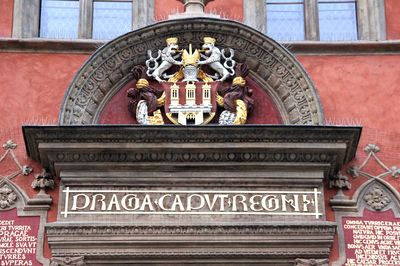
There are two versions of the town coat of arms in use: a large one and a small one. The large version is blazoned as follows: “On the shield, three silver spiked helmets (toad-headed helmets) with gold crowns and red-and-gold visors. From the central helmet rises a silver lion, crowned in gold and adorned with gold armour and a gold tongue; the two outer helmets are each adorned with twelve provincial flags with golden flagpole tips. Shield bearers: two silver lions, each crowned with gold, armed with gold and tongued with gold. Beneath the base, a red ribbon bearing the motto in black capital letters: ‘PRAGA CAPUT REI PUBLICAE.’" The small city coat of arms is described as follows: “On a red field, a rising golden city wall with black joints and silver battlements, featuring three rising golden towers with black joints and black windows crossed with silver bars; the outer towers have shingle-covered golden hipped roofs, the central one taller with a similar hipped roof; in the centre, an open black gate with a silver frame, its gate wings projecting outwards in natural colours and a half-lowered golden portcullis; protruding from beneath it, an arm clad in armour with a sword of the same sort.”[1]
The Prague city flag, with an aspect ratio of 2:3, consists of vertical yellow and red stripes.
Nicknames
In the Middle Ages, the city was known as ‘Praga totius Bohemiæ domina’ (Lady of all Bohemia) or ‘Praga caput regni’ (Capital of the Kingdom [of Bohemia]). A more recent designation is ‘Praga mater urbium’ (Mother of all Cities). It is also referred to as the ‘Golden City’ or ‘Golden Prague’ (Czech: Zlatá Praha), for which there are several explanations (1. Prague’s sandstone buildings glistening golden in the evening sun, 2. the gilded domes of Prague Castle, 3. Prague as a magnet for alchemists under Emperor Rudolf II [1552–1612); furthermore, since the 19th century, it has also been known as the ‘City of a Hundred Spires’ (Czech: Praha stověžatá). The emotional attachment of the city’s inhabitants is expressed in the popular epithet ‘Little Mother Prague’ (Czech: Matička Praha).[2]
Prehistory and Early History
Within the present-day city limits, evidence of settlement from a wide range of periods dating back to the Palaeolithic has been found at several sites. During the La Tène period, there was a large oppidum in what is now the southern district of Závist. The Celts and Germanic tribes already had permanent settlements there.
Middle Ages
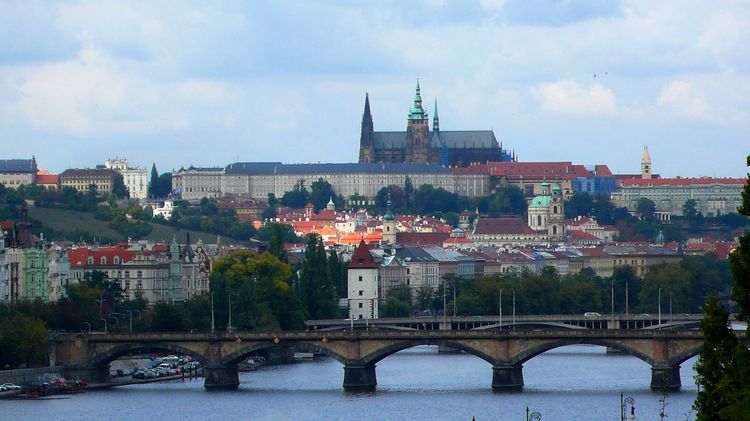
Following the Migration Period, Slavic tribal communities began to settle in the Bohemian Basin from the 6th century AD onwards. Prague Castle was built in the 9th century as a hilltop fortress with an associated town settlement (suburbium); in the 10th century, Vyšehrad followed on the opposite bank of the Vltava as the seat of the Přemyslid dynasty, named after the legendary first ruler, Přemysl. These two protective castle complexes formed the starting points for the founding of towns. They developed into the geographical centres of power for the Bohemian dukes and kings. Around 1230, King Wenceslas/Václav I (1205–1253) granted the Old Town of Prague (Czech: Staré Město) the Nuremberg charter. His son Přemysl II Otakar (1232–1278) founded the Lesser Town (Czech: Malá Strana) in 1257 between the Vltava and the castle. In 1320, the castle town, Hradčany (Czech: Hradčany), which was granted town privileges. The fourth town to be established, in the 1340s, was the New Town (Czech: Nové Město), under King and Emperor Charles IV of Luxembourg (1316–1378), who made Prague the centre of his empire. In 1348, Charles IV founded the university that was later named after him, the first north of the Alps. During his reign, which began in 1346, the Stone Bridge – later known as Charles Bridge (Czech: Karlův most), to replace the older Judith Bridge (1170), which had been destroyed by a flood of the Vltava, and several churches, foremost among them St Vitus Cathedral, construction of which began in 1344 and was not completed until the 20th century.[3] At that time, Prague was the third-largest city in Europe after Rome and Constantinople.
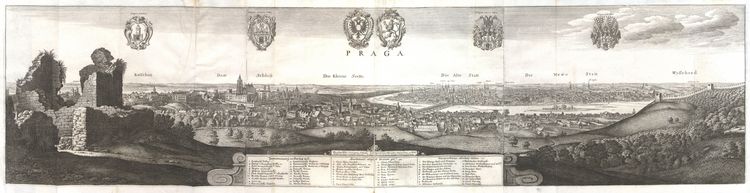
The waning Middle Ages were characterised by internal urban conflicts between the sovereign, the bishop, the patriciate, the guilds and a growing urban underclass. Added to this were religious divisions between the Roman Catholic Church and the Hussite Reformation movement, which came to a head at the Council of Constance following the martyrdom of the theologian and university rector Jan Hus (c. 1372–1415)[4] . In 1419, an angry Prague mob threw several city councillors from the New Town out of a window (the First Defenestration of Prague); in 1420, a Hussite army under Jan Žižka (c. 1360–1424) defeated an army of crusaders led by Emperor Sigismund (1368–1437) on Vitkov Hill. In 1434, the moderate Hussites gained the upper hand over their radical wing. Overall, the towns of Prague emerged from the Hussite Wars with their status strengthened.
Modern times
During the Jagiellonian period (1471–1526), Prague witnessed the development of an estate-based society in Bohemia. Following the extinction of this Central European dynasty, the Habsburgs assumed rule from 1526 to 1918. During this period, Prague’s towns continued to expand their autonomy. Prague experienced a renewed period of prosperity under Emperor Rudolf II (1552–1612), who made Prague his residence in 1583 and transformed it into a centre of European art, culture and science.
The unresolved conflicts between the Catholic Habsburgs – who promoted the Counter-Reformation, for example through the founding of a Jesuit college in 1556 – and the Protestant estates escalated in the early 17th century. The defenestration of two imperial envoys by Protestant representatives of the estates (the Second Defenestration of Prague, 1618) is regarded as the trigger for the Thirty Years’ War. At the Battle of White Mountain, west of Prague, on 8 November 1620, the imperial troops defeated the army of the Protestant estates. This was followed by a systematic replacement of the opposition nobility with families loyal to the Emperor. New monasteries, churches and palaces were built, giving Prague its Baroque character. Severe destruction occurred during the Seven Years’ War (1756–1763).
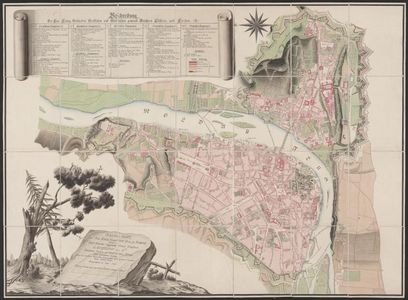
With the Enlightenment, a revival of the Czech language and culture began in Prague; this return to tradition heralded the so-called National Revival in the 19th century. During the reign of Joseph II (1741–1790) and his successors, a series of reforms took place. The most significant development for the city was the merger of the four towns – Hradčany, the Old Town, Lesser Town and New Town – which had previously been administratively independent of one another, to form the unified Royal Capital of Prague (1784). The establishment of manufacturing workshops marked the beginning of proto-industrialisation and, with it, an expansion of the urban area.
During the Revolution of 1848, national-minded Czechs rose up against Habsburg rule, but were crushed by the troops of Marshal Alfred zu Windischgrätz (1787–1862). At the same time, the Slavic Congress was in session in Prague, attended by delegations from various, primarily West Slavic, nations.
The city’s and its citizens’ newfound self-confidence was reflected in prestigious buildings. Connection to the Central European railway network spurred a further economic boom. The medieval city walls were demolished, industrial and residential districts sprang up, and the city’s area expanded steadily through the incorporation of surrounding areas. Prague has had an elected city council since 1861. In the city centre, bourgeois culture flourished with coffee houses, theatres, salons and casinos, whilst the poorer suburbs were home mainly to workers and craftsmen. As a result of the city’s growth, the German majority – which had been continuous since the Middle Ages – was lost around 1860.
Contemporary History
When, at the end of the First World War – a period marked by hardship and loss for the people of Prague as well – the Habsburg Monarchy collapsed, Czech politicians proclaimed the Czechoslovak Republic (Czech: Československá republika) in Prague on 28 October 1918, and the city became its capital. As the seat of the central authorities and the most important cultural institutions, the city experienced a renewed upswing during the interwar period. There were occasional tensions with the German minority in the city, for example in 1920 following the confiscation of the Ständetheater (which had functioned as the ‘Royal German Provincial Theatre’ during the Habsburg era) or the Lex Mareš, passed in the same year, by virtue of which the Czech Charles University was declared the sole legitimate successor to the Alma Mater Carolina, whereupon the German Karl-Ferdinand University of Prague was forced to rename itself the German University of Prague.
At the same time, however, Prague became a hub of the cultural avant-garde in Europe, a magnet for people from all over the world.
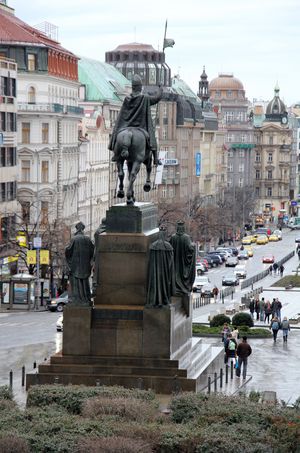
In the final phase of the interwar period, Czechoslovakia was the last democratic state in Europe. Following the annexation of the ‘Sudetenland’ by Nazi Germany in the autumn of 1938, the remaining territory was occupied in March 1939, and the Protectorate of Bohemia and Moravia was proclaimed at Prague Castle on 16 March 1939. This marked the beginning of a reign of terror that lasted until May 1945, during which the Gestapo and the SS tyrannised the people of Prague.[5] There were numerous instances of collaboration on the part of the Czech administration, which continued to function under German control. In the short term, the German occupying authorities intended to exploit the economic resources of this highly industrialised and technologically advanced country. The long-term aim, however, was the complete incorporation of the ‘Protectorate’ and its capital, Prague, into the German Reich, accompanied by the partial assimilation, resettlement or extermination of the Czech people. Key figures in this policy were Sudeten German National Socialists such as the Deputy Reich Protector Karl Hermann Frank (1898–1946) and the Deputy Mayor of Prague Josef Pfitzner (1901–1945), a well-known historian. Members of the numerically significant Jewish community, in particular, were initially oppressed and later deported to the Theresienstadt ghetto and, from there, in some cases to Auschwitz concentration camp or other extermination camps. In Prague, plans were made to establish a ‘Museum of theVanished Race’featuring Jewish artefacts collected from across Bohemia (the foundation of today’s Jewish Museum).[6] Following the assassination of the deputy ‘Reich Protector’ Reinhard Heydrich (1904–1942) – who died as a result – an unprecedented wave of persecution against Czechs in Prague began (‘Heydrichiáda’). Allied air raids, which were actually intended for Dresden, caused extensive damage in the city in early 1945. The tension amongst the oppressed population erupted in early May 1945 in the Prague Uprising. This led to riots against the Germans living in Prague, who were subsequently expelled.
With the return of the Czechoslovak government-in-exile under President Edvard Beneš (1884–1948) in 1945, the formal re-establishment of democratic structures began; however, these were undermined by the Communist Party of Czechoslovakia. In February 1948, the Communists seized power in a coup in Prague. This marked the beginning of a renewed period of oppression and repression. The incorporation of 60 previously independent municipalities led to a massive expansion of the city’s boundaries; this growth was reflected in the numerous prefabricated blocks on the city’s outskirts, whilst at the same time the historic city centre fell into increasing disrepair. In the 1960s, a process of liberalisation initiated by reformers within the Communist Party began, but this slipped out of the government’s control. When, in 1968, the protagonists of the ‘Prague Spring’ began calling for democratic reforms and structures, Warsaw Pact troops intervened in August 1968 and restored the communist dictatorship. In protest against this, on 16 January 1969, the student Jan Palach (1948–1969) set himself alight and died as a result of his injuries.
A period of ‘normalisation’ began, which lasted until 1989. Opposition to the repression took shape underground, finding expression in 1977, following the CSCE resolutions, in Charter 77, a call for liberalisation. A counter-culture to the ruling doctrine of the Communist Party developed within the samizdat. It was from this milieu that the leading figures of the Velvet Revolution in the autumn of 1989 emerged; this revolution, following a peaceful agreement between the government and the opposition, facilitated a non-violent transition to a democratic system.
Since the division of Czechoslovakia into the Czech Republic (Česká republika, the Czech Republic) and the Slovak Republic (Slovenská republika) at the beginning of 1993, Prague has been the capital of the Czech Republic.
Administration
Medieval town charters favoured the rise of individual patrician families, who sought self-government in the face of secular and ecclesiastical rulers and were, in turn, challenged by the guilds. In 1338, construction began on the Old Town Hall (Czech: Staroměstská radnice); the other individual towns also had their own town halls and representative bodies until 1784, including the Jewish Quarter (Czech: Židovské město, Josefov). The merger of the constituent towns reflected an absolutist trend towards standardisation that was also evident elsewhere (cf., for example, the amalgamation of the Königsberg districts of Altstadt, Löbenicht and Kneiphof to form the unified city of Königsberg in Prussia in 1724).
All buildings in Prague have a dual numbering system: alongside the (blue) house numbers based on street names, there are also (red) cadastral numbers, a classification system dating from the Habsburg era.[7]
Prague is currently divided into 22 administrative districts (Czech: správní obvody) and 57 city districts (Czech: městské části). The local self-governing bodies are the City Council and the Mayor (Czech: Primátor).
Population
During the reign of Emperor Charles IV, the four towns of Prague already had a population of around 40,000. By the mid-19th century, approximately 150,000 people lived in Prague, the majority of whom were Czechs, though Germans still accounted for about a third. The population continued to grow rapidly (1900: 222,588, 1925: 718,300, 1950: 931,500),[8] although the number of Germans remained constant at around 25,000 in absolute terms until 1939, meaning that their percentage of the total population declined. Today, Prague has a population of 1,335,084 (as at 31 December 2020). The number of Germans still living in Prague today is minimal: the Association of Germans, Prague and Central Bohemia Region, currently has 20 official members;[9] the situation is likely to be similar for the Prague branch of the Cultural Association of Citizens of German Nationality in the Czech Republic.[10] A bilingual primary school and the bilingual Thomas Mann Grammar School are therefore attended primarily by the children of German and Austrian expatriates.
Before 1941, there were around 39,000 Jews living in Prague; as a result of the Shoah, this number fell to 7,540 by 1945. Today, the Jewish Community of Prague still has around 1,600 members.
Economy
Prague had been an important trading centre since the 10th century. Situated at the crossroads of medieval trade routes, Prague has always been a transit point for goods and people. Towards the end of the 18th century, manufacturing workshops began to be established, which evolved into modern factories over the course of the 19th century. The manufacturing sector, in particular the textile and food industries, became of great importance in Prague, including several large breweries. A strong economic boom, which was also reflected in demographic trends, began around 1860. From 1870 onwards, the Vltava River was regulated within the city limits, whilst the electrification of the city was also driven forward. Between 1939 and 1945, the property titles of Prague’s Jewish residents were ‘Aryanised’ by the Protectorate administration.
In the 19th century, Prague also became a railway hub in Bohemia. The main station (Czech: Hlavní nádraží, 1871–1918: Emperor Franz Joseph Station, 1918–1939: Wilson Station), Masaryk Station (Czech: Masarykovo nádraží, 1862–1918: State Station), designed as a terminus, and the stations at Holešovice (Czech: NádražíPraha-Holešovice) and Smíchov (Czech: Nádraží Praha-Smíchov) are the most important long-distance stations. Alongside trams and buses, the Prague Metro – which currently comprises three lines – has played an important role in local public transport since 1974. Prague has motorway links to Nuremberg, Dresden, Hradec Králové and Brno. Prague is connected to the international air transport network via Ruzyně Airport (also known as Václav Havel Airport since 2012), situated in the north-west of the city.
These transport links fostered economic development, with manufactories and factories springing up in the 18th and 19th centuries. As the capital, Prague is also the service centre of the Czech Republic.
History of Religion and the Church
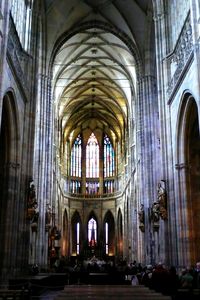
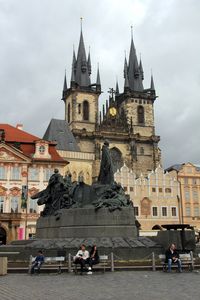
Missionaries from the Diocese of Regensburg were active during the Christianisation of Bohemia. Around 883, Duke Bořivoj I (c. 852–890) and his wife Ludmila (c. 855–921) were baptised. In 973, following negotiations between the Přemyslids, Emperor Otto II (955–983), Rome and the Diocese of Regensburg, the independent Diocese of Prague was founded, whose jurisdiction originally extended far beyond the country’s borders. With the establishment of the Moravian Diocese of Olomouc, its jurisdiction was reduced to Bohemia. Until 1341, it belonged to the Metropolitan See of Mainz and was elevated to an archdiocese in 1344. Prague was home to large monastic communities, including the Benedictine Abbey of Břevnov, the Premonstratensian Monastery of Strahov, the Emmaus Monastery and the Agnes Convent. Branches of the mendicant orders were responsible for caring for the poor.
In the 15th century, Prague became the scene of the Hussite Reformation, sparked by the university rector and theologian Jan Hus, who was condemned to death by burning at the Council of Constance. Among his ideological followers, who called themselves‘Hussites’, violent, religiously motivated conflicts broke out with the Catholics. With the adoption of the Four Prague Articles of the Hussites by Archbishop Konrad von Vechta (c. 1370–1431) in 1421, a period of papal vacancy began from Rome’s perspective, lasting until 1561, as the archbishops now in office—who were also the heads of the Hussite Church—were not recognised by the Pope. The Counter-Reformation pursued by the Habsburgs led, in 1561, to the restoration of the Catholic archdiocese and to the re-Catholicisation of the capital and the entire country. The Catholic faith was established as the only permitted religion in 1627.
The Church suffered severe persecution and expropriation both during the German occupation (1939–1945) and under the communist dictatorship (1948–1989). Following the political changes of 1989, the restitution of church property began.
Prague is not only a centre of the Roman Catholic Church, but also of the Evangelical Church of the Bohemian Brethren, the Czechoslovak Hussite Church (founded in 1918) and the Czech Orthodox Church. However, only a minority of the city’s inhabitants belong to any of the Christian churches or free churches; most Praguers today describe themselves as non-denominational.
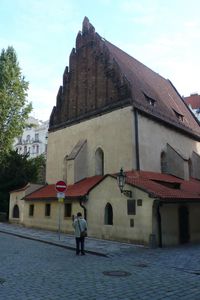
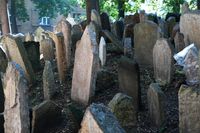
The Jewish community in Prague has been one of the most important in Central Europe since the Middle Ages; despite massive losses in membership as a result of pogroms (1348, 1389), expulsions (1744) and the Shoah (1941–1945), it has existed almost continuously. Although there had already been a synagogue below the castle in the 12th century and a Jewish quarter had existed as early as the 11th century, the Old-New Synagogue (Czech: Staronová synagoga) was built in the 13th century with the involvement of Christian master builders and stonemasons from the nearby St Agnes Convent. Under Charles IV, the Jewish Quarter was granted special rights; however, these were severely curtailed in the 18th century, for instance by the ‘Familiantenordnungen’ (family regulations) applicable throughout Bohemia, which set a limit on the maximum number of Jewish families permitted to reside in any one place. In the 19th century, the former ghetto of the Jewish Quarter became the Josefstadt district (Czech: Josefov), most of whose buildings were demolished as part of an urban regeneration project, with the exception of a few places of worship and the Old Jewish Cemetery. The Pinkas Synagogue (16th century) as well as the Klaus Synagogue (1689–1693), the Maisel Synagogue (1590) and the Spanish Synagogue (1868) have been preserved. Also worth mentioning is the Jerusalem Synagogue, built in 1905–1906 and situated not far from the main railway station. Jewish cemeteries can be found in various parts of the city, including Žižkov and Libeň.
History of Architecture and Art
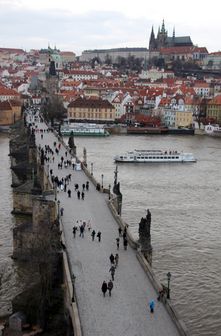
Prague’s cityscape can be ‘read’ like an open book of architectural and art history, spanning from the Middle Ages to the 21st century. As early as the 10th century, the Oriental traveller Ibrahim Ibn Jakub described Prague as a city built ‘of stone and lime’. Surviving from the Romanesque period are the cellars of residential buildings in the Old Town, as well as several church rotundas and the monastery church of St George at the Castle. An outstanding example of early Gothic architecture is the House of the Stone Bell in the Old Town.
The work of the architect and sculptor Peter Parler was of decisive importance during the reign of Charles IV. The choir of St Vitus Cathedral, Charles Bridge with its two bridge towers, the bay window of the main university building, Karlstein Castle not far from Prague, and a number of churches bear witness to this. In the field of religious painting, Master Theodoricus (14th century) is particularly noteworthy from this period.
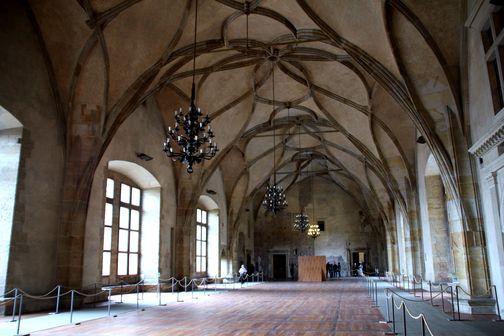
During the reign of the Jagiellonian monarchs, the Renaissance took hold in Prague. The Bavarian architect Benedikt Ried (1454–1534) designed, amongst other things, the Vladislav Hall at Prague Castle. On the initiative of the Habsburgs, the Royal Summer Palace (Czech: Královský letohrádek) was built to designs by Paolo della Stella (c. 1500–1552), followed later by the Hvězda Hunting Lodge (Czech: Hvězda) just outside the city gates. The Astronomical Clock was installed on the Old Town Hall tower around 1490.
Printing also flourished in Prague at that time, with the printing houses of Jiří Melantrich (c. 1511–1580) and Daniel Adam of Veleslavín (1546–1599).
During the reign of Rudolf II, Prague was a European centre of the arts, home to Giuseppe Arcimboldo (c. 1526–1593), Hans von Aachen (1552–1615), Bartholomäus Spranger (1546–1611), Aegidius Sadeler (c. 1570–1629) and Joseph Heintz the Elder (1564–1609), as well as the sculptor Adriaen de Vries (c. 1545–1629). Among the Protestant artists who were forced to leave the Bohemian capital after 1620 was the renowned copperplate engraver Wenzel/Václav Hollar (1607–1677).
Kilian Ignaz Dientzenhofer (1689–1751), the son of the master builder Christoph Dientzenhofer (1655–1722), who had emigrated to Bohemia from Upper Bavaria,. Another significant Prague Baroque architect was František Maximilián Kaňka (1674–1766). In the field of sculpture, Jan Brokoff (1652–1718) from Spiš and Matthias Bernhard Braun (1684–1738), originally from Tyrol, were pioneers. Baroque painting in the Bohemian capital was dominated by Karel Škréta (1610–1674), Peter Johann Brandl (1668–1735) and Wenzel Lorenz Reiner (1689–1743). In addition to those mentioned, artists from Italy and Spain were also active in Prague during the 17th and 18th centuries.
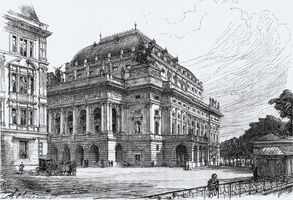
In the 19th and early 20th centuries, Prague experienced a veritable building boom; inspired by a new sense of Czech national identity, this period saw the expansion of Vyšehrad, including the Slavín Memorial Cemetery, the construction of the National Theatre (Czech: Národní divadlo, 1868–1881 and 1883), the Rudolfinum (1876–1884) and the National Museum (Národní muzeum, 1885–1891). Before the First World War, modern architectural styles gained prominence – including the Secession, the most prominent example of which is the monumental Municipal House (Czech: Obecní dům, 1905–1911) – and Expressionism (such as the House of the Black Madonna [Czech: Dům U Černé Matky Boží], 1911–1912, and the residential buildings below Vyšehrad).
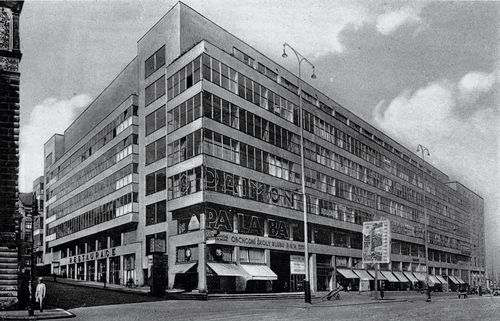
During the interwar period, buildings in the ‘Neues Bauen’ style were erected as a symbol of the democratic constitution and the cosmopolitan outlook of many citizens, with so-called Rondo Cubism, Late Expressionism and Functionalism succeeding one another in turn. Prominent examples of the latter include the Müller Villa, with its interior designed by Adolf Loos, and the Prague Exhibition Palace.
After the Second World War, Prague was surrounded by a ring of satellite towns featuring multi-storey blocks of flats built using the prefabricated panel construction method. However, this period also produced a number of internationally recognised examples of Brutalism.
Music
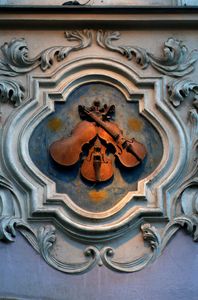
It was in Prague that Wolfgang Amadeus Mozart (1756–1791) enjoyed his greatest successes, including the premiere of his opera *Don Giovanni* in 1787. The Conservatoire of Music was founded in 1811.
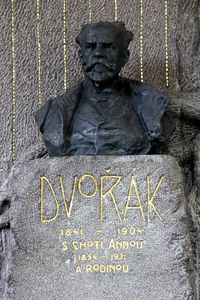
The two great Czech composers of the 19th century were Bedřich Smetana (1824–1884) and Antonín Dvořák (1841–1904). Smetana had come to Prague as a young man and had become part of the social and musical life of the Bohemian capital. He made a name for himself as a composer of operas and symphonic works. His quest for a ‘national music’was continued by the internationally renowned Dvořák, whose symphonies and operas also form part of the classical repertoire of Prague’s concert halls and opera houses.
To this day, Prague is regarded in Central Europe as a mecca for classical music, jazz and a wide variety of forms of light music.
Special cultural institutions
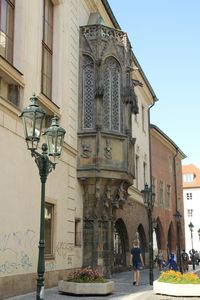
Prague has been a centre of scholarly learning for centuries, supported by the monasteries and, since 1348, by Charles University (Czech: Univerzita Karlova). Between 1882 and 1939, following the division of the city, there was a Czech university and a German university; during the German occupation from 1939 to 1945, only the German University of Prague existed, which was closed in 1945; after the Second World War, the Czech Charles University was re-established. Since the second half of the 19th century, there has also been a Technical University, as well as an Agricultural University, an Academy of Fine Arts, a Conservatoire and various higher technical colleges.
The National Library (Czech: Národní knihovna) in the Klementinum, the building of the former Jesuit college, and the National Archive (Czech: Národní archiv) house valuable cultural treasures.
Other significant cultural institutions in Prague include the following museums and galleries:
- Museum of the Capital City of Prague (Czech: Muzeum hlavního města Prahy, http://www.muzeumprahy.cz),
- Prague City Gallery (Czech: Galerie hlavního města Prahy, https://www.ghmp.cz),
- Prague National Gallery (Czech: Národní galerie v Praze, (www.ngprague.cz) with several locations
- National Museum (Czech: Národní muzeum, www.nm.cz) with several branches
- Museum of Decorative Arts (Czech: Uměleckoprůmyslové muzeum, www.upm.cz)
- Jewish Museum in Prague (Czech: Židovské muzeum v Praze, www.jewishmuseum.cz)
- National Technical Museum (Czech: Národní technické muzeum, www.ntm.cz)
- National Agricultural Museum (Czech: Národní zemědělské muzeum, www.nzm.cz).
- Kampa Museum (for modern art, www.museumkampa.cz).
as well as theatres and concert halls:
- National Theatre (Czech: Národní divadlo, www.narodni-divadlo.cz,
- Estates Theatre (Czech: Stavovské divadlo, www.narodni-divadlo.cz/cs/sceny/stavovske-divadlo),
- State Opera (Czech: Státní opera, www.narodni-divadlo.cz/cs/sceny/statni-opera),
- Vinohrady Theatre (Czech: Divadlo na Vinohradech, www.divadlonavinohradech.com
- Rudolfinum (www.rudolfinum.cz/,
- Theatre on the Balcony (Czech: Divadlo na zábradlí, www.nazabradli.cz/),
- Dejvice Theatre (Czech: Dejvické divadlo, https://www.dejvickedivadlo.cz).
Literature and academia
We know of notable chroniclers from the Middle Ages, foremost among them Cosmas of Prague (c. 1045–1125). Throughout the centuries, Prague has been a centre for writers of various languages.
‘Prague German literature’ constituted a unique phenomenon around 1900. This umbrella term is used in German studies to refer to German-speaking authors who were active between the 1890s and 1939. They used to meet in the coffee houses ‘Concordia’, ‘Jung-Prag’ and ‘Arco’. Among many others were Rainer Maria Rilke (1875–1926), Hugo Salus (1866–1929), Paul Leppin (1878–1945), Gustav Meyrink (1868–1932), Hugo Steiner-Prag (1880–1945), Oskar Baum (1883–1941), Max Brod (1884–1968), Franz Kafka (1883–1924), Egon Erwin Kisch (1885–1948), Franz Werfel (1890–1945), Louis Fürnberg (1909–1957) and Franz Carl Weiskopf (1900–1955).
They represented different literary movements – ranging from realism through expressionism and New Objectivity to the theatre of the absurd – as well as divergent political views; many of them came from the assimilated Jewish middle class in Prague, which had been partly shaped by the German-speaking culture of the Habsburg Monarchy. Key publications for literary features and shorter literary forms were *Bohemia* (1828–1938) and the *Prager Tagblatt* ( 1876–1939), in which writers from abroad such as Joseph Roth (1894–1939) and Sándor Márai (1900–1989); alongside these, there were numerous German-language or multilingual literary journals and publishing houses in Prague. Prague’s German-language literature has been the subject of extensive research in the fields of literary and cultural studies in recent years.
4. Discourses and controversies
When, in the 19th century, the Germans of Prague lost their demographic majority and, with it, administrative control over the city, the notion of Prague as a ‘German city’ began to take hold in German nationalist discourse – even though the Germans no longer constituted the dominant element, the city had, in the past, been shaped to a significant extent by German culture and history, and therefore the city rightfully belonged to the Germans.[11] This line of thinking reached its first peak during the so-called Badeni Crisis in the late 19th century,[12] when a bilingual system of administration was to be introduced in Bohemia and Moravia, but this failed due to resistance from German politicians and civil servants. It flared up again in particular following the founding of the Czechoslovak Republic in 1918, which was denounced by German nationalists as an act of presumption. In the ethno-nationalist Sudeten German discourse, the Germans of Prague were co-opted as ‘Sudeten Germans’, whilst in reality, as metropolitan, urban citizens, they looked down from a position of superiority upon the ‘peripheral Bohemians’ who had been socialised in small towns or villages. During the years of the Protectorate of Bohemia and Moravia, efforts were made to Germanise Prague by instilling terror, reducing the cultural life of the Czechs to a minimum and, for example, closing down their university. In 1945, this policy backfired with full force against the Germans of Prague, who were now held collectively responsible for the crimes of the Third Reich.
In the discourse on displaced persons after 1945, the Sudeten German Association continued to appropriate German culture in Prague. Now, even Jewish figures associated with the German language and culture – such as Franz Kafka, Max Brod and Egon Erwin Kisch – were declared to be‘Sudeten Germans’– despite the fact that, prior to 1939, ethnic ideologues from Sudeten German circles had frequently lamented the ‘Judaisation’ of Prague. This ignored the fact that the use of the German language and German ethnicity did not necessarily go hand in hand; quite the contrary: There are numerous examples in Eastern Europe, particularly within the former Habsburg Monarchy, where German was used as a cultural language without the individuals in question necessarily identifying as ‘Germans’ in an ethnic or national sense. The German-language literature in Czernowitz/Černivci/Cernăuți, the capital of Bukovina – predominantly written by Jewish authors – provides a good point of comparison in this regard.
Bibliography
- Peter Becher, Jörg Krappmann, Manfred Weinberg, Steffen Hohne (eds.): Handbook of German Literature in Prague and the Bohemian Lands. Stuttgart 2017.
- Hartmut Binder: Prague. Literary Walks through the Golden City. Prague 2017.
- Detlef Brandes, Alena Míšková (eds.): From the Eastern European Studies chair to Prague City Hall. Josef Pfitzner 1901–1945. Essen 2013.
- Gary B. Cohen: The Politics of Ethnic Survival: Germans in Prague, 1861–1914. West Lafayette 2006.
- Peter Demetz: Prague in Black and Gold. Seven Moments in the Life of a European City. Munich, Zurich 1998 (original title: Prague in Black and Gold. The History of a City. London 1998).
- Johanna von Herzogenberg: Prague. A Guide. Munich, New York ⁹1997.
- Václav Ledvinka, Jiří Pešek: Prague. Prague 2001.
- Ines Koeltzsch: Divided Cultures. A History of Czech-Jewish-German Relations in Prague (1918–1938). Munich 2012.
- Bernard Michel: History of Prague. Paris 1998.
- Alena Míšková, Vojtěch Šustek (eds.): Josef Pfitzner and Prague under the Protectorate, 1939–1945. Prague 2000–2001.
- Cynthia Paces: Prague Panoramas. National Memory and Sacred Space in the Twentieth Century. Pittsburgh, PA 2009.
- Jiří Padevět: Prague 1939–1945 under German occupation: Places – Events – People. Halle (Saale) 2021.
- Jiří Padevět: The Bloody Summer of 1945: Post-war Violence in the Bohemian Lands. Leipzig 2020.
- Jiří Pešek: From Conurbation to Metropolis. Prague and Central European Metropolises 1850–1920 [From Conurbation to Metropolis: Prague and the Central European Metropolises 1850–1920]. Prague 1999.
- Jaroslaus Schaller: Description of the Royal Capital and Residence City of Prague, Together with All the Notable Sights Therein. Prague 1795 (3 vols.).
- Oskar Schürer: Prague. Culture, Art, History. 3rd, revised edition, Prague 1935.
- Jaroslava Staňková, Jiří Stursa, Svatopluk Voděra: Prague Architecture. Significant Buildings from Eleven Centuries. Prague 1991.
- Jan Vlk et al. (eds.): History of Prague. Volume 1: From the Earliest Times to the Merger of the Prague Towns (1784). Prague 1997; Volume 2: From the Merger of the Towns in 1784 to the Present Day. Prague 1998.
- Tobias Weger: A Brief History of Prague. Regensburg 2013.
Periodicals
- Pražský sborník historický (The Prague Historical Review), 1964 onwards, published by the Prague City Archives.
- Český časopis historický (The Czech Historical Review), 1895 onwards.
- Landesecho. Published by the Regional Assembly of German Associations in the Czech Republic, 1994 onwards.
- Prager Zeitung, 1991–2016 as a print edition, online since then: https://www.pragerzeitung.cz
Web links
- https://www.praguecitytourism.cz (Prague Information Office)
- kramerius5.nkp.cz (Digital Library of the Czech National Library)
- digitalniknihovna.mlp.cz (Digital Library of the Prague City Library)
- www.herder-institut.de/bildkatalog/wikidata/Q1085 (Images of Prague in the image archive of the Herder Institute, Marburg)
Notes
[1] See Znaky a vlajka Prahy [The Emblems and Flag of Prague], www.czechatlas.com/prague/symbols-of-town/ (26 March 2021). See also: Václav Vojtéšek: Znak hlav[ního] města Prahy/Les armes de la ville de Prague. Prague 1928.
[2] See ‘On the Demolition of Prague’s Walls’. In: *Český lev*. *Pražské noviny předměstské*, vol. 2, no. 10, 15 April 1874, p. 1.
[3] On Charles IV and his era, see Markus Hörsche, Jiří Fajt (eds.): Emperor Charles IV 1316–2016. Exhibition catalogue. National Gallery, Prague/Germanisches Nationalmuseum, Nuremberg. Nuremberg 2016.
[4] See Andrea Strübind, Tobias Weger: Jan Hus. 600 Years of the First Reformation. Munich 2015 (Publications of the BKGE 60).
[5] See Jan Boris Uhlíř: *Praha ve stínu hakového kříže* [Prague in the Shadow of the Swastika]. Prague 2005.
[6] See Jan Björn Potthast: The SS Central Jewish Museum in Prague. Research into Opponents and Genocide under National Socialism. Frankfurt am Main, New York 2002.
[7] Ernst Gamillscheg: Prague, Vienna. Two European Metropolises Through the Centuries. Vienna 2003, p. 223.
[8] Prague; de.wikipedia.org/wiki/Prag (26 March 2021).
[9] landesversammlung.cz/de/verband-der-deutschen-region-prag-und-mittelboehmen, 7 April 2021.
[10] www.kulturverband.org/?page_id=75&lang=cs, 7 April 2021.
[11] See Tobias Weger: ‘The “German Prague” – on the enduring nature of a myth’. In: Yearbook for German and East European Folklore 44 (2001), pp. 197–218.
[12] Named after the Cisleithanian Prime Minister and Imperial and Royal Minister of the Interior, Kazimierz Feliks Badeni (1846–1909), who, in a language decree dated 5 April 1897, decreed the equal status of Czech and German as official languages in the Bohemian lands. This concerned the ‘internal’ official language, meaning that German civil servants would also have had to be proficient in Czech, which they generally were not, whilst Czech civil servants were bilingual. Following massive protests by German-speaking Bohemians and Moravians, who feared that Czech officials would drive them out of their jobs, Badeni was forced to resign from his posts on 28 November 1897; his language ordinance was subsequently revised. The ‘Badeni Crisis’ is regarded as a key turning point in German nationalist mobilisation in the Bohemian lands. See Hans Mommsen: 1897. The Badeni Crisis as a Turning Point in German–Czech Relations. In: Detlef Brandes (ed.): Turning Points in Relations between Germans, Czechs and Slovaks 1848–1989 (Publications of the German-Czech and German-Slovak Historians’ Commission 14). Essen 2007, pp. 111–118.
Citation
Tobias Weger: Prague/Praha. In: Online Dictionary of the Culture and History of Germans in Eastern Europe, 2021. URL: ome-lexikon.uni-oldenburg.de/p32515 (accessed 30 July 2021).
Terms of use for this article
Copyright © University of Oldenburg and the Federal Institute for the Culture and History of Germans in Eastern Europe (BKGE), all rights reserved. This work was produced as part of the project ‘Online Encyclopaedia on the Culture and History of Germans in Eastern Europe’ and may be reproduced and published provided the rights holders’ consent has been obtained. Please contact:
If you have any specialist comments or additions to the text, please contact the editorial team, citing relevant literature and source references.