

Czernowitz/Černivci/Cernăuţi
Czernowitz/Černivci/Cernăuţi
Names in other languages
Russian: Černovcy; Romanian: Cernăuţi; Polish: Czerniowce; Yiddish: טשערנאָװיץ; Hebrew: צֶ׳רנוֹבִיץ
Etymology
The origin of the town’s name has not been conclusively established. It may derive from the Polish word ‘czern’ (= ford), as a medieval trade route crossed the Pruth at this point. Other sources derive the name from the Slavic term ‘černo’ (= black) and interpret it as a reference to the colour of the city walls during the reign of the Rurikid dynasty.
Location
Chernivtsi is situated in the south of western Ukraine at48° 18' north latitude,25° 56' east longitude, 248 m above sea level, approximately 40 km from the Romanian border and 60 km from the Moldovan border.
Topography
The town, situated near the Ukrainian Carpathian Forests, lies mainly on the right bank of the Pruth, a tributary of the Danube.
Political and administrative affiliation
Ukraine. Chernivtsi is the capital of Chernivtsi Oblast (Černivec'ka oblast') and the seat of the regional administration. The city is currently divided into three districts (Peršotravnevyj, Ševčenkivs’kyj and Sadhirs’kyj [German: Sadagora]).
Coat of arms
Chernivtsi was granted its first coat of arms in 1784. It underwent changes during the Austrian, Romanian, Soviet and Ukrainian periods. Today, it is partly based once again on the old Austrian coat of arms and depicts a silver city gate with seven battlements on a red background, featuring the golden trident as a symbol of Ukraine.
Common or historical nicknames
"Jerusalem on the Pruth", "Little Vienna", "Austria’s Jewish Eldorado". These geographical and conceptual descriptions are terms coined in the 19th and early 20th centuries.
Middle Ages
Czernowitz was first mentioned in a document in 1408 as a customs post in a charter granting free trade issued by the Moldavian Prince Alexander the Good (Alexandru cel Bun). A 12th-century list of towns in the Ruthenian Principality of Halych mentions a place called Cern-Askyi (= Czernowitz?) on the Pruth. In the 15th century, the town was a market town within the catchment area of the important trading centre of Suczawa/Suceava and was burnt to the ground in 1497 during the war between Stephen the Great (Stefan cel Mare) and Poland. Czernowitz was part of the Principality of Moldavia until 1774; from 1512 onwards, it was a vassal state of the Ottoman Empire.
Modern times
Following the Russo-Turkish War of 1768–1774, Czernowitz and Bukovina were occupied by an Austrian military unit, thereby establishing a link between Northern Transylvania and Galicia (annexed by Joseph II in 1772). Following negotiations with the Ottoman side, Chernivtsi and Bukovina became part of the Austrian Crown in 1775 and were incorporated into the Crown Land of Galicia and Lodomeria. From 1782 onwards, German-speaking settlers (craftsmen and farmers) from south-west Germany, Bohemia, the Banat and the Spiš region began to settle in the area. They had been guaranteed long-term exemption from taxation and military service. In Rosch/Roša near Czernowitz – which later became part of the town – it was primarily so-called ‘Swabians’, who originated from south-west Germany, who settled there and who later had a lasting influence on the character of the Germans of Czernowitz. From 1789, Joseph II’s Patent on Jewish Affairs made it easier for Jews in Galicia and Bukovina to choose their professions and guaranteed them leasehold rights, which led to increased settlement from various parts of the Habsburg Monarchy. Jews from Russia also came to the region without being summoned.
In 1832, Czernowitz was granted full municipal self-government and, after Bukovina had been granted regional autonomy with its own provincial government (from 1854) and a provincial parliament in Czernowitz (from 1861), it became the provincial capital of the Crown Land (until 1918). As a result of the expansion of the administration and urban infrastructure, from the mid-19th century onwards civil servants, teachers and members of the liberal professions moved to the city, including many Jews, the majority of whom identified with German-Austrian culture. For many decades, they constituted the most significant cultural and economic force in the city and, through a dense network of charitable and educational societies, fostered an extraordinary development of civil society.
Contemporary History

Until 1914, Czernowitz was an important garrison town of the Habsburg Monarchy, home to several Imperial and Royal regiments. During the First World War, between 1914 and 1917, it was occupied three times by Russian troops (the longest period of occupation lasted from 18 June 1916 to 3 August 1917). During this period, there were large-scale exoduses of the city’s population to the western crown lands. Following its recapture by Austrian troops in August 1917, Romanian units entered Czernowitz on 11 November 1918. Under the 1919 Paris Peace Treaties, Bukovina and Czernowitz were awarded to Romania. The interwar period was characterised by processes of Romanianisation, which ultimately led, in the late 1930s, to the revocation of Romanian citizenship for a third of the city’s Jewish inhabitants. Although the secret additional protocol tothe ‘Hitler–Stalin Pact’ of 23 August 1939 had only laid claim to Bessarabia, the Soviet government, shortly before the expiry of an ultimatum to Romania (26 June 1940), the Soviet government also demanded the annexation of Bukovina. On 28 June 1940, Northern Bukovina, including Chernivtsi, was occupied by Soviet units. The “German-Soviet Agreement on the Resettlement of the Ethnic German Population from the Territories of Bessarabia and Northern Bukovina to the German Reich”, signed on 5 September 1940, was followed between 27 September and 17 November 1940 by the almost complete resettlement of the German ethnic group. Following the German Reich’s invasion of the Soviet Union, crimes were committed against the large Jewish population in Chernivtsi from 6 July 1941 onwards, after Romanian units and a detachment of SD Einsatzgruppe D under Otto Ohlendorf had reached the city. They ransacked Jewish institutions, burnt down the Jewish synagogue and shot several hundred Jews, including representatives of the Jewish community such as the Chief Rabbi Abraham Jakob Mark. Almost 50,000 Jews from Czernowitz were crammed into a ghetto. In October and November 1941 and in June 1942, 32,530 Jews were deported to the camps in Transnistria. With the help of special permits (authorisations), 15,633 Jews were able to remain in Czernowitz.[1] On 28 March 1944, the Red Army reached Chernivtsi. From 1947 to 1991, the city belonged to the Ukrainian Soviet Socialist Republic. Since December 1991, Chernivtsi has been part of independent Ukraine.
Population
The population of Czernowitz had been growing steadily since 1775 (2,300 inhabitants). In 1832, Czernowitz had a population of around 11,000, including Romanians, Ukrainians (Ruthenians), Germans, Jews, Poles and other ethnic groups. Over a period of around 40 years, the population rose from 33,884 (1869)[2] to 87,113 (1910). In 1910, the population comprised Jews (32.8 per cent), Ukrainians (17.5 per cent), Poles (17.1 per cent), Romanians (15.4 per cent), Germans (14.7 per cent) and members of other nationalities (2.5 per cent). 48.4 per cent of the town’s inhabitants stated in the survey that German was their everyday language.[3] According to the 1930 census, 112,427 people lived in Czernowitz, including 42,592 Jews (37.9 per cent), 30,367 Romanians (27 per cent), 16,359 Germans (14.5 per cent), 11,130 Ukrainians (9.9 per cent), 8,986 Poles (8 per cent) and 2,993 members of other ethnic groups (2.7 per cent, mainly Russians and Hungarians). In this census, 32,731 residents stated Yiddish as their mother tongue and 26,223 stated German.[4] Between 1940 and 1946, the population was almost entirely replaced as a result of the deportation of Jews to Siberia and Transnistria, the resettlement of Germans, the flight or repatriation of Romanians, and finally a controlled influx of Ukrainians, Russians and members of other ethnic groups (including many Jews) from other parts of the Soviet Union. Around 30 per cent of the Jewish population had survived the war years. The majority of them resettled in Romania by 1946 and later emigrated to Palestine/Israel. The 2001 census recorded a population of 236,691 for Chernivtsi, comprising 189,021 Ukrainians (79.9 per cent), 26,733 Russians (11.3 per cent), 10,553 Romanians (4.5 per cent), 3,829 Moldovans (1.6 per cent) and 6,555 others (including 1,408 Poles, 1,308 Jews and 971 Belarusians).[5] According to the 2013 census, Chernivtsi has a population of 258,842.[6]
Economy
Chernivtsi is the most economically significant city in south-western Ukraine and a major centre for the textile, engineering and food industries. The city is also a service centre and is home to one of the largest commodity markets in Ukraine (Kalynivs’kyj rynok, 35 ha). Along with Lemberg/L’viv, Kiew/Kyiv and Odessa/Odesa, Chernivtsi is a major tourist attraction in Ukraine. The city has an international airport.
Society

The German House in Czernowitz/
Černivci (2013), built in 1910 [Photo: M. Winkler].

The multilingual nature of the city’s population and a relatively even distribution of ethnic groups fostered a culture of tolerance and the capacity for dialogue between cultures for a long time. It is undisputed that the linguistic and national disparities experienced on a daily basis helped to shape the residents’ intercultural awareness. From the 1860s onwards, a multi-layered social structure emerged in Chernivtsi, which was reflected in the association and press movements and in the Romanian, Ukrainian, Polish, German and Jewish national houses. The Germans founded the ‘Association of Christian Germans’ (1897) and built the ‘German House’ (1910), whilst the Jewish population established the ‘Jewish National House’ (1908), but subsequently became more distinct from the other ethnic groups; alongside the larger groups of assimilated and Germanised Jews, Zionist and socialist (Bundist) circles also emerged. As, for many years, “overarching political common ground was valued more highly than particular interests”[7], inter-ethnic and inter-denominational cooperation frequently took place in the fields of culture, education and politics. Industrialisation and nationalist movements also led to social and political tensions in Czernowitz prior to 1914, although these were less pronounced than in other cities within the Habsburg Monarchy. After 1918, the new political landscape also affected communal life in Czernowitz. Germans, Jews, Ukrainians and Poles – although they effectively constituted the majority – were now only accorded minority status, subject to legal restrictions. The state-driven Romanianisation of the administration and public institutions (schools, the university, the theatre) altered the social climate in the city. At the same time, these measures triggered a desire for compensation, and the social networks and cultural life of the individual nations flourished particularly well. From the mid-1930s onwards, economic crises and the radicalisation of political groups led to social erosion, which was also linked to the loss of civil liberties, particularly for Jews and Ukrainians, following the introduction of the royal dictatorship in 1938.
History of Religion and the Church
In 1797, German settlers in Czernowitz began keeping the church registers of the Protestant parish (Augsburg Confession). In 1814, the first Catholic parish church was completed. From 1873, the city had an archdiocese with the seat of the metropolitan, to whom all Orthodox Christians from the kingdoms and states represented in the Imperial Council were subject. The Jewish community administered around 70 synagogues (including the Israelite Temple and the Great Synagogue) and prayer houses. The distribution of religious denominations amongst the population of Czernowitz largely corresponded to the ethnic structure. The 1890 census revealed the following: 32 per cent Jewish (17,359 people), 27.4 per cent Roman Catholic (14,822), 12 per cent Greek Catholic (6,522), 22.9 per cent Greek-Oriental (= Orthodox, 12,431), 5 per cent Protestant (2,697), 0.7 per cent other.[8] Until 1940, the Jewish community was the largest religious group. Today, the majority of residents belong to the Ukrainian Orthodox Church (Kyiv Patriarchate and Moscow Patriarchate), whilst others belong to the Ukrainian Greek Catholic Church and the Autocephalous Orthodox Church.

Special cultural institutions
Of cultural significance is the theatre, built by the architects Ferdinand Fellner and Hermann Helmer in 1905. The city is home, amongst other things, to an art museum housed in the former building of the savings bank (in the Vienna Secession style), an ethnographic museum (founded in 1863), the Chernivtsi Museum of Jewish History and Culture of Bukovina, and the State Archive of the Chernivtsi Region (Deržavnyj arhivČernivec’koï oblasti), which houses one of the largest collections of German-language documents and press clippings outside the German-speaking world. The Jewish cemetery, with around 50,000 graves, is also of cultural and historical significance.
Education and Science

, Chernivtsi, main building (2013), formerly the archbishop’s residence
[Photo: M. Winkler].

From the 1870s onwards, language decrees and new education laws fostered a distinctly diverse education system in Chernivtsi. This led to the establishment of teacher training colleges and educational associations, which contributed to social modernisation but also reinforced the nationalisation of the education system. In 1875, the Franz Joseph University (now the Yuriy Fed’kovych National University of Chernivtsi) was founded as the easternmost German-speaking university, comprising three Schools (Law, Philosophy and Theology, the latter also using Romanian and Ruthenian as the language of instruction) was founded. Notable professors included the economist Joseph A. Schumpeter, the sociologist of law Eugen Ehrlich, the English scholar Leon Kellner, and the historians Ion Nistor and Raimund Friedrich Kaindl.
Art History
The population boom in the second half of the 19th century went hand in hand with urban expansion and a flurry of building activity. The largely intact townscape is characterised by buildings in the Historicist and early Modernist styles from the Habsburg era; examples include, alongside the theatre, the Town Hall, modelled on Italian city palaces (1847–1848, architects Andreas Mikulicz and Adolf Marin) and the railway station, featuring Neo-Baroque and Art Nouveau motifs. The most significant architectural monument is the former residence of the Archiepiscopal Metropolitan (now a university building), completed in 1882, in a mixed Neo-Gothic and Byzantine style (1864–1882, architect Josef Hlavka), a UNESCO World Heritage Site since 2011. The Great Synagogue, built in the Moorish style (1873–1878, architect Julian Zachariewicz), was set alight by the German occupying forces in 1941. Since 1959, the heavily altered building has housed a cinema.
Press history
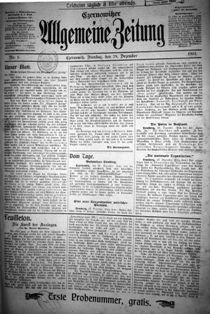
Czernowitzer Allgemeine Zeitung,
Front page of the first issue dated 29
December 1903 [Photo: M. Winkler].

Czernowitz was the largest centre for the German-language press outside the German-speaking world between 1848 and 1940. Alongside individual figures (Philipp Menczel, Adolf Wallstein), who contributed significantly to the modernisation of the press in the city, this boom in the press was also linked to the numerous associations (political, cultural and educational, amongst others) that published their own newspapers and magazines. An estimated 300 German-language periodicals were published, including daily and weekly newspapers, monthly magazines and specialist journals. The most important daily newspapers were the *Bukowinaer Rundschau* (1882–1907), the *Czernowitzer Allgemeine Zeitung* (1903–1940) and the *Czernowitzer Morgenblatt* (1918–1940).
Bibliography
The literary output of authors from Czernowitz helped to shape the city’s legend. To this day, perceptions of the city are influenced by the works of renowned poets; it was a ‘special landscape […], which was home to many artists, poets, and lovers of art, literature and philosophy’ (Rose Ausländer), in which ‘people and books lived’ (Paul Celan) or in which the resurgence of German-language poetry in the 1920s and 1930s – described simply as a ‘miracle’ (Alfred Margul-Sperber). Czernowitz was the birthplace and home of significant German- and Yiddish-speaking writers and poets. Among the best known are Karl Emil Franzos, Paul Celan (born Paul Antschel), Rose Ausländer, Selma Meerbaum-Eisinger, Alfred Margul-Sperber, Moses Rosenkranz, Alfred Gong, Alfred Kittner, Immanuel Weissglas, Gregor von Rezzori, Elieser Steinbarg, Itzik Manger and Josef Burg. Furthermore, the works of the Ukrainian authors Osyp Jurij Fed’kovyč and Ol’ha Kobyljans’ka, as well as those of the writer Aharon Appelfeld, who lives in Israel and writes in Hebrew, are also of outstanding literary quality.
Culture of memory and remembrance
Up until 1991, there were extensive changes to street names in Chernivtsi throughout every historical period; national monuments also disappeared and new ones were erected. Today, numerous commemorative plaques honour politicians, writers and artists – regardless of their nationality or ideological leanings. Former residents of Chernivtsi now living in Europe, the USA and Israel, along with their descendants, keep the city’s memory alive through publications and websites. Interest in the city’s cultural and literary heritage has also grown on the Ukrainian side in recent years. The annual ‘Meridian Czernowitz’ poetry festival, held every September (since 2010) – which includes a literary co-operation with the Leipzig Book Fair (2012–2014), and the Ukrainian-German Cultural Society at the Chernivtsi ‘Zentrum Gedankendach’ (founded in 2009) are currently the two most important venues whose events combine the cultural and literary past with contemporary art forms. Performances by young European artists and authors, as well as a writer-in-residence programme, promote exchange between creative professionals from numerous countries. The Paul Celan Literature Centre (Literaturnyj Celanivs’kyj centr, due to open in September 2014) will further deepen the discourse on remembrance concerning the city’s cultural heritage.
4. Discourses/Controversies
In the wake of the political upheavals in Chernivtsi between 1775 and 1991, national-oriented historiographies emerged, some of which sought to ideologically reinterpret or distort historical processes and failed to do justice to the city’s multi-ethnic character. To this day, debates between Romanian and Ukrainian historians continue to centre on the question of the ‘national’ origins of the city and the region. In Romanian historiography, for example, the occupation of the city in 1918 is interpreted as a liberation from Austrian rule, with Chernivtsi and Northern Bukovina being described as originally ‘Romanian territory’[9] , whilst the nationalist movement is idealised. In the Soviet interpretation, the rule up to 1918 was likewise described as an ‘Austrian occupation’ and the period 1918–1940 as the ‘occupation of Boyar Romania’[10] . Since 1993, writings by the Organisation of Ukrainian Nationalists have once again been circulating in Ukraine, declaring Northern Bukovina, including Chernivtsi, to be historically Ukrainian tribal territory.[11]
Bibliography
- Andrei Corbea-Hoisie (ed.): Czernowitz. A Jewish Cityscape. Frankfurt am Main, 1998.
- Andrei Corbea-Hoisie: Stories from Chernivtsi. On an Urban Culture in Central Eastern Europe. Vienna et al. 2003 (Literatur und Leben 63).
- Cecile Cordon, Helmut Kusdat (eds.): On the Margins of Time. Chernivtsi and Bukovina. History, Literature, Persecution, Exile. Vienna 2002.
- Mariana Hausleitner: An Eventful History. Bukovina and the City of Czernowitz from the 18th to the 20th Century. In: Helmut Braun (ed.): Czernowitz. The History of a Lost Cultural Metropolis. Berlin 2005, pp. 31–81.
- Marianna Hirsch, Leo Spitzer: Ghosts of Home. The Afterlife of Czernowitz in Jewish Memory. Berkeley, Los Angeles 2009.
- Ion Lihaciu: Czernowitz 1848–1918. The Cultural Life of a Provincial Metropolis. Kaiserslautern et al. 2012 (Bukovina Studies 1).
- Winfried Menninghaus: ‘Czernowitz/Bukovina’ as a Topos of German-Jewish History and Literature. In: Lyrik. On Poetry. Special issue of *Merkur*. German Journal for European Thought. No. 600 (1999), pp. 345–357.
- Markus Winkler: Jewish Identities in the Communicative Sphere: Press, Language and Theatre in Czernowitz up to 1923. Bremen 2007 (The Jewish Press – History of Communication in Europe/The European Jewish Press – Studies in History and Language 4).
Periodicals
- Spiegelungen. Journal of German Culture and History in South-Eastern Europe (2006–present).
Web links
- www.city.cv.ua/ (City Council website in Ukrainian)
- www.czernowitz.de (website with information on new publications and events relating to Chernivtsi and Bukovina in German)
- czernowitz.ehpes.com/ (photos, documents and discussions on the Jewish history of Chernivtsi in English)
- www.meridiancz.com/ (Meridian Chernivtsi – International Literary Corporation)
- www.gedankendach.org (Ukrainian-German Cultural Society at the Yuriy Fed’kovych National University of Chernivtsi)
- www.herder-institut.de/bildkatalog/wikidata/Q157725 (Images relating to Czernowitz/Černivci in the image archive of the Herder Institute, Marburg)
Notes
[1] Liviu Cărare: Conclusions of the Commission of Inquiry into ‘Irregularities Committed during the Evacuation of the Jews from Chernivtsi’ (1941) [The findings of the Commission of Inquiry into “the investigation of irregularities committed during the evacuation of the Jews from Czernowitz” (1941)]. In: Yearbook of the “G. Bariţiu” Institute of History L (2011) [Yearbook of the “George Bariţiu” Institute of History]. Series Historica, p. 252.
[2] Gazetteer of the Duchy of Bukovina. Compiled on the basis of the census of 31 December 1869. Chernivtsi 1872, p. 3.
[3] The results of the population and livestock census of 31 December 1910 in the Duchy of Bukovina, based on data from the Imperial and Royal Central Statistical Commission in Vienna, compiled and published by the Provincial Statistical Office of the Duchy of Bukovina. Chernivtsi 1913 (Bulletins of the Provincial Statistical Office of the Duchy of Bukovina 17), p. 55.
[4] Sabin Manuilă: Recensământul general al populaţiei României din 29 Dec. 1930 [General Census of the Population of Romania of 29 December 1930]. Vol. 2. Bucharest 1938, p. 384.
[5] Major Ethnic Groups in the Towns, Settlements and Villages of the Chernivtsi Oblast According to the 2001 Census. [Nationalities in the towns, small towns and villages of the Chernivtsi Oblast according to the 2001 census]. URL: www.ukrcensus.gov.ua/ (accessed 19 November 2013).
[6] State Statistics Service of Ukraine: Data on the Population of Ukraine. Kyiv 2013, p. 108.
[7] Emanuel Turczynski: History of Bukovina in the Modern Era. On the Social and Cultural History of a Central European-Influenced Region. Wiesbaden 1993 (Studies of the Centre for Research on East-Central Europe at the University of Dortmund 14), p. 9.
[8] Special Local Repertory of Bukovina. Revised edition based on the results of the census of 31 December 1890. Published by the Imperial and Royal Central Statistical Commission. Vol. XIII: Bukovina. Vienna 1894, p. 1.
[9] Mariana Hausleitner: The Romanianisation of Bukovina. The Enforcement of Greater Romania’s Nation-State Claim, 1918–1944. Munich 2001 (Southeast European Studies 111), p. 449.
[10] Kurt Scharr: ‘The Landscape of Bukovina’. The Emergence of a Region on the Periphery 1774–1918. Vienna et al. 2010, p. 251.
[11] Hausleitner: Romanianisation (note 9), pp. 449ff.
Citation
Markus Winkler: Czernowitz/Černivci. In: Online Encyclopaedia on the Culture and History of Germans in Eastern Europe, 2013. URL: ome-lexikon.uni-oldenburg.de/p32366 (as at 16 May 2022).
Terms of use for this article
Copyright © University of Oldenburg and the Federal Institute for the Culture and History of Germans in Eastern Europe (BKGE), all rights reserved. This work was produced as part of the project ‘Online Encyclopaedia on the Culture and History of Germans in Eastern Europe’ and may be reproduced and published provided the rights holders’ consent has been obtained. Please contact:
If you have any specialist comments or additions to the text, please contact the editorial team, citing relevant literature and source references.