

Bessarabia
Bessarabia
Etymology
The region on the north-western shore of the Black Sea, situated between the rivers Dniester (also Dnjestr; Romanian: Nistru), the Pruth (Romanian: Prut) and the Danube (Romanian: Dunărea), was not officially named ‘Bessarabia’ until following the Treaty of Bucharest in 1812. ‘Bessarabia’ first appeared as a distinct geographical designation in the Russo-Turkish peace treaties of the late 18th century, alongside‘Moldavia’and‘Wallachia’. This term referred to Southern Bessarabia, which the Romanians called ‘Tataria’ or ‘Bugeac’ (Budschak, Tatar for ‘angle’ or ‘triangle’). The name was a reference to the Wallachian princely dynasty of Basarab, whose territory at times also included the region beyond the Pruth and north of the mouth of the Danube.
Location
The territory of Bessarabia covered an area of approximately 45,000 km²; its north-south extent was approximately 200 km, and its east-west extent along the Black Sea coast was also approximately 200 km, whereas in the north it was only about 22 km wide. In the north-west, Bessarabia extended as far as the historic regions of Bukovina (also known as Buchenland; Romanian: Bucovina, Ukrainian: Bukovyna) and Galicia (Polish: Galicja, Ukrainian: Galyčyna), and in the north-east as far as Podolia (Romanian: Podolia, Ukrainian: Podillja). In the south, the Danube, with its estuary branches, formed the boundary between Bessarabia and Dobruja (Romanian: Dobrogea, Bulgarian: Dobrudža). The Bessarabian Black Sea coast stretched from the mouth of the Danube to the Dniester Liman, the estuary lagoon of the Dniester.
Topography
The landscape of Southern Bessarabia is – apart from a completely flat strip about 45 km wide along the Black Sea coast – hilly and undulating, and characterised by steppes. The northern part of Bessarabia is characterised by the foothills of the Carpathians.
Historical Geography
From the 14th century onwards, the region of Bessarabia formed part of the Principality of Moldavia and thus came under Ottoman influence from the 16th century onwards. The southern part, the Budjak region, was annexed to the Ottoman Empire in 1484. From 1812 until the collapse of the Russian Empire, the region between the Pruth and Dniester rivers formed the westernmost and smallest governorate of New Russia, with its capital at Kishinev/Chişinău, and was known as ‘Bessarabia’. From the mid-19th century until the end of the Second World War, Bessarabia’s political allegiance was a subject of contention, particularly between the Principality and later Kingdom of Romania on the one hand, and the Russian Empire and subsequently the Soviet Union on the other (see the section ‘History and Culture’). In 1917, the Democratic Republic of Moldova was established as the first independent state on the territory of Bessarabia; however, it was reintegrated into the Romanian state as early as 1918. In 1940–41, and then again from the summer of 1944, the Moldavian Soviet Socialist Republic (Moldavskaya Sovetskaya Socialističeskaya Respublika; MSSR) was established in Northern and Central Bessarabia (including the areas east of the Dniester that now form the Transnistria region); Southern Bessarabia belonged to the Ukrainian Soviet Republic. At present, Southern Bessarabia is part of the Republic of Ukraine, whilst Northern and Central Bessarabia, together with Transnistria, form the Republic of Moldova.
Prehistory and Early History
As far back as antiquity, Bessarabia was a transit route for various peoples, such as the Greeks, the Scythians, the Sarmatians, the Romans, the Thracians, the Goths, the Huns and the Slavs, who all left traces of their respective cultures. This is clearly illustrated by the various historical names of the city of Bilhorod-Dnistrousjkyj/Bilhorod-Dnistrovs’kyj (Turkish: Akkerman, Romanian: Cetatea Albă), which was founded around 600 BC on the western bank of the Dniester Estuary as the Greek city of Tyras, was called Alba Julia by the Romans and Belgorod (‘white city’) by Slavic tribes during the Migration Period. In pre-Christian times, the Greeks and Scythians were linked by close economic and cultural contact. The Scythian burial mounds in southern Bessarabia, known as kurgans, bear witness to the great civilisation of this people. Ukrainian excavations have uncovered over 20 burial mounds of varying sizes. The two Trajan’s Walls in southern Bessarabia bear witness to the north-eastern expansion of the Roman Empire.
Modern times
From the late 15th and 16th centuries respectively, the Principality of Moldavia, which included the region of Bessarabia, and the Principality of Wallachia were both under Ottoman suzerainty. Tsar Alexander I (reigned 1801–1825) succeeded in conquering Bessarabia during the Russo-Turkish War of 1806–1812. Under the Treaty of Bucharest on 16/28 May 1812, the Ottoman Empire was forced to cede the eastern Moldavian territory beyond the Pruth River to the Russian Empire.
Following its defeat in the Crimean War of 1853–1856, Russia lost the south-western part of Bessarabia to the Principality of Moldavia. It only regained the Ismail and Kagul regions at the Congress of Berlin in 1878, despite fierce protests from the Principality of Romania, which had been formed in 1859 from the two principalities of Moldavia and Wallachia. Bessarabia subsequently remained part of the Russian Empire within the borders of 1812 until 1917.
20th century
Following the collapse of the Russian Empire in the revolutionary year of 1917, Bessarabia enjoyed a brief period of political independence. In April, Romanian intellectuals founded the National Moldavian Party (Partidul Naţional Moldovenesc), which advocated the unity of all Romanians and was to play a decisive role in shaping Bessarabia’s political destiny. It pushed through the formation of a Provincial Council (Sfatul Ţării), which was dominated by Romanians – 70 per cent of the delegates were Romanian and 30 per cent non-Romanian. Tensions between the ethnic representatives arose as early as its first meeting on 4 December. On 15 December 1917, the Provincial Council proclaimed Bessarabia’s autonomy as the Moldavian Democratic Republic within the framework of the Russian Soviet Republic. A government was appointed, and universal suffrage, guaranteed minority rights and land reform – including a ban on the colonisation of Bessarabia – were announced.
During this period, the Eastern Front began to disintegrate, and Russian troops flooded into neighbouring Bessarabia, leading to conditions verging on anarchy. On 4 January 1918, the understaffed Provincial Council debated whether to request Romanian military assistance, as it feared for its domestic political power. On 20 January 1918, several members of the Provincial Council met in secret and decided to request Romanian troops. However, fearing revolutionary unrest, the Romanian government had already planned an intervention in Bessarabia on 12 January 1918, and on 20 January 1918 the troops set off. Bessarabia was under martial law. Anyone who criticised the invasion as an occupation was silenced.
On 6 February 1918, a majority in the Provincial Council declared independence from Russia. In a secret additional protocol to the provisional peace treaty of Buftea, the Central Powers had given Romania a free hand in Bessarabia. For the Romanian government, the annexation of Bessarabia was a foregone conclusion. Ultimately, at its meeting on 9 April 1918, in the presence of high-ranking Romanian government representatives, the Provincial Council also approved the conditional annexation to Romania, followed by the unconditional annexation on 10 December 1918.
With the end of the war and the Paris Peace Treaties, the Kingdom of Romania was able to double its territory and population. The annexations of Transylvania, Bukovina, Bessarabia and parts of the Banat (Hungarian: Bánság), which had belonged to the Austro-Hungarian Empire or to Russia prior to the First World War, transformed the emerging Greater Romania into a multi-ethnic state with around 30 per cent non-Romanian inhabitants. Russia was not a party to the peace conference and continued to reject the secession of Bessarabia.
In 1924, an uprising took place in Tatar Bunar/Tatarbunary in the south of Akkerman County, in which political, social and ethnic issues were intertwined. The uprising provided the Romanian National Liberal government with the justification it needed to ultimately ban the Communist Party and carry out political ‘purges’. Among those on the left who were persecuted were many Jews and Slavs. The Communists had called for a referendum in Bessarabia and Bukovina on the territorial status of the regions. In order to maintain its claims to Bessarabia, the Soviet Union, in response to the suppression of the uprising at Tatar Bunar in October 1924, established the Autonomous Moldavian Soviet Socialist Republic, which was established in the narrow strip of territory east of the Dniester, with its capital at Tiraspol – later Balta – within the territory of the Ukrainian Soviet Socialist Republic (USSR). Ten years later, although the Soviet Union established diplomatic relations with Romania, the Bessarabia question remained unaddressed. Its vulnerable border location meant that Bessarabia was under martial law, with the exception of the period when the National Peasants’ Party was in power from 1928 to 1933, which entailed severe restrictions on civil society (newspaper censorship, restrictions on freedom of assembly, etc.).
Shortly before the outbreak of the Second World War, the German Reich and the Soviet Union concluded a non-aggression pact, the ‘Secret Additional Protocol’ of which set out the provisional division of the two countries’ spheres of interest and, amongst other things, placed Bessarabia within the Soviet Union ’s sphere of influence. In June 1940, the Soviet Foreign Minister Vyacheslav Mikhailovich Molotov (1890–1986) informed the German envoy in Moscow that the ‘Bessarabian question’ could no longer be postponed, and issued an ultimatum to the Romanian government to cede Bessarabia and Northern Bukovina to the Soviet Union or to evacuate them within three days. As early as 28 June 1940, before the deadline had expired, Soviet troops occupied Bukovina. Romanian military personnel and civilian employees left these areas in a hurry and in a state of panic, as there was little time for an orderly withdrawal.
From 2 August 1940 to June 1941, Bessarabia, together with the Autonomous Moldavian Soviet Socialist Republic, formed the independent Moldavian Soviet Socialist Republic (MSSR). During Soviet rule between June 1940 and June 1941, many Romanians were deported to camps as ‘class enemies’.
After the Red Army had captured Bessarabia in June 1940, it was agreed that all members of the German minority would be resettled in the German Reich. The Central Office for Ethnic Germans (Volksdeutsche Mittelstelle ) carried out the resettlement of the 93,342 Germans from Bessarabia. The resettlers were deliberately not settled together, as they were intended to assimilate into the ‘German nation’.
In June 1941, the Romanian army, as an ally of the German Reich, recaptured Bessarabia. With the support of the German Einsatzgruppe D, it carried out a mass murder of the Jewish population. Of the quarter of a million Jews living there before the war, only 56,000 were still alive when the Romanian dictator Ion Antonescu (1882–1946) ordered the deportation of all Jews from Bessarabia and Bukovina to the Romanian-occupied territory of Transnistria, between the Dniester and the southern Bug, as early as 21 June 1941. In Transnistria, half of the Jews from Bessarabia died of starvation and malnutrition.
The region remained under Romanian administration for three years, until the Soviet Army reoccupied Bessarabia in 1944 (see the article‘Republic of Moldova’for further details).
The Political History of the Bessarabian Germans
Following the February Revolution of 1917, when Germans in Russia were permitted to organise themselves as a community, an independent political life was also able to develop amongst the Germans of Bessarabia. After the First World War, this work gave rise to the German People’s Council for Bessarabia. In the Romanian parliaments, the Bessarabian Germans were initially represented by several individuals across different parties. When they subsequently aligned themselves with the German Parliamentary Party and its electoral alliances with the respective governing party, the Bessarabian Germans were consistently allocated only a single place on the electoral list. From 1926 until the end of the parliamentary period in 1937, this seat was held by the Protestant senior pastor Daniel Haase (1877–1939), who from 1926 onwards combined a whole series of leadership roles in his person.
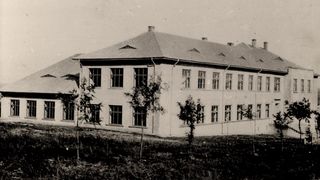
As a German had already been murdered by Slavs in Tatar Bunar in 1921, German colonists fought alongside Romanian soldiers in 1924 against the insurgents, whose leaders came from Soviet Russia. The National Liberal Party government subsequently promised to reward the Germans’ efforts with concessions in the education sector. However, Haase failed to secure sufficient support for the German primary schools. The National Peasants’ Party, which was in power between 1928 and 1933, did announce that it would pay the subsidies to which the Romanian state had committed itself in the 1919 Treaty on the Protection of Minorities. However, due to the effects of the Great Depression, its governments had been unable to pay even the full salaries of Romanian civil servants since 1930. The National Liberals, who had been in power since 1934, once again prioritised support for Romanian schools. Some Germans hoped to achieve social advancement through training at the Protestant teacher-training college in Sarata. However, graduates were rarely employed by state primary schools. Following the example of the ‘National Socialist Self-Help Movement of Germans in Romania’, which was already widespread in Bessarabia (NSDR), which was already widespread in Bessarabia, the ‘Bessarabian German Renewal Movement Volksdienst’ was formed in early 1933, supported primarily by intellectuals in Tarutino.
The Bessarabian branch of the National Socialist Self-Help Movement, with its Gauleiter, Johannes Wagner (1891–1967), a teacher at the Werner School (see below), Johannes Wagner (1891–1967), initially viewed the ‘Volksdienst’ merely as a rival and refused to join forces with it to take action against Haase’s ‘accumulation of offices’. From the ‘Volksdienst’s’ perspective, nothing stood in the way of a merger with the ‘Selbsthilfe’ except the refusal to support Haase’s political resignation.
The regional leadership of the NSDR in Hermannstadt/Sibiu, known since December 1933 as the ‘National Renewal Movement of Germans in Romania’ (NEDR) since December 1933, finally ordered a merger with the ‘Volksdienst’, apparently also in the hope that this would bring more members to the National Socialist movement in Bessarabia. The plan worked. The ‘Volksdienst’ disbanded, and almost all its members joined the NEDR, which had a knock-on effect, attracting further potential members from the teaching profession.
In conjunction with the NEDR, Haase was forced to step down prematurely as chairman of the People’s Council in February 1934. The subsequent elections to the local political bodies resulted in an electoral victory for the NEDR. Because Wagner had to resign from his post as Gauleiter under pressure from the state, he wished to remain a teacher at the Werner School; Fritz Fabritius (1883–1957), on the advice of the Tarutino lawyer Artur Fink, to appoint Otto Broneske (1899–1989), head of the Economic Association, as his successor. The new ‘People’s Programme’ was modelled in every detail on the Transylvanian-Saxon version of 1 October 1933. Even after the dissolution of the NEDR in June 1934, the newly constituted People’s Councils – known as Gau Councils from autumn 1935 onwards – continued their work.
The new Gau Council faced no serious competition from the radical National Socialist DVR (German People’s Party in Romania), which was formed in Bessarabia under the leadership of the lawyer Artur Fink from January 1936, but rather from the far-right Cuzapartei and, following its dissolution in 1935, from the merger with Octavian Goga’s (1881–1938) Agrarian Party (Partidul Naţional-Agrar) and the National Christian Party (Partidul Naţional-Creştin). The anti-Semitic League for Christian-National Defence (Liga Apărării Naţionale Creştjne [LANC]), led by Alexandru C. Cuzas (1857–1946) had drawn up a special programme for Bessarabia and founded a German section, chaired by Robert Koch (born 1898), the local doctor in Beresina. Support for this party and its membership were far greater than those of the DVR. It campaigned with slogans and emblems similar to those of the National Socialists and emphasised the shared Christian foundation in the struggle against Judaism.
The political landscape of Bessarabian Germans became further fragmented as a result of the encroachment of National Socialism. The aspired-to ideal of a unified ‘Volksgemeinschaft’ (people’s community) faded in proportion to its increasing propagation and the attempts to enforce it by force.
Population and Economy
Trade between Russia, Poland and the Romanian principalities was in the hands of Greeks, Armenians and Jews during the 18th century. Although southern Bessarabia was sparsely populated until 1812, it was by no means uninhabited. The Russo-Turkish War of 1806–1812 had driven the Nogai Tatars, who were of the Islamic faith and had once lived there, out of the region. Tsar Alexander I had the Budzhak settled primarily by Germans, Bulgarians and Gagauz, a Turkish-speaking ethnic group.
The immigration of German-speaking populations to Bessarabia marked the end of a long-standing colonisation policy pursued by the Russian Crown, which had been implemented to settle newly conquered and fallow lands. As part of this settlement policy, 150 settlements were established between 1814 and the First World War, the inhabitants of which had migrated or moved on, predominantly for economic reasons. The first settlements founded in 1814 were Tarutino/Tarutine, Borodino and Krasna/Krasne. In addition to Lutherans, who made up the majority, the German settlements were also home to Catholics – in Krasna, Emmental/Pervomaisc, Larga and Balmas/Balmaz – as well as Reformed Protestants – Schabo (a settlement with German- and French-speaking Swiss) and Hoffnungstal. Religiously motivated immigration led to the establishment of the towns of Teplitz/Tepliza (1817) and Sarata (1822). All settlers had been granted privileges; not least, they were permitted to practise their religion freely. Only missionary work amongst the Orthodox population was strictly forbidden to those of other faiths.
As early as the 18th century, Russian serfs had fled to Bessarabia, and distinct Orthodox groups such as the Old Believers (Raskolniki), later known as Lipovans, had retreated into the marshes at the mouth of the Danube.
The central and northern regions of Bessarabia were settled mainly by Orthodox Moldovans or Romanians. Among them were large landowners, free peasants and dependent landless peasants. Romanian nobles who had remained in Bessarabia were granted legal equality with Russian nobles in 1818. They later held positions in the administration and, in many places, assimilated into Russian society.
Ukrainians had settled in the north and south of Bessarabia, where they worked for Romanian or Russian landowners, and later also for German farmers. Unlike the colonists, they were not allocated their own plots of land.
After 1812, the Jewish population grew, particularly in the north and in the towns. They mostly earned their living through trade. Jewish grain merchants usually handled the distribution of grain harvested in Bessarabia.
With the abolition of provincial autonomy in 1828, the Russian population grew in the towns, where they often took the place of Romanian officials in the administration and the judiciary. Russian remained the sole official language. Only the German colonists remained under the authority of the colonial administration until 1871 and governed themselves largely autonomously.
Among the inhabitants of Bessarabia, it was primarily the Romanians who felt under pressure to assimilate, particularly as the number of Romanian primary schools declined steadily and, from 1867, lessons were taught exclusively in Russian. From the 1870s onwards, no Romanian publications were permitted to be imported. Furthermore, the Romanians, along with the entire Orthodox population, were incorporated into the Russian Orthodox Church, and by the late 1880s the liturgy was celebrated exclusively in Church Slavonic, a language the peasants did not understand.
As part of the major reforms in the Russian Empire under Tsar Alexander II (1818–1881), the Welfare Committee – the authority responsible for foreign settlers – was dissolved by the Act of 4 June 1871. By 1873, the German self-governing bodies – the district and village councils – had been incorporated into the zemstvo system, and Russian had been introduced as the language of administration and communication.
The introduction of universal conscription in 1874, which lasted four to six years, meant that the former German colonists lost one of their most important privileges. As a result, large-scaleemigration from Bessarabia began: across the Pruth/Jalpug border into neighbouring Romania or across the Danube into Dobruja, but also to North and South America. In the wars waged by Russia after 1874, Bessarabian Germans fought on the Russian side, first in the war against the Turks in 1877–78, then in the Russo-Japanese War of 1904–05 and finally in the First World War.
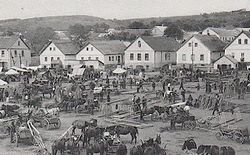
In rural areas, contact with other ethnic groups – such as Bulgarians, Ukrainians, Romanians, Russians, Jews or smaller minorities, some of whom lived in neighbouring villages – was limited to economic exchange and trade right up until the Second World War. Vegetables were sourced from Bulgarians, agricultural surpluses were sold to Jewish traders, Ukrainians were employed as seasonal or year-round workers, and Russians were encountered in the administration. In market towns such as Tarutino, Arzis and Sarata, farmers, craftsmen and small traders gathered to conclude business deals and trade in livestock and goods.
The land issue was one of the most pressing problems in the early 1920s. In January/February 1915, the Russian government had expropriated all German-owned land and planned the deportation of the German population to the eastern parts of the country. The Volhynian Germans and the Germans in Northern Bessarabia had already been forcibly resettled. A severe onset of winter in 1916 and the outbreak of the February Revolution in 1917 prevented the deportation of the Bessarabian Germans. Although the Provisional Government annulled the expropriations in 1917, as did the Romanian Government in 1919, no changes in ownership were permitted until the agrarian reform had been implemented – meaning no transfers of inheritance, sales, etc. Once the Romanian Parliament had approved the Bessarabian agrarian reform, the expropriation of agricultural holdings exceeding 100 ha began in 1920. Landless people were allocated between six and eight hectares – too little to feed a family on their own. Legal proceedings concerning expropriated land could drag on until the end of the 1920s. As a result of the agrarian reform, the Germans in Bessarabia lost around 64,000 ha (25 per cent) of their former land holdings.
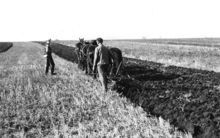
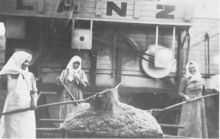
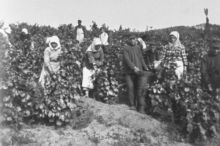
An economic upturn in agriculture was initially prevented by a series of crop failures and the global economic crisis, which took hold in Romania from 1930 onwards. New markets for agricultural produce from Bessarabia – which had previously been shipped via Odessa/Odesa to the whole of the Russian Empire – first had to be developed, and transport routes to the western parts of the country had to be expanded. The railways ran on the Russian gauge and first had to be converted to the Central European standard. As late as 1930, there were only around 165 km of good, paved roads. Surplus grain could be shipped via Brăila or Galatz/Galaţi, but this meant having to put up with long journeys to the cargo ports.
In 1921, the German population of Bessarabia founded a trade association in Tarutino to keep the intermediary trade within their own ranks and to establish a wholesale trade in agricultural machinery and equipment. As late as 1930, the majority of Germans were still employed in agriculture and the skilled trades (95 per cent). Small-to-medium-sized industry was found primarily in market towns such as Tarutino, Sarata, Arzis and up-and-coming communities.
The 1930 Romanian census recorded a population of just over 2.8 million in Bessarabia, the majority of whom (56.2 per cent) were the Moldovan, Romanian-speaking population. In addition, larger minority groups settled in the region, including Russians (12.3 per cent), Ukrainians (11 per cent), Jews (7.2 per cent), Bulgarians (5.7 per cent), Gagauz (3.4 per cent) and Roma. The Germans, who had been immigrating since 1814, accounted for 2.8 per cent of Bessarabia’s total population and were concentrated in the south, where they made up 15 to 16 per cent of the population of the Akkerman district.[1]
During the 22 years of Romanian rule, the governments of the National Liberal Party in particular attempted to Romanianise the minorities through Romanian schools. However, this was only partially successful, as Russian and Yiddish continued to be the main languages spoken in the towns. Despite subsidies, the Romanian newspapers were unable to survive, whereas several Russian newspapers and one Yiddish daily were published.
History of the Church and Schools
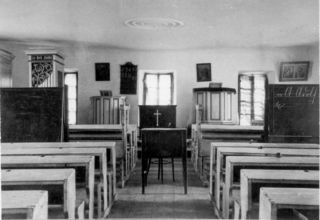
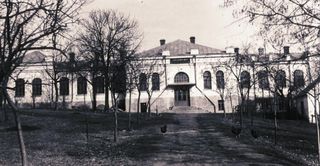
The German-speaking and Jewish communities ran their own church schools, where lessons could be taught in the pupils’ mother tongue, albeit with restrictions from 1890 onwards. A teacher training college had existed in the German colony of Sarata since 1844, and secondary schools for girls and boys were opened in Tarutino after 1905. Germans and Jews had the highest literacy rates in multi-ethnic Bessarabia, whilst the Moldovans/Romanians had the lowest level of education.
The Lutheran congregations of Bessarabia were affiliated with the Evangelical Lutheran Church in Russia until 1918. With the occupation of Bessarabia by the Romanian military from spring 1918 onwards, the 121 Lutheran parishes in Bessarabia, comprising 66,385 members, were cut off from their church leadership in St Petersburg/Leningrad. Inevitably, consideration had to be given to a reorganisation of the church, which led to a contractual affiliation – since 1927 under a common church constitution – with the Evangelical Church of the Augsburg Confession in Transylvania and Romania respectively. The merger under a single church constitution sparked a church dispute amongst the Lutheran population of Bessarabia, which was only fully resolved after ten years.
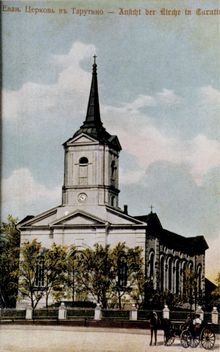
The Tarutino church district was the largest in terms of numbers amongst the Lutheran churches and parishes affiliated to the Transylvanian Church. In 1927, there were around 71,000 parishioners in 127 parishes. By 1940, the number of parishes had risen to 142 and the number of parishioners to 82,213, who were served by 12 deaneries and three independent parishes. Fifty per cent of the Lutheran parishes comprised more than ten congregations. Each parish centre was led by a pastor, whilst in the remaining congregations so-called ‘sexton-teachers’ performed both pastoral and educational duties. These local, non-ordained ‘assistant clergy’ performed all pastoral duties except for the celebration of Holy Communion, confirmation and church weddings. By the end of the 1920s, the financing of the Church’s overall work had escalated into a severe financial crisis within the Bessarabian Lutheran Church.
The majority of German primary schools had succumbed to the pull of creeping nationalisation in the 1920s. This process was facilitated by the unclear legal status of the ‘parish schools’, diverging educational policy objectives between the consistory and the People’s Council on the one hand, and teachers and the teachers’ association on the other, a lack of funding in the parishes and the consistory, as well as state efforts towards centralisation and Romanianisation. Whilst in 1926/27 18 per cent (23) of all primary schools were still operating as church schools, by 1931 this figure had fallen to just 2.3 per cent (Alexanderfeld/Alexanderfeld, Neu-Dennewitz/Swetlyi, Sofiewka/Sofievca) out of approximately 126.
The majority of Bessarabian German primary school teachers therefore worked in state primary schools until 1939. Most of them had been able to complete their training at the teacher training college in Sarata, known as the Werner School. From 1934 onwards, the Romanian government refused to employ graduates of the Werner School in German primary schools, thereby curtailing the teaching of German and religion and reducing the number of students in the teacher-training classes at the Werner School.
The three secondary schools – the Wernerschule and the two grammar schools in Tarutino – had resisted nationalisation and remained under church sponsorship. Only the Wernerschule in Sarata was able to cover 90 per cent of its budget through school fees; the two grammar schools were dependent for their very survival on grants provided by the Central Executive Committee of the Gustav Adolf Foundation in Leipzig and, above all, by the VDA (an association, later the Volksbund für das Deutschtum im Ausland) in Germany. It was only under totalitarian conditions that the German communities in Bessarabia regained a large proportion of their church schools and school buildings, yet the resettlement of the Germans from Bessarabia, Bukovina and Dobruja to the German Reich in the autumn of 1940 not only brought this development to an end, but also halted the entire settlement process.
Cultural activities of the Germans
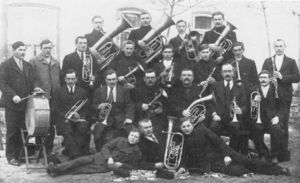
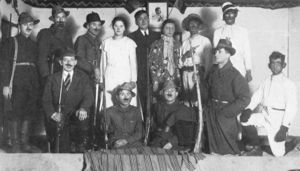
A modest cultural and literary movement developed within the framework of the music, educational and cultural societies that were established in the German communities of Bessarabia, particularly after the First World War. Local chronicles were written, and works of poetry and prose were produced, which were published in Bessarabian German magazines and calendars. In 1922, a local history museum was founded in Sarata, which reflected and presented the community’s own history.
In November 1919, the *Deutsche Zeitung Bessarabiens* was published for the first time. From February 1935, the *German Volks-* or *Gaurat* for Bessarabia published its own weekly newspaper, the *Deutsche Volksblatt*. Both newspapers were published until 1940 and, over time, expanded their content to include profession- or group-specific supplements, for example for teachers, farmers and women. Also from 1935, the Gau Youth Leadership of the People’s Council published a youth magazine, *Die Jugend*, which was distributed throughout all German-speaking areas of Romania from 1938 onwards. The *Bessarabischer Beobachter*, founded in 1932 as the mouthpiece of the German cultural and professional associations, was taken over as early as 15 October 1933 by the National Socialist Self-Help Movement of Germans in Romania as the campaign newspaper of the N.S.D.R. With the dissolution of the NSDR and NEDR by the Romanian government in July 1934, this newspaper ceased publication.
From 1920 to 1939, the *German People’s Calendar for Bessarabia* was published without interruption . Yearbook of the Germans in Bessarabia. From 1936 onwards, the *German People’s Gazette* published the *German Farmers’ Calendar*. Albert Knauer (born 1890), a bookseller from Sarata, produced four editions of his ‘Heimatkalender’ (Homeland Calendar) for the German inhabitants of Bessarabia and Dobruja(in the years 1922, 1925, 1932 and 1933).
From 1 January 1936, the Tarutino Consistory published the *Sonntagsgruß* (*Sunday Greeting*). A Christian guide for the German people in Bessarabia, featuring edifying narrative texts as well as official news from the district consistory.
Culture of memory and remembrance
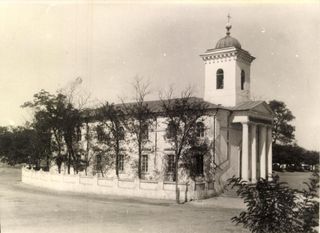
To preserve the history and culture of the Bessarabian Germans, members of the Bessarabian German community founded the Bessarabian German Heritage Museum on 25 May 1952; this museum currently occupies several floors of the Heimathaus in Stuttgart, which house exhibition spaces, a library, an archive and administrative offices. After 1991, former resettlers began restoring churches and school buildings in their places of origin. As a result, there are now more traces of the German presence there than there were during the Soviet era, when most of the buildings were being used for other purposes. The merger of the Aid Committee, the Regional Association and the Local History Museum Association into a single Bessarabian German Association took place in 2005. The process of coming to terms with and passing on their own history has yielded, in addition to the material artefacts collected in the local history museum, numerous local chronicles, personal accounts in the Yearbook of the Germans from Bessarabia (published since 1949), as well as literary and academic treatises. With the establishment of a Historical Commission in 2009, efforts to come to terms with the community’s own entanglement in Nazi history were intensified. Research was carried out into ‘disappeared’ resettlers who fell victim to the euthanasia programme, and into the influence of Nazi ideology on the Bessarabian Germans, based on press publications that appeared in Bessarabia.
Bibliography
- Detlef Brandes: Adopted by the Tsars. German colonists and Balkan settlers in New Russia and Bessarabia, 1751–1914. Munich 1993 (Publications of the Federal Institute for East German Culture and History, vol. 2).
- Luminiţa Fassel: The German School System in Bessarabia (1812–1940). A Comparative-Historical and Socio-Cultural Study. Munich 2000 (Publications of the South-East German Cultural Association, Series B, Scholarly Works 75).
- Mariana Hausleitner: Germans and Jews in Bessarabia 1814–1941. On the Minority Policies of Russia and Greater Romania. Munich 2005 (Publications of the Institute for German Culture and History in South-Eastern Europe (IKGS) at Ludwig Maximilian University of Munich, Academic Series 102: History and Contemporary History).
- Dirk Jachomowski: The Resettlement of the Germans of Bessarabia, Bukovina and Dobruja. From an Ethnic Group in Romania to a ‘Settlement Bridge’ on the Reich’s Border. Munich 1984 (Book Series of the South-East German Historical Commission 32).
- Cornelia Schlarb: Tradition and Change. The Evangelical Lutheran Congregations in Bessarabia 1814–1940. Cologne et al. 2007 (Studia Transylvanica 35).
- Ute Schmidt: The Germans from Bessarabia. A Minority from South-Eastern Europe (1814 to the present day). 3rd, unaltered edition. Cologne 2006.
- Ute Schmidt: Bessarabia. German Settlers on the Black Sea. Potsdam 2008 (Potsdam Library on Eastern Europe – History).
- Olga Schroeder: The Germans in Bessarabia 1914–1940. A Minority Torn Between Self-Assertion and Assimilation. Stuttgart 2012 (Publications of the Local History Museum of the Germans from Bessarabia 45).
- Stefanie Wolter: Nazi Influence on the Germans in Bessarabia. A Press Documentation. Stuttgart 2013 (Publications of the Local History Museum of the Germans from Bessarabia 46).
Bibliographies
- Olga Schröder-Negru: Bibliography on the History and Culture of the Bessarabian Germans 1918–1940. Düsseldorf 2001 (Research on the History and Culture of the Russian Germans 11).
- Flavius Solomon: Ethnic Identity and Minorities in the Republic of Moldova. A Bibliography. Iaşi 2001.
Notes
[1] See Hildrun Glass: *A Shattered Neighbourhood: German-Jewish Relations in Romania (1918–1938)*. Munich 1996 (Südosteuropäische Arbeiten 98), pp. 50–54.
* All rights to the images in this article are held by the Bessarabian German Association. The use of photographs and the accompanying texts by third parties is expressly prohibited. They may only be reproduced, published, or incorporated into electronic databases or onto electronic media with the written permission of the Bessarabian German Association.
Citation
Cornelia Schlarb: Bessarabia. In: Online Encyclopaedia on the Culture and History of Germans in Eastern Europe, 2014. URL: ome-lexikon.uni-oldenburg.de/p32551 (as at 4 July 2022).
Terms of use for this article
Copyright © University of Oldenburg and the Federal Institute for the Culture and History of Germans in Eastern Europe (BKGE), all rights reserved. This work was produced as part of the project ‘Online Encyclopaedia on the Culture and History of Germans in Eastern Europe’ and may be reproduced and published provided the rights holders’ consent has been obtained. Please contact:
If you have any specialist comments or additions to the text, please contact the editorial team, citing relevant literature and source references.