

Dobruja
Dobruja
Names in other languages
Romanian: Dobrogea; Bulgarian: Dobrudža; Turkish: Dobruca; English: Dobrudja (also Dobruja); French: Dobroudja
Etymology
The name ‘Dobrudja’ is thought to derive from the Cuman ruling dynasty of Dobrotič (Romanian: Dobrotici). Other theories derive the region’s name from the Slavic languages; it would then mean ‘oak forest’ or ‘oak grove’ (dăb = oak, rošta = grove).
Location
The historical region of Dobruja encompasses the area between the Black Sea at Balčic, the Danube Delta and the lower reaches of the Danube, extending westwards to the town of Tutrakan. To the south, historical Dobruja is bounded by the mountainous region of Ludogorje in Bulgaria.
Political and administrative affiliation
Dobruja was part of the Ottoman Empire until 1878. Under the Treaty of Berlin (1878), the larger northern part of the region became part of Romania. Southern Dobruja, which belonged to Bulgaria, was annexed by Romania in 1913 following the Second Balkan War (Treaty of Bucharest), but was returned to Bulgaria in 1940 (Treaty of Craiova).
Northern Dobruja (Romanian: Dobrogea Veche or Dobrogea de Nord; Bulgarian: Severna Dobrudža) consists of two administrative districts, each named after its largest town – Constanța (Bulgarian: Kjustendža, Turkish: Köstence) and Tulcea (Bulgarian: Tulča, Turkish: Tulça). Located in south-eastern Romania, the region has a total area of 15,570 km². Southern Dobruja (Bulgarian: Južna Dobrudža, Romanian: Cadrilater, Dobrogea Nouă or Dobrogea de Sud) stretches across 7,565 km² in north-eastern Bulgaria. It consists mainly of the administrative districts of Dobrich (Bulgarian: Dobrič, Romanian: Bazargic, Turkish: Pazarcık) and Silistra (Romanian: Durostor, Latin: Durostorum). The total area of the historical region thus covers just over 23,000 km².

Common symbolism
The coat of arms of Dobruja was created after 1878 and depicts two golden dolphins facing each other on a blue background. It also forms part of the Romanian national coat of arms.
Prehistory and Early History
In ancient times, the Dobruja region was inhabited by the Getae, a branch of the Thracians related to the Dacians, and by the Scythians, a people of Iranian origin. In the 4th century BC, the region was known as Scythia Minor. From 700 BC onwards, the city-states of Istros (now the ruined town of Histria), Tomis (Constanța), Partenopolis (Costinești) and Kallatis (Mangalia) were established as Greek trading colonies on the Black Sea coast, whilst Axiopolis (Cernavodă) was founded on the Danube. Alongside seafaring, cereal cultivation was of great importance to the Greek population of the region. The first permanent Greek colony was established following the expulsion of the Scythians and Cimmerians.
History up to 1500
From the mid-1st to the mid-3rd century AD, the area formed part of the Roman province of Moesia, and later of Moesia Inferior. The Tropaeum Traiani in Adamklissi, erected in 109 AD, commemorates the Roman conquest of Dacia. The Romans were able to hold the region for just under 200 years. The once-thriving settlements were destroyed by incursions from migrating tribes.
From the end of the 3rd century until the 13th century, the territory of present-day Dobruja was alternately under Eastern Roman (Byzantine) and Bulgarian rule. Under the hegemony of the Cuman ruling dynasty of the Dobrotič, Dobruja attained a degree of autonomy in the mid-14th century.
During the reign of Mircea the Elder (Mircea cel Bătrân), Prince of Wallachia (1386–1418), groups of Balkan Wallachians migrated to join the Wallachian-Moldavian population already settled in Dobruja.
At the beginning of the 15th century, Dobruja was conquered by the Ottomans, incorporated into the Sanjak of Tulcea (Sancak Tulça) and secured through the settlement of Turks.
History up to 1800
At the beginning of the 16th century, a considerable number of Armenians migrated to Dobruja via the trade route from Constantinople/Istanbul to Lemberg/L’viv/Lwów. There are records of Roma in Dobruja who had converted to Islam dating back to the 16th century. From the mid-17th century onwards, Greeks and Jews are documented in the region, mainly in urban settlements. They were primarily active there as merchants.
Following the schism in the Russian Orthodox Church in 1654 and the legalisation of the persecution of opponents of the reform (Russian: raskol’niki) by the regent Sofija (1685), around one million Old Believers fled the Tsarist Empire for religious reasons, some of them to northern Dobruja, where they became known as Russian Lipovans (Romanian: lipoveni, Russian: starovery, staroobrjadcy, rarely lipovane). At the beginning of the 18th century, Bulgarian settlements began to spring up in increasing numbers.
As the Ukrainian Zaporozhian Cossacks opposed the settlement of their territory by Russians following the end of the Russo-Turkish War in 1774, Tsarina Catherine II deported their leadership to Siberia and dismantled their military organisation. As a result, around 5,000 Ukrainian Cossacks fled to the Danube Delta.
History in the 19th century
From 1842 onwards, German settlers migrated in four waves via Bessarabia and southern Russia to the Ottoman Dobruja, mainly for economic reasons. This was not a state-organised migration; rather, it took place haphazardly, as a form of secondary settlement. The German immigrants were required to comply with the ‘Colonisation Regulations for Turkey’. In 1930, the number of Germans in Dobruja still stood at around 15,000.
Kabaïli Tatars arrived in the region from Bessarabia in the 18th century. Among the Dobruja Tatars, the Crimean Tatars, who immigrated to Dobruja after the Crimean War (1853–1856), form the largest group.
Signs of the Ottoman Empire’s disintegration were already clearly evident in the first half of the 19th century. The election of a joint prince in 1859 laid the foundations for the union of Moldavia and Wallachia. The consolidation of the union between the two principalities was secured in 1866 with the election of the German Prince Karl von Hohenzollern-Sigmaringen as prince. Following the Russo-Turkish War of 1878, further territorial changes took place. At the Congress of Berlin (June to July 1878), the Great Powers resolved to recognise Romania as a sovereign state. They decided to divide the region into Northern and Southern Dobruja. Northern Dobruja was ceded to Romania, whilst Southern Dobruja was awarded to Bulgaria. In return, Bucharest was required to cede southern Bessarabia (the districts of Bolgrad, Cahul and Ismail) to the Russian Empire.
History in the 20th century
The Romanian governments laid claim to a contiguous territory and control over a homogeneous population. The realisation of these objectives resulted in cultural and linguistic standardisation. In Dobruja, the demographic majority of Muslims and Bulgarians was drastically altered by a large-scale settlement policy pursued by the Bucharest government in favour of the Romanian population. Public life was Romanianised through legislative measures and the introduction of new state administrative structures. Ultimately, the Muslim and Bulgarian communities were largely deprived of their means of subsistence through the expropriation of 75 per cent of their land holdings, whereupon many left the country. Nevertheless, due to the resettlement of Romanians, the population of Northern Dobruja rose steadily, from 147,246 people in 1880 to 267,808 in 1900. From 1923 onwards, large groups of Aromanians from the Southern Balkans migrated to Dobruja. During the interwar period, there was another major wave of emigration among the Muslims of Dobruja, who emigrated to Turkey for economic, political, religious and social reasons. From 1923 to 1940, the Internal Dobrujan Revolutionary Organisation (Bulgarian: Вътрешна добруджанска революционна организация, Romanian: Organizația Internă Revoluționară Dobrogeană) for the reintegration of Southern Dobruja into Bulgaria. It was classified by Bulgaria as a freedom movement and by Romania as a terrorist organisation.
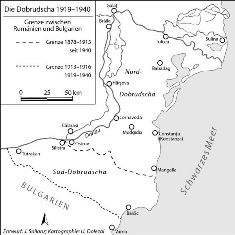
Dobruja 1919–1940.
[Credit: J. Sallanz/U. Dolezal]

The Treaty of Craiova (1940), which definitively divided Dobruja into a Romanian northern part and a Bulgarian southern part, led to an ethno-territorial separation of Bulgarians and Romanians in the region, described using the diplomatic euphemism ‘population exchange’. Consequently, within three months, around 100,000 Romanians were forced to leave Southern Dobruja and some 61,000 Bulgarians had to leave Northern Dobruja. The Romanians were resettled on the land formerly owned by the expelled Bulgarians and, from 1941 onwards, also in Bessarabia. At the same time, under an agreement between the German Reich and Romania, around 14,000 Dobrujan Germans were resettled in the Warthegau and in the Protectorate of Bohemia and Moravia. Even whilst Romania and Bulgaria were members of the Warsaw Pact, relations between the two countries remained strained. Since joining the European Union, Romanian-Bulgarian relations have no longer been so heavily strained by the issue of Dobruja.
Population

Even today, Dobruja remains an ethnic and cultural mosaic, although the number of people belonging to ethnic minorities has fallen sharply.
Northern Dobruja[1]
Population by ethnicity | 1880 | 1899 | 1913 | 1930 | 1956 | 1966 | 1977 | 1992 | 2002 |
Total population | 139,671 | 258,242 | 380,430 | 437,131 | 593,659 | 702,461 | 863,348 | 1,019,766 | 971,643 |
Romanians | 43,671 31% | 118,919 46% | 216,425 56.8% | 282,844 64.7% | 514,331 86.6% | 622,996 88.7% | 784,934 90.9% | 926,608 90.8% | 883,620 90.9% |
Tatars | 29,476 21% | 28,670 11% | 21,350 5.6% | 15,546 3.6% | 20,239 3.4% | 21,939 3.1% | 22,875 2.65% | 24,185 2.4% | 23,409 2.4% |
Bulgarians | 24,915 17% | 38,439 14% | 51,149 13.4% | 42,070 9.6% | 749 0.13% | 524 0.07% | 415 0.05% | 311 0.03% | 135 0.01% |
Turks | 18,624 13 % | 12,146 4% | 20,092 5.3% | 21,748 5 % | 11,994 2 % | 16,209 2.3% | 21,666 2.5% | 27,685 2.7% | 27,580 2.8% |
Russians (Lipovans) | 8,250 6 % | 12,801 5% | 35,859 9.4%[2] | 26,210 6 % | 29,944 5% | 30,509 4.35% | 24,098 2.8% | 26,154 2.6% | 21,623 2.2% |
Ukrainians | 455 0.3% | 13,680 5 % | 33 0.01% | 7,025 1.18% | 5,154 0.73% | 2,639 0.3% | 4,101 0.4% | 1,465 0.1% | |
Greeks | 4,015 2.8% | 8,445 3 % | 9,999 2.6% | 7,743 1.8% | 1,399 0.24% | 908 0.13% | 635 0.07% | 1,230 0.12% | 2,270 0.23% |
German | 2,461 1.7% | 8,566 3 % | 7,697 2 % | 12,023 2.75% | 735 0.12% | 599 0.09% | 648 0.08% | 677 0.07% | 398 0.04% |
Roma | 702 0.5% | 2,252 0.87% | 3,263 0.9% | 3,831 0.88% | 1,176 0.2% | 378 0.05% | 2,565 0.3% | 5,983 0.59% | 8,295 0.85% |
Southern Dobruja[3]
Population by ethnicity | 1910 | 1930 | 2001 |
Total population | 282,007 | 378,344 | 357,217 |
Bulgarians | 134,355 47.6% | 143,209 37.9% | 248,382 69.5% |
Turks | 106,568 37.8% | 129,025 34.1% | 76,992 21.6% |
Roma | 12,192 4.3% | 7,615 2 % | 25,127 7 per cent |
Tatars | 11,718 4.2% | 6,546 1.7% | 4,515 1.3% |
Romanians | 6,348 2.3% | 77,728 20.5% | 591 0.2% |

Ethnographic map of Dobruja, *
*, 1918. [O. Tafrali: *La Roumanie
Transdanubienne (La Dobroudja)*, *
*, Paris, 1918]

Economy
For the Ottoman Empire, Dobruja was of strategic importance as a border region. An important trade route also ran through it, leading from Istanbul via Babadag (Turkish: Babadağ) and Isaccea (Turkish: İshakçı) to Poland. During the Ottoman period, the population lived mainly from arable farming, livestock rearing and fishing.
Around 80 per cent of the Dobruja Germans were employed in agriculture, whilst around 14 per cent were craftsmen. It was not until after the First World War that they established a small number of businesses. Despite the favourable soil conditions, the high birth rate among the Dobruja Germans meant that the customary division of land in the region led to increasing impoverishment. By 1940, over 40 per cent of the Dobruja Germans were landless farmers. Around a quarter of German farmers owned between two and five hectares of land; very few owned more than 50 hectares.
The region’s most important industrial sectors are shipbuilding and ship repair, as well as the processing of regional agricultural produce. The fish-processing industry, which was significant until 1989, has seen a sharp decline in production. The Cernavodă nuclear power station is of great importance for energy production. Tourism was a major economic factor throughout the region. After 1989, tourism on the Black Sea coast declined dramatically. Whilst tourism on Bulgaria’s Golden Sands recovered quickly, there is now virtually no organised international tourism left on the Romanian coast.
History of Religion and the Church
Evidence exists of a Christian diocese in the province of Scythia Minor at Tomis (Constanța) in the 4th century. Christian inscriptions (4th–6th centuries AD) have also been discovered in Kallatis (Mangalia), Ulmetum (Pantelimon), Dinogetia (Garvăn) and Histria; the basilicas found in Tomis, Tropaeum Traiani (Adamclisi), Piatra Frecăţei and Niculiţel can be dated to the same period. Following the destruction of Tomis in 587 by the Avars, the diocese fell into decline. Following the Christianisation of the Bulgarians in 865, another Christian centre was established in Durostorum (Silistra). After 971, the region between the Danube and the Black Sea came under the jurisdiction of the Byzantine Bishop of Durostorum. At the beginning of the 13th century, Bitzina/Vicina (Isaccea) emerged as an Orthodox diocese and the seat of a Franciscan monastery. The last bishop, Hyakinthos, was forced to flee from the Mongols; in 1359, he became the first Ungro-Wallachian metropolitan.
From the Ottoman period, in addition to mosques and Muslim cemeteries, mausoleums and funerary monuments of Muslim saints and Ottoman rulers have been preserved, for example in Babadag (Turkish: Babadağ), Isaccea (Turkish: İshakçı) and Cernavodă (Turkish: Boğazköy). The Muslims of Dobruja adhere, almost without exception, to Sunni Islam of the Hanafi school of jurisprudence. Southern Dobruja is also home to the Gagauz, an Orthodox Turkic people.
The majority of the population in Northern Dobruja are Romanian Orthodox, whilst in Southern Dobruja they are Bulgarian Orthodox. The majority of the Russian Lipovans adhere to the Old Rite Orthodox faith and have their own ecclesiastical hierarchy, based in Brăila. The majority of the Dobruja Germans were Evangelical-Lutheran. They were ministered to by the Evangelical Supreme Church Council in Berlin, which also sent pastors; between 1923 and 1940, they belonged to the Evangelical Church A. B. in Romania. From 1883, the Roman Catholic parishes came under the jurisdiction of the Archdiocese of Bucharest/Bucureşti, which ensured that, at least in part, German priests were able to serve in the parishes. Furthermore, there were Baptists and Adventists amongst the Dobrujan Germans.


Cultural institutions
The historical, archaeological and ethnographic museums in Constanța, Tulcea, Balchik, Dobrich and Silistra showcase valuable collections that highlight the cultural significance of the region, dating back to the Stone Age. The region is home to numerous Greek and Roman ruins, such as the early Christian basilicas in Niculiţel and Kallatis/Mangalia, the necropolises in Histria and Kawarna, and the merchant’s house with its 4th-century Roman floor mosaic in Constanţa.
Education
After 1878, it was not only the Romanian school system that was expanded in Dobruja. In 1891, the Muslim Theological Seminary was established in Babadag to ensure the training of religious personnel for the mosques and of teachers for the Muslim denominational school in the region. It existed (from 1901 in Medgidia) until 1967 and was re-established in 1992 as the bilingual Kemal Atatürk College. University centres emerged in Dobruja during the 20th century. The Ovid University was established in 1990 from the Pedagogical Institute founded in Constanța in 1961. Furthermore, following the merger of various institutions, the Civil Maritime Institute was founded in Constanța in 1990; it changed its name to the Maritime University of Constanța in 2000. In Southern Dobruja, the International University College of Dobrich was founded in 1992. Since 1997, the University of Ruse in Silistra has had a School of Education.
Bibliography
- Detlef Brandes: Adopted by the Tsars. The German Colonists and the Balkan Settlers in New Russia and Bessarabia 1751–1914. Munich 1993 (Publications of the Federal Institute for East German Culture and History 2).
- Wilfried Heller, Josef Sallanz (eds.): Dobruja. A New Border Region of the European Union. Socio-economic, Ethnic, Political-Geographical and Ecological Problems. Munich, Berlin 2009 (Southeast European Studies 76).
- Dirk Jachomowski: The Resettlement of the Germans from Bessarabia, Bukovina and Dobruja. From an Ethnic Group in Romania to a ‘Settlement Bridge’ on the Reich’s Border. Munich 1984 (Book Series of the South-East German Historical Commission 32).
- Ortfried Kotzian: The Resettlers. The Germans from Western Volhynia, Galicia, Bukovina, Dobruja and the Carpathian Ukraine. Munich 2005 (Study Series of the East German Cultural Council Foundation 11).
- Josef Sallanz: The Changing Meaning of Ethnicity under the Influence of Globalisation. Romanian Dobruja as an Example. Potsdam 2007 (Potsdam Geographical Research 26).
- Josef Sallanz: Dobruja: German Settlers between the Danube and the Black Sea (Potsdam Library on Eastern Europe – History). Potsdam 2020.
- Andrea Schmidt-Rösler: Romania after the First World War. The drawing of borders in Dobruja and the Banat and the resulting problems. Frankfurt am Main et al. 1994 (European University Publications Series 3, History and its Auxiliary Sciences 622).
Web links
Libraries
- www.biblioteca.ct.ro/(‘Ioan N. Roman’ County Library, Constanţa)
- www.tulcealibrary.ro/ (‘Panait Cerna’ County Library, Tulcea)
- www.libdobrich.bg/ (Регионална библиотека "Дора Габе" Добрич [Dora Gabe Regional Library, Dobrich])
Museums
- www.minac.ro/ (Muzeul de Istorie Naţională şi Arheologie Constanţa [Museum of National History and Archaeology, Constanţa])
- muzeuetno.wordpress.com/ (Muzeul de Artă Populară Constanţa [Museum of Folk Art, Constanţa])
- www.info-delta.ro/orasul-tulcea-23/muzeul-de-istorie-si-arheologie--144.html (Tulcea Museum of History and Archaeology)
- meaptulcea.wordpress.com/ (Muzeul de Etnografie şi Artă Populară Tulcea [Museum of Ethnography and Folk Art, Tulcea])
- www.dobrichmuseum.bg/index.php/bg/ (Regional Museum of History in Dobrich)
- www.museumbalchik.com/ (Balchik History Museum)
- museumsilistra.net1.cc/ (Regional History Museum, Silistra)
Notes
[1] See Grégoire Danesco: Dobrogea – La Dobroudja. A Study in Physical and Ethnographic Geography. Bucharest 1903; Jean N. Roman: The Population of Dobrogea. Based on the census of1 January 1913. In: Anghel Demetrescu: Romanian Dobrogea. Studies and documents. Bucharest 1919; Sabin Mănuilă: The Population of Dobroudja. Bucharest 1939; INS = National Institute of Statistics (ed.): Population and Housing Census, 18 March 2002. Vol. IV: Population – Ethnic and Religious Structure [Population and Housing Census of 18 March 2002. Vol. 4: Population – Ethnic and Religious Structure]. Bucharest 2003.
[2] In 1913, Russians and Ukrainians were listed under a single heading.
[3] See Sabin Mănuilă: La Population de la Dobroudja. Bucharest 1939; Population as at 1 March 2001 by region and ethnic group: www.nsi.bg/Census/Ethnos.htm.
Citation
Josef Sallanz: Dobruja. In: Online Encyclopaedia on the Culture and History of Germans in Eastern Europe, 2012. URL: ome-lexikon.uni-oldenburg.de/54120.html (as at 23 July 2020).
Terms of use for this article
Copyright © University of Oldenburg and the Federal Institute for the Culture and History of Germans in Eastern Europe (BKGE), all rights reserved. This work was produced as part of the project ‘Online Encyclopaedia on the Culture and History of Germans in Eastern Europe’ and may be reproduced and published provided the rights holders’ consent has been obtained. Please contact:
If you have any specialist comments or additions to the text, please contact the editorial team, citing relevant literature and source references.