

Protectorate of Bohemia and Moravia
Protectorate of Bohemia and Moravia
Name in another language
Czech: Protektorát Čechy a Morava; Czech (derogatory term) ‘Protentkrát’ [‘for the time being’, ‘until further notice’]
Etymology
According to the standard definition, a protectorate is a partially sovereign state whose foreign representation and national defence are placed under the authority of another state by virtue of a treaty under international law. The Treaty of La Marsa of 8 June 1883, which established France’s protectorate over Tunisia as part of its colonial rule, served as the model for the structure of the Protectorate of Bohemia and Moravia.
Location
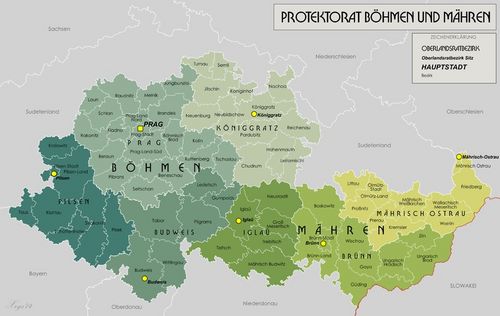
The Protectorate of Bohemia and Moravia was established by a ‘Führer Decree’ of 16 March 1939 on the territory of Czechoslovakia that had been occupied by Nazi Germany the previous day, which had already been stripped of its border regions – predominantly inhabited by a German population – on 30 September 1938 under the Munich Agreement. It covered an area of 49,363 square kilometres. The borders of the Protectorate corresponded to the provisions already agreed in Munich on the basis of an alleged linguistic boundary – and were therefore based neither on the geographical features of the landscape nor on economic or military criteria.
Common symbolism

The symbolism of this state entity, subordinate to the Reich, was based on that of the dismantled Czechoslovakia: the flag consisted of three stripes in white, red and blue, whilst the coat of arms combined the Bohemian lion with the female eagle in the colours of the flag.
Contemporary History


The occupation of what remained of the Czechoslovak Republic ( Slovakia had declared its independence the day before) took place, with a few minor exceptions, without a fight. Following the cession of the border fortifications to Germany under the Munich Agreement, the territory was virtually impossible to defend. Reich Chancellor Adolf Hitler placed the decisive power in the occupied territory in the hands of the ‘Reich Protector’, under whose authority the Central Office of the German State Police was also established.
Immediately following the well-organised occupation, the Gestapo launched ‘Operation Gitter’ with the aim of internmenting communist and social-democratic officials, political émigrés from Germany and a number of prominent figures from public life and the arts as hostages. In ‘Operation Albrecht I’, carried out in early September, this practice of preventive arrest was further developed in order to intimidate Czech society and deter it from resisting the occupying power. Since the end of April, there had been a series of large mass gatherings—triggered by historical anniversaries (such as the anniversary of Jan Hus’s death) or organised by the Church—involving tens of thousands of citizens, which had a Czech nationalist and, in some cases, openly anti-German character.
Particularly large demonstrations took place on 28 October 1939, the anniversary of the founding of the Czechoslovak Republic. The German police responded to the mass demonstrations in the centre of Prague/Praha by firing their weapons. On 17 November, the funeral procession for the student Jan Opletal (1915–1939), who had been shot dead, became the catalyst for new Czech student demonstrations – demonstrations which were banned by the German police but deliberately provoked by students from German universities. The reaction of the occupying regime, which had been prepared in advance, was harsh: during the night, nine leading officials from all the student associations involved were arrested and shot; a large-scale round-up in Prague, Brno and Příbram, culminating in the deportation of 1,300 students to the Sachsenhausen-Oranienburg concentration camp, where they remained interned for several years. The following day, Hitler’s decision to close the Czech universities for three years as a punishment was announced. The fact that their buildings, along with all their equipment, were immediately handed over to German universities suggested that this closure was intended to be permanent.
The change in the person of the German Reich’s highest representative in Prague led to an escalation of terror in the Protectorate: on 27 September 1941, Reinhard Heydrich (1904–1942) assumed the post of (deputy) Reich Protector. In a secret speech, he informed the leading German officials of the plan to exterminate the Czech people after the end of the war. From the moment he took office, Heydrich took aggressive action against any defiance by the Czech Protectorate government and, in particular, against the Czech resistance. He declared a state of emergency, imposed martial law, launched a wave of arrests – which affected, amongst others, the Prime Minister of the Protectorate government, General Alois Eliáš (1890–1942), and ordered the execution by firing squad of members of the Czech elite.
With Heydrich in charge, the situation of the Jews in the Protectorate also deteriorated dramatically. After all the inhabitants had been evacuated from the Baroque fortified town of Theresienstadt/Terezín, the first Jewish construction detachment arrived on 24 November 1941 to build a vast ghetto there for Jews from across Central Europe. A total of 139,517 Jews – 73,468 of whom were from the Protectorate – were sent to Theresienstadt. 33,521 of them died there, whilst 87,000 were transported on to the extermination camps in the East.
Through a combination of terror and social promises aimed at the workers, Heydrich sought to boost the output of the Protectorate’s war-critical economy. He initiated a scheme, initially ostensibly ‘voluntary’ but later openly enforced, for Czechs to work in the German Reich. A total of 640,000 Czechs were affected by this; 6,000 of them lost their lives in the process, whilst 60,000 died immediately upon their return as a result of the forced labour.
The Protectorate experienced its greatest wave of repression following the successful assassination of Heydrich on 27 May 1942 by paratroopers from the Czechoslovak Army-in-Exile, who found support and shelter within the Czech resistance network until they were discovered by the Gestapo following a betrayal and died in the ensuing firefight. During the so-called ‘Heydrichiade’ – the reprisal operation following the assassination – many of those previously detained as hostages, representatives of the Czech elite, members of the resistance, family members of soldiers in exile, as well as the entire populations of the villages of Lidice and Ležáky and hundreds of citizens who had been arrested for ‘approving of the assassination’, were executed without trial. In total, it is estimated that 1,585 Czechs were shot in the Protectorate, with further executions taking place in the concentration camps. The total number of victims stands at around 5,000. The largest mass murder of Czech citizens took place on 8 March 1944 in Auschwitz, when 5,000 Czech Jews from the so-called ‘family camp’ were gassed in a single night.
The approaching end of the war led to numerous German refugees, so-called ‘national guests’, mainly from Silesia, entering the Protectorate, as well as a series of death marches involving prisoners from disbanded concentration camps, some of whom were executed here. Following the fierce battle for Ostrava and the capture of Brno by the Red Army on 26 April 1945, the ‘Bohemian Basin’ (Česká kotlina) was fortified as a ‘fortress’ for 900,000 soldiers of Field Marshal Ferdinand Schörner’s (1892–1973) Army Group Centre. Between 25 April and 6 May,Western Bohemia, including Pilsen/Plzeň, was liberated by the US Army. An overly optimistic assessment of the situation led to a series of local Czech uprisings inEastern Bohemia and the Elbe region. These were brutally suppressed. On 5 May, the Prague Uprising began spontaneously and, in its early stages, in a disorganised manner; leadership was subsequently assumed by the Czech National Council (Česká národní rada) under the chairmanship of Albert Pražák (1880–1956). The military commander of the insurgents was General Karel Kutlvašr (1895–1961). The fighting with the army and the Waffen-SS units lasted until 8 May. The Wehrmacht surrendered and was granted safe passage by the Czech National Council to American captivity. The Red Army, whose tank units reached Prague on 9 May 1945, eliminated the last remaining SS strongholds.
Administration
The President was the Protectorate’s highest representative. Emil Hácha (1872–1945), the former President of Czechoslovakia – whose territory had already been reduced – remained in office even after the occupation and held this post throughout the entire period of the Protectorate until 8 May 1945. He was dependent on the favour of Hitler and, by extension, the Reich Protector, who acted as his representative. The Protectorate government, appointed by the President, had to be confirmed by the Reich Protector, who also had the right to veto all laws, decrees and court judgements. The Czechoslovak Constitution remained formally in force, but the parliament was dissolved, as were all political parties. The Protectorate government, which operated on the basis of Enabling Act No. 330/1938 – declared to be of limited duration by a decree of the Reich Protector dated 12 December 1940 – was not permitted to pass laws, but only government decrees. Even these could be amended by the Reich Protector, vetoed or replaced by his own decrees.
The first Reich Protector in Prague was Konstantin von Neurath (1873–1956), who remained in this post de facto until the summer of 1941 and formally until 1943. On 27 September 1941, SS-Obergruppenführer and Police General Reinhard Heydrich effectively took over his position as deputy Reich Protector. Following Heydrich’s death, SS-Oberst-Gruppenführer and Commander-in-Chief of the Order Police Kurt Daluege (1897–1946) was sent to Prague as his successor to crush all resistance in the Protectorate. An even more significant role in determining the fate of the occupied society was played by the State Secretary in the Office of the Reich Protector and Commander of the Police, SS-Gruppenführer Karl Hermann Frank (1898–1946), who had been a leading figure among the Sudeten German National Socialists since the 1930s. In August 1943, he was appointed German Minister of State for Bohemia and Moravia. As a result, the office of Reich Protector – which was at that time held only nominally by Wilhelm Frick (1877–1946), the former Reich Minister of the Interior who had been stripped of his powers in the German Reich – was effectively sidelined, and all power was concentrated in Frank’s hands until the end of the war.
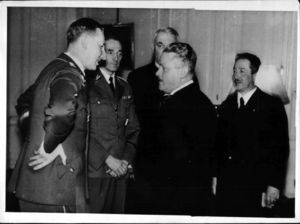
The Protectorate government was not formed until some time after the German occupation. Until 27 April 1939, the last Czechoslovak government, led by the Agrarian Rudolf Beran (1887–1954), continued to govern under its new name. The first Protectorate government, newly appointed by the President, was led by Alois Eliáš until his arrest on 28 September 1941; he was then replaced by the Minister of Justice, Jaroslav Krejčí (1892–1956), who remained in office until 19 January 1942. Krejčí also headed the subsequent government, established on Heydrich’s initiative, which remained in office until 19 January 1945. In this government, the newly created Ministry of Labour and Economy was entrusted to a Reich German, SS-Brigadeführer Walter Bertsch (1900–1952). German became the government’s working language, enabling Bertsch to exercise control over its activities. Among his main responsibilities was the organisation of the Czech labour force in the German Reich. From 19 January 1945, the last Protectorate government was led by the former Minister of the Interior and Deputy Prime Minister, Richard Bienert (1881–1949); Krejčí remained his deputy.
Within the framework of this dual government structure, the Czech executive—which was vested with far-reaching powers in domestic affairs (justice, home affairs, finance, public works, agriculture, trade, health and education)—endeavoured, particularly in the early years of the occupation, but also later on, to work systematically for the benefit of its own society and even to cooperate with political resistance groups. It maintained contact with the government-in-exile in London and acted as a protective force for the Czech population. In fact, the government was able to mitigate the Nazi terror, which had escalated dramatically in other occupied territories in Eastern Europe, and ensure more or less tolerable living conditions for society in everyday life for a relatively long period. However, the Gestapo was sufficiently aware of the opposition activities of the government and the conservative-nationalist Czech elites that, following Heydrich’s arrival, it was able to swiftly and thoroughly dismantle their networks. Nevertheless, the situation in the Protectorate was generally more comparable to that in the occupied countries of Western and Northern Europe than to that of Poland, Yugoslavia or Ukraine, which became the scenes of genocide.
Population
In 1939, the Protectorate had a population of 7.38 million. As a result of the Munich Agreement, the majority of the population of the new entity were Czechs. Only 240,000 people (3.25 per cent) belonged to the German-speaking minority. Most German-speaking citizens of the Protectorate lived in the larger urban centres (particularly in Prague, Brno, Jihlava and Olomouc), whilst in rural areas they were concentrated particularly in the region around Jihlava.
Until the enactment of a series of regulations by the Reich Protector on 21 June 1939, German-speaking Jews were also counted as part of the German minority. According to official German figures and the definition set out in the Nuremberg Laws, a total of 118,310 Jews lived in the Protectorate (88 per cent of whom were practising). Only around 30,000 managed to leave the country, either legally or illegally, by the end of 1940.
Economy
Economic ties between Bohemia and Germany had traditionally been close. Following the occupation, the German role in the Protectorate’s economy expanded significantly. German banks and large-scale industry, as well as smaller companies run by National Socialists, benefited from the ‘Aryanisation’ of Jewish property and took over businesses belonging to emigrants or citizens arrested for underground resistance activities. From September 1940, the Protectorate formed part of the customs territory of the German Reich. According to estimates, the share of German capital in the Protectorate increased tenfold between 1939 and 1945.
From March 1939, German trustees were appointed to many businesses. The most important companies in the heavy and armaments industries (e.g. the Vitkovitz and Poldi Kladno ironworks, the Škoda Works in Pilsen and the Zbrojovka Brno arms factory) were under Reich control. Although many large firms remained formally independent, they had lost all freedom of decision-making due to Reich shareholdings and their integration into armaments projects. A forced consolidation of the light and food industries made it possible to transform many Czech enterprises into subsidiary operations of armaments conglomerates vital to the war effort. The first step in this direction was taken in early 1942, whilst Heydrich was still in office; the second followed the declaration of ‘total war’ in 1943.
From the start of the war, the Protectorate was required to pay a ‘war tax’ to the German Reich – initially amounting to three billion Protectorate crowns annually, rising to 12 billion by 1944.
Military history
The army of the former Czechoslovakia was disbanded following the occupation. Its weapons and ammunition were taken over by the German Wehrmacht. The Protectorate government retained a government force (Vládní vojsko) comprising 6,000 soldiers and officers drawn from the ranks of former professional soldiers. The official task of this poorly equipped government force was to maintain internal order within the Protectorate. Given the unpredictability and unwillingness of these troops to cooperate, 5,000 soldiers and officers were sent to northern Italy in May 1944, on Frank’s initiative, to carry out guard duties and fight against partisans. There, 800 soldiers deserted; the remainder were disarmed in October 1944 and sent to the Alps for forced labour. The Castle Guard battalion left behind in Prague fought on the side of the insurgents during the Prague Uprising.
Of far greater military significance were the Czechoslovak exile armies in Great Britain and the Soviet Union. From 1944 onwards, larger partisan groups and units also began to form within the Protectorate. Several – politically diverse – underground organisations had already formed at the start of the occupation. They had political, intelligence and sabotage-oriented objectives, which, in the final phase of the war, also included the preparation of a major uprising. The first such organisation, the ‘Political Centre’ (Politické ústředí), was established shortly after the Munich Agreement and was completely destroyed by the Gestapo as early as 1940. The ‘Petition Committee – We Remain Loyal’ (Petiční výbor věrni zůstaneme, PVVZ) was socialist in orientation, whilst Obrana národa ( National Defence) brought together former professional soldiers. At the beginning of 1940, the Ústřední vedení odboje domácího (UVOD, Central Leadership of the Domestic Resistance) was formed as the coordinating body for the Western-oriented resistance. Another network of communist resistance had been forming since the German invasion of the USSR. One problem was the limited capacity of this and many other smaller groups to carry out effective defensive intelligence work, which meant that the Gestapo was able to take action against them.
Society
All political parties were dissolved following the occupation. On the initiative of the President, the ‘National Unity’ (Národní souručenství) , a single-party organisation reserved exclusively for men, was established on 6 April 1939 as the only permitted party, bringing together over 97 per cent of adult men. Its sole purpose was to support the President and the Protectorate government. Following initial attempts to use this organisation as a basis for the resistance, the occupying forces replaced the entire leadership with collaborators in 1941. The party, which also controlled the press, was dissolved on 15 January 1943 or, rather, transformed into a cultural propaganda organisation. Collaboration with the Nazi regime was similar to that in Western European countries: After the end of the war, some 10,000 court cases were brought against citizens on the basis of decrees issued by the Czechoslovak president-in-exile, Edvard Beneš. 740 collaborators were executed; in proportion to the total population, this was the highest rate in Europe.
Society had to contend with the hardship typical of wartime. Food rations were introduced as early as September 1939: ration cards marked ‘D’ guaranteed Germans the highest allocations. The food rations to which the cards marked ‘T’ (for Czechs) entitled holders were significantly lower. The lowest rations were allocated to Jews, whose cards were marked ‘J’. The merging of the ‘D’ and ‘T’ cards in 1941 was part of Heydrich’s campaign to boost labour productivity amongst the Czech population. From the end of 1939, additional ration cards were introduced for clothing. Farmers received reduced rations and were required to hand over prescribed quantities of produce at fixed prices. One consequence of these measures was the emergence of a black market which, although draconianly suppressed, nevertheless flourished.
The Jews, who had been gradually marginalised from mainstream society since the Munich Agreement of 1938, lived under the most appalling conditions. The exclusion of Jews from public spaces and life intensified radically following Heydrich’s appointment. Many Czechs who, despite all the decrees, continued to interact with Jews, shop at their establishments or seek treatment from Jewish doctors, faced severe penalties.
Within Czech society, the situation was particularly dire for the young, educated classes: on the initiative of the Reich Protector, the number of Czech secondary schools was systematically reduced from 1942 onwards. As a result, the number of secondary school pupils fell from 85,000 in 1939 to 35,000 in 1944. The closure of universities was accompanied by the deployment of thousands of school-leavers to industry or to ‘total deployment’ in the German Reich.
History of Religion and the Church
The dominant denomination in the Protectorate was the Catholic Church, although the Protestant Church – formerly known as the Czechoslovak Church (Církev československá), which came to be known as the Bohemian-Moravian Church (Církev českomoravská) in the Protectorate, also maintained a significant presence with around 800,000 members. The Nazi regime assigned the Christian churches the primary task of issuing certificates of Aryan descent or certificates attesting to various degrees of Jewish ancestry in accordance with the Nuremberg Race Laws, which were based on the information contained in the church registers. Those designated as ‘Mischlinge’ (half-breeds) under the Nuremberg Laws, as well as the Christian spouses of citizens classified as Jewish who did not divorce, were also discriminated against and, in later phases of the persecution, deported to the camps.
On 29 September 1941, Reich Protector Heydrich ordered the closure of all synagogues and Jewish prayer rooms as ‘gathering places for destructive forces’. The Jewish communities were gradually dissolved; most of the 88,000 registered Jews who had not managed to leave the country were gradually concentrated in Prague and then, from 16 October 1941, deported in convoys either directly to the extermination camps in the East or, from 1942, to Theresienstadt as a transit camp. The communities’ property was confiscated and transferred to the Emigration Fund for Bohemia and Moravia, established by the Reich Protector. Items of historical or art-historical value (books, devotional objects, etc.) were deposited at the Jewish Museum in Prague and catalogued as exhibits for a future ‘Museum of an Extinct Race’.
Culture
Culture took on symbolic significance in the Protectorate as the last bastion of the Czech nation. The Nazi Protectorate regime went to great lengths – albeit less consistently than in Germany – to eliminate the avant-garde culture that had flourished in Czechoslovakia during the interwar period. During the period of German occupation, society turned en masse and demonstratively towards the Romantic and Realist authors and works of the era of the Czech ‘national revival’ in the 19th century. German-Czech rivalry in the field of mass culture remained, at least until the outbreak of ‘total war’ in the summer of 1943 and the associated official suppression of most cultural activities, one of the most important areas of resistance – recognised as such by both sides – as it provided a unique stimulus for Czech activities under the occupation.
4. Discussions/Controversies
There is still very little discussion in the Czech Republic about the Protectorate period. Following the long-standing communist narrative that ‘the entire nation was part of the resistance’, the question of Czech collaboration with the Nazi regime was raised after 1989. In some cases, the assessment was rather conciliatory and aimed at a partial rehabilitation of the Czech representatives of the Protectorate (Eliáš, Hácha), who had been ostracised after the war and particularly following the Communist takeover in 1948. Furthermore, the protagonists of the non-communist resistance – who had previously been silenced or defamed – were highlighted in a positive light. In the necessary debate on the anti-Semitic and racist behaviour of a significant section of Protectorate society towards Jews and Roma, there is a recurring risk that these phenomena will be relativised by reference to the Holocaust and the terror inflicted on society as a whole. To date, there have been hardly any international comparative debates on this subject.
Bibliography
- Detlef Brandes: The Czechs under German Protectorate. 2 vols. Munich 1969, 1975.
- Detlef Brandes: ‘Ethnic Replacement, Resettlement, Racial Census’. Nazi ‘Ethnic Policy’ in the Bohemian Lands. Munich 2012 (Publications of the Collegium Carolinum 125).
- Chad Bryant: *Prague in Black. Nazi Rule and Czech Nationalism*. Cambridge 2007.
- Jan Gebhart, Jan Kuklík: Velké dějiny zemí Koruny české [A Comprehensive History of the Bohemian Lands]. Vol. XVa/b: 1938–1945. Prague, Litomyšl 2006/2007.
- Monika Glettler, Alena Míšková, Lubomír Lipták (eds.): Divided, Occupied, Ruled: Czechoslovakia 1938–1945: Reichsgau Sudetenland, Protectorate of Bohemia and Moravia, Slovakia. Essen 2004 (Publications of the German-Czech and German-Slovak Historians’ Commission 11; Publications on Culture and History in Eastern Europe 25).
- Drahomír Jančík, Eduard Kubů: ‘Arisation’ and the Arisers: Small and Medium-Sized Jewish Property in Loans from the Kreditanstalt der Deutschen 1939–45 [Aryanisation and the Aryanisers: small and medium-sized Jewish property in the loans of the Kreditanstalt der Deutschen 1939–45]. Prague 2005.
- Miroslav Kárný, Jaroslava Milotová, Margita Kárná: German Policy in the Protectorate of Bohemia and Moravia under Reinhard Heydrich 1941–1942. Berlin 1997 (National Socialist Occupation Policy in Europe 1939–1945 2).
- Stanislav Kokoška: Prague in May 1945. The Story of an Uprising. Göttingen 2009 (Reports and Studies 55).
- Helena Krejčová: Jews in the Protectorate. Reports of the Jewish Religious Community in 1942. Documents [The Jews in the Protectorate of Bohemia and Moravia. Reports of the Jewish Religious Community in 1942. Documents]. Prague 1997 (Historia Nova 11).
- René Küpper: Karl Hermann Frank (1898–1946). A Political Biography of a Sudeten German National Socialist. Munich 2010 (Publications of the Collegium Carolinum 119).
- Andrea Löw (ed.): The Persecution and Murder of European Jews by Nazi Germany 1933–1945. Vol. 3: The German Reich and the Protectorate of Bohemia and Moravia. September 1939–September 1941. Munich 2012.
- Pavel Maršálek: Under the Protection of the Swastika. The Nazi Occupation Regime in the Czech Lands 1939–1945 [Under the Protectorate of the Swastika. The Nazi Occupation of the Czech Lands 1939–1945]. Prague 2012.
- Volker Mohn: Nazi Cultural Policy in the Protectorate of Bohemia and Moravia. Concepts, Practices, Reactions. Essen 2014 (Publications on Culture and History in Eastern Europe 45).
- Tomáš Pasák: JUDr. Emil Hácha: 1938–1945. Prague 1997.
- Tomáš Pasák: Under the Protection of the Reich [Under the Reich Protectorate]. Prague 1998.
- Livia Rothkirchen: The Jews of Bohemia and Moravia. Facing the Holocaust. Lincoln, Jerusalem 2006.
- Vojtěch Šustek: The Assassination of Reinhard Heydrich and the Second State of Emergency in the Territory of the so-called Protectorate of Bohemia and Moravia: A Collection of Historical Documents [The Assassination of Reinhard Heydrich and the Second Martial Law in the Territory of the so-called Protectorate of Bohemia and Moravia. A Collection of Historical Documents], 2 vols. Prague 2012/2014 (Documenta Pragensia: Monographia 26).
Web link
- www.herder-institut.de/digitale-angebote/dokumente-und-materialien/themenmodule/quelle/1950/details.html ( Herder Institute edition : ‘Decree of the Führer and Reich Chancellor on the Protectorate of Bohemia and Moravia. Dated 16 March 1939.”)
Citation
Jiří Pešek: The Protectorate of Bohemia and Moravia. In: Online Encyclopaedia on the Culture and History of Germans in Eastern Europe, 2018. URL: ome-lexikon.uni-oldenburg.de/p32580 (as at 2 October 2023).
Terms of use for this article
Copyright © University of Oldenburg and the Federal Institute for the Culture and History of Germans in Eastern Europe (BKGE), all rights reserved. This work was produced as part of the project ‘Online Encyclopaedia on the Culture and History of Germans in Eastern Europe’ and may be reproduced and published provided the rights holders’ consent has been obtained. Please contact:
If you have any specialist comments or additions to the text, please contact the editorial team, citing relevant literature and source references.