

Olmütz/Olomouc
Olmütz/Olomouc
Names in other languages
Latin: Ebrurum or Olomucium; Moravian-Hannak: Olomóc or Holomóc; Polish: Ołomuniec
Etymology
The origin of the name ‘Olomucz’, first recorded in 1055 in the Chronicle of Cosmas of Prague, is a matter of debate. The most likely explanation is that ‘Olomouc’ is derived from the two Old Czech words ‘holy’ (= bare) and ‘mauc’ (= mountain), whilst the derivation from the hypothetical personal name ‘Olomút’ (assimilated in the ending to ‘c’, meaning ‘village belonging to Olomut’) has not gained acceptance in research.
Topography
The sixth-largest city in the Czech Republic is situated in the fertileHaná Plain in Central Moravia, in a floodplain of the MiddleMorava River at the confluence with theBystřice. The town centre lies 219 metres above sea level.
Political and administrative affiliation
Czech Republic. Administrative centre of the Olomouc Region (Olomoucký kraj); capital of Moravia until 1641. Part of the Habsburg Empire since 1526, along with the lands of the Crown of St Wenceslas, Olomouc served as a district capital from 1850 (and again from 1918 in the First Czechoslovak Republic). From 1939 to 1945, Olomouc was part of the Protectorate of Bohemia and Moravia.
Common symbolism
Since the late 13th century, the coat of arms has featured, on a blue shield, a gold-crowned eagle with red and white chequered plumage and golden armour (the Moravian eagle); from 1558 onwards, it has been flanked in each of the four corners by a single golden capital letter ‘S’, ‘P’, ‘Q’ and ‘O’ (‘Senatus populusque Olomucensis’= ‘University Senate and People of Olomouc’).
In 1758, Queen Maria Theresa (1717–1780) had the coat of arms adorned with the Austrian banded shield and the initials ‘FMT’ as the central shield (Babenberg shield) in recognition of the steadfastness of the fortress of Olomouc against the Prussian troops under King Frederick II (1712–1786). The initials stood for Emperor Francis I (1708–1765) and the Empress (“Francisus, Maria Theresia”). After 1918, the central shield bearing the letters was temporarily replaced by a simple white rectangle; in 1993, the letters SPQO were restored to the coat of arms.
Middle Ages
Ceramic finds point to an early Slavic settlement north of Michaelsberg dating from before the mid-7th century. Subsequently, permanent settlement began in the area of what is now the suburb of Povel, around two kilometres south of Petersberg. On Petersberg itself, a fortified settlement was established around 800 as a central settlement in the course of Great Moravian centralisation efforts. Following its destruction at the beginning of the 10th century, it was rebuilt here and on the Wenzelsberg, forming the starting point for the development of the Přemyslid castle, in the vicinity of which merchants and craftsmen from the surrounding area, as well as newly arriving colonists, settled.
Following the final incorporation of Moravia into the Duchy of Bohemia in 1019/20, the castle on Petersberg served as the seat of Břetislav I (c. 1005–1055), the sub-prince of Olomouc, who became Duke of Bohemia in 1034. His son, Otto the Fair (d. 1087), founded the Moravian Přemyslid dynasty in 1061 together with his brother Conrad (c. 1035–1092), founded the Moravian Přemyslid dynasty and, before 1070, began construction of a new secular residence on the northern Wenzelsberg. However, following the extinction of the local branch of the Přemyslids around 1200, its importance declined, and after 1253 the castle ceased to fulfil its function entirely. In 1306, King Wenceslas III (1289–1306), the last representative of the main line of the Přemyslid dynasty, was murdered here.
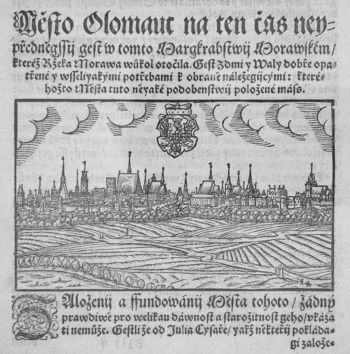
However, as the Fürstenburg lost its importance, settlement in the west became increasingly dense; these settlements merged to form a town, with churches – some of which dated back to earlier times – at their centre. The establishment of the two market squares (Oberring and Niederring), which probably took place as early as the 12th century, was also decisive for the town’s topographical development.
Under King Wenceslaus I (c. 1205–1253), the town of Olomouc was granted a charter under Magdeburg law between 1239 and 1248. In 1352, Margrave Johann Heinrich of Moravia (1322–1375) confirmed Olomouc’s status as the supreme court for the towns governed by Magdeburg law in Moravia. The latter was not superseded by Bohemian municipal law until around 1709. In 1261, 1278 and 1291, the town was granted market and customs privileges.
The council mentioned in 1271 consisted almost exclusively of citizens with German names (a three-quarters majority in the pre-Hussite period). The provision that only Germans should be elected to the council – otherwise unique in Bohemia and Moravia – was probably adopted from Saxony. The first Czech councillor, named Milota, is not attested until 1343. The dominant influence of the German patriciate was reflected in its hostile stance towards Hussitism, which placed Olomouc at the forefront of the anti-Hussite towns of Moravia.
As early as the 13th century, the Moravian Estates and the Provincial Court had been meeting alternately in Olomouc and Brno. In 1314, King John of Luxembourg (1296–1346) designated Olomouc as the capital of the Margraviate of Moravia. In 1479, Władysław II Jagiello of Bohemia and Hungary (1456–1516) and Matthias Corvinus (1443–1490) concluded the Treaty of Olomouc, which legalised the existing dual rule in the lands of the Bohemian Crown.
Modern times
The Lutheran Reformation spread rapidly in Olomouc. Whilst the bishop represented the Catholic faith, a significant proportion of the townspeople sided with Protestantism. By 1602 at the latest, however, the Catholics were once again in control of the town hall.
During the Bohemian Estates Uprising of 1618–20, Olomouc sided with the estates’ freedoms. In September 1622, the property of the remaining representatives of the Estates’ Directorate from among the townspeople was confiscated. With the transfer of the land registers to Brno in 1641, Olomouc lost its status as the capital of the Margraviate of Moravia. The Swedish occupation from 1642 to 1650 had catastrophic consequences for the town: after their withdrawal, only 168 of the town’s 700 houses remained habitable. Furthermore, in 1643 the city was ravaged by fires, three major famines and, in 1645, a plague epidemic. In 1655, Olomouc was declared a fortress; in the 18th century, it was gradually expanded and provided with a permanent garrison.
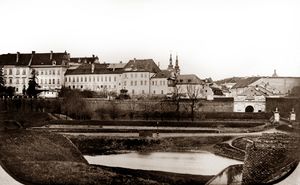
In the revolutionary year of 1848, Archbishop Maximilian Joseph, Baron von Sommerau-Beeckh (1769–1853), provided refuge for the imperial court, which had fled Vienna due to the unrest there. On 2 December 1848, in the archbishop’s palace, Emperor Ferdinand I (1793–1875) entrusted the reins of government to the 18-year-old Franz Joseph I (1830–1916). In 1848, Germans and Czechs each established their own political organisations (Lípa slovanská, Eintracht and Concordia).
In 1850, Olomouc came to the attention of the European public as the site where the so-called Olomouc Points (also known as the ‘Treaty of Olomouc’) were concluded, a diplomatic agreement between Prussia, Austria and Russia concerning the end of the Prussian–Austrian conflict of 1848–50, in which Prussia provisionally relinquished its claim to leadership.
Under the liberal mayors Josef von Engel (1830–1900) and Karl Brandhuber (1846–1934), the motto was: ‘Olmütz: better small, but German!’.
In 1886, Emperor Franz Joseph I revoked the town’s status as a fortress. Despite the town hall’s policy of national isolation (until 1918, the town was governed exclusively by German mayors), the proportion of the population that was Czech increased in Olomouc during the last third of the 19th century.
Contemporary History
Following the establishment of the Czechoslovak Republic in 1918, the town’s administration passed into Czech hands, partly as a result of the incorporation of 13 surrounding villages and the formation of Greater Olomouc.
In the 1935 general election, 14.9 per cent of the population voted for Konrad Henlein’s (1898–1945) Sudeten German Party (SdP). On 15 March 1939, with the establishment of the Protectorate of Bohemia and Moravia, soldiers of the German Wehrmacht’s 5th Army Group occupied Olomouc and were cheered by the majority of the city’s German population. The persecution of the Jewish population in Olomouc reached its peak in 1942, after an internment camp had been set up in the school on Halkova Street. From June/July of that year until March 1945, the occupying forces had 3,498 Jews transported in four waves to Theresienstadt, from where most were deported to extermination camps. Protectorate and occupation authorities headed the city administration from 1939 to 1945.
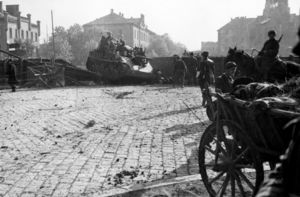
The Red Army marched into Olomouc on 8 May 1945. With the end of the war, the remaining German population was initially concentrated in internment camps (including the Neu-Hodolein/Nové Hodolany camp) and then forcibly expelled by 1946. Compared with 1938, the population of Olomouc thus fell by around 17,000; by the end of 1946 there were only 2,000 Germans left in Olomouc (mostly from mixed marriages), of whom, however, only 84 were recognised as ‘anti-fascists’.[1]
Today, the university and cultural city of Olomouc is, alongside Ostrava, the most important economic and transport hub in Northern Moravia; since the administrative reform in 2000, it has been the administrative centre of the region and the seat of one of the two Czech High Courts. The old town has been a listed conservation area since 1971.
Population trends
| Time | Population[2] |
| 15th century | approx. 3,500–4,000 |
| 1640 | 30,000 |
| 1650 | 1,675 |
| 1880 | 20,176 (12,879 Germans, 6,123 Czechs) |
| 1919 | 23,622 (9,772 Czechs, 8,019 Germans, 1,010 Jews) |
| 1930 | 66,440 (including 14,617 Germans, 2,189 Jews) |
| 1950 | 63,878 |
| 1980 | 102,112 |
| 2011 | 100,043 (2006: 0.15% German) |
Economy
Crafts and trades organised into guilds (particularly the cloth trade) shaped the character of Olomouc well into the modern era, as did local and long-distance trade (withPoland, the Baltic states and Russia). In 1841, Olomouc gained a railway connection via the Olomouc–Prerau/Přerov line, followed four years later by theOlomouc–Prague line. Initially, there was an almost complete lack of an industrial workforce. In the final decades of the 19th century, the metal, leather and food industries (including the sugar works owned by the Primavesi family of entrepreneurs) in particular gained in importance.
Society
In 1910, there were 288 German (174) and Czech (114) associations. The Germans were active, amongst other things, in the Gymnastics Association (founded in 1851), the Music Association (1851) and the Trade Association (1885), whilst the Czechs were active in Sokol (The Falcon, 1869), the Matice školská (School Parents’ Fund, 1872) and the Česká obchodnická beseda (Czech Commercial Academy, 1902). Cultural life was also shaped by the Society of Art Lovers in Olomouc, founded in 1900, the Olomouc branch of the Prague-based Jednota filosofická (Philosophical Society), established in 1923, which sought to foster dialogue between German, Czech and Jewish intellectuals, and the intellectual ‘Engelmann Circle’ from 1910 to 1930.
History of Religion and the Church
In 1063, the Bohemian Duke Vratislav II (c. 1035–1092) initiated the re-establishment of the former Great Moravian Diocese of Olomouc. The first bishop was Johannes, a Benedictine monk from the Bavarian monastery of Niederaltaich (d. 1085). Otto the Fair, a prince of Olomouc, together with his wife Eufemia (c. 1045/55–1111), in 1078, not far from Olomouc Castle, the Benedictine monastery of St Stephen (known as Hradisch [Hradisko] from the 12th century onwards), which was initially staffed by Benedictines from Prague-Břevnov and subsequently endowed with property on several occasions.
Ever since the pro-German Bruno of Schauenburg (c. 1205–2181), the metropolitans had resided mainly in Kremsier/Kroměříž and, following the conquest by the Hussites in 1432, in the newly built castle at Wischau/Vyškov, whilst the chapter and the vicar-general remained essentially in Olomouc. Bishop Johann the Iron (actually von Bucca, d. 1430) made a name for himself throughout the country as a staunch opponent of Hussitism, and was also militarily involved in the fight against the ‘heretics’. Bishop Stanislaus von Thurzo (1470–1540) turned Olomouc into a centre of humanist scholarship.
In quick succession, all the major religious orders established themselves in Olomouc during the first half of the 13th century: in 1213, the Augustinian convent of St James was founded (which passed to the Friars Minor following its dissolution in 1524). The Franciscans followed, presumably in 1250, and the Dominicans at St Michael’s by 1237 at the latest. The founding of the Poor Clares’ convent of St Clare may have been linked to plans to elevate the Diocese of Olomouc to an archdiocese, though these were not realised until 1777. This was followed in 1287 by the establishment of the Dominican nuns’ convent of St Catherine. The Catholic Restoration following the Hussite Revolution led to the establishment of further monastic communities: From 1434, the Augustinian Canons from Landskron/Lanškroun and Prossnitz/Prostějov, who had sought refuge from the Hussites in Olomouc, formed their own convent, which was granted the Chapel of All Saints as its seat in 1492/93. In 1443, the Charterhouse of the Assumption in Olomouc succeeded the Dolein Charterhouse, which had been destroyed by the Hussites. Shortly after the visits of the Franciscan preacher Johannes Kapestran (1386–1456), the church (now the Church of the Immaculate Conception) and the monastery of the Discalced Franciscans (Bernardines) were built on the north-western outskirts of the town.
Martin Luther’s Reformation was widely embraced in Olomouc. In 1528, several Anabaptists were burned at the stake. The bishops of Olomouc initially remained very much in the background whilst this process of religious upheaval was taking place; it was not until Bishop Wilhelm Prusinovsky (1534–1572) who summoned the Jesuits to the city; they moved into the former Minorite monastery in 1566/67. Between 1782 and 1784, the majority of the monasteries were dissolved as part of the Josephinian reforms, which were driven by the Enlightenment. With the Premonstratensian monastery at Hradisch, the Heiligenberg provostry was secularised, and the monastery itself became the seat of the Josephinian General Seminary for the training of priests. Josef Gobrovsky (1753–1829), the founder of Slavic classical studies, served here as vice-rector and later rector from 1787 to 1790. From 1795, the monastery served as a military hospital, whilst the Jesuit college was used as barracks.
Sources first mention settled Jews in 1140. In 1454, they were expelled, as they were from all the royal towns of Moravia. It was not until after 1848 that they were able to settle permanently in Olomouc once more. Between 1895 and 1897, a synagogue in the Oriental-Byzantine style was built on the square by the Theresien Gate (now Palachovo náměstí) to designs by the Viennese architect Jakob Gärtner (1861–1921), a synagogue in the Oriental-Byzantine style was built on the square by the Theresien Gate (now Palachovo náměstí); it was burnt down following the Wehrmacht’s invasion on the night of 16 March 1939. Following the deportation of the Jews during the Second World War, it was not until after the Velvet Revolution in 1991 that a new, independent Jewish community was established.
Education and Science
Bishop Protasius of Boskowitz and Černahora (d. 1482) had already shown himself to be open to humanism. Stanislaus Thurzó of Béthlenfalva (1470–1540), who had been bishop since 1497, transformed the cathedral chapter and the provincial capital of Olomouc into a humanist-influenced, transnational centre of Neo-Latin poetry, philological scholarship and historical research. The Olomouc circle of humanists included, amongst others, Stephan Taurinus (Olomucensis, c. 1485–1519), who in his *Stauromachia* also composed a panegyric to Olomouc; Augustin Käsbrot (Augustinus Olomucensis, 1467–1513), as well as the pupils of Celtis, Gregor Nitsch and Martin Sinapinus, who in 1502 founded the scholarly society‘Sodalitas litteraria Marcomannia’(also known as the Meierhofiana), which existed until 1511. Johannes Dubravius (1486–1553), a humanist and diplomat, was Bishop of Olomouc from 1541, and distinguished himself not only as a historian (Historia regni Bohemiae, 1552), but also as the author of a treatise on fish farming and fishing techniques (De piscinis, 1596). At the same time, as a representative of the King of Bohemia and later Emperor Ferdinand I (1503–1564), he took part in the Bohemian Diet and negotiated with the estates regarding aid against the Turks.
In 1573, the school founded by the Jesuits was granted university status by Pope Gregory XIII (1502–1585) and Emperor Maximilian II (1527–1576); this second-oldest institution of higher education in the Bohemian Lands was administered by the Jesuits until the suppression of the Order in 1773. In 1778, it was relocated to Brno. Transferred back to Olomouc in the 1880s, the institution did not regain its status as a university (the Imperial and Royal University of St Francis) until 1827, before being completely dissolved in 1860. Only the independent School of Theology (renamed the Cyril and Methodius School in 1919) survived. Following the closure of all Czech universities in the Protectorate of Bohemia and Moravia, the Alma Mater did not resume its activities until 1946, under the name Palacký University.
In the second half of the 19th century and at the beginning of the 20th century, German schools played an important role, in particular the Imperial and Royal German State Grammar School and the Imperial and Royal German Upper Realschule, founded in 1854. Graduates of the State Grammar School included, amongst others, the philosopher and mathematician Edmund Husserl (1859–1938), the Austrian writer Franz Spunda (1890–1963), who was born in Olomouc, and Arthur Seyß-Inquart (1892–1946), who later became a leading figure in National Socialism. In 1869, the Czech Slavic Grammar School was founded, and in 1895 the Czech Girls’ School. In 1900, the German School moved into the so-called Elisabethinum, which was headed by Josef Föhner (1849–1933), a prominent figure in Olomouc’s cultural life.
In 1746, Joseph Baron von Petrasch (1714–1772) founded the‘Societas incognitorum eruditorum in terris Austriacis’ in Olomouc, an enlightened scholarly society, the first of its kind in the Habsburg lands with both domestic and foreign members. The society served to promote the sciences and published the journal *Olmützer Monathliche Auszüge Alt- und neuer Gelehrter Sachen *.
The origins of the Olomouc Study Library (now the Scientific Library in Olomouc [Vědecká knihovna v Olomouci]) are linked to the arrival of the Jesuits in Olomouc in 1566.
Art History and Architecture
The great Basilica of St Wenceslas was built on the site of Wenzelsberg between 1104 and 1107. The originally Romanesque basilica was extended between 1184 and 1199, and its core has been preserved in the cathedral, which has since been remodelled several times. Running parallel to the main axis of the basilica, the Romanesque Bishop’s Palace was built to the north-east with the involvement of Rhineland-based builders. Having already been severely damaged by a fire in 1204, the building – which was restored in the 13th century and is classified as a national monument – underwent extensive renovation and reconstruction after the Second World War. Bishop Bruno von Schauenburg had the older St John’s Chapel, consecrated in 1268, built in the Westphalian Gothic style in front of the Bishop’s Palace.
The rivalry between Brno and Olomouc was also visibly reflected in the grand new religious buildings and the lavish furnishings of the two main churches: St James’s in Brno and St Maurice’s in Olomouc. Following the devastating fire of 1398, work on the new St Mauritz church began three years later with the construction of a tower. Repeatedly interrupted by fires, the construction of the immense three-nave nave dragged on for almost one and a half centuries. The early Gothic hall church of St Michael, newly built for the Dominicans between 1246 and 1275, remains largely intact to this day, as does the monastery’s Gothic cloister, which dates from the second half of the 14th century. Among the best-known examples of late Gothic architecture are, alongside the parish church of St Mauritz, the St Jerome’s Chapel in the Town Hall (before 1488) and the Barfüßer Monastery.
The outer double staircase and the portal of the Town Hall, built in the Renaissance style before 1530; the burial chapel of the Olomouc citizen Wenzel Edelmann (d. 1572?) on the south side of the choir of St Mauritz (before 1572); the family crypt of Bishop Stanislaus Pavlovský (d. 1598) in the choir of the cathedral (St Stanislaus Chapel, 1582–91), as well as numerous town houses and aristocratic palaces on the Oberring and Niederring (including the Edelmann Palace on the Oberring, 1572–86; and the Hauenschild Palace on the Niederring, 1583).
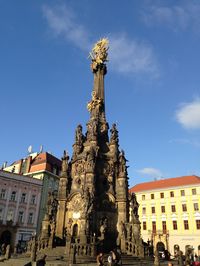
Following the Thirty Years’ War and the withdrawal of the Swedes, the city was redesigned in the Baroque style. Among other things, this led to the construction of the episcopal (now archiepiscopal) residence (1665–69). The Premonstratensian monastery at Hradisch took on its present form between 1659 and 1736. This also included the Heiligenberg (Svatý Kopeček) pilgrimage church, built between 1629 and 1633 some 8 km north-east of Olomouc on a ridge by the Olomouc citizen Jan Andrysek (1595–1673) on a ridge some 8 km north-east of Olomouc; this church, known as Heiligenberg (Svatý Kopeček), took on its present appearance between 1670 and 1690. In Olomouc itself, numerous Baroque fountains were erected from the end of the 17th century onwards (including the Hercules and Caesar fountains on the Upper Ring, the Neptune and Jupiter fountains on the Lower Ring, and the Triton Fountain in front of the Poor Clares’ convent). To commemorate the plague epidemic of 1713–15, the monumental Holy Trinity Column on the Upper Ring was erected between 1716 and 1754, and the Marian Column on the Lower Ring between 1716 and 1727.
History of Theatre and Music
German and Italian travelling theatre companies had been performing in Olomouc as early as the 17th century. In 1770, the first proper theatre – the Royal Municipal National Theatre – opened above the meat market at Niederring 25; as early as 1828, construction began on a new theatre building based on plans by the Viennese architect Josef Kornhäusel (1782–1860). The Royal Municipal Theatre in Olomouc was one of the first engagements in 1883 for the young, then as yet unknown, conductor Gustav Mahler (1860–1911). The operetta composer Leo Fall (1873–1925) was born in Olomouc. Amongst others, Leo Slezak (1873–1946), Adele Sandrock (1863–1937) and Tilla Durieux (1880–1971) made their debuts or performed at the theatre. Ludwig van Beethoven (1770–1827) composed his *Missa solemnis* for the enthronement of Archbishop Rudolf of Austria (1788–1831) in Olomouc Cathedral.
History of Literature and the Press
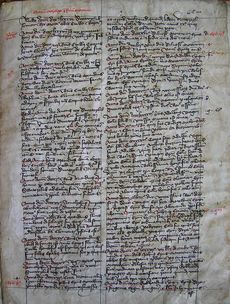
The famous liturgical codex *Horologium Olomucense* (1142/43) dates from the 12th century. The rise of Humanism in Olomouc around 1500 was also linked to the beginnings of printing (1499, Matthias Preinlein [documented between 1486 and 1499]).
From 1848 onwards, the *Olmützer Lokal-Anzeigeblatt* and the *Olmützer Zeitschrift* were published, followed in 1877 by the literary and local history journal *Moravia*, before the editorial office and printing operations moved to Brno in 1882. From 1880, the newspaper *Mährisches Tagblatt* was added to the list. Among the Czech periodicals, *Beseda* gained particular prominence, especially from 1872 onwards.
Franz Spunda (1890–1963) was one of the most important German-speaking authors from Olomouc. The atmosphere in Olomouc before and after 1945 was vividly described by Peter Härtling (1933–2017), who attended school in Olomouc from 1942 to 1945, in his novels *Nachgetragene Liebe* (1980) and *Leben lernen* (2003), as well as in his short story *Božena* (1994).
Bibliography
- Archbishop Theodor Kohn (1893–1904). The turbulent life of a talented man. Exhibition catalogue. Olomouc 2013.
- Josef Föhner: Memories of Olomouc. Olomouc 1930.
- Martin Hájek: The Expulsion of the Germans from Olomouc. Olomouc 2014.
- Johann Kux: History of the Royal Capital of Olomouc up to the Revolution of 1918. Reichenberg/Olomouc 1937.
- Lukáš Motyčka, Veronika Opletalová (eds.): Literary Walks through German Olomouc – Literary Walks through German Olomouc. Olomouc 2012.
- Jindřich Schulz (ed.): Dějiny Olomouce [History of the City of Olomouc], 2 vols. Olomouc 2009.
- Vladimír Spáčil (ed.): The Oldest Olomouc Town Register from 1343–1420. Olomouc 1982.
- Libuše Spáčilová: German Wills of Olomouc Citizens. The Development of a Text Type in the Olomouc City Chancery between 1416 and 1566. Vienna 2000.
- Libuše Spáčilová, Vladimír Spáčil: The Olomouc Memorial Book (Codex of Václav of Jihlava) from 1430–1492 [The Olomouc Memorial Book. The Codex of Wenceslas of Jihlava from the years 1430–1492]. Olomouc 2004.
- Peter Wörster: Humanism in Olomouc. Regional descriptions, eulogies of the city and historiography in the first half of the 16th century. Marburg 1994.
Periodicals
- Historical Olomouc: A Collection of Papers [Historical Olomouc: Anthology].
- Olomouc Archive Anthology [Olomouc Archive Almanac].
- Yearbook of the State District Archive in Olomouc (1993–2002).
Web links
- www.olomouc.eu (multilingual website of the city of Olomouc)
- www.ok-tourism.cz/en (tourism portal for the Olomouc region)
- www.vmo.cz (website of the Regional History Museum in Olomouc)
- www.archives.cz/web/soka/olomouc/o_archivu/ (website of the Olomouc State Archive)
- www.visitczechrepublic.com/de-DE/8b12dbef-c352-42b7-b6f1-9de02a106869/place/c-olomouc-art-museum (Olomouc Art Museum)
- www.ado.cz (Archdiocese of Olomouc website)
- www.ac-olomouc.cz (website of the Olomouc Archaeological Centre)
- www.kehila-olomouc.cz (multilingual website of the Jewish Community of Olomouc)
- www.vkol.cz/wissenschaftliche-bibliothek-olomouc (website of the Olomouc Scientific Library in German, with a link to the digital library)
- www.prager-literaturhaus.com/?page=kulturni-krajina&town=13 (reference from the Prague House of Literature to the Centre for German-Moravian Literature in Olomouc, with a link in German)
- www.moric-olomouc.cz (Czech-language website of the Roman Catholic Parish of St Mauritz in Olomouc, featuring a historical overview of the town church)
- www.herder-institut.de/bildkatalog/wikidata/Q81137 (Images of Olomouc in the image archive of the Herder Institute, Marburg)
Notes
[1] Karel Konečný: From the Košice Government Programme to February 1948. In: Jindrich Schulz (ed.): Dějiny Olomouce [History of the City of Olomouc], vol. 2, pp. 275–290, here p. 278.
[2] Data taken from: Oldřich Juryšek: Dějiny Olomouce 1017–1920 [History of the City of Olomouc 1017–1920]. Olomouc 2008; and: ‘Olomouc’. URL: cs.wikipedia.org/wiki/Olomouc (accessed 25 August 2014).
Citation
Thomas Krzenck: Olmütz/Olomouc. In: Online Encyclopaedia on the Culture and History of Germans in Eastern Europe, 2014. URL: ome-lexikon.uni-oldenburg.de/p32500 (as at 30 July 2021).
Terms of use for this article
Copyright © University of Oldenburg and the Federal Institute for the Culture and History of Germans in Eastern Europe (BKGE), all rights reserved. This work was produced as part of the project ‘Online Encyclopaedia on the Culture and History of Germans in Eastern Europe’ and may be reproduced and published provided the rights holders’ consent has been obtained. Please contact:
If you have any specialist comments or additions to the text, please contact the editorial team, citing relevant literature and source references.