

Hussites
Hussites
Term
The term ‘Hussites’ refers to the movement in Bohemia and Moravia in the 15th century that was opposed by the Catholic Church as heretical; its followers were disparagingly referred to by their opponents as ‘Hussen’ – that is, followers of Hus (= Hussites).
Support, Use
Contemporary sources in German and Latin use the terms ‘Wycliffites’, ‘Hussites’ (Wycliffistae et Hussitae) or, more generally, ‘heretics’ (Heretici) as synonyms. The Hussites (Czech: husité) did not use a specific term to describe themselves, but regarded themselves as devout Christians and consequently as part of the Church – as “friends of divine truths”, as is evident from contemporary Hussite manifestos.
2. Definition
Behind the collective term ‘Hussites’ lies a heterogeneous movement centred primarily in Bohemia, whose followers spanned a broad social spectrum (from sections of the Bohemian high nobility to the lesser nobility, from the lower clergy through the urban lower and middle classes to the peasantry). Under pressure from outside (anti-Hussite crusades), they occasionally formed coalitions. The unifying force was the catalogue of demands set out in the ‘Four Articles of Prague’ (Čtyři artikuly pražské) as a minimum programme.
3. Discourses/Controversies
From the second half of the 19th century onwards, the assessment of Hussitism increasingly reflected the ethnic and national tensions between Czechs and Germans. Under the decisive influence of the historical narrative developed by František Palacký, Hussitism served as a source of legitimacy for the Czechs, who were striving first for federal and subsequently for state independence. In this context, the Hussite era came to be regarded as the supposedly most glorious period in Czech national history since the founding of Czechoslovakia in 1918, and was accorded a role central to the state. The Hussite motto ‘Pravda vítězí’ (Truth Prevails) was exploited socially and ideologically by the Communist Party following its foundation in 1921 and used as a shield in 1945 against the German minority, and after the seizure of power in 1948 against its own ‘bourgeois enemies of the people’. This was done in the belief that revolutionary Hussitism provided the legitimate basis for their own, forcibly installed communist system, and consequently found its reflection in the official historical narrative, which, admittedly, began to show cracks as early as the 1960s, when historians such as F. Šmahel, J. Mezník, J. Kejř and others countered propagandistic platitudes with a different, source-based interpretation of Hussitism. Under the influence of Western European and Anglo-American historiography, a multifaceted picture of the Hussite movement emerged in terms of social, intellectual and mental history; since 1989, in particular, the emphasis has been on situating the events in Bohemia within their historical and intellectual context (periodisation of the Reformation of the 15th and 16th centuries, links to the Lutheran Reformation, connections to other ‘heretical’ movements, particularly the Waldensians). Questions regarding the end of the revolution, the very concept of revolution itself, and the substance of the enforced tolerance following 1436 remain the subject of scholarly debate.
The precursors of Hussitism and signs of crisis in Bohemian society
The roots of Hussitism date back to the reign of Charles IV, when criticism of the obvious abuses within the Church began to take shape. Prague (with a population of around 40,000), with its university, 44 parishes, 24 monasteries and some 1,200 clergymen, was, after Avignon, Paris, Rome and Florence, the largest centre of the clergy in what was then a crisis-ridden Europe (including climate change, the so-called agrarian crisis and the Great Schism of 1378). The growing number of clergy competing for benefices came into increasing conflict with the declining economic vitality of the Bohemian lands (desolate public finances, a slump in silver production since 1350, the depreciation of the currency and the tax burden, compounded by the consequences of Charles IV’s costly land consolidation and acquisition policies). In Prague, the symptoms of the crisis were particularly evident given the enormous number of clergy and monasteries, which created a broad forum for criticism of the Church and society. Pioneers in this regard, from the 1360s onwards, were men such as Konrad Waldhauser, Johann Militsch von Kremsier and Matthias von Janov. At the centre of their criticism – delivered in the vernacular and before a growing audience – was the call for a true Church, renouncing worldly possessions and luxury, following in the footsteps of Christ and his poverty. The Bethlehem Chapel, founded in 1391 as the religious centre of Czech-speaking Prague, developed into the actual centre of the intellectual struggle for a return to the ideals of the early Church and its authorities. For all strata of society, the position of the Catholic Church – in particular its ethical and moral state and its extensive landholdings in the country, which amounted to 30–40 per cent of the total arable land – was a thorn in the side. Added to this were power struggles between the high nobility and the king, the king and the Archbishop of Prague, Wenceslas IV and other members of the House of Luxembourg.
The struggle over Wyclif and the University of Prague
The University of Prague, founded in 1348, emerged as the centre of intellectual unrest. A young, up-and-coming generation of Bohemian university masters and preachers took their cue from the ideas and demands of the Oxford church critic John Wyclif (c. 1330–1384), who called for a reform of the Church and the clergy based entirely on Holy Scripture. Even before a reform movement had taken shape in the capital, Prague, and beyond—a movement that was to form the intellectual framework of Hussitism—the local Germans, who had lived in Bohemia and Moravia since the High Middle Ages, were for the most part opposed to it. They found support amongst the ‘Pragenses’ – that is, the former German professors and students who had left the city on the Vltava in protest against the Kuttenberg Decree of January 1409 and the associated change in the voting ratio at Prague University in favour of the native Czechs.
Jan Hus – Rebel against the established church and martyr
Jan Hus, a charismatic and eloquent preacher at the Chapel of St Bethlehem since 1402, increasingly became a leading figure amongst his growing following among the ‘people’ of Prague and an object of hatred for his no less numerous opponents from the ranks of the Prague clergy and the higher clergy, whom he had fiercely criticised. In word and deed – closely following Wyclif – Hus strove for a renewal of the institutionalised Church and of social life. This was a matter of reformation, not revolution (lex Dei = divine law as a binding principle). With the condemnation of Wyclif’s theses in Rome in 1408, Hus and his followers lost the support of the Archbishop of Prague; and in 1412, they also lost the backing of King Wenceslas IV, who – for reasons of political expediency and against the backdrop of the Council of Pisa – had initially been favourably disposed towards the domestic reform movements (the Kuttenberg Decree of 1409). At the same time, the heresy trial brought against Hus by the Roman Curia got under way, leading to the differentiation, formation and radicalisation of the protest and reform movement critical of the Church. Hus himself sought, relying on the letter of safe conduct granted by the Roman-German King Sigismund— which was, of course, ultimately revoked, to secure a hearing to defend his views before the Council of Constance; however, shortly after his arrival at Lake Constance, he was thrown into prison and finally burned at the stake in 1415. The reform movement in Bohemia thus now had an ideal figure and, at the same time, an exemplary martyr as a great source of inspiration, as was also the case with Jerome of Prague, who was executed in the same place a year later. The protest against Hus’s burning as a heretic initially took the form of a letter of protest from the Bohemian and Moravian nobility to the Council, whose doctrinal authority was denied, whilst the University of Prague was henceforth elevated to the final authority on matters of faith. In a process of rapid radicalisation, separate parishes formed around ‘chalice priests’, leading to secret – and soon public – mass pilgrimages organised by ‘chalice priests’ who held no official position and supported by the lower nobility, during which the participants collectively awaited the end of the (earthly) world, following biblical examples.
The Hussite Revolution – Groups, Aims and Course of Events
The revolution began with the First Defenestration of Prague on 30 July 1419 in Prague’s New Town – an area characterised by a mobile and up-and-coming class of Czech artisans – under the leadership of the former Premonstratensian Johann von Seelau (Jan Želivský). His impassioned sermons spurred the Utraquists to action: they occupied the central parish church in Prague’s New Town and marched in procession to the town hall to secure the release of their fellow believers who had been imprisoned, a demand which the Catholic Czech councillors refused to grant. The latter were then summarily thrown out of the window by the fanatical crowd. Further attacks on monasteries and Catholic priests followed in a spiral of violence. During the crucial phase of the revolution (1419–1422), a total of five leading groups emerged: the radical Prague magisters, the Bohemian nobility, the moderate Hussite Old Town of Prague, the more radical New Town of Prague, and the town of Tabor in South Bohemia, newly founded in the spring of 1420, with its short-lived ‘proto-communist’ experiment in social equality. The latter served as a base of operations for a people’s army of ‘God’s warriors’ (peasants, craftsmen, minor nobility) and quickly established itself as a second centre of the revolution alongside Prague, whilst being far more radical theologically and more socially revolutionary than the provincial capital. A similarly radical centre also emerged in Eastern Bohemia (‘Orebites’, later ‘Orphans’) near Königgrätz/Hradec Králové. Wenceslas’s successor, Sigismund of Luxembourg, tried in vain to seize the Bohemian throne by force, with the support of a large crusader army and the papal blessing. It was only in Moravia that Sigismund was able to assert himself in 1423 with the help of his son-in-law, Duke Albert of Austria. The military campaign in early summer 1420 ended in a fiasco, as did all subsequent anti-Hussite crusades.
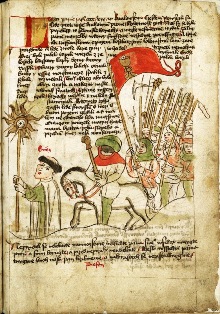
Jan Žižka at the head of the Hussite
army. Göttingen manuscript, after 1460
[Lower Saxony State and University
Library, 2° Cod. Ms. theol. 182
Cim, fol. 82r].

In 1420/21, the Hussites presented their central programme, the so-called ‘Four Articles of Prague’: the Eucharist in both kinds; freedom to preach the Word of God; the Church’s renunciation of its secular power and the secularisation of ecclesiastical property; and the punishment of serious public sins committed by the clergy, such as usury, luxury or simony. On Prague’s initiative, a General Diet convened in June 1421 in Čáslav, Central Bohemia, attended by all political forces in the country across denominational lines – with the exception of the Moravian towns. Sigismund of Luxembourg was denied recognition as King of Bohemia; in his place, the Diet appointed a council of 20 regents, comprising barons, provincial nobles and – constituting the numerical majority – townspeople – and which was intended to ensure internal peace in the country, though this, of course, remained a pipe dream. Subsequently, the focus shifted to the Hussite armies under the leadership of the politically ambitious minor nobleman and brilliant military commander Jan Žižka of Trocnov, who, following internal Taborite disputes at the end of 1421, had the radical branch of the Chiliasts (the so-called Adamites). Two years later, Žižka turned his back on Tabor and made East Bohemia the centre of his brotherhood, with a military order based on an estate-based structure serving as a kind of constitution to regulate communal life. After Žižka’s death, his successor, Prokop the Bald (‘the Great’), took the helm of the Hussite forces of the Taborites and the Orphans. In the battles against the inadequately equipped, yet at times numerically superior, crusader forces, Prokop successfully utilised the innovative form of warfare developed by his predecessor, which was characterised, amongst other things, by the use of wagon forts – a tactic which the “Warriors of God” had virtually perfected. The majority of the high nobility leaned towards a moderate form of Hussitism based on the “Four Articles”. Furthermore, they advocated the secularisation of church property and a monarchy dependent on the aristocracy. A Catholic minority continued to support Sigismund of Luxembourg, led above all by the powerful Baron Ulrich von Rosenberg. Following the defeat of the crusader army at Aussig/Ústí nad Labem in 1426, the Hussites, for their part, shifted from a defensive to an offensive military stance, whilst at the same time attempting, through propagandistic manifestos in which they explained the ‘Four Articles of Prague’ and called upon Christendom to join forces against the Church, the Papacy and secular power. On the so-called ‘glorious campaigns’ (spanilé jízdy), Hussite armies advanced deep into several territories of the Holy Roman Empire (Silesia, Saxony, Brandenburg, Franconia, Bavaria and Austria), often leaving a trail of devastation in their wake. Occasionally, the Hussites also found supporters in Germany, though most of these ultimately met their end at the stake in a series of Inquisition trials. In 1427, with the help of an unpopular ‘Hussite tax’, the electors and imperial cities sought to raise additional funds for the defensive campaign against the Bohemian heretics.
Diplomacy and Violence – The End of the Revolution

The Battle of Hussites at
[In: Eberhard Windecke: The Book of Emperor Sigismund
, illustration from the workshop
of Diebold Lauber, c. 1445–1450]

Following the crushing defeat of a crusader army led by the papal legate Giuliano Cesarini at Taus/Domažlice in 1431, as well as armed incursions by the Hussite brotherhoods into neighbouring countries, the Council meeting in Basel (1431–1437), which was sitting in Basel, finally proved willing to engage in peace negotiations; these were also supported by King Sigismund, who had already held talks on peace in Pressburg/Bratislava in 1429 with Hussites, Catholic magnates and university theologians from Vienna and Paris. Following protracted negotiations, the so-called Basel Compacts were concluded in 1433; however, these permitted the Hussites only to receive communion under both kinds, a condition accepted only by the conservative Hussites, whilst the radicals reaffirmed their rejection. On 30 May 1434, a noble-Utraquist army inflicted a crushing defeat on the radical forces led by Prokop the Great at the Battle of Lipany, thereby paving the way for general acceptance of the Basel Compacts, which in turn enabled Sigismund’s accession to the throne in Prague in 1436 and his recognition as King of Bohemia – in a country where, from then on, a dual confessional system (tolerance born of necessity) prevailed. It was not until 1485 that a religious truce was concluded between Catholics and the increasingly divided Utraquists at the Kuttenberg Diet, bringing to an end the period of almost six decades during which two societies of different denominations had existed in parallel.
The Results of the Revolution
At the political level, a constitution based on the estates took hold, headed by an elected monarch, in which the estates – the lords (high nobility), knights and royal towns – secured decisive political influence, even at the expense of the marginalised clergy. Within the spectrum of social forces, the high nobility continued to dominate, not least thanks to their occupation of church and royal estates. The urban bourgeoisie continued to suffer for a long time from the economic consequences of the war years and the disruption of trade links, as well as the relocation of the transit trade route. The Hussite Revolution also completed the process of ‘Czechisation’ of most Bohemian towns; the German patriciate lost a great deal of influence – with the exception of the northern Bohemian border towns. The neighbouring region of Moravia went its own way: the major towns remained unchallenged as German and Catholic, with the Diocese of Olomouc at the forefront. For the peasants, on the other hand, virtually nothing changed in practice – with the exception of their religious denomination, in which they were obliged to follow that of their respective rulers. Two denominations shaped the character of the Church, with the Utraquists clearly dominant amongst the nobility and the urban bourgeoisie. The Utraquist Church was poor, dependent on the secular estates, yet independent of Rome in matters of ecclesiastical jurisdiction and the appointment of office-holders. Catholic church property had been considerably depleted, and the Archdiocese of Prague remained vacant until 1561.
Bibliography
- Michaela Bleicher: The Duchy of Lower Bavaria-Straubing during the Hussite Wars. Everyday Life and Warfare as Reflected in the Provincial Clerk’s Accounts. Regensburg 2009 (epub.uni-regensburg.de/10414/).
- Stanisław Bylina: The Hussite Revolution. The Prelude and the Early Years. Warsaw 2011.
- Petr Čornej: Velké dějiny zemí Koruny české [A Comprehensive History of the Lands of the Bohemian Crown]. Vol. 5: 1402–1437. Prague, Litomyšl 2000; Vol. 6: 1437–1526. Prague, Litomyšl 2007.
- Three Inquisition Proceedings from the Year 1425. Files from the trials against the German Hussites Johannes Drändorf and Peter Turnau, and against Drändorf’s servant Martin Borchard. Edited and annotated by Hermann Heimpel. Göttingen 1969 (Publications of the Max Planck Institute of History 24).
- Winfried Eberhard: The Hussite Revolution in Bohemia. Causes – Aims and Groups – Course – Outcomes. In: Klaus Herbers, Florian Schuller (eds.): Europe in the 15th Century. Autumn of the Middle Ages – Spring of the Modern Era? Regensburg 2012, pp. 136–160.
- Howard Kaminsky: A History of the Hussite Revolution. Berkeley 1967 (reprinted 2004).
- Thomas Krzenck: John Hus, Theologian, Church Reformer, Martyr. Gleichen, Zurich 2011 (Personality and History 170).
- Franz Machilek: The Rise and Fall of Cooperation between the Waldensians and the Hussites in the 15th Century (with particular reference to conditions in Germany). In: Albert de Lange, Kathrin Utz Tremp (eds.): Friedrich Reiser and the ‘Waldensian-Hussite International’ in the 15th Century. Heidelberg, Ubstadt-Weiher, Basel 2009 (Waldensian Studies 3), pp. 277–316.
- Franz Machilek (ed.): The Hussite Revolution. Religious, Political and Regional Aspects. Cologne, Weimar, Vienna 2012 (Research and Sources on the Church and Cultural History of Eastern Germany 44).
- Ferdinand Seibt: *Hussitica*. On the Structure of a Revolution. 2nd, expanded edition. Cologne 1990.
- František Šmahel: The Hussite Revolution. 3 vols. Hanover 2002 (Monumenta Germaniae Historica 43). Czech edition Prague 1995/96 (2nd, expanded edition)
Yearbooks, journals
- Husitský Tábor [Hussite Tabor], www.husitskemuzeum.cz/ht/
Web links
- cms.flu.cas.cz/index.php (website of the Centre for Medieval Studies in Prague, featuring digitised versions of key source texts, primarily in Czech)
- www.husitskemuzeum.cz/ (website of the Hussite Museum in Tábor, South Bohemia)
- www.bauernkriege.de/tabor.html (German-language website on the Hussites and Taborites)
- www.husitstvi.cz/ (Czech-language website on the history of the Hussites: figures, battles, military affairs, Hussite legacy)
Citation
Thomas Krzenck: Hussites. In: Online Encyclopaedia on the Culture and History of Germans in Eastern Europe, 2013. URL: ome-lexikon.uni-oldenburg.de/p32873 (accessed 6 December 2021).
Terms of use for this article
Copyright © University of Oldenburg and the Federal Institute for the Culture and History of Germans in Eastern Europe (BKGE), all rights reserved. This work was produced as part of the project ‘Online Encyclopaedia on the Culture and History of Germans in Eastern Europe’ and may be reproduced and published provided the rights holders’ consent has been obtained. Please contact:
If you have any specialist comments or additions to the text, please contact the editorial team, citing relevant literature and source references.