

Silesia
Silesia
Names in other languages
Latin: Silesia; Polish: Śląsk; Czech: Slezsko; English: Silesia; French: Silésie
Etymological derivation
It is thought that the name Silesia derives from the river Ślęża (German: Lohe) and the mountain of the same name (German: Zobtenberg, first mentioned in 1108 as ‘in monte Silencii’). Its etymology probably dates back to the period before Germanic settlement, but was previously often interpreted by Germans as ‘Germanic’ and by Poles as ‘Slavic’.
Location
Silesia refers to the region on both sides of the upper and middle Oder/Odra; it encompasses the northern part of the Sudeten Mountains/Sudety and the Moravian Gate/Moravská brána (the watershed between the Oder and the March/Morava). To the south-east, it is bounded by the Beskids (Polish: Beskidy, Czech: Beskydy); to the north-east, by the watershed between the Oder and the Warta; and to the north, by the Barycz and Obra lowlands. At 1,603 metres, Sněžka in the Karkonosze/Krkonoše Mountains is the highest peak in Silesia.
Climate
Silesia has a continental climate, whilst the mountains have a temperate alpine climate. The climate is milder in the west than in the east. Annual rainfall ranges from 480 to 720 mm, but exceeds 1,200 mm in the mountains.
National and regional affiliation
Silesia was part of the Kingdom of Poland (until 1202 under the Polish ‘seniorate system’); from 1327, the Silesian principalities were successively annexed to the Crown of Bohemia; 1335 (Trenčín Treaty), 1339 (Kraków Treaty): renunciation by the Polish king; 1348 ‘incorporation’ of Silesia into the Crown of Bohemia by Emperor Charles IV; 1526: Transfer of the Bohemian Crown, together with the Silesian feudal principalities, to the House of Habsburg; 1742 (Treaty of Berlin): Transfer of the greater part of Silesia to Prussia; the remainder remained as Austrian Silesia under the Habsburgs (from 1918 as part of Czechoslovakia, with the northern part of Cieszyn Silesia being ceded to Poland in 1918; part of the Czech Republic since 1993); 1815: Expansion to include Silesian Upper Lusatia; 1866: Prussian Silesia became part of the North German Confederation, and from 1871 part of the German Empire; In 1919, the southern district of Ratibor was ceded to Czechoslovakia as the ‘Hultschiner Ländchen’; 1922 Division of Upper Silesia: the eastern half ceded to Poland; 1945 Potsdam Conference: largely placed under Polish administration; smaller parts of historic Lower Silesia (the western half of Silesian Upper Lusatia to the left of the Lusatian Neisse) remained with Germany.
Common symbolism
In the historic parts of Silesia, various forms of the Piast eagle were used, from which the following main variants were derived:
- in Lower Silesia, a black eagle on a gold background, with a white crescent on its breast and a cross. The coat of arms of the Polish Lower Silesian Voivodeship is based on the design found on the tomb of Duke Henry IV.
- in Upper Silesia, originating from the Duchy of Opole, a golden eagle on a blue background, often depicted with a crown.
Common or historical nicknames
In early modern chronicles, Silesia was personified as ‘die Schlesie’. The historical German-language dialect term was ‘Schläsing’ and was personified in literature (for example, by Karl von Holtei) as ‘Mutter Schläsing’. In the ‘Water Polish’ (Schlonsak) dialect, the term ‘Ślůnsk’ is used.
Prehistory and Early History
The earliest evidence of human presence in Silesia dates back to the Palaeolithic period, whilst settlement began in the Neolithic period. Around 500 BC, the Scythians migrated from the east into Silesia, which was then characterised by the Lusatian culture; later, the Celts arrived from the south and south-west. During the Migration Period, Germanic Vandals settled in Silesia, amongst whom the Silingen tribe stood out. From around the 6th century onwards, Slavic tribes began to settle in the region. Population growth fostered the emergence of tribal confederations (the Slezan, Opolan and Trebowian tribes, amongst others). The beginnings of West Slavic state formation, through the unification of tribal territories under the rule of princes, can be dated to the 8th/9th century.
Medieval history (up to 1500)
Before the year 1000, the region was inhabited by several West Slavic tribes. It became caught up in the power struggles of its expanding neighbours, was conquered and Christianised by the Bohemian Přemyslids around 900 and then by the Polish Piasts after 950. Consequently, in the year 1000, the Diocese of Breslau/Wrocław was established as a suffragan of the Polish Archdiocese of Gnesen/Gniezno. Within the boundaries of the new diocese, the individual political territories of Silesia essentially developed, which, in the 11th century, together with Greater Poland/Wielkopolska, Masovia/Mazowsze, Lesser Poland/Małopolska and eastern Pomerania/Pomorze, formed the basis of Poland. The early period under Bohemian and Polish rule was followed, from 1138 onwards, by a fragmentation of the Polish state and a phase of internal power struggles within Poland and Silesia:
As a result of the seniorate constitution stipulated in the will of Duke Bolesław III Crooked-Mouth/Krzywousty (d. 1138) in his will, which was intended to hold the Polish state together under a ‘princeps’, Silesia became one of four Polish sub-duchies (Greater Poland, Lesser Poland, Kuyavia-Masovia, Silesia). It was at this time that a distinct Silesian Piast line began to emerge, which subsequently branched out – initially, probably in 1173 and then in 1202 – into a Lower Silesian line based in Wrocław and an Upper Silesian line based in Opole. Following the failure of Henry I the Bearded’s (Henryk Brodaty, 1201–38) attempt to unify all of Poland and after the Mongol invasion of 1241 (Battle of Liegnitz/Legnica), Silesia split into as many as 17 sub-duchies.
At the beginning of the 14th century, Silesia found itself confronted with claims to sovereignty from a now-empowered Poland under King Władysław I Ellenlang/Władysław Łokietek, as well as political pressure from the Bohemian King John of Luxembourg (1310–46). The Silesian Piast dukes, who had little political influence, ceded their territories to Bohemia after 1327 by transferring their duchies to the Bohemian Crown in order to receive them back as fiefs. Under the Treaty of Trenčín, ratified in 1339, King Casimir III the Great of Poland (1333–70) renounced his suzerainty over Silesia, which was subsequently ‘incorporated’ into Bohemia in 1348 by the future Emperor Charles IV was ceremonially ‘incorporated’ into Bohemia and thus indirectly annexed to the Holy Roman Empire, without the Silesian dukes—who were reduced to the status of mediat princes—having attained imperial status. From then on, Silesia, like Lower and Upper Lusatia and Moravia, was a dependency of the Bohemian Crown, within which distinct forms of estate representation and a separate provincial administration developed in the 15th century. Nevertheless, due to ongoing ecclesiastical, dynastic and political ties, numerous contemporary sources continued to count it as part of ‘Polonia’; close economic and trade links with Poland also persisted. In the 15th century, the Upper Silesian regions of Sewerien/Siewierz (1443), Auschwitz/Oświęcim (1453) and Zator (1494) became permanently part of Poland; the Lower Silesian town of Crossen/Krosno Odrzańskie fell to Brandenburg (1482), whilst the Moravian town of Troppau/Opava – which later became independent – had belonged to Silesia since the 15th century.
After initial attempts to establish a pan-Silesian military organisation in the context of the Hussite Wars (the Strehlen Agreement of 1427) had proved unsuccessful, the strict provincial administration implemented by the Bohemian King Matthias Corvinus (1469–90) to establish an early modern territorial organisation in the fragmented Silesia by creating the central body of the Princes’ Assembly and appointing a High Provincial Captain (1474). Under his successor, the Jagiellonian Ladislaus/Władysław II, these central institutions were confirmed by the Great Provincial Privilege (1498).
Of all the regions of Eastern Central Europe, Silesia had been most strongly shaped by the influx of Western settlers and townspeople – mainly German, but also Flemish and Walloon – in the 12th and 13th centuries, a process guided by the local rulers. Alongside Breslau, early towns founded included Goldberg/Złotoryja, Löwenberg/Lwówek Śląski, Zobten am Berge/Sobótka and Neisse/Nysa. The development of the region that accompanied this settlement took place within the context of a process of European rebalancing, which, in the case of Silesia, had been initiated primarily by Duke Henry I the Bearded. New farming methods, agricultural and craft techniques were introduced, whilst old European legal traditions, combined with forms of urban self-government, became established within a closely-knit network of towns that was developing at the time. From the 14th century onwards, the novel rural settlement law (Ius Teutonicum) was also granted to non-German settlers upon the founding of towns and villages. Wrocław, which had been destroyed by the Mongols, was systematically rebuilt in 1241 following a second town charter and was granted Magdeburg city rights by 1261 at the latest. The Cistercian Order played a particularly significant role in this settlement activity; in 1175, starting from Pforta on the Saale, it founded the monastery of Leubus/Lubiąż, and in 1203, from Bamberg, it founded the convent in Trebnitz/Trzebnica, with the aim of establishing further monasteries in Silesia (Heinrichau/Henryków in 1227, Grüssau/Krzeszów in 1242).
By the end of the 15th century, Lower Silesia had become largely German-speaking as a result of resettlement and the assimilation of the existing population, whilst in Upper Silesia – with the exception of Troppau/Opava, Katscher/Kietrz, Bielitz/Bielsko and the towns situated within a compact German-speaking area, as well as a few individual villages, almost all German-populated settlements had reverted to Polish. Even larger towns (including Oppeln/Opole, Ratibor/Racibórz and Teschen/Cieszyn) retained significant German minorities, predominantly amongst the ruling classes.

Ducatus Silesiae, in: Willem & Jan Blaeu: Theatrum Orbis Terrarum […], Amsterdam 1645
[Wikimedia Commons]. The map shows the borders of the Silesian sub-principalities
(the duchies of Breslau/Wrocław, Brieg/Brzeg, Glogau/Głogów, Grottkau/Grodków, Jägerndorf/
Krnov, Jauer/Jawor, Liegnitz/Legnica, Münsterberg/Ziębice, Oels/Oleśnica, Oppeln/Opole,
Ratibor/Racibórz, Sagan/Żagań, Schweidnitz/Świdnica, Teschen/Těšín/Cieszyn, Troppau/
Opava, Wohlau/Wołów and the districts of Militsch/Milicz, Pleß/Pszczyna,
Trachenberg/Żmigród, Wartenberg/Syców).

Early modern history (up to 1800)
Around 1500, Silesia emerged as a focal point of humanism in literature and the arts, and as a centre of industry, trade and urban development. As a dependency of Bohemia, Silesia was, in accordance with a dynastic inheritance treaty, recognition by the Silesian estates and election by the Bohemian estates in Prague in 1526, to the Habsburgs, whose policy of centralising authority and integrating the state soon came into conflict with the politically and religiously independent policies of the Silesian princes and estates. The Reformation, which had been gradually spreading across almost the whole of Silesia from 1522 until the end of the 16th century – and which was initially embraced by the city of Breslau and, by 1600, by all the secular sub-dukes – could not be suppressed. Nevertheless, from the reign of King Ferdinand I (1526–64), the Habsburgs had increasingly asserted their authority over the princes and estates of Silesia and were able, in the long term, to reduce the influence of the Protestant Hohenzollerns, who were gaining a foothold in the region through dynastic alliances and territorial acquisitions. The success of Protestantism led to Silesia orienting itself, in intellectual life and education, towards the Protestant north-western regions of the Holy Roman Empire, towards Lutheranism or Dutch Calvinism, whilst the region remained politically and administratively oriented towards Prague and, after 1620, towards Vienna. General Silesian Diet sessions on exceptional matters of state, finance and politics were convened in Breslau, primarily to raise the taxes demanded by the Habsburgs to repel the Ottomans (first siege of Vienna in 1529) and to organise the defence of the province.
Following the short-lived assurances given by Emperor Rudolf II (1576–1612) to the Protestants in the Letter of Majesty of 1609, and following the anti-Habsburg alliance of resistance formed by the Silesian and Bohemian estates in the same year, the conflict over religious policy intensified. In 1619, the Silesian estates rallied to the ‘Winter King’, Frederick V of the Palatinate. Following the suppression of the rebellion in 1620 (the Battle of White Mountain), the region initially escaped relatively unscathed, but during the Thirty Years’ War (1618–48), Silesia was ravaged by Swedish, Saxon and Imperial armies, and its population was decimated by plagues and epidemics. Through the mediation of Protestant powers (particularly Sweden), Silesian Protestantism was granted a degree of protection under the Treaty of Westphalia (1648). However, wherever the Emperor was the direct sovereign (in the hereditary principalities of Breslau, Schweidnitz-Jauer, Glogau and Troppau), Catholicism became the state religion, enforced through a Counter-Reformation that was, in part, imposed by force. It was not until the Convention of Altranstädt (1707), concluded under massive pressure from the Swedish King Charles XII (1697–1718), that Protestants were granted some respite once more.
The prolonged period of crisis in the 17th century, characterised by political and religious tensions, times of hardship and existential threats, ushered in a cultural era in Silesia – an ethnically diverse region structured around Lutheran, Catholic and Calvinist centres – in which the region assumed a leading role in the literature – Martin Opitz (1597–1639), Andreas Gryphius (1616–64), Daniel Casper von Lohenstein (1635–83) –; Polish Baroque literature was also written and printed in Silesia (Adam Gdacjusz [Gdacius; 1610–88]). In 1740, the invasion of Silesia by Frederick II of Prussia (the Great; King 1740–86) brought the Austrian-Bohemian period of the region’s history to an end.
In the three Silesian Wars, 1740–42, 1744–45 and 1756–63 (the Seven Years’ War), Frederick II was able to maintain the annexation of Silesia and, through it, establish Prussia’s status as a great power in Europe. Under the Treaty of Berlin (1742), Prussia acquired 35,786 km² of Silesia’s total area of 40,625 km², as well as the Bohemian county of Glatz/Kłodzko (1,636 km²) and the Moravian enclave of Katscher; a total of approximately 1.2 million people lived in these territories. Only the Duchy of Teschen/Cieszyn and the greater parts of the duchies of Troppau/Opava and Jägerndorf/Krnov as far as the River Oppa remained in Habsburg possession and formed (until 1918) the Crown Land of Austrian Silesia. Within the Hohenzollern Monarchy, Silesia, which was placed under the authority of its own provincial minister, enjoyed special administrative status until 1807. In 1815, parts of Upper Lusatia were annexed to Prussian Silesia, which became a province in its own right.
To ensure the military security of the region and to streamline the administration and improve its efficiency, Frederick II carried out military, administrative and economic reforms (the canton system, the division into districts, improvements to the judicial, financial and tax systems, a customs policy favouring free trade, subsidies, settlement programmes, the expansion of waterways, and proto-industrial development). The various Christian denominations and, gradually, the Jewish faith were tolerated. The promotion of mining (Mining Ordinance of 1769) and the establishment of state-owned smelting works in the second half of the 18th century laid the foundations for the subsequent industrialisation of Upper Silesia. The Napoleonic Wars and the collapse of Prussia (1806/07) were again accompanied by hardship, economic setbacks and financial hardship; numerous towns in Silesia were occupied by France’s allies. The secularisation of the substantial Catholic church estates carried out in Silesia in 1810 was intended to provide relief for the state budget during the financial crisis of the time. Silesia played a not insignificant role in the Prussian reforms of the administration, the legal system and the army that were implemented in the early 19th century.
Following the move in 1813 of King Frederick William III (1797–1840) and his family to Breslau, Silesia became one of the two regions from which the ‘Wars of Liberation’ originated (the appeal ‘To My People’; Victory of Field Marshal Blücher at Katzbach/Kaczawa). After 1815, the province was reorganised, initially into four (with Reichenbach/Dzierżoniów also planned), then into three administrative districts (Breslau = Central Silesia, Liegnitz = Lower Silesia, Oppeln = Upper Silesia).
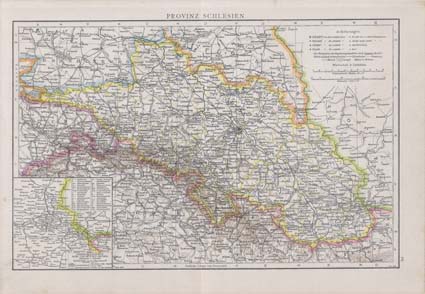
Province of Silesia (1885/90), in: Richard Andree’s General Hand Atlas.
2nd revised edition, Bielefeld 1890 [Wikimedia Commons]. The map shows
the administrative districts and counties of the Prussian Province of Silesia.

History in the 19th century
Silesia was part of the German Confederation from 1815 to 1866, of the German Customs Union from 1834, of the North German Confederation from 1866 to 1871, and of the German Empire from 1871 onwards. Whilst Silesia had been a leading proto-industrial region in the 18th century (cottage industries, linen exports), the province’s economy declined rapidly in the face of Prussian free-trade policies, the loss of markets as a result of the Napoleonic Continental Blockade, and competition from more efficient producers, particularly the English linen and cotton industries. Due to obstruction by the large landowners, the emancipation of the peasants was delayed until 1850, and a restructuring of the state advocated by Prussian reformers made no headway. Social tensions erupted in 1844 in the weavers’ revolt in the Eulengebirge, which caused a sensation throughout Germany due to its ruthless suppression. At the same time, dissatisfaction with Prussian absolutism found expression in Silesia through the formation of democratic organisations, the smashing of machinery and peasant uprisings. The urban middle classes increasingly organised themselves into political, as well as economic, scientific and social associations. The Democrats’ advocacy of the Imperial Constitution adopted by the Frankfurt National Assembly led to the Breslau May Uprising of 1849.
For Upper Silesia, the 19th century brought rapid industrialisation, coupled with explosive population growth (Opole administrative district in 1819: 561,173 inhabitants; 1910: 2,207,981 inhabitants) and rapid urbanisation. On the right bank of the Oder lay Europe’s largest coal deposits, as well as iron and zinc ore deposits. Huge metallurgical industries sprang up near the coal seams. The downside of this growth was the intensifying religious tensions in Upper Silesia following the Kulturkampf between the Prussian state and the Catholic Church (1871–87). Many Polish Upper Silesians also found their political home in the German Centre Party (Centre), the political organisation of Catholicism in the German Empire, which opposed Prussian-Protestant dominance and the ruthless policy of Germanisation. In many cases, these conflicts were also interpreted in ethnic terms and helped to fuel the Polish national movement in Upper Silesia.
Towards the end of the 19th century and at the beginning of the 20th, Silesia was thus characterised by a multitude of confessional, ethnic and social problems, but at the same time also by a diversity of religious movements (such as the Free Churches), minorities (Jews, Poles, Czechs) and by stark social disparities between a small class of wealthy industrialists and large landowners and an ever-expanding class of industrial and agricultural workers.
History in the 20th century
Although Silesia was not a direct theatre of war during the First World War, the region was severely affected by the secondary consequences of the war (food rationing, political restrictions, prisoner-of-war camps, the famine of 1917). In 1918, Silesia also experienced a revolutionary upheaval with the establishment of workers’ and soldiers’ councils. Following the end of the First World War, under the terms of the Treaty of Versailles, Germany ceded the southern part of the Ratibor/Racibórz district (Hultschiner Ländchen/Hlučínsko) to Czechoslovakia under the Treaty of Versailles (a total of approx. 49,000 inhabitants and 316 km²); in Central Silesia, smaller parts of the districts of Guhrau/Góra, Militsch/Milicz, Groß Wartenberg/Syców and Namslau/Namysłów to Poland (a total of approximately 26,000 inhabitants and 512 km²).
In Upper Silesia, Polish units attempted to press home their demand for annexation to the re-established Poland in three military uprisings (the Silesian Uprisings) in 1919, 1920 and 1921. In the referendum of 20 March 1921, in the disputed territory previously declared a referendum zone, 59.4 per cent of those eligible to vote opted to remain part of Germany, 40.6 per cent for annexation to Poland, whilst no vote was held in the western part of Upper Silesia. Following the recommendation of a League of Nations commission, the Allies decided in 1921 to cede an area of 3,213 km² with approximately 890,000 inhabitants and a large part of the industrial region to Poland (1922). This eastern part of what was formerly Prussian Upper Silesia was merged with the northern half of Cieszyn Silesia to form the Polish Silesian Voivodeship (Województwo śląskie), with its administrative centre in Katowice and extensive rights of autonomy within the Republic of Poland.
To ensure the protection of the respective substantial ethnic minorities, Germany and Poland concluded the Geneva Convention in 1922 under the auspices of the League of Nations, which, in addition to numerous administrative, economic and transport-related concessions, also provided for the establishment of a Minority Office in Opole (in the German part) and in Katowice (in the Polish part).
The strength of the Weimar-era parties (the SPD in Lower Silesia and the Centre Party in Upper Silesia) contributed to the relative domestic political stability of Prussian Silesia until the Great Depression. Whilst the NSDAP received hardly any votes in Silesia in the 1928 Reichstag election, in 1930 it achieved 24.1 per cent and 20.9 per cent respectively in the Lower Silesian administrative districts of Breslau and Liegnitz, well above the Reich average; in Upper Silesia, where the radicalisation of the working class benefited the KPD, it initially secured only 9.5 per cent of the vote. In the 1932 Reichstag election, the NSDAP became the strongest political force in Lower Silesia with 43.5 per cent and 48.8 per cent respectively; in Upper Silesia, it secured 29.2 per cent. The far-right forces benefited from years of propaganda which had portrayed Silesia as a ‘threatened’ region.
In Silesia, which had been part of Czechoslovakia since 1918, protests arose in the 1920s against the administrative merger with Moravia, which was implemented in 1928. The smouldering conflict between Poland and Czechoslovakia over Cieszyn Silesia, which had been divided in 1920 along a new border (running along the River Olsa/Olza/Olše and a ridge of the Silesian Beskids), resulting in the creation of the town of Český Těšín alongside the Polish town of Cieszyn.
Following the NSDAP’s seizure of power in the German Reich in 1933, Prussian Silesia too began to undergo a transformation at all levels of state and society in line with Nazi ideology. From 1933 onwards, political opponents were interned in concentration camps and prisons, whilst the Jewish population – which was proportionally significant, particularly in the major cities – was subjected to increasingly severe discrimination. With the expiry of the Geneva Convention in 1937, the special legal status of Jews in the former voting district of the Opole administrative region (to which numerous Jews from across the German Reich who wished to leave the country had previously fled), who were now also affected by the anti-Jewish laws and regulations. During ‘Kristallnacht’ on 9–10 November 1938, synagogues were set alight in Silesia too, shops owned by Jews were ransacked and thousands of Jews were arrested.
Also in 1938, Upper and Lower Silesia were merged into a single province, which, at party level, corresponded to the structure of the unified NSDAP Gau of Silesia. Most of Czech Silesia was incorporated into the German Reich in 1938 as the ‘Eastern Sudetenland’, whilst Poland annexed the southern part of Cieszyn Silesia.
In September 1939, Silesia became a key staging area during the German invasion of Poland, which had been triggered by the staged ‘attack on the Gleiwitz radio station’. Areas in eastern Lesser Poland, such as Saybusch/Żywiec, Auschwitz/Oświęcim and the Dąbrowa Industrial Region/Zagłębie Dąbrowskie, were incorporated into the newly created administrative district of Katowice. During the Second World War, the population faced severe restrictions. In 1940, the Groß Rosen concentration camp, with numerous satellite camps, was established in the granite quarries of the Striegau Uplands. In the annexed region of Eastern Upper Silesia, from 1941 onwards the population was required to be categorised according to ethnic criteria in the so-called ‘German People’s Register ’. In 1941, Lower and Upper Silesia once again became separate provinces. Given its location far from the front lines, Silesia became the ‘Reich air-raid shelter’, to which many people and goods were evacuated from cities and areas of the German Reich under threat of bombing. It was not until 1944 that Silesia came within the range of Allied bombers. Following the collapse of the German Eastern Front, Soviet forces reached eastern Silesia in January 1945, and by the end of January almost the whole of Silesia to the right of the Oder had been occupied. The Nazi authorities ordered the forced evacuation of the German civilian population living in this area and in the city of Breslau. Repression, freezing cold and poor preparation resulted in a high number of casualties. Wrocław, which had been declared a ‘fortress’, did not surrender until 6 May 1945, after a large part of the city had been destroyed by the Wehrmacht’s clearance operations and as a result of the siege.
At the Potsdam Conference (July/August 1945), the former Prussian Silesia, with the exception of the small area west of the Lusatian Neisse (which was placed under Polish administration within the Soviet Occupation Zone [SBZ]/German Democratic Republic [GDR]), was placed under Polish administration. However, as early as May 1945, Polish advance units had already begun establishing a Polish administration. Whilst many Germans had already fled Silesia or been expelled from there between May and August 1945, the Potsdam decisions led, from 1946 onwards, to the systematic forced resettlement of the remaining German population (approx. 1.4 million), which continued until 1947/48. In Upper Silesia, camps for Germans existed in 1945–46 (such as Lamsdorf/Łambinowice and Schwientochlowitz/Świętochlowice). In Upper Silesia, the Polish authorities sought to retain many local residents as ‘autochthonous’ inhabitants, who were not expelled but for whom the use of the German language was severely restricted. Once the expulsions were complete, members of the German minority were given the opportunity for family reunification and later resettlement in the GDR or the Federal Republic of Germany (FRG). Only a relatively small German minority remained in Poland, particularly in Upper Silesia; approximately 850,000 autochthons were required to undergo ‘verification’. In the Czech part of Silesia, most of the German-speaking inhabitants were expelled.
In Silesia, now part of Poland and heavily scarred by the war, some so-called resettlers were settled there from the former eastern Polish voivodeships that had fallen to the USSR as a result of the Hitler–Stalin Pact in 1939 and remained under its control after 1945, from central and southern Poland, as well as former Polish migrant workers from Belgium and France and settlers from Bosnia. In line with the ‘Piast idea’, Silesia was highlighted as a ‘traditionally Polish region’ or one of the ‘regained territories’ (including the ‘Exhibition of the Regained Territories’ in Breslau/Wrocław in 1948). In 1950, the Görlitz Treaty/Układ zgorzelecki between the GDR and the People’s Republic of Poland recognised the border along the Lusatian Neisse; the agreements between reunified Germany and the Republic of Poland – the Border Treaty of 17 November 1990 and the Neighbourhood Treaty of 17 June 1991 – referred to, as did the Warsaw Treaty between the Federal Republic of Germany and the People’s Republic of Poland of 7 December 1970. In Silesia, numerous members of the bourgeois opposition and the Home Army (Armia Krajowa, AK) had settled after 1945; in the 1950s, the communist regime also established itself here. A new cultural life flourished in the urban centres (universities and theatres in Wrocław, film production in Katowice and Bielsko-Biała). At the same time, the construction of new industrial complexes began in Upper and Lower Silesia. The administrative reorganisation of 1975 created new, smaller voivodeships (Jelenia Góra, Katowice, Legnica, Opole, Wałbrzych, Wrocław, Zielona Góra) were created, whose boundaries no longer corresponded to those of the old regions and which enabled greater centralisation of Poland. The nationwide political unrest (1956, 1968, 1980 onwards) also had a significant impact in Silesia; in the 1980s, Silesia was an important arena for the political opposition. Even at that time, a shift in thinking regarding the treatment of Silesia’s cultural heritage was taking hold within its ranks, a shift that came to the fore after 1989.
Following the collapse of the communist system, the German minority living in Upper Silesia was officially recognised in 1990, and the formation of regional associations was permitted. At the same time, a Silesian autonomy movement emerged, positioning itself between German and Polish culture. The political upheaval led to far-reaching reforms in the economy, administration and social policy. Particularly in the once-thriving industrial regions of Upper Silesia, but also around Waldenburg/Wałbrzych and Neurode/Nowa Ruda, privatisations and company closures had a painful impact on those affected. Since 1999, the historic Silesian regions have essentially been divided among the three newly established voivodeships of Lower Silesia (województwo dolnośląskie), Opole (województwo opolskie) and Silesia (województwo śląskie); the former Zielona Góra region (Ziemia zielonogórska) now forms part of the Lubusz Voivodeship (Województwo lubuskie).
Alongside these restructuring measures, a new cultural policy gave rise to significant initiatives aimed at preserving the German contribution to Silesian cultural heritage, with all its material and intangible elements. In many cases, this led to the emergence of new local and regional identities, which coalesce in an updated understanding of Silesia as a multicultural region, shaped throughout its history by several nations, ethnic and religious groups.
Population and Society
Silesia experienced strong population growth, particularly during the 18th to 20th centuries, which is reflected (for the Prussian Province of Silesia and for Austrian Silesia) in the following population figures:
| Year | Population |
| 1742 | approx. 1,100,100 |
| 1770 | 1,327,078 |
| 1791 | 1,747,065 |
| 1797 | 1,795,468 |
| 1817 | 1,992,598 |
| 1820 | 2,120,175 |
| 1840 | 2,858,800 |
| 1850 | 3,101,871 |
| 1862 | 3,349,495 |
| 1871 | 3,707,167 |
| 1875 | 3,843,699 |
| 1880 | 4,007,925 |
| 1890 | 4,224,458 |
| 1900 | 4,668,857 |
| 1905 | 4,942,611 |
| 1939 | 4,846,333 |
| Year | Population |
| 1776 | 247,064 |
| 1804 | 270,891 |
| 1851 | 438,586 |
| 1890 | 605,649 |
| 1900 | 680,422 |
| 1910 | 756,949 |
History of Religion and the Church
Since its foundation in the year 1000, the Diocese of Wrocław has formed the administrative basis for the Catholic Church in Silesia. Until 1821, it was a suffragan diocese of the Polish Diocese of Gniezno. A separate cathedral chapter had existed since 1100. A distinctive feature was the secular rule of the Breslau bishops over the duchies of Ottmachau/Otmuchów and Neisse/Nysa, confirmed in 1290, which earned them the title of ‘prince-bishops’. Since the Middle Ages, numerous monasteries scattered across the country had been centres of ecclesiastical scholarship and piety (see above). Following the Reformation, these monasteries also provided important impetus for the Catholic Counter-Reformation. This led, particularly in Upper Silesia, to a thorough re-Catholicisation of parishes that had in the meantime become Protestant. In 1930, the Diocese of Wrocław was elevated to an archdiocese. The Diocese of Breslau – which became Polish after 1945 – was restructured following the Second World War; it has been an archdiocese again since 1972.
Since the introduction of the Reformation, Protestant parishes—primarily following the Augsburg Confession —spread rapidly throughout Silesia; however, there were also numerous Reformed congregations. From 1817, Lutherans and Reformed Protestants were united in the Old Prussian Union (until 1945); many Old Lutherans who did not wish to join the Union emigrated from Silesia to overseas destinations. After 1945, Breslau became the seat of a diocese of the Evangelical Church of the Augsburg Confession; Congregations exist in, amongst other places, Breslau, Jauer/Jawor, Schweidnitz/Świdnica, Liegnitz/Legnica, Bad Warmbrunn/Cieplice-Zdrój and Brückenberg/Karpacz Górny (Wang). A separate Evangelical Church of the Augsburg Confession diocese is based in Teschen, which has traditionally had a high proportion of Polish Protestants.
Alongside the two major denominations, Christian sects were disproportionately well represented in Silesia.
There is evidence thatJews had been living in Silesia since the 12th/13th century; however, suspicions following plague epidemics and hate sermons in the late Middle Ages led to their gradual expulsion, with the result that only the privileged communities in Glogau and Zülz/Biała remained. It was not until the Prussian period that Jews gradually gained civil rights in Silesia, and their numbers rose significantly by 1880, only to decline again due to emigration to Berlin and also overseas (1791: 9,066, 1817: 16,476, 1880: 52,682, 1913: 46,845). The 19th century was characterised by conflicts between reformist and orthodox tendencies within Silesian Jewry. The Jewish Theological Seminary, founded in Breslau in 1854, was one of the leading institutions of its kind worldwide. The Holocaust largely destroyed the once-flourishing German-Jewish culture in Silesia. In Polish Silesia today, only scattered communities remain in the larger towns.
Special cultural institutions
As early as 1924, Schlesische Funkstunde AG (known from 1934 as Reichssender Breslau) had been broadcasting radio programmes, later supported by transmission facilities in Gleiwitz/Gliwice and Reichenbach OL. The buildings of the Schlesische Funkstunde in Breslau have been used by Polskie Radio Wrocław since 1945.
After the Second World War, evacuated collections from the Ossolineum/Zakład Narodowy im. Ossolińskich – a national Institute founded in 1817 in Lemberg/Lwów/Ľviv by Józef Maksymilian Count Ossoliński – were found in Adelin/Zagrodno in Lower Silesia. Since 1947, the Ossolineum has been based in Wrocław in the former monastery building of the Order of the Cross with the Red Star, which later became the Matthias Gymnasium. It is dedicated to research into Polish history and literature and possesses extensive collections (including valuable manuscripts, historical maps, prints and coins) and a library.
Education
In numerous Silesian parish villages, elementary schools had existed since the Middle Ages and the early modern period, whilst in the towns there were church-run Latin schools, notable examples of which include those attached to the churches of St Magdalena (1267) and St Elisabeth (1293) in Breslau. Following the Reformation, many of the existing Latin schools were expanded into grammar schools. Another prominent educational institution for the nobility was the Knights’ Academy in Liegnitz, which was established in 1708 and opened its doors to pupils from the bourgeoisie from 1811 onwards.
Following the Prussian annexation of Silesia, the principles of the Prussian school system (such as the General Provincial School Regulations of 1763) came into force there; this system had been shaped by the Enlightenment since the late 18th century and was subject to state supervision.
The centre of scholarship in Silesia prior to 1945 was the Silesian Friedrich-Wilhelm University in Breslau, founded in 1811, which arose from the merger of the Academia Leopoldina – established in Breslau in 1702 with the assistance of the Jesuits – and the University of Viadrina, which had been situated in Frankfurt (Oder) since 1506. It comprised five Schools (Protestant Theology, Catholic Theology, Law, Medicine, Philosophy) and numerous seminars and institutes. Furthermore, the independent Technical University of Breslau had existed since 1910. After 1945, the tradition of these two institutions was carried on primarily by university lecturers who had been forcibly resettled from Lemberg/Lwów/Ľviv in eastern Poland; today’s Breslau is one of Poland’s most important centres of higher education. More recent establishments include the universities of Opole, Katowice and Zielona Góra, as well as the Technical University of Gliwice.
Everyday culture
The social and economic situation of the rural lower classes in Silesia, who were dependent on the landlords, was poor in the 18th and 19th centuries. Only a few free peasants and settlers in the Oder Valley, who were exempt from manorial duties or subject to special regulations, enjoyed better living conditions. As a result of the emancipation of the peasants, a large section of the population was unable to retain their land and had to seek a livelihood in cottage industries (weaving) and as agricultural labourers; others migrated either seasonally or permanently (as domestic servants, mainly to Berlin, and as industrial workers to the Ruhr region). These grievances were not regarded as having been overcome until the 20th century.
In terms of house types, the transverse-plank house predominated in Lower Silesia; larger farms featured four-sided layouts, whilst the settlement patterns consisted of terraced villages and ‘Waldhufen’ villages. In the Giant Mountains, huts with steeply sloping roofs were common; within a very confined space, they provided accommodation for up to 15 people and facilities for processing their own produce (milk, wool). From around 1800, farm labourers’ families on the estates were also housed in very cramped conditions in multi-family dwellings with communal cooking areas and usually only two rooms per family. Household goods, furniture, clothing, wall decorations and other material possessions were generally correspondingly meagre.
So-called ‘traditional costumes’, as group-specific clothing of the rural population, required a certain level of prosperity to adopt urban clothing elements and were therefore only found in villages with a more affluent population; adapting aristocratic and urban fashions, 19th-century women’s traditional dress featured skirts and bodices, bonnets and shawls, whilst men’s attire comprised (leather) trousers, boots, shirts, waistcoats, long-tailed jackets and hats. By the early 20th century, local traditional dress had long since been in decline; only as a distinguishing feature of certain occupational groups (maids, traders), individual traditional costumes (or elements thereof) managed to survive until, in the wake of an idealisation that was initially bourgeois-romantic and later also national in character, they acquired special significance and eventually, from around 1920, became objects of a deliberate effort to preserve folk traditions.
Dietary habits, too, were consistently characterised above all by scarcity. In the 18th century, soups, cereal porridges and cabbage were everyday fare; meat was practically non-existent for the lower classes. In the 19th century, rye bread – spread with butter, jam or syrup – became increasingly common; the hot meal consisted of either a (flour) soup, cabbage, potatoes with sour milk, and the like. By the mid-19th century, the potato had become the most important staple food. The drink of choice was initially weak beer, which was later replaced by grain or chicory coffee. The consumption of cheap spirits was considerable. Records also indicate luxury consumption in the more affluent farming villages of Lower Silesia (ground coffee, wine, meat, fine vegetables, etc.). This also applied to the urban middle classes; the dietary habits of the workers there resembled those of the rural lower classes, although the latter were often able to practise a modest degree of self-sufficiency. Dishes that are now regarded as Silesian specialities, such as poppy seed and yeast dumplings, crumble cake, carp with sauerkraut, potato salad and white sausage, or the ‘Silesian Heaven’, date predominantly from the late 19th century and were initially either festive dishes or reserved for the wealthy.
In Silesia, too, customs were primarily linked to church festivals, working life and the course of one’s life. They served to demonstrate a sense of community and exclusion, to temporarily redress social inequalities (begging customs), to facilitate contact between the sexes, and to mark important transitions in the life cycle (rites de passage). Among the better-known customs, documented in Upper Silesia until the end of the 20th century, is the so-called ‘carrying out of the dead’ on Laetare Sunday; in some cases, this custom – also known as ‘summer singing’ – was linked to a begging procession. The blessing ceremony on a child’s first birthday was widespread amongst Catholic Upper Silesians and, due to the high infant mortality rate, was regarded, as it were, as a second baptism right up until the 20th century.
Popular stories and reading material were linked to the realities of people’s lives outlined above. The socially disciplining function of tales of threats and punishment is just as evident as the compensatory function of stories about legendary treasure finds, which were said to provide a way out of material hardship. In the 19th century, the mountain spirit Rübezahl became a figure with whom the people of Silesia identified. Alongside the oral tradition, and in a process of mutual interpenetration, various printed media such as devotional pictures, leaflets, and, in the 18th century, the so-called ‘folk books’ were in circulation; finally, in the 19th century, newspapers and calendars reached wider sections of the population. In the 1920s and 1930s, radio began its triumphant advance, which took on particular significance in the politically contested border region.
Lower Silesia, on the left bank of the River Oder, had been part of the area where Silesian dialects were spoken since the end of the 13th century; these dialects are classified as East Central German and exhibit numerous lexical and phonetic similarities to Polish and Czech respectively. The prominence of the dialect steadily declined in the 19th century in larger towns in favour of High German, whilst in rural areas Silesian remained widespread well into the interwar period. In Upper Silesia, alongside Upper Silesian variants of Central German, Polish was widespread in the form of the dialect also known as Silesian (po ślonsku), ‘Water Polish’ or Schlonsakisch, which was spoken primarily in the countryside and amongst the urban working class and features numerous loanwords from German. Since 1989, Silesian has been experiencing a minor renaissance as an expression of regional identity and autonomy. H. K.
Bibliography
The origins of literature in Silesia can be found in Latin and Middle High German religious poetry. Psalms, Marian salutations and laments have been preserved, as well as a rich body of specialised prose, much of which is original. In the ‘Liber fundationis claustri Sancte Marie Virginis in Henrichow’ (Heinrichau Foundation Book/Księga Henrykowska; 1268–72), the first Polish sentence has been preserved (“Daj, ać ja pobruszę, a ty poczywaj!” – “Let me grind, and you rest!”). Minstrel epics and the legend of St Hedwig were also widespread. Courtly love poetry by Heinrich von Pressela (Wrocław) and the ‘Crusade of Landgrave Louis the Pious of Thuringia’ (early 14th century), commissioned by Duke Bolko I, point to a distinct literary life in Silesia.
With the advent of printing in Breslau from 1475 onwards, a literary development also began in Silesia, coinciding with the economic rise of the urban patriciate and the Reformation. Initially, it was religious writings – notably the Legend of Hedwig (Baumgarten 1504), which was reprinted several times, and hymnals (Dyon 1525) – that shaped Silesia’s literary landscape. Silesia drew significant impetus from important grammar school and private libraries that had existed since the Middle Ages. Also worthy of mention is Polish book printing, such as the writings of the vicar Adam Gdacjusz (Gdacius), a native of Kreuzburg O.S./Kluczbork, published by Johann Christoph Jakobs’s printing house in Brieg/Brzeg.
Of particular note are the humanist regional studies by Barthomoläus Sthenus (c. 1513) and Nicolaus Henel von Hennenfeld (1613). Alongside this, panegyric Latin poetry flourished in Silesia, mostly in praise of Breslau.
Martin Opitz made a decisive contribution to German literature as a whole with his treatise on poetics, *Buch von der deutschen Poeterey* (1624), in which he called for literature in the German language, drawing an analogy with the high-quality vernacular poetry of Italy, France and England. Thanks to poets and playwrights such as Daniel Czepko, Friedrich von Logau, Andreas Gryphius, Christian Hoffmann von Hoffmannswaldau and Daniel Casper von Lohenstein, Silesia became a centre of German poetry by around 1700. The long-established classification of Silesian poetry into ‘poetic schools’ is now methodologically outdated. The transition from the Baroque to the Early Enlightenment, Anacreontic poetry and experiential poetry was brought about by the plays of Johann Christian Hallmann, the anthology by Benjamin Neukirch and the poems of Johann Christian Günther.
Silesian poets of the 18th century failed to achieve national prominence. Only the poetry of Anna Louisa Karsch gained wider circulation.
After 1800, Joseph von Eichendorff brought together Romantic themes and subjects and, through his accessible style that also conveyed emotional depth, became a poet whose work is still read today. Gustav Freytag enjoyed great success with his historical novels, but his stereotypical portrayal of Polish and Jewish characters resulted in overly simplified ‘cultural images’.
Gerhart and Carl Hauptmann moved between naturalism, adaptations of Greek classics and scholarship. Max Herrmann-Neisse, Georg Heym and Kurt Heynicke set new standards for expressionism, whilst political literature was represented by Alfred Hein, Arnold Zweig and Franz Jung. The landscape and society of Upper Silesia were depicted by authors such as Valeska von Bethusy-Huc, Hans Marchwitza, Hans Niekrawietz and August Scholtis.
After 1945, it was Heinz Piontek, Dagmar Nick, Horst Bienek, Hans Lipinsky-Gottersdorf and others who explored the loss of their homeland in their writing.
To this day, Silesia remains a literary theme both in novels (Christoph Hein, Theodor Buhl) and in travelogues (Roswitha Schieb). Silesia is also being rediscovered in Polish literature (e.g. Tadeusz Różewicz, Marek Krajewski, Olga Tokarczuk, Henryk Waniek). D. H.
Culture of memory and remembrance
As early as the 16th century, German and Polish chronicles presented the question of the ‘Germanic’ and ‘Slavic’ character of Silesia’s indigenous population and its initial settlement as a matter of controversy between Germans and Poles. In each case, a right of ownership for the respective nation was derived from the concept of indigenousness. From the Reformation onwards, interpretations of history were shaped by Protestant and Catholic positions, which after 1741 evolved into a Protestant-Prussian and a Catholic-Habsburg perspective respectively.
From the 19th century onwards, regional historical discourse overemphasised German national aspects, with historians and the press highlighting the region’s role as a ‘bulwark’, whilst on the Polish side (particularly in the context of the dispute over Upper Silesia), the historical and cultural links to Polish culture and the Polish state were emphasised.
The culture of remembrance in the Federal Republic of Germany initially followed a nationalist line; it was not until the 1970s that a modernised image of Silesia began to gain acceptance in academic circles. In regional association circles, traditional patterns of remembrance continue to be cultivated to this day.
In communist Poland after 1945, Silesia’s return to the ‘Piast motherland’ was celebrated, and Silesia was integrated into the national memory as part of the ‘regained territories’; accordingly, Polish aspects were brought to the fore in this memory. Nevertheless, in the shadow of official propaganda, a shift in mindset had already begun among many people, which, after 1989, also found expression in historical politics as a paradigm of the history of relations.
In the regional culture of remembrance, memories of military conflicts in Silesia have always played, and continue to play, a major role: for example, the futile siege of Nimptsch/Niemcza by Emperor Henry II (1017), the ‘Battle of the Mongols’ at Wahlstatt/Legnickie Pole near Liegnitz (1241), the battles fought under Frederick the Great at Mollwitz/Małujowice (1741), Hohenfriedberg/Dobromierz (1745) and Leuthen (1757), the Prussian victory over Napoleon’s troops at Katzbach (1813) and the fighting for the ‘Fortress of Breslau’ (1945). Another element of the region’s collective memory is the 13 Nobel Prize laureates with Silesian roots. M. W.
Bibliography
- Ernst Badstübner, Dietmar Popp, Andrzej Tomaszewski, Dethard von Winterfeld (eds.), Sławomir Brzezicki, Christine Nielsen (comp.): Dehio Handbook of Art Monuments in Poland. Silesia. Munich, Berlin 2005 [Polish version: Zabytki sztuki w Polsce – Śląsk. Warsaw 2006].
- Joachim Bahlcke (ed.): Silesia and the Silesians. Munich 1996 (Study Series of the East German Cultural Council Foundation 7).
- Norbert Conrads (ed.): Silesia. Berlin 1994 (German History in Eastern Europe).
- Marek Czapliński, Elżbieta Kaszuba, Gabriela Wąs, Roscisław Żerelik: History of Silesia. Wrocław 2002 (Acta Universitatis Wratislaviensis 2364).
- Dan Gawrecki et al.: History of Czech Silesia 1740–2000 (2 vols.). Opava 2003.
- Arno Lubos: History of Silesian Literature (3 vols.). Munich 1960–1974.
- C[zesław] Osękowski: Society in Western and Northern Poland, 1945–1956. Processes of Integration and Disintegration, [Society in Western and Northern Poland in the Years 1945–1956. Processes of Integration and Disintegration]. Zielona Góra 1994.
- Piotr Pregiel, Tomasz Przerwa: The History of Silesia. Wrocław 2005.
- Hugo Weczerka (ed.): Handbook of Historical Sites. Silesia. Stuttgart 1977 (Kröners Taschenausgabe 316).
Web links
Key literature, journals, illustrations and printed sources on the culture and history of Silesia can be found in the regional digital libraries:
- Dolnośląska Biblioteka Cyfrowa [Lower Silesian Digital Library]: www.dbc.wroc.pl/dlibra
- Śląska Biblioteka Cyfrowa [(Upper) Silesian Digital Library]: www.sbc.org.pl/dlibra.html
- Cyfrowy Dolny Śląsk [Digital Lower Silesia]: jbc.jelenia-gora.pl/dlibra
- Index of place names (German–Polish and vice versa): www.genealogienetz.de/reg/SCI/orte-d.html
- Lower Silesian Picture Archive at the Herder Institute, Marburg: www.herder-institut.de/projekte/abgeschlossene-projekte/digitalisierung-und-dokumentation-des-niederschlesischen-bildarchivs-nba.html
Museums:
- Silesian Museum in Görlitz: www.schlesisches-museum.de/
- Museum of Silesian Regional History, Königswinter-Heisterbacherrott: www.hausschlesien.de/
- Upper Silesian Regional Museum, Ratingen-Hösel: www.oberschlesisches-landesmuseum.de/
- National Museum in Wrocław: mnwr.pl/en/
- Muzeum Śląska Opolskiego [Museum of Opole Silesia]: muzeum.opole.pl/
- Silesian Museum in Katowice: www.muzeumslaskie.pl/
- Museum of Cieszyn Silesia: muzeumcieszyn.pl
- Slezské muzeum v Opavě [Silesian Regional Museum, Opava]: www.szmo.cz/
Citation
Detlef Haberland, Heinke Kalinke, Matthias Weber, Tobias Weger: Silesia. In: Online Encyclopaedia on the Culture and History of Germans in Eastern Europe, 2011. URL: ome-lexikon.uni-oldenburg.de/54153.html (accessed 28 October 2015).
Terms of use for this article
Copyright © University of Oldenburg and the Federal Institute for the Culture and History of Germans in Eastern Europe (BKGE), all rights reserved. This work was produced as part of the project ‘Online Encyclopaedia on the Culture and History of Germans in Eastern Europe’ and may be reproduced and published provided the rights holders’ consent has been obtained. Please contact:
If you have any specialist comments or additions to the text, please contact the editorial team, citing relevant literature and source references.