

Resettlers (SBZ/GDR)
Resettlers (SBZ/GDR)
1. Definition
In the Soviet Occupation Zone (SBZ) and in the GDR, the term ‘resettler’ referred to refugees and displaced persons from the formerly German and (also) German-populated territories in Eastern Europe. According to a contemporary definition, resettlers were “those persons who, as a result of international decisions [of the Potsdam Conference] were compelled, as Germans, to leave their home towns, provided that these were situated outside the current German borders and that they were admitted as resettlers into the territory of the current German occupation zones.”[1] In total, around 4.3 million refugees and displaced persons arrived in the Soviet Occupation Zone; on average, they accounted for just under 25 per cent of the population.[2] The politically instrumentalised term ‘resettler’ reduced the forced migration resulting from the Second World War to a mere ‘resettlement’.[3]
2. Historical overview
In order to address the most pressing (supply) problems facing refugees and displaced persons, the Central Administration for German Resettlers (ZVU) was established in September 1945 on the orders of the Soviet Military Administration in Germany (SMAD). Its tasks included setting up reception and quarantine camps, providing medical care and registering new arrivals, procuring accommodation, food and everyday necessities, and organising employment opportunities. From October 1945, so-called resettlement committees were set up in local authorities and districts to support, at a local level, the accommodation and provision of supplies for resettlers, but above all their integration.[4]
Both state and private aid measures were subsequently designed to promote integration.
For resettlers in rural areas, the land reform from 1945 onwards offered an opportunity to ‘put down new roots’. In many cases, taking over a new farm marked a fresh start for them.
Between autumn 1947 and early 1948, the ‘resettlement weeks’ organised by the resettlement committees brought the refugees and displaced persons into the public eye one last time as a special group.[5] In 1948, the SMAD ordered the integration of the ZVU as the ‘Main Department for German Resettlers’ into the German Ministry of the Interior. A gradual winding up of this authority, as well as its subordinate institutions, began.[6]
Finally, from a political perspective, the supposed integration reached its peak and conclusion with the ‘Law on the Further Improvement of the Situation of Former Resettlers inthe German Democratic Republic’, enacted in September 1950. This marked the end of a specific resettlement policy. Consequently, from the early 1950s onwards, refugees and displaced persons were no longer recorded in official statistics.
Definition of terms
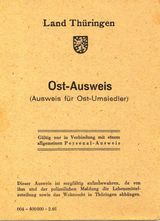
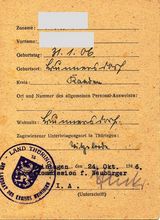
As early as the autumn of 1945, the ZVU established the euphemistic term ‘resettlers’ for all refugees and displaced persons in the Soviet Occupation Zone. Its first circular, dated 2 October 1945, contained – in accordance with SMAD guidelines – the following provision: “It should be noted here that, from now on, we shall refer only to resettlers in our usage. The terms ‘refugees’ or ‘expellees’ are no longer to be used.”[7] As early as 1945, refugees and displaced persons were issued with so-called ‘resettler’ passports, which documented their status and new group classification. The term ‘resettler’ was modelled on Soviet political and linguistic regulations and quickly found its way into official communications.[8] However, particularly in the press, the term “refugees” continued to be used repeatedly alongside the term “resettlers”. Even within families, this choice of words remained common for a long time; the self-designation as “resettlers” only became established to a limited extent in these contexts.[9]
Disappearance of the term
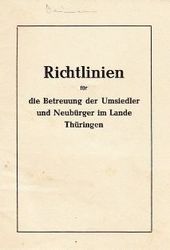
As early as 1946, the term ‘Neubürger’ was introduced into public discourse – for example, in the media and public administration – with the aim of giving verbal expression to a further step towards supposed integration. The ‘Guidelines for the Care of Resettlers and New Citizens in the State of Thuringia’, issued in February 1947, for example, distinguished between the terms according to residence status: Accordingly, “resettlers” were to be referred to as “new citizens” “once they had been assigned to a local authority”.[10] However, the term ‘resettler’ and its synonyms did not disappear entirely from public discourse; rather, they remained part of ideologically charged success stories that were publicised in the media, for example, on the anniversaries of the land reform.
3. Controversies
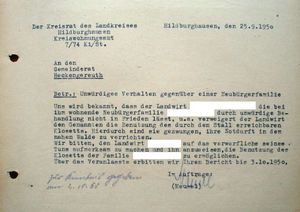
The term reflects the forced integration which – in the sense of assimilation – was predominantly one-sided, focusing on the adaptation of the new arrivals.[11] In public discourse, ‘resettlers’ were as quickly as possible reclassified as ‘new citizens’ and later as ‘former resettlers’, yet the integration this was intended to suggest was far from complete just five years after the end of the war. Numerous conflicts characterised coexistence in the early years: the refugees and displaced persons were seen by the local population as competitors for scarce goods; moreover, tensions between the two population groups arose time and again, for instance in the context of compulsory accommodation.
The official term ‘resettlers’ was intended to obscure the involuntary nature of their displacement, as well as the suffering and injustice they had endured, thereby also negating any mistakes or transgressions on the part of the ‘socialist brother states’. At the same time, it denied any connection to the ‘old homeland’. The term “resettler” was thus part of a reinterpretation of reality and the tabooing of flight and expulsion in theSoviet Occupation Zone/GDR.
Not least, this linguistic policy served to distance the term from West German terminology: in the Federal Republic, the term ‘(Heimat-)Vertriebene’ (displaced persons from their homeland) was particularly common, referring to the circumstances under which people had left their homeland. Regional associations and displaced persons’ organisations represented the interests of those affected; these were banned in the GDR and frowned upon as revanchist. The aim here was rather to avoid public debate on flight and expulsion.
In fact, it was the older resettlers in particular who found it difficult to settle in. It was only the generation of their children who grew up within GDR society and, in many cases, made use of the opportunities for participation that were available.
Following the upheavals of 1989–90, refugees and displaced persons in what were now the ‘new Federal States’ had a wide range of opportunities for both private and public remembrance and engagement with the past, for example, in the form of trips back to their homelands or membership of regional associations or federations. Consequently, many of those affected shifted their self-identification from ‘resettlers’ to ‘displaced persons’. Nevertheless, attitudes towards the term remain extremely ambivalent: they range from a rejection of its trivialisation and tabooisation to a use of the term that is – even today – taken for granted.
4. Bibliographical references
- Arnd Bauerkämper: Assimilation Policy and Integration Dynamics. Displaced Persons in the Soviet Occupation Zone/GDR from a Comparative Perspective. In: Marita Krauss (ed.): Integrations. Displaced Persons in the German States after 1945. Göttingen 2008, pp. 22–47.
- Dierk Hoffmann, Michael Schwartz (eds.): Successful Integration? Specific Features and Comparisons of the Integration of Displaced Persons in the Soviet Occupation Zone/GDR. Munich 1999.
- Michael Schwartz: Taboo and Memory. On the Issue of Displaced Persons in Politics and the Literary Public Sphere of the GDR. In: Zeitschrift für Geschichtswissenschaft 51 (2003) 1, pp. 85–101.
- Michael Schwartz: ‘Resettlers’ as Enemies of the State. In: Stefan Aust, Stephan Burgdorff (eds.): The Flight. On the Expulsion of Germans from the East. Bonn 2003, pp. 224–234.
- Michael Schwartz: ‘From Resettler to Citizen’. Totalitarian and Subversive Elements in the Language Policy of the Soviet Occupation Zone/GDR. In: Dierk Hoffmann, Michael Schwartz, Marita Krauss (eds.): Displaced Persons in Germany. Interdisciplinary Findings and Research Perspectives. Munich 2000, pp. 135–166.
- Manfred Wille: The Central Administration for German Resettlers – Possibilities and Limits of its Activities (1945–1948). In: Manfred Wille, Johannes Hoffmann, Wolfgang Meinicke (eds.): They Had Lost Everything. Refugees and Displaced Persons in the Soviet Occupation Zone of Germany. Wiesbaden 1993, pp. 27–54.
Notes
[1] Paul Merker: The Next Steps Towards Resolving the Problem of Displaced Persons. Berlin 1947, p. 24.
[2] As at 1 May 1948. Manfred Wille: Displaced Persons in the Early Post-War Years in the Soviet Occupation Zone of Germany – Notes on the Statistics. In: Manfred Wille, Karlheinz Lau, Jörg Bernhard Bilke: Displaced Persons in Central Germany. Bonn 1991 (Germany Policy Series 10), pp. 1–8, here p. 6.
[3] Under National Socialism, the term ‘resettlers’ was used to describe the approximately one million people who, as part of the National Socialist settlement policy, had been resettled in annexed parts of Poland or the so-called ‘Altreich’. In the Soviet Occupation Zone/GDR, the designation of this group of people continued uninterrupted. Even if continuity with regard to the refugees and displaced persons around 1945 was hardly intended, both forms of the term’s usage were nevertheless characterised by a euphemistic tendency. See Schwartz: ‘From Resettler to Citizen’, p. 138 ff.
[4] Michael Schwartz: ‘Controlled Participation: The “Resettler Committees” of the Soviet Occupation Zone of Germany caught between special administration, party politics and social interests, 1945–1949’. In: Sylvia Schraut, Thomas Grosser (eds.): The Refugee Question in Post-War German Society. Mannheim 1996 (Mannheim Historical Research 11), pp. 161–191.
[5] Wille: Central Administration, p. 51.
[6] Arnd Bauerkämper: ‘The Feigned Integration: The Effects of Land Reform and Refugee Resettlement on the Occupational Integration of Displaced Persons into Agriculture in Germany, 1945–1960’. In: Dierk Hoffmann, Michael Schwartz (eds.): Successful Integration? Specific Features and Comparisons of the Integration of Displaced Persons in the Soviet Occupation Zone/GDR. Munich 1999, pp. 193–214, here p. 193.
[7] Circular No. 1 from the Central Administration for German Resettlers to the resettlement offices of the state and provincial administrations, to the district administrators and mayors of independent cities, Berlin, 2 October 1945, quoted from: Manfred Wille (ed.): The Displaced Persons in the Soviet Occupation Zone/GDR. Documents, Vol. 1: Arrival and Reception 1945. Wiesbaden 1996 (Studies by the Centre for Research on East Central Europe at the University of Dortmund 19/1), pp. 264–269, here p. 264.
[8] Schwartz: ‘From Resettler to Citizen’ (note 3), here p. 137.
[9] Cf. Heike Amos: ‘Displaced Persons’ Associations in the Crosshairs. Activities of the GDR State Security from 1949 to 1989’. Munich 2011 (Series of the ‘Vierteljahrshefte für Zeitgeschichte’: Special Issue), p. 25.
[10] Ministry of the Interior, Office for New Citizens, Guidelines for the Care of Resettlers and New Citizens in the State of Thuringia. Weimar 1947, p. 3.
[11] On integration, see also Bauerkämper: Assimilationspolitik.
Citation
Uta Bretschneider: Resettlers (SBZ/GDR). In: Online Encyclopaedia on the Culture and History of Germans in Eastern Europe, 2013. URL: ome-lexikon.uni-oldenburg.de/p32669 (as at 9 August 2021).
Terms of use for this article
Copyright © University of Oldenburg and the Federal Institute for the Culture and History of Germans in Eastern Europe (BKGE), all rights reserved. This work was produced as part of the project ‘Online Encyclopaedia on the Culture and History of Germans in Eastern Europe’ and may be reproduced and published provided the rights holders’ consent has been obtained. Please contact:
If you have any specialist comments or additions to the text, please contact the editorial team, citing relevant literature and source references.