

New residents
New residents
1. Definition
The term ‘new residents’ refers to members who have recently been admitted to a community and who enjoy certain rights.
2. Historical overview
In the Middle Ages, newly admitted town citizens were called ‘new citizens’. Anyone who owned a residential property, made a monetary payment, had reached a certain age and was a free person could become a citizen. Citizenship also included membership of the town’s judicial community and the legal protection afforded by it. Only citizens had the right to vote for the town government. After the end of the Holy Roman Empire (1806), when municipal citizenship had lost its significance, the term ‘citizen’ came to be equated with‘citizen of the state’, and the term ‘new citizen’ fell out of use.
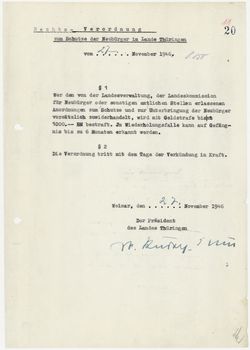
It was reintroduced and first used by the authorities after the Second World War in Thuringia to refer to the refugees and displaced persons who had been taken in.[1] In the Soviet Occupation Zone, the refugee administration established on the orders of the Soviet Military Administration in Germany was known as the ‘Central Administration for German Resettlers’(ZVU). Accordingly, refugees and displaced persons were officially referred to here as‘resettlers’.[2] In Thuringia, the term ‘new citizens’ was also adopted when a ‘State Committee for New Citizens’ was established there in February 1946.[3]
The term ‘new citizens’ was also most widely used in Thuringia, though it was also employed in Saxony and Mecklenburg, as well as in states within the American occupation zone: the term appears to have spread from Thuringia to Hesse and from there to Baden-Württemberg and Bavaria. In the French and British zones, however, it was scarcely used. In Thuringia – as with the term‘Umsiedler’– it was scarcely used as an official designation after the dissolution of the State Office for New Citizens at the turn of the year 1948/1949, because the rapid integration with the local population had rendered these terms superfluous.[4] In the territory of the former Federal Republic, the use of ‘Neubürger’ in administrative contexts declined following the enactment of the Federal Displaced Persons Act (BVFG) of 1953, in which the terms ‘Vertriebene’, ‘Heimatvertriebene’ and ‘Flüchtlinge’ were defined.
In everyday language, however, the term ‘new residents’ has come back into more frequent use in the context of rising immigration since the 1990s and the associated integration initiatives. Today, both German and foreign immigrants who have recently moved to a local authority area are referred to as ‘new residents’. For example, many local authorities regularly organise ‘welcoming events’ or ‘guided tours of the town for new residents’.
3. Discourses/Controversies
The relevant department of the SED Central Secretariat criticised the term ‘new citizens’. In August 1947, it called on the Thuringian SED Regional Executive Committee to adopt the term ‘resettlers’ (Umsiedler), which had been uniformly prescribed across the zones, on the grounds that ‘the resettlers […] were, following their induction, ‘citizens’ and not ‘new citizens’”, and that, in this respect, the term “new citizens” was also inappropriate in substance. By going it alone, Thuringia had “effectively created three categories of resettlers, namely resettlers, new citizens and citizens”.[5]
However, the SED Central Committee was unable to fully enforce its criticism: the term ‘new citizens’ continued to be used occasionally even by central government bodies and persisted in the GDR ‘well into the 1950s’.[6]
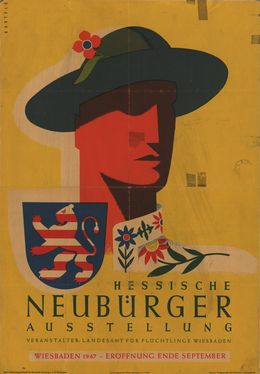
The fact that Thuringia was initially occupied by American troops between 1 and 16 April 1945, and that the ‘Federation of Democratic Socialists’ (BdS) was founded here – an organisation which, with its own programme, sought to unite the SPD and KPD parties – may have contributed to the success of the term ‘Neubürger’ here and in the American zone. This question has not yet been investigated, but there is much to suggest that the term ‘Neubürger’ originated amongst the members of the BdS, who ‘desired a new form of democracy that would not be limited to empty, formulaic parliamentarianism, but would enable the broad masses in town and country to have a real say in politics and administration.’[7] The extent to which the term ‘Neubürger’ can be traced directly back to Hermann Brill (1895–1959), the leading figure of the BdS, remains an open question. As head of the Hessian State Chancellery from July 1946 to 1949, Brill, following his escape from the Soviet Occupation Zone, oversaw the establishment of the Hessian “State Office for Refugees (New Citizens)”. In his cabinet memorandum, he gave the office to be established the title ‘State Office for New Citizens’.[8]
In the states of the Soviet Occupation Zone (SBZ), the term ‘new settlers’ was intended to help avoid the term‘resettlers’and thus draw even less attention to the fact that there were refugees and displaced persons in the SBZ who could not return to their homeland; furthermore, there were also political forces here who hoped that, in the refugees, they had found people who were particularly close to the desired ‘new spirit’ simply because they had lost their old ties. In the American Zone, by contrast, a psychological factor likely also played a part in the frequent use of the term: namely, to show both refugees and locals that the refugees – whose permanent settlement was beyond doubt – had already embarked on the path to successful material and mental integration.
Bibliography
- Michael Schwartz: ‘From Displaced Person to Citizen’. Totalitarian and Subversive Elements in the Language Policy of the Soviet Occupation Zone/GDR. In: Dierk Hoffmann, Marita Krauss, Michael Schwartz (eds.): Displaced Persons in Germany. Interdisciplinary Findings and Research Perspectives. Munich 2000, pp. 135–166.
Notes
[1] See, as a fundamental source on this, Schwartz: ‘From Resettler to Citizen’, in particular section 3, pp. 149–153.
[2] For an example, see Paul Merker: The Next Steps Towards Solving the Resettler Problem. Berlin 1947, p. 24. See also Arnd Bauerkämper: Administration and Society. Ambivalences in the Relationship: The Case of the ‘Resettlers’ Authorities in the Soviet Occupation Zone/GDR 1945–1952. In: Jochen Oltmer (ed.): Governing and Managing Migration. Germany from the Late 19th Century to the Present. Göttingen 2003 (Publications of the Institute for Migration Research and Intercultural Studies (IMIS) at the University of Osnabrück 12), pp. 227–251.
[3] Helga A. Welsh: Thuringia. In: Martin Broszat, Hermann Weber (eds.): Handbook of the Soviet Occupation Zone. State Administrations, Political Parties, Social Organisations and their Leaders in the Soviet Occupation Zone of Germany 1945–1949. Munich 1990, pp. 167–189, here p. 183.
[4] Schwartz: ‘From Resettler to Citizen’, p. 153.
[5] Schwartz: ‘From Resettler to Citizen’, p. 151. Schwartz quotes here from: SED Central Secretariat, Department of Labour and Social Welfare, Weck/Belcke, to the SED Thuringia Regional Executive Committee, Department of Labour and Social Welfare, 12 August 1947. In: Federal Archives, Berlin, DO 2/4, pp. 150 ff.
[6] Schwartz: ‘From Resettler to Citizen’, p. 152.
[7] Quote from the Buchenwald Manifesto, reprinted in Hermann Brill: *Gegen den Strom. Wege zum Sozialismus*. Issue 1. Offenbach 1946, pp. 96–102, here p. 98.
[8] Cf. Hessian Main State Archives, Wiesbaden, Ref. 502 No. (0) 7804: Cabinet meeting on 29 January 1947 (Item 25: State Office for New Citizens). At its meeting on 29 January 1947, the Cabinet did indeed change the official title proposed by Brill, ‘State Office for New Residents’, to ‘State Office for Refugees (New Residents)’, it retained the term ‘new residents’, favoured by Brill, as an addition in brackets.
Citation
Bernhard Parisius: New Citizens. In: Online Encyclopaedia on the Culture and History of Germans in Eastern Europe, 2015. URL: ome-lexikon.uni-oldenburg.de/p32803 (accessed 3 December 2021).
Terms of use for this article
Copyright © University of Oldenburg and the Federal Institute for the Culture and History of Germans in Eastern Europe (BKGE), all rights reserved. This work was produced as part of the project ‘Online Encyclopaedia on the Culture and History of Germans in Eastern Europe’ and may be reproduced and published provided the rights holders’ consent has been obtained. Please contact:
If you have any specialist comments or additions to the text, please contact the editorial team, citing relevant literature and source references.