

Gleiwitz/Gliwice
Gleiwitz/Gliwice
Etymology
There are several theories regarding the origin of the town’s name. ‘Gleiwitz’ is associated either with the proper name ‘Gliw’ or ‘Gliwa’, which was in use in medieval Silesia, or with the Slavic term ‘gliw’, meaning marshy, damp ground.
Location
Gleiwitz is situated at 50° 17' north latitude and 18° 40' east longitude, about 30 km west of Katowice.
Topography
Gleiwitz is situated in the west of the Upper Silesian industrial region on the Klodnitz, a right-bank tributary of the Oder.
Political and administrative affiliation
Poland. Gliwice is the fourth-largest city in the Silesian Voivodeship (Śląsk), the capital of Gliwice County (powiat gliwicki) and a city with independent municipal status.
Common symbolism
The coat of arms of Gleiwitz is divided into two parts; on the left it shows half of the golden eagle from the Upper Silesian coat of arms on a blue background, and on the right, on a red background, a silver crenellated tower with a blue conical roof. The coat of arms was adopted in 1964 and derives from a seal design that was already in use as early as 1400.
Until 1945, a coat of arms granted in 1629 by Emperor Ferdinand II was used, which featured the black Habsburg eagle alongside the Upper Silesian eagle.
Middle Ages
A town governed by German law had already existed on the Klodnitz since around 1260, prior to which there had been a Slavic market settlement situated on the route between Kraków and Wrocław (in Old Gleiwitz, presumably in the area of ul. Kozielska/Coseler Straße). In 1276, Gleiwitz is first mentioned in historical sources. The area of Gleiwitz initially belonged to the Duchy of Opole; following its partition in 1281, it became part of the Duchy of Cosel-Beuthen. When that duchy was divided in 1355, Gleiwitz fell to Duke Primislaus of Teschen; just two decades later, the region was divided between the Dukes of Oels and Teschen, and Auschwitz respectively. In 1430, the town came under attack from the Hussites, led by Sigismund Korybut, a relative of the Polish King Władysław Jagiello and a candidate for the Bohemian crown; several months later, Konrad VII of Oels recaptured it. With the extinction of the Piast line of Oels in 1492, the town passed to the Piasts of Opole. From 1475, Magdeburg Law was in force in the town.
Early modern period
Gleiwitz remained in the possession of the Opole branch of the Silesian Piasts until 1532; following the extinction of that line in the male line, it passed as an extinct fief to the Bohemian Crown and thus into the possession of the Habsburgs. In 1557, the town, together with nine surrounding villages, was pledged by Emperor Ferdinand I as the Gleiwitz domain. After the town council had purchased the manorial rights from Emperor Rudolf II in 1596, Gleiwitz became a free royal town (an ‘immediate city’). In 1742, it was annexed to Prussia as a result of the First Silesian War. Accelerated, amongst other things, by a series of fires (1596, 1601, 1711, 1730, 1735, as well as in 1813 and 1820), the town experienced a gradual decline right up until the early 19th century.

19th century
The development of the metallurgical and mining industries brought Gleiwitz a rapid economic boom (see Economy). The town’s architectural landscape also changed: new private and public buildings were erected in the town centre and a modern infrastructure was established. Trams had been running in Gleiwitz since 1894, initially horse-drawn trams, and from 1898 onwards, electrically powered vehicles.
20th century
Following the Polish uprisings in Upper Silesia in 1919–1921 and the referendum in March 1921 on the future political affiliation of the region, Gleiwitz, like the neighbouring towns of Hindenburg/Zabrze and Beuthen/Bytom, part of the German Empire and became a border town. In 1925, Gleiwitz gained an airport with flights to Berlin and Breslau, as well as its own radio transmitter (in 1935, the transmitter was replaced by a new building, whose wooden transmission tower, at 111 metres, remains the tallest wooden structure in the world to this day). Under the code name ‘Operation Tannenberg’, on 31 August 1939 the SS, dressed in Polish uniforms, carried out an attack on the Gleiwitz radio station, which served as a propaganda pretext for the invasion of Poland the following day.
During the Second World War, Gleiwitz was initially spared from hostilities. Between March 1944 and January 1945, four satellite camps of the Auschwitz concentration camp were in operation in Gleiwitz. On 24 January 1945, the town was occupied by the Red Army. In March 1945, Gleiwitz came under Polish administration. The majority of the inhabitants of German origin were expelled; Poles settled in the town, mostly displaced persons from the former eastern territories. The industrial enterprises were nationalised.
New settlements sprang up in and around Gleiwitz, and the neighbouring towns of Alt-Gleiwitz/Stare Gliwice, Laband/Łabędy, Schechowitz/Czechowice and Eichenkamp-Siedlung/Wilcze Gardło were incorporated into the municipality.
Population trends
In the Middle Ages and the early modern period, Gleiwitz had a predominantly Polish-speaking population. In 1787, the town had a population of 1,872.[1]
During the economic boom of the 19th century, there was an increased influx of settlers from the west; the technical specialists, in particular, were German-speaking. In 1852, the population rose to 9,173; by 1905, following the incorporation of the villages of Petersdorf/Szobiszowice and Trinneck/Trynek, it had risen to 61,326.[2] In 1910, 74 per cent of the inhabitants were native German speakers, which roughly corresponded to the results of the 1921 referendum in the town. In 1939, Gleiwitz had a population of 114,048.[3] After the Second World War, the German inhabitants were expelled, and displaced persons from the former Polish eastern territories settled in their place. In 2010, Gleiwitz had a population of 195,472.[4]
Economy
In the 15th century, the town experienced a modest period of prosperity (with the right of staple, hop cultivation, and later as a centre for cloth-making and the cloth trade).
It was not until the development of the ironworks and mining industries in the 19th century that the town experienced a vigorous economic boom. In 1796, the Royal Ironworks and later the Gleiwitz Ironworks were founded, featuring the first coke oven on the European mainland; the project was initiated by the mining captain Count Friedrich Wilhelm von Reden and designed by the architects Friedrich Wedding and John Baildon. A major munitions, cannon and art foundry had been in operation here since 1804. In the second decade of the 19th century, the first insignia for the Order of the Iron Cross – endowed by King Frederick William III – were produced there, based on a design by Karl Friedrich Schinkel.
In 1927, Ellguth-Zabrze/Ligota Zabrska, Sosnitza/Sośnica, Richtersdorf/Wójtowa Wieś and Zernik/Żerniki were incorporated into the municipal area.
To facilitate the transport of coal and iron products, the Klodnitz Canal was built between 1792 and 1812; stretching for approximately 50 km, it linked the Klodnitz with the Oder (at Cosel). Between 1934 and 1939, the old Klodnitz Canal was replaced by the Gleiwitz Canal (inaugurated in December 1939 as the Adolf Hitler Canal).
In 1845, construction began on the railway line to Oppeln/Opole and Breslau.
With the growth of the metallurgical and mining industries, numerous new businesses sprang up in and around Gleiwitz in the second half of the 19th century, including breweries, brickworks and lime kilns, sawmills, printing works, as well as an asphalt factory and a cardboard factory.
During the interwar period, Gleiwitz derived some benefit from the relocation of businesses and institutions from Katowice in Poland, despite the generally strained economic situation. After 1945, a large proportion of the machinery from the Gleiwitz steelworks was dismantled and transported to the Soviet Union. In the post-war period, Gleiwitz once again developed into an important centre for the steel and defence industries (the Łabędy steelworks in the Laband/Łabędy district). Following the political changes of 1989, Gleiwitz remained a significant economic hub in the region. In 1998, General Motors relocated part of its Opel production to the newly built car factory in Gleiwitz; several special economic zones and a technopark were established in the city.
Society
Despite the increased influx of people from the West in the 19th century, Gleiwitz remained a centre of Polish-Upper Silesian culture during Prussian rule: From 1845 onwards, Polish calendars and magazines were published here (Opiekun Katolicki, Iskra, Sztandar Polski). Although Gleiwitz remained part of Germany following the 1921 plebiscite, Polish institutions and associations continued to operate (including the Association of Poles in Germany [Związek Polaków w Niemczech] and the Polish People’s Bank).
History of Religion and the Church
Little is known about the spread of the Reformation in Gleiwitz in the 16th century – apart from a report by the Bishop of Breslau in 1587 stating that non-Catholics could not acquire citizenship in the town. With the influx of the German population in the wake of industrialisation, the number of Protestant residents also rose. The Protestant congregation was founded in 1809 and was granted the use of St Barbara’s Church in 1815. In 1890, 3,709 of the 19,667 inhabitants were Protestant; by 1939, the figure had risen to 13,993 out of 114,048 inhabitants.[5]
The first documented information about Jewish residents of the town dates from the 17th century. After 1750, a Jewish community was founded in Gleiwitz, which had its own house of prayer by 1763 and a synagogue and a school by 1812. In that year, 46 Jewish families comprising 174 members lived in the town,[6] by 1890 their number had risen to 1,767.[7] In 1861, a new synagogue in the Moorish style was built; it was set on fire during the ‘Reichskristallnacht’ in 1938 and subsequently blown up. After 1933, most of the Jews of Gleiwitz were expelled or murdered. The old cemetery on the former Löwenstraße (pl. na Piasku) and the New Cemetery on Lindenstraße (ul. Poniatowskiego), which features a memorial to the Jews murdered during the Nazi era, still serve as reminders of Jewish life in Gleiwitz.
Special cultural institutions
The theatre opened in 1899. A war ruin since 1945, it is currently once again being used by theGliwice Music Theatre (Gliwicki Teatr Muzyczny), which was founded in 2001. Since 1945, the so-called Piast Castle (Zamek Piastowski) has housed the Historical Museum.
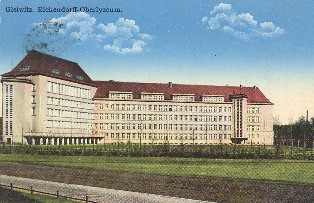
The Eichendorf Lyceum (now part of the Technical University of
) on the former Kattowitz Street/
ul. Pstrowskiego, was built between 1928 and 1930 to a design
by the Gliwice City Planning Officer Karl Schabik
[Archive B. Störtkuhl].

Education and Science
Gleiwitz is home to a technical university (Politechnika Śląska), which was re-established in 1945 with the help of Polish scientists who had been displaced from Lemberg/Ľviv, and went on to become an important centre of scholarship in post-war Poland.
Bibliography
The town gained literary significance in the Gleiwitz Tetralogy by the writer Horst Bienek (1930–1987). In these four novels, the author – who was born in Gleiwitz and was forced to flee in 1946 – combines memories of his own childhood with a chronicle of Upper Silesia during the Second World War.
Art History and Architecture
The medieval town centre, with its grid-like street layout, was built on an oval plan. Along the main axis (north-west to south-east), between the Beuthen (White) Gate and the Ratibor (Black) Gate, run the two main thoroughfares that flank the square market place (Ring). The medieval city walls were almost entirely demolished in the 18th and 19th centuries. Some remnants of the late medieval building fabric have been preserved in the town houses on the Ring (including some Gothic cellars). Most of the houses were rebuilt between 1957 and 1960 in simplified historicist styles.
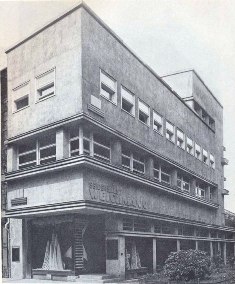
Erich Mendelsohn: Weichmann Silk House
, on the former Wilhelmstraße/al.
Zwycięstwa (1922/23) [B. Störtkuhl Archive].

Since the end of the 18th century, the city’s expansion has taken place predominantly northwards, along the prestigious Wilhelmstraße (ul. Zwycięstwa), which is lined with predominantly historicist commercial and residential buildings. A key example of Modernist architecture is the Weichmann Silk House (No. 37), the first department store designed by the architect Erich Mendelsohn (1922/23), who became famous for this type of building. In competition with Katowice, which was now part of Poland, numerous prestigious buildings were erected during the interwar period, such as the former ‘Haus Oberschlesien’ hotel (1922–1928, Richard Gaze & Alfred Böttcher), which was regarded as the most elegant hotel in Upper Silesia. Rebuilt in the style of Socialist Realism following the fire of 1945, it is now the seat of the city administration. Since the late 19th century, a key focus of construction activity has been the development of new residential districts. The All Saints’ Parish Church, situated within the historic city walls, is first mentioned in documents dating from 1335 (a parish priest is recorded as early as 1279). The brick hall church, which today has three naves and a single-nave chancel, was built in the second half of the 15th century and was rebuilt between 1930 and 1933. The Catholic branch church of St Bartholomew in the former village of Petersdorf (now the district of Szobiszowice) was, according to tradition, built by the Knights Templar in 1232, and was rebuilt in the 15th century and after 1626. The Gothic hall church – the foundations of which may still partly be Romanesque – with a square west tower built of limestone rubble, features interior furnishings from the Baroque period (pulpit, altar, baptismal font). The modernist hall church of Christ the King on ul. S. Okrzeji ( formerly Stadtwaldstraße), on the corner of ul. ks. Józefa Poniatowskiego, formerly Leipziger Straße) was built in 1934–1935 by Karl Mayr. The entrance area to the west is designed as a striking, flat-roofed transverse wing, staggered in height and width. The Town Hall on the Ring was built in the 15th century and has been rebuilt several times. The present building dates mainly from the early 20th century. Villa Caro at 8a Niederwallstraße (ul. Dolnych Wałów) was built in 1885 in the Neo-Renaissance style for Oskar Caro, the owner of the Gliwice wire factory. It has served as a museum since 1934. The former Eichendorff Girls’ Grammar School (now the Faculty of Environmental Engineering and Energy at the Silesian University of Technology) at 22 ul. Konarskiego is one of the most important late Expressionist buildings in Upper Silesia. The five-storey building, designed between 1928 and 1930 by the city’s chief architect Karl Schabik, is notable for its sharply projecting stairwells, reminiscent of a ship’s bow. The former Royal Ironworks (now Gliwickie Zakłady Urządzeń Technicznych, GZUT) was founded in 1796 and comprises a total of 18 buildings listed as historic monuments, built in the Neoclassical and round-arched styles from around 1840. In one of the production halls (now the Muzeum Odlewnictwa Artystycznego), artistic castings produced by the foundry from 1796 to the present day are on display, including works by Theodor Kalide (1801–1866). The Eichenkamp (Wilcze Gardło) housing estate on the south-western outskirts of the town was built by Rudolf Fischer as a model estate for the SA as part of the ‘Dankopfer der Nation’ campaign between 1937 and 1941.
Bibliography
- Jan Drabina (ed.): *Historia Gliwic* [The History of Gleiwitz]. Gliwice 1995.
- Leszek Jodliński: Gliwice znane i nieznane [Gleiwitz – known and unknown]. Gliwice 2007.
- Gleiwitz City Council (ed.); City Planning Officer Carl Schabik (comp.): Gleiwitz. Berlin-Halensee 1928 (German Urban Planning).
- Przemysław Nadolski: Historia osadnictwa Żydów w Gliwicach – sytuacja prawna Żydów na Śląsku do I wojny światowej [History of Jewish Settlement in Gleiwitz – The Legal Situation of Jews in Silesia up to the First World War]. In: Bożena Kubit (ed.): The Jews of Gliwice. Museum in Gliwice. Gliwice 2006, pp. 47–63.
- Józef Pilch: Leksykon Zabytków Architektury Górnego Śląska [Encyclopaedia of Architectural Monuments of Upper Silesia]. Warsaw 2006, pp. 268–276.
- Damian Recław (ed.). Gliwice znane i nieznane II [Gleiwitz – known and unknown 2]. Gliwice 2008.
- Tomasz Torbus: Gleiwitz/Gliwice. In: Ernst Badstübner, Dietmar Popp, Andrzej Tomaszewski, Dethard von Winterfeld (eds.); Sławomir Brezicki, Christine Nielsen (eds.): Dehio Handbook of Art Monuments in Poland. Silesia. Munich, Berlin 2005, pp. 289–297.
- Hugo Weczerka: Gleiwitz. In: Ibid. (ed.): Handbook of Historical Sites. Silesia. Stuttgart 1977 (Kröners Taschenausgabe 316), pp. 123–127.
Web link
- www.herder-institut.de/bildkatalog/wikidata/Q105084 (Images relating to Gleiwitz/Gliwice in the image archive of the Herder Institute, Marburg)
Notes
[1] Weczerka: Gleiwitz, p. 125.
[2] Weczerka: Gleiwitz, p. 125ff.
[3] Michael Rademacher: A History of German Administration from the Unification of the German Empire in 1871 to Reunification in 1990. URL: treemagic.org/rademacher/www.verwaltungsgeschichte.de/ (accessed 13 August 2021).
[4] Central Statistical Office, 2011 Elections to the Sejm and Senate. URL: http://pkw.gov.pl (9 October 2011).
[5] treemagic.org/rademacher/www.verwaltungsgeschichte.de/ (note 3).
[6] Nadolski: History, p. 55.
[7] treemagic.org/rademacher/www.verwaltungsgeschichte.de/ (note 3).
Citation
Beata Lejman, Tomasz Torbus: Gleiwitz/Gliwice. In: Online Encyclopaedia on the Culture and History of Germans in Eastern Europe, 2013. URL: ome-lexikon.uni-oldenburg.de/p32380 (as at 30 July 2021).
Terms of use for this article
Copyright © University of Oldenburg and the Federal Institute for the Culture and History of Germans in Eastern Europe (BKGE), all rights reserved. This work was produced as part of the project ‘Online Encyclopaedia on the Culture and History of Germans in Eastern Europe’ and may be reproduced and published provided the rights holders’ consent has been obtained. Please contact:
If you have any specialist comments or additions to the text, please contact the editorial team, citing relevant literature and source references.