

Neisse/Nysa
Neisse/Nysa
Etymology
Named after the River Neisse (GlatzerNeisse/Nysa Kłodzka), which was first mentioned by Cosmas of Prague at the beginning of the 12th century as *flumen nomine Nizza(m) *.
Location
Neisse is situated at 50° 45' north latitude and 17° 20' east longitude, approximately 80 km south of Breslau/Wrocław.
Topography
Neisse is situated in the hilly foothills of the Altvater Mountains, which form part of the Sudeten Mountains, at the confluence of the Biele (Biała Głuchołaska/Bělá) and the (Glatzer) Neisse, at an elevation of 187 metres above sea level.
Region

View of the town of Neisse/Nysa (postcard: before 1939)
[Herder Institute, Marburg, Image Archive, Inv.
No. 142969]
Political and administrative affiliation
Poland. Since 1950, Neisse has been part of the Opole Voivodeship (Województwo opolskie). In the 13th century, the town belonged to the Duchy of Silesia (Ottmachau castellany); from 1342, it belonged to the ecclesiastical principality of the Bishops of Wrocław (Principality of Nysa-Grottkau, historically part of Lower Silesia); became part of Prussia in 1742, belonged to the German Empire from 1871 and has been part of Poland since 1945.
Common symbolism
There is evidence of a town seal dating from 1260. The coat of arms features six silver lilies on a red field, arranged in a ratio of three to two to one (derived from the bishop’s regional coat of arms).
Archaeological significance
In 1938, excavations were carried out at the parish church of St James, which, reportedly consecrated in 1198, was rebuilt following a fire in the second half of the 13th century. The present-day hall church was built following another fire in 1401.
Middle Ages
Nysa is one of the oldest towns in Silesia; it is thought that the first settlement there dates back to the 10th century. In 1201, Jarosław, Bishop of Wrocław, designated Nysa as the capital of the ecclesiastical principality in his will.
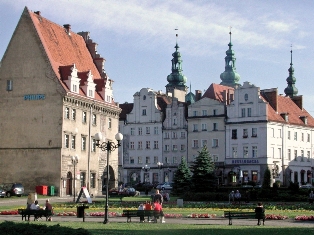
View of Neisse/Nysa with the treasury building and St Peter and Paul’s Church (
) in the background (2004).
[Photo: T.Weger/CC BY-SA 3.0]

Nysa is first mentioned in 1223 as a town governed by Flemish law, with a bailiff named Walter. An older Slavic settlement was incorporated into what later became the old town, which was situated outside the neighbouring town, which had been laid out according to a plan. In 1308, Nysa adopted the Magdeburg municipal charter. The city’s lord was the Bishop of Wrocław, who, from 1342/44 onwards, as a spiritual prince independent of the Piasts, held jurisdiction over capital offences and market rights. Following the resolution of conflicts with the townspeople in 1313, the administration of the town lay largely with the council and the lay magistrates. In 1428, the Hussites unsuccessfully besieged the town; the suburbs and the surrounding countryside were destroyed. Following the crisis of the 15th century, its location on the Vienna–Wrocław road led to a renewed boom in Nysa as a trading town, partly due to the cloth and wine trade with Austria, Bohemia, Moravia and Hungary.
Modern times
Following the introduction of the Reformation in Breslau, Neisse served almost continuously as the seat of the bishops of Breslau throughout the 16th and 17th centuries, a period which was marked by an economic and cultural boom. By purchasing the bailiwick rights in 1551, the town gained extensive independence from the bishop. However, in the wake of the Counter-Reformation, conflicts arose under Bishop Karl of Habsburg (reigned 1608–1624), who in 1609 prevented the exercise of the religious freedoms guaranteed in the Letter of Majesty issued by Emperor Rudolf II in 1609. In 1616, Karl banned all ‘gatherings and conventicula’ by Protestants in the town and had one of the two town envoys, who had presented the complaints of the citizens of Nysa at the Silesian Diet, arrested and executed. When the Thirty Years’ War broke out in 1618, the bishop evaded the citizens of Nysa’s attempt to arrest him by fleeing to his brother-in-law, the Polish King Sigismund III. Following Ferdinand II’s victory at the Battle of White Mountain near Prague (Praha), the Counter-Reformation began in 1620 with the arrival of the Jesuits, who established a college and (unsuccessfully) attempted to found a university. This was followed by the exodus of the Protestant citizens, who in 1622 made up almost three-quarters of the population, with the result that by 1647 the town had only 3,500 inhabitants, compared with 7,300 in 1551. Some of these losses, however, were attributable to the events of the war and epidemics.

The bombardment of Neisse/Nysa on 19 February 1741
(illustration) [Herder Institute, Marburg, Image Archive, Inv.
No. 128414]
From 1650 onwards, Neisse was expanded into a fortress with wide moats, based on the Dutch system. In 1741, it was surrendered to Prussian troops. During the Prussian period, work on the fortress continued and the Friedrichsstadt district was established to house a garrison of over 4,000 men. Following the secularisation of 1810, monasteries and convents were dissolved and their buildings put to use as municipal and state institutions. The political climate in Neisse was conservative in the 19th century. During the Kulturkampf and in the years that followed, Neisse was a stronghold of the Catholic Centre Party, so much so that the 1899 Katholikentag – a major ‘show of strength of political Catholicism’ – took place here. In 1911, Neisse became a city independent of a district. The centre’s democratically legitimised dominance came to an end in 1933 with the National Social ists’ ‘Gleichschaltung’ (enforced conformity).
Contemporary History
When Soviet troops marched into the town in April 1945, 75 per cent of Neisse was destroyed. In 1946, the German inhabitants were forcibly displaced. The town was subsequently placed under the administration of the Polish United Workers’ Party (PZPR). Neisse has had a democratic local government since 1989/90.
Administration
The Bishop of Wrocław ruled as lord of the town through a hereditary bailiff (Schultheiß); following the settlement of 1313, the council and the lay judges became the dominant forces in the town. In 1551, Nysa acquired the bailiwick. From 1742, the city’s administration was determined by the Prussian government; from 1809, the city was granted self-government under the Prussian Municipal Ordinance. In the second half of the 19th century, local elections were held under the three-class suffrage system; from 1919 onwards, the local electoral system was democratised (until 1933). From 1946, the right to vote was governed by communist regulations, and from 1990, the right to vote was unrestricted.
Economy and Society
In Schedel’s *World Chronicle* of 1493, the inhabitants are described as *plebs rustica polonici ydeomatis* (urban population of Polish speech). In the Middle Ages and the early modern period, Neisse, as a residential and trading town on the Vienna–Wrocław route, was home to a flourishing craft industry (goldsmiths). Trade included, amongst other things, cloth, linen and wine.
From the 18th century onwards, the military was the most important economic factor, alongside a modest textile industry. The industry was only able to develop after the fortress was demolished in 1919. This led to an increase in the population, and housing construction and industrial development were encouraged. Today, Neisse is significant as a tourist and administrative centre.
Population trends: 1787: 5,863; 1825: 10,398; 1905: 25,390; 1939: 37,859; 1961: 24,710 inhabitants.[1] In 2005, the town had a population of 47,500.
History of Religion and the Church
Cultural life in Neisse during the Middle Ages was largely shaped by the bishop and the religious orders; alongside the Minorites and the Knights of the Cross, the Franciscans also played a role from 1474 onwards. St James’s Church, built as a parish church from the 13th century onwards, served as the seat of a collegiate chapter from 1477 and, from 1539 to 1608, as the burial place of six bishops. It also served as a subsidiary cathedral for the bishops of Wrocław. From the first half of the 15th century, there was a Jewish community in the town, which maintained a synagogue and a cemetery. In 1466/68, the Jews were expelled from the town following accusations of an alleged ritual murder and desecration of the Host.
The bishops’ humanist outlook allowed the Reformation to spread, though the cathedral chapter opposed this and succeeded in preventing any overt profession of the Lutheran faith. Vigorous Counter-Reformation measures were implemented under Bishop Karl of Habsburg, who refused to honour the denominational concessions set out in the Letter of Majesty (1609) and, particularly following the victory of Ferdinand II in 1620, sought to re-Catholicise the city by appointing Jesuits in 1622 and founding the University of Neisse. A Protestant congregation for civilians and military personnel was not established until 1742; from 1816 onwards, it was granted the former Franciscan church as its parish church. From 1751 onwards, there was once again a Jewish community in Neisse; from the 1830s onwards, there was also a synagogue, the new building of which, dating from 1892, was destroyed during ‘Kristallnacht’ in 1938. From 1873, Neisse also had an Old Catholic congregation.
Special cultural institutions
The former bishop’s residence now houses a museum dedicated to prehistory, early history and the history of the city, as well as to domestic culture, decorative arts and painting from the 15th to the 20th centuries. The bell tower of St James’s Church houses a museum of sacred art featuring goldsmith’s work from Neisse. The medieval and early modern monasteries and abbeys house libraries, including that of the Jesuits, which contains over 100 manuscripts and more than 200 incunabula.
Education and Science
The parish school in Neisse was first mentioned in 1366. From 1418 onwards, there was a grammar school, a teacher-training college from 1586, and the Jesuit grammar school Carolinum from 1624 (famous pupils included, amongst others, the future King of Poland, Michał Korybut Wiśniowecki, and the Nobel Prize winner in Medicine, Konrad Bloch).
Today, the town is home to a lyceum, a university of applied sciences specialising in medicine, and a state university of applied sciences with an Institute of Foreign Languages and an Institute for German Studies.
Everyday culture
In 1851, the ‘Philomatie’ Society was founded to promote the sciences. The Neisse Art and Antiquities Society has existed since 1897 and established a municipal museum.
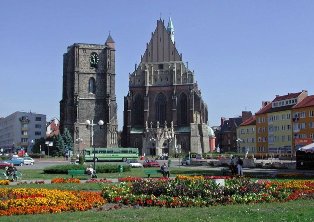
St James’s Church in Neisse/Nysa in 2003.
[Photo: T.Weger/CC BY-SA 3.0]

Art History
Neisse has numerous churches. Construction of the Gothic parish church of St James, designed as a hall church, began in the mid-13th century and was completed in 1430 by the master builder Peter von Frankenstein. Construction of the (campanile) bell tower began in 1474 and was completed in 1516 with the addition of the third storey. The interior of St James’s Church, which was rebuilt after 1945, features Gothic and Renaissance tombs of the bishops, as well as the ‘Anna Selbdritt’ sculpture group dating from 1500. Other architectural monuments include the former Jesuit Church of St Mary (1687–1692) by Michael Klein, with frescoes by Karl Dankwart (1689); the former Church of the Order of the Holy Cross, St Peter and Paul, built between 1720 and 1728 (probably also by Michael Klein) with frescoes by the Scheffler brothers (1730), and the town weigh house, built in 1602 with a late Renaissance gable, which was rebuilt in a simplified form in 1947–48.
Music
Evidence of church music in Neisse in the 15th century can be found in the Codex Mf. 2016 (Music Institute of the University of Wrocław). Around 1500, there was a town piper. There is evidence of performances in Neisse of five- or six-part motets by Johannes Nucius (1560–1624), the most significant Silesian composer and Cistercian abbot, conducted by his friend Georg Wolff, a teacher at the town grammar school. Numerous hymnals were published by the Nysa printing houses in the 16th and 17th centuries. Composers served as court Kapellmeisters in the court chapel of Bishop Karl von Habsburg
History of Books and Printing
The town printing house, founded by Bishop Balthasar von Promnitz, is documented from 1555 onwards with 259 printed works in the 16th century, including Hieronymus Emser’s *Testamentum Novum Germanum* (1571) as the Catholic counterpart to Luther’s translation of the Bible. The municipal printing house remained in operation until the end of the Second World War. The most significant achievement of the printer J. Cruciger was Martin Helwig’s map of Silesia from 1561. Although the printing house was founded as a Catholic counterpart to the Protestant printing houses in Breslau, the printer Johann Schubarth also published Protestant works, such as the prayer book *Suspiria* (Sighs) by Magister Nikolaus Anther, subtitled ‘Sighs and prayers to be recited daily by the Protestant churches in Neisse and other devout Christians, who are wholeheartedly devoted to and committed to the pure Augsburg Confession, during these recent troubled times’.
Bibliography
The most notable writers from Neisse were the ‘Young Germany’ poet Friedrich von Sallet (1812–1843) and the Expressionist Max Herrmann (Herrmann-Neisse) (1886–1941). Joseph von Eichendorff (1788–1857) in Neisse, where, at the request of Heinrich Förster, Bishop of Breslau, he conceived a legend about St Hedwig, of which, however, only the introduction was published posthumously.
Culture of remembrance
Joseph von Eichendorff’s grave in the Jerusalem Cemetery in Neisse has been a magnet for numerous tourists since the destruction of the Eichendorff House during the Second World War. The Eichendorff monument near the cemetery, which was unveiled in 1888 and destroyed in 1945, was rebuilt in 2002 with the help of German sponsors.
4. Discourses/Controversies
In the debate surrounding the city’s foundation, earlier authors assume that the Old Town developed from the former Slavic settlement, whilst the city itself was established independently of this as a town under German law. A more recent interpretation (W. Irgang) assumes that the bailiff Walter, mentioned in 1223, was the head of a municipality governed by German law in the Old Town, and interprets the re-establishment of the systematically planned town of Nyza as the result of urban planning and defensive considerations.
Bibliography
- Werner Bein, Vera Schmilewski, Ulrich Schmilewski (eds.): Neisse. The Silesian Rome through the Centuries. Würzburg 1988.
- Detlef Haberland (ed.): “The City Murmurs, Eerie, Far and Near”. Literary Expressionism between Neisse and Berlin. Berlin 1995 (Conference Series of the Haus Oberschlesien Foundation 6).
- Wojciech Kunicki (ed.): Neisse. Texts and Images. With contributions by Marta Kopij and Gabriela Połutrenko. 2nd, revised edition. Nysa 2005.
- Wojciech Kunicki, Monika Witt (eds.): Neisse. Cultural Identity and Regionality. Nysa 2004 (German Studies, Supplement 1).
- Christine Nielsen: Nysa/Neisse. In: Ernst Badstübner, Dietmar Popp, Andrzej Tomaszewski, Dethard von Winterfeld (eds.), Sławomir Brzezicki, Christine Nielsen (ed.): Dehio Handbook of Art Monuments in Poland. Silesia. Munich, Berlin 2005, pp. 669–697.
- Paul Ronge: Neisse. In: Hugo Weczerka (ed.): Handbook of Historical Sites. Silesia. Stuttgart 1977 (Kröners Taschenausgabe 316), pp. 331–338.
- Aleksandra Szewczyk: The Art Patronage of the Bishops of Wrocław during the Reformation and the Post-Tridentine Renewal of the Church [The artistic patronage of the bishops of Wrocław during the Reformation and the Tridentine renewal of the Church] (1520–1609). Wrocław 2011.
Web links
- www.nysa.eu/ (the town’s multilingual website)
- www.herder-institut.de/bildkatalog/wikidata/Q815721 (Images relating to Neisse/Nysa in the image archive of the Herder Institute, Marburg)
Citation
Arno Herzig: Neisse/Nysa. In: Online Encyclopaedia on the Culture and History of Germans in Eastern Europe, 2013. URL: ome-lexikon.uni-oldenburg.de/p32316 (as at 30 July 2021).
Terms of use for this article
Copyright © University of Oldenburg and the Federal Institute for the Culture and History of Germans in Eastern Europe (BKGE), all rights reserved. This work was produced as part of the project ‘Online Encyclopaedia on the Culture and History of Germans in Eastern Europe’ and may be reproduced and published provided the rights holders’ consent has been obtained. Please contact:
If you have any specialist comments or additions to the text, please contact the editorial team, citing relevant literature and source references.