

Brno
Brno
Etymology
The most likely explanation for the origin of the name Brno is that it is derived from the Old Slavic word ‘brn’ (= clay or marsh). The theory that the city’s name is derived from the Celtic word ‘bryn’ (= hill) is a matter of debate.
Location
Brno is situated at 49° 12' north latitude and 16° 36' east longitude, 200 km south-east of Prague (Praha), 140 km north of Vienna and 130 km north-west of Bratislava (Pressburg).
Topography
Brno lies at the point where the South Moravian lowlands give way to the Central Moravian highlands, in the valley basin formed by the rivers Schwarza (Svrátka) and Zwitta (Zwittawa, Svítava), which converge here, at an altitude of approximately 220–250 metres above sea level.
Political and administrative affiliation
Czech Republic. Administrative centre of the South Moravian Region (Jihomoravský kraj). Brno has been the capital of Moravia since 1641. From 1784, as the capital of the Crown Land of Moravia, it was the seat of the Moravian-Silesian Governorate; from 1850, the Moravian governor resided here. From 1928 to 1949, Brno was the capital of the province of Moravia-Silesia. From 1939 to 1945, the city was part of the Protectorate of Bohemia and Moravia.
Common symbolism
The coat of arms, the origins of which are disputed in research due to a lack of sources, has featured since 1315 a triangular Gothic shield with rounded corners, bearing four horizontal bars in the colours (from top to bottom) white–red–white–red in the proportions 1:2.2:2 (before 1918, it was also red–white–red–white).
Middle Ages
The town’s origins lie, on the one hand, on the left bank of the Zwitta in what are now the districts of Malmeritz (Maloměřice), Schimitz (Židenice) and further towards Obersess (Obřany), and on the other hand, primarily in the area of Old Brno (Staré Brno) at a ford across the Schwarza, where Slavic craftsmen and traders settled between the 10th and 12th centuries. Archaeologists have unearthed, amongst other things, pottery and bronze jewellery, skeletons, as well as the foundations of an early Romanesque rotunda—built around the year 1000 on the site of what would later become the Cistercian convent—and its successor buildings. The pre-urban settlement and its religious centre were situated in the immediate vicinity of a ‘castle’ first mentioned in 1091, the exact location of which remains unclear. However, this is not to be confused with Spielberg Castle, which first appears in historical records in 1277. The castle in Old Brno served as the administrative centre of the Provincia Brunensis. Around 1200, the centre of the settlement shifted north-eastwards to the site of today’s city centre. Whilst Slavic craftsmen and traders settled below St Peter’s Hill (Petrov), Germans settled in the vicinity of St James’s Church and Walloons in the area around St Nicholas’s Chapel on what is now Freedom Square. In 1243, King Wenceslas I granted the town extensive privileges modelled on the Babenberg town charters (Enns, Vienna). The administration of the town was in the hands of a royal judge and the 24-member town council (Schöffen). German names predominated amongst the citizenry. From 1328 onwards, council registers were kept; here too, Czech names remained the exception.
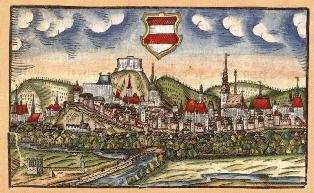
First known depiction of Brno and the Spielberg, *
* (The City of Brno and its Fortress), woodcut by Johann Willenberg, 1593 [Museum of the *
* City of Brno, Inv. No. 2289].

Margrave Johann Heinrich (1322–1375) repeatedly granted privileges to the citizens; however, the city’s status as the margrave’s residence also entailed financial burdens (city tax) as well as the obligation to provide military support for all the margrave’s military campaigns. The Moravian nobility met in Brno for the provincial court and the provincial assemblies. The plague epidemics of 1349/50, 1356 and 1372, with their demographic declines, as well as a devastating conflagration in 1356, temporarily paralysed the city’s development as the economic and political centre of the Margraviate of Moravia and as a counterbalance to Olomouc, the spiritual centre. During the Hussite period, Brno, with its Catholic German patriciate, remained loyal to King Sigismund of Luxembourg.
Modern times

From 1526 to 1918, Brno, as the centre of the Margraviate of Moravia, was part of the Habsburg Empire. Following the Battle of White Mountain in 1620, the imperial army occupied Brno, which – despite internal religious divisions – had already sided with the Protestants in 1619 through the formation of a 30-member directorate. From then on, a royal chamberlain appointed the council, which was dominated by Germans. The Spielberg, which had passed into municipal ownership in 1560, was confiscated. In 1643 and 1645, the Swedes unsuccessfully besieged the city, which was under the command of the French Huguenot Louis Raduit de Souches.
Ferdinand III rewarded the citizens’ wartime efforts with a new coat of arms featuring the imperial double-headed eagle, as well as a remission of debts. The councillors were granted titles of nobility and further privileges; however, local self-government remained restricted by a royal judge. Brno, which had been the sole provincial capital and repository of the provincial records since 1641, was systematically developed into a provincial fortress, which even Frederick II was unable to capture in 1742 during the First Silesian War.
In 1784, as part of his reforms, Emperor Joseph II established, amongst other things, joint political and judicial authorities for Moravia and Austrian Silesia, based in Brno. During the Napoleonic Wars, the French army occupied the city twice: following the ‘Battle of the Three Emperors’, fought just outside Brno at Austerlitz/Slavkov at the turn of the year 1805/06, and again in 1809.
During the Revolution of 1848–49, the provincial capital demonstrated its loyalty to the Emperor. The National Guard, established in Brno on 15 March 1848 by imperial decree, suppressed workers’ unrest in the city at the end of October 1848. The new municipal code, approved by Emperor Franz Joseph I on 1 July 1850, also resulted in the incorporation of 27 Brno suburbs.
A week after the proclamation of Czechoslovakia in the autumn of 1918, the German city council was forced to resign. On 6 November 1918, Petr Kerndlmayer von Ehrenfeld, appointed as government commissioner, took over the administration of the city together with a 24-member commission (16 Czechs, 8 Germans). In April 1919, 22 villages were incorporated into the city (Greater Brno). The city council formed following the elections of 29 February 1920 comprised 61 Czechs and 29 Germans. Important national organisations were established in Brno, including the Supreme Court.
Contemporary History
On 15 March 1939, the German Wehrmacht occupied Brno. Mayor Rudolf Spazier (1887–1963) was forced to resign, and the Brno Nazi representative Oskar Judex (1894–1953) was appointed as his successor. During the occupation from 1939 to 1945, several student halls of residence, as well as the Spielberg, were used as Gestapo prisons. On 26 April 1945, Brno was captured by the Red Army; nearly 1,300 houses in the city were destroyed.
The Germans who remained in Brno were driven on 30 May 1945 in the ‘Brno Death March’ towards Pohrlitz/Pohořelice and the Austrian border. The death toll is disputed; according to recent studies, it is thought to have been around 5,200 people. Since 1995, a memorial stone in the garden of the Augustinian monastery in Brno has commemorated the victims of this brutal expulsion. Following the official expulsion of the Germans in 1945, only 1,500 residents of German nationality remained in Brno.
During the era of totalitarianism (1948–1989), Brno developed into a ‘socialist metropolis and trade fair city’, whose political significance was subordinated to Prague’s centralism. With the Soviet invasion in August 1968, the so-called ‘normalisation’ also began in Brno. It was not until the ‘Velvet Revolution’ at the end of 1989 that the socialist order came to an end. In the summer of 1992, the peaceful separation of the Czech and Slovak Federal Republic (ČSFR) into the Czech Republic and the Slovak Republic was agreed at Villa Tugendhat. Today, Brno is a modern industrial and trade fair city with a wide range of cultural activities; it is the seat of the Constitutional Court and the Supreme Administrative Court of the Czech Republic, as well as the Office of the Prosecutor General.
Population
The population is thought to have stood at around 6,000–7,000 in the 14th century, but fell to around 5,000 by the end of the 15th century. The rise to 11,000 before 1618 was followed by a further decline during the Thirty Years’ War to 4,500 (1650). From the mid-19th century onwards, industrialisation led to rapid growth. 1846 (inner city and suburbs): 45,354; 1880: 82,660, of whom 48,951 were Germans (60 per cent) and 32,142 were Czechs; 1910: 125,737, of whom 81,617 were Germans (65.9 per cent) and 41,943 were Czechs; 1919: 131,663, of whom 80,144 were Czechs and 45,233 were Germans (34.4 per cent); 1921: 221,758, of whom 157,189 were Czechs and 55,816 were Germans (25.9 per cent), plus 3,818 Jews and 1,671 people of other nationalities; 1930: 264,925, of whom 212,760 were Czechs and 52,165 were Germans (20.3 per cent); 1950: 284,946; 1991: 388,296. On 1 January 2013, Brno had a population of 378,327. In 2001, 425 people officially declared themselves to be Czech citizens of German nationality.
Jews were first mentioned in Brno in 1253; they lived in the south-west of the walled city. They repeatedly enjoyed royal protection as ‘court Jews’, but were nevertheless expelled in 1454 – as was the case in other royal towns in Moravia – and effectively disappeared from the town’s landscape for four centuries. It was not until the Revolution of 1848 that Jews were granted full civil equality; their number rose to 2,230 by 1857, with many Jewish entrepreneurs driving the city’s economic growth. By 1890, there were already 7,087 Jews living in Brno; their number rose to around 12,000 by 1938. Between November 1941 and July 1943, over 9,000 Jews were deported eastwards via Theresienstadt/Terezín and murdered. Today’s Jewish community in Brno and South Moravia numbers around 350 people.
Economy
Following the Thirty Years’ War, Brno experienced a slow economic recovery, initially characterised by mercantilist policies. In 1663, the first cotton mill was established in the Brno suburb of Radlas. A milestone on the path to the Industrial Revolution was the ‘Leihbank Unser Lieben Frau’ in Brno, founded in 1751 by Johann Anton Kehrnhofer, a kind of state-backed development bank. Within a century, the South Moravian city had risen to become a European industrial metropolis. The beginnings of Brno’s manufacturing history in the 1780s are linked to the cloth factories of Johann Leopold Köffiler (1743–1814) and Johann Heinrich Offermann (1748–1793).
By 1845, there were already 45 factories run by German or German-Jewish entrepreneurs. Among the best known was the firm owned by the Schoeller family, who had emigrated from Düren (Rhineland) and founded the ‘Gebrüder Schoeller k. k. priv. Feintuch und Schafwollwarenfabrik’ (Schoeller Brothers Imperial and Royal Private Fine Cloth and Sheep’s Wool Goods Factory) in Brno in 1818/19.
In 1802, the first spinning machine factory was established. In 1861, Ignaz Stork’s foundry was founded, where Viktor Kaplan designed his famous turbine in 1912; in 1864, Friedrich Wannieck’s engineering works were established; and in 1889, the Königsfeld Engineering Works was founded. When Brno was connected to the railway line to Vienna in 1839, a third of the output of all cloth factories and a quarter of all dye works in the whole of Moravia and Austrian Silesia were concentrated in the suburbs of Brno. With significant involvement from Jewish entrepreneurs, new firms such as L. Auspitz, the Popper Brothers and Löw & Schmal were established. They cemented the Moravian capital’s reputation as the ‘Austrian Manchester’.
During the period of the so-called Protectorate of Bohemia and Moravia, the Zbrojovka armaments factory took on particular significance. In the Lösch district, a factory for the manufacture of aircraft engines was established, which later became the Zetor plant. After the war, production was switched to the manufacture of tractors.
Society
The growing ethnic and national tensions between Czechs and Germans in the second half of the 19th century led to the establishment of numerous nationally-defined associations. The German gymnastics club was founded in 1861, and the Czech gymnastics club Sokol was founded in 1868. Czech associations, including the Reading Society (Čtenářský spolek), took up residence in the Community Centre (Besední dům), which was completed in 1873. German club life centred on the ‘Deutsches Haus’ (destroyed in 1945), built in 1891 in the German Late Renaissance style. Among the Jewish clubs were Bar Kochba and Makkabi Brno (sports clubs).
History of Religion and the Church

From the 13th century onwards, the parish church of St James served as the church for the Germans, whilst St Peter and Paul remained reserved for the Czechs. Between 1227 and 1239, the Dominicans settled in the town, followed by the Friars Minor around 1230 and, from 1240, the Augustinian nuns in the so-called Herburg Convent. King John of Luxembourg’s first wife founded a convent of Dominican nuns in the city in 1312, whilst Elizabeth of Poland-Kalisz, the widow of Wenceslas II, founded the monumental Cistercian convent of Aula S. Mariae in Old Brno in 1323.
Protestantism began to gain a foothold in Brno from 1530, but met with resolute resistance from the Catholics. The Jesuits arrived in Brno in 1572. From 1599, the Bishop of Olomouc, Cardinal Franz von Dietrichstein, initiated a systematic crackdown on the Lutherans, who, for example, were no longer permitted to bury their dead at St James’s. In 1604, the Capuchins settled in Brno. With the defeat of the Bohemian Estates’ Revolt in 1620 and the subsequent punitive measures, Catholicism triumphed once and for all. In 1777, Brno became a bishop’s seat.
In 1783, the former Cistercian convent of Old Brno was assigned to the Augustinian Hermits. The monastery was dissolved by the Communist government in 1950. In 1989, the Augustinians returned to the abbey. The original Augustinian monastery of St Thomas in Brno, on what is now Moravian Square (Moravské náměstí) was founded in 1350 (its church served as the burial place of the Moravian Luxembourgs) and was elevated to the status of an abbey in 1752, as the clergy were required to send a representative to the sessions of the Moravian Diet. This historical fact gives rise to the unique feature that Brno is home to the world’s only abbey of the Order of Augustinian Hermits (OSA). The naturalist Gregor Mendel was abbot of this monastery from 1868 until his death in 1884.
The first modern Jewish (Great) Synagogue was built in 1855 in the Neo-Romanesque style (it was burnt down by the Nazis in 1939). The Jewish community was established in 1859. In 1904, the New Synagogue was added. During the First World War, several thousand Jews fled from Galicia to Brno. Following the founding of Czechoslovakia in 1918, Jewish institutions were concentrated in Legionářská Street (tř. Kpt. Jaroše) and at the Glacis (Koliště). In 1936, the Agudas Achim Synagogue was added. In 1998, the first mosque in the Czech Republic was built in Brno.
Education and Science
In the second half of the 14th century, a number of notaries from the chancellery of Emperor Charles IV held positions as canons at St Peter’s in Brno and disseminated early humanist ideas throughout the city. Numerous ecclesiastical institutions, such as St James’s and the Order of Friars Minor, possessed their own libraries containing valuable manuscripts.
The Jesuit grammar school, which opened in 1578, was also opened to secular teachers and Jewish pupils following the expulsion of the Jesuits in 1773. This gave rise to the Imperial and Royal (First) Grammar School, which was nationalised in 1848 and reformed in 1878, with German as the language of instruction (renamed the Masaryk State Grammar School after 1918).
In 1775, a school commission for Moravia was established in Brno, which also oversaw the opening of a standard secondary school. The parish school at St James’s was also elevated to the status of a secondary school; further school foundations, all of them German, followed. It was particularly within Brno’s secondary and primary education systems that the ethnic and national divisions between Germans and Czechs found significant expression after 1850, with the ‘battle for the child’ (Tara Zahra) beginning as early as pre-school age. In 1900, there were 18 German and 11 Czech kindergartens, alongside 19 German and 6 Czech elementary and secondary schools, the number of which continued to rise as a result of subsequent municipal amalgamations, whilst at the same time becoming more differentiated.
As part of the Josephine reforms, the University of Olomouc moved to Brno in 1778; however, just four years later, it was relocated back to Olomouc. The Franzensmuseum (Moravian State Museum), founded in 1817, played a leading role in cultural life; the Moravian State Archive (Moravský zemský archiv) was established in 1839. In 1849, the German Technical University of Brno was founded, which existed until 1945. The Czech Technical University of Brno (Vysoké učení technické v Brně) was established in 1899, followed by Masaryk University in 1919.
In 1904, the Brno City Museum was opened on the premises of the Old Provincial House; today, its collections form part of the Museum of the City of Brno (Muzeum města Brna) on Brno’s Spielberg. The Museum of Decorative Arts (Uměleckoprůmyslové muzeum) houses a significant collection of international and national arts and crafts. Documents relating to the city’s history can be found in the City Archive (Archiv města Brna). BRUNA, the local heritage association for (former) residents of Brno, publishes the *Brünner Heimatbote*, whilst the Brno German Language and Cultural Association publishes the *Kleiner Brünner Gassenbote *.
Art History
The origins of St Peter and Paul’s Cathedral on St Peter’s Hill date back to at least the 12th century. In the 14th century, the original Romanesque basilica was converted into a Gothic hall church. The interior décor dates back to the Baroque period in the 18th century and the Neo-Gothic period in the 19th century. The late-Gothic parish church of St James (construction begun in 1220) was completed in 1575, whilst the sacristy was added by Anton von Pilgram in 1510. The architect, born in Brno around 1460, is also regarded as the creator of the late-Gothic portal – completed in 1511 – of the Old Town Hall, which was built in 1311 and subsequently renovated several times. The former Augustinian Church of St Thomas, founded in 1356 by Margrave Johann Heinrich, was converted to the Baroque style between 1661 and 1666 according to designs by Giovanni Battista Erna. The limestone Pietà in the church, created around 1385, is attributed to Heinrich Parler the Younger. On Mendel Square (Mendlovo náměstí) stands St Mary’s Church, founded in 1323 by Queen Elizabeth of Poland-Kalisz as the church of a Cistercian convent, and completed after 1340.
The Dominicans, who had been based in Brno since around 1230, built a new church in the last third of the 17th century on the square later named after them. As early as the Middle Ages, the Dominicans had ceded part of their monastery to the Moravian Provincial Diet, which sat in Brno, for its meetings. The building complex was extended time and again until, in 1935, the city council moved in here (the so-called New TownHall/Nová radnice) after vacating the Old Town Hall due to a lack of space. Daniel Gran created the Baroque ceiling painting *Hercules Protects the Arts and Sciences* in the former Great Hall of the Estates, where the city council now meets.
The roughly triangular Freedom Square (naměstí Svobody), with its Marian Column donated in 1679 in gratitude for the averting of the plague, is the heart of the historic city centre. In the Middle Ages and the early modern period, the square was bordered by noble palaces – the former town palace of the Lords of Leipa and Dauba has been preserved. Built between 1589 and 1596 by Georg Gialdi, the manor house is regarded as an important work of the so-called ‘Moravian Renaissance’.
The Parnassus Fountain on the Vegetable Market (Zelný trh) was built between 1693 and 1695 to a design by Johann Bernhard Fischer von Erlach. In the lower part of the square stands the Redoute, the city’s oldest theatre, dating from the 18th century; the upper part is dominated by the Palais Dietrichstein, built between 1614 and 1620 to plans by the Italian architect G. G. Tencalli, named after the Governor of Moravia who initiated the recatholisation following the Battle of White Mountain in 1620. The rooms of the palace now house the Moravian Museum.
In 1852, Brno’s status as a fortress came to an end; from 1860 onwards, the fortifications were replaced by a ring road and parks modelled on the Viennese example.
The work of architects such as Bohuslav Fuchs, Ernst Wiesner, Otto Eisler and Jiří Kroha turned Brno into a centre of modernism during the interwar period (including the Kommerzbank on Freedom Square, the Hotel Avion on Česká Street, villas and detached houses inSchreibwald/Pisárky or in Schwarze Felder/Černá Pole). Between 1928 and 1930, Ludwig Mies van der Rohe built the villa for the German-Jewish entrepreneurial couple Fritz and Grete Tugendhat (a UNESCO World Heritage Site since 2001). In 1928, to mark the tenth anniversary of the founding of the state, Czechoslovakia presented itself as a progressive nation with a new exhibition centre (Výstaviště) designed in the International Style.
The International Biennial of Graphic Design has been held in Brno since 1963. Among others, the architect Adolf Loos (1870–1933) and the sculptor Anton Hanak (1875–1934) were born in Brno.
History of Theatre and Music
From 1600 onwards, performances by travelling actors took place in the tavern building on Krautmarkt, which had been purchased by the town and which burnt down in 1693. In 1734, a new wooden theatre was erected, which also fell victim to several fires. On the initiative of Mayor Gustav Winterholler (1833–1894), construction began in 1881 on the German Municipal Theatre on Obstmarkt (now Mahenovo náměstí), based on designs by the Viennese theatre architects Ferdinand Fellner and Hermann Helmer.
The Brno Music Society was founded in 1862. The Deutsches Haus also served as a concert hall for the German community in Brno. The roots of the Brno Philharmonic Orchestra, founded in 1956, date back to the time of Leoš Janáček (1854–1928) in the late 19th century. Today’s Academy of Music, housed in the building of the former German State Grammar School, bears his name; furthermore, the international Janáček Music Festival takes place in Brno every two years in the autumn. The Janáček Theatre, which opened in 1965 as a venue for opera and ballet, also bears the composer’s name. Brno was the birthplace of, amongst others, the German-Jewish composer and Oscar winner Erich Wolfgang Korngold (1897–1957).
History of Literature and the Press

In 1486, the first book, the *Agenda Olomucensis*, was printed in Brno. The first Brno newspaper, the *Wöchentliche Intelligenz-Zettel*, was published in 1755, followed in 1778 by the *Brünner politische Zeitung* (which became a daily newspaper in 1814). From 1850, the *Brünner Tagesbote* was also published. In 1893, the politician and journalist Adolf Stránský (1855–1931) founded the liberal newspaper *Lidové noviny* in Brno, the oldest Czech newspaper still in existence under its original name. The printing and publishing house, founded in 1786 by Joseph Georg Traßler and taken over in 1861 by Rudolf Maria von Rohrer – which was expanded in 1897 through the acquisition of the Friedrich Irrgang publishing house – played an important role; it was here that the largest Moravian newspaper, the *Tagesbote*, was published.
Among the Austrian writers born in Brno was the monarchist and patriotic poet Richard von Schaukal (1874–1942). Robert Musil (1880–1942) studied mechanical engineering in Brno and, in his novel *The Man Without Qualities*, described the gloomy atmosphere of the industrial city. Brno’s German-Jewish literary tradition has been all but forgotten, partly because many authors left their hometown at an early age, including Philipp Langmann (1862–1931), Ernst Weiß (1882–1940), Oskar Jellinek (1886–1949), Ernst Lothar (1890–1974) and Fritz Beer (1911–2006). The Czech writers František Halas (1901–1949), Bohumil Hrabal (1914–1997), Ludvík Kundera (1920–2010), Jan Skácel (1922–1989), Milan Kundera (born 1929) and Jan Trefulka (born 1929).
Bibliography
- "Bruna", Association of Brno Natives in the Federal Republic of Germany e. V. (ed.): Encyclopaedia of Notable Germans from Brno 1800–2000. Their biographies, their personalities, their achievements. Famous and significant figures, those honoured and distinguished, well-known and lesser-known individuals. Compiled by Erich Pillwein and Helmut Schneider. Schwäbisch Gmünd 2000.
- Alexandr Brummer, Michal Konečný: Brno under the Nazis. A City Guide. Brno 2013.
- Alexandr Brummer, Michal Konečný: Brno during the Normalisation Period. A City Guide. Brno 2025.
- Alexandr Brummer, Michal Konečný: Occupied Brno. A City Guide. Brno 2018.
- Alexandr Brummer, Michal Konečný: Stalinist Brno. A City Guide. Brno 2015.
- Alexandr Brummer, Michal Konečný: Brno Seeking Revenge. A City Guide. Brno 2014.
- Andrea Březinová, Tomáš Zapletal (eds.): Brno: Moravian Manchester . Brno 2014.
- Bronislav Chocholáč, Tomáš Knoz (eds.): Dějiny Brna [History of Brno], Vol. 4: Město v raném novověku [The City in the Early Modern Period]. Brno 2024.
- Lukáš Fasora: A Free Citizen in a Free Municipality? Civic Elites and Local Self-Government in the City of Brno 1851–1914 [A Free Citizen in a Free Municipality? The Civic Elites and Municipal Self-Government in the City of Brno 1851–1914]. Brno 2007 (Edice Země a kultura ve střední Evropě 6).
- Lukáš Fasora, Jiří Malíř (eds.): History of Brno, Vol. 4: The Modernisation of the City 1790–1918. Brno 2020.
- Lukáš Fasora, Václav Štěpánek (eds.): Dejiny Brna [History of Brno], Vol. 6: Předměstské obce [The Suburban Communities]. Brno 2017.
- Vladimír Filip, Vlastimil Schildberger Jr., Jan Břečka, Lubor Nedbal: Brno – Brünn 1939–1945. Roky nesvobody – Years of Oppression. 3 vols. Brno 2011–2013.
- Hermann Freudenberger, Gerhard Mensch: From Provincial Town to Industrial Region (Brno Study). A contribution to the political economy of social innovation, illustrated by the surge in innovation brought about by the Industrial Revolution in the Brno region. Göttingen 1975 (Studies on Social and Educational Change in the Nineteenth Century 13).
- Hanns Hertl (ed.): The ‘Brno Death March’ 1945. The Expulsion and Mistreatment of Germans from Brno. A Documentation. Schwäbisch Gmünd 1998 (in Czech, Prague 2005).
- Hana Jordánková, Ludmila Sulitková: Předbělohorské Brno. Hospodářský potenciál města a sociální situace jeho obyvatel [Brno in the Era before the Battle of White Mountain. The Economic Potential of the City and the Social Situation of its Inhabitants]. Brno 2020.
- Jiří Kroupa (ed.): Dějiny Brna [History of Brno]. Vol. 7: Uměleckohistorické památky – historické jádro města [Art-historical monuments – the historic city centre]. Brno 2016.
- Thomas Krzenck: Lost Homeland. Between Cultural Diversity and National Tragedy. Brno in the Years 1918–1938 as Reflected in Literature. In: Yearbook of the Stifterverein München 31 (2017), pp. 109–150.
- Karel Kuča: Brno. The Development of the City, its Suburbs and Incorporated Villages. Prague, Brno 2000.
- Zdeněk Kudělka, Jindřich Chatrný (eds.): For New Brno. The Architecture of Brno 1919–1939 (Catalogue of the Museum of the City of Brno). Brno 2000.
- Jan Libor (ed.): Dějiny Brna [History of Brno]. Vol. 2: Středověké město [The Medieval City]. Brno 2013.
- Rudolf Procházka (ed.): Dějiny Brna [History of Brno]. Vol. 1: Od pravěku k ranému středověku [From Prehistory to the Early Middle Ages]. Brno 2011.
- Leipzig City Archives (ed.): The Beautiful Capital of a Beautiful Land. Brno in South Moravia as Reflected in its History. Leipzig 2016.
- František Šujan: Dějepis Brna [History of Brno]. Brno 1902. (digitised at openlibrary.org/books/OL24608713M/D%C4%9Bjepis_Brna)
- Katharina Wessely: Theatre of Identity. The German Theatre in Brno during the Interwar Period. Bielefeld 2011.
Periodicals
- Brno in the Past and Today, 1959 onwards.
- Forum Brunense, 1988 onwards.
- Brünner Heimatbote (bhb.bruenn.eu/)
Web links
- www.brno.cz (multilingual website of the City of Brno)
- www.bruenn.org (website of Bruna, the association of Germans expelled from Brno)
- landesversammlung.cz/de/verbaende/bruenn/deutsche-kulturverien-region-bruenn (German Cultural Association of the Brno Region)
- www.archaiabrno.org/home_de/ (multilingual website of the Brno-based ‘Society for the Protection, Preservation, Documentation and Research of Archaeological, Architectural and Other Historical Monuments, as well as for Education, Training and the Popularisation of Archaeology and Heritage Conservation’)
- encyklopedie.brna.cz (Notable figures, events, buildings, archaeology, literature, etc. in the city of Brno, including a virtual model of the city under siege by the Swedes in 1645 and a panoramic view of Brno in 1867 taken from the tower of St James’s Church)
- www.archiv.brno.cz (multilingual website of the City Archive. Under the heading ‘Digiarchiv’, currently digitised sources are presented, starting with the censuses from 1850 onwards)
- www.mza.cz/ (website of the Moravian Regional Archives in Brno, with a link to digitised collections, including material on the history of Brno at www.mza.cz/digitalizovane-fondy-pomucky)
- www.zob.cz (website of the Jewish Community, containing a wealth of information on the history of Brno and on notable Jewish figures from the city)
- www.hantec.cz (website on the so-called ‘Brünner Hantec’, the Brno dialect)
- www.herder-institut.de/bildkatalog/wikidata/Q14960 (Images of Brno in the image archive of the Herder Institute, Marburg)
Citation
Thomas Krzenck: Brünn/Brno. In: Online Encyclopaedia on the Culture and History of Germans in Eastern Europe, 2013. URL: ome-lexikon.uni-oldenburg.de/p32354 (as at 17 March 2023).
Terms of use for this article
Copyright © University of Oldenburg and the Federal Institute for the Culture and History of Germans in Eastern Europe (BKGE), all rights reserved. This work was produced as part of the project ‘Online Encyclopaedia on the Culture and History of Germans in Eastern Europe’ and may be reproduced and published provided the rights holders’ consent has been obtained. Please contact:
If you have any specialist comments or additions to the text, please contact the editorial team, citing relevant literature and source references.