

Wallachia
Wallachia
see also Oltenia/Little Wallachia
Terms in other languages and their historical development
There are various names for Wallachia, each of which also represents different phases of its historical development. One of the earliest was the Hungarian term Havaselve (Terra Transalpina; later, Havasalföld came into common use), which referred in particular to the eastern part of Wallachia (Muntenia, see below). In the 14th century, the term Ungrovlahia or Ungrovalachia emerged as a designation for the entire region; this term was found in Greek sources of the Ecumenical Patriarchate of Constantinople. The intention in Constantinople was to distinguish the Vlahia situated near Hungary from other regions in south-eastern Europe also known as Vlahia. In Bulgarian and Serbian sources, the area north of the Danube was known as Vlaško and Vlaška. The Romanian name was Ţara Românească. In the Ottoman Empire, the name Eflak was used.
Etymology
The term ‘Wallachia’ originates from the Germanic-speaking world. It can be found from the north-west (Walcheren on the North Sea) through Bavaria (Walchensee) and Serbia (Vlaška) to the south-east of Europe, and derives from the Romance-speaking population who settled or practised transhumance there at certain times, primarily engaging in livestock farming.
Location of the region
Wallachia is almost entirely surrounded by the Southern Carpathians, a short stretch of the Western Carpathians and the Danube. In the north-east, the Milcov and Sereth (Romanian: Siret) rivers form the border with Moldavia. To the north and north-west, the Carpathians form the border with Transylvania and the Banat. To the east, the Danube marks the boundary with Dobruja; to the south, with Bulgaria; and to the west, with Serbia.
Political and administrative affiliation
Wallachia forms the southern part of Romania, and is commonly divided into Muntenia (Greater Wallachia) and Oltenia (Lesser Wallachia). Muntenia, stretching east to west from the Danube to the River Olt (Romanian: Olt), makes up the larger part. The region is divided into 13 administrative units (counties/județe), including the capital, Bucharest/București. To the west, it borders Oltenia , with six counties and Krajowa/Craiova as its main city. Historical names for Oltenia included: ‘Banat’, ‘Banat of Severin’, ‘Banat of Krajowa’, ‘Cis-Alutana Wallachia’ or ‘Caesarea Wallachia’.
Common symbolism

The eagle has always been at the centre of Wallachia’s flags, which have changed over time. Alongside a silver eagle holding a cross in its beak on a gold background, there was also a golden eagle on a blue background, featuring a golden cross, a golden sun and a golden crescent moon. During the period of the principality, the following variant also appeared on coats of arms: against a blue background, a black eagle with outstretched wings stands on an uprooted deciduous tree, holding a golden cross in its beak and framed by a golden sun and a silver crescent moon. A crown is perched on the edge of the shield.
Early days
Originally, Wallachia could not be regarded as a distinct region. Following a brief period of Dacian rule under King Burebista in the 1st century BC, the western part of the territory was incorporated into the Roman province of Dacia and a small part into the province of Moesia Inferior, and remained part of the Roman Empire for over a century and a half. From the 2nd century onwards in particular, the eastern part of the region served as a transit route and gateway into the Byzantine Empire for various peoples, including the Goths, Huns, Gepids, Avars and Slavs. In this multi-ethnic region, the Romance-speaking population of the Vlachs (Wallachians, Romanians) emerged between the 11th and 13th centuries.
The Middle Ages and the Founding of the Principality
Following the collapse of Roman rule north of the Danube, and whilst the Migration Period was still underway, Byzantine influence began to spread across the territory that would later become Wallachia during the 5th and 6th centuries. At the end of the 7th century, the First Bulgarian Empire assumed control of the region. Following its collapse in the 10th century, the Pechenegs and Cumans continued to exercise power. From the 12th century onwards, another player entered the scene: The Kingdom of Hungary sought – much as it had done in the region that would later become Moldavia – to open up trade routes and establish border strongholds south of the Carpathians. Following the Mongol invasion of 1241–42, the area came under the rule of the Crimean Tatar Golden Horde. Under their suzerainty, small-scale principalities (knezates, voivodeships) developed, which are mentioned in sources as early as the 10th century. With the decline of Tatar power, Hungary once again sought to lend greater weight to its still-existing, albeit merely formal, suzerainty. A military campaign against the voivode Basarab, who did not recognise Hungarian suzerainty, failed. His victory over the Hungarian army under Charles I Robert of Anjou (1330) is regarded by research as the birth of the Principality of Wallachia. The first seats of power were located in the southern foothills of the Carpathians, in the towns of Langenau/Câmpulung and Argisch/Curtea de Argeş. From the 15th to the 17th century, Tergowisch/Târgovişte, also situated in the foothills of the Southern Carpathians, was the capital; from the second half of the 17th century, Bucharest became the centre of the principality.
The Principality of Wallachia
The emergence of a distinct statehood between the Carpathians and the Danube had become possible due to the weakness of the neighbouring powers. The principality’s survival was secured, much as in the case of Moldavia, by the voivodes’ shrewd policy of balancing powers, initially between the Tatars, Hungarians and Bulgarians. Transit trade routes from Transylvania to the Danube provided a source of income. From the end of the 14th century, the influence of the Ottoman Empire began to be felt, and the principality came under its suzerainty between the 15th and 16th centuries. The Danube ports of Großnikopel/Turnu Măgurele, Giurgiu and Braila/Brăila were placed under direct Ottoman administration. The rest of Wallachia was obliged to pay tribute and provide military service, but administered its own internal affairs autonomously and was not formally integrated into the Ottoman Empire. However, the situation was by no means comfortable, as Wallachia served as a buffer zone between the Ottomans and the Christian powers hostile to them. This necessitated frequent intervention by the Sublime Porte in internal affairs north of the Danube. It also asserted its influence by frequently appointing and deposing voivodes.
Demographic structure and the early days of German settlements in Wallachia
Even more so than in the Principality of Moldavia, the Greek Orthodox, Romanian-speaking population constituted the absolute majority of the inhabitants in Wallachia. Estimates from the 17th century onwards suggested only a low population density: half a million in the 17th century, at most one million in the 18th, and two million in the mid-19th century. The unstable political situation led to a high degree of population mobility and to ongoing changes in the settlement pattern. Migrations out of and into Wallachia characterised the situation well into the 19th century.
As in Moldavia, German immigrants in Wallachia concentrated in urban settlements. These included, in particular, Langenau and Bucharest. In the 19th century, Germans lived in considerable numbers in towns such as Braila, Krajowa, Ploieşti, Piteşti, Câmpina and Râmnicu Vâlcea, amongst others, yet their history has scarcely been studied. The beginnings of German history and culture south of the Carpathians, just as in Moldavia, were closely linked to the efforts of the medieval Kingdom of Hungary to further expand its sphere of influence and dominion. The earliest records of German settlers south of the Carpathians date back to the 13th century. The gravestone of Count Laurentius von Longo-Campo bears the earliest reference to the presence of a German population in Langenau: “Hic sepultus est comes Laurencius de Longo-Campo, pie memorie, anno Domini MCCC.”[1] In Bucharest, settlers who had migrated from Transylvania around 1300 are documented, even before the first written mention of them in 1459. They were primarily traders who presumably used the area as a stopover between Hungary, Poland, the Black Sea and Constantinople. Particularly from the 16th and 17th centuries onwards, further groups of people arrived in Wallachia who played an important role not only in trade but also in the crafts, the hospitality industry, the credit sector, the civil service and the Church. These included Greeks, Jews, South Slavs, Albanians, Armenians and others. However, there was no question of any intensive political or administrative penetration of the area between the Danube and the Carpathians.
The Principality in the 18th century

The balance of power remained unchanged until the beginning of the 18th century. It was only as the Habsburg Monarchy and Russia gained influence that changes began to take place. The advance of Vienna and the retreat of the Ottoman Empire brought Little Wallachia (the area west of the River Alt) under Habsburg administration between 1716/18 and 1737/39. At the same time, Constantinople brought the principality more closely under its control by appointing the princes – the so-called ‘Phanariots’ – itself between 1715 and 1821, thereby significantly encroaching upon its internal autonomy. Russia emerged as a further power on the scene; following the Russo-Ottoman War (1768–1774), the Ottoman Empire was compelled to recognise Russia as the protecting power over the Orthodox faithful within its sphere of influence under the Treaty of Küçük Kaynarca in 1774. This gave St Petersburg the means to exert influence in Wallachia, even though Constantinople retained its suzerainty until well into the next century. Another war between Russia, the Habsburg Monarchy and the Ottoman Empire (1787–1792) had a severe impact on Wallachia, particularly as hostilities took place on the territory of the principality.
Pockets of unrest in neighbouring regions at the beginning of the 18th century meant that Wallachia once again became a destination for immigrants during that century. Around 1700 – by which time Bucharest had risen to become the principality’s sole capital – new German-speaking immigrants arrived: some from Transylvania, others from the mining region of Ciprovac in Bulgaria. For settlers from other areas wishing to settle, however, the region held no appeal; moreover, the living conditions, as they appeared to travellers and observers in the 18th and 19th centuries, did not inspire confidence. Mistrust of these distant regions, lying beyond the Habsburg Monarchy, seemed to have been widespread in German lands. People tended to end up here against their will, as examples from southern Hesse show. Either one was ‘sold’ to Serbia ‘because of debts’, as it was said, or one had to flee to Slavonia because of an ‘offence akin to sedition’. Franz Joseph Sulzer, too, reports in his History of Transalpine Dacia that, alongside a few Saxons who worked as watchmakers, apothecaries and silversmiths in Wallachia, the following were also to be found there:
“a host of craftsmen who had fled because of debts or other crimes, and other dissolute riff-raff, joined by imperial defectors and the remaining Germans of the Protestant faith.”[2]
It was not only the raids by the Pasha of Vidin, but also the recurring outbreaks of plague and cholera epidemics that prompted numerous inhabitants of Wallachia to emigrate to Transylvania at the end of the 18th century.
Towards the end of the 17th and in the mid-18th century, we encounter the first known German names in Wallachia, who were also representatives of the humanities and natural sciences. Paul Benkner, originally from Kronstadt/Braşov, initially taught in Bucharest, served as a preacher to the Protestant congregation and, in 1742, became secretary to Prince Mihai Racoviţă (c. 1660–1744). Brecht von Brechtenberg, the son of a pastor from Frankfurt an der Oder, initially came to Transylvania as a doctor and then, in 1693, served for some time as personal physician to Prince Constantin Brâncoveanu (1654–1714). Other notable figures included Stefan Bergler from Kronstadt/Brașov, the librarian to Prince Nicolai Mavrocordat (1670–1730), and Christian Maler, a doctor originally from Brandenburg who died in 1741.
The Principality in the 19th century

The early 19th century was also marked by a Russo-Ottoman War (1806–1812), which took place partly on Wallachian soil and led to yet another change of ruler at the head of the principality. The violent clashes of 1821, linked to the outbreak of the Greek War of Independence – the uprising led by the ‘Philike Hetairia’ under Alexandros Ypsilantis (1792–1828) – were crushed by Ottoman troops in and around Bucharest – brought about the end of the foreign rulers, the ‘Phanariots’, in both Wallachia and Moldavia. The Russo-Ottoman War (1828–1829), fuelled by the Greek struggle for independence, led to the temporary military occupation of the two principalities by Russian troops; the Treaty of Adrianople in 1829 elevated Russia to the status of ‘protectorate power’ over the two principalities. The Danube ports of Großnikopel, Giurgiu and Braila passed from the jurisdiction of the Ottoman Empire to that of Wallachia. Under Russian tutelage, the two principalities were granted their first modern constitutions, the so-called Reglements Organiques of 1831–32. The power struggles surrounding the Eastern Question also affected Wallachia. Consequently, in the context of the Crimean War, the region was subject to alternating Russian and Austrian military occupations. The Treaty of Paris in 1856 placed Wallachia, like Moldavia, under the guarantee of the signatory powers. The election of Alexandru Ioan Cuza (1820–1873) as Prince of Wallachia on 5 February 1859, having already been elected Prince of Moldavia on 17 January, led to the personal union of the two principalities. This ultimately paved the way for state independence under the name of Romania, which was achieved at the Congress of Berlin in 1878.
The rise in German immigration
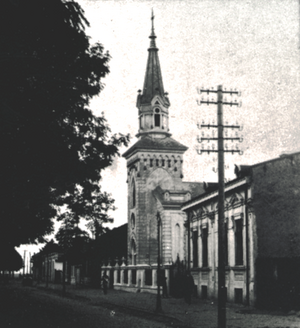
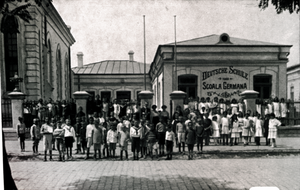
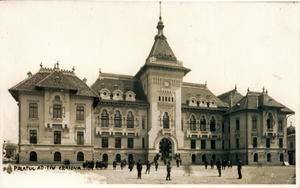
Despite the turmoil of war at the beginning of the 19th century, the increased interest shown by Prussia and the Habsburg Monarchy in the development of Moldavia and Wallachia – as evidenced by the dispatch of consuls in the late 18th century – led, amongst other things, to an increase in emigration of craftsmen and industrialists from Transylvania to Wallachia and Moldavia. Privileges ensured that the settlers were not subject to the tax or criminal jurisdiction of the Prince of Wallachia, and the exemption from taxation in particular may have been a reason for many German settlers to settle in the principalities’ towns and take up a trade. Emigration, particularly from Transylvania, must have become so widespread that the Transylvanian Governorate and the Transylvanian Court Chancellery felt compelled in 1796 to restrict the issue of passports. Immigrants from Prussia and other parts of Germany, Austria and Switzerland also settled in Bucharest under the protection of the Austrian and Prussian consulates there. Towards the end of the 18th century, German traders and craftsmen, together with Armenian, Jewish and Greek merchants, played a significant role in Bucharest’s economic boom.
In addition to Bucharest, a significant German population had also been recorded in Krajowa, the main town of Little Wallachia, since 1830. The Protestant congregation establishing itself there had joined the Prussian Regional Church in the mid-19th century, as had the congregation in Bucharest. Furthermore, in the 19th century, Protestant German communities could also be found in the following larger towns: Caracal, Corabia, Calafat, Verciorova, Gruia and Patulele in the south-west of Wallachia. German-speaking people settled in Turnu-Severin because of the shipyard there, which had been operated by the Austrian Danube Steamship Companies since the 1850s. In the foothills of the Southern Carpathians, there were other key towns with a German population: Piteşti (where a small Protestant congregation had existed since 1855), Tergowisch, Argisch, Langenau, Râmnicu Vâlcea and Târgu Jiu.
Overall, the conditions for German immigration in the 19th century were favourable. The effects of the Treaty of Adrianople in 1829 led to an economic and political upswing in Wallachia. The Reglement Organique was responsible for the latter. This provided foreigners with a certain guarantee for industrial and commercial investment. The revolutionary years of 1848–49 in the Habsburg Monarchy once again prompted numerous Transylvanian Saxons to flee, under Hungarian pressure, to the Danubian Principalities and, in particular, to Bucharest.
Following the election of Karl von Hohenzollern-Sigmaringen (1839–1914) as Prince of Wallachia in 1866, and also thanks to the efforts of his wife Elisabeth, née Princess von Wied (1843–1916), German culture and history in Wallachia experienced a golden age in the second half of the 19th century.
Bibliography
- Alexandru Ciocîltan: German Colonisation South of the Carpathians [Die Ansiedlung der Deutschen im Süden der Karpaten]. In *Revista Istorică* 2011, No. 5–6, pp. 431–460.
- Neagu Djuvara: Between East and West. The Romanian Lands at the Dawn of the Modern Era. Bucharest 1995.
- Gustav Gündisch: On the German Past of Câmpulung (Langenau). In: Ibid.: On the History and Culture of the Transylvanian Saxons. Selected Essays and Reports. Cologne et al. 1987 (Schriften zur Landeskunde Siebenbürgens 14).
- Hans Petri: On the Origins of the Town of Cîmpulung in Romania. In: Südostdeutsches Archiv 14 (1971), pp. 47–56.
- Hans-Christian Maner: German Traces in the History of Bucharest. Encounters and Influence between Openness and Isolation. Notes from Travel Accounts and Memoirs. In: Südostdeutsche Vierteljahresblätter 46/3 (1997), pp. 245–255.
- Daniel Ursprung: Wallachia as a historical region – a crossroads of European interconnections on the periphery. In: Thede Kahl, Michael Metzeltin, Mihai-Razvan Ungureanu (eds.): Romania. Territory and Population, History and Historical Narratives, Culture, Society and Politics Today, Economy, Law and Constitution, Historical Regions. Vienna 2006 (Österreichische Osthefte 48.2006, special issue), pp. 807–824. URL: www.daniel-ursprung.ch/pdf/walachei.pdf (accessed 11 January 2021).
- Ekkehard Völkl: Wallachia. In: Edgar Hösch, Karl Nehring, Holm Sundhaussen (eds.): Encyclopaedia of the History of South-Eastern Europe. Vienna et al. 2004, pp. 739–740.
Web links
- erasmusisha.wordpress.com/2002/01/01/identitatea-comunitatii-germane-din-campulung-muscel-in-secolele-xiii-xviii/ [The Identity of the German Community in Langenau in the 13th and 14th Centuries]
Notes
[1] See the reference in Alexandru Ciocîltan: ‘The Identity of the German Community in Câmpulung Muscel in the 13th–18th Centuries’. In: Erasmus 13/2002. URL: erasmusisha.wordpress.com/2002/01/01/identitatea-comunitatii-germane-din-campulung-muscel-in-secolele-xiii-xviii/ (accessed 11 January 2021).
[2] Franz Joseph Sulzer: History of Transalpine Dacia, that is, Wallachia, Moldavia and Bessarabia, in the context of the history of the rest of Dacia, conceived as an attempt at a general Dacian history with critical licence. Vol. 2. Vienna 1781, p. 112.
Citation
Hans-Christian Maner: Wallachia. In: Online Encyclopaedia on the Culture and History of Germans in Eastern Europe, 2013. URL: ome-lexikon.uni-oldenburg.de/54163.html (accessed 29 January 2021).
Terms of use for this article
Copyright © University of Oldenburg and the Federal Institute for the Culture and History of Germans in Eastern Europe (BKGE), all rights reserved. This work was produced as part of the project ‘Online Encyclopaedia on the Culture and History of Germans in Eastern Europe’ and may be reproduced and published provided the rights holders’ consent has been obtained. Please contact:
If you have any specialist comments or additions to the text, please contact the editorial team, citing relevant literature and source references.