

Oltenia/Little Wallachia
Oltenia/Little Wallachia
see also Wallachia
Location
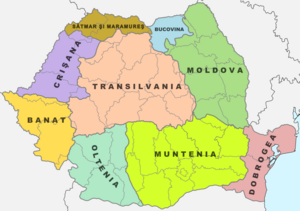
The Southern Carpathians form the northern border of Little Wallachia with Transylvania and its western border with the Banat. To the south, the Danube forms the border with Serbia and Bulgaria. The River Olt (Romanian: Olt) separates this region from Greater Wallachia (Muntenia). In the Middle Ages and the early modern period, the Olt could only be crossed at a few points. Furthermore, there were only three passable mountain passes at that time: the Iron Gate (Romanian: Porțile de Fier) along the Danube into the Banat, the Red Tower Pass (Romanian: Pasul Turnu Roşu) along the Olt to Transylvania, and the Jiul Pass (Romanian: Pasul Jiului) along the river of the same name, also to Transylvania. This made it relatively easy to defend the country and provided a favourable starting point for the formation of the medieval state.
Topography
Topographically, the region can be divided into three areas: firstly, the mountainous landscape to the north, comprising the Parâng and Retezat-Godeanu mountain ranges; secondly, the hilly landscape on both sides of the River Jiu, situated in the centre of Little Wallachia, comprising the ‘Getic’ and Mehedinți plateaus as well as the Severin Plain; thirdly – in the south of the region – the western parts of the Wallachian Plain (the Little Wallachian Plain; Romanian: Câmpia Olteniei).
National and regional affiliation
Romania. Little Wallachia, often referred to as Oltenia (= the land along the Olt), together with Muntenia (= the mountainous region), which is also known as ‘Greater Wallachia’, forms the historical region of Wallachia (Romanian: Ţara Românească).
There are currently five counties in Little Wallachia (Mehedinţi, Gorj, Dolj, Vâlcea and Olt), which also include territories in the Banat and in Muntenia. The most important town is Krajowa/Craiova.
(see also Wallachia)
Common symbolism
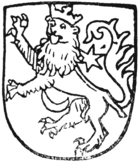
During the period of the Voivodeship of Litovoi – believed to have been founded by Slavs – the coat of arms of Little Wallachia consisted of horizontal gold and red stripes, a design not uncommon in the region. It was probably modelled on the coat of arms of the Hungarian ruling house of the Árpáds. Traditionally, the symbol of Oltenia is a lion wearing a crown. Currently, the Oltenian coat of arms depicts the lion without a crown standing on a bridge; this is thought to be the ancient bridge at Turnu Severin/Drobeta Turnu Severin, which was built by the architect Apollodorus of Damascus (c. 65–130) in 101–102 on the orders of Emperor Trajan (53–117).
Antiquity and the Middle Ages
Dacian tribes were mentioned in the region during the reigns of Kings Burebista (d. c. 44 BC) and Decebalus (d. 106); the remains of several Dacian fortresses (davae) have survived, particularly in the mountainous regions. In late antiquity, there was a marked Roman influence, evident through colonists and several Roman forts, such as the one at Turnu Severin (also known as the ‘Theodora’ fortress under Emperor Justinian [c. 482–565]). This influence persisted after the withdrawal of the Roman army and administration, as archaeological finds (coins, pottery) demonstrate. Between 450 and 550, Little Wallachia fell within the sphere of influence of the Gepids (Gepidia). The Slavic migration in the 7th century is likely to have altered the ethnic composition of the region, as it did elsewhere in the Balkans. There is evidence of punitive expeditions by Bulgarian forces north of the Danube against Slavic tribes. At times, the Bulgarian Empire was able to bring the region under its suzerainty.
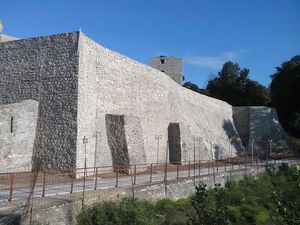
In the 13th century, mention was made of the political entity of Litovoi, a vassal of the Hungarian king. Severin Castle (Romanian: Cetatea Severin, Hungarian: Szörényvár) – situated in the area of the present-day town of Turnu Severin – was a Hungarian fortress and the centre of a border march; from 1228 at the latest, it served as the seat of the Severin Banat (Banatus Zewriniensis), with territories extending into what is now Mehedinți County and the mountainous region. The extent of the Severin Banat as far as the Alt River, and thus across the whole of Oltenia, is a matter of dispute.[1] The Order of St John was granted this area in 1247 as a border march for defensive purposes, which the Hungarian king had separated from the rest of the Wallachian territory. Another local prince or voivode, also named Litovoi, was mentioned in 1277 as an undisciplined vassal of the Hungarian Crown. He was defeated at that time by a Hungarian army under Magister Georgius and fell in battle, whereupon his brother Bărbat—who had been taken prisoner but released in return for a payment—assumed rule as a vassal of the Hungarian Crown. In 1406, the Hungarian King Sigismund of the House of Luxembourg (1368–1437) ceded the Severin Banat to the Wallachian voivode Mircea the Elder (1355–1418). Catholics from Severin (referred to as ‘Zürm’ in the Council sources) are mentioned in the context of the Council of Constance (1414–1418). For a short time, the castle and Banat of Severin were ceded to the German Order for the purpose of border defence under the Order’s knight Nikolaus von Redwitz (1428–1435), who was, however, driven out of Severin Fortress by the Ottomans in 1432. (see also Wallachia)
The region around Severin Fortress was the subject of constant conflict between the voivodes of (Little and later Great) Wallachia and the Hungarian Crown. Since the 14th century, the greater part of Oltenia had belonged to the domain of the Wallachian voivodes. They, in turn, were forced to recognise the suzerainty of the Ottoman Sultan in the early 15th century. When the Ottomans succeeded in permanently conquering Severin Fortress in 1524, they had it razed to the ground.
Habsburg rule
As a result of the so-called ‘Turkish War’ of 1716–18, the Voivode of Wallachia – and, by extension, his suzerain, the Sultan – was forced to cede Little Wallachia to the Habsburg Monarchy under the Treaty of Passarowitz. The Vienna court’s interest in the region, which was referred to as‘Valachia Cis-Alutana’ or‘Valachia Caesarea’, is documented in Prince Eugene of Savoy’s (1663–1736) plan for the organisational reorganisation of the region. The Habsburgs’ local contacts were the local aristocracy (large landowners, middle- and small-scale boyars) as well as some members of the free peasantry and the very small urban class (less than two per cent of the population). In order to prepare for a fiscal reform, data was collected on the size and structure of the population, which varied during the twenty-year period of administration: in 1720, 13,245 taxpayers were recorded; by 1722, the figure had risen to 25,192; in 1725 only 14,689, but in 1728 26,008, in 1731 the figure was 30,291 and in 1735 34,346. These sharp fluctuations were also due to the fact that serfs on boyar lands did not register, causing the number of taxpayers in Oltenia to fall accordingly. After 1726, the Ban of Krajowa was dismissed and the administration was placed directly under the Imperial Court, represented by a Praeses Administrationis. The district administrations (counties) were also increasingly brought under imperial control in the years after 1730 and staffed by Austrian officials. To prevent tax evasion, tax burdens per family were reorganised, the abolition of medieval corvée labour was pursued, and efforts were made to abolish serfdom. These reforms were gradually implemented, despite resistance from the boyars. Under the Treaty of Belgrade in 1739, the Habsburg Monarchy was forced to cede Little Wallachia once again to the Ottoman Empire, which reunited it with Great Wallachia.
German diaspora communities
In the 16th and 17th centuries, Transylvanian Saxons, amongst others, lived in Rimnik/Râmnicu Vâlcea; they maintained close ties with Hermannstadt/Sibiu, particularly in ecclesiastical and economic matters.
During the Habsburg period, the presence of a small number of Germans in the region is documented in connection with the military and administrative presence of the Imperial forces; examples include a number of German butchers in Krajowa who supplied the army, several civil servants, and Piarist monks (founded by Joseph/José von Calasanz [c. 1556–1648] as ‘Fratelli scolopi’), who ran a German-Latin school.
Following another Russo-Ottoman War (1828–1829) and the Treaty of Adrianople in 1829, Russia’s protectorate was effectively exercised in Little Wallachia until 1854, although the military occupation lasted only until 1834. At that time, craftsmen and labourers from German-speaking regions came to Tîrgu Jiu/Târgu-Jiu, Krajowa, Turnu Severin (from 1836), Rimnik, Calafat and Caracal. Traces of these German immigrants that are still visible today include the neo-Gothic Catholic and Protestant churches and cemeteries.
In the 19th century, businesses with exclusively or predominantly German capital were established in the service sector (pharmacies, printing works, mills and factories), enabling a small but stable urban community to develop. To provide support for the 14,529 people from Austria-Hungary and the 944 Germans from the German Empire (in 1899: together 1.3 per cent of the total population of Oltenia and 10.3 per cent of the urban population), Prussian and Austrian vice-consulates were established in Krajowa and Turnu-Severin.[2]
In the first half of the 20th century, despite the disruption caused by the First World War and some signs of assimilation, there was an active community life in the ecclesiastical and cultural spheres: choir and gymnastics clubs, predominantly German-speaking parishes, denominational private schools, church associations and church institutions of both denominations; these received continuous support from abroad (the Gustav-Adolf Association, the Reich Association for Catholic Germans Abroad, the School Brothers, the Deaconesses, the Steyler Fathers). In 1930, 3,442 members of the German ethnic group were recorded in Oltenia, with 3,216 people stating German as their mother tongue.[3]
In the penultimate census in October 2011, 234 people in Oltenia stated German as their mother tongue and 307 registered as German.[4] According to preliminary results from the most recent census in 2022 (reference date: 1 December 2021), 171 people registered as German in the districts that predominantly belong to Oltenia. There are active local branches of the Democratic Forum of Germans in Romania in Rimnik and Krajowa.
Church history
Missionary activity by the Franciscans and Dominicans is mentioned in the 14th century; a Catholic diocese with twelve Latin bishops existed between 1380 and 1502. Three medieval churches have been discovered within the present-day town limits of Turnu Severin; in terms of architectural style, they belong to the Western cultural sphere.
The Germans living in Rimnik became Evangelical Lutherans in 1550; their pastors, mentioned between 1574 and 1642, were appointed by the Transylvanian-Saxon superintendent. During the Habsburg period, Catholic Bulgarians – the so-called Pavliks – are also mentioned. The Romanians, who constituted and continue to constitute the overwhelming majority of the population, were Greek Orthodox. They were under the jurisdiction of their own Severin diocese, founded around 1370, which was later moved to Strehaia and Rimnik and re-established in Rimnik in 1503.
Bibliography
- Viorel Achim: The Significance of the German Order in the History of the Banat of Severin. In: Konrad Gündisch (ed.): Generalprobe Burzenland: New Research on the History of the German Order in Transylvania and the Banat. Cologne, Weimar, Vienna 2013, pp. 177–188.
- Constantin Dănescu: Şantierul Naval din Turnu Severin [The Shipyard in Turnu Severin]. Vol. 1: 1851–1950. Turnu Severin 2004.
- Julius Hering: Annals of the Roman Catholic Parish of Turnu Severin. In: Echo of the Lecture Series 12 (2006), pp. 22–32.
- Şerban Papacostea: Oltenia under Austrian Rule 1718–1739. Bucharest 1971, 2nd ed. 1998.
- Hans Petri: The First Two Decades of Protestant Parish Life in Krajowa. In: Hans Petri: Contributions to the History of Protestant Parishes in Old Romania. Vol. 2. In: Kirchliche Blätter (1931), pp. 85–96.
- Hans Petri: From Five Decades. History of the German Protestant Congregation of Turn-Severin 1861–1911. In: Evangelical Central Archive in Berlin (ZA 5091/107), reference number: EZA Bibl. 81/154. Reprinted in: Echo der Vortragsreihe 12/2007. Reschitza 2007.
- Adrian-Andrei Rusu: The Castles of Turnu-Severin in the 13th–14th Centuries. In: Budapest Régiségei 37 (2003), pp. 63–77.
- Christa Stache, Wolfram Theilemann: Protestants in Old Romania. Bonn, Sibiu 2012.
Notes
[1] See Rusu: The Castles of Turnu-Severin, pp. 63–64, and Achim: The Significance of the German Order, pp. 177–188.
[2] Leonida Colescu: Analiza rezultatelor recensământului general al populației României de la 1899 [Analysis of the 1899 General Census of the Population of Romania]. Central Institute of Statistics 1944, pp. 32, 96 and 100. The total population of Oltenia in 1899 was 1,181,243.
[3] Sabin Manuilă: The General Census of the Population of Romania of 29 December 1930. Volume II: Ethnicity, Mother Tongue, Religion [The General Census of the Population of Romania of 29 December 1930. Vol. 2: Ethnicity, Mother Tongue, Religion]. Published by the Central Institute of Statistics, Printed in the Official Gazette, National Printing House. Bucharest 1938, p. XXV. Data expressed as percentages: 0.2 per cent of the total population of Oltenia (1,746,347) is recorded as ethnically German, and 0.2 per cent state German as their mother tongue.
[4] 2011 Population and Housing Census [Recensământul populaţiei şi al locuinţelor 2011]: www.recensamantromania.ro/rezultate-2/ (accessed 1 September 2014).
Citation
Daniel Banner: Oltenia/Little Wallachia. In: Online Encyclopaedia on the Culture and History of Germans in Eastern Europe, 2014. URL: ome-lexikon.uni-oldenburg.de/p32597 (as at 9 March 2023).
Terms of use for this article
Copyright © University of Oldenburg and the Federal Institute for the Culture and History of Germans in Eastern Europe (BKGE), all rights reserved. This work was produced as part of the project ‘Online Encyclopaedia on the Culture and History of Germans in Eastern Europe’ and may be reproduced and published provided the rights holders’ consent has been obtained. Please contact:
If you have any specialist comments or additions to the text, please contact the editorial team, citing relevant literature and source references.