

Bucharest/Bucureşti
Bucharest/Bucureşti
Etymology
The Romanian name literally means ‘You are happy’ and is, according to folk etymology, associated with the legendary founding of the city by the shepherd Bucur. However, it can also – and this is probably the more accurate interpretation – be interpreted as a clan name (‘belonging to the Bucur clan’).[1]
Topography
Bucharest lies between the Carpathian Arc and the Danube in the Wallachian Plain (Romanian: Câmpia Română), south of the Vrancea region, one of the most seismically active regions in Europe. The city has been struck repeatedly by severe earthquakes, most recently in 1940 and 1977. To the north of the city lies a natural belt of lakes fed by the Dâmboviţa and Colentina rivers.
Political and administrative affiliation
The capital of Romania. Bucharest is the only municipality (municipiu) that constitutes its own administrative area within the country’s county system (județe); it is also the seat of the Patriarch of the Romanian Orthodox Church and of the Roman Catholic Archdiocese of Bucharest.
Common symbolism
The town coat of arms[2] depicts a golden crowned eagle (the crown of Mircea the Elder) on a blue shield, holding a sword and sceptre in its talons and a cross in its beak; below is a banner in the Romanian national colours bearing the motto ‘Patria şî dreptul meu’ (My homeland and my right); on the eagle’s breast is a red shield bearing the town’s patron saint, St Demetrius the New of Basarbovo (Sfântul Cuvios Dimitirie cel Nou Basarabov), with the attributes of a soldier-saint. The coat of arms is surmounted by seven battlements, with a black eagle holding a cross in its beak on the central one.
Pre-urban development
Palaeolithic and Neolithic (including the Gumelniţa culture) as well as Bronze Age (including the Tei culture) finds within the present-day city limits suggest early settlement.[3] Roman and Slavic finds are regarded as evidence of continuous settlement.[4] Its favourable location on east-west trade routes, between the mountain passes in the Carpathian Arc and the Danube in the south and the Black Sea in the east, had a lasting influence on the town’s development.
The Middle Ages and the Early Modern Period
The beginnings of urban development in the 15th century are linked to the establishment of the Principality of Wallachia. Alongside the first princely seats at Argisch/Curtea de Argeș and Tergowisch/Târgovişte, the settlement soon served as the seat of power (Cetate de scaun). Basarab I (Negru Vodă) is said to have commissioned the construction of a fortification on the Dâmboviţa in the 14th century. Evidence of building activity at the old princely court (Curtea veche) can already be found during the reign of Vlad III Drăculea (the ‘Impaler’); a document signed by him in 1459 contains the first mention of the town as Grad (= castle) Bucureşti. Over the following 250 years, the town’s importance grew, and under Constantin Brâncoveanu (d. 1714) it finally established itself as the princely seat. Conflicts with the Ottomans and domestic political turmoil led to repeated destruction of the town and a change in the princely seat (to Tergowisch/Târgovişte).
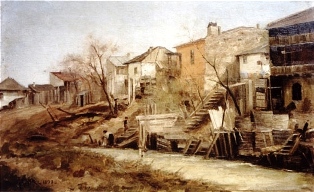
Ioan Alexandru Paraschivescu (1855–1901):‘
’ Mahalaud Dracului [Wikimedia Commons].

By then, an unfortified settlement of an urban character had developed around the medieval castle, which gradually incorporated surrounding villages as ‘mahala’ (suburbs), particularly after its elevation to the status of capital, especially under Constantin Brâncoveanu. During the Phanariot period, numerous bridges were built across the Dâmbovița, where watermills also characterised the landscape. The mahalas consisted of single-storey wooden buildings grouped irregularly around the churches, whilst the more substantial boyar houses with gardens dominated the townscape. Another defining feature was the inns for travelling merchants (Romanian: han).
19th century
Following the end of Phanariot rule (see Romania), Ottoman influence waned noticeably. Between 1789 and 1791, Bucharest was occupied by Austrian troops under Friedrich Josias of Saxe-Coburg-Saalfeld, and between 1807 and 1812 by Russian troops during the Russo-Turkish War. Around 1800, the city was ravaged by earthquakes and waves of the plague.
During the transition to the sovereign state of Romania, the Ottoman suppression of the uprising led by Tudor Vladimirescu in 1821 is significant in the city’s history; furthermore, the ‘Organic Regulations’ (the first constitutional-style body of law in Romania) under Russian protection (following the Russo-Ottoman War of 1828–29).
Amidst the signs of the Ottoman Empire’s disintegration, the Wallachian Revolution of 1848 spread from Bucharest; it was led in Bucharest by Nicolae Bălcescu (1819–1852), Gheorghe Magheru (1802–1880), Ion Brătianu (1821–1891) and others. At Russia’s request, the uprising was brought to an end by an intervention of Ottoman troops in September 1848. The period of occupation continued: during the Crimean War of 1853–1856, Bucharest was occupied in turn by Russian, Ottoman and Austrian troops. In 1861, the city became the capital of the united Principality of Romania, formed from the Danubian principalities of Moldavia and Wallachia under Alexandru Ioan Cuza (1820–1873). Following domestic political turmoil, Karl Eitel Friedrich von Hohenzollern-Sigmaringen (1839–1914) became Prince Carol I of the young state in 1866; the country finally gained independence from the Ottoman Empire in 1878 and became a kingdom in 1888. Under Carol I, reforms and modernisation efforts ushered in a golden age for the steadily growing city of Bucharest. Industrialisation progressed rapidly right up to the First World War, a process in which numerous German figures also played a part (see below).
The 20th century and the present day
Bulgaria’s expansionist ambitions were curbed following the Second Balkan War by the Treaty of Bucharest (1913). After initially remaining neutral, Romania entered the First World War on the side of the Entente in 1916; as a result, Bucharest was occupied by the Central Powers from December 1916 to November 1918, and the Romanian government was relocated to Iași.
The substantial territorial gains made by Romania after the First World War under the Treaty of Trianon (1920) also marked a period of prosperity for the capital of what was now a self-assured nation state. Culturally and politically, the shift towards Western Europe that had begun in the 19th century intensified.
When Romania entered the Second World War on the side of the German Reich on 23 November 1940, German troops were stationed in Bucharest and the surrounding area, amongst other places, to protect important oil fields. After the country switched sides to the Allies on 23 August 1944 following a coup d’état, Bucharest was successively bombed by Soviet, American and, finally, German forces. On 31 August 1944, the Red Army marched into the city.

View from the Intercontinental Hotel onto University Square
(Piaţa 21 decembrie 1989) [Photo: © T. Schares].
As the capital of the Socialist Republic of Romania (1948–1989), Bucharest doubled its population and tripled its area within 40 years. The centralism of the Kingdom era continued, meaning that Bucharest remained the country’s political, economic and cultural centre even during the communist era. An architectural symbol of this period is the Casa Scînteii (now the ‘House of the Free Press’ – Casa presei libere), which was built in the Socialist Realist style, modelled on Moscow’s Lomonosov University, and housed the country’s press publishers and agencies.
Bucharest was the main theatre of the revolutionary events of 1989, which led to the overthrow of Nicolae Ceauşescu (1918–1989), and was the second city, after Timişoara, where the protests flared up. The establishment of the Democratic Republic of Romania brought an economic boom to the old and new capital, but also specific signs of social upheaval (stray dogs and street children, derelict sites in the city centre, unfinished buildings, ageing infrastructure and an inefficient administrative system).
Administration
The city is divided into six sectors, each with its own administration and mayor’s office; in addition, the city has a mayor (Primarul general al municipiului).
Population and Religion
As a trading centre, Bucharest traditionally had an international character and, until the outbreak of the Second World War, had its own Armenian, Greek, Jewish and Turkish quarters, as well as smaller German and various Slavic quarters, amongst others, and corresponding religious communities. This character was suppressed during the communist era and is most clearly evident today in the surviving places of worship belonging to the various communities: the Armenian Church, the Lutheran Church, the Roman Catholic Archdiocesan Church, the Italian Catholic Church, the Greek Church, several synagogues, and so on.
Today, most Romanians in Bucharest belong to the Romanian Orthodox Church; alongside this, there are small Greek Catholic, Roman Catholic and Evangelical Reformed communities, as well as a small number of Jews and Muslims.
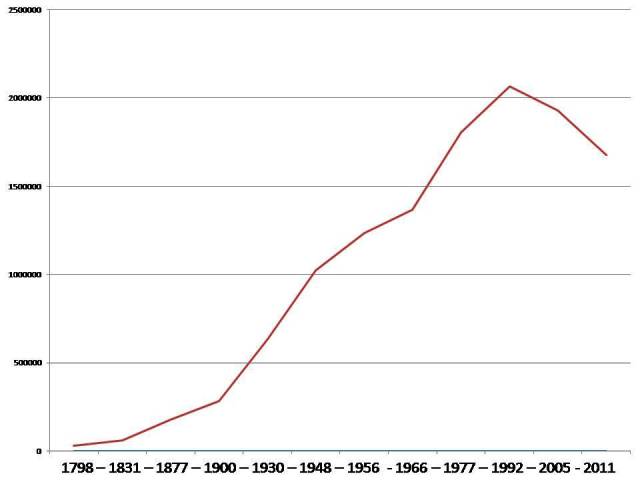
Following the city’s rapid growth in the 19th and 20th centuries, the population has been declining for some time; it peaked in the early 1990s at over two million inhabitants, compared with the current (2011) figure of 1.68 million (see fig.). According to the 2011 census [Recensământ], over 96 per cent of Bucharest’s population are Romanian; fewer than four per cent identify as belonging to another ethnic group.[5]
Population structure of Bucharest according to the 2011 census (top row; below, for comparison, 2002).
Total | Romanian | Roma | Hungarian | German | Ukrainian | Turkish | Tatar | Russian | Other | not specified |
1,677,985 | 1,646,230 | 3,525 | 3,012 | 922 | 199 | 2,147 | 272 | 774 | 10,272 | 10,632 |
1,926,334 | 1,869,069 | 27,322 | 5,834 | 2,358 | 425 | 2,473 | 363 | 1,141 | 14,953 | 545 |
Art and Architectural History
Buildings from every historical period of the city have survived. A defining feature is the coexistence of Oriental and Occidental elements, which are artfully blended in the Brâncoveanu style (e.g. Mogoşoaia Palace in the north of the city, and the Kreţulescu Church). Another characteristic feature is the boulevards linked by squares (such as those converging in a star-shaped pattern at the Triumphal Arch Square), between which lie labyrinthine neighbourhoods and (former) suburbs with winding Oriental alleyways. Architecturally, alongside this fusion of styles—unique in the Balkans—one finds every Western-influenced architectural style developed since the 19th century, ranging from Classicism through Art Nouveau, the Bauhaus and Socialist Realism to Postmodernism. Cultural landmarks such as the National Theatre (1852), the Athénée (1888), the main university building (1869) and the central university library (1895), amongst others, date from the second half of the 19th century. In the city centre, a Francophile architectural style (which earned the city the nickname ‘Little Paris’ – Micul Paris) and international modernism have taken hold; exemplified by the Triumphal Arch and the Telephone Palace (Palatul Telefoanelor) in the Art Deco style.
One of the greatest turning points in the city’s recent history was the earthquake of 4 March 1977, the extensive destruction caused by which was used by the Communist Party leader and head of state, Ceauşescu, as a pretext for a radical restructuring of the city centre in the style of Socialist Realism, resulting in the loss of around one-fifth of the old town’s area. At the heart of the redevelopment lies the monstrous ‘Boulevard of the Victory of Socialism’ (now Bulevardul Unirii), an east-west axis featuring the no less megalomaniacal ‘Palace of the People’ (now the Palace of Parliament, Romanian: Palatul Parlamentului). Even before this, socialism had left its mark on the cityscape in the form of blocks of flats and the “House of the Free Press” (Casă presei libere), built in the 1950s and modelled on Moscow’s Lomonosov University.
A point of criticism today is the lack of a structural development plan for Bucharest, even 20 years after the fall of communism.
Transport, Economy

Bucharest (woodcut: 1717) [Wikimedia Commons].
Towards the end of the 18th century, sewerage works and the construction of a water main were carried out, whilst the manufacturing industry also flourished.
The motorways completed to date in Romania link Bucharest with Piteşti in the north-west and with Constanţa in the east. Romania’s largest railway station, Gara de Nord (which connected the city to the railway line in 1869), and the Băneasa and Otopeni airports to the north make the city a national and international transport hub. Bucharest is the country’s economic centre, with numerous service providers and banks having their headquarters here. A large proportion of media companies are based in the capital, as are the Bucharest Stock Exchange and the large Romexpo exhibition centre. The metalworking and mechanical engineering industries play a significant role for the city and the surrounding county (județ) of Ilfov.
Education
Bucharest has eight state universities: The University of Bucharest (UB), the Polytechnic University (Politehnica), the University of Civil Engineering (UTCB), the University of Agriculture and Veterinary Medicine, the University of Medicine and Pharmacy, the University of Architecture and Urban Planning, the Academy of Economic Studies (ASE), and the College of Political Science and Public Administration. In addition, there are colleges of art and design, music and film, as well as police and military academies; in recent years, some of the numerous private universities have been the subject of scandals (‘degree mills’). The capital is also home to the headquarters of the Romanian Academy and the National Library.
Bibliography
As the capital, Bucharest is also the country’s cultural and media centre. Most of Romania’s major publishing houses are based here. Even after the fall of communism, the legendary Bucharest-based Kriterion publishing house remained the most important publisher of German-language literature (and other minority literatures) in Romania. Some of Romania’s most important writers came from, or still come from, Bucharest, for example Tudor Arghezi (1880–1967), Mircea Eliade (1907–1986) and Mircea Cărtărescu (who immortalised the city in his novel trilogy *Orbitor* ). The German-speaking authors Paul Celan (1920–1970) and Alfred Margul-Sperber (1898–1967) had close ties to Bucharest; Oscar Walter Cisek (1897–1966) was born in Bucharest.
Germans in Bucharest
The fact that Germans had been settled in Bucharest since the late Middle Ages is evidenced in the former merchants’ quarter of the Old Town by the names of Leipziger Straße (Str. Lipscani) and the neighbouring Str. Smârdan, which was formerly known as Deutsche Straße (Uliţa Nemţească). In the 19th century, under Carol I, a large number of Germans shaped the cultural life (notably through their journalistic activities[6]) and economic life of the city. The Storck family of sculptors were active in the city, as was the royal court sculptor, Emil Wilhelm Becker, who, amongst other works, created the significant monument to the Unknown Soldier in Carol Park. The brewer Erhard Luther founded the Griviţa Brewery in 1869, which still exists today.[7] In 1930, Bucharest had over 14,000 German residents.[8]
The small group of ‘Altreich’ (or ‘Regats’) Germans living in Bucharest today is a very ageing population; they are primarily members and descendants of the German-speaking minority in Romania who came to the capital during the communist era because of their work in industry and the service sector, and above all in the cultural sphere (Kriterion-Verlag, the daily newspaper *Neuer Weg*, which is still published today as the *Allgemeine Deutsche Zeitung für Rumänien*).[9] They are organised within the local branch of the ‘Democratic Forum of Germans in Romania’ (Forumul de centru Bucureşti). In addition to the state-run Goethe College (Colegiul German Goethe), there are a number of German-language educational and training institutions.
Culture of memory and remembrance
Street and square names commemorate significant events in national history (the Union of the Principalities, the Unification of Greater Romania, the 1989 Revolution), either by being named after these events themselves (Piaţa Unirii = ‘Union Square’, Piaţa Revoluţiei, Calea Victoriei, etc.) or by being named after historical figures.[10]
The era of the Kingdom, and in particular that of the ‘German’ King Carol I, is romanticised in the public consciousness – in publications, films and elsewhere – as a ‘golden age’.
By contrast, the process of coming to terms with the injustices of the 20th century and problematic events in recent history is proceeding slowly and plays a minor role in public life and consciousness. The pogrom against Jews (1941), the deportation of thousands of Jews and Roma to Transnistria, and the crimes of the communist regime find little expression in the culture of remembrance. Since 2009, there has been a Holocaust memorial created by the Ploieşti-born sculptor Peter Jacobi.
Bibliography
- Axel Barner (ed.): City Guide to Bucharest. Bucharest 1995.
- Constantin C. Giurescu: Istoria Bucureştilor [History of Bucharest]. 3rd ed. Bucharest 2009.
- Birgitta Gabriela Hannover: Bucharest. The Romanian Capital and its Surroundings. Berlin 2008.
- Nicolae Iorga: Istoria Bucureştilor [History of Bucharest]. Bucharest 2008 (reprint of the original edition, Bucharest 1939).
- Paul Jeute: Bucharest. Historical Context and the Influence of the Prevailing Mission Statement on Urban Development. Munich 2011.
- Hans Liebhardt: Germans in Bucharest. Two or three centuries of lived history. Bucharest 2003.
- Hans Liebhardt: In Bucharest and Old Romania. German Traces, Still and Still. Bucharest 2006.
- Hans-Christian Maner: German Traces in the History of Bucharest. Encounters and Influence between Openness and Isolation. Notes from Travel Accounts and Memoirs. In: Südostdeutsche Vierteljahresblätter 46/3 (1997), pp. 245–255.
- Hans Petri: History of the Protestant Congregation in Bucharest. Leipzig 1939 (Contributions to the Understanding of German Culture in Romania 2).
- Christa Stache, Wolfram G. Theilemann (eds.): Protestantism in Old Romania. Research and Sources on the History of German-speaking Protestant Parishes in the Romanian Regat. Sibiu, Bonn 2012 (Publications of the Protestant Central Archive in Berlin 9; Miscellanea ecclesiastica 9).
- Joachim Vossen: Bucharest. The Development of the Urban Area from its Beginnings to the Present Day. Berlin 2004.
Web links
- www.pmb.ro/ (the Mayor’s website)
- muzeulbucurestiului.ro/ (website of the Museum of the City ofBucharest/Muzeul Municipului Bucureşti)
Notes
[1] The descendants of Prince Vlad Dracul, for example, were given the family name ‘Drăculești’.
[2] By Decision No. 76 of 26 July 1993 of the Mayor (Primăria generală a Capitalei), it replaced the socialist coat of arms; the design draws on the first coat of arms from the 19th century.
[3] Illustration of artefacts in Giurescu: Istoria, p. 841 (plate 1).
[4] A Roman castrum is presumed to have existed, though this has not yet been proven.
[5] The figures given here are based on the preliminary final results (rezultate preliminare) of the 2011 census conducted by the National Institute of Statistics (Institutul național de statistică); see www.recensamantromania.ro/rezultate-2/ (accessed 22 April 2013). At least as regards the number of Roma living in Bucharest, the results of the 2011 census must be viewed with caution (cf. 2002); the figures are based on self-reported mother tongue; in my view, the inaccuracy of the census methodology and its implementation became public knowledge shortly after its completion; see Allgemeine Zeitung für Rumänien, 2 November 2011, www.adz.ro/artikel/artikel/volkszaehlung-verlief-mit-geringer-praezision/ (accessed 22 April 2013).
[6] See Horst Fassel: ‘The Cultural Identity of the Germans in Bucharest’. In: Banatica. Contributions to German Culture 4/1996, special issue ‘Nation or Ethnic Groups? Paths and Missteps’, pp. 82–98, here p. 84.
[7] See the individual analyses in Liebhardt: German and Liebhardt: In Bukarest.
[8] 1930 census: Central Institute of Statistics: General Census of the Population of Romania of 29 December 1930. Bucharest: Official Gazette 1930.
[9] Cf. Angelika Herta, Martin Jung (eds.): From the Periphery to the Centre. The German Minority in Bucharest. Berlin 2011, pp. 8ff.
[10] Over the past 100 years, the square now known as Piaţa Charles de Gaulle has, for example, been successively named: Pta. M. Eminescu, Pta. Adolf Hitler, Pta. Generalisimul I. V. Stalin and Pta. Aviatorilor. The following example illustrates how regime changes lead to extensive renaming campaigns, which can also be confusing for residents: A metro station at the junction of Calea Griviţei and Bd. Ion Mihalache is named 1 May because Bd. Ion Mihalache used to be called Bd. 1 May; however, a major road in another part of the city now bears that name.
Citation
Thomas Schares: Bucharest/Bucureşti. In: Online Encyclopaedia on the Culture and History of Germans in Eastern Europe, 2013. URL: ome-lexikon.uni-oldenburg.de/54190.html (as at 12 January 2021).
Terms of use for this article
Copyright © University of Oldenburg and the Federal Institute for the Culture and History of Germans in Eastern Europe (BKGE), all rights reserved. This work was produced as part of the project ‘Online Encyclopaedia on the Culture and History of Germans in Eastern Europe’ and may be reproduced and published provided the rights holders’ consent has been obtained. Please contact:
If you have any specialist comments or additions to the text, please contact the editorial team, citing relevant literature and source references.