

Königsberg/Kaliningrad
Königsberg/Kaliningrad
Etymology
The city of Königsberg was named in honour of the Bohemian King Ottokar II of the Přemyslid dynasty (c. 1332–1278). Following the death of the long-serving (1922–1946) Chairman of the Presidential Board of the Supreme Soviet of the USSR, Mikhail Ivanovich Kalinin (1875–1946), it was renamed Kaliningrad (literally ‘Kalinin City’) in 1946.
Location
Kaliningrad (54° 44′ North, 20° 29′ East) is the westernmost major city in the Russian Federation and lies on the River Pregel (Russian: Pregolja), which flows through it in two branches, not far from its mouth at the Vistula Lagoon (Kaliningradskij zaliv). To the north and west, the city borders the Samland Peninsula (Kaliningradskij poluostrov [ literally: Kaliningrad Peninsula]) on the Baltic Sea, and to the east and south, the Pregel Lowlands.
Political and administrative affiliation
Kaliningrad is part of the Kaliningrad Oblast (Kaliningradskaya oblast’), the North-West Federal District (Severo-zapadny federalny okrug) and an exclave of the Russian Federation. It is divided into three urban districts (raions): Leningrad, Moscow and Central Raion.
Common symbolism
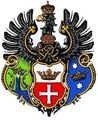
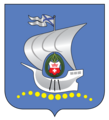
The coat of arms of Kaliningrad depicts, on a blue background, a stylised cog with a billowing sail, bearing the Russian naval ensign and the Old Town’s coat of arms on the mast.
The historic coat of arms of Königsberg is a tripartite composite coat of arms and depicts the three coats of arms of the formerly independent towns of Altstadt, Löbenicht and Kneiphof, surmounted by the crowned Prussian eagle bearing the initials FWR (Friedrich Wilhelm Rex, for King Frederick William I [1688–1740]).
Archaeological significance
Evidence of settlement in what would later become the town’s area dates back to the Neolithic period, as demonstrated by finds associated with the Comb Ceramic culture. Archaeological evidence has confirmed the existence of a Prussian refuge fortress, an anchorage and a fishing village.
The Era of the Teutonic Order (1255–1525)
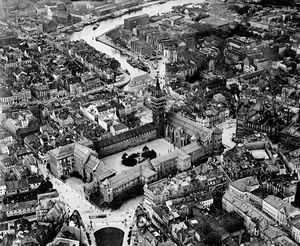
Lübeck’s efforts to establish a subsidiary town on the Pregel River did not come to fruition. Königsberg was founded by the German Order, as the ruling power, which built a castle on Twangste Hill in 1255 during a missionary campaign against the Prussians; the castle was dedicated to the crusader and King of Bohemia, Ottokar II Přemysl, who had taken part in the campaign. A settlement situated outside the town, bearing the Prussian name Twangste, was destroyed during the Prussian uprising of 1262. Following the peace treaty with the Prussians and the influx of settlers, mainly from Low German regions, three towns were founded under the Kulm Charter: Königsberg’s Old Town (1286), Löbenicht (1300) and Kneiphof (1327). This meant full self-government by a mayor, a council and a lay court. Guilds and trades began to form. Each town had its own parish church and a market. The Old Town, situated between the castle and the Pregel, was the largest and most powerful settlement; Löbenicht, adjoining it to the east, was a town of craftsmen and farmers, whilst Kneiphof, situated on the Pregel Island, was characterised by long-distance merchants. Both the Old Town and Kneiphof had hospitals. The castle’s domain included the old Prussian villages of Tragheim and Sackheim, Roßgarten and Neue Sorge, as well as the castle’s free territory. The Old Town comprised Lomse, Steindamm, Laak, Roßgarten and the Hufen – Königsberg’s only urban village – whilst the Kneiphof comprised the front and rear suburbs and Haberberg.
Kneiphof was the seat of the Samland Cathedral Chapter, which was incorporated into the German Order; this incorporation did not entail the loss of secular sovereign rights (the bishop’s seat was Fischhausen/Primorsk). In accordance with the papal bull of circumscription of 1243, which formed the legal basis for the bishoprics within the territory of the German Order, the territory of the bishoprics was divided in 1254 in a ratio of 2 to 1 between the German Order and the respective bishop, with the bishops receiving one third as a secular domain; of the episcopal portion, the chapter received one third.
Königsberg Castle, which gave its name to the German Order’s commandery, had been the seat of the Supreme Marshal of the German Order since 1311; from 1330, he also served as Commander of Königsberg. Between 1330 and 1380, the Gothic cathedral was built in the Kneiphof; it also served as the town’s parish church. In Löbenicht, the German Order, under Grand Master Heinrich Dusemer (c. 1280–1353), founded a nunnery following the Benedictine Rule in 1349.
The city was the starting point for the so-called ‘Litauerreisen’ (military campaigns by European nobles alongside the German Order, which were regarded as crusades), which brought prominent members of the high nobility to Königsberg until the end of the 14th century. The Königsberg convent was, after Marienburg/Malbork, the largest in Prussia.
During the conflict between the Prussian estates and the German Order in the mid-15th century, in which the three towns took varying stances, Kneiphof in particular ultimately opposed the sovereign and was defeated by Altstadt and Löbenicht with the support of the German Order. In 1456, the three towns of Königsberg once again pledged their allegiance to the sovereignty of the German Order, after the Order had defeated Poland at the Battle of Konitz/Chojnice (1454). Following the Thirteen Years’ War (1454–1466), the Order was forced to cede the western part of Prussia to Poland–Lithuania under the Second Peace of Thorn/Toruń (1466). With the loss of Marienburg in 1457, Königsberg Castle became the seat of the Grand Master of the German Order.
The Reformation and the Ducal Period (1525–1701)
During the term of office of Grand Master Friedrich of Saxony (1473–1510), the secularisation of the Order’s remaining territories began in 1498. The last Grand Master in Prussia, Albrecht of Brandenburg-Ansbach (1490–1568), elected in 1511, led the country towards the Reformation from 1523 onwards. Albrecht had maintained a lavish court in Königsberg and, in a manner unbecoming of a clerical lord, organised tournaments; his ill-fated cavalry campaign (1519–1521) against Poland–Lithuania had ruined the finances of the Order’s territories and Königsberg. The Grand Master laid down his Order’s mantle in 1525 and became a Polish vassal. Under the Treaty of Kraków (8 April 1525), the former Order’s territory became, in terms of constitutional law, a hereditary duchy of Albrecht under Polish suzerainty.
The 16th century was a period of prosperity in Königsberg (the establishment of the stock exchange towards the end of the 16th century, the expansion of trade), which was reflected in particular in a flourishing festival culture, brisk building activity in the city and the conversion of the Teutonic Order’s castle into a princely palace. The economic boom can be attributed, amongst other things, to the fact that the city was spared the ravages of the Thirty Years’ War; furthermore, the Albertus University (Albertina), founded in 1544, grew and came to play a major role in the city’s life.
However, religious conflicts and the plague years of 1620, 1629, 1639 and 1653, which claimed many lives, also shaped life in Königsberg. In the years 1626–1627, a rampart fortification was built around the city; the completion of which by 1634 – a joint endeavour of all three towns – fortified the whole of Königsberg. During the Swedish War (1630–1635), Königsberg attempted in vain to gain independence from Brandenburg-Prussia.
Prussia remained a Polish fief until the Great Elector Frederick William (1620–1688) secured full sovereignty in the Treaties of Labiau/Polessk (1656), Wehlau/Snamensk and Bromberg/Bydgoszcz (1657) as well as Oliva/Oliwa (1660), and this was done entirely against the will of the people of Königsberg. The establishment of an absolutist Prussian rule, in opposition to the remnants of medieval municipal autonomy, was achieved at the latest when the Elector violently suppressed the so-called Königsberg Uprising (1656–1663) led by Hieronymus Roth (1606–1678). The Elector won public favour when he repelled the Swedish invasion in 1678/1679. From 1663 onwards, the influence of the city administration declined significantly in favour of that of the sovereign: the provincial authorities were concentrated in the palace, and the sovereign’s rule increasingly interfered with the city and its flourishing trade.
Modernisation during the royal era (1701–1918)
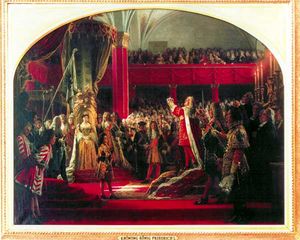
On 18 January 1701, Frederick III (1657–1713) was crowned King Frederick I of Prussia in the Königsberg Castle Church and established the Order of the Black Eagle in the Prussian coronation city. Following the coronation, Königsberg was gradually modernised: pumps replaced wells, roads were widened and drainage was systematised.
Between 1708 and 1710, Eastern Prussia suffered heavy population losses due to the plague, which also hit Königsberg hard. The reconstruction of the region and the redevelopment of the city took place from 1714 onwards under Frederick William I, aided in part by exiles from Salzburg, although only a small number of them came to Königsberg. Königsberg, which had been home to a garrison since 1655, increasingly developed into a Baroque-style garrison town with barracks, wide streets and street lighting (1731).
On 13 June 1724, the three towns of Altstadt, Löbenicht and Kneiphof were united to form the city of Königsberg. The town hall in Kneiphof became the seat of the magistrate, which had been reformed by the King through the War and Domains Chamber (from 1723). From then on, there was one chief mayor and two other mayors, with the King reserving the right to appoint a lord mayor to exercise oversight. Under this streamlined administration, there was scarcely any scope left for citizen participation. The introduction of mercantilist economic policies (fully established by around 1750) led to the emergence of manufactories (often producing textiles), which were primarily run by English, French and Jewish merchants.
During the reign of Frederick II (the Great; 1712–1786), from 1740 onwards, the economy in Königsberg flourished. During Frederick II’s wars (1740–1745; 1756–1763), Königsberg repeatedly became a theatre of war; it was occupied by Russian troops from 1758 to 1761 and was forced to pay heavy contributions, though this ultimately did not hinder the city’s economic upswing. In 1764, Königsberg (particularly Löbenicht and Sackheim) was ravaged by severe fires.
The First Partition of Poland (1772) led to the creation of the provinces of East and West Prussia, which were governed from Berlin. Königsberg became the capital of East Prussia.
Prussia’s defeat at the hands of Napoleon and the Prussian reforms
After Prussia had been defeated by Napoleon in the Coalition Wars, Marshal Nicolas Jean-de-Dieu Soult (1789–1851) entered Königsberg on 16 June 1806, followed by Napoleon Bonaparte (1769–1821). The occupation ended after 39 days, during which Königsberg was considerably weakened by contributions and the Continental Blockade. From 1808 to 1809, the royal family lived in Königsberg. The city became the centre of the Prussian Reforms, which fundamentally modernised the defeated state in terms of society and administration. The royal reform commissions worked in the palace. The Prussian Municipal Code of 1808 abolished class distinctions, granted the right to vote to all male citizens on the basis of a property qualification, and separated the legislative and executive branches.
In 1811, a severe fire ravaged the city. The damage, amounting to 13 million talers, was barely covered by the fire insurance. In 1812, the emancipation of the Jews was enshrined in law. In the same year, the French once again levied substantial contributions for the Russian campaign. When, in 1813, King Frederick William III (1770–1840) called upon the citizens of Prussia to fight against Napoleon Bonaparte in his ‘Appeal to My People’ in Breslau/Wrocław, Governor-General Ludwig Yorck von Wartenburg (1759–1830) called for the mobilisation of the Landwehr at the House of the East Prussian Provincial Assembly in Königsberg, thereby contributing to the organised struggle for liberation against Napoleon.
During the Vormärz period, Königsberg was a hotbed of political liberalism. The Provincial Assembly’s demand of 5 September 1840 for a general provincial representation fell on deaf ears with King Frederick William IV (1795–1861) – and so unrest continued to simmer in Königsberg at gatherings where speeches were delivered. The leading figures were Jakob Friedrich Alexander Jung (1799–1884), Johann Jacoby (1805–1877), Ferdinand Falkson (1820–1900) and Ferdinand Gregorovius (1821–1891). In 1848, a peaceful revolution took place in Prussia in favour of democracy and a constitution. Eduard von Simson (1810–1899) was elected to the German National Assembly, whilst Theodor von Schön (1773–1856) and Raphael Kosch (1803–1872) were elected to the Prussian National Assembly. The revolution resulted in a constitutional monarchy. The revolution was followed by an era of reaction; the surveillance of politically liberal figures and the efforts to ward off further revolutionary tendencies characterised city life, leading to political stagnation.
Modernisation of the city’s infrastructure in the second half of the 19th century
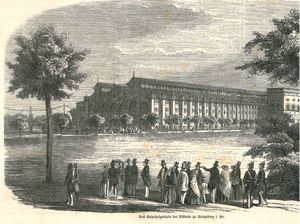
The 1850s to the 1870s were characterised by the modernisation of Königsberg’s infrastructure, alongside political stability and perseverance. Between 1843 and 1864, the fortifications were renovated. In November 1852, Königsberg was provided with gas lighting (coal gasification). The railway station was inaugurated in 1853, and a telegraphic link to Berlin had been in place since 1854. With the completion of the Prussian Eastern Railway in 1860 – which terminated at Eydtkuhnen/Černyševskoe and linked the city and East Prussia with Berlin – Königsberg, which had been the intellectual centre of Prussia for centuries, was fully integrated into the Prussian state by Berlin. Königsberg became a transport hub in north-eastern Europe. The garrison was expanded following the founding of the German Empire (1871). In 1872, orders were given to construct a ring fortification comprising forts and fortifications, which was completed by 1884.
To some extent, Königsberg was a civil service town, partly due to its status as the seat of the Oberpräsidium. From 1829, the two provinces of East and West Prussia were united as the Province of Prussia, with Königsberg as its capital. Following the province’s renewed division in 1878, the city once again became solely the provincial capital of East Prussia and the capital of the Königsberg administrative district.
The First World War (1914–1918) and the Weimar period (1919–1933)
Königsberg and East Prussia, situated in a vulnerable position vis-à-vis Russia, were already under threat at the outbreak of the World War, when the Tsarist army invaded the eastern province; however, it was decisively defeated at the Battle of Tannenberg (1914). Like other German cities, the city suffered from shortages of food and raw materials when the Revolution triumphed without bloodshed in 1918. Power was taken over by the People’s Navy Division, but it was lost again to the Reichswehr as early as 4 March 1919. As a result of the provisions of the Treaty of Versailles (1919), which granted Poland access to the sea via Pomerellia (the so-called ‘Polish Corridor’), East Prussia was cut off from the German Empire, a situation which further exacerbated the already severe economic problems of the predominantly agrarian region – despite not inconsiderable assistance from the Reich. The new mayor, Hans Lohmeyer (1881–1968), shaped the town’s political history during his term of office from 1919 to 1933; his deputy from 1920 onwards was Carl Goerdeler (1884–1945), who later played a key role in the assassination attempt on Adolf Hitler on 20 July 1944. The dismantling of the fortress gave rise to Königsberg’s extensive green belt.
The Nazi era (1933–1945) and the Second World War
During the Nazi era, Königsberg was the seat of the Gau leadership for East Prussia under Gauleiter Erich Koch (1896–1984), who later served as Reich Commissioner in Ukraine and was convicted as a war criminal. The city’s leadership was filled with members of the NSDAP, whilst political opponents were removed. Lord Mayor Lohmeyer was initially suspended and then retired; he was succeeded by Hellmuth Will (1900–1982), who remained in office until 1945. In 1934, 1938 and 1939, the city was significantly enlarged through the incorporation of neighbouring areas.
Following the ‘seizure of power’, the town experienced anti-Semitic terror and denunciations directed against the approximately 3,500 Jews, whose numbers had more than halved by 1939. During the so-called ‘Reichskristallnacht’, the Old and New Synagogues were destroyed by fire. On 24 June 1942, the first deportation of 465 Jews from Königsberg took place; they were transported to the Maly Trostenez extermination camp near Minsk, where they were murdered.
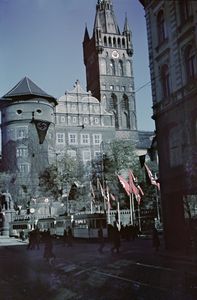
For a long time, Königsberg’s location in the north-east of the Reich initially protected it from Allied air raids. In August 1944, British bomber formations carried out massive air raids which almost completely destroyed the city centre. Around 200,000 citizens were left homeless. At the end of January 1945, Königsberg – already surrounded by the Soviet Army – was declared a fortress and the civilian population was forbidden to flee. On 9 April 1945, the Wehrmacht under General Otto Lasch (1893–1971) surrendered in Königsberg, where 110,000 civilians were still present. The period of fighting and the subsequent Russian occupation were marked by acts of violence, rape, deportations and war crimes committed against the civilian population by members of the Red Army.
In June 1945, a Soviet census recorded 73,000 residents of Königsberg with German nationality; of these, according to earlier estimates, only 25,000 survived due to starvation, disease and acts of violence.[1] Other scholars assume lower population and casualty figures, although the accuracy of the censuses is open to question given the events of the war and its aftermath.[2]
The remaining German inhabitants were transferred to the Soviet Occupation Zone in 1948; a small minority remained in the now Soviet city, which was repopulated with citizens of the Soviet Union – mostly Russians, Belarusians and Ukrainians – as well as military personnel.
Since 1946: Recent developments
In 1946, Königsberg was renamed Kaliningrad and the city became a restricted military zone, with the ice-free port of Pillau/Baltijsk serving as the main base for the Soviet Baltic Fleet. Under the Potsdam Agreement, northern East Prussia was placed under Soviet administration. Citing the much-touted ‘proto-Slavic soil’ and arguing that Russia had no ice-free Baltic Sea ports, the USSR annexed the northern part of East Prussia. Königsberg became a Soviet model city built using prefabricated concrete blocks.
Economy
The three medieval towns and what later became Königsberg were shaped by trade. In the Middle Ages, the merchants lived in the Kneiphof; for fire safety reasons, their warehouses were located in a separate quarter known as the Lastadie. Tradesmen’s guilds provided an organisational framework for merchants and craftsmen. The Old Town had been a member of the Hanseatic League since 1340 and sent delegates to the Hanseatic Assemblies until 1579. Königsberg was also the seat of one of the two ‘Großschäffer’ (a kind of senior trade representative) of the German Order and thus part of a trade network that extended far beyond Prussia; through this network, the Order, as a monopolist, profitably exported amber, copper, wax and furs. The merchants of Königsberg were in competition with the Order in this regard; they traded primarily in grain and timber.
The reign of Frederick the Great (from 1740) marked Königsberg’s first economic heyday. The city’s harbour was the largest in the Prussian monarchy and, around 1783–1784, remained a major centre of maritime trade with substantial turnover. In 1801, the newly built stock exchange was inaugurated. By 1848, shipowners based in Königsberg had a fleet of 38 merchant ships.
In the wake of industrialisation, Königsberg’s economy experienced a significant upswing from the mid-19th century onwards. Of great importance was the Union Foundry, which soon began manufacturing machinery and, later, ships and locomotives. Industrialisation increasingly spread to other sectors of the economy, such as distilleries and mills. With the railway link to Russia, Königsberg became the largest German grain port, handling Polish and Russian agricultural produce. The city was also a major trading centre for tea. Shipping companies flourished, such as Meyhöfer and Kleyenstüber. In 1864, a major economic congress was held in Königsberg for the first time: the 24th Assembly of German Farmers and Foresters. Following the cession of East Prussia under the Treaty of Versailles (1919), the harbour was developed into a deep-sea port. The German East Prussian Trade Fair in Königsberg (from 1920) was the second-largest trade fair in the German Empire. By establishing commercial enterprises and the municipal bank, the city was able to sustain itself economically (‘the Königsberg System’). The port was expanded by 1930, and an airport was built on the Devauer Feld from 1922 onwards.
Until 1945, Königsberg was the industrial centre of East Prussia, with iron foundries and numerous factories (particularly in the pulp industry). During the Second World War, the Schichau shipyard also worked on the war effort, utilising forced labour.
Today, the chemical industry, mechanical engineering, shipyards and the fishing fleet are significant sectors.
Population
Population trends[3]
| Year | Population |
| 1450 | 8,000–10,000 |
| End of the 17th century | 40,000 |
| 1755 | 50,000 |
| 1797/98 | 50,000 |
| 1850 | 74,000 |
| 1867 | over 100,000 |
| 1900 | 190,000 |
| 1914 | 266,604 |
| 1925 | 275,000 |
| 1937 | 372,000 |
| 9 April 1945 | 110,000 |
| 1956 | 188,000 |
| 1993 | 400,000 |
| 2014 | 448,000 |
Alongside Germans, there had been Lithuanian, Prussian and Polish communities since the Middle Ages, although the Prussian groups had been assimilated by the 18th century. Polish and Lithuanian groups are only statistically verifiable from the 1920s onwards, when they numbered around 900 and 700 people respectively.[4] The inhabitants spoke the Middle High German dialect. In modern times, the population became more diverse as a result of English, Dutch and Scottish immigration. Around 1700, the three towns of Königsberg combined were twice the size of the capital, Berlin. Ethnically, the population today (2014) consists of Russians (87.4 per cent), Ukrainians (4 per cent), Belarusians (3.8 per cent), Armenians (0.7 per cent), Tatars (0.5 per cent), Lithuanians (0.5 per cent), Germans (0.4 per cent), Poles (0.3 per cent) and others (2.4 per cent).[5]
History of Religion and the Church
The town, which emerged in the wake of the Crusades and the so-called German eastward settlement, was the seat of the Catholic cathedral chapter of the Diocese of Samland. By 1525, Albrecht of Brandenburg-Ansbach had introduced the Reformation. Johannes Brismann (1488–1549), a colleague of Martin Luther (1483–1546), preached at Königsberg Cathedral and became an adviser to the bishop, as did Johannes Poliander (1487–1541). Paul Speratus (1484–1551), who later became a hymn writer and Bishop of Pomesania, was appointed court chaplain in Königsberg. In 1524, a monastery in Königsberg was stormed.
Under Joachim Friedrich (1546–1608), a Catholic church was once again built in Löbenicht at the request of the Poles. In addition, a Jesuit mission (removed in 1780) was established, which founded a school. The dispute between the Lutherans and followers of other Protestant reformers continued to play a major role in everyday life and at the Albertina for a long time to come. Five new Lutheran churches were built in the first half of the 17th century.
Despite the presence of Catholic, Jewish and Mennonite minorities, Königsberg remained predominantly Lutheran. Around 1925, approximately 92 per cent of Königsberg’s inhabitants belonged to the Evangelical United Church, 5 per cent were Catholics, 1.45 per cent were Jews and 0.1 per cent were Mennonites.[6] There were no Jews in Königsberg during the Middle Ages; they are thought to have arrived only from 1680 onwards.[7] The Jewish community was one of the largest in the German Empire.[8] Jewish life was eradicated from Königsberg during the Nazi era.
Today, the majority of residents are Russian Orthodox. Königsberg is the cathedral seat of the Diocese of Kaliningrad and Baltijsk. Around 1,000 Russian-Germans have rejoined 38 Protestant congregations in the city and the surrounding area.[9] The German-Russian House (Nemecko-russkij dom) in Kaliningrad, which reopened in 2017, makes an important contribution to intercultural dialogue as a meeting place for Russian-Germans and the Russian majority population.[10]
Education and Science
The oldest school in Königsberg was the Cathedral School, which was probably established shortly after 1296. The Old Town Council founded a parish school in 1337, and Löbenicht’s School is mentioned in 1441. In the wake of the Reformation, the three municipal schools became Latin schools under the supervision of the Protestant clergy. In addition, every town continued to have a German school, as well as church schools and village schools. Under King Frederick William I, the school system was reformed in 1730. In 1753, there were eleven schools for the poor; in addition, there were regimental schools. The Humboldt reforms led to the establishment of humanistic grammar schools; the first in Prussia was the Friedrichskolleg in Königsberg. The three Latin schools became municipal institutions, and elementary schools were established in 1867. In 1914, the city had the Altstädtisches and Kneiphöfisches Gymnasium, the Friedrichskolleg, the Wilhelmgymnasium, the Hufengymnasium, the Realgymnasium, as well as four Realschulen and Oberrealschulen.
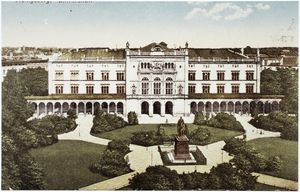
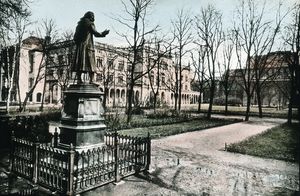
In 1544, Duke Albrecht founded the Albertus University, the second Protestant university in Europe after Marburg, which quickly attracted a large number of students. Albrecht had envisaged three tasks for it: evangelisation beyond the duchy, the dissemination of humanist education, and the cultivation of academically educated elites. From 1755, Immanuel Kant (1724–1804) of Königsberg taught there, initially as a private lecturer and later as a professor; his lectures influenced figures such as Johann Gottfried Herder (1744–1803), amongst others. Kant, arguably the city’s most famous son, never left his hometown permanently. Through him, the University of Königsberg became a centre of European philosophy. The Albertina was home to a vibrant student community, which organised itself into student corps and fraternities (Corps Masovia, founded in 1830, Corps Hansea Königsberg, founded in 1876, and the Burschenschaft Germania, founded in 1843), which were suppressed in the period before 1848 and organised in secret. The Albertina also received new impetus in the wake of the Prussian Reforms, notably through Johann Friedrich Herbart (1776–1841), and was expanded. In 1862, the new university building was inaugurated. The Albertina grew to 1,650 students by 1914 and to 4,113 students (761 women) by the summer of 1930; it had previously been expanded once more in 1927. Academically, alongside Kant, it was shaped by figures such as Andreas Osiander (1498–1552), Johannes Voigt (1786–1863), Karl Lachmann (1793–1851), Ernst August Hagen (1797–1880), Ernst von Leyden (1832–1910), Felix Dahn (1834–1912), Julius Walter (1841–1922), Hans Prutz (1843–1929), Ludwig Lichtheim (1845–1928) and Hans Rothfels (1891–1976). The art academy founded by von Hagen had been in existence since 1841. In 1907, a business school was added.
The Baltic Federal Immanuel Kant University (Baltijskij federal’nyj universitet imeni Immanuila Kanta), which had existed since 1948 initially as a teacher training college (which has borne this name since 2010) is a full-scale university and regards itself as the successor to the Albertina. Other significant higher education institutions in Königsberg include the Baltic State Academy of the Fishing Fleet (Baltijskaja Gosudarstvennaja Akademija Rybopromyslovogo Flota), the Baltic Institute of Economics and Finance (Baltijskij institut ėkonomiki i finansov), the Baltic Military Naval Institute (Baltijskij vojenno-morskoj institut), the Academy of Management of the Russian Ministry of Internal Affairs in Kaliningrad (Аkademija upravlenija Ministerstva vnutrennich del Rossijskoj Federacii), the Kaliningrad School of International Business (Kaliningradskaya shkola mezhdunarodnogo biznesa) and the Kaliningrad State Technical University (Kaliningradskiy gosudarstvennyy tekhnicheskiy universitet).
Notable museums include the Immanuel Kant Museum (Muzej Immanila Kanta), the Cathedral Museum (Königsberg Cathedral), the Kaliningrad Regional Museum of History and Art (Kaliningradskij oblastnoj istoriko-chudožestvennyj muzej) and the Museum of the World Ocean (Muzej mirovogo okeana).
Society
Until around the end of the 19th century, the guilds, which had their origins in the Middle Ages, were important social organisations. A vibrant club and society scene (including political, commercial, choral, trade, gymnastics and shooting clubs) also developed in Königsberg.
Art History
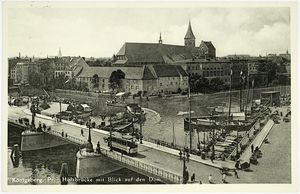
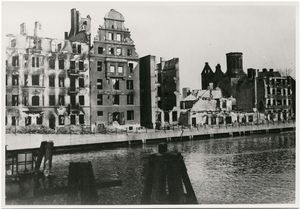
Königsberg Cathedral (construction begun around 1325) is situated on Kneiphof Island. The church, a three-aisled brick hall church and the most significant Gothic religious building in East Prussia, was the cathedral of the Diocese of Samland and the burial place of Albrecht of Brandenburg-Ansbach, Luther of Brunswick (c. 1275–1335) and Immanuel Kant. The Wallenrodt Library was also housed here. In 1944/1945, the church was severely damaged – reconstruction has been underway since 1992.
The castle, originally built as a four-winged Gothic complex after 1255 and most recently used as a government and museum building (including the State Archives, the Silver Library and the Prussia Museum), underwent numerous alterations. Paintings by the Königsberg Impressionist Lovis Corinth (1858–1925) were also exhibited in the palace. The ruins were demolished in 1968; in their place, the block of the ‘House of Councils’ (Dom Sovjetov) was erected, which remains unfinished to this day.
Following the city fires of 1769, 1775 and 1783, the cityscape underwent a fundamental transformation, with private houses and churches – such as the Baroque Catholic church completed in 1777 – being rebuilt in the contemporary Neoclassical style.
In 1824, the Old Town church was closed, demolished due to its dilapidated state, and the square was redesigned by Peter Joseph Lenné (1789–1866). Between 1838 and 1845, the new Old Town church was built to a design by Karl Friedrich Schinkel (1781–1841); between 1870 and 1875, the New Stock Exchange was constructed in the Neo-Renaissance style.
In 1864, the city commissioned a statue of the philosopher Kant, which was eventually erected on Paradeplatz in 1885, as well as a memorial grave (1881) at the cathedral. In 1992, a recast version was erected in front of the university.
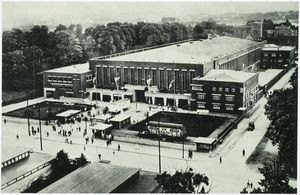
In 1905, the process of dismantling the fortifications began; although it was never fully completed, it nevertheless opened up new possibilities for urban development. The Schlossteichpromenade was laid out; in the suburbs, housing estates and green spaces emerged, such as Luisenwahl Park (1913), the Tiergarten (1896) and Germany’s first open-air museum (1912). Notable modernist buildings included the Stadthalle and the Haus der Technik. The Stadthalle, inaugurated in 1912, was a modern building with a steel structure and boasted the city’s largest event halls (1,600 seats). The Haus der Technik was built as a clinker-brick exhibition hall for the 1925 German East Fair by the architect Hanns Hopp (1890–1971), who was influenced by Expressionism and later by the Bauhaus. Hopp was also responsible for the construction of the Parkhotel (1930–1931), the East Prussian Girls’ Vocational School (1928) and the New Broadcasting House (1932–1933).
The castle, all the churches in the city centre and the Albertina – along with all the city’s historic buildings – were severely damaged by the bombing of 1944. The ruins of Königsberg were cleared away; today, large green spaces and prefabricated blocks of flats occupy their place. Historicist buildings (Fischdorf) were erected on the site of the fish market near the cathedral, and there are also plans to rebuild the Old Town and the Kneiphof. The German settlements outside the historic city centres, as well as the factories, were preserved and put to appropriate use by the new residents.
Music and Theatre
In the Middle Ages, sacred music was cultivated in the churches, monasteries and schools of Königsberg. Grand Master Friedrich von Sachsen had already established a court orchestra. During the ducal period, the choir and orchestra were part of the princely court for ceremonial purposes, in the spirit of the Renaissance and the Reformation – causes to which Albrecht was as committed as he was to organ playing. Under Georg Friedrich (reigned 1577–1603), a Franconian court orchestra came to Königsberg, and Theodor Riccio (1540–1600) composed in the Italian style, whilst Johannes Eccard (1553–1611) wrote pieces in the style of the Dutch school. The most significant musicians of the 17th century were Johann Stobäus (1580–1646) and Heinrich Albert (1604–1651). Under Frederick William I (reigned 1713–1740), church and organ music flourished. Around 1790, operas and Singspiele were regularly staged in Pregelstadt. The concerts organised by the music director Friedrich August Riel (1774–1845), tutor to Queen Luise (1776–1810), represented a high point in cultural life. Joseph von Eichendorff (1788–1857) also made his mark in Königsberg with his Romantic repertoire. In the 19th century, choral societies, public concerts and music festivals flourished. The operatic music of Richard Wagner (1813–1883, who worked at the Königsberg City Theatre in 1836/37) met with a mixed reception in the city. Louis Köhler (1820–1886) was Königsberg’s leading music critic and was also active as a musician. In the 20th century, Wilhelm Furtwängler (1886–1954), Hans Knappertsbusch (1888–1965) and Karl Böhm (1894–1981) were guest conductors in Königsberg. The opera house – originally built in 1806 as the city’s first municipal theatre, reopened in 1918 as a dedicated opera house and merged with the Neues Schauspielhaus in 1924 to form the East Prussian State Theatre – was, under the direction of Hans Schüler (1897–1963) from 1928 to 1932, it was Germany’s most avant-garde opera house.
Following the conversion of the old Komische Oper into the Neues Schauspielhaus (1927), artists such as Paul Wegener (1874–1948), Emil Jannings (1884–1950) and Agnes Straub (1890–1941) performed here; it developed into one of Germany’s most modern theatres.
Bibliography
The German Order, the cathedral chapter and the clergy of the three towns acquired mainly religious literature, the extent of which we know only in fragments. With the Reformation, the written word experienced a renewed appreciation, enabling Albrecht to lay the foundations for the ‘bibliotheca nova’, which later became the Royal Library and, in 1919, the State Library. The book trade, printing and publishing (e.g. Gräfe und Unzer, from 1722) also experienced an upswing from this time onwards. Notable newspapers included the Königsberger Hartungsche Zeitung, the Ostpreußische Zeitung, the Ostpreußische Woche (formerly the Königsberger Woche), the Königsberger Allgemeine Zeitung, the Königsberger Anzeiger and the Königsberger Volkszeitung. Today, the Königsberger Express is the city’s most important German-language newspaper.
Notable for the 17th century is the Baroque Königsberg circle of poets (known as the ‘Kürbishütte’) centred on Simon Dach (1605–1659), Robert Roberthin (1600–1648) and Johann Peter Titz (1619–1689). Key figures of the High Baroque period were Christian Donatus (1622–1679) and Michael Kongehl (1646–1710). Under Frederick William I, religious poetry—such as the Pietist verse of Johann Valentin Pietsch (1690–1726)—was significant. Alongside Kant and Herder, numerous writers of the Enlightenment and Romanticism are represented – Johann Georg Hamann (1730–1788), Theodor Gottlieb von Hippel the Elder (1741–1796), Johann Friedrich Reichardt (1752–1814), Zacharias Werner (1768–1823) and Ernst Theodor Amadeus (E. T. A.) Hoffmann (1776–1822) – represent the so-called ‘Königsberg Century’ (1701–1806). During the Vormärz period, Cäsar von Lengerke (1803–1855) was active as a poet. Ernst Wichert (1831–1902) and Felix Dahn (1834–1912) shaped literary life in the second half of the 19th century, as did, in their own time, Agnes Miegel (1879–1964), Walter Heymann (1882–1915) and Ernst Wiechert (1887–1950), who belonged to a later generation. Also well-known both in the city and beyond were the now largely forgotten authors Gutti Alsen (1869–1929) and Katarina Botsky (1880–1945), who are both largely forgotten today; they both lived in Königsberg and are considered part of the literary modernist movement. The Goethebund, led by Ludwig Goldstein (1867–1943), brought together writers who linked Königsberg to the Reich through literature, for example by organising readings by prominent poets. After the end of the German city, quite a few titles were published, such as Hans Graf von Lehndorff’s (1910–1987) *Ostpreußisches Tagebuch* (*East Prussian Diary *) or Max Fürst’s (1905–1978) *Gefilte Fisch*, which can be classified as memoir literature.
Culture of memory and remembrance
Following the forced resettlement of the last Germans from Königsberg, the displaced persons and refugees in their new homeland – particularly within the associations for displaced persons – kept the memory of the formerly German city of Königsberg alive; the Museum Stadt Königsberg in Duisburg continues to preserve the heritage of the people of Königsberg to this day.[11] The parts of the Königsberg archives that were rescued and brought to Germany are held at the Secret State Archive of the Prussian Cultural Heritage Foundation in Berlin. With the dissolution of the Soviet Union (1991), German-Russian relations eased, and, with official support, the inhabitants of Kaliningrad increasingly began to engage with their city’s almost 700-year-old German history.
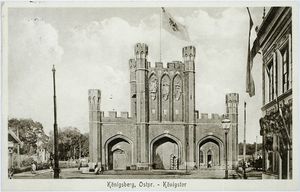
Immanuel Kant, who was already held in high regard during the Soviet era, is a common point of connection for Germans and Russians. From an economic and tourism perspective, culinary traditions from Königsberg – such as Ostmark beer and Königsberger Klopse – are being revived in the exclave. Plans to rebuild the cathedral have been implemented, whilst the reconstruction of neighbourhoods dating from the German era has not progressed beyond the planning stage. The restored Königstor has become a landmark of the Russian city. The possibility of renaming the city ‘Königsberg’ is a recurring topic of lively debate.
4. Discourses/Controversies
Following selectively ideological perceptions and portrayals of the province of East Prussia as a ‘bulwark of Protestantism’[12] or as a ‘bulwark against Slavic culture’[13] in German urban and regional historiography, historians have increasingly introduced more nuanced assessments and interpretations.[14] The war crimes committed by the Red Army and the disenfranchisement of the remaining Germans remain controversial topics, as assessments continue to be shaped by political or national perspectives.[15]
Bibliography
- Robert Albinus: Königsberg Encyclopaedia. The City and Its Surroundings … for all those who love Königsberg. Würzburg 2002.
- Michael Antoni (ed.): Dehio Handbook of Artistic Monuments. West and East Prussia. The former provinces of West and East Prussia (Prussia of the Teutonic Order) including the Bütow and Lauenburg regions. Munich, Berlin 1993, pp. 301–320.
- Hartmut Boockmann: East Prussia and West Prussia. Berlin 1992 (German History in Eastern Europe).
- Per Brodersen: The City in the West. How Königsberg Became Kaliningrad. Göttingen 2008.
- Bernhard Fisch, Marina Klemeševa: On the Fate of the Germans in Königsberg 1945–1948 (in the light of previously unknown Russian sources). In: Journal of East Central European Studies 44 (1995), pp. 391–400.
- Kurt Forstreuter: The Prussian State Archives in Königsberg. A historical review with an overview of its holdings. Göttingen 1955 (Publications of the Lower Saxony Archives Administration 3).
- Klaus Garber: Old Königsberg. A memoir of a lost city. Weimar et al. 2008.
- Fritz Gause: The History of the City of Königsberg in Prussia. 3 vols. Cologne et al. 1965–1971.
- Fritz Gause: Königsberg. In: Erich Weise (ed.): Handbook of Historical Sites. East and West Prussia. Stuttgart 1981 (Kröners Taschenausgabe 317), pp. 100–107.
- Gerhard von Glinski, Peter Wörster: Königsberg. The East Prussian Capital in History and the Present. Bad Münstereifel, Bonn, Berlin 1990 (East German City Scenes 6).
- Walther Hubatsch: Albrecht of Brandenburg-Ansbach. Grand Master of the Teutonic Order and Duke of Prussia 1490–1568. Heidelberg 1960 (Studies in the History of Prussia 8).
- Walther Hubatsch (ed.): History of the Protestant Church in East Prussia. 3 vols. Göttingen 1968. (In particular vol. 2, pp. 45–53; Vol. 3, pp. 199–203, 236–254, 324–327, 532–536, 548–552).
- Bernhart Jähnig (ed.): 750 Years of Königsberg. Essays on the History of a Temporary Capital. Marburg 2008 (Proceedings of the Historical Commission for East and West Prussian Regional Research 23).
- Ruth Kibelka: The German Population between Assimilation and Expulsion North and South of the Memel (1945–1948). Berlin 1997.
- Erwin Kroll: Königsberg: City of Music. Freiburg im Breisgau 1966.
- Hugo Linck: Königsberg 1945–1948. 5th ed. Leer 1987.
- Jürgen Manthey: Königsberg. History of a Cosmopolitan Republic. Munich 2005.
- Hans Mendthal (ed.): Documentary Collection of the City of Königsberg in Prussia, Vol. 1 (1256–1400). Königsberg 1910.
- Stefanie Schüler-Springorum: The Jewish Minority in Königsberg/Prussia 1871–1945. Göttingen 1996 (Publications of the Historical Commission of the Bavarian Academy of Sciences and Humanities 56).
- Werner Stark: Kant in Königsberg. In: Heike Müns, Matthias Weber (eds.): ‘A Thirst for Knowledge …’ Research on the Culture and History of Germans in Eastern Europe. Two Decades of the Immanuel Kant Scholarship. Munich 2007 (Publications of the Federal Institute for the Culture and History of Germans in Eastern Europe 29), pp. 11–36.
- Christian Tilitzki: The Albertus University of Königsberg. Its History from the Founding of the German Empire to the Demise of the Province of East Prussia (1871–1945). Vol. 1: 1871–1918. Osnabrück 2012.
- Wulf D. Wagner, Heinrich Lange: Königsberg Castle. A History of Architecture and Culture. Regensburg 2011.
- Axel E. Walter (ed.): The History of Books and Libraries in Königsberg. Cologne et al. 2004 (From the Archives, Libraries and Museums of Central and Eastern Europe 1).
Bibliographies and yearbooks
- Ernst Wermke (ed.): Bibliography of the History of East and West Prussia up to 1929, with a supplement from 1962; 1930–1938; 1937–1970; 1971–1974. Aalen, Bonn-Bad Godesberg, Marburg 1962–1978.
- Preußenland. Yearbook of the Historical Commission for East and West Prussian Regional Research and the Copernicus Association for the History and Regional Studies of West Prussia; Communications from the Secret State Archives of the Prussian Cultural Heritage Foundation (1963 onwards).
Web links
- www.hiko-owp.eu/ (Historical Commission for Research into East and West Prussia)
- www.stadtgemeinschaft-koenigsberg.de/ (Association of Former Residents of Königsberg)
- www.museumkoenigsberg.de/ (Königsberg City Museum in Duisburg)
- www.klgd.ru/ (City Representative Office of Kaliningrad)
- gsta.preussischer-kulturbesitz.de/recherche/literatur-zu-den-bestaenden/xx-ha-historisches-staatsarchiv-koenigsberg/ (Archival holdings relating to Königsberg)
- www.herder-institut.de/bildkatalog/wikidata/Q1829 (Images relating to Königsberg/Kaliningrad in the image archive of the Herder Institute, Marburg)
Notes
[1] Gause: History of the City of Königsberg, Vol. 3, pp. 172–174.
[2] The figures cited, for example, in Linck: Königsberg 1945–1948, p. 75; lower figures in Fisch, Klemeševa: On the Fate of the Germans, pp. 399–400. On the issues surrounding the figures: Kibelka: The German Population, pp. 220ff.
[3] Data according to Gause: *History of the City of Königsberg*, Vol. 1, pp. 119 and 560 (for 1450 and the 17th century); Ibid.: *History of the City of Königsberg*, Vol. 2, pp. 148, 293 and 761 (1755, 1797/98, 1914); Ibid.: *History of the City of Königsberg*, Vol. 3, pp. 104 and 172 (1925, 9 April 1945); Boockmann: East Prussia and West Prussia, p. 369 (1850, 1867, 1900); Antoni (ed.): Dehio Handbook, p. 302 (1937, 1993); Results of the 1956 census: istmat.info/files/uploads/17165/narhoz_sssr_1956_svodnyy.pdf (accessed 30 January 2015). The data for 2014 have been calculated from registration records: www.gks.ru/free_doc/doc_2013/bul_dr/mun_obr2013.rar (accessed 30 January 2015); cf. von Glinski, Wörster: Königsberg, p. 140.
[4] Gause: History of the City of Königsberg, Vol. 3, p. 103.
[5] 2010 Census: kaliningrad.gks.ru/population (accessed 15 April 2015).
[6] Gause: History of the City of Königsberg, Vol. 3, p. 104.
[7] Gause: History of the City of Königsberg, Vol. 1, p. 502.
[8] Schüler-Springorum: The Jewish Minority in Königsberg/Prussia, pp. 43–46, p. 367.
[9] www.propstei-klg.com/unsere-kirche (accessed 15 April 2015).
[10] mdz-moskau.eu/kaliningrad-neues-haus-fur-russlanddeutsche/ (accessed 21 February 2022).
[11] By way of example, reference is made to Michael Wieck’s memoir, first published in 1989: *Testimony to the Downfall of Königsberg. A ‘Prominent Jew’ Reports* (paperback edition, Munich 2005).
[12] Paul Genrich, Professor of Theology at the Albertina, quoted in Tilitzki: *The Albertus University of Königsberg*, p. 442.
[13] Hans Rothfels: ‘The Albertina as a Borderland University’. In: Ibid.: ‘The Eastern Territories, Prussian Identity and the Idea of the Reich’. Historical Treatises, Lectures and Speeches. Leipzig 1935, pp. 129–145, here pp. 129f. For further reading on this: Robert Traba: East Prussia – The Construction of a German Province. A Study of Regional and National Identity. 1914–1933. Osnabrück 2010 (Klio in Poland 12).
[14] See ‘5. Bibliographical Notes’ on this.
[15] The German perspective, focusing on the victims, is emphasised, for example, by: Hubertus Knabe: Day of Liberation? The End of the War in East Germany. Berlin 2005. See the Russian perspective in Peter Jahn (ed.): Triumph and Trauma. Soviet and Post-Soviet Memories of the War 1941–1945. Berlin 2005, pp. 48–51; see also Jutta Scherrer: Soviet Union/Russia. The Myth of Victory versus Coming to Terms with the Past. In: Monika Flacke (ed.): Myths of Nations. 1945 – Arena of Memories. Vol. 2. Berlin 2004, pp. 619–670.
Citation
Marcus Wüst: Königsberg/Kaliningrad. In: Online Encyclopaedia on the Culture and History of Germans in Eastern Europe, 2015. URL: ome-lexikon.uni-oldenburg.de/p32293 (as at 21 February 2022).
Terms of use for this article
Copyright © University of Oldenburg and the Federal Institute for the Culture and History of Germans in Eastern Europe (BKGE), all rights reserved. This work was produced as part of the project ‘Online Encyclopaedia on the Culture and History of Germans in Eastern Europe’ and may be reproduced and published provided the rights holders’ consent has been obtained. Please contact:
If you have any specialist comments or additions to the text, please contact the editorial team, citing relevant literature and source references.