

Minsk
Minsk
Official designations
Belarus. Minsk (transliterated from Belarusian); Minsk (transliterated from Russian )
Etymology
According to the prevailing view, the historical place name of Minsk, Men(e)sk, is derived from the name of the Menka River – which has now almost dried up – on the banks of which Minsk is said to have originally been situated, and whose hydronym refers to the Indo-European root *men- ‘small’. A second theory derives the name from the verb menjat’ ‘to exchange , to swap’, citing the city’s role as an important trading centre as the basis for this.
Location
Minsk lies about 70 kilometres north-west of the geographical centre of present-day Belarus and is situated at 53°54’ north latitude and 27°33’ east longitude.
Topography
Minsk lies at the confluence of the Nemiga (Belarusian: Njamiha, Russian: Nemiga) and the Svislach (Belarusian: Svislač, Russian: Svisloč), a non-navigable river which rises in the Belarusian ridge (Belarusian: Belaruskaja hrada, Russian: Belorusskaja grjada) and flows into the Bjaresina (Belarusian: Bjarėzina, Russian: Berezina), a tributary of the Dnipro/Dnjapro/Dnepr (Belarusian: Dnjapro, Russian: Dnepr, Ukrainian: Dnipro).
Political and administrative affiliation
Minsk is the administrative centre of the Minsk Oblast (Belarusian: Minskaja voblasc’, Russian: Minskaja oblast’), which has existed within its current borders since 1954. However, the city itself is not part of the oblast. Following the collapse of the Soviet Union , Minsk became the capital of the Republic of Belarus ( Belarusian: Rėspublika Belarus’, Russian: Respublika Belarus’).
Common symbolism

The Virgin Mary, depicted on the city’s coat of arms, is regarded as the patron saint of Minsk; she is said to have appeared to the people of Minsk in the year 1500.
Archaeological significance
The earliest settlement of what is now the city area, as documented by archaeological research, took place in the ninth century by the East Slavic tribes of the Krivichians and Dregovichians.
Middle Ages
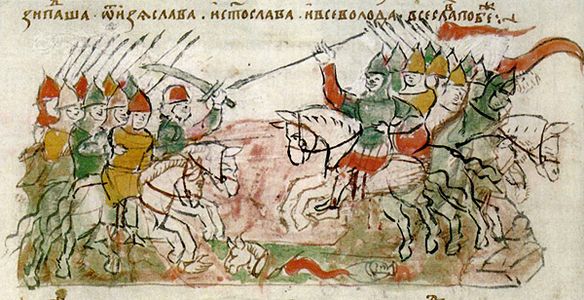
The exact date of Minsk’s foundation is unknown. From the end of the tenth century, the city was part of the East Slavic principality of Polazk (Belarusian: Polack; Russian: Polock). It was first mentioned in the Nestor Chronicle (Belarusian: Apovesc’ minulych časoŭ, Russian: Povest’ vremennych let) in an entry for the year 1067.
Following the partition of the Principality of Polazk in the early 12th century, Minsk became an independent principality and developed into an important trading hub between Kyiv and the Baltic Sea. The first Prince of Minsk and founder of the Hlebavičy dynasty was Hleb Usjaslavič (year of birth disputed, died 1119), who came into conflict with the Kyiv Principality whilst attempting to expand the principality’s territory. Minsk was conquered in 1119 by the Kyiv prince Volodymyr/Vladimir and incorporated into the Principality of Kyiv. In the 1140s, the Principality of Minsk regained its independence, and the Hlebavičy dynasty resumed rule.
The Principality of Minsk was initially spared from the so-called ‘Mongol invasion’ (1237–1239) on Rus’, the Principality of Minsk was initially spared; however, in the face of the continuing threat from the Mongol-Tatars and the disintegration of Kyiiv Rus’, it turned to the neighbouring Lithuanian princes for protection. In 1242, it voluntarily joined the emerging Grand Duchy of Lithuania . The first settlement by German-speaking people, including missionaries, traders, craftsmen and knights, took place in what is now Belarus, including Minsk, around the beginning of the 14th century. As a result of Minsk’s incorporation into the Grand Duchy of Lithuania , the rule of the local princes of Minsk came to an end in the 1340s. In 1413, Minsk became part of the province of Vilnius; in the second half of the 15th century, it became the capital of the district (Belarusian: pavet, Russian: povet) of Minsk, which, in addition to Minsk itself, comprised the former principalities of Saslauje/Zaslaŭe/Zaslavl’ and Lahojsk/Logojsk.
Modern times
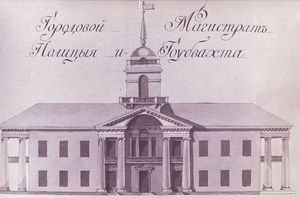
In 1499, Minsk was granted Magdeburg rights and subsequently became an important administrative centre of the Grand Duchy of Lithuania. The Polish–Russian War (1654–1667) and the Great Northern War (1700–1721) weakened the Polish–Lithuanian Commonwealth, founded in 1569 under the Union of Lublin, and, in the wake of the so-called Second Partition of Poland–Lithuania, Minsk became part of the Russian Empire in 1793.
Contemporary History
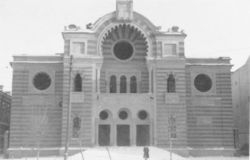
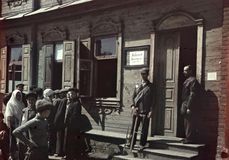

Following several changes in its political and territorial status as a result of the war, Minsk became the capital of the Byelorussian Soviet Socialist Republic (BSSR), one of the four republics that formed the Soviet Union in 1922. Following Germany’s invasion of the Soviet Union, Minsk was under German occupation from June 1941 to July 1944. During this period, the city was the centre of the General District of White Ruthenia, which, together with the General Districts of Estonia, Latvia and Lithuania , formed the Reichskommissariat Ostland. Soviet prisoners of war and civilians, particularly Jews, fell victim to the occupation regime in large numbers. Up to 100,000 Jews, including those deported from the German Reich, were killed in the three Jewish ghettos in Minsk.[1] The city’s population had stood at around 270,400 in 1941, immediately before the occupation began; by the end of the occupation (August 1944), it had fallen to just 43,000.[2] In 1972, Minsk became a city with a population of over one million. Since 1991, it has been the capital of the independent Republic of Belarus and the seat of the Commonwealth of Independent States (CIS).
Economy
Minsk’s location on key land and water routes from the Baltic Sea to the Black Sea helped the city to develop as a trading centre in the early Middle Ages. According to archaeological excavations, goods traded in the 12th and 13th centuries included iron, jewellery, pottery, leather goods and shoes, as well as wood and bone carvings.
The granting of Magdeburg city rights led to an economic boom, particularly in the fields of trade and craftsmanship. The loss of Magdeburg rights following the city’s incorporation into the Russian Empire resulted in a higher tax burden for the inhabitants, which led to the closure of numerous craft and trading businesses. Economic stagnation persisted until the mid-19th century. A new period of growth began with the construction of railway lines from the 1870s onwards, when Minsk was connected both to the east-west line between Moscow/Moskva – Brest/Brest-Litovsk and the north-south line between Libau/Liepāja and Romny.
Population and Society
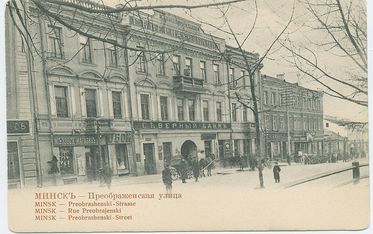
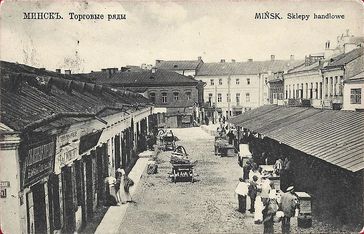
Demographic data were collected on a large scale for the first time in the Russian Empire as part of the 1897 census, with national affiliation being inferred from the mother tongue declared. In the Belarusian governorates, this yielded a figure of 49,073 Germans.[3] In the Minsk Governorate, 76.0 per cent stated Belarusian, 16.0 per cent Yiddish, 3.9 per cent Russian, 3.0 per cent Polish and 0.2 per cent German as their mother tongue.[4] In the Minsk district, one of the province’s nine districts, the proportions were as follows: 59.2 per cent Belarusian, 23.1 per cent Yiddish, 9.5 per cent Russian, 7.1 per cent Polish and 0.4 per cent German. In the city of Minsk, which at that time had a population of 90,912, 51.2 per cent cited Yiddish, 25.5 per cent Russian, 11.4 per cent Polish, 9.0 per cent Belarusian and 0.7 per cent German as their mother tongue. Despite the limited informative value of the category ‘mother tongue’ in relation to complex national and linguistic circumstances and identities, Minsk’s distinctly Jewish-Russian-Polish character is evident when compared with the surrounding countryside. The high proportion of the Jewish population can be explained primarily by the ban, in force since 1835 for Jews in the Pale of Settlement, on settling outside towns and shtetls and on acquiring land. Today, with a population of 1.74 million, Minsk is by far the largest city in Belarus, home to almost a fifth of the country’s population.[5]

History of Religion and the Church

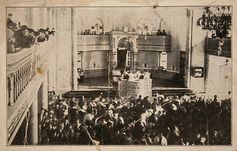
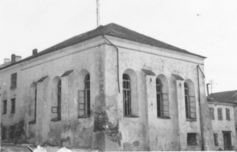
Byzantine Christianity reached what is now Belarus at the end of the 10th century, whilst Roman Catholicism arrived with the baptism of the Lithuanians at the end of the 14th century. In Minsk, excavations in 1949 uncovered the foundations of a stone religious building, which is thought to have been erected at the end of the eleventh century.
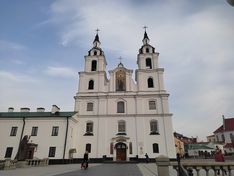
The most important place of worship in the Belarusian Exarchate of theRussian Orthodox Church is the Cathedral of the Holy Spirit. Built in the Vilnius Baroque style in 1642 as a convent of the Bernardine Sisters, this white church has been an Orthodox church since 1870 and was closed from 1918 to 1943. The icon of the Mother of God of Minsk, housed in the cathedral, is of particular spiritual significance.
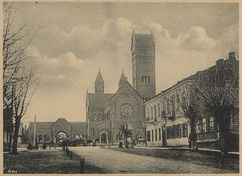
The most important Roman Catholic church in Minsk is St Mary’s Cathedral, the cathedral church of the Roman Catholic Archdiocese of Minsk-Mahiljou (Belarusian: Mahilёŭ; Russian: Mogilёv). It was built in 1710 as a Jesuit church, had its towers removed during the Soviet era and was used as a sports hall until 1994, before being restored to a place of worship in 1997. Another well-known landmark of the city is the Roman Catholic ‘Red Church’ (officially: Church of St Simon and St Helena), a Neo-Romanesque brick building erected in the early 20th century.
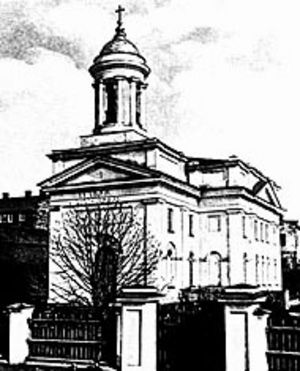
As in other major cities in Belarus, Evangelical Lutheran religious life in Minsk was also a focal point for the German-speaking population. Owing to the success of the Counter-Reformation in Poland-Lithuania, which also extended to the Belarusian population, from the 18th century onwards, German citizens of the Rzeczpospolita – alongside Latvian citizens – constituted the majority of Lutherans in the territory of Belarus. In 1811, the wooden church of St Paul and St Alexander, built under the supervision of Pastor Samuel Karstädt, was consecrated in Minsk; it was destroyed in a major fire in 1835, and its exact location remains unknown to this day. The Church of St Nicholas (consecrated in 1845) was built as a replacement for the Lutherans in Minsk. From 1833 to 1860, there was a school associated with the parish. The number of Protestant Germans in Minsk, who settled in what was then known as the German Suburb (Belarusian: Njameckaja Slabada; Russian: Nemeckaja Sloboda), is said to have exceeded 2,000 in the 1920s.[6] As the political situation deteriorated in the 1930s and in the wake of the war, the two Evangelical Lutheran churches in Minsk at that time – St Nicholas’s and another church building on what was then the main thoroughfare, Zachariasstraße – were demolished or destroyed. Key events following Belarus’s independence included the registration of the Lutheran congregation ‘Erlösung’ in 1994 and the unveiling of a memorial in 2019 on the site of the former Lutheran cemetery in Minsk (Lutheran Square; now a park on Karl-Liebknecht-Straße).
Data from the 1897 census of the Russian Empire, excerpts of which are presented below, shed light on the city’s religious and linguistic character towards the end of the 19th century.[7]
Religious composition of the urban population of Minsk according to the 1897 census[8]
| Religious group | Number of adherents | Percentage |
|---|---|---|
| Jews | 47,561 | 52.3 |
| Orthodox | 27,323 | 30.1 |
| Roman Catholics | 13,760 | 15.1 |
| Muslims | 1,323 | 1.5 |
| Lutherans | 806 | 0.9 |
| Total population | 90,912 | 100.00 |
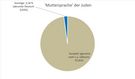
Charts: Data from the 1897 census on ‘mother tongue’ (rodnoj jazyk) of members of religious groups in the city of Minsk[9]


Special cultural institutions
Minsk is home to several of Belarus’s most important cultural institutions , such as museums, theatres and libraries. The National Art Museum houses 33,000 exhibits from more than 132 countries and spanning some twelve centuries. The National Centre for Contemporary Art focuses on works of art from the 20th and 21st centuries, with a particular emphasis on the re-emergence and development of Belarusian contemporary art following the country’s independence in 1991.
Education and Science

As a centre of education and scholarship, Minsk did not play a significant role until the early 20th century, even though a number of renowned scholars had biographical links to the city. Among those of German descent, this applies, for example, to the German-Baltic linguist and Finno-Ugric scholar Nikolai Anderson (1845–1905), who worked as a senior teacher of classical languages at the Minsk Gymnasium from 1872 to 1894, before being offered and accepting a professorship in Finno-Ugric studies at the University of Kazan. His three sons, Wilhelm (1880–1940), Walter (1885–1962) and Oskar (1887–1960), who were born in Minsk, were also active in academia and became influential figures in their respective disciplines of astrophysics, folklore studies, economics and mathematics.
Minsk gained prominence as an academic centre as a result of the policy of ‘indigenisation’ (Russian: korenizacija), which aimed to integrate the respective national elites into the new Soviet order by promoting non-Russian languages and cultures. Part of this policy was the opening of the Belarusian National Technical University (1920), the Belarusian State University (1921), the Institute of Belarusian Culture (Inbelkul’t, 1922; the Academy of Sciences from 1929), the National Library (1922) and the Conservatoire (1932). The shift in nationality policy that took place in Moscow in the early 1930s – from indigenisation towards a form of Soviet patriotism with a clear Russian leading role – also affected the nationally minded intelligentsia integrated into the Soviet system, which was subjected to repression right up until the 1950s and was to be eliminated as a political factor.
In the first few years after the Second World War, schools and higher education institutions in Minsk were clearly marked by the aftermath of the war; there was a shortage of teaching staff, premises and equipment. In the decades that followed, the number of ten-year schools (‘secondary schools’) rose sharply, from 59 in 1955 to 210 in 1990. A similar trend developed in Minsk in the field of academia, where the number of staff increased seven- to eight-fold between 1960 and 1975.
Following the collapse of the Soviet Union , the private European Humanities University (EHU) in Minsk, modelled on European educational objectives and curricula, was founded in 1992. With the support of the German Embassy, an Institute for German Studies was also established at the EHU in 1998. Following an initially tolerant stance on the part of the Ministry of Education, the EHU was forced to close in Minsk in 2004. In 2005, the EHU was re-established in exile in Vilnius .
In the 2019/2020 academic year, 28 of the 51 higher education institutions in Belarus were located in Minsk. In 2021, both the German Academic Exchange Service (DAAD) and the Goethe-Institut were forced to close their facilities in Minsk following a request from the Belarusian Ministry of Foreign Affairs.
Architecture
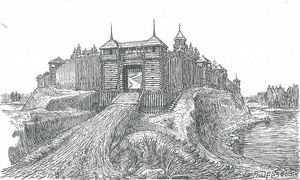
A defining feature of historic Minsk was an oval-shaped wooden castle – no longer in existence – situated on what is now 8 May Square, which had been built in the 11th century on a hill on the western bank of the Svislach. The modern centre of Minsk is characterised in particular by monumental buildings in the Soviet Neoclassical style, straight and wide streets, and spacious squares, with elements of postmodern architecture having been added in more recent times.
From a German-Belarusian perspective, the ‘Potsdam’ restaurant, which opened in Minsk in 1971 and was situated on the corner of Lenin Street and International Street, stands out as a historical curiosity. It had a counterpart in the GDR in the form of the ‘Minsk’ restaurant in Potsdam.
Culture of memory and remembrance
Several memorial sites in Minsk and the surrounding area focus on the German invasion of the Soviet Union, the crimes committed during the occupation and the extermination of the Jews. Notable in this context are the Museum of the Great Patriotic War and the German-Belarusian History Workshop in Minsk, founded in 2003 (renamed the ‘Leonid Lewin’ History Workshop in 2015). Three memorials were unveiled whilst the Soviet Union still existed – in Maly Trascjanec (1961), in Vjaliki Trascjanec (1963) and in Sˇas ˇkouˇka (1966). The groups of victims named on these memorials were civilians, partisans and Soviet prisoners of war.
The memorial site in Maly Trascjanec’ (Russian: Malyj Trostenec), the site of an extermination camp situated some ten kilometres south-east of Minsk city centre, was expanded in 2018 as part of co-operation with the Federal Republic of Germany . However, it is not yet a complete memorial complex. For instance, the third phase of construction – involving the development of the former extermination site in Šaškoŭka, where people were murdered en masse from October 1943 to June 1944 – has not yet been completed. Furthermore, there is no information or documentation centre in Maly Trascjanec.
Bibliography
- Sjarhej Ablamejka: Nevjadomy Mensk. Historyja z’niknen’nja [Unknown Minsk. The Story of a Disappearance]. 2 vols. [no place given] 2021.
- U. A. Babkoŭ (ed.): Historyja Minska / Istorija Minska [History of Minsk]. Minsk 2006.
- André Böhm, Maryna Rakhlei: Belarus. Including Minsk, Brest, Hrodna, Homiel, Mahilioŭ. 2nd, updated and expanded edition. Berlin 2019.
- Thomas M. Bohn: Minsk, City of Heroes. Urbanisation à la Belarus since 1945. 2nd revised and updated edition. Vienna–Cologne 2022 (Eastern Europe in History and the Present 9).
- Aleksej Bratočkin: Politika pamjati v prostranstve Minska: meždu zabveniem i ideej ‘množestvennosti pamjatej’ [The Politics of Memory in the Minsk Area: Between Oblivion and the Idea of the ‘Plurality of Memories’]. In: G. Kas’janov, O. Gajdaj (eds.): Istorija, pamjat’, polityka. Zbirnyk statej [History, Memory, Politics. A Collection of Essays]. Kyiv 2016, pp. 9–52.
- Aliaksandr Dalhouski: Landscapes of Violence near Malyj Trostenez: A History of Research. In: Christoph, Rass/Mirjam, Adam et al. (eds.): An Interdisciplinary Reading of Conflict Landscapes. Vol. 1, Osnabrück 2022, pp. 181–206.
- Christian Gerlach: Calculated Murders. Hamburg 1999 (Hamburger Edition).
- Paul Kohl: The Trostenez Extermination Camp. Eyewitness Accounts and Documents. Dortmund 2002.
- Stephan Lehnstaedt: Occupation in the East – Everyday Life under the Occupiers in Warsaw and Minsk 1939–1944. Munich 2010 (Studies in Contemporary History 82).
- Sjarhej Novikaū, Yuliya von Saal: ‘Restrained Remembrance in Belarus. Maly Trascjanec, the Holocaust and the Culture of Remembrance’. In: OSTEUROPA 10–11/2020, pp. 399–418.
- Petra Rentrop: Sites of the ‘Final Solution’. The Minsk Ghetto and the Maly Trostinez Extermination Site. Berlin 2011.
- Sachar Schybeka: ‘Old’ Minsk – from Tsarist provincial capital to Soviet capital. In: Dietrich Beyrau, Rainer Lindner (eds.): Handbook of the History of Belarus. Göttingen 2001, pp. 308–318.
Web links
- [No author given:] Belorusskie nemcy. Gde žili i komu molilis’? [The Belarusian Germans. Where did they live and to whom did they pray?]. In: Pro Belarus, 2020. URL: https://probelarus.by/blog/belorusskie-nemtsy-gde-zhili-i-komu-molilis.html.
- [No author given:] The history of the ELC in Belarus and in Minsk. In: Evangelical Lutheran Parish ‘Church of the Lord’s Cross’ in Minsk, 2023. URL: http://minsk.luther.by/en/the-history-of-the-elc-in-belarus-and-in-minsk/.
- Darya Kasko: Who are they – the Belarusian Germans? In: Zvjazda, 2017. URL: https://zviazda.by/ru/news/20170807/1502107152-kto-oni-belorusskie-nemcy.
- https://server.iquadart.by/trostenets/exhibition.html (Information on Malyj Trostenez)
- https://malytrostinec.nghm-uos.de/ (Project: ‘Digital Documentation of the Malyj Trostenez Extermination Site’)
- https://gwminsk.com/de (Minsk History Workshop)
- https://isg.gbv.de/ (“Carved in Stone: Digitally Experienced Discourses on Remembrance in Urban Spaces in Lower Saxony and Eastern Europe”)
Notes
[1] Böhm, Rakhlei: Belarus, p. 75
[2] Bohn 2022: City of Heroes, p. 371. It is virtually impossible to provide a nuanced interpretation of population trends, as a commission set up by the Soviet authorities, in its investigations into the crimes of the occupying forces, merely recorded in broad terms the number of people who had died in the city of Minsk and the Minsk region. This therefore also included people who had not lived in Minsk before the occupation began (Bohn 2022: City of Heroes, p. 86ff). Consequently, there is a lack of information on those killed (including victims of the Holocaust) or those evacuated to the eastern Soviet Union amongst the city’s pre-war residents, as well as on the proportion of Red Army soldiers and members of partisan units who were not originally from Minsk. It is also unclear how many Minsk residents had already fallen victim to Stalinist terror before the occupation began.
[3] The Council of Europe: The Republic of Belarus and the European Charter for Regional or Minority Languages. Minsk 2019, p. 89. URL: https://rm.coe.int/the-ecrml-in-the-republic-of-belarus-eng-ru-bel/168097ed09 (13 June 2023).
[4] Here and in the following, our own calculation of the percentages based on the absolute figures from Demoskop Weekly: http://www.demoscope.ru/weekly/ssp/rus_lan_97.php (13 June 2023).
[5] Henning Aubel, Renate Ell, Philip Engler (eds.): Der neue Kosmos Welt-Almanach & Atlas 2023. Data – Facts – Maps on all countries of the world. Stuttgart 2022, p. 66.
[6] [Anonymous]: Historyja ELC u Belarusi i ŭ Minsku [History of the Evangelical Lutheran Church in Belarus and in Minsk]. URL: http://minsk.luther.by/be/gistoryja-jelc/ (1 August 2023)
[7] When interpreting the data, one must, of course, critically take into account the methodology of the time and the political interests of the Russian authorities in conducting the survey. For a comprehensive discussion of this, see Henning Bauer, Andreas Kappeler and Brigitte Roth (eds.): The Nationalities of the Russian Empire in the 1897 Census. Part A: Source-Critical Documentation and Data Handbook. Stuttgart 1991.
[8] Author’s own calculation of the percentages (rounded to one decimal place) based on the absolute figures in the digitised version held by the Russian State Public Historical Library: http://elib.shpl.ru/ru/nodes/15160-vyp-6-nalichnoe-naselenie-oboego-pola-po-uezdam-i-gorodam-s-ukazaniem-preobladayuschih-veroispovedaniy-i-glavneyshih-sosloviy-1905#mode/inspect/page/23/zoom/6 (3 August 2023). It is not known to what extent the 139 people who make up the difference between the total population and the specified religious groups are non-religious or belong to other religious denominations.
[9] Our own calculation of the percentage shares (rounded to two decimal places) based on the absolute figures (for men and women combined) from the digitised version made available online by the Library of the President of Russia (pages 88–91): www.prlib.ru/item/436645 (4 August 2023).
Citation
Mark Brüggemann: Minsk. In: Online Encyclopaedia on the Culture and History of Germans in Eastern Europe. 2025. URL: ome-lexikon.uni-oldenburg.de/p32266 (accessed 21 February 2025).
Terms of use for this article
Copyright © University of Oldenburg and the Federal Institute for the Culture and History of Germans in Eastern Europe (BKGE), all rights reserved. This work was produced as part of the project ‘Online Encyclopaedia on the Culture and History of Germans in Eastern Europe’ and may be reproduced and published provided the rights holders’ consent has been obtained. Please contact:
If you have any specialist comments or additions to the text, please contact the editorial team, citing relevant literature and source references.