

Reich Commissariat Ostland
Reich Commissariat Ostland
1. Toponymy
The term ‘Reichskommissariat’ refers to a form of occupation administration practised by Nazi Germany, whereby the administration of a territory conquered by the Wehrmacht was transferred to a civilian authority headed by a Reichskommissar. In addition to the occupied eastern territories, similar institutions were established in Norway and the Netherlands, amongst other places.
The use of the term ‘Ostland’ in relation to the Baltic region can be traced, on the one hand, to the long tradition of German settlement in this region east of the Reich’s borders and, on the other hand, to Adolf Hitler’s central concept of the ‘conquest of living space in the East’. (see also‘Drang nach Osten’)
Location
The Reichskommissariat Ostland (RKO)[1] was established on 25 July 1941 from parts of the Northern Rear Army Area and was subsequently expanded to include further parts of the Central and Northern Rear Army Areas. Its administrative centre was initially Kauen/Kaunas/Kowno, and from mid-August onwards Riga/Rīga. Latvia and Lithuania were placed under civilian administration on 28 July; later (on 1 September and 1 November respectively), a part of Belarus known as ‘White Ruthenia’ (Belarus) and Estonia (5 December) came under the administration of the RKO. It thus covered an area of more than 400,000 km² with a population of around 16 million. The largest city was Riga, with a population of around 350,000.
Topography
See the country articles on Estonia, Latvia, Lithuania and Belarus, as well as the entry‘Baltic States’.
Politics and Public Administration
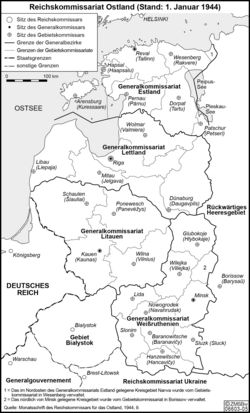
The Reich Commissariat was divided into the General Districts of Estonia, Latvia, Lithuania and White Ruthenia, and further subdivided into main and district areas. Similar structures existed within the regional SS, police and Wehrmacht units. Hinrich Lohse (1896–1964), the NSDAP Gauleiter and Chief President of Schleswig-Holstein, was appointed Reich Commissioner. A large proportion of the newly created senior administrative posts were filled by officials from Lohse’s home region, particularly at the level of district commissioners.[2]
In total, around 2,500 Germans were employed in the civil administration. The following were appointed as General Commissioners: the Mayor of Lübeck, Otto-Heinrich Drechsler (1895–1945), for Latvia, based in Riga; Theodor Adrian von Renteln (1897–1946) for Lithuania, based in Kaunas; Karl-Siegmund Litzmann (1893–1945) for Estonia, based in Reval/Tallinn; and Wilhelm Kube (1887–1943) for White Ruthenia, based in Minsk. After Kube was assassinated in September 1943, he was replaced by the SS and Police Leader for the district, Curt von Gottberg (1896–1945).
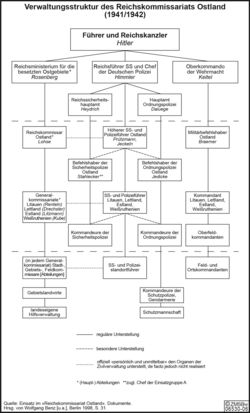
Administration within the RKO was constantly caught between the conflicting interests of the civil administration, which was subordinate to Alfred Rosenberg’s (1893–1946) Reich Ministry for the Occupied Eastern Territories (RMO), the Wehrmacht, Heinrich Himmler’s SS apparatus (1900–1945) and other bodies such as the Authority for the Four-Year Plan and the General Plenipotentiary for Labour Deployment; However, disputes over jurisdiction also arose between the Reich Commissariat and its superior ministry, as well as within the individual branches of the civil administration, for example between Reich and General Commissars. Both had been appointed directly by Adolf Hitler (1889–1945), which led to certain claims of independence vis-à-vis the RMO. In Estonia, Latvia and Lithuania, local administrative bodies also continued to exist; these were supervised by the respective Territorial Commissioners and were officially recognised in March 1942. Particularly intense controversies repeatedly arose with the SS and Police Leaders (SSPF) in the region: Curt von Gottberg, Friedrich Jeckeln (1895–1946) as ‘Senior SSPF’ for the entire RKO, Hinrich Möller (1906–1974) for Estonia, Lucian Wysocki (1899–1964) for Lithuania, and Walther Schröder (1902–1973), Chief of Police in Lübeck, for Latvia.
There were repeated attempts to resolve the overlapping areas of jurisdiction. Plans for far-reaching autonomy under German sovereignty for Estonia and Latvia – as partly drawn up by the Ministry for the East and in which commanders of the rear army areas were also involved – could not be implemented, particularly due to Hitler’s opposition. Further discussions on reform within the regional civil administration, like almost all long-term planning, were overtaken by reality. As the ‘Red Army’ advanced, the administrative headquarters was withdrawn from Riga and, from the summer of 1944, gradually relocated, ultimately to Frankfurt/Oder. The General District of White Ruthenia was placed directly under the RMO in April 1944, but had to be evacuated as early as June of that year. In July, the roles of Reich Commissioner and General Commissioner for Latvia were merged. From September 1944, the former Reich Commissioner for Ukraine – which had already been evacuated – Erich Koch (1896–1986), took over this post on an acting basis. On 24 January 1945, the RKO was dissolved and its remaining responsibilities were transferred directly to the RMO. Alongside the Germans, many local people also fled from the Soviet forces – approximately 66,000 Lithuanians, 70–80,000 Estonians and up to 120,000 Latvians.[3]
Population
In addition to the indigenous majority populations, the region was home, prior to the occupation, to large German (140,000) and Russian (740,000) minorities, amongst others. As early as the Soviet occupation, which began in the summer of 1940, the deportation of local and national elites took place, with some 48,000 people being deported from the Baltic states. The total losses here, resulting from forced conscription and executions, amount to around 129,000 people, which helps to explain the widespread initial willingness for co-operation with the German occupiers.[4] In the context of the Nazi policy of Germanisation and ‘ethnic replacement’ aimed at the permanent reshaping ofthenewly conquered‘living space’, a ‘Racial Screening Commission’ deemed a majority of Latvians and Estonians, as well as a minority of Lithuanians and ‘White Ruthenians’ as capable of ‘Germanisation’ and thus of assimilation. Of the traditional German-Baltic population, some 14,000 people from Estonia and 51,000 from Latvia had been resettled to occupied Poland under the ‘German-Soviet Border and Friendship Treaty’ of September 1939, followed in early 1941 by some 50,000 from Lithuania.[5] Only this group was permitted to return after the occupation of the region; however, up to 30,000 of the affected Lithuanian Germans were resettled, for the most part, in regions other than their actual homeland.[6]
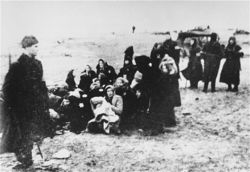
In the RKO, the National Socialist occupation policy led to the almost complete extermination of the local Jewish population. According to Andrej Angrick, this policy can be divided into three phases.[7] During the Wehrmacht’s advance, first in Lithuania and later in Latvia, there were instances of unregulated use of force, for example by special commandos of Einsatzgruppen A and B and units of the Ordnungspolizei, which claimed thousands of victims in the very first days of the invasion. By 1 December 1941, Einsatzkommando 3 of Einsatzgruppe A alone had killed almost 140,000 people; in Latvia, some 32,000 people had been shot.[8] They were supported by members of local ‘self-defence units’, such as the unit led by the Riga police officer Viktor Arājs (1910–1988), which murdered some 45,000 Jews under German rule – including more than 10,000 in White Ruthenia. Members of the German-Baltic minority played a key role in mediating between the occupying forces and the local population, with German-Balts filling key administrative posts below the senior management levels. This group proved to be ‘indispensable to the functioning of German occupation rule […]’.[9]
Jews from various cities across the Reich were also deported to the region, many of whom were likewise murdered by the end of 1941. This took place as early as the second phase of the occupation and, nominally, under the supervision of the civil administration, when the ghettos established during the Wehrmacht’s advance were ‘cleared’ for the transports from the Reich in late 1941/early 1942. In a third phase, beginning in late summer 1942, ‘labour deployment’ came to the fore, leading to the ‘dissolution of the ghettos and the establishment of a vast camp system with numerous satellite camps and workshops’[10]. In Lithuania, the Kauen concentration camp and the ghettos in the cities of Wilna/Vilnius/Wilno and Schaulen/Šiauliai played a central role in this, where a total of around 43,000 Jewish forced labourers were interned. As the Red Army advanced, the forced labourers were then either liquidated or deported westwards. Of the approximately 215,000 Jews who had lived in Lithuania prior to the German occupation, well over 200,000 were murdered. Of the original population of approximately 90,000 Latvian Jews, around 15,000 had fled to the Soviet Union by 1941; almost all of those who remained in the country were killed. In Estonia, around three-quarters of the comparatively small Jewish population had fled to the Soviet Union or Finland; the remaining 1,000 perished under the occupation. Of the more than 800,000 Belarusian Jews, more than 650,000 were murdered.[11]
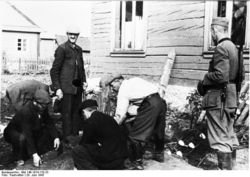
Owing to the rapid transition from military to civilian administration, the latter played a significant role in the financial exploitation of the Jewish population and in their conscription into forced labour. In doing so, it enjoyed a high degree of support from sections of the local population, who regarded this approach as a means of regaining national independence. Economic and military-strategic issues were of particular importance within the RKO, with the result that the Wehrmacht and the civil administration initially resisted the full implementation of the ‘Final Solution’ – Jewish forced labourers were, for example, deployed to repair the airports at Kaunas and Šiauliai. In addition to the Jewish population, members of other minorities such as the local Roma, suspected ‘Communists’ and ‘partisans’, as well as prisoners of war, were affected by the occupation authorities’ purge policy. In Estonia, more than 30,000 people lost their lives in this way during the first few months of Nazi rule.
As the occupation dragged on, acts of resistance intensified, and the authorities responded with severity. In the Latvian region of Latgale (Latvian: Latgale), in the context of the fight against the resistance, a total of around 10,000 people (mostly of Slavic origin) were killed in three major operations carried out by the police in 1943; 8,000 were resettled and 19,000 were deported for forced labour, thereby simultaneously exacerbating the divisions between the Latvian and Latgalian populations.[12]
Economy
Of the RKO’s 400,000 km², 245,000 km² was agricultural land. In Lithuania, returning Germans were given farms that had previously belonged to displaced Poles or Jews and which were now being consolidated into larger units. However, Lithuanians were also displaced in order to drive forward the ‘Germanisation’ of the General District, which was considered ‘unsuited to Germanisation’. According to the RMO’s plans, despite its agricultural character, the region was intended to serve primarily as an industrial production centre for the interests of the Reich and, in the course of the occupation, became a ‘reserve of labour’. In addition to the Jewish population, the local population was also to be conscripted into labour – initially on a voluntary basis, later by force. Around 16,000 Lithuanians, like the Latvian Arājs, enlisted in the auxiliary police and so-called ‘Schutzmannschaften’; 15,000 were employed in harvest operations in East Prussia.[13] Following a recruitment campaign for transport services with the Wehrmacht in early 1942, conscripts were immediately quartered in barracks. In accordance with the requirements of the General Plenipotentiary for Labour Deployment, Fritz Sauckel (1894–1946), for the transfer of labourers to the Reich, forced deportations took place from the spring of that year onwards; in Latvia, for example, these affected 8,000 people in the autumn of 1942. Such operations also often targeted ethnic minorities, such as Poles, in order to continue the ‘policy of Germanisation’ – in May 1942, some 9,000 Old Believers and Poles were deported from Latgale to the Reich.[14]
Culture
The cultural and political activities of the occupying authorities were also geared towards implementing this concept. Referring to his ‘decomposition thesis’, Reich Minister Rosenberg envisaged strengthening the national majority populations, particularly against the Russians.[15]
In the General Commissariat of White Ruthenia, for example, Kube pursued a vigorous policy of ‘Belarusianisation’ in the areas of language and education, which was intended to persuade the majority population to cooperate with the occupying forces and to exclude the Polish and Russian minorities from doing so. In the language guidelines issued by the Ministry for the East, Belarusian – referred to as ‘White Ruthenian’ – was declared the native language alongside German, and Belarusians were given preferential treatment, for example, in the recruitment of teachers.
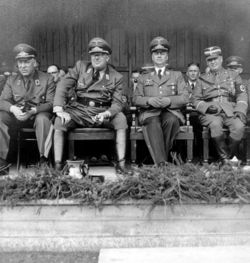
Contrary to the RKO’s original plan not to grant admission to national universities, the one in Riga was reopened by the local population shortly after the Wehrmacht’s invasion, at the instigation of General Commissioner Drechsler, a move which was ultimately sanctioned by Rosenberg. Other institutions in the four General Districts followed suit. The intended imposition of German as the primary language of instruction failed to materialise, and interventions by the Reich Ministry in curricula and organisational matters also remained largely unsuccessful. Particular support was given to primary school teacher training colleges in order to ensure a supply of qualified staff for the school system. In the autumn of 1942, a one-year labour service for students was also established, which had to be carried out in the Reich Commissariat. Despite these measures, dissident movements against the occupation grew at the universities, which became ‘centres of national resistance’.[16]
4. Discourses/Controversies
For a long time, historiography on the Reichskommissariat Ostland in the German-speaking world was dominated by the memoirs of former officials.[17] It is only in the last 25 years or so that more intensive academic research has taken place, based in part on the accessibility of archival holdings in the Baltic states, which have been independent again since 1991. In Estonia, Latvia and Lithuania, the state is also making corresponding efforts. Nazi rule is usually examined in the context of the preceding Soviet occupation and the subsequent membership of the Soviet Union, for example by the ‘International Commission for the Evaluation of the Crimes of the Nazi and Soviet Occupation Regimes in Lithuania’, established in 1998,[18] which gives rise to debates on historical policy. The question of resistance and collaboration is also frequently the subject of controversial discussion.[19] The centre of German-language research is primarily on the various actors involved in the organised extermination of the Jews, set against the backdrop of the spheres of interest outlined above.[20] In the context of ‘recent research on perpetrators’[21], investigations have also focused on issues of self-representation and future career prospects for both the leadership and subordinate officials of the Nazi bureaucracy in the region, as well as on the legal reckoning – and its shortcomings.[22] A comprehensive overview of developments in the Reichskommissariat is still lacking, particularly as recent accounts have tended to focus on the present-day nation-state level of the sub-regions, the former General Commissariats, or even individual towns:[23] ‘A genuine synthesis of the research findings in the form of a “history” of the Reich Commissariat Ostland has not yet been achieved.’[24] For the time being, this remains a gap in the research.
Sources: Files
- Federal Archives, Berlin-Lichterfelde, Collection R 6: Reich Ministry for the Occupied Eastern Territories.
- Berlin-Lichterfelde Federal Archives, Collection R 70 – Soviet Union: Police stations in the Soviet Union.
- Federal Archives Berlin-Lichterfelde, Collection R 90: Reich Commissioner for the Ostland.
- Federal Archives Berlin-Lichterfelde, Collection R 91: Regional Commissioners within the remit of the Reich Commissioner for the Ostland.
- Berlin-Lichterfelde Federal Archives, Collection R 92: General Commissioner in Riga.
- Berlin-Lichterfelde State Archives, Collection R 93: General Commissioner for White Ruthenia in Minsk.
Sources: Periodicals
- Official Gazette of the Reich Commissioner for the Ostland. Riga 1943/44.
- Official Gazette of the General Commissioner in Kaunas. Kaunas 1941–1944.
- Official Gazette of the General Commissioner for White Ruthenia / Official Gazette of the General Commissioner in Minsk. Minsk 1941–1944.
- Official Gazette of the Reich Minister for the Occupied Eastern Territories. Berlin 1943/44.
- Historical Atlas of the Reich Commissariat for Ostland. Riga 1943.
- Ostland. Monthly Journal of the Reich Commissioner for Ostland. Riga 1942/43.
- Statistical Reports on Ostland. Riga 1941–1944.
- Structural Report on Ostland. Part 1: Ostland in Figures. Part 2: Ostland Atlas. Riga 1942. (http://libx.bsu.edu/cdm/landingpage/collection/ostlndAtls).
- Official Gazette of the Reich Commissioner for the Ostland. Riga 1942–1944.
- Regulation Gazette of the Reich Minister for the Occupied Eastern Territories. Berlin 1942–1944.
Sources: Editions
- Wolfgang Benz, Konrad Kwiet, Jürgen Matthäus (eds.): Operations in the ‘Reichskommissariat Ostland’. Documents on the Genocide in the Baltic States and Belarus 1941–1944. Berlin 1998 (National Socialist Occupation Policy in Europe 1939–1945 6).
- Wolfgang Benz, Marion Neiss (eds.): The Murder of the Jews in Lithuania. Studies and Documents. Berlin 1999 (Documents, Texts, Materials 33).
- Tôviyyā Friedman (ed.): SS-Obergruppenführer Friedrich Jeckeln. Responsible for the Murder of the Jews in Lithuania, Latvia and Estonia 1941–1944. Collection of Documents. Haifa 1997.
- Tôviyyā Friedman (ed.): The Three SS and Police Leaders in the Ostland. In Latvia-Riga: SS-Brigadeführer Schröder; in Lithuania-Kaunas: SS-Brigadeführer Wysocki; in Estonia-Reval: SS-Brigadeführer Möller. Collection of documents. Haifa 1998.
- Wolfgang Scheffler, Diana Schulle (eds.): Book of Remembrance. The German, Austrian and Czechoslovakian Jews deported to the Baltic States. 2 vols. Munich 2003.
Bibliography
- Alexander Dallin: German Rule in Russia 1941–1945. A Study of Occupation Politics. London et al. 1957 [German translation: Deutsche Herrschaft in Russland 1941–1945. A Study of Occupation Politics. Translated from the American original by Wilhelm and Modeste Pferdekamp. Unaltered reprint of the 1958 edition, Königstein/Ts., Düsseldorf 1981].
- Uwe Danker: Hinrich Lohse, the NSDAP Gauleiter of Schleswig-Holstein. Reflections on his biography. In: Michael Ruck, Karl Heinrich Pohl (eds.): Regions under National Socialism. Bielefeld 2003 (Publications of the Institute for Schleswig-Holstein Contemporary and Regional History 10), pp. 91–120.
- Sven Jüngerkes: Attempts to Find Meaning in an Administration in Decline. Attempts at Reform in the Reichskommissariat Ostland 1943–1944. In: Stefan Haas, Mark Hengerer (eds.): In the Shadow of Power. Communication Structures in Politics and Administration 1600–1950. Munich 2008, pp. 253–278.
- Sebastian Lehmann, Robert Bohn, Uwe Danker (eds.): Reichskommissariat Ostland. Scene of the Crime and Object of Remembrance. Paderborn et al. 2012 (Age of the World Wars 8).
- Timothy Patrick Mulligan: *The Politics of Illusion and Empire: German Occupation Politics in the Soviet Union, 1942–43*. Westport, CT, London 1988.
- Seppo Myllyniemi: The Reorganisation of the Baltic States 1941–1944. On the National Socialist Content of German Occupation Policy. Helsinki, Vammala 1973 (Historiallisia tutkimuksia 90, Dissertationes historicae 2).
- Gerald Reitlinger: The House Built on Sand. The Conflicts of German Policy in Russia 1939–1945. London et al. 1960 [German translation: A House Built on Sand. Hitler’s Policy of Violence in Russia 1941–1944. Authorised translation from the English by Johann Wolfgang Brügel. Contributor: Heinrich Bodensieck. Hamburg 1962].
- Wolfgang Scheffler: On the role of the civil administration in the implementation of the ‘Final Solution to the Jewish Question’ in the Reichskommissariat Ostland [1974]. In: Helge Grabitz: Perpetrators and Accomplices of the Final Solution Mania. Hamburg Trials for Nazi Crimes of Violence 1946–1996. Edited by the Hamburg Judicial Authority. Hamburg 1999 (Contributions to Recent Hamburg Judicial History 3), pp. 242–272.
- Andreas Zellhuber: ‘Our administration is heading for a catastrophe…’. The Reich Ministry for the Occupied Eastern Territories and German Occupation Rule in the Soviet Union 1941–1945. Munich, Stammsried 2006 (Berlin & Munich: Studies in Politics and History 3).
Notes
[1] For a recent introduction to the actual history, its legacy and the current state of research, see Sebastian Lehmann, Robert Bohn and Uwe Danker (eds.): Reichskommissariat Ostland. Tatort und Erinnerungsobjekt. Paderborn et al. 2012 (Zeitalter der Weltkriege 8). Jonathan Steinberg offers a problem-oriented introduction to the overall context of the occupied territories in the Soviet Union: *The Third Reich Reflected. German Civil Administration in the Occupied Soviet Union, 1941–4*. In: English Historical Review 437 (1995), pp. 620–651.
[2] See Wulf Pingel: From Kiel to Riga. People from Schleswig-Holstein in the German Civil Administration of the Reich Commissariat Ostland. In: Journal of the Society for Schleswig-Holstein History 122 (1997), pp. 439–466; Sebastian Lehmann: Nazi Party Officials from Schleswig-Holstein in the Ostland. On the Source Value of the Files of the Special Courts in the British Occupation Zone for the Role of the Civil Administration in the Reichskommissariat Ostland. In: David Gaunt, Paul A. Levine, Laura Palosuo (eds.): Collaboration and Resistance during the Holocaust. Belarus, Estonia, Latvia, Lithuania. Bern et al. 2004, pp. 77–94, esp. 77–83; Klaus Bästlein: Genocide and Colonial Fantasies. The ‘Reichskommissariat Ostland’ under Schleswig-Holstein administration. In: Alfred Gottwaldt (ed.): Nazi Tyranny. Contributions to Historical Research and Legal Analysis. Berlin 2005 (Publications of the Haus der Wannsee-Konferenz Memorial and Educational Centre 11), pp. 217–246.
[3] These are the maximum figures according to: *Forced Paths: Flight and Expulsion in 20th-Century Europe* (Exhibition at the Kronprinzenpalais, Berlin, 11 August to 29 October 2006). Wiesbaden 2006, p. 64.
[4] Cf. Andrej Angrick: ‘The Role of Terror and Murder in the Concept of German Occupation Policy in the Baltic States’. In: Lehmann, Bohn, Danker (eds.): Reichskommissariat Ostland (as in note 1), pp. 69–87, here pp. 70–73.
[5] On this subject, see directly: Hans-Erich Volkmann: ‘On the Settlement of the Baltic Germans in the “Warthegau”’. In: Zeitschrift für Ostforschung 30 (1981), pp. 527–558; Lars Bosse: ‘From the Baltic States to the Reichsgau Wartheland’. In: Michael Garleff (ed.): The German Balts, the Weimar Republic and the Third Reich. Vol. 1. 2nd, revised and expanded edition. Cologne et al. 2008, pp. 297–387; Markus Krzoska: ‘A Stranger Among Fellow Compatriots?’ German Balts in the Reichsgau Wartheland 1939–1945. In: Online Yearbook of the Carl Schirren Society 2 (2011).
[6] Cf. Rudolf Hilbrecht: ‘Lithuania in the Reichskommissariat Ostland 1941–1943/44. Parallels and contrasts with the rest of the Baltic region, particularly Estonia’. In: Robert Bohn (ed.): German Rule in the ‘Germanic’ Countries 1940–1945. Stuttgart 1997 (Historische Mitteilungen, Supplement 26), pp. 187–207, here pp. 201–203.
[7] Cf. Angrick: The Significance of Terror and Murder (as in note 4), pp. 73–86. The following figures are also given there.
[8] See Helmut Krausnick, Hans-Heinrich Wilhelm: The Troops of the Ideological War. The Einsatzgruppen of the Security Police and the SD 1938–1942. Stuttgart 1981 (Sources and Accounts of Contemporary History 22); Ralf Ogorreck: The Einsatzgruppen and the ‘Genesis of the Final Solution’. Berlin 1996 (Documents, Texts, Materials 12); Peter Klein (ed.): The Task Forces in the Occupied Soviet Union 1941/42. The Activity and Situation Reports of the Chief of the Security Police and the SD. Berlin 1997 (Publications of the Haus der Wannsee-Konferenz Memorial and Educational Centre 6); Wolfgang Curilla: The German Order Police and the Holocaust in the Baltic States and Belarus 1941–1944. Paderborn 2006.
[9] Christoph Dieckmann: Reflections on German Occupation in Eastern Europe 1941–1944. The Case of Lithuania. In: Annaberger Annalen. Yearbook on Lithuania and German–Lithuanian Relations 5 (1997), pp. 26–46, here p. 41.
[10] Angrick: The Significance of Terror and Murder (as in note 4), p. 83.
[11] Figures taken from: Gerd Robel: The Soviet Union. In: Wolfgang Benz (ed.): The Scale of Genocide. The Number of Jewish Victims of National Socialism. Munich 1991 (Sources and Accounts of Contemporary History 33), pp. 499–560, here pp. 500–507, 556–560; Eberhard Jäckel, Peter Longerich, Julius H. Schoeps (eds.): Encyclopaedia of the Holocaust. The Persecution and Murder of European Jews. Berlin 1993, pp. 419–421 (Estonia), 854–857 (Latvia), 869–873 (Lithuania), 1567–1573 (Belarus).
[12] Cf. Tilman Plath: The Latvian Region of Latgale under German Occupation 1941–1944. Reactions of the Population. In: Lehmann, Bohn, Danker (eds.): Reichskommissariat Ostland (as in note 1), pp. 101–115, here 112–114.
[13] See Hilbrecht: ‘Lithuania in the Reichskommissariat Ostland’ (as in note 6), pp. 192–195; for a detailed account, see Tilman Plath: ‘Between Leniency and Manhunts. The Labour Deployment Policy in the Baltic General Districts of the Reichskommissariat Ostland 1941–1944. Essen 2012.
[14] See Plath: The Latvian Region of Latgale (as in note 12), pp. 108ff.
[15] For the overall picture, see H[ans]-D[ieter] Handrack: The Reich Commissariat Ostland. The cultural policy of the German administration between autonomy and Gleichschaltung 1941–1944. Scheden [1979] / Hann. Münden 1981, here pp. 94–101. For a critical assessment, see Jörg Hackmann: The Reichskommissariat Ostland in the Context of German Historiography. In: Lehmann, Bohn, Danker (eds.): Reichskommissariat Ostland (as in note 1), pp. 285–301, here pp. 293ff.
[16] Handrack: The Reich Commissariat Ostland (as in note 15), p. 138.
[17] Cf. for example Peter Kleist: Between Hitler and Stalin 1939–1945. Memoirs. Bonn 1950 [translated into French in 1953]; Otto Bräutigam: This Is How It Happened… A Life as a Soldier and Diplomat. Würzburg 1968. See also, for an overview of the research literature, Hackmann: The Reich Commissariat Ostland (as in note 15), esp. pp. 287–293; Klaus Bästlein: On the historiography of the genocide of European Jews, taking the Reichskommissariat Ostland as an example. In: Lehmann, Bohn, Danker (eds.): Reichskommissariat Ostland (as in note 1), pp. 303–329, esp. pp. 304–321.
[18] On the work of this commission and similar bodies in Estonia and Latvia, see Walter M. Iber, Peter Ruggenthaler: Three Occupations under Two Dictatorships. A Preliminary Assessment of the Research Work of the International Commissions of Historians in Latvia, Lithuania and Estonia. In: Yearbook for Historical Research on Communism 15 (2007), pp. 276–296; Eva-Clarita Onken: ‘The Politics of Finding Historical Truth. Reviewing Baltic History Commissions and their Work’. In: Journal of Baltic Studies 38 (2007), pp. 109–116.
[19] See, for example, Robert Bohn: ‘Collaboration and German Mobilisation Efforts in the Reichskommissariat Ostland. Fundamental Considerations’. In: Gaunt, Levine, Palosuo (eds.): *Collaboration and Resistance* (as in note 2), pp. 33–44; ibid.: Collaboration and Genocide in the Reichskommissariat Ostland. Criminal Prosecution in the Federal Republic of Germany: The Case of the Arajs Trial. In: Lehmann, Bohn, Danker (eds.): Reichskommissariat Ostland (as in note 1), pp. 269–284. For Lithuania, see, amongst others, the individual studies by Joachim Tauber: The Lithuanian Administration and the Jews in Vilnius, 1941–1943. In: Johannes Hürter, Jürgen Zarusky (eds.): Occupation, Collaboration, Holocaust. New Studies on the Persecution and Murder of European Jews. Munich 2008 (Series of the Vierteljahrshefte für Zeitgeschichte 97), pp. 103–114; ibid.: ‘Jews, your history on Lithuanian soil is at an end!’ Lithuania and the Holocaust in 1941. In: Osteuropa 52 (2002), No. 9/10, pp. 1346–1360; for Estonia, Anton Weiß-Wendt: *Murder Without Hatred. Estonians and the Holocaust*. Syracuse, N.Y., et al., 2009 (Religion, Theology, and the Holocaust); Ruth Bettina Birn: The Security Police in Estonia 1941–1944. A Study of Collaboration in the East. Paderborn et al. 2006 (Schöningh Collection on History and the Present).
[20] See, for example, the overviews of the extermination of Jews in Latvia in Andrej Angrick, Peter Klein: The ‘Final Solution’ in Riga. Exploitation and Extermination 1941–1944. Darmstadt 2006 (Publications of the Ludwigsburg Research Centre of the University of Stuttgart 6) [English translation 2009, War and Genocide 15]; Andrew Ezergailis: The Holocaust in Latvia 1941–1944. The Missing Centre. Riga 1996; Bernhard Press: The Murder of the Jews in Latvia 1941–1945. 2nd, revised ed. Berlin 1995 (Documents, Texts, Materials 4). On the role of the civil administration, see Uwe Danker: The ‘Civil Administration’ of the Reichskommissariat Ostland and the Holocaust. Perception, Role and ‘Coming to Terms’. In: Gaunt, Levine, Palosuo (eds.): Collaboration and Resistance (as in note 2), pp. 45–76.
[21] For an introduction, see Frank Bajohr: Recent Research on Perpetrators, Version: 1.0. In: Docupedia – Contemporary History. 18 June 2013: docupedia.de/zg/Neuere_Taeterforschung (accessed: 15 July 2014).
[22] See, for example, the articles by Uwe Danker: ‘The Failed Attempt to Debunk the Myth of the “Clean” Civil Administration. Prosecutorial Complex Investigations into the Holocaust in the “Reichskommissariat Ostland” up to 1971’. In: Bohn (ed.): German Rule (as in note 6), pp. 159–185; the same author: ‘We are subsidising the murderers of democracy’. The tug-of-war over the pension arrangements for Gauleiter and Oberpräsident Hinrich Lohse between 1951 and 1958. In: Journal of the Society for Schleswig-Holstein History 120 (1995), pp. 173–199; ibid.: ‘Stories and Historical Constructions for the Courts and the Public. Perpetrator Narratives: The Case of Hinrich Lohse’. In: Lehmann, Bohn, Danker (eds.): Reichskommissariat Ostland (as in note 1), pp. 229–250.
[23] For detailed information on Lithuania, see Christoph Dieckmann: German Occupation Policy in Lithuania 1941–1944. 2 vols. Göttingen 2011; Vincas Bartusevičius, Joachim Tauber, Wolfram Wette (eds.): The Holocaust in Lithuania: War, the Murder of Jews and Collaboration in 1941. Cologne et al. 2003. For Latvia, see Sven Jüngerkes: German Occupation Administration in Latvia 1941–1945. A History of Communication and Culture in National Socialist Organisations. Konstanz 2010 (Historical Cultural Studies 15); Katrin Reichelt: Latvia under German Occupation 1941–1944. The Latvian Role in the Holocaust. Berlin 2011 (Documents, Texts, Materials 78); Björn M. Felder: Latvia in the Second World War. Between Soviet and German Occupiers 1940–1946. Paderborn et al. 2009 (War in History 43), pp. 189–318. For Belarus, see Bernhard Chiari: Everyday Life Behind the Front. Occupation, Collaboration and Resistance in Belarus 1941–1944. Düsseldorf 1998 (Publications of the Federal Archives 53); Christian Gerlach: Calculated Murders. German Economic and Extermination Policy in Belarus 1941–1944. Hamburg 1999; Leonid Rein: The Kings and the Pawns. Collaboration in Byelorussia during the Second World War. New York, NY et al. 2011 (War and Genocide 15). For a city-centred approach using Riga as an example, see Angrick, Klein: The ‘Final Solution’ in Riga (as in note 20) and Eduard Mühle, Norbert Angermann (eds.): Riga in the Process of Modernisation. Studies on the Transformation of a Baltic Metropolis in the 19th and Early 20th Centuries. Marburg 2004 (Conferences on East Central European Research 21), including the contributions by Edvīns Evarts (pp. 255–264), Uwe Danker (pp. 265–287) and Uldis Neiburgs (pp. 288–293).
[24] Sebastian Lehmann: Introduction. In: Ibid., Bohn, Danker (eds.): Reichskommissariat Ostland (as in note 1), pp. 9–34, here: p. 12.
Citation
Martin Munke: Reichskommissariat Ostland. In: Online Encyclopaedia on the Culture and History of Germans in Eastern Europe, 2014. URL: ome-lexikon.uni-oldenburg.de/p32579 (as at 21 August 2014).
Terms of use for this article
Copyright © University of Oldenburg and the Federal Institute for the Culture and History of Germans in Eastern Europe (BKGE), all rights reserved. This work was produced as part of the project ‘Online Encyclopaedia on the Culture and History of Germans in Eastern Europe’ and may be reproduced and published provided the rights holders’ consent has been obtained. Please contact:
If you have any specialist comments or additions to the text, please contact the editorial team, citing relevant literature and source references.