

Lettgallen (Polish Livonia, Inflantia)
Lettgallen (Polish Livonia, Inflantia)
Names in other languages
Latvian: Latgale; Latgalian: : Latgola; Russian: Latgalija/Latgale; Polish: Łatgalia; historically also Inflanty; Lithuanian: Latgala; Latin: Lettgallia
Etymology
The name (Letgola) is first mentioned in the Old East Slavic ‘Tale of Bygone Years’ (the Nestor Chronicle, written between 1113 and 1118) in reference to a Baltic ethnic group near the Baltic Sea who settled there during the 11th century. In the Chronicle of Henry of Latvia from the first half of the 13th century, the Latin terms ‘Lethi’ and ‘Lethigalli’ are used synonymously (‘Lethos, qui proprie dicitur Lethigalli’) and refer to the population of the Baltic principalities of Jersika, Tālava, Atzele and Koknese in the east of present-day Latvia. Whilst the term ‘Lethi’ or ‘Letten’ became established in Latin and German with the Livonian Rhyming Chronicle (late 13th century), the First Novgorod Chronicle from the 14th century still used the term ‘Latygola’. The root ‘Let’ or ‘Lat’ may be related to the Lithuanian river Latava.
Location

Generally speaking, Latgale refers to the historically and culturally defined region in eastern Latvia, bounded to the south by the Daugava (Latvian: Daugava) to the south, by the rivers Ewst/Awex (Latvian: Aiviekste) and Pededze to the west and north-west, and by the borders with Russia and Belarus to the east.
For pragmatic reasons, however, the narrow region between historical Latgale and Lithuania – the Ilūkste region – which historically belonged to Semigallia, is also considered part of Latgale for administrative purposes; consequently, there is currently a cultural-historical Latgale and a somewhat larger administrative unit known as Latgale.
Cultural-historical Latgale covers an area of 14,546 square kilometres. The administrative unit of Latgale covers an area of 16,423 square kilometres and has a population of 255,968 (2020).
Topography
Lettgallen is known as the ‘Land of Blue Lakes’ for its numerous lakes. Of the approximately 1,000 lakes, Lake Rāzna and Lake Lubān are the best known and largest. There are also many marshes and peat bogs. Around 30 per cent of the region’s area is forested. In the centre and east lies the hilly Lettgallen Uplands, which reach a height of 289.8 metres at the Great Linden Hill (Latvian: Lielais Liepukalns), making it the third-highest point in Latvia.
The largest town in the region is Dünaburg/Daugavpils (approx. 82,000 inhabitants). However, the de facto cultural capital is the second-largest town, Rositten/Rēzekne (approx. 28,000 inhabitants), situated in the centre of the region. Other small towns with fewer than 10,000 inhabitants include Ludsen/Ludza, Aglohn/Aglona, Bolwen/Balvi, Karsau/Kārsava, Kreslau/Krāslava, Prely/Preiļi and Rosenau/Zīlupe.


Historical Geography
A distinction must generally be made between medieval and modern Lettgallen. In the medieval context, the term referred, on the one hand, to the settlement area of the Lettgallians, which covered a much larger territory than present-day Lettgallen and extended both significantly further west, into what is now Vidzeme (Livonia), and as far east as what is now Belarusian and Russian territory. In addition, the term ‘Latgola/Letgola’, as used in Old Slavonic sources, also denoted a smaller political entity comprising part of present-day Latgale as well as Belarusian territories. The eastern border was marked by the division of this territory in 1264 between the German Order and the Principality of Polotsk.
The western border of modern Latgale dates back to 1629, when the Polish–Lithuanian Commonwealth was forced to cede the territory west of the Daugava to Sweden, thereby establishing the historical region of Latgale, even though it was known as Inflanty under Polish rule and the name Latgale only came back into use in the wake of the national movement around 1900. Under Russian rule, from 1772 onwards, the region was not reunited with the Russian Baltic provinces, but was integrated into internal Russian governorates.
Following the attainment of independence in 1918–20, Latgale was united with the other areas inhabited by Latvians within the Republic of Latvia. In addition, in the north-east, there was a small strip of territory around the town of Pytalovo (Latvian: Abrene/Jaunlatgale), which is now once again part of Russia; this had to be ceded to the Soviet Union after the Second World War and remained part of Russia even after 1991. On the other hand, however, after 1991 the small strip of land between Latgale and Lithuania – which historically belongs to Semigallia – was administratively incorporated into Latgale. From a cultural-historical perspective, however, it is not considered part of the Latgale region.
Common symbolism

The coat of arms of Lettgallen depicts a silver griffin holding a sword in its right claw against a blue background.
In addition, an unofficial flag has existed since around 2010, consisting of dark blue, white and dark blue stripes arranged in a 2–1–2 ratio, like the Latvian flag. In the foreground, the coat of arms of early modern Polish Livonia can be seen, which in turn depicts an armed griffin (this time facing left) on a red background and which traces its origins back to the Polish-Lithuanian noble family of Chodkiewicz.
Nicknames
As the name Lettgallen was not in use during the Early Modern period and the region was under Polish-Lithuanian rule, ‘Inflanty’, derived from ‘Polish Livonia’ (short for Województwo inflanckie/Liv onia Voivodeship), a historically significant alternative term, though one that no longer holds any relevance in everyday language.
The inhabitants of Lettgallen are referred to by Latvians outside the region, in a friendly yet mocking manner, as Čangaļi ( probably from Čanga: colloquially, a person who stirs food). Conversely, the name Čiuļi (probably from Ķūlis: a coarse, strange and clumsy person) is used with the same intention to refer to the majority of Latvians outside Latgale.
Prehistory and Early History
The earliest evidence of a settled way of life in the Latgale region is found in the area around Lake Lubān and dates to the Kunda culture (c. 8000–5000 BC). This was followed by the Narva culture (c. 5000–3000 BC), for which settlement remains have also been found around Lake Lubān. The Comb Ceramic culture (c. 4000–2000 BC) is also attested in this area and is frequently associated with the migration of Finno-Ugric peoples. However, it is possible that these peoples did not arrive in the region until later.
Between the fifth and seventh centuries AD, the Baltic tribes arriving from the south drove the Finno-Ugric population northwards and westwards, with the result that Baltic tribes settled in the eastern and northern parts of present-day Latvia; these were first referred to in Russian sources from the 11th and 12th centuries as the Lettgalians, a name which gave rise to the terms ‘Lettgallen’, ‘Latvia’ and ‘Latvians’. Before 1200, the Lettgallian tribes formed various confederations; Jersika, north of the Daugava, and Tālava, near present-day Estonia, were the largest and most powerful of these. The chronicler Heinrich von Lettland even records that Visvaldis (?–1230), ruler of Jersika during the period of conflict with the German Crusaders, held the title of king. To some extent, there were ties of dependency to the Principality of Polotsk, from where the Orthodox Church also undertook attempts at evangelisation.
Middle Ages
In the first half of the 13th century, German crusaders, the Principality of Polotsk, Lithuania and Jersika, as well as several smaller Latgalian confederations, fought in shifting alliances for supremacy in the region; this culminated in a victory for the German Order, as a result of which the region became part of the Livonian Confederation. To consolidate the German Order’s rule, Order castles were built at Wolkenburg (1263) near Lake Rāzna, Alt-Dünaburg (1275) and Rositten (1285). In the wake of ongoing border disputes and armed conflicts between the German Order, Lithuania and Novgorod in the 14th century – which were also marked by internal conflicts between the Archbishop of Riga and the German Order – the Order’s castle in Ludsen was added at the end of the 14th century to provide better defence and control. Following the conquest and destruction of the Order’s castles by Ivan III, Grand Prince of Moscow (1440–1505), at the end of the 15th century, and a battle won by the Order at Lake Smolina under Grand Master Wolter von Plettenberg (1450–1535) not far from northern Latgale in 1502, a further fortress was built in Marienhausen/Viļaki to defend against the Principality of Moscow; however, this was not situated on Teutonic territory but belonged to the Archdiocese of Riga.
Modern times
The Livonian War had devastating consequences for the region. Old Dünaburg was completely destroyed during the Russian conquest by Tsar Ivan IV (1530–1584) and re-established some 20 kilometres downstream. The town still stands there today. At the end of the war, the Russian troops were forced to withdraw, and Latgale became part of the Duchy of Livonia (Polish: Księstwo Inflanckie or Księstwo Zadźwińskie), which also encompassed present-day Vidzeme and areas of southern Estonia. Jan Hieronimowicz Chodkiewicz (1530–1579) became the first governor, based in what is now the Latvian town of Segewold/Sigulda. However, Poland–Lithuania lost these territories to Sweden as early as 1621, so that only present-day Latgale remained as the Voivodeship of Livonia, a condominium under Poland–Lithuania. The seat of the voivode became Dünaburg, which had been granted Magdeburg city rights by the Polish King Stefan Batory (1533–1586) in 1582. During the Second Northern War (1655–1661), the Swedes destroyed the castle at Rositten, whilst the Russians occupied the southern and central parts of Latgale between 1656 and 1667, renaming Dünaburg ‘Borisoglebsk’ during this period, but were forced to withdraw following the Treaty of Andrusovo.
During the Great Northern War, the plague claimed a considerable number of lives in 1710, but Polish Livonia remained part of the Polish–Lithuanian Commonwealth despite Russian conquests. A distinctive feature of the Polish–Lithuanian period was the Polonisation of the region’s formerly German-speaking nobility. Families such as the Manteuffels, Platers, Borchs, Hilsens, Tiesenhausens and Weißenhofs gained political significance within the Polish–Lithuanian state, even beyond the region. In addition to the Polonisation of the German-speaking nobility, membership of the Polish–Lithuanian Commonwealth also led to an influx of Jewish settlers who were culturally close to Lithuanian Jewry – the so-called ‘Litvaks’. Furthermore, the proximity to Russia meant that Russian emigrants who did not support the reform of the Russian Orthodox Church in the mid-17th century sought refuge in the Latgale region.
Following its incorporation into the Russian Empire as a result of the partitions of the Polish-Lithuanian Commonwealth, the influx of Russian settlers intensified from 1772 onwards, not least because Dünaburg – officially known in Russian as Dvinsk from 1893 – became a garrison town for the Russian army. Construction of a major citadel began here in the early 19th century; it was put to immediate military use in the war against Napoleon and gained strategic importance, although by the time it was actually completed in 1878, it was already obsolete in military terms. In addition to the influx of Russian soldiers, the construction of the citadel also brought a number of German-speaking officers and civil engineers to Dünaburg. It was designed by Johann Friedrich Heckel (1764–1832). One of his successors as chief engineer of the fortress, Nikolai Hagelstrom (1812–1883), later became mayor of the town (1865–1870, 1874–1876) and founder of the municipal theatre. The fortress commanders Georg Leonard Christoph von Richter (1778–1823), Gustav Helwig (1776–1855) and Rudolf Johann von Schulmann (1814–1874), as well as the officer and architect Alexander Staubert (1780–1843), all gained regional significance in the town’s history. However, the greatest influence was exerted by Karl Jacob Arvid Pfeffer (1847–1918), who served as mayor of Dünaburg from 1899 to 1915 – longer than any other person.
The town experienced a further significant surge in development as a result of the intensified construction of the railway from the 1850s onwards, as theWarsaw/Warszawa–St. Petersburg/Sankt-Peterburg and Riga/Rīga–Orel lines, and there was a connection to the Libau/Liepāja–Romny line in what is now Ukraine. As a result, a number of industrial enterprises established themselves in the town.
Alongside Dünaburg, Rositten also benefited from the construction of the railway line between St Petersburg and Warsaw, though it did not experience such a significant surge in development as Dünaburg. In general, industrialisation largely bypassed the rural region of Latgale, with the result that Latgale still bears the stigma of being underdeveloped compared to the rest of Latvia. It should be noted that, unlike the other regions of Latvia, Latgale was not part of the so-called Baltic Provinces and therefore did not enjoy any special privileges; this played a particularly significant role in the abolition of serfdom, which, here as in other parts of the Russian Empire, was abolished much later than in the Baltic Provinces – not until 1861. This explains the region’s comparatively slow pace of social change. Culturally, too, the Latvian national movement that emerged in the 19th century struggled to gain a foothold in Lettgallen, partly because the population’s literacy rate lagged significantly behind that of other parts of Latvia, but also because centuries of administrative separation had left their mark on the region’s culture. Latgale was thus also swept up in the Polish uprisings of the 19th century, which, after 1865 – as in other parts of Poland – resulted in a ban on printing in the Latin alphabet; this ban was not lifted until 1904 and severely hampered the development of Latvian, or Latgalian, as a written language in the region. On the other hand, Latgale was also part of the so-called Jewish Settlement District, which fostered the development of Jewish culture in parallel with the formerly Lithuanian and Polish territories within the Russian Empire. One such example was the early establishment of the Jewish-socialist workers’ party, the Bund, in Dünaburg. Zionist movements also found support in Latgale before the First World War. Dünaburg, in particular, became a centre of Jewish culture before the First World War, with Jews making up more than half of the population at that time.
Contemporary History

Following the advance of German troops as far as the Daugava in 1915, the First World War turned Latgale into a frontline region and had a devastating effect on the previously dynamic urban development of Daugavpils, whose population fell to below 20,000. Shortly after the February Revolution, at the First Latvian Congress of Latgale in Rositten, the majority of delegates voted in favour of unification with the other regions of Latvia, whilst a congress of the Russian population held shortly afterwards voted to remain within the Vitebsk Governorate. Attempts to establish a socialist state in the wake of the October Revolution of 1917 were somewhat more enduring in Latgale than in other parts of Latvia, this was due less to the population’s greater affinity for socialism than to the military support provided by neighbouring Russia, which was under Bolshevik rule. It was not until 1920 that Latvian and Polish troops succeeded in conquering the region and uniting it with the rest of Latvia within the new parliamentary republic. Subsequently, the highly heterogeneous political landscape of Latgale was successfully integrated into the young democracy. During the authoritarian rule under Kārlis Ulmanis (1877–1942), efforts to harmonise Latgale with the Latvian nation-state, including in cultural terms, intensified from 1934 onwards. This policy is reflected in the House of Unity (Daugavpils Vienības nams) in Daugavpils, the monument to the Latgalian partisan units in the 1938 War of Independence in Bolwen, and the imposing sculpture ‘United for Latvia’ in Rositten from 1939, as well as the increasingly patriotic song festivals, such as the grand Latgale Song Festival organised in Daugavpils in June 1940, shortly before the loss of independence.
As a result of the Hitler–Stalin Pact, Latgale, together with Latvia, initially became a Soviet Socialist Republic in 1940, but was conquered by the Germans as early as 1941 and became part of the General Commissariat of Latvia. As the proportion of the Jewish population in Latgale was significantly higher than in other parts of Latvia, the Holocaust represents, in a particular way, a loss of the region’s cultural identity. In Daugavpils, a Jewish ghetto existed until early 1943 in the part of the fortress situated south of the Daugava. The extent of collaboration by the non-Jewish population during the Holocaust in Latgale is a matter of debate.[1]
Nazi terror measures were also directed against other population groups in Latgale. For instance, the Old Believer inhabitants of the village of Audriņi near Rositten were killed in their entirety in early 1942 as a reprisal. The patients at the psychiatric hospital in Aglohn were also all murdered by the German occupying forces. On the other hand, the German occupation authorities attempted to win over the Russian-speaking population to collaboration by establishing Russian police units in German service. Nevertheless, the majority of the anti-German partisans in Latgale were Russian-speaking. In the wake of the Red Army’s summer offensive in 1944, Latgale came under Soviet rule and was subsequently, like other parts of Latvia, affected by Soviet deportations and acts of terror. The so-called ‘Forest Brothers’, armed anti-Soviet resistance fighters, fought back against this, but ultimately without success. As a result of forced industrialisation, many Russian-speaking people returned to Latgale over the decades, not least to the rapidly growing town of Daugavpils, where Russian became the dominant everyday language. Nevertheless, here too, a majority of eligible voters voted in March 1991 in favour of the restoration of an independent Latvia.
Administration
In the Middle Ages, Lettgallen was divided into the Dünaburg Commandery in the south and the Rositten Bailiwick in the centre – both of which belonged to the Teutonic Order – and into a territory belonging to the Archdiocese of Riga around Marienhausen/Viļaka in the north. In the Duchy of Livonia, the region belonged to the Voivodeship of Wenden/Cēsis before it became a separate voivodeship after 1621. This voivodeship was in turn divided into four districts (Polish: trakt), namely Dünaburg, Rositten, Ludsen and Marienhausen. Under Russian rule, the area was initially part of the Pskov Governorate until 1776, then, from 1777 to 1796, part of the Polotsk Governorate; between 1796 and 1802, part of the Belarusian Governorate; and from 1802 until the end of the Russian Empire, part of the Vitebsk Governorate. During this period, the region was subdivided into the districts (Russian: uezdy) of Dünaburg, Rositten and Ludsen. From 1924, the region (Latvian: apgabals) of Latgale was subdivided into four districts (Latvian:apriņki): Dünaburg, Rositten, Ludsen and Abrene. Currently, the region is divided into approximately 19 smaller districts (Latvian: novadi), including the Ilūkste district, which lies south of the Daugava.
Population
Ever since it became part of the Polish-Lithuanian Commonwealth, at the very latest, the region has been characterised by marked ethnic diversity.
The population grew rapidly to over 115,000 inhabitants by the First World War, meaning it was higher than it is today. Together with the approximately 15,000 inhabitants of the Dünaburg district of Grīva, situated south of the Daugava, which was only incorporated into the town in 1953 and where the famous Latvian national poet Jānis Rainis (1865–1929) attended the German grammar school between 1875 and 1879, this was in fact the highest figure in the city’s history. Germans also played a significant role in the city’s industrialisation. Around 1900, with 11,000 Germans living in the city, there were more than six times as many Germans as Latvians.
This trend had reached its peak by the end of the Soviet era, when the Latvian/Latgalian population no longer constituted a majority in the region.
On the other hand, the total population has been falling steadily since 1989, from over 400,000 inhabitants to around 250,000 in 2020. At the same time, the proportion of Latvians and Latgalians has increased.
Economy
The declining population figures reflect the economic problems facing Latgale, which suffers particularly from its peripheral location. Whilst the industrial town of Daugavpils’ boom at the end of the 19th century was largely due to its good rail links, rail transport there is comparatively insignificant today. Modern projects such as ‘Baltic Rail’ bypass the Latgale region. The years of fruitless discussions regarding the use of the disused airport in Daugavpils also highlight the region’s connectivity issues. In an effort to transform the decline of industrial enterprises since 1989 into a positive structural change, efforts are being made to develop a modern, sustainable form of tourism tailored to the experience of nature. Furthermore, the Latgale Special Economic Zone was established in 2017 to improve coordination and generate synergies.
Military history
The region has time and again been the scene of armed conflicts between the major regional powers. Key turning points included the conquest by the German Knights of the Order in the 13th century, which was accompanied by the construction of the first fortresses – from which the urban centres that remain significant to this day developed – as well as the era of the Northern Wars between Sweden, Poland–Lithuania and Russia. Furthermore, the hostilities of both the First and Second World Wars had a devastating effect on the region. The most important garrison town was Daugavpils, with its fortress built in the 19th century.
Society
The region is characterised above all by its ethnic diversity, which can be attributed to its changing allegiances. This applies in particular to the Polish influence in the early modern period and the more pronounced ‘Russification’ in the 19th and 20th centuries. From a German perspective, it is noteworthy that, whilst the German-Baltic nobility became Polonised in the early modern period, a large number of Germans – particularly in Dünaburg – played an active role in industrialisation, a fact that has tended to be neglected in German-Baltic historiography. Furthermore, the region is characterised by a contrast between Dünaburg and the rural areas. Owing to Dünaburg’s rapid industrialisation, socialist ideas were more widespread here, whilst conservative and religious views were firmly entrenched in the countryside. The ethnic composition also followed different trajectories. Whilst the proportion of the Jewish population in Dünaburg was above average in the late 19th century, and an above-average number of Russians lived in the town from the second half of the 20th century to the present day, Latvians/Latgalians predominated in rural areas.
History of Religion and the Church

Alongside its multi-ethnic character, the region is also characterised by a distinct multi-denominational and multi-religious nature. Compared with other parts of Latvia, the Catholic faith of the Latgalian population is particularly striking here; it dates back to the Polish-Lithuanian period and, apart from brief periods of success for the Protestant Reformation, remains dominant to this day. Furthermore, during the Polish-Lithuanian period, many Jews and Old Believers came to the region. Finally, under Russian rule, Orthodox Russians, as well as Protestant Germans, settled in Latgale. The church hill in the centre of Daugavpils, where a Protestant, a Catholic, an Orthodox and an Old Believer church stand side by side within a very small area, exemplifies this diversity. The Soviet period led to the spread of atheistic tendencies.
Special cultural institutions / Education and science
The two towns of Daugavpils and Rositten are cultural centres. The region’s two higher education institutions are also located here – Daugavpils University (Daugavpils Universitāte), with around 4,000 students, and the Rositten Academy of Technology (Rēzeknes Technoloģiju akadēmija, formerly Rositten University of Applied Sciences) with around 2,000 students. Both trace their origins back to teacher-training colleges established in the interwar period. Due to its peripheral location, its size and its history shaped by industrial development, Daugavpils is less representative of the region than Rēzekne. Accordingly, Daugavpils is home to only one museum of urban and art history (Daugavpils Novadpētniecības un mākslas muzejs), which, however, was founded as far back as 1938, whilst Rositten is home to a larger and more modern regional history museum dedicated to the culture and history of Latgale (Latgales Kultūrvēstures muzejs). The multifunctional cultural centre (Latgales vēstniecības gors), which opened in 2013 and features a 1,000-seat concert hall and many other facilities, underlines Rositten’s role as the cultural centre of Latgale, as does the city’s ultra-modern central library, which opened in 2015.
On the other hand, Daugavpils can point to its supra-regional cultural significance through the Mark Rothko Art Centre (Daugavpils Marka Rotko mākslas centrs), which opened in 2013 within the fortress; its namesake (1903–1970) spent the first ten years of his life in the town at the beginning of the 20th century. A small Jewish Museum provides information on the broader context of the town’s Jewish history. The library and theatre are housed in the House of Unity, a building dating from the interwar period.
Cultural life in Latgale, outside the two largest cities, centres on the cultural centres – most of which were built in the 1950s – that can be found in many small towns. In addition, as tourism develops, a number of craft museums are opening in rural areas.
Everyday culture
In terms of everyday culture, Latgale stands out for the Latgalian language, which is actively spoken by around 100,000 people, particularly in the centre and north-east of the region, and constitutes a variant of Latvian. In the wake of the Counter-Reformation, Latgalian began to develop as a written language in the 18th century. From 1920 to 1934, it held the status of an official language restricted to Latgale, alongside Latvian. Having received no support during the Soviet era, Latgalian is currently experiencing a revival in the cultural sphere, ranging from various printed works and theatre plays to youth music culture such as rap and pop music.
History of Architecture
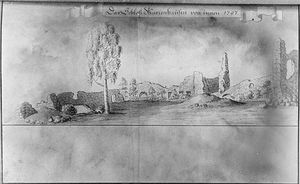
From an architectural-historical perspective, the medieval castle ruins at Ludsen, Marienhausen and Rositten are outstanding features of the region. Polish-Lithuanian rule left its mark in the form of numerous church buildings, amongst which the 18th-century basilica at Aglohn stands out. Alongside the Catholic churches, the Old Believer churches – some of which are timber-framed and situated in the heart of the countryside – are a particular feature. Furthermore, the numerous manor houses of the Polish/German-Baltic nobility, such as the Kreslau Castle belonging to the Plater family or the Prely Manor House belonging to the von der Borch family, remain attractions in the countryside to this day. As evidence of the rapid building boom around 1900 in Dünaburg, several Art Nouveau façades in the town centre have been well preserved, whilst in Rositten a few 19th-century timber-framed houses survived the destruction of the Second World War, the most notable of which is the renovated Green Synagogue. The most striking building from the interwar period is the House of Unity in Dünaburg. The Soviet era left behind the neoclassical cultural centres, the characteristic prefabricated blocks of flats and, in Dünaburg, a television tower over 200 metres high. The best-known monument is the ‘United for Latvia’ monument in Rositten, dating from the Ulmanis era.
Music
The singing festivals, which are fundamental to Latvian musical culture, also became an integral part of the wider folk culture in Latgale during the interwar period. In 1923, a music conservatoire opened in Daugavpils under the direction of the nationally renowned organist Nikolajs Vanadziņš (1892–1978), who, however, continued his career in Riga from 1929 onwards. His successor at the conservatoire in Daugavpils was Alfrēds Feils (1902–1942), who, having helped organise the 1940 singing festival in Daugavpils, was deported in 1941 and died in custody a year later. Jānis Ivanovs (1906–1983) hailed from the region itself; he worked at the Conservatoire and the National Opera in Riga both during the interwar period and under Soviet rule, and his Sixth Symphony is dedicated to Latgale. The Polish composer and conductor Grzegorz Fitelberg (1879–1953) gained international renown; he was born in Dünaburg in 1879, spent the early years of his life there and later collaborated with, amongst others, Sergei Diaghilev (1872–1929), amongst others. In the field of light music, Oscar Strock (1892–1975), who was also born in Dünaburg at the end of the 19th century, achieved international fame with his tangos.
History of Books, Printing and Literature
The first texts in the Latvian and Latgalian languages in the region, as well as the first regionally based book printing, can be traced back to the efforts of the Jesuits in the 17th century. The first book in the Latgalian language to have survived to this day was published in 1753 under the title *Evangelia toto anno*. It contains hymns and cemented the tradition of close symbiosis between Catholicism and Latgalian culture and literature. The ban on the use of Latin letters from 1863 onwards, following the Polish January Uprising, hindered the further development of journalism in the region. During this period, the scholar and civil servant Gustav von Manteuffel-Szoege (1832–1916) rendered outstanding service to the further development of the Lett-Gallian written tradition by publishing works in Lett-Gallian himself. He published the first Latgalian-language magazine (Inflantu zemes laika grōmota aba kalenders), which appeared from 1862 to 1871. However, his book *Pilniga lyugszonu gromota* [Complete Collection of Prayer Books] became his best-known work. In the early 20th century , St Petersburg became the intellectual centre of the Latgalian/Latvian national movement. Andrivs Jūrdžs (1845–1925) is regarded as a champion and figurehead of the Latgalian language, although none of his published works have survived. There is a certain irony in the fact that it was precisely during the German occupation of 1941–1944 that Lett-Galician journalism was encouraged, with the aim of weakening Latvian nationalism. This led to the establishment of the Lōcs publishing house; several Latgalian newspapers were published; and even a Latgalian–German dictionary was printed, which was to remain the only one of its kind for a long time. Germany’s special relationship with Latgalian journalism continued with the publication of the leading Latgalian journal *Acta Latgalica* in Munich in 1965. However, the journal came to a temporary halt in 1981, just a few years after the death of the Latgalian intellectual and co-editor, Miķelis Bukšs (1912–1977). Publication resumed in 1993, this time in Daugavpils by the publishing house of the Institute for Latgalian Studies at the University of Daugavpils (Latgales Pētniecības institūts), which, alongside the publishing house of the Centre for Latgalian Culture (Latgales Kultūras centra izdevniecība) in Rositten, is currently the most important publication organ for regional culture and history.
The town of Dünaburg was also immortalised in Soviet Russian literature in 1934 with the avant-garde novel *The City N* by Leonid Dobyčin (1894–1936), who had grown up in the town itself. However, the text fell victim to marking and was not published until 1989.
Culture of memory and remembrance
For the purposes of tourism marketing, a Lettgallian tradition is currently being actively constructed, as can be seen not only in hands-on activities at provincial craft museums and culinary attractions, but also in the promotion of Lettgallian culture in popular culture. At the same time, the region’s long-suppressed Jewish heritage is also receiving greater attention – again for tourism purposes – through relevant publications and the opening of synagogues as museums. The region’s Polish heritage is less of a focus, even though it is certainly visible in the form of the monument to the Polish January Uprising in Dünaburg or the Józef Piłsudski School. The Russian-Soviet heritage presents the greatest challenge, owing to the large Russian minority – which constitutes a majority in Dünaburg – and the tense foreign policy situation with Russia. There is virtually no commemoration of these periods with positive connotations, even though both before the First World War and during the Soviet era, economic and population growth were considerable.
4. Discourses/Controversies
The most problematic aspect is the stigma of backwardness, which is also closely linked to the peripheral location in which the region has always found itself in various contexts. Whether viewed from Riga, Stockholm, Warsaw, St Petersburg or Moscow, the region has always had to contend with a sense of cultural difference from the political centre. More recent attempts to view the region’s unique cultural path as a strength have yielded successes in terms of folklore-based tourism, but at the same time fuel the risk of overly strong regional identities, which, particularly against the backdrop of conflicts with Russia, lead to new problems. For instance, during the conflict in Ukraine, volunteers from Latgale fought on the side of the Russian-backed People’s Republics of Luhansk and Donetsk, and the idea of establishing a People’s Republic of Latgale was put forward, which, given the sometimes significant proportion of the population of Russian origin, revealed the potential for conflict. It is precisely for this reason that a more open and honest integration of the region’s Russian-Soviet heritage is desirable, in order to avoid or mitigate overreactions driven from outside.
Bibliography
- Boguslaw Dybas: Polish Livonia (Lettgallen) in the 18th century. A land between states and nations. In: Michael Schwidtal and Armands Gūtmanis (eds.): The Baltic States as reflected in German literature. Carl Gustav Jochmann and Garlieb Merkel. Heidelberg 2001. Winter (Contributions to Modern Literary History, Series 3, 181), pp. 241–246.
- Fjodors Fjodorovs (ed.): *Latgale kā kultūras pierobeža* [Latgale as a Cultural Borderland]. Daugavpils 2008.
- Aleksandrs Ivanovs: Essays on the Historiography of Latgale’s History. Up to 1945. Rēzekne 2003.
- Ēriks Jēkabsons, Valters Ščerbinskis: Latgalian Politicians and Political Parties in Independent Latvia. Riga 2006.
- Andrejs Plakans: Regional Identity in Latvia: The Case of Latgale. In: Martyn Housden and David J. Smith (eds.): Forgotten pages in Baltic history. Diversity and inclusion. Amsterdam 2011 (On the boundary of two worlds, 30), pp. 49–70.
- Tilman Plath: The Latvian Region of Latgale under German Occupation 1941–1944: Reactions of the Population. In: Sebastian Lehmann, Robert Bohn and Uwe Danker (eds.): Reichskommissariat Ostland. Scene of the Crime and Object of Remembrance. Paderborn 2012, pp. 101–116.
- Henriks Soms (ed.): Regional Identity of Latgale. Riga 2002.
- Josifs Šteimans: Latgales ebreju vēstures historiogrāfija [Historiography of the History of the Jews of Latgale]. Rēzekne 2000.
- Josifs Šteimans: Latgale. 1914–1920. Rēzekne 2005.
- Krzysztof Zajas: Absent Culture. The Case of Polish Livonia. Frankfurt am Main 2013.
- Pēteris Zeile: The Cultural History of Latgale’s Culture. From the Stone Age to the Present Day]. Rēzekne 2006.
- Pēteris Zeile: Latgale’s periodicals [Magazines and newspapers of Latgale]. 1862–2013. Rēzekne 2013.
Periodicals
- Acta Latgalica (1965–1981 Munich; since 1993: Latgale Research Institute at the University of Daugavpils)
- Via Latgalica (since 2008, Latgalian Cultural Institute, Rositten)
- Vēsture: Avoti un cilvēki (since 1991, University of Daugavpils)
Web links
- https://stat.gov.lv/lv (Official statistics portal of the Republic of Latvia)
- http://lpi.du.lv/ (Homepage of the Lettgallen Research Institute at the University of Daugavpils)
- www.lkcizdevnieciba.lv/ (website of the Latgale Cultural Institute’s publishing house)
- latgalesdati.du.lv/ (online resource on the history and culture of Latgale)
Notes
[1] Here, the views of the historian Andew Ezergailis on the one hand, and those of Jorif Ročkos, Aigars Urtāns and Grigorijs Smirins on the other, are set against one another.
Citation
Tilman Plath: Lettgallen. In: Online Encyclopaedia on the Culture and History of Germans in Eastern Europe, 2021. URL: ome-lexikon.uni-oldenburg.de/p32568 (accessed 7 June 2021).
Terms of use for this article
Copyright © University of Oldenburg and the Federal Institute for the Culture and History of Germans in Eastern Europe (BKGE), all rights reserved. This work was produced as part of the project ‘Online Encyclopaedia on the Culture and History of Germans in Eastern Europe’ and may be reproduced and published provided the rights holders’ consent has been obtained. Please contact:
If you have any specialist comments or additions to the text, please contact the editorial team, citing relevant literature and source references.