

Livonia
Livonia
Names in other languages
Latin: Lyvonia, Livonia; Latvian: Livonija or Vidzeme; Estonian: Liivimaa; Polish: Liwonia; Russian: Ливония (Livonija)
Etymology
The word ‘Livonia’ refers to the settlement area of the region’s former inhabitants, the Livs. In the Livonian language, ‘liiw’ means ‘sand’.
Historical Geography
The Livonians, who belong to the Baltic-Finnic branch of the Finno-Ugric language family, settled on the lower reaches of the Düna (Latvian: Daugava) and to the north of it, along the eastern coast of the Gulf of Riga. They were the first inhabitants with whom Hanseatic merchants came into contact in the 12th century and who became the targets of Christian missionary activity.
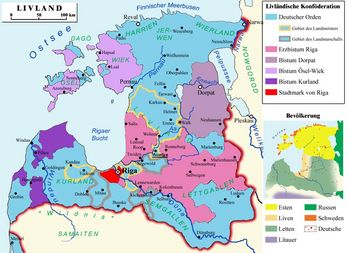
In the course of Christianisation, the so-called Livonian Confederation was formed, comprising the Archdiocese of Riga/Rīga, the dioceses of Dorpat/Tartu, Ösel-Wiek and Courland, as well as the territory of the Order of the Brothers of the Sword – or, from 1237, theLivonian/German Order. From 1227 to 1237 and from 1346 onwards, the former Danish Duchy of Estonia, which stretched around Reval/Tallinn along the southern coast of the Gulf of Finland, also belonged to the Livonian Confederation. The term ‘Livonia’ thus referred not only to the settlement area of the Livs, but also to that of the Estonians (who were also Baltic Finns) and the (Baltic) Latgalians, Curonians, Semigallians and Selonians, from whom the Latvian people developed by the early modern period. Over time, the Livonians, too, were integrated into the Latvian people. Livonia roughly comprised the area on the Baltic Sea between Narva (Estonian: Narva) in the east, southwards along Lake Peipus to the Daugava above Dünaburg/Daugavpils, and from there westwards along the Curonian-Lithuanian terminal moraine to the Baltic Sea at Heiligenaa/Šventoji.
From around 1566, the term ‘Livonia’ was used only for that part of Old Livonia which, in the wake of the Livonian War, came under the authority of Poland–Lithuania as a titular duchy and condominium. From 1629 onwards, the term‘Polish Livonia’(Lettgallen, Latgale) came to be used to refer to the part which, unlike large sections of the duchy, did not pass to Sweden following the armed conflicts but remained under Polish rule (see also ‘Modern Era’).
In 1721, Livonia became a Russian governorate, encompassing the territory between Estonia and Courland. All three governorates (Livonia, Estonia and Courland) together formed the so-called Baltic Governorates. With the establishment of the states of Estonia and Latvia in 1918, the historical region of Livonia was divided; since then, its Latvian part (Vidzeme) has often been equated with ‘Livonia’.
Topography
The historic region of Livonia lies between the Gulf of Riga and Lake Peipus. The landscape is characterised by flat, gently undulating or, at most, hilly terrain. Forests and water have shaped the landscape to an extraordinary degree.
Common symbolism
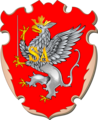
The coat of arms of the Duchy of Livonia and the Livonian Knights’ Order, dating from 1566 when Livonia was under Polish-Lithuanian rule, depicts a silver griffin holding a sword on a red shield. The initials ‘SA’ on its chest stand for Sigismundus Augustus (Sigismund II Augustus [1520–1572], the first ruler of the Polish–Lithuanian Commonwealth).
Middle Ages
Until the mid-12th century, the peoples of the eastern Baltic coast differed from those in the rest of Europe essentially in that, despite numerous attempts to Christianise them since the 10th century, they were still pagans.
Around 1180, Meinhard (1130/35–1196), a canon from Holstein, travelled with merchants involved in the German-Russian trade between Lübeck and Novgorod/Novgorod, to the lower reaches of the Daugava to preach the Christian faith – with the permission of the Russian prince Vladimir of Polotsk (1186–1216). His peaceful missionary work met with little success. Meinhard’s successor, Berthold (d. 1198), was consecrated as the second Bishop of Livonia in 1196. Under his successor, Albert of Buxhoeveden (Buxthoeven, c. 1165–1229), a canon of Bremen, the violent Christianisation intensified. It took him almost a year to reach Livonia. In 1199, he first obtained a crusade bull from Pope Innocent III (1160/1161–1216), in which the Livonian Crusade was equated with the Crusade to the Holy Land. In 1201/1202, Bishop Albert consecrated the ‘cathedral’ in Riga ‘and the whole of Livonia in honour of the Most Blessed Virgin Mary’.[1] In 1215, the consecration was confirmed by Innocent III.
Three further events were of great military and political significance for the history of Livonia: firstly, the founding of the city of Riga in 1201; secondly, the handing over of the castles of Üxküll and Lennewarden on the Daugava to two crusaders in the same year, which marked the beginning of vassalage in Old Livonia; and thirdly, the founding of a military order of knights (fratres miliciae Christi de Livonia) modelled on the Templars and governed by their rules in 1202 by the missionary and Cistercian monk Theoderich von Treyden (d. 1219) to protect the newly baptised Livonian community.
The Order, also known as the Order of the Sword Brothers after its emblem—a red sword beneath a cross pattée on a white cloak—was confirmed by the Pope in 1204. In 1205, Theoderich von Treyden also founded a Cistercian monastery at the mouth of the Daugava. Just as the Order of the Sword Brothers was vital to Livonia’s military security, so the Cistercian monastery was vital to the mission. By 1207, the crusaders had subjugated all the Livonians and baptised them. As a reward for the conquest of Livonia, the Order demanded and received one-third of Livonia in 1207, thereby creating the first Order state of the High Middle Ages.
In 1208, the Latgalians from Tholowa formed an alliance with the Brothers of the Sword to protect themselves against the hostile Estonians. This marked the beginning of a long war. The Estonians were supported by Russians from Novgorod and Pskov. With the help of King Waldemar II of Denmark (1170–1241), who founded a duchy in the north of present-day Estonia in 1219, the Brothers of the Sword subjugated Estonia and the island of Ösel/Saaremaa by 1227. On 22 September 1236, a large part of the Order of the Brothers of the Sword’s troops was defeated in the battle against the Lithuanians at Šiauliai; the remnants of the Order were incorporated into the German Order in 1237 (the Livonian Order).
Whilst all the Latgalians baptised in the Greek rite had already voluntarily embraced the Christian faith as early as 1214, the subjugation of the Curonians (1267) and the Semigallians (1290) proved to be very difficult. It was only when the German Order finally succeeded in breaking the resistance of the Estonian people in 1345 and purchased Danish Estonia from King Waldemar IV (c. 1321–1375), did the entire territory inhabited by Estonians, Livonians and Latvians come under German rule.
Towards the end of the 13th century, the five ecclesiastical territories, which together formed the Livonian Confederation, gave the country its political structure. These lands of Livonia were formally under the sovereignty of the Pope and the German Emperor; in practice, however, power lay with the local rulers. The 14th and 15th centuries in Livonia were characterised by their military and diplomatic struggles for supremacy. The Order sought to expand its position of power vis-à-vis the Archbishop of Riga and the bishops, to whom the Order was subordinate under the applicable treaties, and to convert its military power into political power. The Order’s aim was a unified Livonia, in which the bishops would hold ecclesiastical power and the officials secular power. The city of Riga played a decisive role in this conflict.
At the Battle of Tannenberg on 15 July 1410, against a combined force of the Kingdom of Poland and the Grand Duchy of Lithuania, the German Order suffered a heavy defeat. Nevertheless, its Livonian branch managed to maintain its position as the leading power in Livonia. From 1422 onwards, the common interests of the Old Livonian ‘Five States’ – comprising all the local lords, the representatives of the estates (knighthoods) and the town envoys – were discussed at annual provincial assemblies. These were organised along estate lines; peasants were never invited.
The rivalries between the city of Riga and the Order continued until 1491. In 1492, Riga was forced to recognise not only the Order but also the Archbishop as its suzerain. The real victors in the struggle between the Livonian rulers were the German estates, which gradually evolved from a professional class of knights into vassals and a hereditary nobility. The rise of the vassals was accompanied by a curtailment of the legal rights of the ‘non-German’ peasants, mostly of Latvian, Livonian or Estonian descent.
Modern times
The power and sphere of influence of the Livonian Order initially grew during the first half of the 16th century under Grand Master Wolter von Plettenberg (1494–1535). From the reign of Ivan III, Grand Prince of Moscow (1440–1505, reigned from 1462), foreign policy came to the fore in Livonian politics, whilst internal Livonian conflicts lost their significance. The Livonian War (1558–1583) centred on the struggle for supremacy in the territory of the German Order between the Grand Prince of Moscow and the Crowns of Sweden and Poland–Lithuania, and at times also Denmark. Estonia came under Swedish rule; King Frederick II of Denmark (1534–1588) purchased the island of Ösel and the territories of the Pilten/Piltene deanery in Courland that did not belong to the Order. The territory north of the Daugava and south-west of Lake Peipus came under the rule of Poland–Lithuania, and for the next hundred years the name ‘Livonia’ was used exclusively to refer to this territory. Courland, as the sole remaining territory of Old Livonia, attained relative independence under Polish suzerainty. The city of Riga remained a free city for twenty years (until 1581) and recognised only the German Emperor. On 5 March 1562, the last Master of the Order, Gotthard Kettler (1517–1587), declared the dissolution of the Order’s state.
In the now Polish-Lithuanian (titular) Duchy of Livonia, the rights of the German nobility were enshrined in the Privilegium Sigismundi Augusti of 1561, which served as a guideline for the German-Baltic nobility for centuries. As the original document has not survived, there are doubts as to whether it was not, in fact, merely a wish list compiled by representatives of the Order.[2] At the same time, a united Livonian knighthood emerged in Livonia, which governed all the affairs of the country.
During the war against Sweden from 1621 to 1629, large parts of the Duchy of Livonia fell to the Kingdom of Sweden; only the area around Dünaburg (Lettgallen,‘Polish Livonia’) remained under Polish-Lithuanian rule. Although the privileges of the nobility were confirmed by the Swedish King Gustav II Adolf (1594–1632) on 18 March 1629, the legal position of the peasants was also strengthened at the same time. During the reign of the Swedish King Charles XI (1655–1697, reigned from 1660), the ‘land redistribution’ took place – in total, five-sixths of the estate lands were expropriated at that time. For the ‘non-German’ peasants, the ‘Swedish period’ is remembered fondly.
During the Second Northern War (1655–1661), Livonia was partially occupied by Russia until the Treaty of Oliva on 3 May 1660 restored peace and established Swedish suzerainty for the next forty years. Following the Great Northern War (1700–1721), which ended in Sweden’s defeat, Livonia was ceded to Russia under the Treaty of Nystad in 1721. The same treaty guaranteed the privileges of the German-Baltic nobility, which went hand in hand with the discrimination against ‘non-German’ peasants. In the years that followed, the country lost more than two-thirds of its population due to wars, the plague (1710), drought (1714) and severe cold (1716).
Livonia became the Governorate of Livonia, in which the knighthoods were granted extensive rights of self-government. The knighthoods were represented at almost all higher administrative and military levels of the Russian Empire. Gradually, the landowners also regained the estates that had been reduced under the Swedish crown. Empress Catherine II (1729–1796, reigned from 1762), who was of German descent, undertook several reforms to modernise the country, which involved restrictions on the rights of the German-Baltic nobility. However, these important reforms were repealed in 1796 by her son Paul I (1754–1801, reigned from 1796). In the second half of the 18th century, the issue of the abolition of serfdom became increasingly pressing, culminating in the emancipation of the peasants in Livonia in 1819 (and in the rest of Russia in 1861); however, peasants did not have the right to purchase land until 1849, meaning that only farm labourers, who were henceforth no longer bound to their landlords, were able to benefit from the emancipation of the peasants. From 1884, during the reign of Tsar Alexander III (1845–1894, reigned from 1881), the Russification of the Baltic provinces began in the areas of administration, education and the judiciary. The privileges of the German-Baltic nobility were no longer recognised. The Russian municipal code had already been introduced in 1877. The Russian Revolution of 1905 also had an impact on Livonia, which was the region with the highest intensity of strikes. An agrarian movement directed against the Baltic German nobility emerged in the Baltic provinces. More than 400 manors were destroyed, 38 per cent of them in predominantly Latvian Livonia (Southern Livonia). Numerous landowners were driven out, and 82 Germans, including several pastors, were killed.
During the First World War, measures were taken in Livonia – as in the rest of Russia – that were directed against the Baltic Germans and the German language. From 1917 onwards, Livonia was partially occupied by German troops. The supplementary treaty to the Treaty of Brest-Litovsk of 27 August 1918 stipulated that Livonia and Estonia were to be separated from the Russian Empire. With the consent of the Courland Provincial Council, the United Provincial Council of Livonia, Estonia, Riga and Ösel proclaimed the United Baltic Duchy under German leadership at its conference from 5 to 8 November 1918. Germany’s defeat in the war brought about the rapid demise of this state.
Contemporary History
Following the establishment of the Republic of Estonia on 24 February 1918 and the Republic of Latvia on 18 November 1918, the term ‘Livonia’ came to be used only for the Latvian province of Vidzeme (Southern Livonia). Gradually, the German-Baltic upper class became a minority in the newly founded nation states.
Under the secret additional clause of the Hitler–Stalin Pact concluded on 23 August 1939, the former Livonia was assigned to the Soviet sphere of influence on 28 September 1939. Also on 28 September 1939, a ‘Mutual Assistance Pact’ was signed in Moscow/Moskva between Estonia and the Soviet Union. This was followed on 5 October of the same year by an almost identical treaty between Latvia and the Soviet Union. On 17 June 1940, the Soviet occupation of Estonia and Latvia began. On 20 July 1940, the newly elected national parliaments declared their respective countries to be Soviet Socialist Republics. On 5 and 6 August 1940, Latvia and Estonia were officially incorporated into the Soviet Union. During the night of 13 to 14 June 1941, more than 11,000 ‘enemies of the state’ were arrested in Estonia and more than 16,000 in Latvia, and deported to Soviet labour camps.
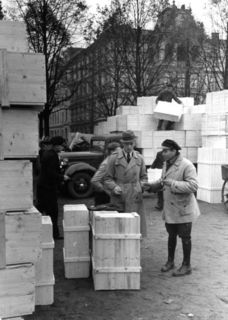
Between 1939 and 1941, most Baltic Germans left Latvia and Estonia for Germany in accordance with a treaty concluded on 30 October 1939 between Latvia and Germany, following theGerman–Soviet Protocol of 28 September 1939, which formed the legal basis for the resettlement of the Baltic Germans. All Germans wishing to leave Latvia were required to confirm voluntarily their intention to ‘renounce Latvian citizenship for all time’ (the so-called ‘dictated option’).[3] A protocol with similar wording had already been signed on 15 October by the Republic of Estonia and the Reich Government.
Following the invasion by German troops on 22 July 1941, the Baltic states, together with Belarus, were merged to formthe ‘Reichskommissariat Ostland’, in the administration of which many Baltic Germans were also employed. The “Reich Minister for the Occupied Eastern Territories” was Alfred Rosenberg (1893–1946), a Baltic German born in Reval.
Between 1941 and 1944, around 90,000 Jews were murdered in Latvia under German command and with the assistance of sections of the local population – 70,000 Latvian Jews and 20,000 from other European countries who had been deported to Latvia.[4] Most Estonian Jews had fled abroad; almost all of the remainder (approximately 1,000 people) were killed (see also‘Reichskommissariat Ostland’).
Population and Society
Around 1200, there were approximately 20,000 Livonians and 150,000 Estonians living in Livonia. At the beginning of the 13th century, around 150,000 people lived in what is now Latvia.[5] Around 1500, Livonia had fewer than 500,000 inhabitants,[6] and before the Livonian War, around 1558, the population was approximately 650,000–675,000.[7] In 1858, 884,000 people were resident in the Russian Baltic province of Livonia.[8]
Until the beginning of the 20th century, the majority of the population were peasants; in the northern part these were Estonians, and in the southern part Latvians. Members of the upper classes and the Evangelical Lutheran clergy were mostly of German descent and spoke a German dialect (Baltic German). German was the language of law and education in Livonia; it was not until the Russification process began in 1870 that Russian was introduced as the official language.
Economy
In the Middle Ages, alongside the three largest cities of Livonia – Riga, Reval and Dorpat – smaller Hanseatic towns also served as trading centres between the West and the cities of ‘Rus’ (Novgorod, Pskov, Polotsk/Polack/Polock, etc.). They served as transhipment points for goods, including salt, herring, cloth and metals from the West, and wax, furs, flax, fish oil and other commodities from the East. Unmarried merchants and craftsmen in Riga, Reval and Dorpat joined together to form the ‘Brotherhood of the Blackheads’.
The emancipation of the serfs, which freed up a large labour force, and other reforms of the 1860s paved the way for an economic boom. The textile and heavy industries developed particularly rapidly. As part of industrialisation, the first railway line between Riga and Mitau/Jelgava opened in 1868, followed by a second in 1870 linkingBaltischport–Reval–Narva–Saint Petersburg. Riga grew most rapidly as an industrial centre. The importance of the Baltic Sea ports increased particularly from the 1860s onwards. In 1913, Riga even became the largest port in the Russian Empire; shortly before the war, it had the largest timber port in the world. At that time, trade was mainly in the hands of Jewish and German-Baltic merchants. After the outbreak of the First World War, a large part of Latvian industry was relocated to the Russian heartland.
History of Religion and the Church
The pre-Christian religious life of the indigenous peoples was characterised by a hierarchically organised priestly class and the concept of a diverse and extensive pantheon of gods of Indo-European origin. The paganism of the Baltic peoples withstood the Roman Catholic Church’s efforts at Christianisation and conquest in Europe for the longest period during the Middle Ages. Whilst they adopted the cult of the saints, they adapted it to their own folk traditions.
During the Reformation, a paradoxical situation arose in Livonia under the Master of the Order, Wolter von Plettenberg: in this state governed by the Catholic Church, Lutherans were granted freedom of religion. As early as 1521, the clergyman Andreas Knopken (c. 1468–1539) preached the Lutheran faith in Riga, which was very well received by the local nobility and townspeople. As the peasants’ religious affiliation depended on the denominational choice of their landlords, the serfs reacted with indifference to Protestant teachings. During the ‘Polish period’, the Counter-Reformation took hold in Livonia; the Jesuits were particularly successful amongst Latvians and Estonians. It was also during this period that the first books were printed in Estonian (1535) and Latvian (1585): the Catholic Catechism. During the ‘Swedish period’, Livonia not only returned to Protestantism, but, with financial support from the Swedish Crown, the Latvian translation of the Bible, translated by Ernst Glück (1654–1705), was published in 1694; the Estonian translation by Anton Thor Helle (1683–1748) was published in 1739. In the first half of the 19th century, the Russian Orthodox Church succeeded in persuading a considerable proportion of the Estonian- and Latvian-speaking population to convert to Orthodoxy by offering them the prospect of land ownership.
Education and Science
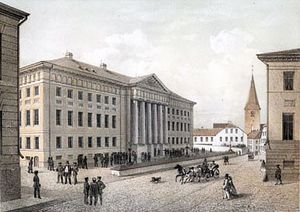
In the year of the death of King Gustav Adolf of Sweden (1594–1632), the first (Latin-Swedish) university, the Academia Gustaviana, was opened in Dorpat, Livonia. On 14 October 1862, the first students began their studies at the newly founded Riga Polytechnic, the first multi-disciplinary technical university not only in Livonia but in the entire Russian Empire.
Main building of the University of Dorpat. The ‘Academia Gustaviana’ was reopened in 1802 in the Russian Governorate of Livonia as the ‘Imperial University of Dorpat’. [Chromolithograph on paper. In: Louis Höflinger: Album of Dorpat and its Surroundings. Tartu 1860].
Art History
The historic old town of Reval was inscribed on theUNESCO World Heritage List in 1997. The Art Nouveau ensemble in the Neustadt district of Riga has also beena UNESCO World Heritage Site since 1997.
Culture of memory and remembrance
In 2001 – 800 years after Bishop Albert had consecrated Livonia to the Virgin Mary – the Conventus Terra Mariana was re-established in Estonia.[9] In Latvia, by contrast, 2015 marks the 800th anniversary of the consecration of Livonia by Pope Innocent III.[10]
In honour of Estonia’s independence, the ‘Terra Mariana’ Order (Estonian: Maarjamaa Risti teenetemärk) was introduced in 1995 as a state honour of the Republic of Estonia, awarded to foreign nationals for exceptional services to the Republic of Estonia.
4. Discourses/Controversies
The Christianisation of Livonia is closely linked to the myth ofthe ‘discovery’of Livonia by merchants from Bremen. This account can be traced back to an erroneous copy of the Livonian Chronicle by Heinrich von Lettland (born c. 1188), the oldest source of German-Baltic, Estonian and Latvian historiography: An unknown 16th-century copyist supplemented the chronicler’s work with fictitious tales about Bremen merchants. This fact was discovered and revealed in the mid-19th century by the German-Baltic historian Carl Schirren (1826–1910); nevertheless, the myth continued to be used for promotional purposes in Bremen in later years.[11]
Bibliography
- Norbert Angermann, Manfred Hellmann, Heinz von zur Mühlen: Livonia. In: Encyclopaedia of the Middle Ages. Vol. V. Munich 1991, cols. 2045–2052.
- Michael Garleff: The Baltic States – Estonia, Latvia, Lithuania from the Middle Ages to the Present Day. Munich 2001 (Eastern and South-Eastern Europe).
- Heinrich of Latvia: The Livonian Chronicle. Newly translated by Albert Bauer. Darmstadt 1959.
- Gert von Pistohlkors: The Baltic States. Berlin 1994 (German History in Eastern Europe [4]).
- Ralph Tuchtenhagen: History of the Baltic States. Munich 2005 (Beck’sche Reihe 2355: C.H.Beck Wissen).
- Reinhard Wittram: Baltic History. The Baltic States of Livonia, Estonia and Courland 1180–1918. Outlines and Perspectives. Darmstadt 1973 (Göttingen Working Group: Publication 83; History of Peoples and States).
Periodicals
- Yearbook of Baltic German Culture (published since 1927, edited by the Carl-Schirren-Gesellschaft e. V. on behalf of the Deutsch-Baltische Gesellschaft e. V.)
- News from Baltic Life (published since 1954, re-established in 2008, edited by the German-Baltic Society e. V.)
- Latvijas vēstures institūta žurnāls [Journal of the Latvian Institute of History] (published 1936–1940, revived in 1991, edited by the Institute of History at the University of Latvia)
Web links
- www.deutsch-balten.de/ (website of the German-Baltic Society e. V.)
- www.baltische-ritterschaften-de.de/ritterschaften/livland/ (website of the Association of Baltic Knighthoods e. V.)
- www.historia.lv/ (Latvian-language website on Latvian history, with numerous sources)
- www.maliv.eu/ (project on medieval architecture in Livonia)
Notes
[1] Heinrich of Latvia: Chronicle of Livonia, p. 25.
[2] Alexander Schmidt: History of the Baltic Region. From the Ancient Gods to the Present Day. Munich 1992 (Piper Series 1518), pp. 83ff.
[3] Dietrich A. Loeber (ed.): A Forced Choice. The Resettlement of the German-Baltic Population from Estonia and Latvia 1939–1941. Neumünster 1972.
[4] Antonijs Zunda: Latvia under Nazi German Occupation (1941–1945). In: Daina Bleiere, Ilgvars Butulis, Inesis Feldmanis, Aivars Stranga, Antonijs Zunda: History of Latvia. 20th Century. Riga 2008. pp. 268–333, here p. 288.
[5] Tuchtenhagen: History of the Baltic States, pp. 11ff.
[6] Norbert Angermann: Wolter von Plettenberg. Bonn 1985 (Arbeitshilfe 44), p. 2.
[7] Norbert Angermann: The Significance of Livonia for the Hanseatic League. In: ibid. (ed.): The Hanseatic League and the German East. Lüneburg 1990, pp. 97–115, here p. 108.
[8] Constitutional Law of the Duchy of Livonia: www.verfassungen.eu/ee/recht1721-livland.htm (accessed 28 May 2015).
[9] www.terramariana.ee/web/de/ (accessed 20 May 2015).
[10] katolis.lv/baznica-latvija/latvijas-biskapu-konference/pazinojums-par-terra-mariana-jubilejas-gadu.html (accessed 14 April 2015).
[11] Michael Garleff: Stereotypes in reciprocal German–Baltic cultural exchange. In: Hans Henning Hahn (ed.): Stereotype, Identity and History. The Function of Stereotypes in Social Discourses. Frankfurt am Main 2002 (Central Europe – Eastern Europe 5), pp. 349–363.
Citation
Anda Godlinski: Livonia. In: Online Encyclopaedia on the Culture and History of Germans in Eastern Europe, 2015. URL: ome-lexikon.uni-oldenburg.de/p32600 (accessed 4 June 2021).
Terms of use for this article
Copyright © University of Oldenburg and the Federal Institute for the Culture and History of Germans in Eastern Europe (BKGE), all rights reserved. This work was produced as part of the project ‘Online Encyclopaedia on the Culture and History of Germans in Eastern Europe’ and may be reproduced and published provided the rights holders’ consent has been obtained. Please contact:
If you have any specialist comments or additions to the text, please contact the editorial team, citing relevant literature and source references.