

Wilna/Vilnius
Wilna/Vilnius
Etymology
The origin of the place name is disputed; Vilnius is generally thought to be derived from the hydronym Vilnia or Vilnelė (Polish: Wilenka; Russian: Ви́льня [ Vil‘nja]), the left-bank tributary of the Wilia (Lithuanian: Neris). It is often suggested that the name was borrowed from the Slavic variant of the main river’s name – Polish: Wilia; Russian: Вилия [Vilija] (Old Slavic: велья [vel’ja] = ‘great’)) is often assumed.[1]
Topography
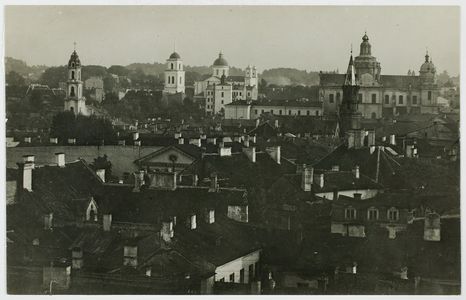
The town is situated in south-eastern Lithuania, approximately 20 kilometres south of the geographical centre of Europe – as calculated in 1989 – and 312 kilometres from the Baltic Sea. The landscape of the town, which was founded at the confluence of the Wilia and Vilnia rivers, is characterised by wooded hills (80–230 metres).
Political and administrative affiliation
Vilnius is the capital of Lithuania and , with a population of 589,425 (2021), the country’s largest city. It is the seat of the Lithuanian Parliament (Seimas), the national government, the President, the Constitutional Court and three bishops: the Roman Catholic, the Russian Orthodox and the Evangelical Lutheran.
Common symbolism

The town’s coat of arms depicts St Christopher with the double cross, carrying the infant Jesus on his shoulders across a river. The earliest recorded reference to the coat of arms dates back to 1568 in a letter from Sigismund II Augustus, King of the Polish–Lithuanian Commonwealth (Polish: Zygmunt II August, Lithuanian: Žygimantas Augustas) (1520–1572), dated 1568. Changes were made in the 18th and 19th centuries; due to its religious content, it was not permitted to be used during the Soviet era. In 1991, the town’s historic coat of arms was restored.
The Early Period and the Middle Ages
According to archaeological evidence, the area now occupied by the city was already settled by Proto-Baltic tribes as early as the 4th millennium BC. Between the 10th and 13th centuries AD, the settlement developed into an important regional trading centre. It is believed that the coronation of the first Lithuanian king, Mindaugas (c. 1200–1263), also took place in 1253 in the cathedral built for this purpose.[2] The first written mention of the town dates from the reign of Grand Duke Gediminas (c. 1275–1341). In one of his letters to German towns, written in 1323, the Grand Duke sought to attract foreign merchants, craftsmen and clergy to the‘Civitate nostra Regia Vilna dicta’[3] . In doing so, he promised the settlers privileges and religious tolerance. In response to the Grand Duke’s call, settlers from Lübeck, Bremen, Stralsund and other Hanseatic cities soon established an independent quarter in Vilnius, at the centre of which stood the Church of St Nicholas (Šv. Mikalojaus g. 4) – the patron saint of sailors and merchants – stood at its centre. The densely built-up quarter stretched over approximately six hectares between the present-day streets of Rūdninkų, Naugarduko and Trakų in the south-west and Vokiečių (German Straße) in the east of the Old Town. Until the 19th century, this quarter was home predominantly to residents of German origin, including the master of the mint and later mayor Ulrich Hosse (1455–1535), the personal physician to King Władysław IV Waza (Polish: Władysław IV Waza, Lithuanian: Vladislovas II Vaza), Mattheus Vorbeck Lettow (1593–1663), and the city’s most famous Baroque architect, Johann Christoph Glaubitz (1700–1767). Under Grand Duke Algirdas (1296–1377), Vilnius was provided with a network of three castles, which served to protect it from the recurring attacks by the German Knights of the Order. Between 1365 and 1402, the German Knights of the Order laid siege to the city seven times without success[4]. As early as 1385, Lithuania and Poland agreed to a personal union. The Lithuanian Grand Duke Jogaila (c. 1348–1434) married the Polish ruler Hedwig of Anjou (Polish: Jadwiga Andegaweńska) (c. 1374–1399), and ascended the Polish throne under the name Władysław II Jagiełło. At his behest, the place of worship dedicated to Perkūnas, the god of thunder, ‘ ’ in Vilnius was destroyed and the sacred fire extinguished. In its place, a Gothic cathedral was erected, and in 1387 the Diocese of Vilnius was founded. In the same year, Władysław II granted Vilnius the Magdeburg municipal charter ; the Lithuanian term for ‘town hall’ (Lithuanian: rotušė) was borrowed from German. Until the signing of the Union of Lublin (1569), Vilnius remained the coronation site of the Grand Dukes of Lithuania. During this period, the city developed into a multicultural and multiconfessional metropolis in Eastern Europe, home to Lithuanians, Poles, Russians, Germans, Tatars and Karaites. Jews fleeing pogroms in Western Europe also increasingly settled in Vilnius.
The Renaissance and the Modern Era
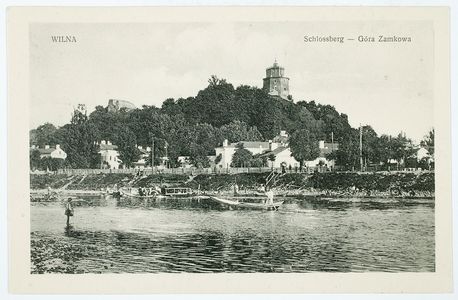
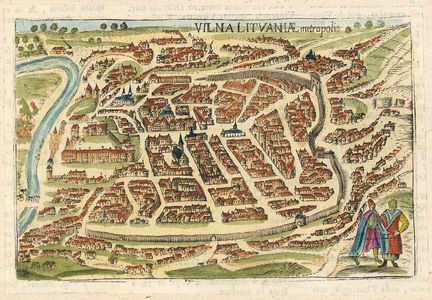
The reigns of Sigismund I the Old (Polish: Zygmunt I Stary, Lithuanian: Žygimantas Senasis) (1467–1548) and Sigismund II Augustus went down in the city’s history as a Golden Age: Protected by a city wall three kilometres long and up to 12 metres high, with ten gates, Vilnius grew to become one of the largest cities in Eastern Europe, with a population of around 30,000. In 1532, the city’s first water pipeline was built; in 1536, the first bridge over the Vilia; in 1527, a paper mill; and in 1547, a glassworks. With the founding of Franciszek Skoryna’s printing press in 1522, the city became a centre for book printing, where books in Latin, Ruthenian, Polish, Lithuanian and Latvian were printed. The town owed its progress not least to the marriage of Sigismund I ‘ ’ to the Italian princess Bona Sforza (1494–1557), as a result of which numerous Italian craftsmen and artists settled in the town.[5] The medieval castles also underwent a transformation: the Lower Castle, which had been converted into a Renaissance palace, henceforth housed not only the royal couple’s apartments but also a theatre, a zoo, a valuable library and an impressive collection of paintings and tapestries. Under the direction of the master builder Michael Enkinger, alias Carpentarius, who hailed from Danzig/Gdańsk, the Brick Gothic ensemble comprising St Anne’s Church and the adjacent Bernardine monastery – now regarded as the city’s landmark – was constructed in the early 16th century. St Anne’s Church, built using 33 different types of brick, was the seat of two German brotherhoods: the Brotherhood of St Anne and the Brotherhood of St Martin. For the Brotherhood of St Martin – which was not dissolved until 1940 – German was, amongst other things, the language in which sermons were delivered. Thanks to the proclamation of religious freedom (1563), denominational conflicts were largely avoided in Vilnius. The founding of the university by King Stephen Báthory (Polish: Stefan Batory; Lithuanian: Steponas Batoras; Hungarian: Báthory István) (1533–1586) in 1579 cemented the city’s leading position in the region. Although the Jesuits regarded this institution as an instrument of the Counter-Reformation, they too practised religious tolerance: not only Catholics, but also Protestants and Orthodox Christians were permitted to study at the university.[6]
In the 17th century, the city gradually began to feel the negative effects of the Union of Lublin (1569). Under the terms of that union, Kraków became the king’s coronation city and seat of government, whilst Warsaw became the seat of the Sejm (parliament). Vilnius, the former seat of the Grand Duke of Lithuania, was not assigned any special role in the dual state that now existed. The Great Fire of 1610 and the occupation of the city (1655–1661) by the troops of the Russian Tsar Alexei Mikhailovich (1629–1676) accelerated its decline in importance.
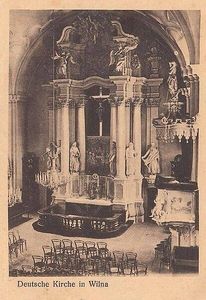
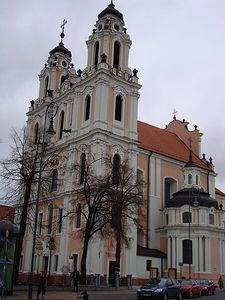
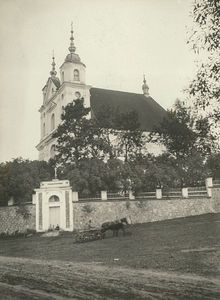
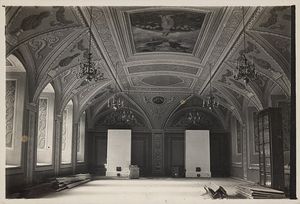
The 18th century was characterised by political, cultural and social rapprochement with the Electorate of Saxony. Following the death of King John III Sobieski (Polish: Jan III Sobieski, Lithuanian: Jonas III Sobieskis) (1629–1696), the Polish-Lithuanian nobility elected Frederick Augustus I (1670–1733), the Elector of Saxony, as King of Poland and Grand Duke of Lithuania in 1697. His son, Frederick Augustus II (1696–1763), subsequently became ruler of the dual monarchy. Despite numerous military conflicts in which the Grand Duchy of Lithuania became embroiled during the reign of the House of Wettin, Vilnius experienced a building boom in the 18th century: In addition to magnificent palaces, wealthy patrons commissioned around 40 churches and 18 monasteries. One of the city’s most sought-after architects was Johann Christoph Glaubitz (c. 1700–1767), a German originally from Silesia . Based on his designs, the Evangelical Lutheran Church (1737–1744), the Baroque main façade and the high altar of St John’s Church (1738–1739), the Benedictine Church of St Catherine (1741–1743), the iconostasis of the Orthodox Church of the Holy Spirit (1749–1751), the Franciscan Church of the Assumption (1750–1756), the portal at the entrance to the Basilian monastery with the Church of the Holy Trinity (1761), as well as numerous secular buildings.
Following the Third Partition of Poland–Lithuania (1795), the city fell to Russia. With a population of around 55,000, Vilnius was not only the third-largest city after Moscow and Saint Petersburg (formerly Leningrad), but also the empire’s most important centre of learning. In 1803, the university founded by the Jesuits was granted the title of Imperial University and subsequently enjoyed the personal patronage of the Polish magnate Adam Jerzy Czartoryski (1770–1861), who was a friend of Tsar Alexander I (1777–1825) and served as Minister for Foreign Affairs of the Russian Empire under him. Thanks to Czartoryski, the university enjoyed a high degree of autonomy in the fields of research and teaching. It developed into a centre of the Enlightenment within the Russian Empire, where the historian Joachim Lelewel (1786–1861), the astronomer Jan Śniadecki (1756–1830) and the painter and founder of the Vilnius School of Art, Franciszek Smuglewicz (1745–1807), taught there. The contribution of the German professors working at the university was also significant, including the classical philologist Gottfried Ernst Groddeck (1762–1825), the forensic pathologist Johann Karl Baerkmann (1780–1856), the pharmacologist Johann Friedrich Wolfgang (1776–1859), the pathologist Joseph Frank (1771–1842) and the professor of anatomy and physiology Johann Andreas Lobenwein (1759–1820).
At the beginning of the 19th century, Vilnius became the target of Napoleon Bonaparte’s (1769–1821) Russian campaign, which, however, proved disastrous for France: In the winter of 1812, some 80,000 French soldiers died of hunger and cold in Vilnius alone.[7] In 1832, the university – which had by then become a focal point for national self-determination – was closed following the failed uprising against the Russian occupying power (1831), and the city sank into obscurity for several decades.
The 20th and 21st centuries

In 1905, the Great Seimas (the Great Parliament) of Vilnius (Lithuanian: Didysis Vilniaus Seimas) set out demands for political and economic autonomy from the Russian Empire; however, these could not be realised due to repressive measures taken by the Tsarist regime. The First World War, which broke out in 1914, once again offered the chance to restore independence. In August 1915, German troops captured the heavily fortified town of Kauen/Kaunas/Kowno, and in September 1915 they captured Vilnius. The city became the provisional headquarters of the German 10th Army and one of the centres of ‘Ober Ost’. On 12 December 1915, Emperor Wilhelm II (1859–1941) visited Vilnius. According to Wilhelm Gaigalt (1870–1945), a member of the Prussian House of Representatives, the Lithuanians welcomed the Germans as liberators, whilst at the same time expecting the German regime to guarantee ‘the inviolability of their nationality and the freedom for further national development’[8]. However, the German Empire’s position regarding Lithuanian aspirations for independence was ambivalent. On the one hand, the government in Berlin supported the attainment of extensive autonomy and the creation of a buffer zone between East Prussia and what was now Soviet Russia; on the other hand, an independent Lithuania was not desired. According to a memorandum initiated by the Commander-in-Chief East, Field Marshal Prince Leopold of Bavaria (1846–1930), the aim of German policy towards Lithuania should be the ‘expansion of German power through the incorporation of land and people into the Reich and into the German people. [...] It is therefore advisable to create a border state which, under international law, belongs to the German Empire but, under constitutional law, stands outside the Reich Constitution, and which is to be linked to the Crown of Prussia through a personal union”[9]. In view of the setbacks on the front in 1918, Germany revised its intentions and became the first country in the world to recognise the Republic of Lithuania , which had been proclaimed on 16 February 1918. In 2017, Liudas Mažylis, Professor of Political Science at Vytautas the Great University, discovered the original copy of Lithuania’s Declaration of Independence in the Political Archive of the Federal Foreign Office in Berlin.

Following the declaration of independence, the question of Vilnius’s national affiliation proved problematic. As the proportion of Lithuanians living there was only around two per cent compared with other ethnic groups, the proclamation of the Republic of Lithuania, with Vilnius as its capital, met with opposition in Poland. In 1920, the city was occupied by Polish troops and incorporated into the Republic of Poland , whilst Kaunas became the capital of Lithuania. Under Polish rule, the university, which had been closed in 1831, and numerous Catholic churches were reopened. The Polish period came to an end in 1939 with the invasion by Soviet troops. Following the signing of the Mutual Assistance Pact between the USSR and Lithuania on 10 October 1939, Vilnius was handed over to Lithuania , and with Lithuania’s incorporation into the Soviet Union on 15 June 1940, Vilnius became the capital of the Lithuanian Soviet Socialist Republic (LSSR). During the Second World War, 73 per cent of businesses and approximately 40 per cent of the city’s buildings were destroyed. Under German occupation from 1941 to 1944, around 70,000 Jewish citizens (around 41 per cent of the population) were murdered. During the early post-war years under Soviet rule, 90,000 Poles were forcibly resettled. By contrast, the proportion of Russians and Lithuanians rose sharply.[10]
The Soviet era (1945–1990) was characterised by the misappropriation of sacred cultural heritage, by major industrial and infrastructure projects, and by the construction of prefabricated housing estates such as Lazdynai, Karoliniškės, Fabijoniškės and others. On 11 March 1990, independence was restored in Vilnius. In 2009, the city was European Capital of Culture alongside Linz.
Demography
Population of Vilnius
| Year | 1769 | 1834 | 1909 | 1916 | 1941 | 1944 | 1989 | 2006 | 2021 |
|---|---|---|---|---|---|---|---|---|---|
| Number | 17,500 | 52,300 | 205,200 | 140,800 | 270,000 | 110,000 | 282,500 | 541,824 | 589,425 |
Ethnic composition of Vilnius (figures in per cent) [11]
1897 | 1931 | 1959 | 1979 | 2011 | |
|---|---|---|---|---|---|
| Lithuanians | 2.1 | 0.8 | 33.6 | 47.3 | 63.3 |
| Poland | 30.9 | 65.9 | 20.0 | 18.0 | 16.5 |
| Russians | 20.1 | 3.8 | 29.4 | 22.2 | 12.0 |
| Belarusians | 4.2 | 0.9 | 6.2 | 6.4 | 3.5 |
| Jews | 40.0 | 28.0 | 4.4 | 2.3 | 0.4 |
Architecture
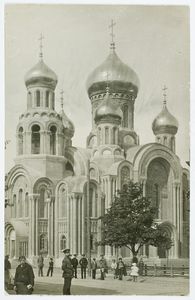
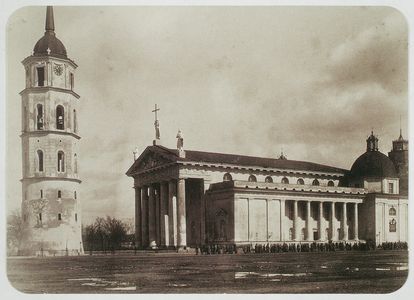
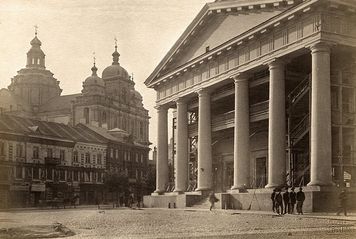
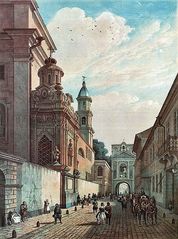
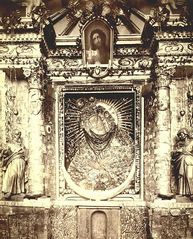
The historic city centre of Vilnius, which was inscribed on the UNESCO World Heritage List in 1994,[12] was built between the 13th and 18th centuries and comprises 1,487 buildings spread over an area of 352 hectares. Its architectural landscape is characterised by medieval alleyways lined with craftsmen’s houses, neoclassical palaces, and Baroque and Orthodox religious buildings. Numerous sights are clustered around the central Cathedral Square: the Neoclassical Cathedral of St Stanislaus and Vladislaus (1801) with the Casimir Chapel (17th century), the 57-metre-high Gothic-Baroque-Classical bell tower, the Grand Duke’s Palace (16th century), which was rebuilt in 2009, and the Gothic Gediminas Tower. The fabric of the Old Town houses, dating from the 15th to the 18th centuries and forming a network of around 70 alleyways, is made of brick, most of which is concealed beneath Baroque or Neoclassical plaster. Alongside the remains of the Upper Castle (13th–14th centuries) and St Nicholas’ Church (14th century), the complex comprising St Anne’s Church and the Bernardine Church of St Francis and St Bernard (c. 1500) is regarded as the finest example of Brick Gothic architecture. The Old Arsenal (16th century), the Alumnat (17th century) and the University’s Great Courtyard (17th century), on the other hand, represent the Renaissance period. St Casimir’s Church (1604–1618), built by the Jesuits, is the city’s oldest Baroque religious building. Other masterpieces of Baroque architecture include the Church of St Peter and St Paul (17th century), adorned with some 2,000 white stucco figures and ornaments; the Dominican Church of the Holy Spirit (17th century) and St Catherine’s Church, built in the Vilnius Baroque style in 1743. Neoclassical styles characterise prestigious buildings such as the Town Hall (1799), the Presidential Palace (1832; the bishop’s seat until 1794), the Chodkevičiai Palace (1834) and the Pacai Palace (1841). Examples of historicism include the Lithuanian National Philharmonic building (1902) and numerous houses on Gediminas Avenue. The Russian Orthodox churches with their domes and onion domes (St Michael and St Constantine’s Church), as well as the Cathedral of the Assumption of the Mother of God, built in the Neo-Georgian style, are also part of the cityscape. On 13 January 1991, during the breakaway from the Soviet Union, bloody clashes took place at the city’s tallest building, the TV tower (326 metres), resulting in several fatalities.
Economy
Thanks to trade with Riga/Rīga, Pskov and Moscow , Vilnius became an important trading hub in the Grand Duchy of Lithuania during the 14th century. Wittinen (river boats), up to 60 metres long and seven metres wide, were used to transport wax, timber, furs, grain, salt and wool. The city’s rapid growth in the 15th and 16th centuries laid the foundations for an economic boom in the craft trades. The first guild was founded by the goldsmiths (1495). In the 17th century, the number of guilds rose to 21, to 38 in 1795 and to 54 in 1885. Industrialisation began with the city’s connection to the St Petersburg–Warsaw railway line (1860). By 1895, there were already 20 factories in Vilnius. During the Soviet era, the city was an important industrial centre, home to large enterprises such as Kuroaparatūra (a fuel pump factory, approx. 10,000 employees) and Elfa (electrical engineering, 8,200 employees).
Today, 16 per cent of the country’s total industrial output is produced in Vilnius. Key industrial sectors (accounting for 20 per cent of all jobs) include the plastics industry (Plasta), the paper and furniture industry (Grigeo), the pharmaceutical industry (Siccor Biotech, Thermo Fisher Scientific Baltics), the textile industry (Sparta), the recycling industry (VKJ) and the food industry. Most residents work in the service sector (72 per cent), whilst around seven per cent are employed in construction. Recently, Vilnius has emerged as a key location for service companies (Western Union, Nasdaq, Cognizant, etc.) and as a centre for digital financial innovation (FinTech). The city accounts for 41 per cent of Lithuania’s gross domestic product (GDP).
The city maintains close economic ties with Germany. Among the most important investors in Vilnius are companies such as Siemens, Birkle IT AG, Homanit and Nokera. According to the German-Baltic Chamber of Commerce, a total of 877 German subsidiaries were operating in Lithuania in 2021, many of them based in the capital. Foreign direct investment from Germany amounted to 1 . 45 billion euros (ranking fourth among investors). With a turnover of approximately 6 billion euros, Germany is one of Lithuania’s most important trading partners ( 2nd place).[13] The number of tourists from Germany is also rising steadily: 1.5 million tourists visited Vilnius in the pre-pandemic years, including approximately 230,000 Germans (12 per cent).
Education and Science
The city is home to several state and private universities and universities of applied sciences, including Gediminas Technical University, the Lithuanian Academy of Music and Theatre, the Lithuanian Military Academy, Mykolas Romeris University, St Joseph’s Seminary, the International School of Management and Economics (ISM) and Vilnius College, amongst others.
Founded in 1579, Vilnius University is the oldest and, with 22,830 students and 3,095 staff, the largest higher education institution in the Baltic States. The university’s historic complex is situated in the Old Town and comprises 13 courtyards, which house the Rector’s Office, the library and the Schools of Philosophy, Philology and History. Among the university’s most famous professors and alumni are the poet Mathias Casimirus Sarbievius, known as the ‘Horace of Christianity’ and awarded the laurel wreath by Pope Urban VIII (reigned 1623–1644) (Polish: Maciej Kazimierz Sarbiewski S.J.) (1595–1640), the Polish national poet Adam Mickiewicz (1798–1855), the Ukrainian national poet Taras Shevchenko (1814–1861), the Polish Nobel Laureate in Literature Czesław Miłosz (1911–2004), as well as numerous Lithuanian intellectuals such as Simonas Daukantas (1793–1864), Tomas Venclova (born 1937) and others. The contribution of academic staff from German territories was also significant for the university’s development, including the first Chancellor of the Akademia Vilnensis, Dr Philipp Jakub Widmannstadt (1539/1541–1588), the professor of mathematics and astronomy Dr Oswald Krüger (1598–1655), and the founder of public hygiene, Dr Johann Peter Frank (1745–1821).
Currently, Vilnius University’s research focus is on biochemistry and biotechnology, as well as laser and semiconductor research. According to the QS World University Rankings 2021, the university is among the world’s top 500 higher education institutions (ranked 423rd).[14].
‘Jerusalem of the North’
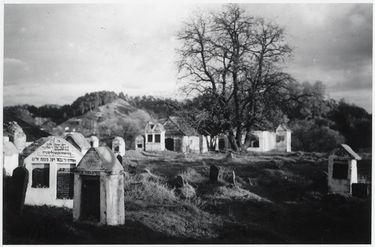
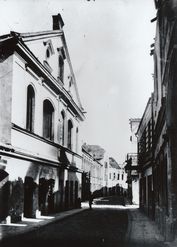
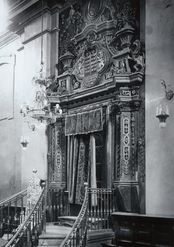
It is thought that the first Ashkenazi Jews migrated to the Grand Duchy of Lithuania in the 14th century due to widespread persecution and plague epidemics in German-speaking regions. Some of them may have responded to Grand Duke Gediminas’s invitation to merchants and craftsmen to settle in his new capital, Vilnius – attracted by the promise of religious tolerance and numerous privileges. The first written mention of Jews in the city dates from 1487. As in other settlements across the country, Jews are said to have enjoyed the privilege of economic equality with Christian townspeople as early as the reign of Grand Duke Vytautas (1392–1430). Following a series of pogroms at the beginning of the 16th century, permission was granted in 1573 to build a synagogue, which from the 17th century onwards became the spiritual centre of the Jewish community in Eastern Europe and formed the heart of the Jewish quarter. In the 18th century, Vilnius, with over 40 rabbinical scholars, developed into a centre of the Jewish Enlightenment, the Haskalah. The city, now known as the Jerusalem of the North, gained worldwide fame thanks to the Gaon of Vilna, the Orthodox Talmudic scholar Elia ben Salomon Zalman (1720–1797), who saw it as his duty, amongst other things, to combat the mystical movement of Hasidism. In the 19th century, the city’s reputation as a spiritual and cultural centre of Jewish life was cemented: it was home to a rabbinical school, ten religious academies, numerous publishing houses and printing works, six newspapers, a theatre, a writers’ association and around 100 synagogues. Vilna became the centre of standardised Yiddish. In 1925, the YIVO (Yidisher Visnshaftlekher Institute) was founded, with Sigmund Freud and Albert Einstein among its board members.
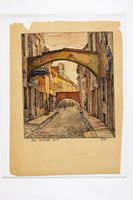


Shortly before the Second World War , there were around 70,000 Jews living in the city – 41 per cent of the total population. On 24 June 1941, the German Wehrmacht occupied Vilnius. As early as 6 September, two ghettos were established in the Old Town, separated by Deutsche Straße (nowVokiečių g.). The Small Ghetto, housing around 11,000 people and intended primarily for the elderly and those unable to work, was dissolved 46 days later when its inhabitants were shot in the Ponary Forest (Lithuanian: Paneriai). The mass execution was carried out by SS officers Peter Eisenbarth and Erich Wolff in accordance with the instructions of SS-Standartenführer Karl Jäger. The so-called Judenrat was responsible for life in the Large Ghetto. Until 1943, the ghetto maintained medical facilities, schools, a court and a theatre, in which 120 plays (including a musical by Lein Rosenthal) were performed. In view of the advancing front, the evacuation of the ghetto was ordered in August 1943. The mass murder was coordinated by the NSDAP official Franz Murer (the ‘Butcher of Vilnius’), and subsequently by the SS Scharführers Bruno Kittel and Martin Weiss. By the time the ghetto was finally liquidated on 23 September 1943, the Germans, with the help of the volunteer Lithuanian Sonderkommando, had murdered up to 70,000 Jews. The Great Synagogue, which had been severely damaged during the fighting for Vilnius, was demolished in 1957. Today, approximately 3,500 Jews live in Vilnius. The city currently has one synagogue, a Jewish community centre and a Jewish museum. A memorial stands at the site of the mass murder in Paneriai.
4. Controversies
The question of the local population’s historical complicity in the Holocaust is still largely suppressed in many sections of Lithuanian society. The book *Mūsiškiai* (Our Own), published in 2016[15] by Rūta Vanagaitė, in which the theatre scholar, together with Efraim Zuroff, director of the Jerusalem branch of the Simon Wiesenthal Centre, examines, amongst other things, the role of the Lithuanian partisans, the so-called miško broliai (Forest Brothers), in the mass murder, caused widespread outrage. Under public pressure, the publisher withdrew the book from bookshops, and the author went into exile in Israel due to the hostility she faced. In 2018, the European Rabbinical Conference awarded Rūta Vanagaitė the Moshe Rosen Prize.
Bibliography
Felix Ackermann: My Lithuanian Driving Licence. Berlin 2017.
Solomon Atamuk: Jews in Lithuania: A Historical Overview. Konstanz 2000.
Monika Bednarczuk (ed.): Cultural Transfer in the Provinces: Vilnius as a Centre of German Culture and Scholarship (1803–1832). Wiesbaden 2020.
Matthias Dornfeldt, Enrico Seewald: A Hundred Years of German–Lithuanian Relations. Husum 2017.
Antanas Rimvydas Čaplinskas: Vilniaus istorija. Legendos ir tikrovė [The History of Vilnius. Legends and Reality]. Vilnius 2015.
Cornelius Hell: Europe’s Finest: Vilnius. Klagenfurt/Celovec 2009.
Napoleonas Kitkauskas. The Castles of Vilnius: Construction and Architecture. Vilnius 1989.
Libertas Klimka: Serious, Funny and Beautiful Stories from Old Vilnius. Vilnius 2018.
Czesław Miłosz: The Streets of Vilnius. Munich 1997.
Darius Pocevičius: 100 istorinių Vilniaus reliktų [100 Historical Monuments of Vilnius]. Vilnius 2018.
Joachim Tauber, Ralph Tuchtenhagen: Vilnius: A Brief History of the City. Cologne 2008.
Joachim Tauber: Work as Hope: Jewish Ghettos in Lithuania 1941–1944 (Sources and Accounts of Contemporary History, Vol. 108). Berlin/Boston 2015.
Irena Veisaitė, Aurimas Švedas: A Century of Life in Lithuania. Göttingen 2019.
Tomas Venclova: Vilnius: A City in Europe. Berlin 2006.
Web links
vilnius.lt (The city’s official English-language website)
http://www.juden-in-europa.de/baltikum/vilna/inhalt.htm (Traces of Jewish history in Vilnius)
https://www.ahk-balt.org/ (German-Baltic Chamber of Commerce)
https://alles-ueber-litauen.de/ (general information about Lithuania)
https://www.memorialmuseums.org/memorialmuseum/staatliches-judisches-museum-gaon-von-wilna (State Jewish Museum ‘Gaon of Vilnius’)
www.herder-institut.de/bildkatalog/wikidata/Q216 (Images of Vilnius from the Herder Institute’s image archive, Marburg)
Notes
[1] Aleksandras Vanagas: *Names of Lithuanian Towns*. Vilnius 2004, p. 261; E. M. Pospelov: Geografičeskie nazvanija mira. Toponimičeskij slovar’ [Geographical Names of the World. Toponymic Dictionary]. Moscow 2001.
[2] Vytautas Urbanavičius: On the Shrine of Vinius Perkūnas. In: Vytautas Kazakevičius (ed.): Iš baltų kultūros istorijos [From the History of Baltic Culture]. Vilnius 2000, pp. 19–26, here p. 3.
[3] Chapter II. Diplomatic Acts of Lithuania under the reign of Duke Gediminas. Year 1323. A collection of three letters from Gediminas, Duke of Lithuania, to the Fathers of the Orders of St Francis and St Dominic, as well as to the maritime cities of northern Germany. In: Edward Raczyński (ed.): Codex Diplomaticus Lithuaniae. Manuscript codices preserved in the secret archive of Regiomontanus.Vratislavia (Breslau) 1845, pp. 27–32, here p. 29.
[4] Kitkauskas, Vilniaus pilys. Statyba ir architektūra, pp. 13–15.
[5] Venclova: Vilnius, p. 21.
[6] Tauber/Tuchtenhagen, *Vilnius*, pp. 112–117.
[7] Editorial team: Vilniaus istorija. In: Visuotinė lietuvių enciklopedija [Universal Lithuanian Encyclopaedia]. www.vle.lt/straipsnis/vilniaus-istorija/ [last accessed: 20 March 2021].
[8] Wilhelm Gaigalat: *Der Tag* of 12 December 1915. Quoted from: Dornfeldt/Seewald, *Hundert Jahre deutsch-litauischen Beziehungen*, p. 46.
[9] PAAA, R 21699, The Great War 20d, Secret War Files 1914, The Future of the Occupied Territories: Russia, Vol. 2, pp. 1–50 and 65–71. Quoted from: Dornfeldt/Seewald, p. 50.
[1]Editors: Vilniaus istorija. In: Visuotinė lietuvių enciklopedija. www.vle.lt/straipsnis/vilniaus-istorija/ [last accessed: 20 March 2021].
[11] The exact figures regarding the number of residents of German origin cannot be verified. According to the 2011 census, Germans accounted for 0.08 per cent of the total population of the Republic of Lithuania. Lithuanian Department of Statistics: osp.stat.gov.lt/documents/10180/217110/Gyv_kalba_tikyba.pdf/1d9dac9a-3d45-4798-93f5-941fed00503f [last accessed: 21 December 2021].
[12] World Heritage Committee: https://whc.unesco.org/en/list/541 [last accessed: 5 February 2025].
[13] AHK economic profile : www.ahk-balt.org/presse/wirtschaftsprofil [last accessed: 5 December 2021].
[14] QS World University Rankings. www.topuniversities.com/university-rankings/world-university-rankings/2021 [last accessed: 20 March 2021].
[15] Rūta Vanagaitė Mūsiškiai. Vilnius 2016.
Notes
[1] Aleksandras Vanagas: *Names of Lithuanian Towns*. Vilnius 2004, p. 261; E. M. Pospelov: Geografičeskie nazvanija mira. Toponimičeskij slovar’ [Geographical Names of the World. Toponymic Dictionary]. Moscow 2001.
[2] Vytautas Urbanavičius: On the Shrine of Vinius Perkūnas. In: Vytautas Kazakevičius (ed.): Iš baltų kultūros istorijos [From the History of Baltic Culture]. Vilnius 2000, pp. 19–26, here p. 3.
[3] Chapter II. Diplomatic Acts of Lithuania under the reign of Duke Gediminas. Year 1323. A collection of three letters from Gediminas, Duke of Lithuania, to the Fathers of the Orders of St Francis and St Dominic, as well as to the maritime cities of northern Germany. In: Edward Raczyński (ed.): Codex Diplomaticus Lithuaniae. Manuscript codices preserved in the secret archive of Regiomontanus.Vratislavia (Breslau) 1845, pp. 27–32, here p. 29.
[4] Kitkauskas, Vilniaus pilys. Statyba ir architektūra, pp. 13–15.
[5] Venclova: Vilnius, p. 21.
[6] Tauber/Tuchtenhagen, *Vilnius*, pp. 112–117.
[7] Editorial team: Vilniaus istorija. In: Visuotinė lietuvių enciklopedija [Universal Lithuanian Encyclopaedia]. www.vle.lt/straipsnis/vilniaus-istorija/ [last accessed: 20 March 2021].
[8] Wilhelm Gaigalat: *Der Tag* of 12 December 1915. Quoted from: Dornfeldt/Seewald, *A Hundred Years of German–Lithuanian Relations*, p. 46.
[9] PAAA, R 21699, The Great War 20d, Secret War Files 1914, The Future of the Occupied Territories: Russia, Vol. 2, pp. 1–50 and 65–71. Quoted from: Dornfeldt/Seewald, p. 50.
[1]Editors: History of Vilnius. In: Universal Lithuanian Encyclopaedia. www.vle.lt/straipsnis/vilniaus-istorija/ [last accessed: 20 March 2021].
[11] The exact figures regarding the number of residents of German origin cannot be verified. According to the 2011 census, Germans accounted for 0.08 per cent of the total population of the Republic of Lithuania. Lithuanian Department of Statistics: osp.stat.gov.lt/documents/10180/217110/Gyv_kalba_tikyba.pdf/1d9dac9a-3d45-4798-93f5-941fed00503f [last accessed: 21 December 2021].
[12] World Heritage Committee: https://whc.unesco.org/en/list/541 [last accessed: 5 February 2025].
[13] AHK economic profile : www.ahk-balt.org/presse/wirtschaftsprofil [last accessed: 5 December 2021].
[14] QS World University Rankings. www.topuniversities.com/university-rankings/world-university-rankings/2021 [last accessed: 20 March 2021].
[15] Rūta Vanagaitė Mūsiškiai. Vilnius 2016.
Citation
Aleksej Burov: Wilna/Vilnius. In: Online Encyclopaedia on the Culture and History of Germans in Eastern Europe. 2025. URL: ome-lexikon.uni-oldenburg.de/p32440 (accessed 17 February 2025).
Terms of use for this article
Copyright © University of Oldenburg and the Federal Institute for the Culture and History of Germans in Eastern Europe (BKGE), all rights reserved. This work was produced as part of the project ‘Online Encyclopaedia on the Culture and History of Germans in Eastern Europe’ and may be reproduced and published provided the rights holders’ consent has been obtained. Please contact:
If you have any specialist comments or additions to the text, please contact the editorial team, citing relevant literature and source references.