

Ober Ost
Ober Ost
Etymology
‘Ober Ost’ is an abbreviation for ‘Commander-in-Chief of all German forces in the East’ during the First World War and thus refers both to a person or institution and to the occupied territory under their control.
2. Geography
Location
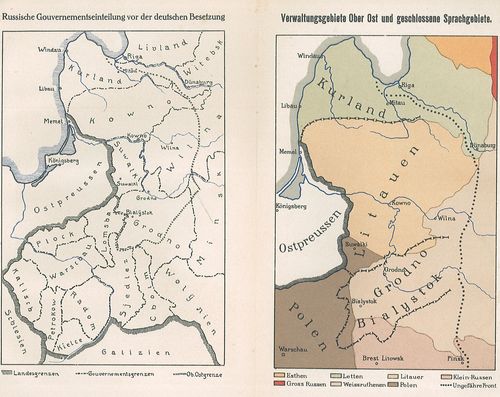
Ober Ost was a territory of the Russian Empire occupied by the Germans during the First World War, bordering East Prussia to the north and east; In 1917, it comprised parts of present-day Latvia and Lithuania, as well as smaller areas of present-day Belarus and Poland – including Grodno/Hrodna and Bialystok/Białystok – covering a total area of 108,808 km².[1]
Topography
The flat or only slightly undulating terrain is characterised by forests in the north, whilst the south also features fertile arable land. It is criss-crossed by many rivers. With a low population density, there were only a few larger towns such as Riga/Rīga or Vilnius/Vilna; the coastal strip along the Baltic Sea was more densely populated than the rest of the country.
Historical Geography
Ober Ost was a territory occupied by the Germans during the First World War, which had been conquered from the spring of 1915 onwards. In 1917 and 1918 in particular, the Germans made further territorial gains, such as the city of Riga, thereby expanding Ober Ost. It was deliberately decided that statehood would only be established after a victorious conclusion to the war; in the meantime, the territory remained exclusively under military administration. Following the defeat of the Central Powers in November 1918, Poland, Lithuania and Latvia divided Ober Ost amongst themselves.
Common symbolism
Ober Ost did not have a flag or coat of arms; the standard insignia of the German Army were used.
Contemporary History
After the outbreak of war in 1914, the Russian army initially went on the offensive and temporarily captured parts of East Prussia. It was not until February 1915 that German troops crossed the Russian border and occupied territories in what are now Lithuania and Latvia; in September, they reached Vilnius. No further significant territorial gains were made until the outbreak of the Russian February Revolution in 1917. Following the October Revolution, the German occupiers established or tolerated puppet states in the ‘Ober Ost’ region, but did not withdraw their troops: on 16 February 1918, the Kingdom of Lithuania (Lietuvos Karalystė) was proclaimed, on 8 March 1918 the Duchy of Courland and Semigallia, and on 12 April 1918 the United Baltic Duchy – the latter two being Baltic German states. Germany did not recognise the independent Baltic nation states – some of which had already been proclaimed – until 22 September 1918, once again without withdrawing its troops. The defeat of the Central Powers brought an end to German rule over Ober Ost, but German soldiers remained involved in the Baltic Wars of Independence in the years that followed, serving in the Freikorps.
Administration
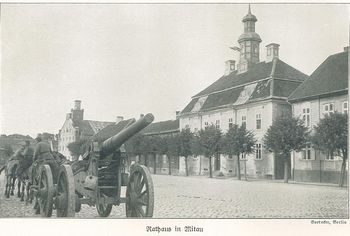
Ober Ost was the only German-occupied territory during the First World War to be governed purely by a military administration, with approximately 18,000 soldiers in the administration. From 26 June 1916, it was divided into six districts: Bialystok, Grodno, Courland, Lithuania, Suwalki and Vilnius. In 1917, these were consolidated into just three districts: Bialystok-Grodno, Courland and Lithuania. This was the area in which the German 10th Army, under Paul von Hindenburg (1847–1934) and his Quartermaster-General Erich Ludendorff (1865–1937), was deployed. Hindenburg served as Commander-in-Chief of all German forces in the East until 29 August 1916, after which he was replaced by Prince Leopold of Bavaria (1846–1930) and his Quartermaster-General Max Hoffmann (1869–1927).
This system of command was implemented through ‘mission-based tactics’, the central element of Prussian military doctrine: an officer receives an order that specifies only the objective, but not the means of achieving it; in this way, situational circumstances are to be taken into account as fully as possible. In contrast to bureaucracy, which prescribes specific measures in each case, the occupation thus remained arbitrary and unpredictable, without, however, achieving better results than elsewhere, for example in terms of exploitation. In 1926, an inquiry by the Reichstag explicitly concluded that, in Ober Ost, overly complex structures—without the involvement of the local population—had prevented the desired ‘successes’ from being achieved.[2]
The local population was enlisted at the lowest level to carry out voluntary auxiliary tasks within the administration, although these obligations were effectively compulsory. In 1918, with the proclamation of formally independent puppet states, bodies of self-government and legislature were established, albeit with limited executive powers. In Courland in particular, Baltic Germans pursued an explicit policy of collaboration, but even they were not granted genuine participation in the occupying regime. The prevailing view regarding the non-German population was that they were incapable of collaboration.
Population
Ober Ost was a multi-ethnic area with a small proportion of German inhabitants. During the war, there were many deportations and numerous people fled, which is why the latest Russian figures from 1897 can only be considered approximate:[3]
| Lithuanians | 1,550,315 | 34.4% |
| Belarusians | 936,067 | 20.8% |
| Jews | 607,896 | 13.5% |
| Poles | 534,102 | 11.5% |
| Latvians | 468,946 | 10.5% |
| Russians | 278,235 | 6.2% |
| Germans | 112,986 | 2.5% |
The geographical boundaries established subsequently largely reflected the ethnic balance of power. Conflicts arose in particular because of the Baltic Germans’ policy of collaboration, which found little support amongst Latvians and Lithuanians; outbreaks of violence were suppressed by the German occupying forces.
Economy
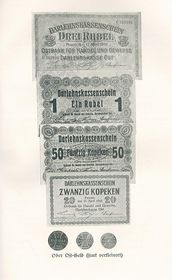
The occupying forces relied on the massive exploitation of the resources of Ober Ost and confiscated industrial goods, foodstuffs and livestock on a large scale. The army introduced a compulsory purchase scheme for the harvest at fixed prices that were unattractive to the farmers, for which a separate currency was created. Over 1,400 large estates were expropriated and run by German officers acting as administrators. Farmers were deployed there as forced labourers, often leaving them unable to cultivate their own fields. The few industrial enterprises in the region were largely at a standstill due to a lack of resources, and unemployment rose. At the same time, the military operated its own factories, for example in Libau/Liepāja, Kowno/Kaunas and Białystok. In the Białowieża Forest, up to 5,000 men worked in the timber industry; it is estimated that, in Lithuania alone, a total of around 60,000 people were conscripted into service under varying degrees of compulsion, whilst a further 24,000 people were sent to Germany as forced labourers.[4]
However, no targeted economic policy was ever implemented in Ober Ost; only the collection of statistical data was perfected during the war – underpinned by the aspiration to achieve universal planning. The urban population in particular fell victim to this policy, suffering severe hunger, whilst at the same time, for example, 50,000 horses, 140,000 head of cattle and 767,000 pigs were exported to Germany; the total value of the resources exported amounted to over 338 million Reichsmarks.[5] Despite the notion that Ober Ost was a potential breadbasket, the results achieved fell far short of the original hopes. Even an ambitious transport policy, which sought to criss-cross the region with infrastructure in order to better control and exploit it, whilst at the same time subjecting it to the regime’s own notions of order, did nothing to change this.
Society
The occupying forces regarded the population of Ober Ost as a barely civilised ethnic mix that needed to be taught German discipline and order. Germany’s purported historical mission culminated in a ‘cultural mission’ which can be understood, on the one hand, as propaganda for its own cause and, on the other, as identity politics. The local population were to be made aware of their inferior position and to recognise German rule as a matter of course. This racist propaganda, particularly that of the press department, proved problematic, especially in 1918, because the original willingness to cooperate with the foreign rulers had been permanently undermined and there was little sympathy for them in the puppet states.
The German position was also intended to be conveyed to their own soldiers. Another target audience for this self-promotion was the home front, to whom they sought to demonstrate the army’s superior achievements, not only in the military sphere. The official book *Das Land Ober Ost*, published in 1917, can be regarded as a kind of showcase and propaganda manifesto, subjecting the country and its people, as well as Germany’s own measures, to an almost colonialist survey and description.
The occupiers’ anti-Semitic attitudes did not lead to specific measures against Jews; on the contrary, German policy proved to be comparatively more liberal than that under Tsarist rule. Although Jews were regarded as pillars of an outdated economic and social order that was now to make way for military planning, they were still needed temporarily, for example as traders and craftsmen.[6] Even after 1917, there was no evidence of them being equated with communists.
Special cultural institutions
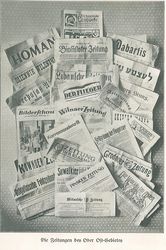
Alongside the local folk theatres, the occupying forces introduced special German theatres, which were also intended to serve as a kind of showcase of the supposedly superior German culture to the local population. Soldiers’ newspapers also served this purpose; although printed in the Reich, they were distributed locally and, with small sections in foreign languages, were explicitly intended to resonate beyond the ranks of their own troops.
The titles of the various newspapers published in Ober Ost under German occupation reflect the different languages spoken in this region. [Photo: Das Land Ober Ost, p. 145].
Education and Science
As in the sphere of religion, the occupying powers in Ober Ost pursued an education policy based on the Prussian model. Enlightenment ideals were promoted in both spheres, but because the supposedly backward ‘national character’ of the non-German population served as justification for patronising and discriminatory measures, the education policy was rejected by the majority of the population. Lessons were taught in the respective national language, no longer in Russian; German was the first foreign language, taught continuously from the first year onwards. Given the country’s ethnic diversity, numerous conflicts arose in which the Germans sought to act as arbiters in order to secure loyalties. This plan could not be realised; instead, dissatisfaction grew with the occupying forces, who permitted only one language per school. In 1918, there were 1,350 primary schools in Ober Ost, of which 750 were Lithuanian, 299 Polish, 164 Jewish (with Yiddish as the language of instruction), 89 Belarusian, 81 German and 7 Latvian.[7] In the face of this‘Germanisation’or national discrimination, there were also – as had been the case under Tsarist rule – numerous underground schools with their own unofficial curricula.
Everyday culture
In Ober Ost, arts and crafts received significant support and were promoted as folk art. At the same time, local culture was regarded as backward and inferior to that of the enemy – both Russian and German. The occupying forces surveyed the most important buildings, documented libraries and museums along with their collections, and exploited the most significant artefacts as expressions of a German culture to which they claimed to trace their origins.
Bibliography
Arnold Zweig (1887–1968) immortalised the military state of Ober Ost in his book *The Dispute over Sergeant Grischa*, published in 1927, drawing on his own experiences – he had served as a soldier in the military judiciary in Ober Ost. In doing so, he created an anti-war novel which, in the form of a judicial drama centring on a Russian prisoner of war, criticises the arbitrariness of the German military; in the character of General Schieffenzahn, he makes a clear allusion to Erich Ludendorff and his hubris and abuse of power, whilst also addressing the clash between Eastern European Jewry and the Prussian Enlightenment.
4. Discourses/Controversies
In 2000 (German edition 2002), Vejas Gabriel Liulevicius argued that Ober Ost was emblematic of German militarism and a‘drive towards the East’, which went hand in hand with violence, oppression and genocide;[8] this occupied territory during the First World War thus represented a kind of link in the chain ‘from Windhoek to Auschwitz’[9] and was a precursor to the Nazi occupation during the Second World War. This thesis has met with both approval and rejection, although critical voices have recently predominated. These critics argue in particular that Ober Ost was hardly representative of German (military) rule during the First World War, but rather an exception, and that Adolf Hitler (1889–1945) later explicitly sidelined the military as an actor and instead relied on an ideologised civilian administration. In this sense, there was no distinct German ‘special path’ in Eastern Europe.[10]
Bibliography
- The Ober Ost Region. German Activities in the Administrative Districts of Courland, Lithuania and Bialystok-Grodno. Edited by the Ober Ost Press Office. Stuttgart, Berlin 1917.
- Vejas Gabriel Liulevicius: A Land of War in the East. Conquest, Colonisation and Military Rule during the First World War. Hamburg 2002.
- Abba Strazhas: German Eastern Policy during the First World War. The Case of Ober Ost 1915–1917. Wiesbaden 1993 (Publications of the Institute for Eastern European Studies, Munich, Series: History).
- Christian Westerhoff: Forced Labour in the First World War. German Labour Policy in Occupied Poland and Lithuania 1914–1918. Paderborn 2012 (Studies in Historical Migration Research 25).
Notes
[1] The Land of Ober Ost, p. 431.
[2] Westerhoff: Forced Labour in the First World War, pp. 79 and 338ff.
[3] The Land of Ober Ost, p. 433.
[4] Westerhoff: Forced Labour in the First World War, pp. 259 et seq. and 264.
[5] Liulevicius: The Eastern Front, p. 100.
[6] Jürgen Matthäus: ‘German Jewish Policy in Lithuania during the First World War’. In: Leo Baeck Institute Yearbook 43 (1998), pp. 155–174, here pp. 173ff.
[7] Liulevicius: ‘War Zone in the East’, p. 160.
[8] Liulevicius: *War Zone in the East*, pp. 20ff. and passim.
[9] Jürgen Zimmerer (ed.): From Windhoek to Auschwitz? Essays on the Relationship between Colonialism and the Holocaust. Münster 2011 (Periplus Studies 15).
[10] This is the conclusion reached by Winson Chu, Jesse Curtis Kauffman and Michael Meng: ‘A Sonderweg through Eastern Europe? The Varieties of German Rule in Poland during the Two World Wars’. In: *German History* 31 (2013), no. 3, pp. 318–344. This essay provides an excellent overview of the controversy.
Citation
Stephan Lehnstaedt: Ober Ost. In: Online Encyclopaedia on the Culture and History of Germans in Eastern Europe, 2015. URL: ome-lexikon.uni-oldenburg.de/p32572 (accessed 14 September 2015).
Terms of use for this article
Copyright © University of Oldenburg and the Federal Institute for the Culture and History of Germans in Eastern Europe (BKGE), all rights reserved. This work was produced as part of the project ‘Online Encyclopaedia on the Culture and History of Germans in Eastern Europe’ and may be reproduced and published provided the rights holders’ consent has been obtained. Please contact:
If you have any specialist comments or additions to the text, please contact the editorial team, citing relevant literature and source references.