

East Prussia
East Prussia
Names in other languages
Polish: Prusy Wschodnie; Russian: Vostočnaja Prussija; Lithuanian: Rytų Prūsija; Latin: Borussia Orientalis, Prussia Orientalis
Etymology
Prussia took its name from the Baltic people of the same name, the Prussians (also known as Pruzzen or Pruteni), who lived mainly in what later became East Prussia. The name ‘East Prussia’ derives, in contrast to West Prussia, from an administrative unit (province) that was formed following the partitions of Poland after 1772 and re-established in 1878. The geographical term ‘Eastern Prussia’ is much older.
Location
‘East Prussia’ refers to the region on the south-eastern bend of the Baltic Sea coast. It stretches along the Vistula Spit (Polish: Mierzeja Wiślana, Russian: Baltijskaja Kosa) and the Curonian Spit (Russian: Kuršskaja kosa, Lithuanian: Kuršių nerija), roughly between the Vistula (Polish: Wisła) delta and the mouth of the Nemunas (Lithuanian: Nemunas, Russian: Neman). The territory under the sovereign’s control, extending from the coast, was initially bounded by a largely uninhabited peripheral zone (the Great Wilderness), and subsequently by a border that remained largely unchanged for a very long period (in the south and east from 1422 to 1919). There were several boundary shifts in the west.
In May 1939, East Prussia – including the Memel Region but excluding the administrative district of West Prussia and the Soldau area – covered 36,481 km² and had a population of 2,341,008.[1]

Topography
As part of the Baltic (Prussian) Ridge, the region is characterised by gently rolling hills (the highest point being Kernsdorfer Höhe [Polish: Dylewska Góra] at 312 m above sea level) and wide river valleys (the Passarge [Polish: Pasłęka], the Pregel [Russian: Pregolja], the Alle [Polish: Łyna, Russian: Lava], and the Deime [Russian: Dejma], Memel), moors and heathland (Elchniederung [Russian: Losinaja Dolina], Großes Moosbruch [Russian: Bol’šoje Mochovoe Boloto], Rominter Heide [Russian: Krasnyj Les, Polish: Puszcza Romincka]). This, combined with extensive woodland, made the region a refuge for large land animals (elk, wolf). The south and south-east boast a rich lake landscape (Masurian Lake District [Polish: Pojezierze Mazurskie]). This is epitomised by the opening line of the East Prussia song, composed in the 1930s: ‘Land of dark forests and crystal-clear lakes’.
Climate
East Prussia lies in the transition zone between a continental climate and an oceanic climate, with cold winters. The annual average temperature ranges between 7 and 7.5°C, whilst the average temperature in January is between −2 and −3°C. Annual rainfall totals around 600–700 mm, with July to September being the wettest period and February to May the driest.
The region’s national affiliation
The first state structures were established during the 13th century following the conquest of the region by the German Order. Separate territories were granted to the archbishoprics and cathedral chapters (Samland, Ermland, Kulm/Chełmno, Pomesania). After 1466/79, the territory of Ermland followed a path similar to that of what would later become West Prussia, becoming more closely linked to the Kingdom of Poland. The larger part of what would later become East Prussia, including Königsberg/Kaliningrad, remained under the control of the German Order in 1466 and was secularised in 1525 as the Duchy of Prussia (as a Polish fief until 1656/60). Following the First Partition of Poland in 1772, a new internal border was drawn between West and East Prussia (separation of the areas around Marienwerder/Kwidzyn and Elbing/Elbląg; incorporation of Warmia). Administered jointly with West Prussia as the Province of Prussia from 1823/29 to 1878, East Prussia became part of the German Empire in 1871. In 1945, East Prussia was divided, with the south coming under Polish administration and the north under Soviet administration. The Kaliningrad Oblast (Kaliningradskaya oblast’) became part of the RSFSR ( Russia after 1991), whilst Memel (under League of Nations administration from 1919 to 1923, part of Lithuania from 1923/24 to 1939) became part of the Lithuanian SSR (Lithuania since 1990). Southern East Prussia today largely corresponds to the Polish Warmian-Masurian Voivodeship (Polish: Województwo warmińsko-mazurskie), with its capital at Allenstein/Olsztyn.
Common symbolism


The insignia of the German Order – a black cross on a white background – continues to be used in the national colours of black and white. The Duchy of Prussia bore, on a white shield, a black eagle with gold armour, initially surmounted by the letter S (feudal lord King Sigmund I [1467–1548]) and a golden neck crown; from 1701 to 1919, it bore the monogram F R (Fridericus Rex). Golden shamrock stems are superimposed on the wings. After 1919, the eagle’s breast was left bare; in 1941, a breast shield bearing the Cross of the Teutonic Order and a mural crown was added.[2] In 1882, a flag divided into black and white was adopted as the flag of the province of East Prussia. The East Prussian Regional Association uses a black elk antler on a white shield as its regional symbol.
Prehistory and Early History
Evidence of human habitation has been found on the southern coast of the Baltic Sea since the end of the Ice Age (the Linear Pottery culture of the lagoon coasts, 11th millennium BC). Numerous finds date from the Bronze Age and early Iron Age, characterised by a large number of burial mounds (West Baltic Burial Mound Culture). This suggests a continuous settlement from the end of the Neolithic period through to the Middle Ages. Amber deposits in Samland gave rise to long-distance trade extending as far as the Mediterranean region (the Amber Road). The Aesti gentes , mentioned in Tacitus’s *Germania* (98 AD), are regarded as the predecessors of the West Baltic tribes known asthe ‘Pruzzi’. This name was first recorded in the 9th century by the author of the *Descriptio civitatum et regionum ad septentrionalem plagam Danubii*, known as the ‘Bavarian Geographer’. The Jewish traveller Ibrahim ibn Ja’cub also reported on the Brus in 965/66. However, the Prussians lacked a written language of their own. Archaeological research varies greatly from region to region.
The Baltic inhabitants of what would later become East Prussia were among the last pagan peoples of Central Europe. During a missionary expedition in 997, the Bohemian nobleman Adalbert (Czech: Vojtěch, Polish: Wojciech; c. 956–997) was killed during a missionary expedition in 997. His transfer to Gniezno, his swift canonisation and the elevation of Gniezno to an archdiocese made Adalbert, the missionary to the Prussians, a national saint of Poland. Further attempts at evangelisation and military campaigns against the Prussian tribes were also primarily launched from Poland, as well as from Rus’ and, for a short time, from Denmark. Most recently, from 1215 onwards, the Cistercian abbot Christian of Lekno (c. 1180–1245), who had been elevated to the rank of missionary bishop, made efforts in this regard.
Middle Ages

Following the failure of these regional attempts at evangelisation and territorial expansion, the German Order took action on the initiative of the neighbouring Duke Konrad I of Masovia (1187/88–1247). The Order secured its mandate through privileges granted by the Emperor (1226 – questionable) and the Pope (1234), and established a territorial base in the Kulm region. It built a series of castles along the Vistula and the Vistula Lagoon coast; among the earliest were Balga in 1239 and Königsberg in 1255.
With the support primarily of German and Polish crusaders, the conquest and Christianisation of the Prussian territories was completed by 1283. The Order established its own territorial rule. One third of the land was ceded to the bishoprics established in 1243 as secular territory (of which two-thirds were archbishoprics and one-third were cathedral chapters). However, these remained dependent on military protection and administrative staff (bailiffs of the prince-bishops) from the German Order, the dominant force within this de jure confederation of states.
Following the incorporation of the Order of the Sword Brothers in Livonia in 1237, the German Order became the regional hegemonic power in the eastern Baltic region, despite geographical separation and Livonia’s autonomous development. With the annexation of Pomerellia in 1308/09, the Order’s rule expanded considerably westwards. Marienburg became the Order’s headquarters and the Grand Master’s residence in 1309/1323. The Grand Master also assumed the duties of the former Landmaster in Prussia. The Grand District Governors, who acted as a permanent council, were usually assigned one of the larger Prussian commanderies. The Supreme Marshal was also the Commander of Königsberg.
The coastal castles of Königsberg, Balga and Brandenburg/Ušakovo housed large Order convents. At the same time, they served as centres of a provincial administration organised across large, clearly defined districts. To the west lay the Commandery of Elbing (extending as far as Ortelsburg/Szczytno) and the Commandery of Christburg/Dzierzgoń (extending as far as Soldau/Działdowo). This gave the Prussian commanderies a distinct strip-like shape. A new commandery was established in Osterode/Ostróda alone after 1340. Another commandery was situated near the border in Ragnit/Neman on the Memel River. The constant mobility and accountability of the celibate knights of the Order, together with an extensive reliance on written records, created an administrative system that appeared ‘almost anachronistically modern’[3].
At the mouth of the Memel, the Livonian branch of the German Order built a castle in 1252. The castle settlement of Memel/Klaipėda, granted Lübeck town privileges in 1272, developed into a trading centre and the main town of the Order’s territory north of the Memel River, inhabited by the Baltic Curonians. An attempt to establish a land connection to Livonia failed. In 1328, the castle, town and surrounding area were handed over to the Prussian branch of the German Order. In 1392, the Bishop of Courland exchanged his rights there.

Administrative boundaries in what would later become East Prussia at the end of the 14th century [My own sketch based on the map by Bernhard Jähnig[4]].
The gradual expansion of the territory was documented by a large number of grants and confirmations of ownership (handfeste). A network of towns was established.[5] The region was now closely integrated into international markets (grain exports as far as Flanders, links to the Hanseatic League). Despite a number of crises, the 14th century – in particular the long tenure of Grand Master Winrich von Kniprode (c. 1310–1382; in office from 1351) – is regarded as the golden age of the Order’s rule, the pinnacle of its supra-regional influence.
After 1340, the German Order turned its attention to the Lithuanians, who were also pagans and had established a large sphere of rule and influence in the north-east and east of what would later become East Prussia. In the 14th century, the Order ’s ‘war against the pagans’ was supported by nobles from the Holy Roman Empire, Poland, France, Burgundy, England and Scotland, who came together on so-called ‘Prussian expeditions’. The Union of Poland and Lithuania (1385) deprived them of their legitimacy. The disastrous military defeat at Tannenberg/Grunwald in 1410 against a Polish-Lithuanian army cost the Order its leadership and its military prestige. The subsequent course of the war and the First Peace of Toruń in 1411 initially confirmed the territorial status quo. The German Order managed to preserve this for several decades through considerable financial, organisational and diplomatic efforts. However, the internal conflict with (parts of) the landed nobility and the towns escalated into a thirteen-year War of the Estates (1454–1466). In the eastern part, the Order was able to maintain its rule; Königsberg became the seat of the Grand Master. From 1498 onwards, the office of Grand Master was filled by princely sons with connections throughout the Empire. Attempts at a military turnaround, most recently in the ‘Cavalry War’ of 1520–21, proved unsuccessful.
Early Modern Period (1525–1772)

In 1525, Grand Master Albrecht (1490–1568), who had converted to Lutheranism and was a relative of the Elector of Brandenburg, secularised the Prussian estates of the Teutonic Order and proclaimed himself Duke. He secured this secularisation by granting a fief to the Polish King Sigmund I, specifically against the continuing existence of the German Order and its support within the Empire (the Imperial Edict, the granting of the administration of the Grand Master’s office in Prussia to the Grand Master of the Teutonic Order, and the Pope’s non-recognition of Hohenzollern rule until the end of the 18th century).
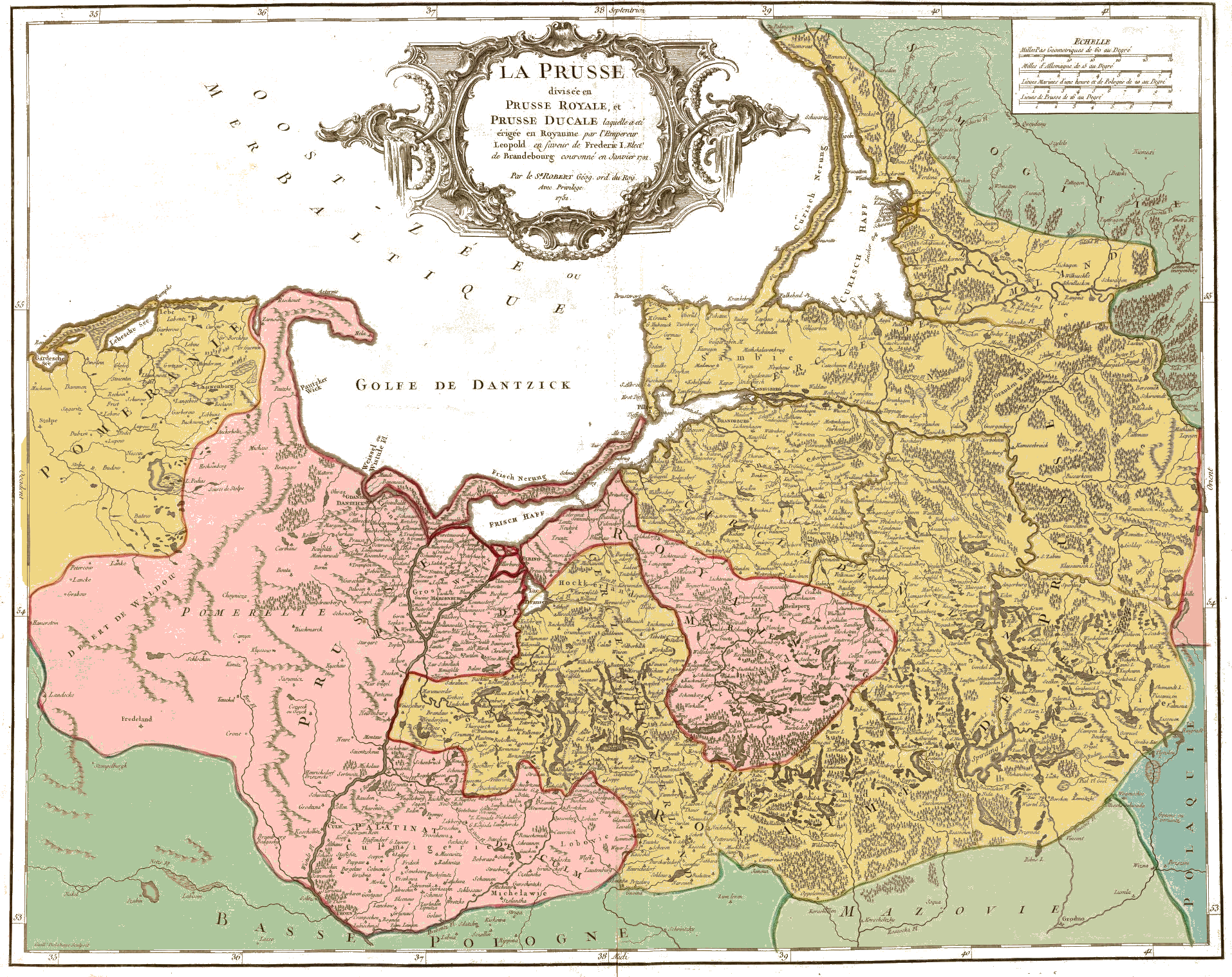
For around 100 years, under Duke Albrecht and his son Albrecht Friedrich (1553–1618), a small independent duchy existed in eastern Prussia. The estates (the nobility and the city of Königsberg) enjoyed a strong position thanks to their backing in Poland and modelled themselves on Polish noble liberties. Albrecht Friedrich’s mental illness led to his being placed under the guardianship of his closest relatives, who from 1603 were the Brandenburg electoral line. They inherited the territory in 1618. Although it served as a refuge for the electoral court as late as 1638, Eastern Prussia has since been governed for the most part from Berlin. In 1657/1660, the Great Elector Frederick William (1620–1688) succeeded in freeing the region from its feudal dependence on Poland. The Duchy of Prussia (which lay outside the Holy Roman Empire ) was elevated to a kingdom in 1701 and gave its name to the entire state. King Frederick William I (1688–1740) modernised his easternmost province. The separate War and Domain Chamber (later an administrative district) of Gumbinnen/Gusev, established for the ‘restoration’ of the north-eastern parts of the country, served as a model for administration. This exclave, cut off from the Brandenburg centre, was abandoned militarily during the Seven Years’ War and occupied by Russia from 1758 to 1762.
Even during the German Order period, the ‘Bishop’s Third’ of the Diocese of Ermland developed more independently than the other bishoprics in the country. The bishopric’s territory formed a contiguous land area. The cathedral chapter was not incorporated into the German Order. Following the partition of the country in 1466 and the two Treaties of Petrikau/Piotrków in 1479 and 1512, the King of Poland became the patron of the bishopric, which had been admitted‘ad corpus et unionem Poloniae’.The bishops initially came from the upper classes of the major West Prussian towns. After 1551, royal appointment became the norm. Ermland was regarded as the best-endowed bishopric in the Kingdom of Poland.
The Long 19th Century (1772–1919)
During the First Partition of Poland in 1772, the Kingdom of Prussia annexed Western Prussia (known as ‘Royal Prussia’); the cities of Danzig/Gdańsk and Thorn/Toruń, which had been excluded at that time, followed in 1793. The administrative boundary of the provinces, first designated as East Prussia and West Prussia in 1773, was redrawn: Marienwerder lay to the west, and Warmia to the east of the new border. A part of Poland acquired in 1793–95, comprising Płock and Białystok, was designated ‘New East Prussia’. As a result of defeats at the hands of Napoleon I (1769–1821) in 1806–07, Prussia lost these territories to the new Duchy of Warsaw. In East Prussia, which served as the King’s place of retreat from 1807 to 1809, the political, social and economic changes known as the Prussian Reforms began.
In 1824–1829, East Prussia was united with West Prussia to form the Province of Prussia. Chief President Theodor von Schön (1773–1856) continued to pursue a liberal reform policy until 1840. In the 1840s, East Prussia came to the fore within the liberal national movement, both in Prussia and in the German National Assembly of 1848–49. Eduard Simson (1810–1899), a professor of law at Königsberg, served as its president. Having previously been part of the German Confederation only from 1848 to 1851, East Prussia (which became a province in its own right again from 1878) became part of the German Empire in 1871, which saw itself as a nation state. Ethnic conflicts and the Kulturkampf affected Masuria and Ermland respectively. A greater administrative density was created by the newly defined districts in 1817 and the formation in 1905 of a separate administrative region for the south of the province, with its seat at the railway junction of Allenstein. During the First World War, large parts of East Prussia were the scene of major military operations (the battles of Tannenberg and on the Masurian Lakes in 1914, and the Winter Battle in Masuria in 1915); with the support of twin towns, reconstruction began whilst the war was still ongoing.
20th century

After the German Empire had lost most of the province of West Prussia under the Treaty of Versailles, its eastern part, centred on Marienwerder and Elbing, became part of the province of East Prussia as the administrative district of West Prussia. In the four southern West Prussian districts (Marienburg/Malbork, Marienwerder, Rosenberg/Susz, Stuhm/Sztum) as well as in southern East Prussia (the administrative district of Allenstein and the district of Oletzko/Olecko), well over 90 per cent (92.42 per cent and 97.9 per cent respectively) voted against annexation by Poland in a referendum held on 11 July 1920, as stipulated by the Treaty of Versailles. The Memel Region, the northern tip of East Prussia comprising the town of Memel, was placed under the supervision of the League of Nations in 1919 and annexed by Lithuania in 1923. The Soldau area (the southern part of the Neidenburg/Nidzica district) had to be ceded to Poland. East Prussia found itself in an isolated position. The Reich sought to offset the economic disadvantages through various support measures (the East Prussia Aid scheme, expanded in 1926 and 1930 to become the East Aid scheme). Continuity was ensured by Ernst Siehr (1869–1945, DDP), who served as Chief President from 1920 to 1932. Otto Braun (1872–1955, SPD) from Königsberg, as the long-serving Minister-President of the Free State of Prussia (1920–1932, with two brief interruptions), was one of the leading democratic politicians of the Weimar Republic.
Above: Mother tongue according to the 1910 statistical survey, as well as the results of the 1920 referendums in the Allenstein and Marienwerder referendum districts, showing percentage shares in the individual districts [Wikimedia Commons. Furfur CC BY-SA 3.0].

Districts in the province of East Prussia after 1920 [own sketch map[6]].
National Socialism in East Prussia was shaped by Gauleiter Erich Koch (1896–1986).[7] He presented himself as a nationalist and a revolutionary. Before his arrival in 1928, the NSDAP had achieved its lowest share of the vote here – 0.8 per cent – and, in March 1933, its highest – 56.5 per cent – in Reichstag elections. The persecution of the Catholic community (the ‘Kirchenkampf’) in Ermland was one of the earliest and most intense in the Reich. The persecution of the Jews ranged from the first pogroms as early as 1923 to the synagogue burnings in 1938 and the deportations in 1942–43. In 1937–38, numerous Lithuanian and Masurian place names were ‘Germanised’. In March 1939, Lithuania was forced to cede the Memel Region to East Prussia. Following Poland’s capitulation, the Soldau region was annexed, whilst the administrative district of West Prussia was incorporated into the newly formed Reichsgau of Danzig-West Prussia. Larger neighbouring territories were annexed to the Province of East Prussia (the ‘Administrative District of Zichenau’ [Ciechanów] in the south, the ‘District of Sudauen’ [Suwałki] in the north-east). Following the German invasion of the Soviet Union in 1941, Gauleiter Erich Koch became head of the civil administration in the ‘Białystok District’ and General Commissioner of Ukraine. Alongside him, a number of East Prussians in senior administrative posts participated in the occupation policy and war crimes committed there. Over 1,500 patients from East Prussian institutions were murdered in 1940 as part of the ‘euthanasia’ programme. It is estimated that more than 10,000 murders took place at the Soldau transit camp. The Hohenstein/Olsztynek prisoner-of-war camp recorded even higher death tolls. A concentration camp was located at Stutthof/Sztutowo, east of Gdańsk; six of its 30 satellite camps were situated in East Prussia. As late as late January/early February 1945, some 7,000 Jewish prisoners were killed during a forced march to Palmnicken/Jantarnyj, ‘the greatest Nazi crime committed on East Prussian soil’.[8]
East Prussia served as a staging area in 1939 and 1941. From 1941 onwards, central command centres for the Europe-wide war were established near Rastenburg/Kętrzyn, including the Führer’s bunker ‘Wolfsschanze’, Heinrich Himmler’s (1900–1945) field command post ‘Hegewald’ and the bunker complexes of the Army High Command, ‘Mauerwald’. The assassination attempt on Adolf Hitler (1889–1945) on 20 July 1944 took place at the ‘Wolf’s Lair’. Among the leading figures of the Resistance were the East Prussians Heinrich Graf Lehndorff (1909–1944), Heinrich Graf zu Dohna-Schlobitten (1882–1944) and the brothers Carl and Fritz Goerdeler (1884 and 1886–1945 respectively), one of whom was a long-serving deputy mayor and the other the treasurer of the city of Königsberg. Ludwig Müller (1893–1945), who served for many years as the Königsberg military district chaplain, came to prominence after 1930 as a co-founder of the German Christians and later as Reich Bishop. He arranged contacts between the National Socialists and military figures, whilst Walter Funk (1890–1960), a native of East Prussia, arranged contacts with big industry. Funk became State Secretary in the Ministry of Public Enlightenment and Propaganda in 1933 and Minister of Economics in 1938; he was convicted in Nuremberg in 1946 as one of the 24 principal war criminals. Also convicted there was the Königsberg-born lawyer Franz Schlegelberger (1876–1970), State Secretary and, for a time, Acting Reich Minister of Justice. Gauleiter Erich Koch had arranged to be flown to the West in April 1945. Only discovered in Schleswig-Holstein in 1949, he was convicted in Poland in 1959. Largely forgotten, he died in 1986 in Wartenburg/Barczewo prison in Warmia.[9]
The British bombing of Königsberg in August 1944 and the Red Army’s advance across the Reich border to Nemmersdorf/Majakovskoe in October 1944 marked the beginning of the conquest of East Prussia. The fighting, which began in January, continued in Königsberg and in the Heiligenbeil/Mamonovo pocket until April 1945. The flight or evacuation of the civilian population was long prohibited; the Soviet advance along the Vistula then cut off the land link to the west. Gross acts of violence against the civilian population, deportations and a mass exodus in winter preceded the expulsion of the majority of the population. Tens of thousands of Germans died of starvation and epidemics in the area surrounding Königsberg;[10] orphans (so-called ‘wolf children’) wandered through the countryside as far as Lithuania.
Since 1945, a border has divided the northern part of East Prussia, which was assigned to the Soviet Union (Russian SFSR), from the southern part, which was incorporated into Poland. The part organised as the Kaliningrad Oblast has been an exclave of Russia since 1991. The Memel Region was once again incorporated into Lithuania (the Lithuanian SSR, since 1990 the Republic of Lithuania).
Economy

Amber from Samland in East Prussia was already being traded in ancient times. Under the German Order, the region became closely integrated into international trade, supported by close links with the Hanseatic League. In particular, grain, amber, timber and other forest products, as well as cloth and furs, were traded mainly with Flanders, and later with the Netherlands and England. Agriculture and forestry predominated. The port city of Königsberg (legally divided until 1724 into the Old Town, Kneiphof and Löbenicht) served as a supra-regional centre for trade and commerce. From the 17th century onwards, Memel developed as a port city (exempted from Königsberg’s staple rights in 1657), whilst the importance of the Ermland port of Braunsberg/Braniewo, once a Hanseatic city, declined. The western and southern parts of the region used the ports of Elbing and Danzig. Trade from Lithuania and Masovia passed through East Prussia.
In Warmia, the bishop and the cathedral chapter owned the majority of the agricultural land. This was mostly leased directly to peasants, preserving the old structures. The nobility held a comparatively small share and experienced greater turnover; after 1772, there was a widespread exodus.
Long-distance trade declined during the early modern period; it was increasingly conducted by Dutch and English merchants. Königsberg, which in the 17th century was still far larger than Berlin, became the first base for a navy after 1657 and, in 1683, the port of call for the Elector’s colonial project in Africa (Groß Friedrichsburg in present-day Ghana). The strengthening of the sovereign’s treasury (the removal of control by the estates, and the establishment of ‘Schatull’ settlements with direct levies) led to the sovereign exerting increasing influence over the economy. Horse breeding was significantly promoted by the establishment of the Trakehnen/Jasnaja Poljana stud farm. Despite some industrial activity (iron foundries, shipyards, pulp), agriculture remained the dominant sector.
The railway (construction of the Ostbahn between 1849 and 1860) greatly expanded the market for, amongst other things, live cattle and dairy products (Berlin, the Ruhr region). The disruption of land links to the main markets led to a severe sales crisis after 1919. The sea link via Pillau/Baltijsk to the Reich was expanded (‘Seedienst Ostpreußen’), the port of Königsberg was developed into a deep-sea port, and an airport was opened in 1922. The Königsberg East Fair (from 1920) became one of the largest trade fairs in the German Reich.
After 1945, the ice-free port of Königsberg was developed as a key economic (and military) hub, whilst economic output in the rest of the northern part of former East Prussia declined significantly. In the southern part, which remained heavily characterised by agriculture and forestry, Allenstein developed into the economic centre (home to Poland’s largest tyre factory and agricultural processing facilities). Tourism is playing an increasingly significant role.
Population and Society
Until the 13th century, the Baltic Prussians were the dominant inhabitants of the region, with small Scandinavian and Slavic populations in the north-west and south respectively. The conquest by the German Order went hand in hand with the influx of (privileged) new settlers. Here, military conquest was uniquely intertwined with the medieval development of the region and eastward settlement of the 13th and 14th centuries. Alongside settlers subject to Prussian (Preussian) law, there were towns and individual grants governed by Kulm law, a variant of Magdeburg law named after the town of Kulm. Prussians, too, were able to benefit from Kulm Law, either through a change in the law or by participating in the internal settlement process. A multi-ethnic population emerged, united by a shared sense of regional identity, although the German element was generally predominant. A sizeable Prussian or Prussian-dominated population persisted in Samland until the 17th century.

After 1466/1525, the local nobility (comprising not only long-established landowners but also mercenary leaders and members of religious orders who had converted to Lutheranism) was strengthened, whilst the traditional free peasants were marginalised. Immigrants from Masovia/Mazowsze and Lithuania in the 16th and 17th centuries shaped the south (Masuria) and the north-west (Prussian Lithuania) respectively. The Lutheran faith fostered a sense of identity distinct from that of their countries of origin. Population losses of up to 40 per cent were caused by the Crimean Tatars, allied with Poland, in 1657 and by a wave of the plague in 1710–11. To ‘repopulate’ the region, new settlers were systematically recruited from across the Empire (Anhalt, Hesse, Nassau, the Palatinate, Switzerland); this culminated in the much-noted settlement of religious refugees from the Prince-Bishopric of Salzburg in 1732, the Protestant ‘Salzburg exiles’. Numerous Dutch, English and Scots lived in Königsberg. Huguenots formed (privileged) French Reformed congregations in Königsberg and Gumbinnen.
Between 1816 and 1864, the population almost doubled, rising from 886,000 to 1,761,000. This was followed by massive emigration, particularly to Berlin and the Ruhr region. Despite a persistently high birth rate, East Prussia then had one of the lowest rates of population growth in the German Empire (1864–1910: 34 per cent).[11] In the 1905–06 census, 79.5 per cent stated German, 14.5 per cent Polish/Masurian and 4.8 per cent Lithuanian as their mother tongue. In five districts in the south, the Polish/Masurian language predominated, whilst in the district of Heydekrug/Šilutė, the Lithuanian language predominated. During the Weimar Republic and the Nazi era, the proportion of non-German speakers declined significantly.
After 1945, a large-scale population exchange took place, concentrated in the northern part until 1948. In the south, the propaganda campaign – linked to claims over the land – aimed at ‘verifying’ the existence of ‘Polish brothers liberated from centuries of Prussian servitude’ failed. It also led to an exodus lasting several decades amongst the Masurians and Ermlanders. In 1947, around 80,000 Masurians and 40,000 Ermländers were still living in southern East Prussia; 50 years later, there were merely 6,000–10,000 Masurians and 4,000–6,000 Ermländers. Between 1971 and 1988 alone, over 55,000 late resettlers left the region.[12] As a result of flight, expulsion and resettlement, the former population of East Prussia, including their descendants, now lives overwhelmingly in Germany, whilst new settlers have been inhabiting the now tripartite region for several generations.
History of Religion and the Church
The Prussians remained pagans until the 13th century. In 1215, the missionary Christian was appointed bishop of the entire region. In 1243, the papal legate Wilhelm von Modena (d. 1251) established four dioceses: Samland, Ermland, Pomesania and Kulm (the latter situated exclusively in what would later become West Prussia), with cathedrals in Königsberg, Frauenburg/Frombork, Marienwerder and Kulmsee/Chełmża. With the exception of Ermland, the cathedral chapters were incorporated into the German Order, and the canonries were filled by priest-brothers of the Order. Memel and the area north of the Memel River belonged to the Diocese of Courland; in 1392, the bishop renounced his claim to this territory. All dioceses belonged to the ecclesiastical province of Riga/Rīga. A network of parish churches was established.
Grand Master Albrecht of Brandenburg-Ansbach and the region were won over to the Reformation at an early stage. In 1523, the Bishop of Samland delivered a Lutheran-oriented Christmas sermon in Königsberg Cathedral. The secularisation of the Teutonic Order’s rule in 1525 created a Protestant duchy. The ecclesiastical rights of the Bishop of Ermland outside his own diocese were suspended; the other two bishops had already embraced the Reformation. Ecclesiastical texts in the vernacular, in particular translations of Luther’s Catechism, are early linguistic artefacts for Poles, Lithuanians and Prussians. The Lutheran faith became part of the regional identity, setting it apart from its neighbours of other denominations (albeit those with related languages). Particularly in the 19th century, there was a strong tradition of lay piety, including in prayer groups (Gromadki) influenced by Lithuanian or Masurian traditions.

With Johann Sigismund (1572–1620), the duchy gained a Reformed prince. The rights of the Lutheran denomination, which dominated the country, remained in force; a few members of the court and the nobility converted to the Reformed faith. With the Prussian Union in 1817, the sovereign and the majority of the population were united within the Evangelical United Church. Under Polish protection, a small Catholic minority continued to exist in the 16th century. Jewish immigration also began from this time onwards. The Jewish community in Königsberg flourished until the early 20th century, becoming one of the largest in the Reich (4,049 members in 1925).
Protestant movements in the Bishopric of Ermland, including in Braunsberg, were suppressed. In 1551, Stanislaus Hosius (1504–1579; Cardinal from 1561), a proponent of the Catholic Reformation, became Bishop of Ermland. Supported by the cathedral chapter and religious orders (the Jesuits from 1565), Ermland became a distinctly Catholic territory. From 1821 and 1929 respectively, the Diocese of Ermland extended across the whole of East Prussia. Ermland, which had become de facto exempt following the abolition of the Archdiocese of Riga, became part of the East German ecclesiastical province (with its seat in Breslau/Wrocław) in 1929–30. Bishop Maximilian Kaller (1880–1947; bishop from 1930) was appointed papal special envoy for displaced Germans in 1946.
After 1945, Polish immigrants turned southern East Prussia into a predominantlyCatholic region. The diocese was redrawn in 1972, the bishop’s seat was moved to Allenstein, and the local St James’ Church was designated as the cathedral. Assigned to the ecclesiastical province of Warsaw (Warszawa) in 1972, Warmia was elevated to an archdiocese in 1992 (Latin: Archidioecesis Varmiensis, Polish: Archidiecezja warmińska), with the newly established suffragan dioceses of Lyck/Ełk and Elbing. In northern East Prussia, the Russian Orthodox denomination is now predominant (Diocese of Kaliningrad and Baltijsk). The Philippons, who emigrated to southern East Prussia at the beginning of the 19th century, represent a remnant of Russian Orthodox secession. Protestants now live and organise themselves as a minority denomination throughout East Prussia.
Education and Science
Schools had existed in towns and parish villages since the late Middle Ages. From the early 14th century onwards, scribes and administrative staff could be recruited from within the region itself[13]; a number of local youths attended universities elsewhere[14]. With the Reformation, the school system was reformed in accordance with the guidelines of Philipp Melanchthon (1497–1560), and in 1542 a ‘Partikular’ was established in Königsberg to prepare for the founding of a university. In addition to several secondary schools in Königsberg, secondary schools were established in the 16th century in Rastenburg, Tilsit/Sovetsk, Lyck and Saalfeld/Zalewo (granted the status of princely schools in 1599), and in 1613 a Latin school was established in Goldap/Gołdap. In 1703, the Latin school for Königsberg Pietists gave rise to the Collegium Fridericianum in Königsberg. Under Frederick William I (school decrees of 1717 and 1718), the rural school system was expanded; by 1739, around 1,000 new schools had been established. In 1767, the first teacher training college for rural schoolteachers was established in Klein-Dexen/Furmanowo near Bartenstein/Bartoszyce. The Königsberg School Plan: Wilhelm von Humboldt (1767–1835) drew up a fundamental reform document for the grammar schools there, which formed the starting point for his educational reforms and the humanist grammar schools. Before 1945, there were 31 grammar schools in East Prussia, eight of which were in Königsberg.
Duke Albrecht, who had close ties to Luther and the Protestant movements in the German-speaking world, founded a university in Königsberg in 1544 (Albertus University, Albertina). The third Protestant university after Wittenberg and Marburg rapidly developed into an educational institution whose influence extended far into neighbouring regions, to Scandinavia, Poland and the Baltic states. During the Thirty Years’ War, it was very well attended. Influenced by Pietism and the Enlightenment after 1700, the University of Königsberg – along with its lecturers and students – played a significant role in shaping the intellectual history of the 18th century, the ‘Königsberg Century’, from Immanuel Kant (1724–1804) through Johann Georg Hamann (1730–1788) and Johann Gottfried Herder (1744–1803) to Christian Jakob Kraus (1753–1805). The university also gave rise to an ‘East Prussian school for civil servants’, which played a decisive role in the Prussian reforms. After 1800, the astronomer Friedrich Wilhelm Bessel (1784–1846) made outstanding contributions. Further innovative new chairs – such as that for the educationalist Johann Friedrich Herbart (1776–1841), the founder of Old German studies Karl Lachmann (1783–1851), the first chair of art history held by Ernst August Hagen (1797–1880) and the first Department of History in 1821 were (merely) starting points for academic careers that continued elsewhere. Whilst Königsberg was a medium-sized university in the 19th century, student numbers had already risen significantly by the turn of the century. ‘Solidarity semesters’ (Ostsemester) in the 1920s led to a further doubling of the student numbers, which had already risen sharply before 1914 (from a low of 295 students in 1847, via 641 in 1892 and 1,649 in the summer of 1914, to a peak of 4,113 in 1930).[15] Following flight and expulsion, the Albertinum hall of residence in Göttingen, amongst other things, serves as a memorial to the University of Königsberg. An art academy was founded in Königsberg in 1841, and a business school in 1915 (which was granted the right to award doctorates in 1930). One of the oldest bird observatories has been located in Rossitten/Rybačij on the Curonian Spit since 1901.
It was chiefly in Allenstein and Frauenburg that the Ermland canon Nicolaus Copernicus (1473–1543) developed the heliocentric model of the universe. In addition to the Warmian Cathedral School and the old episcopal school in Heilsberg/Lidzbark Warmiński, Cardinal Hosius founded a Jesuit grammar school in Braunsberg in 1565. From 1579 onwards, the Jesuits also ran a papal seminary there to train missionaries for northern Europe. In 1630, another Jesuit grammar school was founded in Rößel/Reszel. The Braunsberg grammar school continued as the Lyceum Hosianum; in 1821, the Lyceum, with its School of philosophy and theology, became a higher education institution on a par with universities (in 1912, the State Academy).

In northern East Prussia, the Baltic Federal Immanuel Kant University (Baltijskij federal'nyj universitet imeni Immanuila Kanta, 2005–2012 Immanuel Kant University) is situated in northern East Prussia; it is one of Russia’s eight federal universities and currently has around 16,000 students. In Allenstein, the local University of Education was merged in 1999 with the Technical and Agricultural Academy and the seminary to form the University of Warmia and Mazury (Uniwersytet Warmińsko-Mazurski w Olsztynie). Today, with 15 Schools and over 43,000 students, it is one of 18 universities in Poland. The University of Memel (Klaipėdos universitetas), founded in 1991, now has 10,000 students, seven Schools and eight Institutes.
Left: Bilingual commemorative plaque for Immanuel Kant on the Pregel Bridge in Königsberg [Photo (2009): Wikimedia Commons. Rybec CC BY-SA 2.0].
Special cultural institutions
Regional historical research is coordinated by the Historical Commission for East and West Prussian Regional Research. Of the regional historical societies formed in the mid-19th century, the ‘Association for the History and Archaeology of Ermland’ is still active today, organising conferences and publishing works. The ‘Association for Family History Research in East and West Prussia’, founded in 1925, focuses on a lively programme of publications, including works on general regional studies and reprints.
On the Polish side, regional historical research covering the entire territory of the Teutonic Order is carried out at the Nicolaus Copernicus University in Toruń (Uniwersytet Mikołaja Kopernika w Toruniu). In Olsztyn, the Wojciech Kętrzyński Institute (Ośrodek Badań Naukowych im. Wojciecha Kętrzyńskiego w Olsztynie) is active. The ‘Borussia Cultural Community’ (Wspólnota Kulturowa ‘Borussia’), initiated in 1990 by young academics, incorporates research into history and culture into a wide range of cultural and educational programmes (Cultural Centre in the Mendelsohn House, Allenstein, formerly Bet Tahara). In the Kaliningrad Oblast, too, interest in the region’s history has grown since 1990. In Memel, a research institute for the history of Western Lithuania and Prussia was established after 1991.
A factor that proved favourable for research into regional history after 1945 in the Federal Republic of Germany was that the old collections (dating back to around 1750/1800) from the Königsberg State Archives, as well as the NSDAP Gau Archives, were relocated to the West in 1944. Today, they form the 20th Main Department of the Secret State Archive of the Prussian Cultural Heritage Foundation in Berlin, where the (supplementary) records of the Berlin central authorities and ministries are also held. The old archives of the towns and manors have largely been destroyed. After 1945, state archives were established in Königsberg and Allenstein. These also house surviving archival remnants and administrative records from the German period; of particular note is the Dohna-Reichertswalde archive, which is now held in Allenstein. Further fragments are located in Vilnius and Moscow. The Catholic Church maintains a network of diocesan archives. The Ermland Diocesan Archive had been run on a full-time basis since 1932; Dr Anneliese Birch-Hirschfeld, married name Triller (1903–1998), was one of the first female archive directors.
In 1987, an East Prussian State Museum was opened in Lüneburg with institutional funding from the Federal Government. Its predecessor was the East Prussian Hunting Museum, which opened in 1958/1964. In the Castle of the Teutonic Order in Ellingen, the East Prussia Cultural Centre – co-funded by its patron state, Bavaria – operates a museum, gallery and exhibitions; attached to it is an archive containing a number of estates. The East and West Prussia Foundation in Oberschleißheim is the third institution dedicated to the preservation and promotion of East Prussian cultural heritage. In addition, there are a large number of local history rooms and private collections. Documents relating to East Prussian folklore are held by the Cammann Archive in Rotenburg an der Wümme. The Ermlandhaus in Münster houses memorabilia, books, archival materials (particularly collections relating to church history), sacred objects and exhibits. The Prussia Collection – the archaeological collection on the prehistory and early history of East and West Prussia, established after 1844 at the Prussia Museum in Königsberg – has been distributed amongst Kaliningrad, Allenstein and Berlin (rediscovered in the Berlin Museum of Prehistory and Early History in 1992).[16]
Everyday culture

The various groups of immigrants brought a wide variety of languages and dialects,[17] legends, songs, folk art, customs, pottery, textiles and architectural styles into everyday life in East Prussia. For example, processions featuring ‘Schimmelreiter’ (white-horse riders) at the turn of the year and the Easter custom of ‘Schmackostern’ were widespread.
A well-known example of maritime culture is the ‘Kurenwimpel’ – distinctive markings on fishing boats on the Curonian Lagoon, differentiated by location and type. The arts and crafts sector also made use of the region’s rich amber deposits. The Trakehner breed stands out amongst East Prussian horse breeds. Traditional costumes considered and documented as typical of the region do not, for the most part, date back to before 1919. After 1945, dance and traditional costume performances formed the core of the solidarity expressed by regional associations.

Tilsiter cheese and Königsberger Klopse – a meat dish made from minced meat – originated in East Prussia and became part of mainstream German cuisine. Popular local specialities include Königsberg marzipan and, amongst alcoholic drinks, Bärenfang (honey liqueur) and Pillkaller (almond schnapps).
Left: Tilsiter cheese being made, 1930s [Photo: Federal Archives, B 145 Bild-P016202 / Frankl, A. / CC BY-SA 3.0].
Art History

Notable medieval religious buildings include the two cathedrals (Domes) in Königsberg and Frauenburg. Königsberg Castle, the Komtursburg which had been rebuilt and extended on numerous occasions, was severely damaged in 1945 and demolished in 1968. The large Teutonic Order castles of Balga and Brandenburg remain as ruins. Castle complexes belonging to the bishops of Ermland and the cathedral chapter can be found in Heilsberg, Braunsberg, Rößel and Allenstein. Neidenburg boasts one of the few hilltop castles in the region. A number of town and village churches also date from the Teutonic Order period.
Outstanding Baroque church architecture can be found in the pilgrimage churches of Heiligelinde/Święta Lipka and Krossen/Krosno. The great noble families had stately country houses built for themselves. Some have since been restored (Juditten/Judyty, Quittainen/Kwitajny), whilst others still stand as impressive ruins (Schlobitten/Słobity or Schlodien/Gladysze, which burnt down in 1986). The ruins of Friedrichstein/Kamenka, once the largest castle in East Prussia, have now been cleared away.
Examples of Classicism, based on designs by Karl Friedrich Schinkel (1781–1841), include the Old Town Church in Königsberg and churches in Heilsberg and Wormditt/Orneta. The Neue Börse in Königsberg was built between 1870 and 1875 in the Neo-Renaissance style. In line with the reform ideas of ‘Heimatschutz’ and ‘Typisierung’, the small towns of East Prussia were rebuilt following the destruction caused by the First World War. Modern architecture was created by the academy professor Friedrich Lahrs (1880–1964, Kant’s tomb) and many of his numerous pupils. Hanns Hopp (1890–1971) worked as an architect, primarily in Königsberg, from 1913 to 1944. The architects Bruno and Max Taut (1880–1938 and 1884–1967 respectively) and Erich Mendelsohn (1887–1953) were from East Prussia; the latter designed the Jewish Bet Tahara in his home town of Allenstein and the ‘Loge der Erzväter’ in Tilsit. One of Germany’s greatest monumental structures was the Tannenberg Monument, erected between 1924 and 1927 to designs by Walter and Johannes Krüger (1888–1971 and 1890–1975 respectively).

Both born in East Prussia, the painter and sculptor Käthe Kollwitz (1867–1945) and the painter Lovis Corinth (1858–1925) initially studied at the Königsberg Academy of Fine Arts. Corinth played a part in the artistic discovery of the Curonian Spit and the formation of an artists’ colony in Nidden/Nida from 1890 onwards. Among the approximately 200 painters working there were Max Pechstein (1881–1955), Karl Schmitt-Rottluff (1884–1976), Robert Budzinski (1876–1955) and Ernst Mollenhauer (1892–1963).
Left: Lovis Corinth: Churchyard in Nidden (oil on canvas, 1893).
Music and Theatre
The first court chapel was founded around 1500. Duke Albrecht was a great patron of music in general and church music in particular; he commissioned the printing of several collections of hymns. Ambrosius Lobwasser (1515–1585) worked in Königsberg from 1563 until his death. The Advent hymn ‘Macht hoch die Tür’ by Georg Weissel (1592–1635) and ‘Ännchen von Tharau’, attributed to Simon Dach (1605–1659), remain part of the German musical heritage to this day. Notable musicians of the 17th century included Johann Stobäus (1580–1646) and Heinrich Albert (1604–1651).
Under Frederick William I, church music flourished once more. In the 19th century, East Prussia boasted a vibrant musical life, notably a dense network of choral societies. Highlights included East Prussian music festivals lasting several days. In 1923, Albertus University established an Institute of Musicology under Joseph Müller-Blattau (1895–1976). The operetta composer Walter Kollo (1878–1940) and Werner Richard Heymann (1896–1961), the composer of well-known film hits and songs by the Comedian Harmonists, moved from East Prussia to Berlin.

Operas and Singspiele had been performed in Königsberg since the late 18th century. Richard Wagner (1813–1883) was among those who worked at the Municipal Theatre, built in 1806, in 1836–37. Expanded into an opera house and merged with the Neues Schauspielhaus in 1924 to form the East Prussian State Theatre, it was regarded under Hans Schüler (1897–1963) as one of the most avant-garde opera houses in the Reich. Similarly, the Neues Schauspielhaus was regarded as one of the most modern theatres in the 1920s. Allenstein, Insterburg/Černjachovsk and Tilsit also had their own municipal theatres.
History of Literature and Media
Around 1325, Peter von Dusburg, a priest of the Teutonic Order, wrote his *Chronicon Terrae Prussiae* in Königsberg; owing to its contemporary perspective, it is a key chronicle of the early history and conquest of the region. Königsberg became a literary centre and a hub for printing and libraries on a supra-regional scale, first as the seat of the Grand Master, then through the princely court, and from 1544 onwards through the university. Duke Albrecht’s castle library was opened to the public in 1540; it formed the basis for what later became the Royal Library, and from 1919 the State Library of Königsberg. After 1800, the university’s collections and the private Wallenrodt Library were incorporated into it. The library at Schlobitten Castle was regarded as the largest private library east of Berlin until 1945.
The Königsberg bookshop Gräfe und Unzer, founded in 1722, had one of the largest ranges of books in Europe prior to 1945. The publishing house continued to operate in Munich and is now one of the 30 largest German-language publishers. Königsberg was a newspaper centre of supra-regional significance with a diverse range of publications, from the *Königsberger Hartungsche Zeitung* and the widely circulated *Königsberger Allgemeine Zeitung* to the the social-democratic Königsberger Volkszeitung(founded in 1893 by Otto Braun and Hugo Haase [1863–1919]).
Following an initial golden age for the university and literature under Duke Albrecht, literary and musical life in the mid-17th century was shaped by the circle around Simon Dach, named after their meeting place, the ‘Kürbishütte’; in 1639, Dach was appointed to a chair in poetry. In the 18th century, the following figures lived and/or worked in Königsberg: Johann Christoph Gottsched (1700–1766), Johann Georg Hamann, Theodor Gottlieb von Hippel (1741–1796), Zacharias Werner (1768–1823), Ernst Theodor Amadeus Hoffmann (1776–1822) and Max von Schenkendorf (1783–1817) lived and/or worked in Königsberg. Heinrich von Kleist (1777–1811) and Joseph von Eichendorff (1788–1857) lived in Königsberg for a time. Ignacy Krasicki (1735–1801), Bishop of Ermland, was one of the most important Polish poets of the Enlightenment. Christian Donalitius (Lithuanian: Kristijonas Donelaitis, 1714–1780) is regarded as the founder of modern Lithuanian literature.
Among the authors who shaped literary life in the late 19th century were Ernst Wichert (1831–1902), Felix Dahn (1834–1912), Hermann Sudermann (1857–1928) and Arno Holz (1863–1929), the founder of German naturalism. Widely read authors in the 20th century included Agnes Miegel (1879–1964), Ernst Wiechert (1887–1950), Johannes Bobrowski (1917–1965), Siegfried Lenz (1926–2014), Arno Surminski and Artur Becker. Memoir literature enjoyed high print runs, such as the works of Hans Graf von Lehndorff (1910–1987), Marion Gräfin Dönhoff (1909–2002) and Max Fürst (1905–1978); after 1990, this was combined with travelogues, such as those by Ralph Giordano (1923–2014) and Ulla Lachauer.
Culture of memory and remembrance
The region is a tourist destination, both for its natural beauty (Masurian forests and lakes, the Rominter Heath, spits, the seaside resort of Rauschen/Svetlogorsk) and for its architectural monuments dating back to the late Middle Ages (the cathedralsof Königsberg and Frauenburg, the pilgrimage church of Heiligelinde, and numerous other churches, castles and palaces) and other historical artefacts. These also include the remains of the Nazi bunker complex ‘Wolfsschanze’. Since 1949, the East Prussia Association has organised a ‘Germany Meeting’ approximately every three years. Further gatherings, some of which are held annually, are organised by the district associations and other organisations. These have also established and maintained smaller local history centres, mostly in the twin towns, as places of documentation and remembrance for smaller regions or communities.
4. Discourses/Controversies
From the mid-19th century onwards, the province of East Prussia and the Teutonic Order were at the centre of national tensions (‘bearers of culture’, a ‘bulwark’ of Protestantism,theGerman‘drive towards the East’). The events of the first half of the 20th century reinforced these national perspectives and the emergence of a regional East Prussian identity. Since then, historians and other researchers specialising in regional studies have arrived at far more nuanced assessments. Following 1990, Lithuanian and Russian researchers were increasingly drawn into the intensive German-Polish academic discourse. It was not until after the turn of the millennium that the early 20th century, particularly the Nazi era, was studied in greater depth.
Bibliography
- Michael Antoni (ed.): Dehio Handbook of Artistic Monuments in West and East Prussia. The former provinces of West and East Prussia (Prussia under the Teutonic Order) including the Bütow and Lauenburg regions. Munich, Berlin 1993.
- Hartmut Boockmann: East Prussia and West Prussia. 2nd ed. Berlin 1993 (German History in Eastern Europe).
- Klaus Garber, Manfred Komorowski, Axel E. Walter (eds.): Cultural History of East Prussia in the Early Modern Period. Tübingen 2001 (Early Modern Period 56).
- Jörg Hackmann: East Prussia and West Prussia from a German and Polish Perspective. Regional History as a Problem of Interrelations. Wiesbaden 1996 (German Historical Institute, Warsaw, Sources and Studies 3).
- Christofer Herrmann: Medieval Architecture in Prussia. Studies on the Question of the Artistic Landscape and Geography. Petersberg 2007 (Studies in International Architectural and Cultural History 56).
- Walther Hubatsch: History of the Protestant Church in East Prussia. 3 vols. Göttingen 1968.
- Bernhart Jähnig (ed.): The 1920 Referendum. Background, Course and Consequences. Marburg 2002 (Proceedings of the Historical Commission for East and West Prussian Regional Research 17).
- Bernhart Jähnig (ed.): Music and Literature in Early Modern Prussia. Marburg 2009 (Proceedings of the Historical Commission for East and West Prussian Regional Research 24).
- Bernhart Jähnig (ed.): Literature in Prussia from the End of the Teutonic Order Period to the 20th Century. Osnabrück 2012 (Proceedings of the Historical Commission for East and West Prussian Regional Research 27).
- Andreas Kossert: East Prussia. History and Myth. 3rd ed. Munich 2005.
- Andreas Kossert: East Prussia: History of a Historical Region. Munich 2014.
- Yuri V. Kostyashov (ed.): Eastern Prussia through the Eyes of Soviet Resettlers. The Early Years of the Kaliningrad Oblast in Memoirs and Documents [East Prussia through the Eyes of Soviet Resettlers. The Early Years of the Kaliningrad Oblast in Memoirs and Documents]. 2nd ed. Kaliningrad 2003.
- Gerard Labuda, Stanisław Salmonowicz (eds.): *Historia Pomorza* [History of East and West Prussia and Pomerania], 4 vols. to date. Poznań 1969–2002.
- Peter Mast: East Prussia and West Prussia and the Germans from Lithuania. Munich 2001 (Study Series of the East German Cultural Council Foundation 10).
- Klaus Militzer (ed.): Problems of Migration and Integration in Prussia from the Middle Ages to the Early 20th Century. Marburg 2005 (Proceedings of the Historical Commission for East and West Prussian Regional Research 21).
- Alvydas Nikžentaitis (ed.): Historical Problems of the Regions around Memel and Königsberg from the 16th to the 20th Century. Klaipėda 2001 (Acta historica Universitatis Klaipedensis 8).
- Ernst Opgenoorth (ed.): Handbook of the History of East and West Prussia. 4 vols. Lüneburg 1994–1998 (Monographs of the Historical Commission for East and West Prussian Regional Research 10).
- Christian Pletzing (ed.): Outpost of the Reich? East Prussia 1933–1945. Munich 2006 (Colloquia Baltica 3).
- Hermann Pölking: East Prussia. A Biography of a Province. Berlin 2011.
- Jan Salm: East Prussian Towns in the First World War. Reconstruction and Reinvention. Munich 2012 (Publications of the Federal Institute for Culture and History of the Germans in Eastern Europe 46).
- Jens Stüben (ed.): East Prussia – West Prussia – Danzig. A Historical Literary Landscape. Munich 2007 (Publications of the Federal Institute for Culture and History of the Germans in Eastern Europe 30).
- Tomasz Torbus: The Convent Castles in the Teutonic Order’s Prussia. Munich 1998 (Publications of the Federal Institute for East German Culture and History 11).
- Robert Traba (ed.): Kraina tysiąca granic. Szkice o historii i pamięci [Land of a Thousand Borders. Sketches on History and Memory]. Olsztyn 2003 (Bibliotheka Borussii 25).
- Robert Traba: ‘East Prussian Identity’. Regional and National Identity in German Political Culture. Poznań [et al.] 2005. German: East Prussia – The Construction of a German Province. A Study of Regional and National Identity 1914–1933. Osnabrück 2010.
- Matthias Weber (ed.): Prussia in Eastern Central Europe. A History of Events and Interpretations. Munich 2003 (Publications of the Federal Institute for Culture and History of the Germans in Eastern Europe 21).
- Erich Weise (ed.): Handbook of Historical Sites. East and West Prussia. Stuttgart 1981 (Kröners Taschenausgabe 317).
Periodicals
- Old Prussian Genealogy. Journal of the Society for Family Research in East and West Prussia (1927–1943, New Series 1953 onwards).
- Komunikaty Mazursko-Warmińskie. Kwartalnik [News from Warmia and Masuria. Quarterly Journal] (1949 onwards).
- Preußenland. Yearbook of the Historical Commission for East and West Prussian Regional Research and the Copernicus Association for the History and Regional Studies of West Prussia. Communications from the Secret State Archives of the Prussian Cultural Heritage Foundation (1963 onwards, published as a yearbook from 2010).
- Journal of the History and Archaeology of Ermland (1860–1943, 1960 onwards).
Bibliographies
- Bibliography on the History of East and West Prussia. Bibliography of the History of Gdańsk Pomerania and East Prussia / in collaboration with the Towarzystwo Naukowe w Toruniu and the Biblioteka Uniwersytecka w Toruniu, and in association with the Historical Commission for East and West Prussian Regional Research, published by the Herder Institute. Marburg 1999–2008.
- Maximilian Rankl (ed.): Bibliography of the Literature of East and West Prussia, including Danzig, 1945–1988. Bonn 1990.
- Max Szameitat: Bibliography of the Memel Region. Würzburg 1957.
- Ernst Wermke: Bibliography of the History of East and West Prussia. 4 vols. Königsberg and Aalen, Bonn-Bad Godesberg, Marburg 1933–1978.
Web links
- www.ostpreussen.de/ (website of the East Prussia Association)
- www.bildarchiv-ostpreussen.de/ (Historical Views, Collection of the East Prussia Association / Dr Manfred Schwarz)
- www.kulturzentrum-ostpreussen.de/ (East Prussia Cultural Centre in Ellingen)
- www.ostpreussisches-landesmuseum.de/ (Website of the East Prussian State Museum, Lüneburg)
- www.historischer-verein-ermland.de/ (Historical Society for Ermland)
- www.vffow.org/ (Association for Family Research in East and West Prussia, also providing an overview of its extensive publications)
- www.hiko-owp.eu (Historical Commission for East and West Prussian Regional Research)
- www.olsztyn.ap.gov.pl/ (Allenstein State Archives)
- www.herder-institut.de/bildkatalog/index/index (Images relating to East Prussia in the image archive of the Herder Institute, Marburg)
Notes
[1] Resident population according to the census of 17 May 1939 (2,488,122 people), excluding the administrative district of West Prussia (301,808 people over 2,925.93 km²) and adding the Memel Region (154,694 people on 1 January 1940 over 2,416 km²). The Province of East Prussia within the 1913 borders also included the Soldau area, covering 501 km² with a resident population of 24,830 in mid-1939. Statistical Yearbook for the German Reich 58 (1939/40), p. 7 and p. 10 respectively; and Municipal Statistics. Results of the 1939 Population, Occupational and Agricultural Census. Volume 1: East Prussia. Berlin 1943 (Statistics of the German Reich 559), pp. 4–5.
[2] On the little-known change to the coat of arms referring to the Tannenberg Memorial, see Ernst Vogelsang: ‘From Letterhead Vignette to Troop Insignia – the Tannenberg Reich Memorial as a Symbol of a Province’. In: Udo Arnold (ed.): Prussian Regional History. Festschrift for Bernhart Jähnig on his 60th birthday. Marburg 2001 (Monographs of the Historical Commission for East and West Prussian Regional Research 22), pp. 541–552, here p. 549 with illustration. See also Ludwig Biewer: The Coat of Arms of East Prussia. In: Zeitschrift für Ostforschung 34 (1985), pp. 273–279.
[3] Quoted from Reinhard Wenskus: ‘Prussia, the Order’s Land, as a Territorial State of the 14th Century’. In: Hans Patze (ed.): The German Territorial State in the 14th Century. Vol. 1. Sigmaringen 1970 (Lectures and Research 13), pp. 347–382, here p. 355.
[4] Source: Bernhard Jähnig: Winrich von Kniprode – Grand Master of the German Order 1352–1382. In: Yearbook of the Prussian Cultural Heritage 19 (1982), pp. 249–276, reprinted in the same author’s: Lectures and Research on the History of Prussia and the German Order in the Middle Ages. Edited by Hans-Jürgen and Barbara Kämpfert. Münster 2011 (Sources and Studies on the History of West Prussia 34), pp. 67–89, here p. 75.
[5] The cataloguing of the documents is now being continued in the Virtual Prussian Document Database at www.oa.uni-hamburg.de/datenbanken/preussische-urkundenbuch.html (accessed 17 August 2021).
[6] Source: Martin Armgart, ‘On the History of the Neidenburg District’. In: 40 Years of Twinning 1953–1993. The City of Bochum – The Neidenburg District Community Through the Ages. Bochum 1993, pp. 16–33, here p. 16.
[7] Ralf Meindl: The Gauleiter of East Prussia. Erich Koch – a political biography. Osnabrück 2007 (Individual Publications of the German Historical Institute in Warsaw 18). URL: www.perspectivia.net/publikationen/ev-warschau/meindl_koch (accessed 23 November 2015). See also Pletzing (ed.): Outposts of the Reich?
[8] Quotation from Kossert: East Prussia, p. 317, following a detailed account of the events from p. 310 onwards.
[9] A harrowing account is the television interview conducted by Mieczysław Siemiński in 1986 with the almost 90-year-old Koch; an edited version was broadcast by the SDR in 1992.
[10] Precise figures are, by their very nature, almost impossible to ascertain. One of the first estimates was provided by Otto Lasch in *So fiel Königsberg. Kampf und Untergang von Ostpreußens Hauptstadt*. Munich 1958, p. 127: ‘Of the civilian population, which numbered around 110,000 at the time of the surrender, only around 25,000 are still alive’. According to Soviet statistics, as at 1 September 1945, only 68,014 people were registered in the city of Königsberg, and 139,902 in the whole of northern East Prussia, of whom 39,855 were unfit for work; Ruth Kibelka: The German Population between Assimilation and Expulsion North and South of the Memel (1945–1948). Diss. phil., Berlin 1997, pp. 42ff. A compilation of various surveys and estimates can be found in Gerhild Luschnat: The Situation of the Germans in the Königsberg Region 1945–1948. 2nd ed. Frankfurt am Main et al. 1998 (Europäische Hochschulschriften/3 686), pp. 74–78.
[11] Statistical Yearbook for the German Reich. Berlin 1913, p. 2. (Restricted access at www.digizeitschriften.de/dms/img/?PID=PPN514401303_1912 [accessed 23 November 2015]).
[12] The figures for 1947 and around 1999 are taken from Andrzej Sakson: ‘Between Polishness and Germanness – are there still people from Ermland and Masuria?’ In: Nordost-Archive. New Series 8 (1999), No. 1, pp. 221–236, here p. 221. On the periods after 1945, see Andreas Kossert: Masuria. East Prussia’s Forgotten South. Berlin 2001, pp. 357–379.
[13] Martin Armgart: The ‘Handfesten’ of the Prussian Oberland and their issuers. Diplomatic and prosopographical studies on the history of the chancellery of the German Order in Prussia. Cologne et al. 1995 (Publications from the Archives of the Prussian Cultural Heritage Foundation, Supplement 2), esp. pp. 200–285; on the targeted support of local students, see Hartmut Boockmann: The Law Students of the German Order. Study, academic support and scholarly careers in the late Middle Ages. In: Festschrift for Hermann Heimpel on his 70th birthday on 19 September 1971. Vol. 2, Göttingen 1972 (Publications of the Max Planck Institute of History 36,2), pp. 313–375.
[14] Compiled in Max Perlbach: *Prussia Scholastica*. East and West Prussians at medieval universities. Braunsberg 1895.
[15] The earliest figures are given in Franz Eulenburg: Enrolment at German Universities from their Founding to the Present Day. Leipzig 1904, reprinted Berlin 1994, table covering all universities, pp. 303–307; commented on and extended for Königsberg in Klaus Bürger: *Remarks on the Student Registers and the Students of the University of Königsberg, Prussia* (1829–1921/22). In: *Prussian Regional History* (note 2), pp. 497–512, table for 1900–1922 on pp. 511ff.; the peak figure for 1930 in Fritz Gause: History of the City of Königsberg, Vol. 3: From the First World War to the Fall of Königsberg. Leer 1971, reprinted Cologne et al. 1996 (Eastern Central Europe in the Past and Present 10), p. 62.
[16] Philipp Adlung (ed.): The Prussia Collection. The holdings at the Museum of History and Art, Kaliningrad. Bremen 2005.
[17] Dialects comprising High and Low German elements as well as numerous loanwords are documented in: *Prussian Dictionary. German Dialects of East and West Prussia*. Founded by Erhard Riemann. Continued by Ulrich Tolksdorf. Edited by Reinhard Goltz. 6 vols. Neumünster 1974–2005.
Citation
Martin Armgart: East Prussia. In: Online Encyclopaedia on the Culture and History of Germans in Eastern Europe, 2015. URL: ome-lexikon.uni-oldenburg.de/p32538 (accessed 15 February 2022).
Terms of use for this article
Copyright © University of Oldenburg and the Federal Institute for the Culture and History of Germans in Eastern Europe (BKGE), all rights reserved. This work was produced as part of the project ‘Online Encyclopaedia on the Culture and History of Germans in Eastern Europe’ and may be reproduced and published provided the rights holders’ consent has been obtained. Please contact:
If you have any specialist comments or additions to the text, please contact the editorial team, citing relevant literature and source references.