

Elbing/Elbląg
Elbing/Elbląg
Names in other languages
Latin: Elbinga, Elbingus; Prussian: Elbings; Russian: El'blong; Lithuanian: Elbingas; Latvian: Elblonga; Czech: Elbinek
Etymology
The town’s name is the same as that of the small river, the Elbing, on which it lies. The name means ‘little river’ (cf. Swedish ‘Elf’ = river, ‘ing’ = diminutive form).
Location
Elbing is situated at 54° 10' north latitude, 19° 24' east longitude, 52 kilometres south-east of Danzig/Gdańsk, 85 km north-west of Allenstein/Olsztyn, and 95 km south-west of Königsberg/Kaliningrad.
Topography
Elbing is situated in the Elbing Lowlands on the right bank of the River Elbing (Elbląg), near its mouth where it flows into the Vistula Lagoon (Zalew Wiślany), on the south-western edge of the Elbing Uplands (197 m).
Political and administrative affiliation
Poland. A city with independent district status and the administrative centre of a district in the Warmian-Masurian Voivodeship (Województwo Warmińsko-Mazurskie). From 1970 to 1998, Elbing was the voivodeship capital. An Elbing district had existed since 1815; in 1874, the town became a city with independent administrative status. From 1818 to 1920, Elbing belonged to the Danzig administrative district in the Province of West Prussia (1829–1878: Province of Prussia); from 1922 to 1939, it belonged to the West Prussia administrative district (headquarters: Marienwerder) in the Province of East Prussia.
Common symbolism
The coat of arms is divided and features two cross-pats (order crosses): at the top, a red cross on a white (silver) background; at the bottom, a white (silver) cross on a red background against a golden net. Silver and red are also the colours of Elbing’s ‘mother city’, Lübeck; the net refers to fishing.
Middle Ages
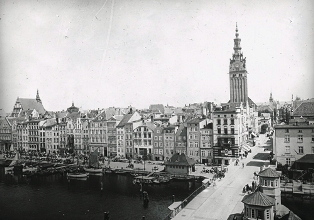
View of the town of Elbing with a row of houses along the River Elbing and the tower of St Nicholas’ Church at
(slide: before 1945)
[Herder Institute, Marburg, Image Archive, Inv. No. 201161].
Not far from the former Prussian-Viking scattered settlement of Truso, which was situated on a bay of the Vistula Lagoon, later known as Lake Drausensee (Jezioro Druzno), and which had enjoyed a heyday as a trading centre in the 9th century, the German Order began construction of a castle in 1237 (extended in stone from 1246 until the early 14th century). From 1251 to 1309, this served as the main seat of the German Order in Prussia and the seat of the Land Masters of Prussia; thereafter, it became the seat of the Grand Spittler. Immediately north of the castle, to the east of the Elbing River, merchants from Lübeck, mostly of Westphalian origin, and other settlers, and in collaboration with the Order, founded the port city of Elbing in 1237, which was granted Lübeck city rights in 1246. In the 1240s, 1260s and 1270s, the town and castle had to fend off several attacks by the Prussians. Following a fire in the town in 1288, it was rebuilt in stone. The town was heavily fortified; around 1300, a wall with 14 defensive towers was erected, and between 1410 and 1437 an outer rampart with towers and a moat was constructed. In the 13th and 14th centuries, numerous granaries were built opposite the town, on the west bank of the Elbing River. Around 1337, the Order founded an independent new town to the south-east of the city – intended solely for craftsmen and farmers, not for merchants – which was granted Lübeck law in 1343; in 1478, the two towns merged. Elbing, which from its foundation onwards was the most important seaport in Prussia for some 150 years, was a co-founder of the Hanseatic League in 1358 and remained a leading member thereafter. Around 1315 and 1360 (and also later, for example between 1656 and 1660), the plague raged in Elbing. In 1440, the Prussian Hanseatic towns of Elbing, Danzig and Thorn/Toruń formed the Prussian Confederation. In 1452, they had their rights and privileges confirmed by Emperor Frederick III, so that these would not be curtailed by the German Order. After the Poles had unsuccessfully besieged the Order’s castle in Elbing in 1414, the citizens of Elbing took part in the Polish siege of the Order’s castle in 1453 and destroyed the castle in 1454; its ruins were largely cleared away in 1554. In 1454, the town paid homage to the Polish King Casimir IV (Kazimierz IV Jagiellończyk), to whom the Order was forced to cede it in 1466 under the Second Peace of Toruń.
Modern times
From 1466 to 1772, Elbing belonged to Royal Prussia (the Royal Polish part of Prussia), whilst retaining its special status as an autonomous city-republic. Around 1620, Elbing withdrew from the Hanseatic League. During the Thirty Years’ War, the Swedish King Gustav II Adolf captured the city; it was occupied by the Swedes three times during the 17th and early 18th centuries (1626–1635, 1655–1660, 1703–1710). Between 1626 and 1635, a further fortification belt comprising bastions and moats was constructed around the entire city, its suburbs and Speicherinsel. In 1657, Elbing was pledged by the Polish king to the Great Elector. During the Great Northern War, from 1710 to 1712, and the Seven Years’ War, from 1758 to 1762, Elbing was occupied by Russia. During the First Partition of Poland in 1772, Elbing became part of the Kingdom of Prussia, in the province of West Prussia. In 1807, the town was occupied by French troops and forced to pay a contribution. In the 19th century, Elbing developed into an industrial town. It had always had a Social Democratic majority and was a Communist stronghold in the 1920s. Under the Treaty of Versailles, Elbing, together with the part of West Prussia situated to the right of the Nogat and Vistula rivers, remained part of the German Empire; from then on, it was the largest city in the administrative district of West Prussia.
Contemporary History
In 1938, during the so-called Kristallnacht, the synagogue – built in 1823–24 – and the commercial buildings belonging to Jewish citizens were destroyed. During the Second World War, five labour camps for Polish forced labourers were established as satellite camps of the Stutthof concentration camp. After a three-week siege, Elbing was captured by the Red Army on 10 February 1945. Between 60 and 65 per cent of all buildings were destroyed in the firestorm; with the exception of six buildings, all structures in the old town were destroyed. A large proportion of the civilian population fled Elbing; many drowned in the Vistula Lagoon; those who remained in the town were expelled. On 19 May 1945, the town was handed over to Poland by the Soviet occupying forces. People from central Poland and from the former north-eastern Poland, which had fallen to the Soviet Union in 1945, were resettled there. The old town remained a field of rubble for a long time; clearance work began in 1958, and reconstruction in 1990. Like Gdańsk, Elbląg was also a centre of resistance against Soviet state power in 1970 and 1980.
Population
In 1772, the year it was ceded to Prussia, Elbing had a population of 10,733,[1] by 1792, the figure had risen to 14,157.[2] According to the Prussian census of 1905, there were 94,065 German-speaking people and 280 Polish- or Kashubian-speaking people in the districts of Elbing Stadt and Elbing Land. In December 1910, the town of Elbing had a population of 58,636, including 115 whose mother tongue was Polish.[3] In January 1945, Elbing had a population of 100,000,[4] and on 14 February 1946 the figure stood at 21,000. Following a large influx of people from Poland and the incorporation of surrounding villages, Elbing once again had 100,000 inhabitants in 1977 and approximately 132,000 in 1990. In 2010, 126,049 people lived in Elbing.[5] Jews had no civil rights until 1772; in 1792, 12 people of the Jewish faith were registered.[6]
Economy
Politically and economically more important than Danzig until shortly before the end of the 14th century, Elbing was subsequently overtaken by its older, larger and arguably even more prosperous neighbouring city. As long-distance trade declined, beer brewing gained in importance during the 15th century. During the armed conflict between Danzig and Stephen Báthory, King of Poland, in 1576–77, Elbing was able to strengthen its position as a trading centre. From 1579 (the founding of the Eastland Company) onwards, it maintained close trade links with England; several merchant families from England and Scotland moved to Elbing. Even after 1772, when Elbing already belonged to Prussia but Danzig did not yet, the smaller town continued to benefit economically. In 1837, Ferdinand Schichau (1814–1896) founded the Schichau Works, which initially built steamships and later also locomotives.[7] Following the construction of the railway line beyond Elbing to Königsberg in 1853, the town experienced a further economic boom. From 1878, Elbing was home to the Loeser & Wolff cigar factory, which employed 3,740 people in 1916 and was regarded as Europe’s largest factory in its sector.[8] In 1906, Franz Komnick (1857–1938) founded a factory that primarily manufactured commercial vehicles. Other businesses included a brewery, a distillery, a chocolate factory and a large dairy. During the Nazi era, the Schichau Works were expanded – eventually employing 18,000 people – and an aircraft factory was also built. After the Second World War, Elbing once again became an industrial town; following the cessation of shipbuilding, it is now home to the engineering, transport, timber, food, leather, textile and furniture industries.
Until 1945, Reichsstraße 1 (Aachen–Tilsit) ran through the city.
Society
Civic humanitarian work in Elbing centred on the Brotherhood of St George. There was an association dedicated to promoting tourism in Elbing and the surrounding area. Among the sports clubs, the rowing clubs ‘Vorwärts’ and ‘Nautilus’ were particularly prominent.
History of Religion and the Church
The German Order’s castle in Elbing also served as the residence of Anselm, Bishop of Ermland, who died there in 1274. With the founding of the town, St Nicholas’s Church, St Mary’s Church and the Dominican monastery were built; shortly afterwards, St James’s Church was erected outside the town walls as a branch of the town parish church, along with other places of worship. The Reformation began in 1525 with an uprising by the townspeople against the town council, whilst the King of Poland, Sigismund I (Zygmunt I), insisted on a return to the Catholic faith. In 1550, King Sigismund II Augustus (Zygmunt II August) granted Elbing full freedom of religion. St Nicholas’ Church was taken over by the Lutherans in 1577 and returned to the Catholic clergy in 1617; in 1626, with the arrival of the Swedish king, it became Protestant, and in 1660, following the Peace of Oliva, it reverted to Catholicism. All of Elbing’s other churches remained Protestant until 1945; St Mary’s Church was the main Lutheran church from 1542 to 1945. Since 1992, Elbing has been the seat of a Catholic diocese within the Archdiocese of Warmia. The Elbing synagogue was built in 1823–24.
Education and Science
As early as the beginning of the 14th century, there was a school in Elbing run jointly by the town council and the parish church of St Nicholas. In 1535, under the influence of the Reformation, the Elbing Grammar School became the first of its kind in Prussia[9] was founded; its first headmaster was the humanist and Reformed Protestant Wilhelm Gnaph(a)eus (1493–1568), an emigrant from the Netherlands. Disputes between the town council and the bishops of Ermland over the religious affiliation of the headmasters were settled by a privilege granted in 1558 by Sigismund II Augustus, King of Poland, and confirmed in 1576 by his successor, Stephen Báthory, in favour of the Protestant school. In 1644/45, Johann Amos Comenius (Jan Amos Komenský, 1592–1670) was headmaster of the grammar school. In total, Elbing had three secondary schools until 1945 and, from 1926, a teacher-training college. Today, Elbląg has a state university of applied sciences (Państwowa Wyższa Szkoła Zawodowa w Elblągu) and a private university of humanities and economics (Elbląska Uczelnia Humanistyczno-Ekonomiczna).
Until the Second World War, Elbing was home to several valuable book collections: the grammar school library, founded in 1601 and later (from 1846) municipal library (containing over 200 manuscripts and over 100 incunabula), the library of the city archives, the city museum with the former Dominican library, and the libraries at St Nicholas’s and St Mary’s churches. These literary treasures were severely depleted in 1945; much of the collection is now in Gdańsk and Toruń, whilst other items were returned to Elbląg from there. Today, the most important library is the Cyprian Kamil Norwid Library in Elbląg (Biblioteka Elbląska im. Cypriana K. Norwida) in the rebuilt Holy Spirit Hospital. Since 1951, there has also been the Warmian-Masurian Pedagogical Library (Warmińsko-Mazurska Biblioteka Pedagogiczna im. Karola Wojtyły).
The former customs house (1624) housed the Elbląg Local History Museum (‘Carl Pudor Museum’) until 1945; there was also the Municipal Museum, located in a large gabled house built in 1647. The old grammar school is now home to the Archaeological and Historical Museum (Muzeum Archeologiczno-Historyczne w Elblągu). The Elbląg State Archives are now based in Malbork (Archiwum Państwowe wElblągu z siedzibą w Malborku).
The Elbląg city historians currently publish their work in the yearbook *Rocznik Elbląski* (1961 onwards), which continues the tradition of the *Elbinger Jahrbuch* (1920 onwards), the journal of the Elbląg Antiquarian Society founded in 1873. Today, Elbląg is home to a scientific society (the Elbląg Scientific Society named after Jan Mylius) and a cultural society (Elbląskie Towarzystwo Kulturalne). The ‘Truso-Vereinigung e. V. – Non-profit Association for Elbląg Culture and Science’ is also involved in the city’s history.
Art History
Of the numerous towers and gates that made up the town’s fortifications, only the Market Gate, built in 1319, has survived. The ruins of the Order’s castle were largely demolished in the early 16th century, though part of it still stands today. St Nicholas’ Church, work on which began in 1237, was built from 1240 onwards in stone as a three-aisled hall church; it was considerably enlarged in the 14th and 15th centuries (featuring a bronze baptismal font by Master Bernhuser from 1387 and a Crucifixion group by Johann von der Matten), it was severely damaged in a fire in 1777 and rebuilt on a smaller scale (by 1790, the new tower – a replica of the slender Renaissance spire added around 1600 – was not completed until 1906/07). Having suffered relatively little damage during the war, St Nicholas’ Church, with its 97-metre-high tower, still dominates the old town today. From around 1248, the Dominican monastery and St Mary’s Church were built; burnt down in 1504, the church was rebuilt in a modified form and now serves as an art gallery (Centrum Sztuki Galeria EL). Construction of the Holy Spirit Hospital and its hospital church began in 1242. In addition, St George’s Hospital Church was built – rebuilt after a fire in 1400 and renamed the Church of the Holy Relics – and, from 1340, the Church of the Three Kings in the New Town (demolished and rebuilt in 1888); outside the city walls, St James’s Church (demolished in 1601) and St Anne’s Church (rebuilt in 1901).

Elbing Market Gate (postcard: before 1945)
[Herder Institute, Marburg, Image Archive,
Inv. No. 102601].
The town hall on the ‘Alter Markt’ was destroyed by fire in 1777; it was rebuilt on a different site between 1779 and 1782. Brick-fronted houses from all periods, ranging from the Gothic (mostly with stepped gables) through the Renaissance (e.g. the so-called ‘Kamelhaus’, 1651) and the Baroque to Historicism, characterised the old town; a number of so-called ‘Beischläge’ had also survived. Following the devastating destruction of 1945, work began in the 1980s to reconstruct parts of the old town, using the historical floor plans and proportions of the houses. In the design of the façades, historic Elbing motifs (stepped gables, pointed arches, half-timbering) were combined with contemporary details and materials, as well as strong colour contrasts, to create a postmodern pastiche. This form of reconstruction, known as ‘retroversion’, served as a model for other Polish towns destroyed in the war, such as Glogau/Głogów.[10] The historically accurate reconstruction of St Nicholas’ Church had already been completed by 1990. The painter Vitus Heinrich lived and worked in Elbing around 1640–1650; several of his works are preserved in Frauenburg Cathedral. The masterpiece by the painter Bartholomäus Strobel the Younger, *The Banquet of Herod and the Beheadingof John the Baptist*, P.p. King Władysław IV, was created in Elbing around 1642.[11] The stone sculptor Andreas Silber was active in Elbing from 1670 to 1700.[12] From 1965 to 1973 and again since 1986, Elbing has hosted the ‘Biennale of Spatial Forms’ (Biennale Form Przestrzennych); the sculptures created for the event are exhibited at various locations throughout the city.
Theatre, music, literature, the press
In 1846, a theatre was opened in Elbing.[13] The present-day Municipal Theatre (Teatr im. Aleksandra Sewruka w Elblągu) performed at the Elbląg Cultural Centre from 1966 onwards and has been based in its own theatre building since 1976.
The musicians and composers Johann Benjamin Groß (1809–1848) and Hieronymus Truhn (1811–1886), as well as the conductor Max Gabriel (1861–1942), were born in Elbing.
The mayor of Elbing and scholar Friedrich Zamehl (1590‒1647) published collections of Neo-Latin epigrams. Also born in Elbing were the Baroque poets Daniel Bärhol(t)z (1641–1688) and Christian Wernicke (1661‒1725), the writer and Slavist Heinrich Nitschmann (1826–1905), author of a history of Polish literature and translator of Polish poems, as well as the writers Paul Fechter (1880–1958), literary historian and author of the comedy *Der Zauberer Gottes* (*God ’s Magician*), and Albrecht Schaeffer (1885–1950), author of the novel *Helianth*. The writer and author of children’s books Johanne Satori (née Neumann, 1786–1863), founder of a lending library, lived in Elbing.[14] Today, Elbląg hosts the ‘Elbląg Literary Autumn’ (Elbląska Jesień Literacka) series of events, as well as the ‘Elbląg Alternative Literary Club’ (Elbląski Alternatywny Klub Literacki). The painter, writer, and art and literary critic Ryszard Tomczyk (born 1931) wrote about cultural life in Elbing after 1945, which he himself helped to shape.[15]
The first Elbląg publication was the *Elbingsche Anzeigen*, which appeared from 1787.[16] The leading daily newspaper in Elbląg used to be the *Elbinger Zeitung * and is now the *Dziennik Elbląski*.
Bibliography
- Edward Carstenn: The History of Elbing. Essen-Bredeney 1951 (Elbinger Hefte 5). – 2nd ed. Edited by Hans Werner Hoppe and Hans-Jürgen Schuch. Münster et al. 1982.
- Wiesław Długokęcki (ed.): Historical Collections of the Elbląg Library. Proceedings of the academic conference held at the Elbląg Library on 24 November 2006. [The Historical Collections of the Elbląg Library. Materials from the academic conference held at the Elbląg Library, 24 November 2001. Elbląg 2006.
- Magdalena Dubiella-Polakowska: Social Life in Elbląg, 1945–2000. Elbląg 2002.
-
Fridrun Freise: Elbing. In: Wolfgang Adam, Siegrid Westphal (eds.): Handbook of Cultural Centres of the Early Modern Period. Cities and Residences in the Old German-Speaking World. Vol. 1. Berlin, Boston 2012, pp. 467–502.
- Klaus Garber (ed.): Handbook of Personal Occasional Writings in European Libraries and Archives. In collaboration with the Research Centre for Early Modern Literature and the Institute for Early Modern Cultural History at the University of Osnabrück. Vol. 21/22: Elbing – Elbląg. With an introduction on library history and an annotated bibliography by Fridrun Freise. Edited by Fridrun Freise in collaboration with Stefan Anders and Sabine Beckmann. 2 parts. Hildesheim et al. 2008.
- Stanisław Gierszewski: Elbląg. Przeszłość i teraźniejszość [Elbing. Past and Present]. Gdańsk 1970. – 2nd ed., revised and expanded. [2nd, revised and expanded edition] ibid. 1978. – 3rd edition, revised and expanded [3rd, revised and expanded edition] ibid. 1988.
- Stanisław Gierszewski †, Andrzej Groth [from Vol. 2: Andrzej Groth] (eds.): Historia Elbląga. Opracowanie zbiorowe [History of Elbing. Collective work]. Gdańsk 1993 onwards. – Vol. 1: S. Gierszewski †, A. Groth (ed.): Up to 1466. 1993. – Vol. 2, Part 1: A. Groth (ed.): 1466–1626. 1996. – Vol. 2, Part [Part] 2: A. Groth (ed.): 1626–1772. 1997. – Vol. 3, Part 1: A. Groth (ed.): 1772–1850. 2000. – Vol. 3, part 2: A. Groth (ed.): 1851–1920. 2001. – Vol. 4: Marek Andrzejewski (ed.): 1918–1945. 2002.
- Andrzej Groth (ed.): 750 Years of Elbląg’s Town Charters. A Commemorative Volume. Gdańsk 1996.
- Karl Hauke, Horst Stobbe: The Architectural History and Monuments of the City of Elbing. Stuttgart 1964 (Architectural and Artistic Monuments of the German East, Series B 6).
- Dieter Heckmann (ed.): Contributions to the Commercial and Economic History of Elbing and Danzig in the Middle Ages and Modern Times. Münster 2013 (Sources and Accounts of the History of West Prussia 36).
- Bernhart Jähnig, Hans-Jürgen Schuch (eds.): Elbing 1237–1987. Papers from the Elbing Colloquium held in Berlin in November 1987. Münster 1991 (Sources and Studies on the History of West Prussia 25).
- Theodor Lockemann: Elbing. Berlin-Halensee 1926 (German Urban Planning).
-
Maria Lubocka-Hoffmann: Retrowersja Starego Miasta w Elblągu [The Retroversion of the Old Town in Elbląg]. In: Maria Lubocka-Hoffmann (ed.): Odbudowa miast historycznych. Achievements of the Past, Present Needs and Opportunities, Challenges of the Future [The Reconstruction of Historic Towns. Past Measures, Present Needs and Opportunities, Future Challenges]. Elbląg 1998, pp. 148–160.
- Hans-Jürgen Schuch: Elbing. From 750 Years of History of the Teutonic Order, Hanseatic and Industrial City. Bad Münstereifel 1989 (East German City Scenes 5).
- Jerzy Sekulski: Books in Elbląg up to 1772 (Biblioteczka Elbląska 8). Gdańsk 1990.
- Joanna Szkolnicka: Życie literackie i biblioteki w Elblągu w latach 1918‒1945 [Literary Life and Libraries in Elbing in the Years 1918‒1945]. In: Rocznik Elbląski 22 (2009), pp. 131‒140.
- Dorota Wcisła, Jerzy Wcisła: Who’s Who in Elbląg. Elbląg 1999.
Web links
- www.elblag.pl (Elbląg City Council website)
- historia.bibliotekaelblaska.pl/ (Elbląg Municipal Library, portal on the history of Elbląg)
- muzycznyelblag.pl/en (Digital archive of Elbląg’s musical history)
- dfkelblag.pl/ (Association of the German Minority in Elbing)
- www.hans-pfau-elbing.de/ (Hans-Joachim Pfau’s Elbląg local history website)
- www.aefl.de/ordld/700%20Jahre%20Elbing/neu220105/700jahre.htm (Christa Mühleisen’s Elbing local history website)
- www.herder-institut.de/bildkatalog/wikidata/Q104712 (Images relating to Elbing in the image archive of the Herder Institute, Marburg)
Notes
[1] 750 Years of Elbing. A city of the Teutonic Order and the Hanseatic League – a centre of industry and higher education. A historical exhibition featuring photographs, documents, models and art. West Prussian State Museum, Münster. [Münster 1987], p. 23.
[2] Schuch: Elbing, p. 35.
[3] Hans-Jürgen Schuch: 750 Years of Elbing’s City History. In: Bernhart Jähnig, Hans-Jürgen Schuch (eds.): Elbing 1237–1987. Papers from the Elbing Colloquium held in Berlin in November 1987. Münster 1991 (Sources and Accounts of the History of West Prussia 25), pp. 9–30, here p. 24.
[4] Schuch: 750 Years (as in note 3), p. 24.
[5] Source: pl.wikipedia.org/wiki/Ludno%C5%9B%C4%87_Elbl%C4%85ga.
[6] Schuch: Elbing, p. 35.
[7] Helga Tödt: The Krupps of the East. Schichau and his heirs – an industrial dynasty on the Baltic Sea. Berlin 2012.
[8] Hans-Jürgen Schuch: Loeser and Wolff. From the History of a Global Company. In: Udo Arnold (ed.): Prussian Regional History. Commemorative volume for Bernhart Jähnig on his 60th birthday. Marburg 2001 (Monographs of the Historical Commission for East and West Prussian Regional Research 22), pp. 405–423.
[9] Cf. Marian Pawlak: The History of the Elbing Grammar School in the Years 1535–1772. In: Sabine Beckmann, Klaus Garber (eds.): Cultural History of the Royal Polish Part of Prussia in the Early Modern Period. Tübingen 2005 (Early Modern Period 103), pp. 371–394.
[10] Lorenz Frank: ‘Concepts for the Reconstruction of Historic Old Towns in Poland after 1945’. In: Beate Störtkuhl (ed.): Architectural History and Cultural Heritage – Aspects of the Preservation of Architectural Monuments in East-Central Europe. Frankfurt am Main et al. 2006 (Central Europe – Eastern Europe. Oldenburg Contributions to the Culture and History of East-Central Europe 8), pp. 94–98.
[11] Jacek Tylicki: Early Modern Painting and Drawing in Elbing up to the Year 1772. In: Beckmann, Garber: Cultural History (as in note 9), pp. 695–735, here pp. 708ff., 717.
[12] Wiesława Rynkiewicz-Domino: Architecture and the Arts and Crafts in Elbing from the mid-16th century to around 1772. In: Beckmann, Garber: Cultural History (as in note 9), pp. 637–693, here pp. 670ff.
[13] Cf. Bruno Th[omas] Satori-Neumann: Three Hundred Years of Professional Theatre in Elbing. The History of an East German Provincial Theatre. Based on Primary Sources. Vol. 1: 1605–1846. Danzig 1936 (Sources and Accounts on the History of West Prussia 20). – Vol. 2: Professional Theatre in Elbing 1846–1888. Edited by Hermann Kownatzki. Marburg 1962.
[14] Alfred Podlech: Elbing Authors and Literature from Five Centuries. Bremerhaven et al. 1976 (Elbinger Hefte 35).
[15] Ryszard Tomczyk: Cultural Life in Elbląg, 1945–1985. Gdańsk 1987 (Biblioteczka Elbląska 5); Ryszard Tomczyk, Janusz Ryszkowski: Literary Elbląg. On the Development of the Literary Scene in Elbląg, 1945–1995 [Literary Elbing. On the Development of Literary Life in Elbing, 1945–1995]. Elbląg 2000 (Biblioteka Seka 1).
[16] Cf. Marek Andrzejewski: Prasa w Elblągu. 1787–1945 [The Press in Elbing. 1787–1945]. Gdańsk 2005 (Biblioteczka Elbląska 12).
Citation
Jens Stüben: Elbing/Elbląg. In: Online Encyclopaedia on the Culture and History of Germans in Eastern Europe, 2013. URL: ome-lexikon.uni-oldenburg.de/p32453 (as at 30 July 2021).
Terms of use for this article
Copyright © University of Oldenburg and the Federal Institute for the Culture and History of Germans in Eastern Europe (BKGE), all rights reserved. This work was produced as part of the project ‘Online Encyclopaedia on the Culture and History of Germans in Eastern Europe’ and may be reproduced and published provided the rights holders’ consent has been obtained. Please contact:
If you have any specialist comments or additions to the text, please contact the editorial team, citing relevant literature and source references.