

Kashubia
Kashubia
Etymology
In a papal bull issued by Pope Gregory IX in 1238, Prince Bogusław is referred to as ‘dux Cassubia ’. This referred to a region in the central area between the Oder and Vistula rivers; later, the term was applied to the area further east that is known by that name today.[1]
2. Geography
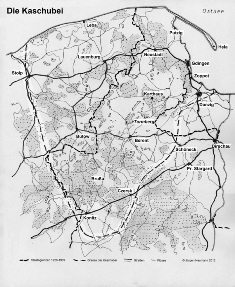
Kashubia [Map: J. Neumann, 2012
© Project ‘Memory and Identity in Kashubia’
, Free University of Berlin]

Location
Kashubia is, first and foremost, a cultural landscape with no clearly defined boundaries. It is defined as the area inhabited by the Kashubians. To the north and north-east, the region is bordered by the Baltic Sea and the Bay of Gdańsk. To the south, it extends as far as Konitz/Chojnice; to the east, as far as Schöneck/Skarszewy and to the outskirts of Danzig/Gdańsk. The western boundary cannot be precisely defined; in Pomerania, it runs roughly level with Stolp/Słupsk.
Topography
The heart of the region is the so-called Kashubian Switzerland, a hilly lake district featuring the Turmberg (328 m). The landscape is heavily forested.
Affiliation with the state, regional authorities and the church
Inthe Republic of Poland, Kashubia forms part of the Pomeranian Voivodeship (Województwo Pomorskie) and covers the districts of Putzig/Puck, Neustadt/Wejherowo, Lauenburg/Lębork, Bütow/Bytów, Kartuzy, Pruszcz Gdański, Kościerzyna and Chojnice.
Within the Roman Catholic Church, the region belongs to the Archdiocese of Gdańsk and the Diocese of Pelplin.
Historical Geography
The Kashubians regard themselves as the successors of the Pomeranians, who once inhabited the region on both sides of the lower Oder as far as the Vistula. The western part of the region came under German influence as early as the Middle Ages; it was chiefly as a result of the Reformation that the Western Kashubians adopted the German language and culture. It is only in the eastern part that the Kashubians have preserved their identity, largely due to their predominantly Catholic faith.
Historically, the region has been referred to by various names: ‘Pomerania’ and ‘Pomorze’ denote the entire coastal region; ‘Pomerania’ (‘Hinterpommern’) refers to the Prussian province comprising the western part of Kashubia; and ‘West Prussia’, ‘Pommerellen’ and ‘Royal Prussia (Polish Part)’ refer to the eastern part of Kashubia. It was not until the 20th century that the term ‘Kashubia’ came to be widely used to describe this region.
Common symbolism
The coat of arms of Kashubia features a griffin on a yellow background. The griffin is derived from the coat of arms of the Pomeranian House of the Griffins and symbolises the Pomeranian Voivodeship. The Kashubian flag is black and yellow.
Middle Ages
The Kashubians are a West Slavic people who emerged from the Pomeranians and are thought to have settled the coastal region in the 6th and 7th centuries. Poland made several attempts to conquer the area, but was unable to maintain a lasting hold over it. In the 12th century, the House of Greifen established itself in western Pomerania, which later came under German influence, whilst in the eastern part the Samborids ruled under Polish suzerainty. In 1294, the Samborid dynasty died out; the German Order emerged victorious from the ensuing wars in 1309. Under the Second Peace of Toruń in 1466, the Order lost Pomerelia and Gdańsk to Poland; these formed an autonomous region within the Kingdom of Poland, known as ‘Royal Prussia of the Polish Part’.[2]
Modern times
The territory ruled by the Greifen family underwent a gradual Germanisation, whilst Polish Prussia, on the other hand, underwent a process of Polonisation. Neither process was coercive in nature, but arose from close ties with the German and Polish cultural spheres respectively. In 1637, the House of Greifen, which had introduced the Reformation, died out, and as a result of the Peace of Westphalia, Hinterpommern became part of Brandenburg. Royal Prussia was able to retain its autonomy within the Kingdom of Poland and, from 1569, the Polish–Lithuanian Commonwealth. With the First Partition of Poland in 1772, Kashubia was incorporated into Prussian rule; in 1793, the city of Danzig was added. The newly acquired territories formed the province of West Prussia, whilst western Kashubia remained part of Pomerania.
Following the defeat of the German Empire in the First World War, Kashubia was divided into three parts under the Treaty of Versailles: Danzig, together with the district of Danziger Höhe, became the Free City of Danzig under the supervision of the League of Nations. The Pomeranian districts of Kashubia remained part of the German Empire. The central region, with access to the Baltic Sea, became part of the Republic of Poland as the Pomeranian Voivodeship (Województwo Pomorskie).[3]
Contemporary History
At the start of the Second World War, Danzig and the Pomerellian Voivodeship were incorporated into the German Reich as the Reichsgau Danzig-West Prussia, under the leadership of NSDAP Gauleiter Albert Forster (1902–1952). German units murdered Jews, alleged Polish nationalists and educated people whom they suspected of leading a resistance movement, as well as many Polish and Kashubian farmers and workers, with revenge and greed being common motives. In the Piasnitz Forest near Neustadt alone, approximately 12,000 people were shot, including many Germans from psychiatric institutions in Pomerania. Towards the end of the war, most Germans fled from the Red Army. The remaining Germans were expelled or left of their own accord. The properties that had been vacated were distributed amongst Poles and Kashubians from the region or from other parts of Poland, particularly from what was now Soviet-occupied eastern Poland.[4]
During the socialist era, a process of intensive Polonisation of the area began. Kashubian culture was scarcely nurtured, and regionalisms were frowned upon. Traces of German heritage were eradicated. Since the fall of communism in 1989, the region has experienced a revival of the previously suppressed Kashubian culture and is now highlighting its distinctive features.[5]
Administration and Constitution
Since the reform of Polish local government in 1999, the whole of Kashubia has, for the first time, been part of a single administrative unit – the Pomeranian Voivodeship (Województwo Pomorskie), with its seat in Gdańsk. The highest self-governing body is the Sejmik, which is elected every four years and appoints a Marszałek as the executive body.
Population
Kashubia has been a multi-ethnic region since the Middle Ages. Alongside the Kashubians, Poles, Germans and Jews lived here. Germans arrived as part of the German eastward expansion, particularly during the era of the German Order in the 14th and 15th centuries, and to some extent also during the period of Polish-Prussia (1466–1772), as well as following the incorporation of the area into the Prussian state in 1772. Jewish settlements developed only to a limited extent during the period of the Kingdom of Poland, whilst Jews lived in Pomeranian Kashubia. From 1772 onwards, more Jews settled in the economically growing region, but the Jewish population remained small.
In the last third of the 19th century and at the beginning of the 20th century, there was a mass exodus from this economically depressed region – the so-called ‘Ostflucht’ – with Jews and Germans in particular emigrating to the Ruhr region and to America. During the German Empire, the Prussian government, as part of its anti-Polish policy, took measures to Germanise the area. After Central Kashubia became part of the Republic of Poland under the Treaty of Versailles in 1919–20, between 60 and 80 per cent of the Germans moved to the German Reich or to Danzig. Polish policy was geared towards ‘de-Germanising’ (odniemczanie) the region.[6] The multi-ethnic history of Kashubia came to an end with the murder of the Jews by the German occupying forces and the flight and expulsion of the Germans during and after the Second World War.
No separate population statistics are available for Kashubia. Towards the end of the 19th century, around 170,000 Kashubians are said to have lived there.[7] The second Polish census in 1931 recorded the following figures for the Kashubian districts of the Pomeranian Voivodeship: 258,418 inhabitants (91.4 per cent) were Polish-speaking and 23,267 (8.2 per cent) were German-speaking. 399 inhabitants were of the Jewish faith (0.1 per cent). The Kashubians were not recorded separately but were counted as part of the Polish population.[8] In the districts of Lauenburg and Bütow in the German Reich, 2,997 Poles lived in the late 1920s, including around 1,000 Kashubians (1939). In a 2002 census, around 53,000 Poles stated that they spoke mainly Kashubian at home.[9]
Economy
Kashubia is a predominantly agricultural region. Small and medium-sized farms predominate, and there are also numerous estates (which were state-owned during the People’s Republic but are now privately owned once again). In the first half of the 20th century, the main crops were cereals, primarily rye, as well as sugar beet and potatoes. In the coastal areas and around the many lakes, fishing was an important source of livelihood. From the 1840s onwards, transport links were significantly improved by the construction of highways and district roads, followed by the railway from the 1870s onwards. In the wake of industrialisation, processing plants for agricultural produce, sawmills and brickworks were established in particular. During the interwar period, the fishing village of Gdingen/Gdynia was developed into a major port and a railway line was built to transport coal from Upper Silesia.[10]
After the Second World War, the People’s Republic expropriated the landowners and established large state-run enterprises, whilst smallholders were allowed to keep their farms. Until the end of the socialist era, a large proportion of the workforce was employed in agriculture; since the 1990s, this proportion has been small. Today, the main employers are the major cities (particularly Gdańsk and Gdynia). Tourism has grown significantly.[11]
Society
Until the end of the First World War, and in some cases as late as 1945, Germans were particularly well represented amongst the urban population, as well as amongst large-scale farmers and landowners. Medium-sized farms were largely in Polish hands, whilst the Kashubians mainly owned smallholdings and worked as farm labourers. The Pomeranian part of Kashubia was predominantly German; only in a few villages was there a significant Polish-Kashubian minority. As German-Polish tensions grew, particularly as a result of the Kulturkampf in the 1870s, a divided civil society emerged, based respectively on separate German and Polish organisations.
History of Religion and the Church
Most Germans were Protestants, whilst the Poles and Kashubians were predominantly Catholic. Catholicism continues to play a crucial role in Kashubian identity to this day. There were also Protestant Kashubians, particularly in Hinterpommern, as well as Catholic Germans, who often had Kashubian roots. In the 19th century, however, the notion that remains dominant to this day took hold: Poles = Catholics, Germans = Protestants. Since the Second World War, there have been no Protestant or Jewish communities here.
Special cultural institutions
In 1956, the Kashubian Association (from 1964: Kashubian-Pomeranian Association [Zrzeszenie Kaszubsko-Pomorskie]), though it was initially restricted to the preservation of folklore and peasant culture and was only permitted to focus on Kashubian identity in the later years of the People’s Republic. Today, it is the most important institution for the preservation of Kashubian cultural heritage. Since 1996, the Kashubian Institute has been based in Gdańsk under the direction of Prof. Dr Józef Borzyszkowski; amongst other things, it is actively involved in publishing. There are numerous Kashubian museums, of which the Kashubian Ethnographic Park – an open-air museum in Sanddorf/Wdzydze founded in 1906 – is the most significant.

Remus monument on the market square in
Berent/Koscierzyna, 2011. The novel *
abenteuerliche Leben des Remus* (*The Adventures of Remus*) by
Aleksander Majkowski (1876–1938) is the
best-known work of Kashubian prose
[Photo: R. Borchers].

Language and Literature
In the second half of the 19th century, a movement arose to preserve Kashubian folk culture and language. It contributed significantly to the development of a body of literature consisting mainly of poems, folk songs, legends, anecdotes and fairy tales. The most important Kashubian novel, entitled *Remus*, was written by Aleksander Majkowski.[12] There is still no standardised form of the language; it comprises various dialects. Kashubian is now recognised as a distinct West Slavic language and has the status of a regional language in Poland; it has been taught in schools since the 1990s and can be studied at the University of Gdańsk.
Culture of memory and remembrance
Whilst regional identities were not fostered in the centralised People’s Republic of Poland, there was a veritable boom in Kashubian culture after 1989. The promotion of this culture has since taken on a strongly folkloric character and plays a major role in the promotion of this scenic region to tourists. In a survey of Kashubians around Putzig, conducted as part of a sociological study in 2006, 80 per cent stated that they felt, first and foremost, Polish. Kashubian – the language and the culture – constitutes a kind of regional ‘sub-identity’ within the Polish national identity.[13]
4. Discourses/Controversies
Since the fall of communism in 1989, the term ‘Kashubia’ has taken on a broader significance in public discourse, as a point of identification for the region’s inhabitants and within academic circles. In Poland, there is resistance to this trend, as critics doubt whether the Kashubians exist as a separate group at all and see the strengthening of regional identities (as in Silesia) as posing a risk of separatism. They tend to use the term ‘Pomerania’ to refer to the region. In Germany, Kashubia as a region has not yet been regarded as a subject of study in its own right; research focuses on the former German provinces of West Prussia and Pomerania.
Bibliography
- Barbara Bojarska: The Extermination of the Polish Intelligentsia in Gdańsk Pomerania (September–December 1939). Poznań 1972 (Studies on the German Occupation of Poland, vol. 12).
-
Roland Borchers, Katarzyna Madoń-Mitzner (eds.): Memories from Kashubia. Experiences and Identities 1920–1939– 1945. Oldenburg 2014 (Publications of the Federal Institute for Culture and History of the Germans in Eastern Europe 54).
- Miłosława Borzyszkowska-Szewczyk, Christian Pletzing (eds.): Jewish Traces in Kashubia. A Travel Guide / Śladami żydowskimi po Kaszubach. Przewodnik. Gdańsk, Lübeck 2010.
- Józef Borzyszkowski, Dietmar Albrecht (eds.): The Kashubian-Pomeranian Homeland. Past and Present / Pomorze – mała ojczyzna Kaszubów. Historia i współczesność. Gdańsk, Lübeck 2000.
- Gerard Labuda: The Kashubians and Their History [Kaszubi i ich dzieje]. Gdańsk 1996.
- Gerard Labuda: The History of the Kashubians within the History of Pomerania. The Middle Ages. Gdańsk 2006.
- Bernhard Lauer, Hanna Nogossek (eds.): Poles, Germans and Kashubians. Daily Life, Customs and Folk Culture at the Hochpaleschken Estate in West Prussia around 1900. Kassel 1997 (Exhibitions at the Brothers Grimm Museum, Major Series 4).
- Cezary Obracht-Prondzyński, Tomasz Wicherkiewicz (eds.): The Kaszubs. Past and Present. Bern 2011.
- Marlena Porębska: The Kashubian Language. Language Death or Revitalisation? Empirical Studies on the Ethnolinguistic Vitality of a Linguistic Minority in Poland. Munich 2006 (Slavistische Beiträge 452).
Web links
- www.instytutkaszubski.pl (Kashubian Institute)
- www.kaszubi.pl (Kashubian-Pomeranian Association)
- www.muzeum-wdzydze.gda.pl/ (Kashubian Ethnographic Park)
- www.muzeum.wejherowo.pl (Museum of Kashubian-Pomeranian Literature and Music)
- www.oei.fu-berlin.de/geschichte/Team/borchers/Projekte/drittmittelprojekt_kaschubei.html (“Memory and Identity in Kashubia” [2011–2013], a project at the Institute for Eastern European Studies at the Free University of Berlin)
Notes
[1] The papal bull concerns a donation to the Order of St John near Stargard in Pomerania. It is unclear whether it refers to Bogislaw I (d. 1187) or his son Bogislaw II (d. 1220). Gerard Labuda: *Historia Kaszubów w dziejach Pomorza. Czasy średniowieczne* [The History of the Kashubians within the History of Pomerania. The Middle Ages]. Gdańsk 2006, pp. 38–40.
[2] Gerard Labuda: Historia Kaszubów w dziejach Pomorza. Czasy średniowieczne [The History of the Kashubians within the History of Pomerania. The Middle Ages]. Gdańsk 2006, pp. 44–53.
[3] Włodzimierz Borodziej: The History of Poland in the 20th Century. Munich 2010, pp. 105–110.
[4] Gerhard Olter: Germans in Gdańsk Pomerania after 1945. In: Andrzej Chodubski, Andrzej Waśkiewicz (eds.): Cultural Identity. Szkice o mniejszościach narodowych na Pomorzu Gdańskim 2 [Cultural Identity. Sketches on National Minorities in Gdańsk Pomerania 2]. Gdańsk 2002, pp. 21–26.
[5] Cezary Obracht-Prondzyński: The Kashubians. Between Discrimination and Regional Identity. Gdańsk 2002, p. 162.
[6] Hugo Rasmus: Pomerellia – West Prussia 1919–1939. Munich 1989, pp. 16–56.
[7] Stefan Ramułt: Słownik języka kaszubskiego, czyli pomorskiego [Dictionary of the Kashubian, or Pomeranian, Language]. Kraków 1893, p. 30.
[8] Second General Census of 9 December 1931. Pomerellen Voivodeship. Warsaw 1938, pp. 30–34. Data for the districts (including towns) of Konitz, Karthaus, Berent and Seekreis (Neustadt, Putzig), excluding Gdynia, including non-Kashubian areas within these districts, e.g. parts of Koschneiderei. Total population 282,620.
[9] Karl Keller: The Foreign-Language-Speaking Population in the Border Regions of the German Reich. Berlin 1929, Tables 1 and 2; Hans Fenske: The Administration of Pomerania 1815–1945. Cologne 1993, pp. 11ff.; Narodowy Spis Powszechy Ludności i Mieszkań 2002 [National Census of Population and Dwellings]. Główny Urząd Statystyczny, Warsaw 2002.
[10] Friedrich-Wilhelm Henning: Economic Development in Rural Areas, in: Ernst Opgenoorth (ed.): Handbook of the History of East and West Prussia, Vol. 3. Lüneburg 1998, pp. 81–90.
[11] Jan Perszon: ‘Religious Culture as an Element of Kashubian Identity’. In: Adela Kuik-Kalinowska, Daniel Kalinowski (eds.): Greater Pomerania. Tożsamość i wielokulturowość [Greater Pomerania. Identity and Multiculturalism]. Gdańsk / Słupsk 2011, pp. 53–56.
[12] Aleksander Majkowski: The Adventurous Life of Remus. Part I, German edition. Cologne 1988 [original Kashubian edition: Toruń 1938].
[13] Cezary Obracht-Prondzyński: Dilemmas of Modern Kashubian Identity and Culture. In: ibid., Tomasz Wicherkiewicz (ed.): The Kashubs – Past and Present. Bern 2011, pp. 181–190.
Citation
Roland Borchers: Kashubia. In: Online Encyclopaedia on the Culture and History of Germans in Eastern Europe, 2012. URL: ome-lexikon.uni-oldenburg.de/55217.html (as at 11 September 2014).
Terms of use for this article
Copyright © University of Oldenburg and the Federal Institute for the Culture and History of Germans in Eastern Europe (BKGE), all rights reserved. This work was produced as part of the project ‘Online Encyclopaedia on the Culture and History of Germans in Eastern Europe’ and may be reproduced and published provided the rights holders’ consent has been obtained. Please contact:
If you have any specialist comments or additions to the text, please contact the editorial team, citing relevant literature and source references.