

Thorn/Toruń
Thorn/Toruń
Etymology
According to some linguists and historians, the name Toruń is derived from the Old Slavic word tor (= a beaten track, meaning roughly ‘settlement by the track’).[1]
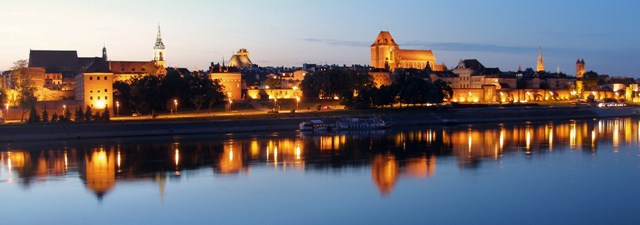
View of the medieval old town of Thorn/Toruń from the opposite bank of the Vistula.
[CC BY-SA 3.0/ T. Weger]

Topography
Thorn lies downstream of the point where the Drewenz/Drwęca flows into the Vistula/Wisła, on the banks of the Vistula in the east of the Bromberg-Thorn Lowlands.
Region
West Prussia. The town lies at the junction of the historical regions of Kuyavia, the Kulm Region and the Dobrin Region. The part on the right bank of the Vistula lies in the Kulm Region, whilst the part on the left bank lies in Kuyavia.
Political and administrative affiliation
Republic of Poland. Toruń is a city with independent municipal status in the Kuyavian-Pomeranian Voivodeship, and the seat of the Voivode, his administration and the Voivodeship Parliament. Since 1992, Toruń has been the seat of the Diocese of Toruń (Diecezja Toruńska).
Common symbolism
Until the merger of the Old Town and the New Town, the towns had different coats of arms. The new coat of arms depicts a red city wall with three towers against a silver background; the central tower features a half-open gate. The coat of arms is held by a kneeling angel clad in blue, who holds a key in his right hand. The figure of the angel first appeared on the town seal of 1470. During the era of the People’s Republic, the angel was removed from the coat of arms; since 1991, the coat of arms has been used in its original form. The Toruń flag features two stripes – white and blue – with the town’s coat of arms in the centre.
Archaeological significance
The earliest evidence of settlement dates back to the Stone Age; excavations confirm the existence of a settlement between 1000 and 1500 BC.
Middle Ages

The Dankser (toilet tower) at the ruins of the Teutonic Order’s castle at
in Thorn/Toruń.
[CC BY-SA 3.0/ T. Weger]

In the 8th century, a settlement was established on the site of what would later become the Order’s castle; in the 10th century, it served to control traffic on the Vistula and to protect the river crossing.[2] The castle was destroyed at the turn of the 12th and 13th centuries, probably as a result of a Prussian raid.[3] In 1231, the German Order erected a fortification on the right bank of the Vistula in the vicinity of the village of Alt-Thorn (Stary Toruń). The resulting settlement was granted town privileges in 1233 under the Kulm Charter. Due to frequent flooding of the Vistula and the final settlement of property rights in the Kulm region between Conrad of Masovia and the German Order, Toruń was relocated upstream to its present-day location in 1236.[4] In 1251, the charter of foundation was renewed to take account of the town’s relocation. Shortly afterwards, construction of an Order castle began on the site of the old fortress. Rapid urban development and the associated demand for craft products led to the founding of Toruń’s New Town in 1264. The crisis facing the Teutonic Order and the resulting economic stagnation led to growing discontent amongst the town’s citizens in the 15th century. In 1440, the Prussian Confederation was founded in Marienwerder/Kwidzyn, to which Toruń belonged; in 1454, an armed uprising against the German Order took place in Toruń, heralding the decline of its rule in this region. The citizens of Toruń captured the Order’s castle and demolished it. On 8 March 1454, Neustadt and Altstadt were united into a single administrative district; later, the area of the demolished Order’s castle was also incorporated. The uprising of the Prussian estates and the incorporation of the Teutonic Order’s state into the Polish Kingdom, carried out on 6 March 1454 by the Polish King Kazimierz Jagiellończyk, marked the beginning of the Thirteen Years’ War. As a result of the Second Peace of Toruń (1466), Toruń became a royal city within the Kingdom of Poland
Modern times
The Swedish Wars of the 17th century and the Great Northern War caused great destruction to the town. The consequences of the wars of the 17th and 18th centuries, as well as a plague epidemic from 1708 to 1710, left the town impoverished.
In 1724, the ‘Thorn Uprising’ took place. The subsequent trial (‘Thorn Blood Trial’) led, amongst other things, to the execution of the Protestant mayor Johann Gottfried Rösner (in office 1703–1724) and nine other citizens. The Protestants were to hand over their churches to the Catholics, and the town council was to consist of an equal number of Catholics and Protestants in future. The harsh verdict and, above all, the execution of the mayor caused a great stir throughout Europe.
Following the First Partition of Poland in 1772, Thorn remained within the Polish state; however, it was cut off from its ‘commercial areas’. In the wake of the Prussian blockade, all roads leading from Thorn to Danzig/Gdańsk and the rest of Poland were sealed off. During the Second Partition of Poland in 1793, Thorn fell to Prussia. On 5 December 1806, Thorn was occupied by French troops and later annexed to the Duchy of Warsaw. As a result of the provisions of the Congress of Vienna, Thorn once again fell to Prussia.
20th century
As a result of the Treaty of Versailles, Thorn was annexed to the Polish state and officially came under Polish administration on 18 January 1920. Thorn became the capital of the Pomeranian Voivodeship (Województwo Pomorskie). The city and its streets were modernised, and new districts were incorporated (including, between 1936 and 1938, Amberg/Podgórz, Stewken/Stawki and Rodeck/Rudak on the left bank of the Vistula). On 7 September 1939, Toruń was occupied by German troops. In the autumn of 1939, the Jews of Toruń were deported to Greater Poland and Łódź; at the same time, the deportations and arrests of Polish residents began (some of those arrested were murdered in the Barbarka Forest). So-called resettlers from the Baltic states, Bessarabia, Danzig/Gdańsk and other areas were quartered in the town. The introduction of the German National Register (DVL) led to a statistical increase in the number of German residents – according to German figures, the town had approximately 67,000 German residents in October 1944 (including approximately 44,246 Poles who were registered in the DVL as Groups III and IV on the DVL).[5]
On 14 January 1945, the Red Army’s winter offensive began, and on 1 February it marched into Toruń. Following the ‘liberation’ of the city, the Polish administration and the Russian military authorities imposed sanctions on those sections of the population who had been classified as German nationals during the war: In the Fort XV labour camps at Stewken/Stawki and Rodeck/Rudak (and later also at Potulice), so-called ‘Reich Germans’, ‘ethnic Germans’ and, initially, also persons from Groups I and II of the DVL were interned. People of German nationality were resettled to the western occupation zones. A ‘rehabilitation procedure’ was carried out amongst the inhabitants registered in Groups II, III and IV of the DVL; people from the former Polish eastern territories were resettled in the city.
After the war, Toruń lost its status as an administrative centre, but following the administrative reform of 1975, it once again became the provincial capital. In 1999, as a result of an administrative reform, the Kuyavian-Pomeranian Voivodeship was established, with its capital at Bydgoszcz.
Population
Thorn’s significant role in medieval trade led to the settlement of merchants from Silesia, Lusatia, Greater Poland and Kuyavia. The presence of settlers from the Rhineland is first documented in 1262 with a Thorn councillor who hailed from Cologne. At the turn of the 13th to the 14th century, settlers from Westphalia also arrived in Toruń.
Population trends[6]
| Year | 1454 | c. 1550 | 1793 | 1920 | 1939 | 1946 | 1991 |
| Population | approx. 10,850 | approx. 12,000 | approx. 6,000 | 37,356 | 78,769 | approx. 68,000 | 202,360 |
As determining the ethnic origins of Toruń’s population in the Middle Ages and the early modern period proves difficult, older estimates by historians vary considerably; the results were often influenced by the researchers’ own nationality and political views. New research findings by Krzysztof Mikulski put the proportion of the population of Polish origin in 1394 at approximately 6.5 per cent in the Old Town and approximately 20 per cent in the suburbs.[7]
The sharp decline in the population between the 17th century and the end of the 18th century can be attributed to wars, a plague epidemic (estimates suggest 4,000–5,,000 victims) and to Toruń’s unfavourable location between 1772 and 1793, when it was cut off from the hinterland.[8]
During the 19th century, the German population grew as a result of the settlement of Prussian civil servants and military personnel; by 1910, approximately 44–45 per cent of the town’s inhabitants were Polish.[9] Thorn also had a Jewish community, which numbered 170 people in 1812.[10] In the 1920s and 1930s, the population had more than doubled, although the ethnic composition shifted: The number of Germans fell from 6,242 (1920) to approximately 2,500 (1939), whilst the number of Jews rose from 147 (1920) to 857 (1939). During this period, there were also around 200–250 Russians and Ukrainians living in Thorn, comprising both ‘White’ émigrés from Russia and former soldiers from units that had fought alongside Polish troops against the Bolsheviks.[11]
Economy
Thanks to its location on the Vistula and along important trade routes, Toruń was already a major trading centre by the 13th century (trading in goods such as cloth, salt, wine and pepper, amongst others) and joined the Hanseatic League in 1280. Towards the end of the 13th century, the conflict between the German Order and Poland led to a crisis in Toruń’s trade. In 1500, what was then the only permanent bridge across the Vistula was completed. From the late 15th to the mid-17th century, Toruń experienced an economic and cultural boom; from the mid-18th century until the Partitions of Poland, the food and textile industries in particular flourished.
In the second half of the 19th century, railway links to Bromberg/Bydgoszcz, Warsaw/Warszawa, Allenstein/Olsztyn and on to Insterburg/Černjachovsk provided a boost to industrial development. Among the most important businesses were brickworks, agricultural machinery factories and gingerbread factories; in the 1920s and 1930s, mechanical engineering and food processing companies became increasingly prevalent. From the late 1950s onwards, the textile industry regained importance. The establishment of a Pomeranian Special Economic Zone in 2006 in Lissomitz/Łysomice, 2 km from Thorn, attracted new investors to the region.
Society and Culture
From the mid-19th century onwards, Thorn developed into a centre of the Polish national movement. Numerous economic institutions and organisations were established, such as an industrial society (Towarzystwo Przemysłowe), a loan society (Towarzystwo Pożyczkowe) and a credit bank (Bank Kredytowy), as well as cultural and educational associations that helped to strengthen the Polish middle class. From 1867, the first Polish-language newspaper in West Prussia – the *Gazeta Toruńska* (Thorn Gazette) – was published, and in 1875 the Scientific Society (Towarzystwo Naukowe) was founded, which initiated the establishment of the Polish Museum (Muzeum Polskie) and the Scientific Library (Biblioteka Naukowa). There were also organisations whose members were predominantly from the German population, such as the Craftsmen’s Association, the Civil Servants’ Association and the Credit Union. Two German-language newspapers were published in Toruń: the Thorner Wochenblatt (renamed the Thorner Zeitung from 1867) and the Thorner Ostdeutsche Zeitung.
In 1839, the Coppernicus Society was founded to support the construction of the Copernicus monument in Toruń. Following the unveiling of the monument in 1853, it was renamed the Coppernicus Society for Science and Art and published the *Communications of the Coppernicus Society for Science and Art in Thorn *. The collections of the Scientific Society’s library, the Coppernicus Society, the Toruń Grammar School and the Council Library were merged in 1923 and taken over by the newly founded Municipal Library (Książnica Miejska).
The Municipal Theatre was founded in Toruń in 1802, and the new theatre building, which still stands today, was constructed in 1904. In the 1920s and 1930s, alongside performances by the Polish Municipal Theatre, the building of the ‘Deutsches Heim’ Society also hosted performances by the amateur theatre group ‘Deutsche Bühne’.
Education and Science
In 1568, a Protestant grammar school was founded; in 1594, it was elevated to the status of an academic grammar school and was provided with its own library. The high standard of education, the qualified professors (including Christoph Hartknoch, who taught there), and the promotion of modern teachings and ideas made the grammar school a cultural and scientific centre of Poland in the 17th century.
Plans to establish a university were already in place as early as the 1920s, but the outbreak of the Second World War brought the preparations to a halt. It was not until August 1945 that the Nicolaus Copernicus University was founded, continuing, amongst other things, the traditions of the Polish University of Vilnius (Wilna/Vilno). In the same year, the University Library was established; its holdings include, amongst other things, incunabula and manuscripts from the State and University Library of Königsberg, as well as a collection on the history of the Baltic Sea region.
Since the Middle Ages, the town’s records had been collected in an archive housed in the town hall, where the Prussian Archive and the records of neighbouring towns were later also kept. Today, these collections form part of the State Archives in Toruń (Archiwum Państwowe w Toruniu).
History of Religion and the Church
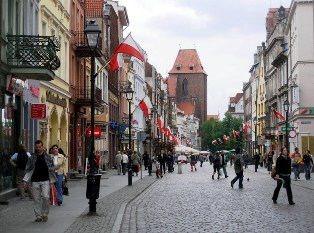
Torn’s city centre, with a view of St John’s Cathedral
. [CC BY-SA 3.0/ T. Weger]

In 1557, Zygmunt August introduced the Reformation in Toruń. St Mary’s Church and St James’s Church became Protestant, whilst St John’s Church hosted both Catholic masses and Protestant services until 1596. In 1645, on the initiative of the Polish King Władysław IV, the Colloquium Charitativum took place in Toruń – a meeting of Catholics and Protestants aimed at fostering understanding between the two denominations. In 1724, riots broke out between Protestants and Catholics in Toruń, resulting in the destruction of the Jesuit monastery by Protestants (see above: ‘Toruń Bloodbath’). Between 1755 and 1756, a Protestant church was built on the market square (today the Church of the Holy Spirit). The church was not permitted to stand out from the neighbouring buildings nor to have a tower. The tower was added later, at the end of the 19th century. The church remained Protestant until 1945. A second Protestant church (Trinity Church) was erected in 1824 on the site of the town hall, which had been demolished in 1818, on the New Town Market; it was used as an Orthodox church from 1927 to 1945. In 1847, a synagogue with a Jewish community centre and a Jewish school was built on the site of what is now ulica Szczytna 12; it was demolished by the German occupiers in 1939.
Art History
Thanks to its medieval architecture, Toruń’s city centre is one of Poland’s most significant cultural heritage sites. These include St John’s Church (mainly from the 13th and 14th centuries; since 1992, the cathedral of the newly established Diocese of Toruń), St James’s Parish Church (construction begun in 1309), St Mary’s Church, the Old Town Hall, which was built during the 13th and 14th centuries and destroyed in 1703 during the Swedish siege of the town (rebuilt between 1722 and 1737). Also of significance are the medieval city walls with their gates and bastions (including the Leaning Tower), the ruins of the Teutonic Order’s castle, the Gothic bridge on Most-Pauliński Street, the granaries dating from the 14th–18th , the complex of Gothic houses (including the Copernicus House from the 15th century and the Eskens House from the 14th century), the ‘Zum Stern’ house with its late Baroque façade, and the Baroque town houses (Dąmbski Palace, Fenger Palace and Meissner Palace).
Also worth mentioning are the headquarters of the Scientific Society (1881), the Artushof, built in the Neo-Renaissance style (late 19th century), the Neo-Gothic Church of St Catherine (1894–1897) and the Art Nouveau theatre (1903/04).
Special cultural institutions
The city’s major historical and art history museums include the City Museum in the Altmarkt Town Hall, which houses the Copernicus House, the Eskens House and the ‘Zum Stern’ House (Museum of Far Eastern Art), the Museum of Folk Life (an open-air museum featuring historic farm buildings) and the open-air museum showcasing the tank fortifications of Thorn Fortress.
Military history
At the end of the war against Sweden (1626–1628), a decision was taken in the town to build modern fortifications based on plans by Anton Petersen, Peter Mönning and Kaspar von Wanken. Once the work was completed around 1649, Thorn boasted one of the most modern fortifications in Poland.
When it was ceded to Prussia in 1815, Thorn became a border town with Russia; the existing fortifications were expanded and modernised, and new military installations were built. In 1871, Thorn was elevated to the status of a fortress, and between 1878 and 1892 new fortifications were erected. A ring of freestanding forts was created at a distance of 3 to 3.5 km from the city centre, so that the city’s fortifications consisted of two rings: an inner one (the old fortifications) and an outer one (the new ones). New military buildings were also constructed: barracks, a garrison hospital, a garrison church and military accommodation. In 1920, the inner ring of fortifications was dismantled; the outer ring and the military installations were subsequently used by the Polish Army.
Culture of memory and remembrance
[CC BY-SA 3.0/ T. Weger]

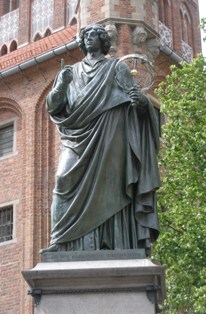
The historic buildings of the Old Town and New Town, which have survived to this day, serve as a reminder of Toruń’s significance in the Middle Ages and the early modern period. In 1997, the Old Town, New Town and the ruins of the Teutonic Order’s castle were inscribed on the UNESCO World Heritage List. The numerous Gothic buildings are one of the city’s defining features, and form the basis of Toruń’s current promotional slogan – ‘gotyka na dotyk’ (Toruń – Gothic up close). A monument on the market square and the museum in his birthplace (Dom Koperniky) commemorate the astronomer Nicolaus Copernicus, who was born in Toruń. Furthermore, the university is named after him and operates an astronomical observatory bearing his name in the nearby village of Sängerau/Piwnice. Another of the city’s distinguishing features is its gingerbread, first mentioned in 14th-century sources, particularly the ‘Thorn Kathrinchen’ (katarzynki). The first gingerbread factory, opened in the mid-18th century by Johann Weese, was one of the largest businesses in Toruń at the start of the 20th century. In 1945, it was nationalised and renamed Fabryka Cukiernicza “Kopernik”, before being converted into a public limited company after 1989.
Bibliography
- Historical Atlas of Polish Cities. Vol. 1: Antoni Czacharowski (ed.): Royal Prussia and Warmia [Royal Prussia and Warmia]. No. 2: Janusz Tandecki, Zenon Kozieł (eds.): Toruń [Thorn]. Toruń 1995.
- Marian Biskup (ed.): Historia Torunia [History of Thorn]. 3 vols. Toruń 1992–2006.
- Reinhold Heuer: Seven Hundred Years of Thorn 1231–1931. Danzig 1931 (Ostland Studies 1).
- Ernst Kestner: Contributions to the History of the City of Thorn. Compiled from archival sources. Thorn 1883.
- Julius Emil Wernicke (ed.): The History of Toruń Based on Charters, Documents and Manuscripts. 2 vols. Toruń 1839–1842.
Bibliography
- Henryk Baranowski (ed.): Bibliografia miasta Torunia [Bibliography of the City of Toruń]. Vol. 1: Do roku 1971 [Up to 1971]. 2nd ed. Toruń 1999 (Annals of the Scientific Society in Toruń 88,3); Vol. 2: 1972–1993 with supplements. Toruń 1996 (Annals of the Scientific Society in Toruń 87,2).
Web links
- www.torun.pl/ (the city’s official multilingual website)
- historicus.umk.pl/kart/planyde.html (Cartographia Thoruniana)
- kpbc.umk.pl/ (Kujawsko-Pomorska Digital Library)
- www.torun.ap.gov.pl/ (multilingual website of the State Archives in Toruń)
- www.sztetl.org.pl/pl/city/torun/ (Virtual Shtetl)
Notes
[1] Tomasz Jasiński: The Origins of Toruń in the Context of Medieval Settlement. In: *Zapiski Historyczne* 46 (1981) No. 4, pp. 5–34, here pp. 11ff.
[2] Jasiński: *Początki*, pp. 13, 16.
[3] Cf. Jadwiga Chudziakowa: Research into the medieval town centre of Toruń in the years 1969–1972. In: *Zapiski Historyczne* 38 (1973) No. 3, pp. 69–81, here pp. 75ff; Jasiński: *Początki*, pp. 14 ff.; Krzysztof Mikulski: Przestrzeń i społeczeństwo Torunia od końca XIV do początki XVIII wieku [Space and Society in Toruń from the End of the 14th to the Beginning of the 18th Century]. Toruń 1999, pp. 25ff.
[4] Mikulski: Przestrzeń, pp. 26ff.
[5] Jan Sziling: Struktura narodowościowa Torunia w okresie okupacji niemieckiej (1939–1945) [The Ethnic Structure of Toruń during the German Occupation (1939–1945)]. In: Mieczysław Wojciechowski (ed.): National and Religious Minorities in Toruń in the 19th and 20th Centuries. Toruń 1993 (Ethnic and Religious Relations in Pomerania in the 19th and 20th Centuries 3), pp. 161–172, here p. 171.
[6] Janusz Tandecki: Toruń. Historia i rozwój przestrzenny [Thorn. History and Spatial Development]. In: Historical Atlas of Polish Cities. Vol. 1: Antoni Czacharowski (ed.): Royal Prussia and Warmia. Part 2: Janusz Tandecki, Zenon Kozieł (eds.): Toruń. Toruń 1995, Marian Biskup (ed.): Toruń dawny i dzisiejszy. Zarys dziejów [Toruń Then and Now. An Outline of History]. Warsaw et al. 1983,
[7] Krzysztof Mikulski: The Ethnic Structure of the Inhabitants and the Social Status of the Population of Polish Descent in Toruń from the End of the 14th to the Mid-17th Century. In: Roczniki Historyczne 63 (1997), pp. 111–129.
[8] Tandecki: Toruń, pp. 7ff; Stefan Cackowski: The First Period of the Prussian Partition and the Duchy of Warsaw (1793–1815) [The first period of the Prussian partition and the Duchy of Warsaw (1793–1815)]. In: Biskup: Toruń, pp. 301–328, here pp. 301ff.
[9] Kazimierz Wajda: Under Prussian Rule Once Again (1815–1920) [Once Again under Prussian Rule (1815–1920)]. In: Biskup: Toruń, pp. 329–417, here p. 366.
[10] Cackowski: Pierwszy, p. 318.
[11] Mieczysław Wojciechowski: W czasach Drugiej Rzeczypospolitej (1920–1939) [During the Second Republic (1920–1939)]. In: Biskup: Toruń, pp. 417–490, here pp. 429ff.; Zbigniew Karpus: Russians and Ukrainians in Toruń in the years 1920–1939 [Russians and Ukrainians in Toruń in the years 1920–1939]. In: Wojciechowski: Minorities, pp. 81–96; Tandecki: Toruń, p. 11.
Citation
Beata Lakeberg: Thorn/Toruń. In: Online Encyclopaedia on the Culture and History of Germans in Eastern Europe, 2012. URL: ome-lexikon.uni-oldenburg.de/54434.html (accessed 10 July 2012).
Terms of use for this article
Copyright © University of Oldenburg and the Federal Institute for the Culture and History of Germans in Eastern Europe (BKGE), all rights reserved. This work was produced as part of the project ‘Online Encyclopaedia on the Culture and History of Germans in Eastern Europe’ and may be reproduced and published provided the rights holders’ consent has been obtained. Please contact:
If you have any specialist comments or additions to the text, please contact the editorial team, citing relevant literature and source references.