

Łódź
Łódź
Etymology
A village called “Lodzia” is first recorded in the 1330s. Until the 16th century, variations of the name were spelled with the ending “a”: Lodza, Lodzya, Łodzia. It was not until the 18th century that the modern form “Łódź” or “Lodz” appeared. It is often assumed that the town’s name is derived from the name of the nearby river Łódka. However, it probably goes back to the Old Polish word łodzia (= fishing boat, small vessel; Łódź also means ‘boat’). Other hypotheses refer to the name ‘Wodzisław’, to a derivation from łoza (= willow bush) or from ród (= trunk).[1]
Location
Łódź is situated at 51° 45' north latitude and 19° 28' east longitude, approximately 130 km west of Warsaw/Warszawa.
Topography
Łódź is situated near the sources of the Ner and Bzura rivers. To this day, the area surrounding the city is characterised by woodland. The numerous streams and rivers played an important role in the city’s industrialisation.
Political and administrative affiliation
Poland. Łódź is the capital of the Łódź Voivodeship. The city is a city with independent status, but serves as the administrative centre of the East Łódź County (powiat łódzki wschodni). Łódź is also the seat of the archdiocese of the same name within the Roman Catholic Church, the seat of the Diocese of Łódź-Poznań of thePolish Orthodox Church, and the seat of the Diocese of Warsaw of the Evangelical Church of the Augsburg Confession.
Common symbolism
The city coat of arms depicts a golden boat (Polish: łódź) with an oar on a red shield. The city flag is red and gold with the coat of arms centred on it.
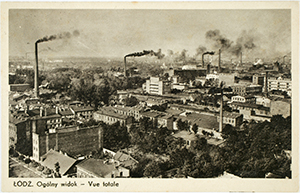
View of Łódź (postcard: before 1939)
[Herder Institute, Marburg, Image Archive,
Inv. No. 191536].
Common or historical nicknames
Owing to its textile industry, the city was nicknamed ‘the Polish Manchester’ in the 19th century. The term ‘The Promised Land’ was popularised by Władysław Reymont’s novel *Ziemia Obiecana* (1899), although the author used this name ironically. The writer Zygmunt Bartkiewicz (1867–1944) described Łódź as złe miasto (the evil city). Efforts are now being made to counter such negative portrayals. As Poland’s leading film school is based in Łódź, the city is also affectionately known as “HollyŁódź”.
Middle Ages
The village was first mentioned in 1332.[2] In 1423, Łódź was granted Magdeburg city rights by Władysław II Jagiełło (before 1362–1434). Until 1798, the town was owned by the Bishop of Włocławek (Leslau/Kuyavia).
Modern times
Following the Second Partition of Poland (1793), Łódź was initially incorporated into Prussia, then into the Duchy of Warsaw from 1807, and into the Kingdom of Poland (“Congress Poland”) in 1815. The city is known for its rapid growth, industrialisation, the labour movement and strikes in the 19th and early 20th centuries. The booming textile industry attracted thousands of German-speaking immigrants, including those from Bohemia, Saxony and Silesia, as well as Yiddish- and Polish-speaking immigrants from the predominantly rural regions of Congress Poland. This rapid growth repeatedly led to strikes and unrest, including the so-called Łódź Uprising (Bunt Łódzki) of 1892, a bloody conflict lasting several days between insurgents and Russian troops. Łódź was also one of the main theatres of the Russian Revolution of 1905–1907.
During the First World War, the city was captured by German troops in December 1914 and incorporated into the ‘General Government of Warsaw’ in 1915; it remained under German occupation until 1918.
In the newly founded Polish state of the interwar period, Łódź became the provincial capital. However, Łódź’s economy recovered only slowly from the loss of its Russian markets, leading factory workers to organise several strikes, including in 1928, 1933 and 1938.
Contemporary History
In 1918, local merchant Adolf Eichler, amongst others, founded the German People’s Party, which was dissolved following the elections to the Polish Constituent National Assembly (1919–1922). In the 1920s, the German Socialist Labour Party of Poland, which cooperated with the Polish Socialist Party, was the largest party representing the German community in Łódź. Following the National Socialists ’ seizure of power in Germany, anti-German riots broke out in April 1933, on what became known as ‘Black Palm Sunday’.
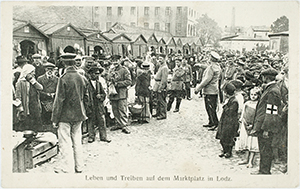
Market scene on the market square in Łódź
(postcard: before 1916) [Herder Institute, Marburg,
image archive, inv. no. 191543].
In the 1930s, the German People’s Association, founded in 1924 by August Utta (1886–1940) and Joseph Spickermann (1870–1947) in 1924, gained in importance and asserted its own regional interests both against the German Association from Posen-Pomerania and against the Young German Party from Bielitz/Bielsko-Biała. The increasing radicalisation of the Germans in Łódź, particularly under the influence of Ludwig Wolff (1908–1988), who became leader of the DVV in 1938, contributed to the fact that many ‘ethnic Germans’ in Łódź were prepared to collaborate with the German occupiers during the Second World War.
Following the defeat of Poland, Łódź was annexed to the German Reich in November 1939 (Reichsgau Posen, later Wartheland or ‘Warthegau’) and renamed ‘Litzmannstadt’ (named after the German General Karl Litzmann, 1850–1936). The city was home to the headquarters of the Central Office for Immigration and the Central Office for Resettlement, which played a key role inthe ‘Germanisation’ and the Holocaust in the Reichsgau Wartheland. The Jews of Łódź were moved to a ghetto in the north of the city (Bałuty) in the spring of 1940. At the end of 1941, an extermination camp was established in nearby Kulmhof/Chełmno, where a large proportion of the ghetto’s inhabitants were murdered. Jews, Poles and Roma from the annexed and occupied Polish territories were also deported there. Further victims came from Germany, Austria, the ‘Protectorate of Bohemia and Moravia’ and other European countries. On 19 January 1945, Łódź was liberated from German occupation by Soviet troops.
In the immediate post-war period, Łódź was , in effect, the capital of Poland due to the extensive destruction of Warsaw. The city became an important centre of Jewish life for Holocaust survivors and evacuees from the Soviet Union.
In early 1971, female textile workers protested against a drastic increase in food prices, which was subsequently reversed by the communist government. In the 1980s, the city was a centre of the Solidarność movement.
Administration
The mayor is elected in local elections (wybory samorządowe), which take place every four years. In 2011, the city council had 43 members.
Population
In 1820, Łódź had a population of just 799.[3] After 1820, the city experienced rapid growth, mainly due to the expanding textile industry. It suffered significant population losses during the First World War and, above all, during the Second World War.
The ethnic composition of the city of Łódź before the First World War (according to Wiesław Puś):[4]
1897 | 1913 | |||
Nationality | in thousands | % | in thousands | % |
Poland | 145.6 | 46.4 | 251.7 | 49.7 |
Jews | 92.4 | 29.4 | 171.9 | 34.0 |
Germans | 67.3 | 21.4 | 75.0 | 14.8 |
Russians | 7.4 | 2.4 | 6.3 | 1.3 |
Others | 1.3 | 0.4 | 1.2 | 0.2 |
Total | 314.0 | 100.0 | 506.1 | 100.0 |
The ethnic composition of the city of Łódź in the interwar period:[5]
1921 | 1931 | |||
Nationality | Number | % | Number | % |
Poland | 279,846 | 61.9 | 356,987 | 59.0 |
Jews | 138,851 | 30.7 | 191,720 | 31.7 |
Germans | 31,670 | 7.0 | 53,562 | 8.9 |
Others | 1,607 | 0.4 | 2,353 | 0.4 |
Total | 451,974 | 100.0 | 604,629 | 100.0[6] |
According to estimates, there were around 388,000 Poles, 230,000 Jews and 60,000 Germans in the town in 1939.[7] In 1945, the city had a population of approximately 300,000; this figure rose in the following decades. Since 1990, the population has been declining.
Population trends according to the Łódź City Statistical Office (in thousands):[8]
1975 | 1980 | 1985 | 1990 | 1995 | 2000 | 2005 | 2009 | 2010 | 2011 |
798.3 | 835.7 | 847.9 | 848.3 | 823.2 | 798.4 | 767.6 | 742.4 | 730.6 | 725.1 |
In 2011, the Łódź Voivodeship had a population of 2,538,677, including 1,489 people who identified as German.[9]
Economy
During the Second World War, the German occupying forces expropriated Jewish shop and factory owners. As the cotton industry’s production capacity within the German Reich was sufficient to meet demand, the Germans closed down many small and medium-sized businesses in Łódź.[10] After the war, further businesses were nationalised. The political upheaval of 1989–90, and in particular the associated loss of markets for textiles in the former Soviet Union, dealt a severe blow to the local and regional economy. Nevertheless, the textile industry continues to play an important role to this day, as do the electrical engineering, mechanical engineering and chemical industries. A number of international companies (Gillette, Dell Computers) have branches in Łódź. The former Poznański textile factory was reopened in 2006 as the Manufaktura shopping centre.
Society
The collapse of the textile industry and other sectors after 1989 brought about major social changes: in 1995, the unemployment rate stood at 15.6 per cent; by 2007, it had fallen to 8.5 per cent.[11] Compared with other major Polish cities, however, Łódź still has high unemployment and low wages.[12]
History of Religion and the Church
In 1931, of the 604,600 inhabitants, 340,200 (56.3 per cent) were Catholics, 56,100 (9.3 per cent) were Protestants, 202,500 (33.5 per cent) Jews and 5,800 (0.9 per cent) belonged to other denominations. The German minority predominantly belonged to the Evangelical Church of the Augsburg Confession. In the Łódź Voivodeship, 2,022,825 people profess the Roman Catholic faith and 27,500 belong to the Orthodox Church (Polish Autocephalous Orthodox Church). Among Protestants, the largest group (3,902 people) belongs to the Evangelical Church of the Augsburg Confession.[13] In 2011, the Jewish community in Łódź comprised several hundred Poles. Their religious life includes two synagogues, a mikveh and a Jewish cultural centre.
Special cultural institutions
The City Museum (Muzeum Miasta Łodzi) is housed in the Poznański Palace and features, amongst other things, a pantheon of notable figures from Łódź (including Karl Dedecius). Ludwig Geyer’s former ‘White Factory’ now houses the Central Textile Museum (Centralne Muzeum Włókiennictwa w Łodzi), whilst the Manufaktura shopping centre is home to a museum dedicated to the history of the former Poznański factory. There is also the Museum of Independence Traditions (Muzeum Tradycji Niepodległościowych), as well as the Archaeological and Ethnographic Museum (Muzeum Archeologiczne i Etnograficzne w Łodzi). The branch of the State Archives and the City and Regional Library contain collections on the history of the city and its surroundings. Also of significance are the local offices of the Polish Academy of Sciences (PAN) and the Institute of National Remembrance (IPN). The city has several theatres (Teatr Muzyczny, Teatr Nowy, Teatr im. Stefana Jaracza), as well as a music academy and several orchestras. The Łódź Opera is housed in the Grand Theatre (Teatr Wielki). The Philharmonic is named after the composer and pianist Artur Rubinstein (1887–1982), who was born in Łódź.
Education and Science
Łódź is home to several higher education institutions, including the University of Łódź (Uniwersytet Łódzki), the Łódź University of Technology (Politechnika Łódzka) and the Medical University of Łódź (Uniwersytet Medyczny). The Leon Schiller State Higher School of Film, Television and Theatre (Państwowa Wyższa Szkoła Filmowa, Telewizyjna i Teatralna im. Leona Schillera w Łodzi) enjoys an international reputation. The Marek Edelman Centre for Dialogue (Centrum dialogu im. Marka Edelmana w Łodzi) sees itself as a forum for historical and contemporary issues relating to interculturalism.
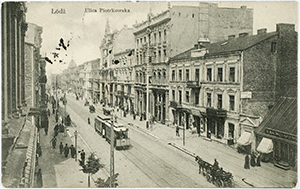
Piotrowska Street in Łódź
(postcard: before 1910) [Herder Institute, Marburg,
image archive, inv. no. 191603].
Art History
Along Piotrkowska Street there are architecturally interesting town houses, palaces and churches in the Neo-Baroque, Neo-Gothic and Neoclassical styles. The architectural heritage of industrial culture is unique, for example the Poznański factory and the Scheibler factory (Księży Młyn). The architect Daniel Libeskind was born in Łódź in 1946.
History of printing
Before the Second World War, there were several Polish, Yiddish and German local newspapers. The most important German-language newspapers of the interwar period were the bourgeois *Neue Lodzer Zeitung*, the conservative-nationalist *Lodzer Freie Presse* and the socialist *Lodzer Volkszeitung*. Since the fall of communism, local editions of the major daily newspapers have dominated the scene, alongside the *Dziennik Łódzki*, which dates back to the 19th century.
Bibliography
Łódź served as the setting for dystopian stories denouncing the industrialised city, including the novels *Ziemia Obiecana* (The Promised Land) by Władysław Reymont (1899) and *Złe miasto: Obrazy z 1907 roku (The Evil City: Images from 1907) by Zygmunt Bartkiewicz (1911). Joseph Roth’s novel *Hotel Savoy* (1924) is set in Łódź in 1919. The translator and author Karl Dedecius (1921–2016), who paints a more favourable picture of the city and its multi-ethnic character, was born in Łódź.
Culture of memory and remembrance
The city draws on its multi-ethnic past, which is romanticised in tourist promotional material. From 2002 to 2009, the ‘Dialogue of the Four Cultures’ festival took place; it has since been revived in a new form (new name: Festival of the Four Cultures). Along Piotrkowska Street stand monuments to notable figures from the city’s history (including Władysław Reymont, Julian Tuwim, Artur Rubinstein and the industrialists Karl Scheibler, Izrael Poznański and Ludwik Grohman). On the site of the former ghetto and in the Jewish cemetery, there are plaques and murals commemorating the Holocaust. There is also a memorial and a museum at Radegast/Radogoszcz railway station, from where deportations from the Łódź ghetto to the extermination camps took place from 1942 onwards. In the ‘Park of the Survivors’ (Park Ocalałych), a monument was dedicated to the ‘Righteous Among the Nations’ in 2009.
In Germany, Łódź is known for the song ‘Theo, wir fahr’n nach Łódź’, a hit by Vicky Leandros (1974) based on a Yiddish song.
4. Discourses/Controversies
German historiography on Łódź has focused primarily on the Germans living in the city. The main proponents of this ‘German Łódź’ were the organisations representing Germans displaced from Poland, in particular the Landsmannschaft Weichsel-Warthe, as well as institutes dedicated to research into Eastern Central Europe. In the post-war period, the memory of ‘German Łódź’ that prevailed in Germany was therefore mainly an uncritical narrative of victimhood and martyrdom. This is particularly evident with regard to the German minority in the interwar period, as well as in the omission of the Holocaust and the Second World War.[14] Even before the First World War, the city’s multi-ethnic character – reflected in the term ‘Lodzermensch’ or ‘Lodzer Mensch’ – represented a problem of denationalisation for many. Since 1989, the multi-ethnic origins of Łódź have largely been re-evaluated in a positive light. In more recent narratives, Russians have now been added to the traditional triad of Germans, Poles and Jews.[15] The forced co-operation of the chairman of the Jewish Council in the Łódź ghetto, Chaim Mordechai Rumkowski (1877–1944), with the German occupiers remains a subject of controversy.
Specialist literature
- Winson Chu: The ‘Lodzermensch’. From Cultural Contamination to Marketable Multiculturalism. In: Kristin Kopp, Joanna Niżyńska (eds.): Germany, Poland and Postmemorial Relations. In Search of a Livable Past. New York, Basingstoke (UK) 2012, pp. 239–258.
- Stefan Dyroff, Krystyna Radziszewska, Isabel Röskau-Rydel (eds.): Łódź Beyond ‘Factories, the Wild West and the Provinces’. Cultural Studies on Germans in and from the Polish Territories. Munich 2009 (Polono-Germanica 4).
- Jürgen Hensel (ed.): Poles, Germans and Jews in Łódź 1820–1939. A Difficult Neighbourhood. Osnabrück 1999 (Individual Publications of the German Historical Institute in Warsaw 1).
- Beate Kosmala: ‘The Difficulties of Remembrance. The Litzmannstadt Ghetto as a Site of Remembrance in Poland and Germany’. In: Zeitschrift für Geschichte 55 (2007), pp. 743–763.
- Andreas Kossert: ‘Promised Land’? Religiosity and Entrepreneurs in Industrial Society. Łódź and Manchester in the Long Nineteenth Century. In: Jörg Gebhard, Rainer Lindner, Bianka Pietrow-Ennker (eds.): Entrepreneurs in the Russian Empire. Social Profile, Symbolic Worlds, Integration Strategies in the 19th and Early 20th Centuries. Osnabrück 2006, pp. 143–163.
- Andrzej Lech, Krystyna Radziszewska, Andrzej Rykała (eds.): Społeczność żydowska i niemiecka w Łodzi po 1945 roku [The Jewish and German Communities in Łódź after 1945]. Łódź 2010.
- Stanisław Liszewski: Łódź. A Monograph of the City. Łódź 2009.
- Andrea Löw: Jews in the Litzmannstadt Ghetto. Living Conditions, Self-Perception, Behaviour. Göttingen 2006 (Series on the Łódź Ghetto Chronicle).
- Joanna B. Michlic: Łódź in the Post-Communist Era. In Search of a New Identity. In: John Czaplicka, Nida Gelazis, Blair A. Ruble (eds.): Cities after the Fall of Communism: Reshaping Cultural Landscapes and European Identity. Baltimore 2009, pp. 281–303.
- Uwe Rada: “The Future is Łódź”. In: Jahrbuch Polen 18 (2007), pp. 44–55.
- Paweł Samuś (ed.): Poles – Germans – Jews in Łódź in the 19th and 20th Centuries: Distant and Close Neighbours [Poles – Germans – Jews in Łódź in the 19th and 20th Centuries. Distant and Close Neighbours]. Łódź 1997.
- Karl Schlögel: Łódź – In Search of the ‘Promised Land’. In: Ibid.: A Stroll through Yalta and Other Cityscapes. 2nd ed. Frankfurt am Main 2006, pp. 126–138.
Yearbooks and journals
- Acta universitatis lodziensis: Folia Historica, 1980 onwards.
- Kronika miasta Łodzi [Chronicle of the City of Łódź], 1991 onwards.
- Tygiel Kultury [Melting Pot of Culture], 1996 onwards.
Web links
- www.difmoe.eu/ (website of the Digitales Forum Mittel- und Osteuropa e. V. [DiFMOE] association, featuring digitised versions of German-language books, periodicals and images with a focus on Łódź)
- www.wimbp.lodz.pl/wimbp/ (Main page of the Biblioteka Cyfrowa Regionalia Ziemi Łódzkiej in Polish and English)
- www.muzeum-lodz.pl/ (Website of the Łódź City Museum featuring collections of photographs and postcards, in Polish and English)
- www.stat.gov.pl/lodz/index_PLK_HTML.htm (Statistics from the Statistical Office in Łódź for the Łódź Voivodeship, the city of Łódź and the districts)
- www.lodzjews.org/root/form/de/fundacja2/index.asp (multilingual website of the Fundacja Monumentum Iudaicum Lodzense foundation)
- www.holocaustliteratur.de/deutsch/Getto-Chronik/ (Chronicle of the Łódź/Litzmannstadt Ghetto – The final year of the interdisciplinary research centre for Holocaust literature at Justus Liebig University in Giessen, in collaboration with the University of Łódź and the State Archives in Łódź, featuring information and documentation)
- www.herder-institut.de/bildkatalog/wikidata/Q580 (Images relating to Łódź in the image archive of the Herder Institute, Marburg)
Notes
[1] Maria Malec: Etymological Dictionary of Geographical Names in Poland. Warsaw 2003, p. 151; Dictionary of Tourist Geography of Poland. Vol. I: A–N. Warsaw 1956, pp. 490–497.
[2] Other sources cite the year 1337. See Kazimierz Badziak: An Outline of the History of Łódź up to 1918. In: Liszewski: Łódź. Monograph of the City, p. 28.
[3] Filip Sumierski, Bronisław Chlebowski, Władysław Walewski (eds.): Słownik geograficzny Królestwa Polskiego i innych krajów słowiańskich [Geographical Dictionary of the Kingdom of Poland and Other Slavic Countries]. Volume 5. Warsaw 1884, p. 678.
[4] Wiesław Puś: The occupational and social structure of the main ethnic groups in Łódź and their development between 1820 and 1914. In: Hensel (ed.): Poles, Germans and Jews, p. 36.
[5] The following data are based on the state censuses conducted during the interwar period: in 1921, questions were asked about nationality; in 1931, about mother tongue and religion.
[6] Ludwik Mroczka: Dynamika rozwoju i struktura społeczno-zawodowa głównych grup etnicznych w Łodzi w latach 1918–1939 [The Dynamics of Development and the Socio-Occupational Structure of the Largest Ethnic Groups in Łódź, 1918–1939]: In: Samuś (ed.): Poles – Germans – Jews, p. 101.
[7] Mroczka: Dynamics of Development (note 6), p. 101.
[8] Statistical Office in Łódź: www.stat.gov.pl/lodz/39_PLK_HTML.htm (accessed 2 October 2013); Information about the City – 2012: www.stat.gov.pl/lodz/69_1169_PLK_HTML.htm (accessed 2 October 2013); Summary Tables/Key Data on Łódź [Summary Tables. Key data on the city], pp. 86–87: www.stat.gov.pl/cps/rde/xbcr/lodz/ASSETS_12m_MAJOR_DATA.pdf (accessed 2 October 2013).
[9] Central Statistical Office [Główny Urząd Statystyczny]: Population. Demographic and social status and structure. National Census of Population and Housing 2011 [Population. Demographic and social status and structure. National Census of Population and Housing 2011]. Warsaw 2013, p. 271 (Table 32. Population by national and ethnic identification): www.stat.gov.pl/cps/rde/xbcr/gus/LUD_ludnosc_stan_str_dem_spo_NSP2011.pdf (accessed 2 October 2013).
[10] Aleksandra Jewtuchowicz, Andrzej Suliborski: The Economic Structure of Łódź from 1918 to 1939. In: Liszewski: Łódź. Monograph of the City, p. 310.
[11] Stanisław Liszewski: Living Conditions of the Inhabitants of Łódź in the Third Republic. In: Liszewski: Łódź. Monograph of the City, p. 424; Łódź Statistical Office: www.stat.gov.pl/lodz/39_PLK_HTML.htm (accessed 2 October 2013); Information about the city – 2012: www.stat.gov.pl/lodz/69_1169_PLK_HTML.htm (accessed 2 October 2013); Summary Tables/Łódź compared with other major cities in Poland, p. 324: www.stat.gov.pl/cps/rde/xbcr/lodz/ASSETS_12m_LODZ_NA_TLE_DUZYCH_MIAST.pdf (accessed 2 October 2013).
[12] The average salary in Łódź in 2011 was PLN 3,427.06 (2010: PLN 3,243.15). Average monthly wages in the national economy, 1950–2012 (basis for calculating pensions) [The average monthly wage in the national economy 1950–2012 (based on pensions)]: www.stat.gov.pl/gus/5840_1630_PLK_HTML.htm.
[13] Łódź Statistical Office: Basic data/Voivodeship: http://www.stat.gov.pl/lodz/index_PLK_HTML.htm (accessed 2 October 2013); Voivodeship data (Source: Statistical Yearbook of the Łódź Voivodeship 2012) [Voivodeship data (Source: Statistical Yearbook of the Łódź Voivodeship 2012)]: www.stat.gov.pl/lodz/38_PLK_HTML.htm (accessed 2 October 2013); Population – Voivodeship data 2012/Population. Religious denominations: www.stat.gov.pl/lodz/69_968_PLK_HTML.htm (accessed 2 October 2013); Some religious denominations in 2011, Table 34 (70), p. 129: www.stat.gov.pl/cps/rde/xbcr/lodz/ASSETS_12w_05.pdf (accessed 2 October 2013).
[14] Wolfgang Kessler: Łódź after Łódź. Observations on the recollections and memories of Germans from Łódź after 1945. In: Dyroff, Radziszewska, Röskau-Rydel (eds.): Lodz beyond ‘Factories, the Wild West and the Provinces’, p. 163.
[15] See Ingo Eser: Łódź – Perspectives on a City’s History. In: Dyroff, Radziszewska, Röskau-Rydel (eds.): Łódź beyond ‘Factories, the Wild West and the Provinces’, pp. 31–55.
Citation
Winson Chu: Łódź. In: Online Encyclopaedia on the Culture and History of Germans in Eastern Europe, 2013. URL: ome-lexikon.uni-oldenburg.de/p32319 (as at 30 July 2021).
Terms of use for this article
Copyright © University of Oldenburg and the Federal Institute for the Culture and History of Germans in Eastern Europe (BKGE), all rights reserved. This work was produced as part of the project ‘Online Encyclopaedia on the Culture and History of Germans in Eastern Europe’ and may be reproduced and published provided the rights holders’ consent has been obtained. Please contact:
If you have any specialist comments or additions to the text, please contact the editorial team, citing relevant literature and source references.