

Kladrau/Kladruby
Kladrau/Kladruby
Political and administrative affiliation
Located in the Pilsen Region (Plzeňský kraj), formerly the Tachov District (Okres Tachov), in the west of the Czech Republic.
Coat of arms, flag
A city wall against a blue background, on which a crucifix is depicted, flanked by the Virgin Mary and St John. In the gateway of the wall, a ruler kneels in a devotional posture, his crown resting on a cushion before him. A coat of arms, borne by two angels and surmounted by a crown, bearing the initial ‘M’ of Emperor Matthias (1557–1619), crowns the gateway.
Middle Ages
Kladrau was first mentioned in a document in 1115 in connection with the founding of the Benedictine monastery by the Bohemian Duke Vladislav I (c. 1070 – c. 1125), whose tomb is located in the monastery church. The monastery’s founding charter is, however, debated amongst scholars as a forgery dating from the late 12th century. The abbey, staffed by monks from Zwiefalten, benefited from its economically favourable location on the trade route between Nuremberg and Prague (Praha), later known as the ‘Golden Road’. The abbey church was consecrated in 1233 in the presence of King Wenceslas I (c. 1205–1253). A charter issued by the Bohemian king in the same year confirms the market rights granted to the town by Duke Vladislav III in 1197. The political unrest during and after the reign of Přemysl Ottokar II (d. 1278) also affected the monastery complex. In the second half of the 14th century, under Abbot Ratzek of Prostibor/Racek z Prostiboře, the east choir of the monastery church and the All Saints’ Chapel were built.
Modern times
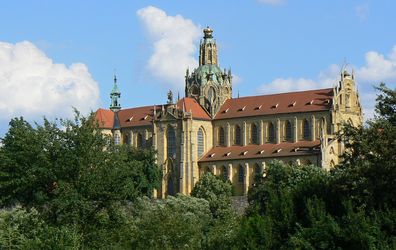
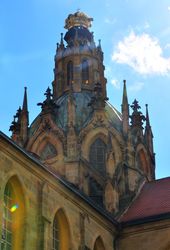
In a charter dated 1616, Emperor Matthias granted the town of Kladrau the privilege of red wax and incorporated his initial ‘M’ into the town’s coat of arms. The complex, which had been severely damaged as a result of the Hussite Wars and the Thirty Years’ War, was rebuilt in the early 18th century. The monastery church of the Assumption of Mary, originally built as a Romanesque basilica, was redesigned between 1712 and 1726/28 by the architect and painter Johann, or rather Giovanni Santini-Aichel (1677–1723) in the Baroque Gothic style. The interior decoration of the church was the work of, amongst others, the brothers Cosmas Damian (1686–1739) and Egid Quirin Asam (1692–1750); the sculptural decoration was created by the circle of Matthias Bernhard Braun (1684–1738) and Karel Legát. Adjoining the so-called Old Convent Building to the south of the church, the New Convent Building was constructed between 1729 and 1739 as a four-winged complex based on a design by Kilian Ignatz Dientzenhofer (1689–1751). In 1785, the monastery was secularised as a result of the Josephine reforms. In 1825, Alfred I zu Windisch-Graetz (1787–1862) acquired the monastery grounds, which remained in the family’s possession until 1945.
Contemporary History
Large parts of the library, as well as the family archive, have been preserved.
4. Discourses/Controversies
Wilhelm Weschta’s publication *Kladrau – History of a Monastery and a Town* (Dinkelsbühl 1966) is the only recent monographic study on the history of the town and monastery to have been published to date. It oscillates between historically sound and annotated research, particularly concerning the early history of the monastery and the town, and revanchist commentary, primarily on the events of the 20th century.
Bibliography
- Ulrich Fürst: The Living and Visible History. Programmatic Themes in Baroque Ecclesiastical Architecture (Fischer von Erlach, Hildebrandt, Santini). Regensburg 2002 (Studies in Christian Art 4), pp. 195–264.
- František Kubů: Kladrau. In: Joachim Bahlcke, Winfried Eberhard, Miloslav Polívka (eds.): Handbook of Historical Sites. Bohemia and Moravia. Stuttgart 1998 (Kröners Taschenausgabe 329), p. 262.
Web links
- www.kladruby.cz/ (the town’s website)
- www.herder-institut.de/bildkatalog/wikidata/Q1744198 (Images of Kladrau/Kladruby from the Herder Institute’s image archive, Marburg)
Citation
Marco Bogade: Kladrau/Kladruby. In: Online Encyclopaedia on the Culture and History of Germans in Eastern Europe, 2011. URL: ome-lexikon.uni-oldenburg.de/p32218 (as at 30 July 2021).
Terms of use for this article
Copyright © University of Oldenburg and the Federal Institute for the Culture and History of Germans in Eastern Europe (BKGE), all rights reserved. This work was produced as part of the project ‘Online Encyclopaedia on the Culture and History of Germans in Eastern Europe’ and may be reproduced and published provided the rights holders’ consent has been obtained. Please contact:
If you have any specialist comments or additions to the text, please contact the editorial team, citing relevant literature and source references.