

Neumarkt am Mieresch/Târgu Mureș
Neumarkt am Mieresch/Târgu Mureș
Names in other languages
Latin: Novum Forum Siculorum; Hungarian: Marosvásárhely; Greek: Agropolis/Areopolis; Transylvanian Saxon: Nai Muark[1]
Topography
A village situated at the junction of the Transylvanian Plateau (Romanian: Câmpia Transilvaniei) with the valley of the River Mieresch (Romanian: Valea Mureșului) and the valley of the River Niersch (Romanian: Valea Nirajului), approximately 117 km north-west of Sibiu, 127 km south-east of Cluj-Napoca and 93 km south of Bistrița.
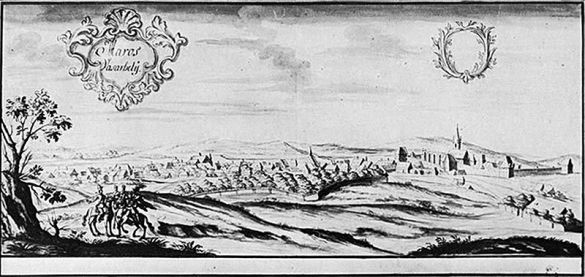
Johann I. Haas: The Hungarian town of Neumarkt on the Mieresch and its castle (Marosvásárhely magyar
város és vár), 1736. [Library of the Lodovika Academy, Budapest]

Political and administrative affiliation
Romania; capital of Mureș County (Romanian: județul Mureș).
Common symbolism
In the blue field of the triangular shield is an arm clad in armour, holding a straight sword with a bear’s head impaled upon it; in the top right-hand corner are a pair of golden scales; above the shield is a circular castle wall with seven towers.
Archaeological significance
During a number of excavations carried out on the site of the castle church, the northern and western wings of the Franciscan monastery and the brick path leading to the church in the 15th century were discovered, along with six further older settlement layers revealing traces dating back to the Stone Age.
Middle Ages
In the earliest documented references to the town (1323), the place is called “Szeklermarkt” (Forum Siculorum, Zekel Wasarhe). Weekly and annual markets were held here, and it was here that the ox tax was collected. Neumarkt was a suburb of the Szekler seat of Mieresch (Hungarian: Maros). One of the first Dominican monasteries was established here early on, but it was destroyed in 1241 during the Mongol invasion. Subsequently, the Franciscans built a monastery, and the Gothic parish church was erected next to it.
Modern times
During a Szekler uprising to defend their special privileges, which were under threat from the prince, Prince Stephen Báthory (1571–1576) ordered the fortified church to be besieged. In the mid-16th century, the Franciscans were expelled in the wake of the Reformation and their church was used by followers of Calvinism. Following the sacking and burning of the town in 1602, the inhabitants, on the advice of Tamás Borsos (1566–1633), began converting the fortified monastery into a castle. The castle served as barracks in the 18th century and subsequently fell into disrepair. In 1616, Prince Gabriel Bethlen (1613–1629) elevated the minor town of Székelyvásárhely to the status of a Free Royal Town under the name Maros-Vásárhely (Neumarkt am Mieresch). Until 1848, the town was the seat of the Royal Provincial Court, the highest court of appeal in Transylvania. In the period that followed, the town experienced a golden age after the incorporation of surrounding villages.
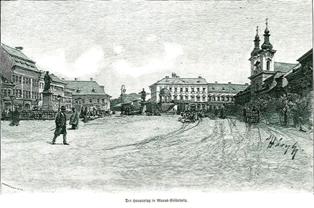
The main square in Neumarkt am Mieresch (Maros-
Vásárhely). [The Austro-Hungarian Monarchy in ‘
’ in words and pictures. Hungary, Vol. 6. Vienna 1902, p. 295]

In 1661, the castle was briefly occupied by the Ottomans. Following the transition to Habsburg rule, the Jesuits arrived in Neumarkt in 1702 as part of Vienna’s Counter-Reformation activities. In 1728, construction work began on the twin-towered church dedicated to St John the Baptist. In 1707, Franz II Rákóczi (Hungarian: Rákóczi Ferenc), leader of the uprising against the Habsburgs (1703–1711), was proclaimed Prince of Transylvania here. In 1848, the town was occupied by imperial troops for several months. In 1876, parts of Thorenburg County (Romanian: Turda, Hungarian: Torda) were merged with the Székely seat of Mieresch to form Maros-Torda County.
Contemporary History
The town experienced a period of prosperity in the early 20th century under the Hungarian mayor György Bernády (1900–1902; 1926–1929): infrastructure projects, the construction of school and university buildings, the present-day Palace of Culture, and the Art Nouveau-style town hall. Following the First World War, Transylvania came under Romanian rule as a result of the Treaty of Trianon (1920). The Romanian mayor Emil Dandea (1922–1926; 1934–1937) continued the town’s development and commissioned the construction of the Orthodox and Greek Catholic churches in the town centre.
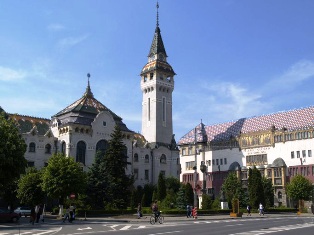
The town hall with its tower and the Palace of Culture in
Neumarkt am Mieresch.
[Photo: B. Moldovan]

Between 1949 and 1967, Neumarkt was a suburb of the Autonomous Hungarian Region (Romanian: Regiunea Autonomă Maghiară), which was intended to illustrate the communist regime’s minority-friendly policies but did not entail actual autonomy; rather, it resulted in strict surveillance by the authorities in Bucharest. In 1967, this arrangement was abolished as part of an administrative reorganisation, and Neumarkt was designated a suburb of Mieresch County. In the 1970s, industrialisation (the chemical combine) was accompanied by a deliberate policy of Romanianisation. Following the fall of communism (1989), Neumarkt witnessed bloody clashes between Romanians and Hungarians in March 1990, known as ‘Black March’.
Population trends
The population of the town of Neumarkt am Mieresch between 1850 and 2011.[2]
Year | Total population | Romanians | Hungarians | Germans | Others |
| 1880 | 13,192 | 5.10% | 85.60% | 3.94% | 5.36% |
| 1,930 | 38,517 | 25.43% | 58.12% | 1.64% | 14.81% |
| 1966 | 80,912 | 27.5% | 70.6% | 0.5% | 1.4% |
| 1992 | 161,216 | 46.2% | 51.6% | 0.3% | 1.9% |
| 2011 | 127,849 | 51.96% | 44.86% | 0.15% | 3.03% |
History of Religion and the Church
Religious affiliation of residents (2002): Orthodox: 46.74 per cent; Reformed: 30.06 per cent; Roman Catholic: 13.50 per cent; Greek Catholic: 2.60 per cent; atheists: 0.37 per cent; members of free churches and others: 36.79 per cent.[3]
Education and Science
University of Medicine (Romanian: Universitatea de Medicină şi Farmacie); Sapientia – Hungarian University of Sciences in Transylvania (Hungarian: Sapientia Erdélyi Magyar Tudományegyetem), “Petru Maior” Private University.
Art History
In the early 19th century, Count Sámuel Teleki laid the foundations of the Teleki Library with a collection of 40,000 volumes, including 66 incunabula and the Vásárhely Codex, a parchment manuscript of Tacitus’s *Annals* bearing the Hunyadi coat of arms. In 1955, the library of the former Reformed College, together with the manuscripts and personal effects of János and Farkas Bolyai, were transferred from the Bolyai Memorial to the library. The Palace of Culture, built in the Secession style, features a magnificent Hall of Mirrors, whose stained-glass windows are decorated with scenes from Szekler ballads. The organ in the concert hall, dating from the early 20th century, is now Romania’s third-largest organ.
Bibliography
- Balázs Orbán: Marosszék [The Chair of Mieresch]. In: A Székelyföld leírása történelmi, régészeti, természetrajzi s népismereti szempontból [A Description of the Székely Land from a Historical, Archaeological, Natural History and Folklore Perspective]. Pest 1868, pp. 1–12, 106–153.
- The Maros-Tordau County. In: Transylvania in Words and Pictures. With an introduction by Krista Zach and supplemented by a gazetteer. Cologne et al. 2004 [Complete reprint of Vol. 23 (Hungary, Vol. 6), Vienna 1902] (Schriften zur Landeskunde Siebenbürgens 28), pp. 287–308.
- Pál-Antal Sándor: The Formation of the Szekler Chairs. In: Harald Roth (ed.): The Szeklers in Transylvania. From a Privileged Special Community to an Ethnic Group. Cologne et al. 2008 (Transylvanian Archive 40), pp. 126–149.
- Tom Gallagher: The violence in Tîrgu Mureş and its aftermath. In: Theft of a Nation. Romania since Communism. London 2005, pp. 84–89.
- Ernő Deák: Royal Free Cities – Municipal Cities. The Urban System of the Lands of the Hungarian Crown (1780–1918), Part 2. Selected Materials on the Urban System. Vienna 1989 (Publications of the Commission for Economic, Social and Urban History / Austrian Academy of Sciences 4), pp. 370–375.
Web links
- www.tirgumures.ro (the town’s official website)
- www.mures.ro (portal website for residents)
- urlaub-in-rumänien.de/de/uir/ausflugsziele-staedte-targu-mures/ (Holidays in Romania, travel guide)
Notes
[1] Ernst Wagner: A Historical and Statistical Gazetteer of Transylvania. With an introduction to the historical statistics of the region. Cologne et al. 1977 (Studia Transsylvanica 4), p. 344.
[2] E. Árpád Varga: Ethnic (native language/nationality) distribution of settlements in Maros County by percentage in 1850 and 2002. [Ethnic (native language/nationality) distribution by percentage of settlements in Mieresch County between 1850 and 2002]: www.kia.hu/konyvtar/erdely/erd2002.htm (Accessed 6 January 2012).
[3] Centre for Ethnocultural Diversity [Central Information Centre on Ethnocultural Diversity]: www.edrc.ro/recensamant.jsp?regiune_id=2568&judet_id=2798&localitate_id=2799 (accessed 6 January 2012).
Citation
Beáta Moldovan: Neumarkt am Mieresch/Târgu Mureş. In: Online Encyclopaedia on the Culture and History of Germans in Eastern Europe, 2012. URL: ome-lexikon.uni-oldenburg.de/56393.html (accessed 22 March 2012).
Terms of use for this article
Copyright © University of Oldenburg and the Federal Institute for the Culture and History of Germans in Eastern Europe (BKGE), all rights reserved. This work was produced as part of the project ‘Online Encyclopaedia on the Culture and History of Germans in Eastern Europe’ and may be reproduced and published provided the rights holders’ consent has been obtained. Please contact:
If you have any specialist comments or additions to the text, please contact the editorial team, citing relevant literature and source references.