

Rzeszów
Rzeszów
Names in other languages
Ukrainian: Ряшів (transliterated as Riaschiv); Czech: Řešov; Latin: Resovia
Etymology
The etymology of the name Rzeszów remains unclear. The hypothesis that the name derives from a German ‘Reichshof’ founded by German colonists has been refuted by German historians, amongst others.[1] According to another theory, when the town was founded under Magdeburg law in the 14th century, the Germans gave it the name Resche.[2] According to legend, the town’s name refers to its supposed founder, Rzech, Rzesz or Rzetysław.
Location
Rzeszów is situated at 50°12′20′′ north latitude, 22°31′58′′ east longitude, approximately 160 km east of Kraków.
Topography
The town is situated in the transitional zone between the Carpathian Foothills (Podkarpacie) and the Sandomierz Basin (Kotlina Sandomierska), on theWisłok, a tributary of the San.
Political and administrative affiliation
Poland. Rzeszów is the capital of thePodkarpackie Voivodeship and a bishopric.
Middle Ages
The first documented mention of the town’s name dates from 1354, when Jan Pakosławic (d. 1374) was granted a charter of foundation under Magdeburg Law by King Casimir III the Great (1310–1370). There was already a parish church by 1363, and a parish school from 1406 onwards. In the 15th century, the town developed rapidly, a development linked to its location on important trade routes. From the end of the 16th century until the late 1640s, Rzeszów experienced its golden age: the town hall was built in 1591, construction of the castle began in 1600, and the Bernardine monastery within the castle was founded in 1629.
Modern times
In 1638, the town came into the possession of the Lubomirski magnate family. The Lubomirskis’ reign can be divided into two phases. During the first, the town developed steadily: In 1658, Jerzy Sebastian Lubomirski (1616–1667) founded the Piarist College, at that time one of the few secondary schools in Poland; in 1681, a library course was established at the Bernardine Church, and art and culture were fostered at court. The second phase marked an economic decline for the city: numerous fires (1681, 1728), the plague and the restriction of civil liberties took a heavy toll on Rzeszów. In 1772, with the First Partition of Poland, the city’s 146-year history under Habsburg rule began. In 1773, Rzeszów, with a population of around 3,000, became a district town (cyrkuł). Its favourable location on the so-called Kaiser-Chaussee, a newly constructed trade route that contributed significantly to the economic revival of Galicia, reinforced Rzeszów’s role as a trading town. In 1845, Rzeszów was granted the status of a Free City. This development, together with the legislative measures of the first half of the 1860s, which allowed for greater autonomy in Galicia, had a positive influence on the city’s further development. In 1858, Rzeszów was linked to Kraków by a railway line, and in 1863 to Lemberg/L’viv/Lwów.
20th century
As early as the beginning of the century, there were gasworks and gas-lit street lighting. In 1911, power stations came into operation. Shortly before the First World War, the town benefited from the expansion of military infrastructure in the northern regions of the Austro-Hungarian Empire. The town’s prosperity enabled a number of construction projects (schools, the refurbishment of the town hall, water supply and sewerage systems). Between 1937 and 1939, as part of the Central Industrial District (Centralny Okręg Przemysłowy, COP), aircraft engine factories and a branch of the Poznań-based ‘Cegielski’ military works were established. During the Second World War, Rzeszów was partially destroyed. The Jewish population was almost entirely deported by the German Nazis. In 1945, the city became the provincial capital, which significantly raised its status. The 1950s and 1960s brought rapid development: new factories, public buildings and housing estates were built. A consequence of the visit by Pope John Paul II (1920–2005) in 1991 was the establishment of the Diocese of Rzeszów in 1992.
Today, with a population of over 180,000, the city is the most important industrial, commercial, cultural and educational centre in south-eastern Poland.
Population trends
The question of the ethnic composition of Rzeszów’s population in the Middle Ages is a matter of debate. On the one hand, there is some evidence of a small Russian population, which was linked to the town’s location on the border between Poland and Ruthenia. On the other hand, however, Polish settlement of the entire border region proceeded with particular vigour, a fact reflected, amongst other things, in the naming of Rzeszów and the surrounding settlements.[3] Furthermore, other ethnic groups were also present in Rzeszów. According to Kurt Lück, the town ‘must have had German inhabitants after its foundation’, as it is ‘hard to believe that it formed an exception amongst the numerous neighbouring German towns’.[4] However, all traces of the German settlers disappeared following a fire in the town in 1427.[5] The first Jews arrived in the town in the 16th century. Their numbers soon exceeded those of the Christians. In 1674, there were 1,400 Jews in Rzeszów; at the beginning of the 19th century, 3,575 Jews lived here, compared with only 1,029 Christians. The history of the Jews of Rzeszów came to an end with the Second World War: just under 20,000 inhabitants of Jewish origin were murdered.[6]
| Year | Population[7] |
| 1910 | 23,700 |
| 1918 | 24,200 |
| 1939 | 41,000 |
| 1946 | 29,407 |
| 1950 | 28,133 |
| 1955 | 52,142 |
| 1960 | 62,526 |
| 1970 | 83,105 |
| 1980 | 121,321 |
| 1990 | 153,041 |
| 2000 | 162,501 |
| 2010 | 178,227 |
Rzeszów has the second-highest birth rate in Poland after Warsaw. In 2013, it had a population of 184,102.[8]
The economic situation today
The aircraft and pharmaceutical industries are among the most important sources of revenue. The following industrial sectors are also represented in Rzeszów: the manufacture of domestic appliances (Zelmer), food production, clothing and footwear manufacturing, the furniture industry and telecommunications. The most important industrial companies include: WSK PZL Rzeszów (aerospace industry), MTU Aero Engine Polska (aerospace systems), BorgWarner (automotive components), Polfa (pharmaceuticals), Koral (ice cream manufacturer) and Elektromontaż (construction sector).
Special cultural institutions
Since 1974, the Rzeszów Philharmonic, with its 85-piece orchestra, has been offering a varied programme and an annual music festival in the nearby town of Landshut/Łańcut. In addition to the state-run Wanda Siemaszkowa Theatre and the ‘Maska’ Puppet Theatre, there are also several private theatres operating in the town. Since 1969, the World Festival of Polish Diaspora Folk Ensembles (Światowy Festival Polonijnych Zespołów Folklorystycznych) has been held every three years.
Education and Science
The first parish school mentioned in historical sources was founded in the 14th century. However, the town only gained prominence as an educational centre with the founding of the Piarist College (1658). In 1784, the Imperial-Royal Secondary School, comprising three classes, was opened on the basis of the college. Subjects taught included German, religion and Latin. Between 1772 and 1876, there were also two primary schools operating in the town. From 1871 onwards, there were girls’ schools in Rzeszów with the aim of preparing women (as a result of emancipation) for their new social and family roles. In 1918, there were eleven primary schools and four general schools here. In 1938–39, a total of 7,948 pupils were enrolled in all the city’s schools. After the war, the city’s school system was re-established. In 1983, there were 24 primary schools and 8 secondary schools. Today there are 26 primary schools, over 40 secondary schools of all types and seven higher education institutions with 54,000 students.[9] Rzeszów has been a university city since 2001. The university was formed through the merger of the University of Education, founded in 1963, and a branch of the Maria Curie-Skłodowska University in Lublin.
Art History and Architecture
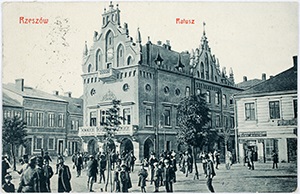
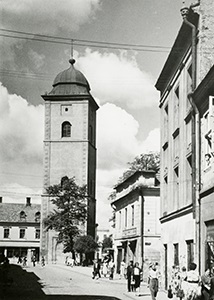
The parish church of St Adalbert and St Stanislaus (św. Wojciecha i Stanisława) is one of the oldest religious buildings in Rzeszów. It is thought to have been built before 1363 and was rebuilt following its destruction around 1434. Rzeszów Castle is thought to have been built at the end of the 16th century. Nearby stands the Lubomirski family’s summer palace, set in a beautiful park. Rzeszów’s market square, with its historic stone houses dating from the 15th to the 19th centuries and a 400-metre-long underground passage, is bordered on the west side by the neo-Gothic town hall from the 16th century (renovated in the 19th century). The Lubomirski mausoleum is situated in the Piarist monastery with its Church of the Cross, which today houses the Regional Museum (Muzeum Okręgowe). The ‘Small’ (16th–17th centuries) and ‘Large’ synagogues (late 17th century) still bear witness to the town’s former Jewish character.
Bibliography
- Zdzisław Budzyński, Jan Draus, Jacek Kawałek (eds.): Encyklopedia Rzeszowa [Encyclopaedia of Rzeszów]. Rzeszów 2004.
- Sylwester Czopek (ed.): Rzeszów – The Rzeszów Region. The Distant and Recent Past (teaching resources) [Rzeszów and its Surroundings. The Distant and Recent Past (Teaching Resources)]. Rzeszów 2000.
- Władysław Hennig, Elżbieta Kurowska: Rzeszów. A Guide [Rzeszów. A City Guide]. Rzeszów 2010.
- Hubert Kotarski, Krzysztof Malicki: The Capital of Podkarpacie: Yesterday and Today. A Sociological Study of the Social Aspects of Change in Rzeszów, 1989–2009 [The Capital of the Carpathian Foothills: Yesterday and Today. A Sociological Study of the Social Aspects of the Transformation Processes in Rzeszów 1989–2009]. Rzeszów 2013.
Web links
- www.rzeszow.pl/ (Official city portal)
- www.herder-institut.de/bildkatalog/index/index?searchfield_parameter=Rzesz%C3%B3w&newperspective=thumbnails (Images of Rzeszów in the Herder Institute’s image archive, Marburg)
Notes
[1] Soviet Council Records of Rzeszów: 1591–1634 [Rzeszów Council Records: 1591–1634]. Edited by Adam Przyboś. Wrocław, Kraków 1957, p. VI; German Settlement in Lesser Poland and Red Ruthenia in the 15th Century (map). Compiled and drawn by Kurt Lück. (no place) 1934.
[2] Adam Przyboś: From the Past of Rzeszów. Inaugural Lecture. In: Annales de l’École normale supérieure à Cracovie. Kraków, Rzeszów 1964 (Roczniki Naukowo-Dydaktyczne. Vol. 1 [23]), pp. 17–27, here p. 18.
[3] Draus (ed.): Encyklopedia Rzeszowa [Encyclopaedia of Rzeszów], p. 287.
[4] Kurt Lück: German Reconstruction Forces in the Development of Poland. Plauen in the Vogtland 1934, p. 529.
[5] Draus (ed.): Encyklopedia Rzeszowa [Encyclopaedia of Rzeszów], p. 287.
[6] Draus (ed.): Encyklopedia Rzeszowa [Encyclopaedia of Rzeszów], p. 289.
[7] pl.wikipedia.org/wiki/Rzesz%C3%B3w#Demografia (accessed 29 August 2014).
[8] Rzeszów. Statistical data: www.rzeszow.pl/miasto-rzeszow/dane-statystyczne/rzeszow-w-liczbach (accessed 29 August 2014).
[9] “Statistically speaking, Rzeszów is a student city”: www.archiwum.wyborcza.pl/Archiwum/1,0,7658773,20121013RZ-DLO,Rzeszow_statystycznie_studentami_stoi.html (accessed 29 August 2014).
Terms of use for this article
Copyright © University of Oldenburg and the Federal Institute for the Culture and History of Germans in Eastern Europe (BKGE), all rights reserved. This work was produced as part of the project ‘Online Encyclopaedia on the Culture and History of Germans in Eastern Europe’ and may be reproduced and published provided the rights holders’ consent has been obtained. Please contact:
If you have any specialist comments or additions to the text, please contact the editorial team, citing relevant literature and source references.