

Seksard/Szekszárd
Seksard/Szekszárd
2. Geography
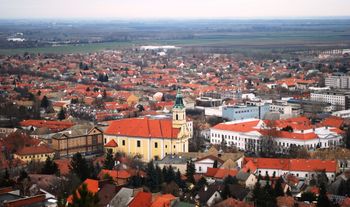
Political and administrative affiliation
Republic of Hungary. Szekszárd is the administrative centre of Tolna County and the centre of the Szekszárd micro-region.
Common symbolism
Against a blue background are depicted four rows of red bricks, above which stands an open bell tower divided horizontally into two sections, with a golden bell in the lower part and a bunch of grapes in the upper part. On the right-hand side of the tower is a vine, whilst on the left-hand side three ears of corn can be seen. Above the shield is a golden crown. The bell tower is a reminder of the church of the Benedictine monastery, which burnt down in 1794.
Historical nicknames
Since the 1990s, the town has been known as the ‘Town of St Ladislaus’, after its patron saint.
Archaeological significance
In Roman times, there was a small settlement on this site called ‘Alisca’, situated near the section of the border (limes) running along the Danube.
Middle Ages
The village gained in importance in the Middle Ages thanks to a Benedictine abbey founded by King Béla I (1060–1063). The founder was buried here. The abbey owned the village of ‘Zaczard’, which also served as the administrative centre for a further thirty affiliated settlements. In the Middle Ages, the abbey’s chapter was a trusted authority for the authentication of documents. The abbey was destroyed by the Ottomans in 1529, and the village was occupied by them in 1541.
Modern times
During the Ottoman occupation, Seksard became the administrative centre of a sanjak. In the summer of 1543, a battle took place near the village in which the Hungarians defeated the Ottomans. Following their expulsion, Abbot Mihály Mérey (1693–1719) had the medieval monastery rebuilt. After the suppression of the uprising led by Franz Rákóczi II, Abbot Mérey had the ruined abbey church rebuilt in 1711. At the instigation of his successor, Abbot Joseph von Trautson (1717–1757), who later became Archbishop of Vienna, settlers from German-speaking regions moved to the village, which remained in the abbey’s possession until 1777 and was then a royal estate until 1848. Seksard has been the seat of Tolnau/Tolna County since 1779.
In 1905, the settlement was elevated to the status of a town with an organised council (rendezett tanácsú város). After the First World War, the Kingdom of Serbs, Croats and Slovenes laid claim to the settlement.
Administration
Local government of the town of Seksard with county status (Szekszárd Megyei Jogú Város Önkormányzata). The German minority local government of Seksard exists.
Population
Seksard had a population of 9,011 in 1836, 12,001 in 1870, 15,066 in 1900, 15,909 in 1941, 19,419 in 1960, 34,648 in 1980, 37,070 in 1996 and 33,883 in 2009. The ethnic composition of the population in 2001: 95 per cent Hungarians, 5 per cent Germans, 1 per cent Sinti and Roma, and 0.1 per cent each of Croats, Slovaks and Serbs.
Economy
Until the mid-19th century, Seksard experienced a golden age of guilds; following their abolition, the town’s industrial development stagnated.
During the Great Depression at the start of the 20th century, the town experienced a severe economic downturn. The economy, traditionally based on agriculture – primarily viticulture and wine production – only began to recover in the second half of the 20th century. Seksard and its surrounding area have been an excellent wine-growing region since the Middle Ages.
History of Religion and the Church
The religious affiliation of the inhabitants was as follows: in 1836, 82.5 per cent were Roman Catholic, 17 per cent Reformed, 0.3 per cent Evangelical, 0.2 per cent Jewish; the religious affiliation of 8 per cent of the inhabitants was unknown. In 1900, 72 per cent were Roman Catholic, 13.5 per cent were Reformed, 1.5 per cent were Evangelical and 5 per cent were Jewish. In 2001, 53.5 per cent were Roman Catholic, 10.4 per cent were Reformed, 0.3 per cent were Greek Catholic and 3.2 per cent were Evangelical; 0.8 per cent belonged to other denominations and 22.6 per cent belonged to no denomination or church; the religious affiliation of 9.2 per cent of the population was unknown.
Special cultural institutions

The town is home to Hungary’s only German theatre, the Deutsche Bühne. It is also home to the Wosinszky Mór County Museum (Wosinszky Mór Megyei Múzeum) and the Mihály Babits Memorial House (Babits Mihály Emlékház).
Education and Science
Seksard is home to the János Garay Grammar School, the Gyula Illyés School of Arts and Sciences at the University of Pécs, the Gyula Illyés County Library and the Tolna County Archives.
Art History
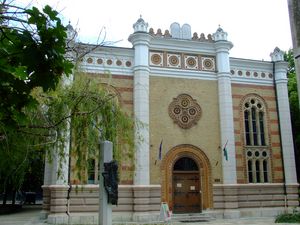
The Church of the Ascension in the city centre was built between 1802 and 1805 in the so-called Zopf style. The synagogue was built in 1897 to a design by the Graz architect Hans Petschnigg. It now serves as a cultural centre.
Bibliography
The town’s grammar school is named after the poet and translator János Garay (1812–1853), who was born in the town. Also born in Seksard was Mihály Babits (1883–1941), one of the outstanding Hungarian poets of the first half of the 20th century.
Bibliography
- Márta Fata (ed.): Swabian Turkey. Ways of Life of the Ethnic Groups in South-West Hungary. Sigmaringen 1997 (Publications of the Institute of History and Regional Studies 5).
- Tamás Fedeles: Szekszárd. In: Diocese of Pécs (ed.), Árpád Duczon (ed.): Our European Heritage. The Dioceses of Pécs and Đakovo Introduce Themselves. Pécs 2008, pp. 80–87.
- János Kolta: Around Towns in South-West Hungary: Szekszárd, Pécs, Kaposvár. 2nd expanded edition. Budapest 1987.
- Josef Schmidt, Johann Müller: The Origins of German Settlers in Tolna County. An Analysis of Parish Registers. Sindelfingen 1995 (Series on Danube Swabian Origins 50, German Settlers in Hungary).
- János Kaczián (ed.): *Tolna Megye Kézikönyve* – *Handbook of Tolna County*. Budapest 1997.
Yearbooks
- A Wosinszky Mór Megyei Múzeum Évkönyve [Yearbook of the Mór Wosinszky Museum] (1970 onwards)
Web links
- www.szekszard.hu (the city’s multilingual website)
- www.dbu.hu (bilingual website of the German Stage Hungary)
- wmmm.hu (multilingual website of the Mór Wosinszky Museum)
Citation
Tamás Fedeles: Seksard/Szekszárd. In: Online Encyclopaedia on the Culture and History of Germans in Eastern Europe, 2012. URL: ome-lexikon.uni-oldenburg.de/57055.html (accessed 29 October 2015).
Terms of use for this article
Copyright © University of Oldenburg and the Federal Institute for the Culture and History of Germans in Eastern Europe (BKGE), all rights reserved. This work was produced as part of the project ‘Online Encyclopaedia on the Culture and History of Germans in Eastern Europe’ and may be reproduced and published provided the rights holders’ consent has been obtained. Please contact:
If you have any specialist comments or additions to the text, please contact the editorial team, citing relevant literature and source references.