

German Academy (DA), Munich
German Academy (DA), Munich
1. Brief description
The “Academy for the Scientific Study and Preservation of German Culture”, or “German Academy” (DA) for short, was founded in Munich in 1925. Its initial remit was to research and promote German culture. After 1930, the focus shifted to promoting the German language abroad. During the Second World War, the DA became the central propaganda institution in the countries occupied by the Wehrmacht. On 31 December 1945, it was dissolved by the US occupation authorities. In 1951, the DA’s funds were used to establish the Goethe-Institute, of which the DA is regarded as the predecessor organisation.
2. Tasks
The DA’s statutes defined its purpose as the promotion of “all intellectual and cultural expressions of German identity” and “non-official cultural relations between Germany and other countries, and between Germans living abroad and their homeland”, with both aims ultimately intended to promote “German national consciousness”.[1] In addition to researching the history of the German people and their political life, the Academic Department was tasked with promoting the German language, German literature and cultural heritage by organising academic events and publications itself or by supporting the organisation of such activities. The Practical Department was also responsible for evaluating academic projects.[2] Furthermore, the Academy was to promote the preservation and teaching of the German language abroad.
From the late 1920s onwards, language teaching increasingly became the focus of the DA, as appropriate institutions already existed for the other areas. Following the rapid victory over France in 1940, German policymakers further intensified this focus in line with the objectives of German occupation policy and the aim of influencing public opinion in neutral countries. During the Second World War, language teaching became the DA’s sole responsibility.
3. Organisation
In organisational terms, the DA consisted of the following bodies: a President, two Departmental Presidents, the Small Council, the University Senate, the Grand Council, a Finance Committee and the General Assembly. There were also self-governing branches (local and regional groups) of the so-called ‘Friends of the German Academy’,[3] whose main tasks were to promote the Academy’s interests and to assist in raising funds.
The first President of the DA as a whole was Georg Pfeilschifter (1870–1936), whilst Hermann Oncken (1869–1945) became the first President of the Scientific Department and Karl Haushofer (1869–1946) the first President of the Practical Department. The latter resigned from his post in the very year the Academy was founded due to excessive workload, but returned in 1934 as (overall) President of the Academy. The Scientific Division was divided into four sections: I. Section for History, II. Section for German Language, Literature and Folklore (a. for Older Language and Literature, b. for Modern Language and Literature, c. for Folklore and Archaeology), III. Section for Fine Arts and Music (a. for Fine Arts, b. for Music), IV. Section for Political Science and Economics.
The President and the two Department Presidents of the Academic and Practical Departments were appointed by the University Senate for a term of three years each. The President headed the entire body; he also presided over the Small Council, the University Senate and the Grand Council, and appointed the Academy’s staff. The Small Council consisted of nine members, namely the President, two department heads, one representative each from the University Senate and the Grand Council, two members of the Finance Committee and two further members whom it elected for a term of three years. It was the Academy’s central decision-making body, to which the staff were also answerable. The Grand Council was composed of honorary delegates from the branch offices and the affiliated larger independent associations, members of the Small Council, and particularly distinguished individuals appointed by the Small Council. The Finance Committee, appointed by the Small Council, consisted of prominent representatives from trade and industry. The General Assembly comprised the members of the Small Council, the University Senate and the Grand Council. The DA was supported in an advisory capacity by the University Senate, which consisted of 100 senators appointed for life. Provision was explicitly made for the appointment of women, but this was not implemented until 1945. At the time of its establishment, the University Senate included figures such as Thomas Mann (1875–1955), Konrad Adenauer (1876–1967) and Max Planck (1858–1947).
The DA’s budget was initially funded mainly by donations from the business community and private individuals, as well as membership fees, which is why its financial situation remained precarious until the outbreak of war. It was only after the Academy refocused its work on promoting the German language abroad from 1929 onwards that it gradually began to receive increasing grants from the Federal Foreign Office (AA). From 1940 onwards, it finally received more comprehensive and annually increasing financial support from the German Reich’s budget, as foreign cultural policy was now regarded as vital to the war effort.
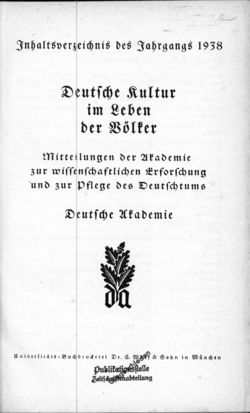
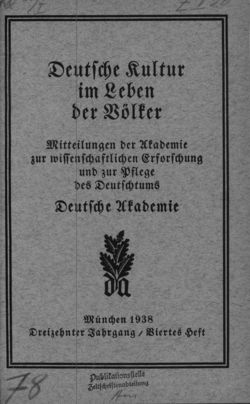
Until 1932, the DA was based in the Residenz on Odeonsplatz in Munich; thereafter, it was located in the Maximilianeum. Towards the end of the war, parts of the DA were relocated from Munich, and the Academy’s structure and nomenclature also changed. From then on, it was divided into two classes, which were geographically separate from one another: Class I – Research and Science – remained in Munich, whilst Class II – Cultural Exchange and Office – was henceforth based in Salzburg. The Foreign Lectureships and the Goethe-Institut Institute were also housed at two further locations in the Salzburg region . In addition to the *Mitteilungen der Deutschen Akademie*(Bulletin of the German Academy), with a print run of 5,000 copies, the DA also published *Deutschunterricht im Ausland* ( German Language Teaching Abroad), the journal of the Goethe-Institut Institute of the German Academy.
4. History
As early as 16 April 1923, on the initiative of the former Bavarian envoy to Paris, Lothar Freiherr von Ritter zu Grünstein (1868–1945), the first discussion took place regarding the establishment of an organisation to promote and protect German culture throughout the world and to draw up a possible programme; this was attended by the historian Hermann Oncken, the Vice-Chancellor of the University of Munich, Georg Pfeilschifter, and the geopolitician Karl Haushofer. Building on this and further discussions, the DA was founded and registered as a private association at the Munich Local Court on 22 December 1924. Its official opening took place on 5 May 1925 in the auditorium of the University of Munich.
The DA joined the ranks of the institutions and organisations founded in the 1920s to compensate for Germany’s weakened position on the international stage through an active cultural policy and scholarship. Its founding initiators compared it to the Académie française, founded in 1635, and saw themselves as continuing the legacy of earlier proponents of a German academy, such as Gottfried Wilhelm Leibniz (1646–1716) and Leopold von Ranke (1795–1886).
The initial focus on promoting ‘German identity’ and unofficial cultural relations with foreign countries – or, conversely, those of ‘Germans abroad’ with Germany – placed the DA in fierce competition with other institutions founded during this period and with similar remits, such as the German Institute Abroad (DAI) in Stuttgart, which led it into a crisis of legitimacy and financial difficulties soon after its foundation. From 1929 onwards, the DA finally devoted itself increasingly to the promotion of the German language abroad, a field in which there were no competing institutions. With this change of direction, it succeeded in securing financial grants from the Foreign Office from 1930 onwards. In 1930, it established the first language schools in South-Eastern Europe, and in 1932 the Goethe-Institute was set up as a new department to provide further training for foreign teachers of German.
From the outset, its representatives were predominantly of a national-conservative persuasion. Following the National Socialists’ seizure of power in 1933, the DA aligned itself with the policies and ideology of the new political rulers. Not only was ‘völkisch’ ideology increasingly propagated, but its staff also reflected its proximity to the National Socialist regime: as early as the summer of 1933, the University Senate was ‘purged’ of members who were now politically unpopular, particularly those of Jewish origin. Figures such as Rudolf Hess (1894–1987) were elected to the Small Council. In 1934, Karl Haushofer – who was acquainted with Rudolf Hess and had been a member of the Small Council since 1933 – assumed the presidency of the Academy as a whole. His successor from 1937, Leopold Kölbl (1895–1970), was an SA Standartenführer; the subsequent presidents, Ludwig Siebert (1939–1942), Walther Wüst (1901–1993; acting in 1943) and Arthur Seyss-Inquart (1892–1946; 1944–1945) also held high-ranking positions as NSDAP functionaries.[4] However, the Reich Government attached great importance to ensuring that, outwardly, ‘the complete independence of the “DA” from the Party and from the Reich Government’ was maintained, so that its ‘scope for action’[5] were not compromised. Against this backdrop, its organisational structure as a private association was initially retained.
Despite the shift in the DA’s main areas of work, its financial situation remained precarious until the end of the 1930s. Admittedly, the number of lecturers rose from 57 in 1936 to 62 at the outbreak of war, for whom the Foreign Office provided a sum of 27,000 RM in 1938/39. However, the funds from the Foreign Office were merely grants. Furthermore, the 1939 ban on raising funds from the private sector presented the DA with new financial difficulties.
The outbreak of the Second World War seemed to make any cultural activity abroad impossible. However, as early as September 1939, the Foreign Office made it clear that it regarded the DA’s work as vital to the war effort. Intensive cultural propaganda was regarded as essential to conceal Germany’s aggressive policies and, in particular, to win over neutral countries. Consequently, the grants from the Foreign Office to the DA also increased. By the end of 1940, the Ministry had paid a total of 860,000 RM to the DA; by 1941, this figure had risen to as much as 3.3 million RM. The expansion of the overseas cultural offices was further accelerated during the war years. From the rapid victory over France at the very latest, the DA’s cultural activities were incorporated into plans for a reorganised Europe under German hegemony. At the same time, this meant a reduction in the DA’s autonomy. From the summer of 1940 onwards, its lectorship offices operating abroad were increasingly demoted to mere language departments of the now numerous German academic Institutes that had been established. In order to secure its finances and ensure the Academy’s structural alignment with the interests of German occupation policy, the DA was finally transformed into a public-law corporation by a ‘Führer decree’ on 15 November 1941 and further expanded. By 1944, it comprised around 250 language schools, compared with 45 at the start of the Second World War, whilst the total number of staff rose from approximately 100 in 1939 to approximately 1,000 in 1944.
After 1941, disputes over jurisdiction flared up between the Foreign Office and the Ministry of Propaganda regarding the question of administrative supervision of the new public-law corporation. In an agreement dated 22 October 1941, the two ministries finally agreed on joint supervision, with the Foreign Office, together with the Ministry of Finance, taking over the administration of the budget.
Its close ties, both in terms of personnel and structure, to the National Socialist power apparatus, as well as its activities in the territories occupied by the Wehrmacht, led to the DA being banned and dissolved by the US occupation authorities on 31 December 1945. However, as early as 1951, the ‘Goethe Institute’ was established at the instigation of Franz Thierfelder (1896–1963), who had served as acting Secretary-General of the DA in 1945. This private association was not only funded by the DA’s financial resources; in terms of personnel, too, it showed strong continuity with the DA during the early years of its existence. The name ‘Deutsche Akademie’ was finally struck off the Munich register of associations in 1962.
Bibliography
- Edgar Harvolk: Oak Branch and Swastika. The German Academy in Munich (1924–1962) and its Folklore Section. Munich 1990 (Munich Contributions to Folklore 11).
- Edgar Harvolk: Key Scientific Organisations in Munich within the Context of the Party and the State. In: Munich City Museum (ed.): Munich – ‘Capital of the Movement’. Bavaria’s Metropolis and National Socialism. Munich 1993, p. 374–377.
- Eckard Michels: German Academy, 1925–1945. In: Bavarian State Library (ed.): Historical Encyclopaedia of Bavaria, www.historisches-lexikon-bayerns.de/Lexikon/Deutsche_Akademie,_1925-1945 (published 31 October 2006, accessed 23 November 2020).
- Eckard Michels: German as a World Language? Franz Thierfelder, the Deutsche Akademie in Munich and the promotion of the German language abroad, 1923–1945. In: German History 2 (2004), p. 206–228.
- Eckhard Michels: From the German Akademie to the Goethe Institute. Language and Foreign Cultural Policy 1923–1960. Munich 2005 (Studies in Contemporary History 70).
Notes
[1] Statutes of the German Academy, 1925. In: Communications from the Academy for the Scientific Study and Preservation of German Culture 1 (1925), pp. 35–40, quoted from Harvolk: Eichenzweig und Hakenkreuz, pp. 102–108, here p. 102 (www.historisches-lexikon-bayerns.de/images/4/4d/Artikel_44466_bilder_value_3_deutsche-akademie3.pdf, accessed 23 November 2020).
[2] Ibid.
[3] The Statutes (note 1), p. 106.
[4] Siebert was the Bavarian NSDAP Minister-President; Walther Wüst was a protégé of Heinrich Himmler and, as Rector of the University of Munich (1941–1945), was involved in the arrest of Hans and Sophie Scholl; Arthur Seyss-Inquart was Reich Commissioner for the occupied Netherlands.
[5] Quoted from Harvolk: Eichenzweig, p. 29.
Citation
Agnes Laba: German Academy (DA), Munich. In: Online Encyclopaedia on the Culture and History of Germans in Eastern Europe, 2018. URL: ome-lexikon.uni-oldenburg.de/p32840 (as at 23 November 2020).
Terms of use for this article
Copyright © University of Oldenburg and the Federal Institute for the Culture and History of Germans in Eastern Europe (BKGE), all rights reserved. This work was produced as part of the project ‘Online Encyclopaedia on the Culture and History of Germans in Eastern Europe’ and may be reproduced and published provided the rights holders’ consent has been obtained. Please contact:
If you have any specialist comments or additions to the text, please contact the editorial team, citing relevant literature and source references.