

Institute for German Labour in the East, Kraków
Institute for German Labour in the East, Kraków
1. Brief description of the institution
The Institute for German Labour in the East (IDO) was founded on 20 April 1940 on the initiative of Governor-General Hans Frank (1900–1946) and was established in the buildings of the Polish Jagiellonian University in the centre of Kraków, which had been dissolved in November 1939. This followed the establishment of the General Government in October 1939.
2. Tasks
The IDO was founded to “continue and expand” “German research in the East”. Its aim was to provide a scientific clarification of “all fundamental questions concerning the Eastern territories” and to disseminate its findings through publications.[1] On the one hand, the institute pursued tasks associated with so-called German ‘Eastern research’, which sought to legitimise Germany’s claims to territory and people by portraying ‘German achievements’ in the past. These efforts resulted in one-sided studies on “Germanness”, a biased engagement with Polish research, and negative or anti-Semitic articles about Poles and Jews.[2] In addition, the IDO carried out research focused on current political, economic and administrative issues. This was closely linked to the administration of the General Government, supported its work and, in doing so, became entangled in the criminal Nazi occupation policy. This applies in particular to the Section for Racial and Ethnic Research, which collaborated closely with the Department of Population and Welfare of the Government of the General Government, as well as with SS bodies such as the ‘Volksdeutsche Mittelstelle’ and the Reich Commissioner for the Consolidation of German Ethnicity.[3]
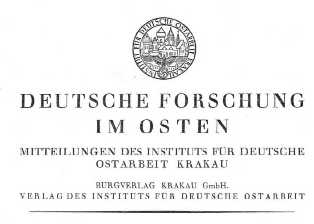
Title of the journal published by the Institute for German Labour in the East (
) from 1941 to 1944:
*Deutsche Forschung im Osten*.

The IDO was funded from the General Government’s budget. From October 1940 to July 1944, it published the quarterly journal *Die Burg *. In addition, the journal *Deutsche Forschung im Osten* was published from January 1941 to March 1944, featuring primarily articles by the institute’s staff. Exhibitions, conferences, lectures and training courses served to promote ‘Germanisation work’.[4] Governor-General Frank planned to transform the Institute at a later date into a German Academy of Sciences, which, following a victorious war, was to be incorporated into a German Copernicus University.[5]
3. Organisation
Hans Frank served as President of the IDO. The Director of the Institute was the administrative lawyer Wilhelm Coblitz (1906–after 1945), one of Frank’s long-standing colleagues. He was appointed by the Governor-General, as were the members of the board of trustees, the Scientific Director and the research staff.
The IDO was organised into several sections covering the humanities and the natural sciences.[6] There were branch offices in Warsaw/Warszawa and Lviv/Ľviv. In total, the IDO employed 188 German staff and 150 Polish ‘auxiliary staff’ between 1940 and 1945,[7] who worked under the direction and supervision of their German superiors.[8]
4. History
During the institute’s founding phase, the key question was whether, and to what extent, the ‘North and East German Research Community’ (NOFG) would influence the IDO and the work of its humanities sections. Despite initial exploratory discussions, Frank ultimately rejected any excessive external interference[9] and instead wished to pursue “its own programme without any form of paternalism”.[10]
Despite generous funding, the Institute faced major difficulties in recruiting qualified staff during the war. For the most part, it was only able to employ second-rate and, until then, largely inexperienced early-career researchers, who were generally members of the NSDAP.
In 1942–43, there was a shift in the IDO’s remit: the humanities sections were largely disbanded, or their staff were conscripted into the Wehrmacht.[11] Instead, the Institute took on ‘tasks vital to the war effort’ in the field of natural sciences. From spring 1943 onwards, the IDO conducted armaments research in two new sections: a section for chemical research was established in Lemberg, whilst a section for general military sciences was set up in Kraków.[12] Both departments employed mainly Ukrainian and Russian scientists.
In the summer of 1944, as part of the partial evacuation of German government offices from Kraków, the remaining staff of the IDO were relocated to two castles (Miltach, Zandt) in Bavaria. The Regional Studies Section, which analysed aerial photographs for the Wehrmacht, remained in the General Government until January 1945. At the end of July 1945, the American occupation authorities ordered the dissolution of the Institute.
Bibliography
- Sabine Arend: The Art History Section at the Institute for German Eastern Work in Occupied Kraków (1940–1945). In: Wojciech Bałus, Joanna Wolańska (eds.): The Establishment and Development of Art History as a Subject in Germany, Poland and Central Europe. Warsaw 2010 (The Shared Cultural Heritage 6), pp. 491–519; English translation: Ibid.: The Art History Section of the Institute for German East Work in Occupied Kraków (1940–1945). In: Centropa 9 (2009) 3, pp. 209–221.
- Sabine Arend: Studies on German art-historical ‘Ostforschung’ under National Socialism. The art-historical institutes at the (Reich) universities of Breslau and Posen and their leading figures caught between academia and politics. Berlin 2009. (edoc.hu-berlin.de/dissertationen/arend-sabine-2009-07-15/PDF/arend.pdf).
- Michael Burleigh: Germany Turns Eastwards. A Study of Ostforschung in the Third Reich. Cambridge et al. 1988, pp. 230–253.
- Rudi Goguel: On the involvement of German scholars in the occupation regime in Poland during the Second World War, examined at three institutes of German Eastern Studies (PhD thesis, Humboldt University of Berlin). Berlin 1964, pp. 132–175 [with documents relating to the IDO reproduced in the appendix].
- Christoph Kleßmann: The Self-Assertion of a Nation. National Socialist Cultural Policy and the Polish Resistance Movement in the General Government 1939–1945. Düsseldorf 1971, pp. 61–70.
- Ute Michel: Ethnopolitical Reorganisation Research at the Institute for German Labour in the East in Kraków 1941–1945. In: Bernhard Streck (ed.): Ethnology and National Socialism. Gehren 2000 (Publications of the Institute of Ethnology at the University of Leipzig, ‘History of the Discipline’ series 1), pp. 149–168.
- Dirk Rupnow: Research on Jews in the Third Reich. Science between Politics, Propaganda and Ideology. Baden-Baden 2011, pp. 131–137.
- Anetta Rybicka: Instytut Niemieckiej Pracy Wschodniej. Institute for German Labour in the East. Kraków 1940–1945. Warsaw 2002.
- Gretchen E. Schafft: From Racism to Genocide. Anthropology in the Third Reich. Urbana 2004, pp. 93–114.
- Michael Strobel: Werner Radig (1903–1985). A Prehistorian in Three Political Systems. In: Working and Research Reports on the Preservation of Archaeological Monuments in Saxony 47 (2005), pp. 283–320.
- Gerhard Volkmer: German research on Eastern Europe and Eastern European Jewry from 1933 to 1945. In: Studies in Eastern European History 42 (1989), pp. 177–182.
- Gordon Wolnik: Institute for German Eastern Studies. In: Ingo Haar, Michael Fahlbusch (eds.): Handbook of ‘Völkische’ Sciences. Individuals – Institutions – Research Programs – Foundations. Munich 2008, pp. 254–290.
Book series and periodicals
- "The Castle" (1940–1944)
- "German Research in the East" (1941–1944)
- Publication series of the Institute for German Labour in the East (1942–1944)
- Yearbook of the Institute for German Labour in the East 1 (1941)
Notes
[1] The founding decree of 19 April 1940 is reprinted in: Wilhelm Coblitz: The Institute for German Labour in the East. In: Yearbook of the Institute for German Labour in the East 1 (1941) (Krakow 1942), pp. 7–57, here pp. 12ff.; see also: Werner Präg, Wolfgang Jacobmeyer (eds.): The Service Diary of the German Governor-General in Poland 1939–1945. Stuttgart 1975, pp. 172–175.
[2] See Rybicka: *Instytut*, pp. 58–118.
[3] Michel: Research into Ethnopolitical Reorganisation, p. 161.
[4] The themes of the exhibitions included ‘German Heritage in the Vistula Region’ (September 1941) and ‘Old German Art in Kraków and the Carpathian Region’ (July 1942). The symposia bore telling titles such as ‘German Fighters on the Eastern Outposts’ (June 1940), ‘The German in the Vistula Region’ (May 1941), ‘The Era of the East’ (October 1942) and ‘German Research in the Pre-Carpathian and Vistula Regions as a Basis for Practical Ethnographic Work’ (February 1943).
[5] See: Präg, Jacobmeyer: Service Diary (as in note 1), p. 394. Entry dated 4 September 1941.
[6] The following lists the sections, their heads and the research staff – insofar as these are known: History – Gerhard Sappok, Helmuth Werner, Erwin Hoff, Gerhard Brauns; Art History – Ewald Behrens, Heinz-Günther Oliass, Dorette Richter; Prehistory – Werner Radig; Law – Siegmund Dannbeck, Johann Werner Niemann; Race and Ethnicity Research (with departments for Anthropology, Ethnology and Jewish Studies) – Fritz Arlt, Anton Plügel, Heinrich Gottong, Erhard Riemann, Josef Sommerfeldt, Elfriede Fliethmann, Ingeborg Sydow; Economics – Walter Emmerich, Helmut Meinhold, Hans-Kraft Nonnenmacher, Erika Bochdam-Löptien; Regional Studies – Hans Graul, Ernst Fugmann, Otto Klippel, Gisela Hildebrandt; Agriculture – Fritz Christiansen-Weniger, Rudolf Bräunig; Horticulture – Erich Maurer; Forestry and Timber Industry – Kurt Mantel, Anton Kriesche.
[7] Rybicka: Instytut (as in note 2), pp. 165–172.
[8] Rybicka’s accusation that some Polish staff members apparently willingly assisted their German superiors and thus collaborated to some extent sparked a heated debate on this issue in Poland. See Rybicka: Instytut (as in note 2), pp. 139–154, and the polemical response from the wife of one of the accused: Teresa Bałuk-Ulewiczowa: Breaking Free from the Vicious Circle. The Institute for German Labour in the East in the Light of Home Army Documents and Materials Preserved in Poland [Breaking Free from the Vicious Circle. The Institute for German Labour in the East in the Light of Home Army Documents and Materials Preserved in Poland]. Kraków 2004 (Arkana historii). Teresa Bałuk-Ulewiczowa rightly points out that Polish employees of the IDO collaborated with the Polish resistance movement and provided it with information about the IDO. She also examines the activities of the Chemistry Section (pp. 105–149 and original documents reproduced in the appendix).
[9] See Eduard Mühle: ‘For the People and the German East. The Historian Hermann Aubin and German Research on the East’. Düsseldorf 2005 (Publications of the Federal Archives 65), pp. 339–346; Rybicka: *Instytut* (as in note 2), pp. 11–25.
[10] Randt to Zipfel, 22 September 1940. Quoted from Goguel: Über die Mitwirkung, Appendix 3, Document 4, p. 101.
[11] In February 1943, the Prehistory, History and Art History sections were merged to form a ‘History Section’. See Burleigh: *Germany Turns Eastwards*, pp. 284ff.; Rybicka: *Instytut* (as in note 2), p. 120.
[12] Präg, Jacobmeyer: Service Diary (as in note 1), p. 658, meeting on 8 May 1943.
Citation
Stefan Lehr: Institute for German Labour in the East, Kraków. In: Online Encyclopaedia on the Culture and History of Germans in Eastern Europe, 2012. URL: ome-lexikon.uni-oldenburg.de/p32728 (accessed 2 February 2021).
Terms of use for this article
Copyright © University of Oldenburg and the Federal Institute for the Culture and History of Germans in Eastern Europe (BKGE), all rights reserved. This work was produced as part of the project ‘Online Encyclopaedia on the Culture and History of Germans in Eastern Europe’ and may be reproduced and published provided the rights holders’ consent has been obtained. Please contact:
If you have any specialist comments or additions to the text, please contact the editorial team, citing relevant literature and source references.