

Integration
Integration
1. Definition
The term ‘integration’ refers to the incorporation of additional individuals into a homogeneous social group and implies that this is a temporary process. It is almost always used transitively in the sense of ‘integrating someone’, but can also be used reflexively, in the sense of ‘integrating oneself’.
The integration of refugees and displaced persons from the former eastern territories of the German Reich and from the German settlement areas in Eastern, Central-Eastern and South-Eastern Europe was understood to mean ‘participation in the national economy, the distribution of property and cultural life, which corresponds to or comes close to one’s abilities, prior education, inclinations and role in the social structure of their homeland”.[1] Integration into the new environment was intended to enable them to attain their former social status, or one recognised as desirable in the course of subsequent developments.
2. Genesis
The term ‘integration’ was first used in 1921 by the Alsatian politician Robert Ernst (1897–1980), who championed regional culture, in a paper on the resettlement of displaced Alsace-Lorraine residents following the First World War. The term was intended to signal that their reception need not be a burden on the national economy, but could even ‘strengthen’ it as part of the ‘reconstruction of our economy’.[2]
3. Distribution
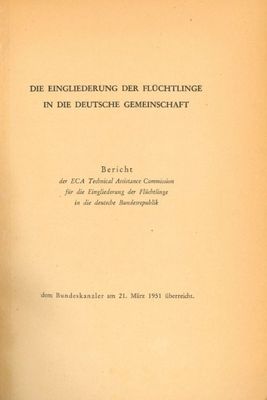
In 1946, the term was revived by West German politicians as the predominant term for the long-term resettlement of German refugees and displaced persons from Eastern, Central-Eastern and South-Eastern Europe. From the mid-1950s onwards, its use in the press became increasingly rare and it was gradually replaced by the term‘integration’.[3] Outside Germany, the term ‘Eingliederung’ – including its translation as ‘insertion’ – was and is hardly ever used.
4. Historical overview
From 1945 onwards, the occupying powers sought the rapid assimilation of over twelve million refugees and displaced persons in order to prevent the formation of political groups and to dampen hopes of a return to their homelands.
However, the concept that displaced persons and refugees should assimilate at their first place of reception reached its limits because most had been accommodated in rural areas, where, although they had a roof over their heads, they were unable to find suitable jobs. West German politicians and civil servants recognised that a redistribution of the population, prioritising employment opportunities, was unavoidable. They utilised the Refugee Committee of the Council of States of the American Occupation Zone – the earliest inter-state body for refugee administration in the western occupation zones – to develop and implement their ‘paths to integration’ and proclaimed in July 1946, ‘that the employment of displaced persons forms part of the overall reconstruction of the German economy.’[4] To this end, existing refugee-run enterprises would have to be expanded and new, export-oriented ones established. The background to these demands was that the American government had moved away from the Morgenthau Plan and now sought the economic reconstruction of Germany, as was subsequently initiated with the help of the Marshall Plan.
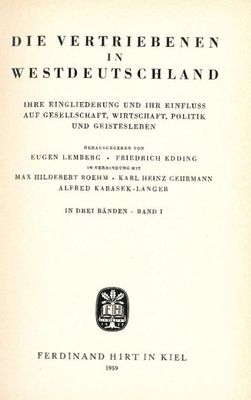
The term ‘integration’, chosen by the Council of the Länder, was incorporated into the refugee laws of the West German Länder. The term ‘integration’ also became a defining feature of the two major federal laws that regulated and shaped the refugees’ settlement: the Burden-Sharing Act of 1952 and the Federal Act on Displaced Persons and Refugees of 1953. Accordingly, the Federal Ministry for Refugees and Displaced Persons also convened a ‘Research Group on Integration’ when, in 1955, on the occasion of the tenth anniversary of the expulsion, it launched a comprehensive research project, the culmination of which was the three-volume publication *The Displaced Persons in West Germany*[5]. However, this made it clear not only to the participating academics just how politically charged the term ‘integration’ was. The ministry official responsible for the research made it clear from the outset that integration had taken on eminent political significance because it had ‘strengthened “liberal Europe” and prevented the displaced persons from succumbing to a rootless and nihilistic “massification”’.“[6]
The new generation of researchers favoured the term ‘integration’.
5. Controversies
The policy of integration was at odds with the territorial restitution claims of German foreign policy and the efforts of the regional associations to maintain the desire to return and their regional identity. This ambivalence was also evident in the contributions to the aforementioned work, *Die Vertriebenen in Westdeutschland* (*Displaced Persons in West Germany*), which summarised the research of the 1950s. In the introduction, the Federal Minister for Displaced Persons, Refugees and War Victims, Theodor Oberländer (1905–1998), emphasised: “The integration of displaced persons is not merely a task dictated by the imperatives of humanity and economic efficiency. It derives special significance from the realisation that the return of Germans to their homeland seems possible only if the displaced persons’ potential is restored in terms of their vitality. Integration is therefore also a prerequisite for return.”[7] Oberländer’s State Secretary, Peter Paul Nahm (1901–1981) described the policy of integration in the same volume as “a gamble given the intensity of the desire to return home” and regretted that not all displaced persons passed “the test” and that some instead chose to assimilate.[8]
Just how difficult this balancing act could be was particularly evident in the resettlement of displaced farmers, because – as Nahm went on to say – the creation of small-scale agricultural settlements and part-time livelihoods ran counter to the requirements of a rational economy and to the necessary structural improvements. However, the determination of the settlers and their helpers to preserve the farming potential indispensable for resettlement nevertheless justified this approach. In this respect, part of the farming resettlement served as proof that integration was also geared towards their homeland in the East. “Part-time employment, in particular, is a stopgap measure for the duration of their stay in West Germany and a training ground for the agricultural resettlement of their homeland.”[9]
Not all the academics involved in the ‘Reintegration Research Group’ shared the minister’s and the state secretary’s balancing act. For example, the Kiel professor of agricultural policy, Hans-Heinrich Herlemann (1908–2004), born in Lubahn in West Prussia/Lubań as the son of a knightly estate owner, distanced himself from what he termed a “lack of realism”, which he claimed was “masked by criticism of the career changes undertaken by displaced persons from an agricultural background and their waning enthusiasm for resettlement”.[10]
A further weakness of the concept of integration was that it implied the improvement in the situation of refugees and displaced persons, and the easing of tensions between them and the local population, were primarily the result of state action. What was largely overlooked – and remains underestimated to this day – is that the initiative shown by the refugees and displaced persons themselves played an equally significant part in the successes achieved during the integration process. This was evident, for example, in the fact that in the 1950s, almost 3.5 million refugees and displaced persons moved from one Federal State to another of their own accord – more than three times as many as those who took part in state-directed and state-supported resettlement.[11]
Bibliography
- Volker Ackermann: The ‘Real’ Refugee. German Displaced Persons and Refugees from the GDR 1945–1961. Osnabrück 1995.
- Ibid.: Integration: Concept, Mission Statements, Problems. In: Klaus J. Bade (ed.): A New Home in the West. Displaced Persons, Refugees, Resettlers. Münster 1990, p. 14–36.
- Karin Böke: Refugees and Displaced Persons: Between the Right to Their Old Homeland and Integration into Their New Homeland. Key Terms in Refugee Policy. In: Ibid., Frank Liedtke, Martin Wengeler: Key Political Terms in the Adenauer Era. Berlin, New York 1996, pp. 131–210.
- Eugen Lemberg, Friedrich Edding (eds.): Displaced Persons in West Germany. Their Integration and Influence on Society, the Economy, Politics and Intellectual Life. 3 vols. Kiel 1959.
- Sabine Schleiermacher: Hans Harmsen. In: Ingo Haar, Michael Fahlbusch (eds.): Handbook of ‘Völkische’ Sciences: Individuals, Institutions, research programmes, foundations. Munich 2008, pp. 222–226.
Notes
[1] Gerhard Weisser: Productive Integration. Monographs on Politics. Issue 5. 2nd ed. Göttingen 1956, p. 149.
[2] Robert Ernst: The Integration of the Expelled Alsatians and Lorrainers into German Economic Life at the Height of its Decline: Facts and Politics. Leipzig 1921, p. 6.
[3] The data is presented in word frequency curves generated by the Digital Dictionary of the German Language (DWDS). The DWDS newspaper corpus comprises a large number of major national daily and weekly newspapers (https://www.dwds.de/d/korpora/zeitungen).
[4] Peter Paul Nahm: ‘The Will to Integration and its Promotion’. In: Eugen Lemberg and Friedrich Edding (eds.): ‘The Displaced Persons in West Germany. Their Integration and their Influence on Society, the Economy, Politics and Intellectual Life’. 3 vols. Kiel 1959, Vol. 1, pp. 145–155, here p. 150. The members of the Refugee Committee of the Stuttgart State Council set out their considerations, discussed at the meeting of 22 July 1946, in a memorandum. A typewritten version is preserved in the library of the Institute for World Economy, and a printed version is also available: The Refugee Problem in the American Occupation Zone. A Report by the State Council to General Clay. Stuttgart 1948.
[5] See note 4.
[6] Quoted from: Volker Ackermann: The ‘Real’ Refugee. German Displaced Persons and Refugees from the GDR 1945–1961. Osnabrück 1995, p. 24.
[7] Theodor Oberländer: ‘Foreword’, in: *Die Vertriebenen*, Vol. 1, p. n.d., here p. VI. See also note 4.
[8] Nahm: *Der Wille* (see note 4), pp. 152 and 154.
[9] Nahm: *Der Wille* (see note 4), p. 153.
[10] Hans-Heinrich Herlemann: Displaced Farmers in the Structural Transformation of Agriculture. In: The Displaced. Vol. 2, pp. 53–165, here p. 152.
[11] Bernhard Parisius: ‘The Reception and Secondary Migration of Refugees and Displaced Persons in the Old and New Federal States’. In: Uwe Rieske (ed.): Migration and Denomination. Denominational Identities in the Refugee Movement after 1945. Munich 2010, pp. 17–56, here p. 27.
Citation
Bernhard Parisius: Integration. In: Online Encyclopaedia on the Culture and History of Germans in Eastern Europe, 2021. URL: ome-lexikon.uni-oldenburg.de/p33008 (accessed 18 November 2021).
Terms of use for this article
Copyright © University of Oldenburg and the Federal Institute for the Culture and History of Germans in Eastern Europe (BKGE), all rights reserved. This work was produced as part of the project ‘Online Encyclopaedia on the Culture and History of Germans in Eastern Europe’ and may be reproduced and published provided the rights holders’ consent has been obtained. Please contact:
If you have any specialist comments or additions to the text, please contact the editorial team, citing relevant literature and source references.