

Engels/Ėngel’s
Engels/Ėngel’s
Etymology
The original place name, Pokrovskaya Sloboda (Pokrovsk Suburb), is derived from the Russian or Church Slavonic word ‘Pokrov’ (= short form of ‘Pokrova Presvjatoj Bogorodicy’, the feast day of the Protection and Intercession of the Holy Mother of God). The German population of Pokrowsk referred to the settlement as ‘Cossack Town’. After being granted town status, Pokrovskaya Sloboda was renamed Pokrowsk in 1914. In 1931, the administration of the Autonomous Soviet Socialist Republic of the Volga Germans (ASSRdWD) in Moscow/Moskva submitted a proposal to rename the republic’s capital to ‘Rota Luxemburg’, ‘Leninstadt’ or ‘Engels’. On 19 October 1931, the capital of the Republic of the Volga Germans was renamed in honour of the German social theorist and communist revolutionary Friedrich Engels (1820–1895).
Location
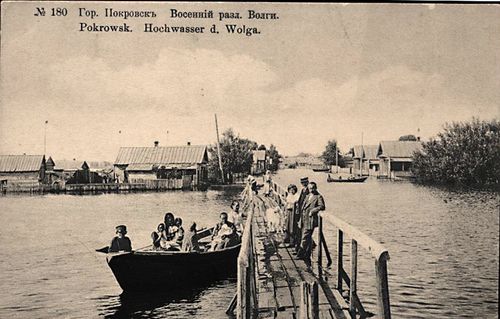
Engels is situated in the European part of the Russian Federation, on the left bank of the Volga, eight kilometres east of Saratov (55° 45″ north latitude, 37° 37″ east longitude).
Political and administrative affiliation
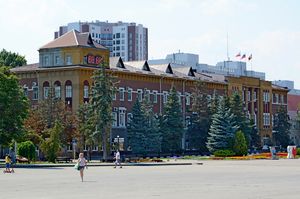
Engels is one of the largest centres in the Volga region, the second-largest city in the Saratov Oblast, and the administrative centre of the Engels urban district and the Engels municipality, which also includes the settlements of Plodosovshos and Pribreschny.
Modern times
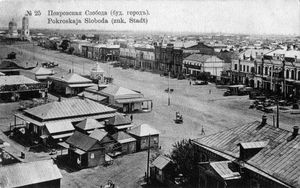
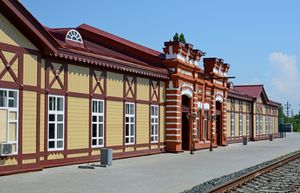
Pokrovskaya Sloboda was founded in 1747. The laying of the foundation stones for the first salt works on the site of the future settlement in August 1747 and the establishment of military bases on the Volga were carried out in accordance with the decree of Empress Elizabeth of Russia (1709–1762) concerning salt production at Lake Elton. As the local horses struggled to cope with transporting salt across the steppe, Ukrainian Chumaks were invited to the Trans-Volga region with their oxen, and they became the village’s first inhabitants.
Following the manifesto of the Russian Empress Catherine II (1729–1796) on inviting foreign colonists, and thanks to the active efforts of recruiters between 1763 and 1769, 104 German colonies were established around Pokrovskaya Sloboda. Over the course of 150 years, the original 23,000 colonists grew into a population of around 570,000 Volga Germans, living both upstream and downstream of the town. The 1897 census recorded 155 German villages in the Volga region .[1] The ethnic composition of Pokrovskaya Sloboda took shape at the intersection of three ethnic traditions – Ukrainian, Russian and German.
In 1922, the town and district of Pokrovsk became part of the Autonomous Region of the Volga Germans through the incorporation of settlements and districts of other ethnicities that lay between the German territories and enclaves. In the same year, the administrative centre of the Autonomous Region of the Volga Germans was moved from Marxstadt (formerly Katharinenstadt) – which was in an unfavourable, remote location with no railway connection – to the centrally situated and much more accessible Pokrovsk.
From 1924, Pokrovsk was granted the status of capital of the Volga Germans’ ASSR, which brought with it considerably more favourable economic and infrastructural conditions for the first socialist German republic. During the 1930s and the ‘Great Terror’, many Volga Germans from Engels were subjected to repression. In September 1941, the entire German population of Engels – more than 13,000 people – was deported to Siberia and Kazakhstan.
The deportation of the Germans took place during the Second World War on the basis of collective suspicions of disloyalty; the German population was forcibly deported to Siberia and Kazakhstan and deprived of their rights and property.
Population from the 19th to the 21st century
| Year | 1859 | 1897 | 1931 | 1939 | 1959 | 1967 | 1992 | 2000 | 2021 |
|---|---|---|---|---|---|---|---|---|---|
| Population | 12,956 | 21,599 | 42,400 | 69,000 | 90,724 | 122,000 | 183,000 | 189,000 | 226,143 |
In 1889, Pokrovskaya Sloboda had a population of 20,426, including 625 Germans; by 1904, the figure had risen to 27,500, including 4,125 Germans; in 1910, 29,600 people lived in the settlement, including 3,316 Germans.[2]
After 1917, the population declined steadily as a result of Bolshevik policies: due to the famine in the early 1920s, repression and emigration. In 1923, 30,025 people lived in Pokrovsk, including 3,256 Germans; in 1926, the population stood at 34,245, including 4,133 Germans.[3] In 1933, the population stood at 58,400, including 14,590 Germans. In 1941, 13,458 of Pokrovsk’s 73,200 inhabitants were German; by 1989, there were 1,094 Germans in the town. In the early 1990s, the number of Germans rose steadily due to the resurgence of autonomy movements. In 1991, 3,260 Russian Germans lived in Engels and a further 1,200 in the Engels district.
Religious composition of the German-speaking population
In 1913, the population of Pokrovskaya Sloboda was recorded as 33,867; of the 3,892 Germans, 3,094 were Lutherans, 222 were Reformed and 576 were Catholics. The Evangelical Lutheran parish in Saratov, to which the congregation in Pokrovskaya Sloboda belonged, was one of the largest in terms of membership within the Evangelical Church in Russia. In 1905, there were 16,400 believers, of whom 12,500 lived in Saratov, 3,500 in Pokrovsk and 400 in Volsk.[4]
History of Religion and the Church
The Germans in Pokrovsk belonged to the Protestant and Roman Catholic faiths. A small proportion of the German population professed the Orthodox faith . The Protestant and Catholic congregations were part of the parishes in Saratov.
The first Protestant school and prayer house in Pokrovskaya Sloboda was built in 1848. In 1866, the merchant Johann Seifert made one of his houses available to the Lutherans. In 1891, the Pokrovsk Lutherans acquired a three-storey stone building, which was converted by the town architect Alexey Salko and subsequently consecrated. Next to the church at 10 Luthergasse stood the school and prayer house, the sexton’s house, the bell tower and the well.
In 1913, the Protestant congregation inherited 26,000 roubles from the Saratov provost, Gustav Adolf Thomson, for the construction of a new church. However, this could not be realised due to the outbreak of war and the subsequent revolutionary events.
For a long time, the Catholics of Pokrovskaya Sloboda had no church of their own and attended the cathedral in Saratov. In 1896–97, the design for a new church building, based on plans by Thaddeus Chilinski, the provincial architect of Samara, was drawn up and approved. In 1897, the Catholics purchased a plot of land for the construction of a stone church. In February 1899, planning permission was granted, but the Catholic parish lacked sufficient funds. In 1912, a small Catholic prayer house was finally opened in a private house on Kamyshinskaya Street (now Thälmannstraße).
In the early 1930s, parishes were expropriated on a large scale and churches were used for ‘social and cultural-educational purposes’. On 15 April 1930, the Commission for Cultural Affairs of the Central Executive Committee of the Volga German Autonomous Soviet Socialist Republic passed a resolution to close the Protestant church . The decision to close the Catholic place of worship had already been taken on 29 January 1930. The faithful lodged a petition with the Standing Commission for Cultural Affairs in Moscow, which overturned the decisions to close the churches. However, the churches still could not be used by the faithful. The Protestant church was used as a central library and later as a music school. At the start of the Second World War, it became a branch of Hospital No. 1113 for evacuees, and in the post-war years the former church was completely destroyed. The Catholic house of prayer was used as a residential building from 1931 onwards.
Economy
When, between 1815 and 1820, the salt trade fell into crisis due to a decline in salt extraction from Lake Elton, Pokrovskaya Sloboda gradually transformed into a settlement of farmers and craftsmen. From the second half of the 19th century, it was the most important centre for the grain trade in the Trans-Volga region. At the beginning of the 20th century, the Pokrovsk grain exchange ranked second in the Russian Empire for the sale of high-quality wheat varieties. At that time, the settlement experienced an economic boom and, in terms of economic capacity, ranked second in the Samara Governorate.
Pokrovskaya Sloboda was home to the region’s largest industrial enterprises, including the German-owned bone mill (1889), the D. J. Bartel agricultural machinery factory (late 1860s), the Stoll brothers’ steam mill (1909), the grain mill (1914) and others. During the Soviet era, Engels was home to a power station, an iron foundry, a brick and roof-tile kiln, repair workshops for tractors and machinery, a bone mill and a canning factory, a sawmill, a meat processing plant, a ham factory and other large enterprises.
Special cultural institutions
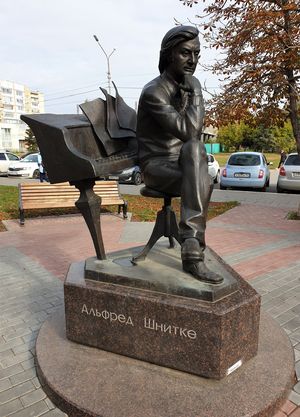
In 1931, the German State Theatre opened in Engels, followed in 1934 by the German State Philharmonic Orchestra. Many well-known Russian Germans hail from Engels, including the composer Alfred Schnittke (1934–1998) and his brother, the poet Viktor Schnittke (1937–1994), whose Jewish father had emigrated from Germany and whose mother was a Volga German . In 1923, the Central Archive of the ASSRdWD was opened (today the Gosudarstvennyj istoričeskij archiv nemcev Povolž’ja = State Historical Archive of the Volga Germans). In 1925, the famous ethnographer and dialectologist Georg Dinges (1891–1931) and the archaeologist Paul Rau (1897–1930) founded the Central Museum of the ASSR of the Volga Germans (now the Local History Museum in Engels). Following the dissolution of the German Republic in 1941, the museum was closed down.
Education and Science
In 1939, the capital of the Volga Germans was home to the German State Pedagogical Institute, which had opened in 1929, the German State Agricultural Institute, a college specialising in pre-school education and librarianship, a Soviet commercial college, a vocational college for music and teacher training, a school of nursing and midwifery, as well as an agricultural college and a music school. In 1923, the German State Publishing House of the ASSRdWD was opened. Engels had a German-language press, including the newspaper *Nachrichten*.[5]
Culture of memory and remembrance
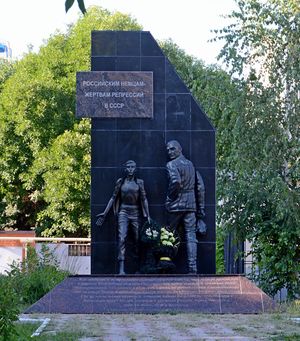
On 26 August 2011, a memorial honouring the Russian-German victims of repression was erected in the courtyard of the State Historical Archive. In 2018, a monument to the eminent composer Alfred Schnittke, created by the sculptor Andrei Scherbakov, was erected in a square in the city centre named in his honour. Since 1990, the Engels Local History Museum has housed a permanent exhibition on the Volga Germans.
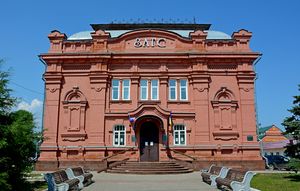
The city is home to an architectural legacy from its brief period as the ‘German capital’: the German Pedagogical Institute (built in 1938), the ‘Rodina’ cinema (built 1936–1938, designed by architects Viktor Kalmykov and Jakob Kornfeld), the ‘Zentral’ Hotel (now the ‘Volga’, built 1936–1938), and several residential buildings, including the City Committee building (built in 1938). These also include several educational institutions: the former German School No. 10 now houses a boarding school, whilst the police station is located in the former railway school. The Grain Exchange building (built 1910–1913, architect Jury Terlikov), which was converted into a sports centre during the Soviet era, is now used as a registry office. One of the city’s central buildings is the former House of Councillors of the ZIK of the ASSRdWD, which today houses the Engels City Council and the Assembly of Deputies. It is interesting to note that the building housing the government of the German Republic was designed and built between 1931 and 1937 by the local organisation ‘Nemprogor’, which achieved this by joining two former merchants’ houses together through the construction of a second storey.
On 5 March 1989, the ‘New Life’ association was founded within the Culture Department of the Engels City Council; it was renamed the ‘Centre for German Culture’ in 1991. It was the first officially registered association of Russian Germans in the USSR.
4. Discourses/Controversies
Both before the unveiling of the memorial to the Russian-German victims of repression in 2011 and in the period that followed, the question ‘Are the Russian-Germans victims of repression?’ was repeatedly and controversially debated. The monument sparked not only much public debate and protest: various political groups also criticised both the decision to erect the monument and the inscription on the commemorative plaque, which read ‘Russian Germans – victims of repression in the USSR’. By July 2011, five public hearings had taken place at which the erection of the monument was hotly debated.
In July 2011, members of the Engels District Council sent official letters to the Chair of the State Duma, the Prime Minister, the Minister of the Russian Federation and the regional governor, demanding that the construction of the monument be halted. The situation surrounding the unveiling of the monument and the organisation of commemorative events to mark the 70th anniversary of the deportation had become so tense at that time that the local media described it as an ‘ethno-territorial political conflict’. In the summer of 2011, picket lines and rallies against the monument were organised on the streets of Engels, and an online campaign entitled ‘We are against the German occupation of the Volga region’ was launched. Two days before the monument was unveiled, a wooden fence was erected around it under the pretext of a children’s drawing competition.
Since the monument was erected, wreath-laying ceremonies have been held here regularly and events organised on 28 August, the Day of Remembrance and Mourning.
Bibliography
Alfred Eisfeld (ed.): From the Establishment of Autonomy to Exile and the Denial of Rights. The Years 1918 and 1941 to 1948 in the History of the Germans in Russia. Special volume in the series ‘Heimatbücher der Landsmannschaft der Deutschen aus Russland’. Stuttgart 2008.
Svetlana V. Choružaja: Corners of My Hometown. A Historical Excursion through the City of Engels. Saratov 2008.
Encyclopaedia of the Saratov Region: in essays, events, facts, names. [Encyclopaedia of the Saratov Region: in essays, events, facts, names]. Edited by V. I. Vardugin et al. Saratov 2011.
Elisaveta M. Erina: Under the Protection of the Holy Mother of God. From the History of the Pokrovskaya Sloboda – Pokrovsk – Engels in Documents and Facts [Under the Protection of the Holy Mother of God. From the History of the Pokrovskaya Sloboda – Pokrovsk – Engels in Documents and Facts]. Volumes 1–5. Saratov 2003–2017.
Arkadi A. German: Istorija Respubliki nemcev Povolž’ja v sobytijach, faktach, dokumentach [History of the Republic of the Volga Germans in Events, Facts and Documents]. Moscow 2000.
Arkadi German: The Republic of the Volga Germans (1924–1941). BKDR Publishing House, 2021.
Eduard Gross: Avtonomnaja Sovetskaja Socialističeskaja Respublika nemcev Povolž’ja [The Autonomous Soviet Socialist Republic of the Volga Germans]. Pokrovsk 1926.
Victor Herdt (ed.): Between Revolution and Autonomy. Documents on the History of the Volga Germans from 1917 and 1918. Cologne 2000.
Viktor Krieger: Red German Volga Region. On the 100th anniversary of the founding of the Volga German Republic. Düsseldorf 2018.
Olga Litzenberger: German Catholic Settlements on the Volga. Germans from Russia – Contemporary History. Volume 15. 2017–2018 edition. Historical Research Association of Germans from Russia e.V. Nuremberg 2018.
Web links
bkdr.de/VRundgang/Engels/ [Permanent exhibition on the Volga Germans at the Engels Local History Museum, virtual tour].
www.goethe.de/ins/ru/de/spr/eng/dss/dsr.cfm [German Traces in Russia. Engels].
lexikon.wolgadeutsche.net/article/1088 [German history of the town of Engels with pictures, in Russian].
enc.rusdeutsch.eu/articles/5962 [Monument in honour of the Russian-Germans who were victims of repression in the USSR, town of Engels, Saratov Region].
Notes
[1] Richard H. Rowland: ‘The Demographic Development of the Volga Germans before 1914’. In: Dahlmann, Dittmar and Tuchtenhagen, Ralph (eds.) Between Reform and Revolution: The Germans on the Volga 1860–1917 (Publications of the Institute for the Culture and History of Germans in Eastern Europe 4, eds. Brandes, Detlef and Neutatz, Dietmar). Essen 1994, p. 71.
[2] Viktor F. Dizendorf (ed.): Nemeckie naselënnye punkty v Rossijskoj Imperii: Geografija i naselenie. Spravočnik [German Settlements in the Russian Empire: Geography and Population. Encyclopaedia]. Moscow 2002, p. 119.
[3] Preliminary results of the 1926 All-Union Population Census for the Volga German Autonomous Soviet Socialist Republic. Pokrovsk 1927. p. 33.
[4] Karl Stumpp: List of Protestant pastors in the individual German and mixed parishes in Russia and the Soviet Union, excluding the Baltic States and Poland, in: The Churches and Religious Life of the Russian Germans. Protestant section, edited by Joseph Schnurr. Stuttgart 1978, p. 191.
[5] The newspaper *Nachrichten* was published from 1918 to 1941 as the main German-language newspaper of the ASSRdWD. Its subtitle as an official organ changed several times over the years (as the organ of the Regional Executive Committee and the Regional Committee of the Communist Party of the Volga Germans’ Labour Commune (1918–1920), later as the organ of the Central Executive Committee of the ASSR of the Volga Germans and the Regional Committee of the Communist Party (Bolsheviks) of the Soviet Union, and finally as the organ of the Supreme Soviet of the ASSR of the Volga Germans (1930s).
Citation
Olga Litzenberger: Engels/Ėngel’s. In: Online Encyclopaedia on the Culture and History of Germans in Eastern Europe, 2026. URL: ome-lexikon.uni-oldenburg.de/p32455 (accessed 30 June 2026).
Terms of use for this article
Copyright © University of Oldenburg and the Federal Institute for the Culture and History of Germans in Eastern Europe (BKGE), all rights reserved. This work was produced as part of the project ‘Online Encyclopaedia on the Culture and History of Germans in Eastern Europe’ and may be reproduced and published provided the rights holders’ consent has been obtained. Please contact:
If you have any specialist comments or additions to the text, please contact the editorial team, citing relevant literature and source references.