

Marburg on the Drau/Maribor
Marburg on the Drau/Maribor
Etymology
The German name dates back to the 12th century, whilst the Slovenian name was first used in 1836 by the Slavicist Stanko Vraz (1810–1851).
Topography
Maribor lies at the foot of the Bacher Mountains (Pohorje), situated to the south of the city, on the banks ofthe Drava. To the north of Maribor lies the hilly region known as ‘Windische Bühel’ (Slovenske Gorice).
Political and administrative affiliation
Maribor is the second-largest city in the Republic of Slovenia, which has been independent since 1991.
Common symbolism
The town coat of arms is based on the town seal of 1282 and depicts two wall towers, a silver town gate on a red field, and a silver dove in flight above it. The flag is white and red, with the town coat of arms in its lower half.
Common or historical nicknames
The phrase ‘on the Drau’ was introduced in 1910 to distinguish the town from ‘Marburg on the Lahn’ (Hesse).
Archaeological significance
Archaeological finds provide evidence of human settlements in the town and its surroundings as early as the Copper Age (24th–19th centuries BC). A more substantial settlement took place during the Late Bronze Age (from the 10th century BC). A particularly important archaeological site is the Burgstall, a fortified settlement dating from the 8th century BC. Between the 3rd and 1st centuries BC, the Celts settled on the eastern edge of the Alps (roughly in the area of present-day Carinthia and Lower Styria). In Roman times (15 BC to the 5th century AD), there was a staging post on the banks of the Drau for traders travelling to Flavia Solva (now Wagna near Leibnitz). At the beginning of the 5th century AD, the Germanic tribes invaded the region. Subsequently, Slavs gradually settled in the area. Clear evidence of Slavic origins dates back to the 10th century.
Middle Ages
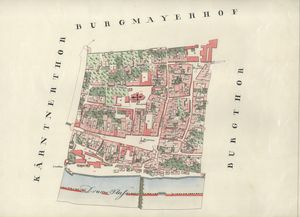
It is likely that the Spanheimer (or Sponheimer) family, who originated from the Rhine-Franconian region, moved during the Investiture Controversy between the Pope and the King around 1100, during which it sided with Rome and the Archbishop of Salzburg, to establish the seat of the ‘Mark an der Drau’ on the Pyramidenberg, a hill some 400 metres high above the present-day town of Marburg, as this belonged to the territory of the Archdiocese of Salzburg. It was there that the Otokars – or, as they were also known, the Traungauers, who ruled Styria from 1056 to 1192 – presumably built the ‘Marchburg’ (‘Obermarburg’). Bernhard von Spanheim (c. 1125–1147), who was referred to as the ‘Count of Marburg’ in the Landbuch von Österreich und Steier (1245)[1], lost his life in Laodicea (Asia Minor) during the Second Crusade. His inheritance passed to his ward, Otakar III (c. 1125–1164).
A settlement developed below the castle in the 11th century; by around the middle of the 12th century, it had grown to a considerable size and took the castle’s name. It developed from two distinct settlements: an older rural settlement and a burgher settlement of tradespeople and merchants on the banks of the Drau. In 1209, it was first mentioned in a charter issued by Leopold VI of Babenberg (1176–1230) as ‘Forum Marchpurch’ and in 1254 as a ‘town’ or ‘civitas’. Following the extinction of the Babenberg dynasty in 1246, Styria – and thus Marburg – passed first to the Hungarian King Bela IV (1206–1270), then to the Bohemian King Ottokar II. Přemysl (c. 1232–1278), and finally, in 1282, to the Habsburgs.
Modern times
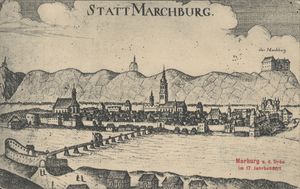
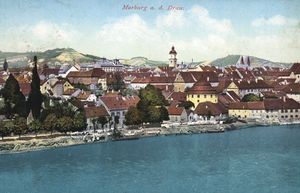
For over 600 years, until 1918, Marburg was under Habsburg rule. From the mid-15th century onwards, Styria – and with it Marburg – lived under the constant threat of Hungarian and Turkish incursions, which also shaped events throughout the 16th and 17th centuries. In 1797, 1805 and 1809, the French under Napoleon (1769–1821) marched into the town, which they finally left in January 1810.
Whilst nationality had played no significant role in public life in Marburg until the mid-19th century – Germans and Slovenes identified primarily as Styrians and Austrians – the national question began to take hold in the second half of the 19th century, fuelled by the ‘Spring of Nations’, to become acute. During the First World War, national conflicts between Germans and Slovenes intensified, fuelled by abuses of military justice, which were often directed indiscriminately against ‘the Slovenes’.
Contemporary History
The First World War marked a sharp turning point. General Rudolf Maister (1874–1934) took over military command of the city. With his help, Marburg became part of the newly founded state,the ‘Kingdom of Serbs, Croats and Slovenes’(renamedthe ‘Kingdom of Yugoslavia’in 1929). The predominantly German town of Marburg became a Slovenian town. Many Germans either emigrated or were expelled. Marburg became the administrative centre of the Marburg District; in 1929, this district, merged with the Ljubljana District, formed the Drau-Banschaft.
The invasion by German troops in April 1941 was accompanied by a radical policy of Germanisation. All Slovenian associations and organisations were dissolved; the Slovenian language was banned from schools, government offices and churches; and Slovenes were deported en masse, particularly many members of the clergy. Countless Slovenes were sent to prisons and concentration camps, where many died.
Due to the German armaments factories located here, Marburg became a target of Allied air raids, in which 47 per cent of all buildings were destroyed. Communist forces organised the resistance against the occupying forces, though their aim was not only to fight the Germans but also to seize power after the war.
After the Second World War, Slovenia, including Marburg, became part of the communist-led People’s Republic of Yugoslavia. Among other things, the mass graves in the district of Tezno and on thePohorje hills (a low mountain range in northern Slovenia) bear witness to the radical nature of the new rulers.
On 25 June 1991, Slovenia – which had been a constituent republic of the multi-ethnic state of Yugoslavia until its collapse – became an independent, democratic state.
In 2012, Marburg was the European Capital of Culture.
Population
Marburg currently has a population of 95,171; including the surrounding area, the figure is 168,000 (2011).[2] The first census took place in 1770. At that time, Marburg had a population of 1,723. Since the mid-19th century, the town has experienced strong growth. Until 1918, it was a predominantly German ‘island’ in the midst of a Slovenian-populated region; according to the 1910 census, 79 per cent of Marburg’s population were German and 14 per cent Slovenian. This changed completely after the First World War. According to the 1921 census, 67 per cent of the city’s population were Slovenes and only 21 per cent were Germans.[3] According to the 2002 census, only 1,628 people in Slovenia (mainly in the Marburg, Cilli/Celje and Gottschee/Kočevje areas) still spoke German as their everyday language.[4] In Marburg at that time, 234 people stated German as their mother tongue, representing 0.2 per cent of the population.[5]
Economy
Marburg was a thriving town in the Middle Ages. It experienced a major boom between 1335 and 1450. The oldest trade mentioned is milling, but the timber trade, leather processing and – to this day – viticulture were also very important. From the end of the 15th to the mid-18th century, however, the town experienced a rapid economic decline, triggered by natural disasters, epidemics, the Turkish invasion and violent internal conflicts in Styria. Following the construction of the Vienna–Triestetrade route in the 18th century under Emperor Charles VI (1685–1740), as well as the Carinthian Railway and the Southern Railway in the mid-19th century, the town subsequently developed into an important trading centre and industrial hub. Between the world wars, industry grew rapidly: the metal and textile industries flourished, and the Fall power station on the Drau River began operations. After the Second World War, the planned economy, with its system of workers’ self-management, led to stagnation and a renewed decline. With the transition to democracy and a market economy after 1991, the economic situation improved, though this transition was a difficult process during which many businesses in Maribor were initially forced to close.
History of Religion and the Church
In 1311, with the approval of Konrad I, Archbishop of Salzburg (1106–1147), the original parish of Marburg was established, becoming the region’s first Christian centre. In 1859, Bishop Anton Martin Slomšek (1800–1862) moved the seat of the Diocese of Lavant from St. Andrä in Carinthia to Marburg. This change, and the associated redrawing of the diocesan boundaries, resulted in a diocese that was predominantly Slovenian and which encompassed almost all the Slovenian parishes in Lower Styria. In 1924, the diocese was separated from the ecclesiastical province of Salzburg and placed directly under the authority of Rome; later, in 1962, it was renamed ‘Maribor-Lavant’ and finally, in 1968, it was incorporated into the newly established ecclesiastical province of Ljubljana (Laibach). In 2006, it was elevated to the status of a Roman Catholic archdiocese, and Marburg became the seat of the metropolitan see.
The Protestants who had settled in Wildenau/Betnava – now a district of Marburg – in the 16th century were forced to give way to the Counter-Reformation around 1600; it was not until 1862 that the Protestant congregation of Marburg could be re-established.
A Jewish community existed in Marburg from the second half of the 13th century until the expulsion of the Jews in 1496 by Emperor Maximilian I (1459–1519).[6]
Education and Science
In 1758, the Jesuits founded the Jesuit College and the town’s first grammar school. A seminary for priests and a boys’ seminary were established in 1859. In addition, the School of Viticulture and Pomology was founded in 1882. The University of Marburg/Maribor was founded in 1975.
Art History
Particularly notable historical landmarks include St John the Baptist’s Cathedral (built between the 13th and 18th centuries), the town castle (built between 1478 and 1483 by Emperor Frederick III [1415–1493], renovated and extended in the 16th century by the Italian architect Domenico dell’Allio [c. 1515–1563]), the Baroque plague column by the sculptor Josef Straub (1743) and the Franciscan Church (Basilica of Our Lady of Mercy) in the Neo-Romanesque style by the Viennese architect Richard Jordan (1847–1922), as well as the synagogue, now a venue for many cultural events, and the water tower (1555), which formed part of the town’s fortifications and now houses a photography gallery.
Literature and Theatre
The theatre held a special place in the city. The first theatre was established in 1811 in the disused Holy Spirit Church on Cathedral Square (now Slomškov trg), until the curtain rose in a new building in 1852. In the second half of the 19th century, three artists in particular were active in Marburg, their fame extending beyond the country’s borders: the playwright Ludwig Anzengruber (1839–1889) and the actors Josef Kainz (1858–1910) and Max Pohl (1855–1935).[7] Every summer, a festival is held on the left bank of the Drau in the Lent/Lend district, featuring a colourful programme of music, theatre and cabaret. In September, an internationally acclaimed chamber music festival takes place.
History of Books and Printing
Marburg’s first printing works was established in 1795. From 1862 , the newspaper *Correspondent für Untersteiermark* was published ; it later took the name *Marburger Zeitung* and had a German nationalist orientation. The first Slovenian newspaper, *Slovenski gospodar* [ The Slovenian Employer], was published from 1867 to 1941. The political newspaper *Slovenski narod* [ The Slovenian People], founded in 1868, moved to Ljubljana in 1871.
Culture of commemoration and remembrance

In 1991, a bronze sculpture by the sculptor Marjan Drev was unveiled in front of Marburg Cathedral, depicting Anton Martin Slomšek, who is revered as a significant reformer in the episcopate and as a great Slovenian educator and writer. The monuments to Emperor Franz Joseph I, Emperor Joseph II, Archduke Johann and Admiral Tegetthoff were demolished after the First World War.
4. Discourses/Controversies
In Marburg, two peoples came into contact with one another in a relationship characterised as much by conflict as by cooperation – and even today, parts of this history still need to be come to terms with. Until the end of the First World War, the Germans dominated; thereafter, many were forced to leave the city (the ‘Away from Rome’ movement, the persecution of innocent Slovenians by military courts during the First World War, ‘Bloody Sunday’[8], etc.).[9] Between 1941 and 1945, the German occupiers committed serious crimes against Slovenians. After the end of the Second World War, Germans in turn were persecuted and deported.[10]
Bibliography
- Klemen Jelinčič Boeta: Judje na Slovenskem v srednjem veku [The Jews in Slovenia in the Middle Ages]. Ljubljana 2009.
- Marjeta Ciglenečki: Maribor/Marburg on the Drava. An Art-Historical Tour. Potsdam 2012.
- Jože Curk, Bruno Hartmann, Jože Koropec (eds.): Maribor skozi stoletja [Marburg through the Centuries]. Maribor 1991.
- Tamara Griesser-Pečar: The Torn Nation. Slovenia 1941–1945. Occupation, Collaboration, Civil War, Revolution. Vienna 2003.
- Tamara Griesser-Pečar: Maribor/Marburg on the Drava. A Brief History of the Town. Vienna, Cologne, Weimar 2011.
- Bruno Hartmann: Dogajanja in osebnosti [Events and Personalities]. Maribor 1998.
- Stefan Karner: The German-speaking ethnic group in Slovenia. Aspects of its development 1939–1997. Klagenfurt, Ljubljana, Vienna 1998.
- Stefan Karner: Styria in the 20th Century. Graz 2000.
- Martin Moll: Political Organisations and the Public Sphere in Styria. In: Helmut Rumpler, Peter Urbanitsch (eds.): Political Public Sphere and Civil Society. Vienna 2006 (The Habsburg Monarchy, Vol. VIII), pp. 397–449.
- Željko Oset, Aleksandra Berberih Slana, Žarko Lazarevič (eds.): City and Economy. The Maribor Economy in the 20th Century [City and Economy. The Maribor Economy in the 20th Century]. Ljubljana, Maribor 2010.
- Rudolf Gustav Puff: Maribor, Marburg in Styria. Its Surroundings, Inhabitants and History. 2 volumes. Graz 1847.
- Norbert Weiss: The Citizens of Marburg on the Drava up to 1600. A Prosopographical Study. Graz 1998 (Publications of the Institute of History 10/1–2). Graz 1998.
Web links
- www.maribor.si/ (the town’s official website)
- www.stat.si/Popis2002/si/rezultati/rezultati_red.asp?ter=SLO&st=60 (2002 census, results)
Notes
[1] A historical and topographical overview of the estates of the Princes of Austria from the Houses of Babenberg and Traungau up to the 13th century.
[2] Official website of the city: www.maribor.si/ (accessed 24 September 2014).
[3] Antoša Leskovec: Politični in kulturni razvoj Maribora 1752–1850 [The Political and Cultural Development of Maribor 1752–1850]. In: Curk, Hartmann, Koropec (eds.): Maribor skozi stoletja [Maribor through the Centuries], pp. 195–218, here p. 280; Stefan Karner: The German-speaking ethnic group, p. 26.
[4] 2002 census, results: www.stat.si/Popis2002/si/rezultati/rezultati_red.asp?ter=SLO&st=60 (accessed 24 September 2014).
[5] 2002 census, data and information: www.stat.si/popis2002/gradivo/informacija-96.pdf (accessed 24 September 2014). However, 4,407 people did not provide any information on their mother tongue.
[6] Boeta: Judje na Slovenskem [The Jews in Slovenia], pp. 277–281, 367–374.
[7] Bruno Hartmann: Dogajanja in osebnosti [Events and Personalities], pp. 224–227, 240–249.
[8] On 27 January 1919, a Sunday, German-Austrians demonstrated in Marburg. Following the arrival of an American delegation led by Lieutenant Colonel Sherman Miles (1882–1966), a shootout ensued, resulting in several deaths and injuries.
[9] For further details: Griesser-Pečar: Maribor/Marburg on the Drava, pp. 148–178, 204–234; Martin Moll: The First World War and Political Justice in Austria-Hungary. In: Oto Luthar, Jurij Perovšek (eds.): Zbornik Janka Pleterskega [Anthology in Honour of Janko Pleterski]. Ljubljana 2003, pp. 253–283, here pp. 260–262; Karner: Styria in the 20th Century, pp. 49–51, 120–122, 130–134; Martin Moll: Political Organisations and Public Space in Styria. In: Helmut Rumpler, Peter Urbanitsch (eds.): Political Public Sphere and Civil Society. Vienna 2006 (The Habsburg Monarchy, Vol. VIII), pp. 397–449, here pp. 429–449.
[10] Milko Mikola: Revolucionarno nasilje na Štajerskem 1941–1945 [Revolutionary Violence in Styria 1941–1945]. Mohorjeva, Celje 2014; Roman Leljak: Ethnic Cleansing in Slovenia. The Expulsion of the Germans in 1945–46. Radenci 2013; Griesser-Pečar: Maribor/Marburg on the Drava, pp. 257–299; Griesser-Pečar: The Torn Nation, pp. 18–36.
Citation
Tamara Griesser-Pečar: Marburg an der Drau/Maribor. In: Online Encyclopaedia on the Culture and History of Germans in Eastern Europe, 2014. URL: ome-lexikon.uni-oldenburg.de/p32317 (accessed 24 September 2014).
Terms of use for this article
Copyright © University of Oldenburg and the Federal Institute for the Culture and History of Germans in Eastern Europe (BKGE), all rights reserved. This work was produced as part of the project ‘Online Encyclopaedia on the Culture and History of Germans in Eastern Europe’ and may be reproduced and published provided the rights holders’ consent has been obtained. Please contact:
If you have any specialist comments or additions to the text, please contact the editorial team, citing relevant literature and source references.