

St Joachimsthal/Jáchymov
St Joachimsthal/Jáchymov
Latin name
Sancti Joachimi
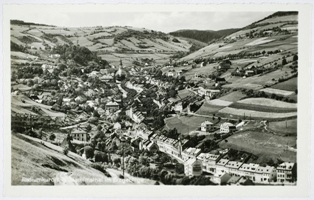
St. Joachimsthal Radium Spa in the Ore Mountains
(postcard: before 1945) [Herder Institute, Marburg,
Image Archive. Inv. No. 182427].
Etymology
The town is named after St Joachim, who, according to legend, was the husband of St Anne and the father of the Virgin Mary. The two female members of this family were the patron saints of the nearby mountain towns of Annaberg and Marienberg.
Location
Sankt Joachimsthal is situated at 50° 21′ north latitude and 12° 55′ east longitude, 146 km north-west of Prague/Praha and 20 km north of Karlovy Vary/Karlsbad, at an altitude of 672 m above sea level.
Topography
The town lies in the valley of the Weseritz (Jáchymovský potok), a tributary of the Weißeritz, in the southern foothills of the Ore Mountains.
Political and administrative affiliation
Czech Republic. Sankt Joachimsthal is situated in the Karlovy Vary Region (Karlovarský kraj) and forms part of the Karlovy Vary District (Okres Karlovy Vary).
Common symbolism
The coat of arms granted to the Free Mountain City of Regensburg by King Ferdinand on 15 July 1546 consists of a shield divided into four equal parts. The upper left and lower right quarters show a coat of arms with a red and gold shield, on which a lion with a double tail and a crown is depicted. The other two quarters depict mountains, whilst the centre of the coat of arms features two mining hammers. The coat of arms is held by St Joachim and St Anne.
Common or historical names
Before the town was given its current name in 1519, it was known as ‘Konradsgrün’. In the 16th century, the common short form ‘Thal’ – from which the name of a type of coin (‘Thaler’) is also derived – is attested in records kept by miners.
Middle Ages
In 1454, the village of Konradsgrün – founded by the Vohburg family, who had ruled the area until then – came into the possession of the Schlick family. Records kept by Mathesius (d. 1565), a vicar at Sankt Joachimsthal, indicate that the area was inhabited by Germans and that remains of older settlements could also be found there. However, sources from this period are scarce.[1]
Modern times
Large quantities of ore were discovered in a tunnel dug in 1512, leading to an economic boom in the town. As neighbouring mines in Bohemia and Saxony were out of operation due to the uprisings taking place there, there was a significant influx of people to Konradsgrün. In view of the development of the mining industry, the Counts of Schlick appointed a mining captain, a mayor and a judge in 1517 and began construction of Freudenstein Castle. Following a brief rebellion in the same year, the first regulations were enacted and the Annaberg Mining Regulations were declared valid. Soon, 914 mines were in operation, employing around 8,000 miners. The silver extracted was sold directly to the major trading houses of the Fuggers in Augsburg and the Welsers in Nuremberg. As a result, the town entered into direct competition with the silver mining industry in Schwaz, Tyrol.[2]
At the Landtag of 1519, King Ludwig II elevated the settlement to the status of a royal free mining town and gave it the name Joachimsthal. At the same time, he granted the Counts of Schlick the right to mint coins, following which a mint was established in St. Joachimsthal. In 1534, the Schlick family granted the municipality a number of privileges, including the right to elect the town’s parish priest. M. Johannes Sylvius Egranus became the town’s first parish priest.
Disputes with the town led, four years later, to a second miners’ uprising, which was soon quelled. The third uprising in 1525 was of a more serious nature: the mayor was taken prisoner, the town hall and the count’s castle were stormed, and the documents granting privileges as well as the court records were destroyed. Between 1534 and 1537, a new mint was established, which was now owned by the King of Bohemia. In 1583, the mint, the town hall and 15 houses were destroyed by fire.[3]
Since its foundation, St Joachimsthal had been owned by the Counts of Schlick until the Protestant Count Hieronymus Schlick sided against the Emperor at the Battle of Mühlberg (1547), which led to the defeat of the Schmalkaldic League, and lost his rights and possessions to the Habsburgs.
From the beginning of the 17th century, revenue from mining declined steadily, leading to the impoverishment of the town. By 1624, only two imperial smelting works were still in operation. Following the Schmalkaldic War and the decline of mining, the Thirty Years’ War hampered the town’s development through the quartering of troops, heavy levies and war taxes. From 1635 onwards, there were repeated incidents of looting and pillaging, to which Freudenstein Castle also fell victim. In 1645, the town was struck by a plague epidemic.
In 1651, the imperial mint was moved from Sankt Joachimsthal to Prague; by 1665 and 1666, no more silver was being smelted.
During the Seven Years’ War, the town was pillaged once again (in 1758, 1759 and 1763). In 1853, the Austrian metallurgical chemist Adolf Patera began producing uranium yellow in Sankt Joachimsthal, thereby laying the foundations for the Imperial and Royal Uranium Dye Factory. This helped the town to experience a renewed boom, before it was almost completely destroyed by a catastrophic fire in 1873.
Contemporary History
With the collapse of the Habsburg Monarchy, the town became part of Czechoslovakia in 1918 and, following the Munich Agreement, was annexed to the German Reich on 29 September 1938, together with the so-called Sudetenland. This marked the beginning of the expulsion of the Jewish population living in Bohemia. As part of the implementation of the ‘Göring Programme’ drawn up in 1941, French and later Soviet prisoners of war were put to work in the mines of Sankt Joachimsthal.
Under Soviet rule, between 1945 and 1948, Czechs, Slovaks and Germans were sent to penal camps by ‘people’s courts’. The number of internees is estimated at around 200,000. This led to the forced expulsion of the German population, although German miners, amongst others, were spared due to a labour shortage.[4] Several penal and internment camps were established in Sankt Joachimsthal to house the forced labourers deployed in the mines; these included the camps named Svornost, Eliás I and II – after their locations near the mine shafts – as well as the smaller Vykmanov II.[5] Those interned there were put to work mining uranium for the Soviet nuclear weapons programme until uranium mining ceased in 1964.
Population
Records show that there were 1,050 inhabitants in 1516. Owing to the rapid development of the mining industry, the population grew to 18,200 by 1534.[6] For the following centuries, population figures can only be estimated on the basis of house censuses, according to which the town had over 2,000 inhabitants in 1601. By 1830, the population had risen to 4,337. A century later, 5,957 people lived in St. Joachimsthal, of whom just under 91 per cent were German.[7] Following the collapse of the Habsburg Monarchy, the town’s population was predominantly German (1931: 7,400 inhabitants, 96 per cent of whom were German[8]), until, from the 1930s onwards, an increasing number of Czech immigrants began to arrive in the town. In 1939, the population stood at 6,388; in 1947, it was 6,806; today, the population stands at 2,999 (as of 2011).[9]
Economy
In the 15th century, forestry was the dominant industry. At the start of the 16th century, the mining industry rapidly gained in importance: Between 1516 and 1545, silver worth 10,431,091 florins was mined, and by 1617, silver worth 4,757,165 talers had been extracted. Mining experienced a renewed boom at the end of the 18th century, when lead, bismuth and cobalt pigment were extracted; between 1755 and 1805, the yield amounted to 62,381 centner of cobalt pigment.
In the 19th century, industrial enterprises specialising in the manufacture of gloves, dolls, papier-mâché, cork goods and tobacco settled around the town. The lace-making business founded in 1561 by Barbara Uthmann experienced a renewed boom.
A major tourist attraction today is the Imperial and Royal Sanatorium for Radium Therapy, completed in the summer of 1911.[10] In addition to tourism, porcelain and glass production are of particular importance to the district of Karlsbad.
History of Religion and the Church
In the late 16th and early 17th centuries, the town experienced a religious schism following the spread of Protestantism, to which most of the town’s inhabitants adhered. When the town was re-Catholicised during the Thirty Years’ War, many citizens and miners migrated to Protestant Saxony.
Education and Science
The town’s most important school was the Latin school, founded in the 16th century, whose library was renowned far beyond the country’s borders. Neither the school nor the library survive in their original form, but the Karlovy Vary District Museum houses valuable items from the former book collection.[11]
Art History
Construction of the town church began in 1534 under the supervision of the master builders Hans Kopp and Wolf Müller, and was completed in 1540. In 1545, the Counts of Schlick donated a three-panel winged altarpiece, attributed to Lucas Cranach. A major town fire destroyed the town church in 1873, leaving only its outer walls standing. Between 1874 and 1876, it was rebuilt in the Neo-Gothic style according to designs by the Prague cathedral architect Josef Mocker and the architect Karl Friedrich Richter from Johanngeorgenstadt.
A sandstone Trinity Column to the south of the town church was erected in 1703. At the southern end of the church square stands a sandstone statue of St John.
The town hall, established in 1531, was renovated in 1901 according to plans by the architect Anton Hammerschmidt following several devastating fires.[12]
Music
Music played an important role in the lives of the miners and other townspeople as early as the second half of the 16th century. Alongside lively mining songs, devotional Christian hymns were also composed. The well-known song ‘In Praise of St Joachimsthal’ (‘But what shall we sing?’) was addressed to the Counts of Schlick.
Bibliography
One of Sankt Joachimsthal’s most important authors is the town physician and apothecary Georgius Agricola (1494–1555), who is also regarded as the ‘father of mineralogy’ on account of his works (including *De re metallica libri XII*). The German theologian and reformer Johannes Mathesius (1504–1565) lived in the town.
4. Discourses/Controversies
In the history of the town, the 20th century, the rule of the communist regime and the atrocities associated with the operation of the labour camp often take centre stage, whilst the significance of the once-thriving mountain town for Central Europe in the Middle Ages and the modern era is pushed into the background.
Bibliography
- Hana Güntherová: A Brief Journey Through the History of the World’s First Radon Spa: Jáchymov – St. Joachimsthal. No place (Karlovy Vary) 1991.
- Peter Hilsch: St Joachimsthal. In: Joachim Bahlcke, Winfried Eberhard, Miloslav Polívka (eds.): Handbook of Historical Sites. Bohemia and Moravia. Stuttgart 1998 (Kröners Taschenausgabe 329), pp. 540–542 (including earlier literature).
- State Office for Folk Culture of the Ore Mountains and Vogtland, Schneeberg, and Karlovarské Muzeum (eds.): St. Joachimsthal in the Time of Georgius Agricola. On the History of a Mining Town in the 16th Century. Edited by Götz Altmann. Schneeberg 1994.
- Otfrid Pustejovsky: Stalin’s Bomb and the ‘Hell of Joachimsthal’. Münster 2009.
Web links
- www.mestojachymov.cz/ (Official website of the town)
- de.kvmuz.cz/kontakt/jachymov-museum (Official website of the Karlovy Vary District Museum)
- www.herder-institut.de/bildkatalog/wikidata/Q830418 (Images of Sankt Joachimsthal/Jáchymov in the image archive of the Herder Institute, Marburg)
Notes
[1] Imperial and Royal Ministry of Public Works (ed.): St. Joachimsthal. Vienna 1911, pp. 7–8.
[2] Joseph Braunbeck: The Radiant Double Eagle. Nuclear Matters from Austria-Hungary. Graz 1996, pp. 10–11.
[3] Imperial and Royal Ministry of Public Works (ed.): St. Joachimsthal. Vienna 1911, pp. 8–10.
[4] Rainer Karlsch, Zbynek Zeman: Uranium Secrets. Berlin 2002, pp. 61–69.
[5] Pustejovsky: Stalin’s Bomb, p. 289.
[6] Imperial and Royal Ministry of Public Works (ed.): St. Joachimsthal. Vienna 1911, pp. 7–26.
[7] Pustejovsky: Stalin’s Bomb, p. 36.
[8] Hilsch: Sankt Joachimsthal, p. 542.
[9] Czech Statistical Office (ed.): Demographic Yearbook of Towns of the Czech Republic (2002–2011), Table 174. URL: www.czso.cz/csu/2012edicniplan.nsf/engt/780032188B/$File/401812174.pdf (accessed 26 January 2013).
[10] The Radium Spa of St. Joachimsthal. In: Austrian Journal of Mining and Metallurgy 10 (1912), pp. 135–136.
[11] See de.kvmuz.cz/o-nas-muzeum-karlovy-vary (accessed 26 January 2013)
[12] Richard Schmidt: Topography of Historical and Artistic Monuments. The Political District of St. Joachimsthal. Prague 1913, pp. 42–124.
Citation
Christian Gepp: Sankt Joachimsthal/Jáchymov. In: Online Encyclopaedia on the Culture and History of Germans in Eastern Europe, 2013. URL: ome-lexikon.uni-oldenburg.de/p32279 (as at 30 July 2021).
Terms of use for this article
Copyright © University of Oldenburg and the Federal Institute for the Culture and History of Germans in Eastern Europe (BKGE), all rights reserved. This work was produced as part of the project ‘Online Encyclopaedia on the Culture and History of Germans in Eastern Europe’ and may be reproduced and published provided the rights holders’ consent has been obtained. Please contact:
If you have any specialist comments or additions to the text, please contact the editorial team, citing relevant literature and source references.