

Trautenau/Trutnov
Trautenau/Trutnov
Etymology
Possibly derived from the name of the river Úpa; according to the chronicler Simon Hüttel, derived from Knight Albrecht von Trautenberg, Middle High German Truthnow/Trutenowe.
Location
Trautenau is situated in Northern Bohemia in the valley of the River Aupa/Úpa and at the foot of the Krkonoše Mountains, at an altitude of 414 metres, at 50° 33' 39.2" north latitude and 15° 54' 46.1" east longitude.
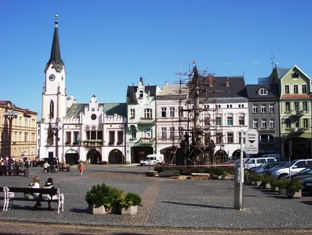
Rübezahl Square in Trautenau/Trutnov, looking towards the town hal
(2008). [Photo: C. Schubert]

Political and administrative affiliation
Czech Republic; Královéhradecký kraj region, Trutnos district. District town comprising 21 localities; the district covers an area of 1,147 km².
Common symbolism
In reference to the legend of the Lindwurm, which is linked to the town’s foundation, the coat of arms depicts a dragon lying in front of the town gate and a raven holding a golden ring in its beak.
Middle Ages
The oldest document is a church charter dating from 1260, which mentions ‘Upa primum’ and ‘Upa secundum’ in connection with the ‘Trautenauer Steig’ trade route, which ran from Prague/Praha to around Breslau/Wrocław. This route passed through the village of Úpa, which in all likelihood dates back to a Slavic settlement. As part of the settlement policy initiated by Ottokar/Otakar II (1256–1273), the Giant Mountains were settled by German immigrants. A charter issued by King Wenceslas/Václav II in 1301 contains the first written mention of the name Novum Trutnow. At that time, Ägidius von Schwabenitz, who also founded a monastery, was the owner of the settlement. A charter dated 27 January 1340 confirms Trautenau’s town privileges (Magdeburg Law). In 1399, the town became the royal dower of Wenceslas IV for his wife, Sophie of Bavaria. Ownership of the castle fief passed between various noble families. During the Hussite Wars, Trautenau and the monastery were destroyed by fire in 1421.
Modern times
During the Thirty Years’ War, the town was attacked on several occasions and partially destroyed. The Silesian War and the Seven Years’ War also left their mark, particularly the former, as Frederick II and his troops took up quarters in the town in 1745. Flax cultivation and the linen industry were already of economic importance as early as the 16th century; a linen weavers’ guild was founded in Trautenau in 1592. In 1775, an uprising by peasants from the surrounding countryside came to a costly end in Trautenau. In 1835, Johann Faltis founded the first mechanical flax yarn spinning mill in Jungbuch near Trautenau; a spinning mill was established in the town itself in 1854. The Battle of Trautenau during the German War on 27 June 1866 ended in victory for the Austrian troops over Prussia. As industrialisation progressed, the population grew. Numerous buildings were erected, including the new town hall in 1862, the railway station in 1869 and the synagogue in 1885. Trautenau was not directly affected by the First World War. The establishment of the Czechoslovak Republic in 1918 brought about far-reaching political changes.
Contemporary History
In the 1920s, the linen industry’s market collapsed, resulting in high unemployment. Although the administration was increasingly staffed by Czech officials, the German mayor Hieronymus Siegel served as head of the town from 1919 to 1927 and from 1931 to 1933. In the 1930s, tensions between the German and Czech populations escalated; in 1935, the Sudeten German Party, founded by Konrad Henlein, received 40.7 per cent of the vote. Following the Munich Agreement in October 1938, German troops marched in and the district of Trautenau was established. The situation became increasingly threatening, particularly for the Jewish population; in November 1938, the synagogue was destroyed. During the Second World War, there was a single air raid in the spring of 1944. The Nazi regime came to an end with the advance of the Soviet Army from 9 May 1945; the expulsion of the German population began immediately afterwards.[1]
Economy and Society
Trends in the town’s population figures:[2]
| Year | Population |
| 1260 | approx. 200 |
| 1583 | approx. 1,000 |
| 1771 | c. 1950 |
| 1880 | 11,239 |
| 1913 | 16,988 |
| 1930 | 15,920 |
Trautenau was a town predominantly populated by Germans of the Catholic faith. With the founding of the Czechoslovak Republic, the proportion of the Czech population rose: whilst it had stood at 9.3 per cent in 1921, by 1930 it had reached 12.8 per cent.[3] In 1930, 2.32 per cent of the population were of the Jewish faith. In 1938, Trautenau had a population of 14,584, of whom 11,412 were Germans and 2,791 were Czechs.[4] Population as at 1 January 2011: 30,819.[5]
Economy
Alongside the linen industry, mining was also significant; it first flourished in the 16th century during the feudal rule of the mining captain and knight Christoph von Gendorf. A paper mill also operated within the town’s boundaries from around 1505 to 1846. Furthermore, tourism is an important sector, having begun to flourish as early as the 19th century. Trautenau has been connected to the railway network since 1871. Today, the town is home mainly to businesses in the electrical industry.
Special cultural institutions
The town is home to a municipal museum, the Museum of the Krkonoše Foothills and the Trautenau State District Archives. The most recent addition is the UFFO Cultural Centre, which opened in 2010.
Culture of remembrance
An educational trail has been established to mark the Battle of Trautenau (1866), leading from Ringplatz or Rübezahlplatz/Krakonošovo náměstí to the monument to General Ludwig von Gablenz on Kapellenberg/Janský vrch and to the Chapel of St John the Baptist. To commemorate the founding legend, a metal figure of a Lindwurm is attached to the tower of the Old Town Hall every year. Memorials have now been erected to the destroyed synagogue and the Jewish cemetery.
Art History
At the heart of the historic town centre lies Ringplatz/Rübezahlplatz, a square surrounded by arcades. The town hall, originally built in the Renaissance style and rebuilt in the Neo-Gothic style following a fire in 1861, is situated there. The square is home to the Baroque Holy Trinity Column, dating from 1704, and the Rübezahl Fountain from 1892. The late Baroque Church of the Nativity of the Virgin Mary was built between 1756 and 1782 by the architect Leopold Niederecker. The Church of St Wenceslas, with its Renaissance tower, Baroque high altar and painted epitaph from 1606, is first mentioned as early as the beginning of the 14th century. In the Parschnitz/Poříčí district stands the Church of Saints Peter and Paul, built between 1897 and 1903 by the Trautenau master builder Vincenz Baier. The Chapel of St John the Baptist has had an eventful history: built in 1714 by Johann Moritz Dreyschock on Kapellenberg, it was burnt down in 1745 and rebuilt and consecrated in 1811. The cemetery, laid out in 1875, is home to the Chapel of the Holy Cross by the Trautenau-based master builder Adolf Bohaty. Also designed by a Trautenau architect, the Protestant Christ Church was built in 1900 and is now used as a concert hall. The townscape features the sculpture of St John of Nepomuk (1728) by the Bohemian sculptor Georg Patzák; the group of figures depicting the Holy Family (1730) is also attributed to the artist. The sculptor Emil Schwantner (1890–1956, resident in Trautenau from 1920 to 1946) is known for his animal sculptures, war and funerary monuments, and his depictions of farmers and craftsmen.
Bibliography
- Jindřich Francek: Trautenau. In: Joachim Bahlcke, Winfried Eberhard, Miroslav Polívka (eds.): Handbook of Historical Sites. Bohemia and Moravia. Stuttgart 1998 (Kröners Taschenausgabe 329), pp. 618–621.
- Simon Hüttel: Chronicle of the Town of Trautenau (1484–1601). Prague 1881 (German Chronicles from Bohemia 2).
- Reinhard Lamer: Trautenau. History of a German Town. Vienna et al. 1971.
- Julius Lippert: History of the Town of Trautenau. Prague 1863 (Contributions to the History of Bohemia, Section 3, Local Histories 1).
- Jürgen G. Nagel: Trautenau. The Town and its Surroundings at the Time of German Settlement. Edited by the Riesengebirgler Heimatkreis Trautenau e. V. Nuremberg 1996.
- Trutnov State District Archive [Státní Okresní Archiv Trutnov] (ed.): Trutnov Town Hall. Chapters from the History of the Town of Trutnov and its Local Government [Das Rathaus von Trautenau. Kapitel aus der Geschichte der Stadt Trautenau und seiner Selbstverwaltung]. Trutnov 2010.
- Rudolf M. Wlaschek: Jewish Life in Trautenau, North-East Bohemia: A Historical Retrospective. Dortmund 1991 (Publications of the Centre for Research on East Central Europe at the University of Dortmund, Series B, 44).
Web links
- www.trutnov.cz (the town’s multilingual website)
- www.trautna.de (local history website in German)
- www.herder-institut.de/bildkatalog/wikidata/Q320950 (images of Trautenau/Trutnov in the image archive of the Herder Institute, Marburg)
Notes
[1] See the website www.trautna.de, under the heading ‘Vertreibung’; the information provided there is taken from the records of the Trautenau State District Archive (www.soka-tu.mstu.cz/).
[2] Lamer: Trautenau, p. 209.
[3] Lamer: Trautenau, p. 181.
[4] According to Ludek Jirásek: *Po prevratu 1918*. In: *Trutnovká radnice*, p. 75.
[5] www.czso.cz/csu/2011edicniplan.nsf/engt/760029E11D/ $File/13011103.pdf.
Citation
Claudia Schubert: Trautenau/Trutnov. In: Online Encyclopaedia on the Culture and History of Germans in Eastern Europe, 2012. URL: ome-lexikon.uni-oldenburg.de/p32477 (as at 30 July 2021).
Terms of use for this article
Copyright © University of Oldenburg and the Federal Institute for the Culture and History of Germans in Eastern Europe (BKGE), all rights reserved. This work was produced as part of the project ‘Online Encyclopaedia on the Culture and History of Germans in Eastern Europe’ and may be reproduced and published provided the rights holders’ consent has been obtained. Please contact:
If you have any specialist comments or additions to the text, please contact the editorial team, citing relevant literature and source references.