

Tyrnau/Trnava
Tyrnau/Trnava
Etymology
The Latin name, as well as the German and Slovak names derived from it, can be traced back to the Trnávka stream (Old Slavic: Tŕň= thorn) which flows through the town. The Hungarian place name ‘Nagyszombat’ (= ‘Big Saturday’) originated from the Saturday markets held in the town.
Location
Tyrnau is situated at48° 23' north latitude and17° 36' east longitude, 49 km north-east of Pressburg/Bratislava and 47 km north-west of Neutra/Nitra.
Topography
The village is situated in the Trnava Hills (Trnavská pahorkatina) between the Little Carpathians (Malé Karpaty) and theVáh valley.
Political and administrative affiliation
Slovak Republic, Trnava Region (Trnavský kraj). The city is the centre of the Slovak ecclesiastical province, established in 1977, and the seat of the Archdiocese of Trnava.
Common symbolism
The coat of arms depicts a golden wheel with six spokes on a blue field, symbolising a Christogram. An image of Christ can be seen in the centre of the wheel. The Greek letters A and Ω symbolise the beginning and the end of the world, whilst the letters R and C stand for Regia Civitas (royal city).
Historical nicknames
Archbishop Péter Pázmány (1570–1637) founded numerous Catholic institutions in Tyrnau, which is why this centre of the Hungarian Counter-Reformation was also known as ‘Little Rome’ or ‘Slovak Rome’.
Middle Ages
The settlement was first mentioned in writing in 1211. Tyrnau was an important economic centre of the county of Pressburg. Its role in trade was linked to the local Jewish community and a customs post established there. King Béla IV (1235–1270) granted Tyrnau the title of ‘Royal Free Town’ by means of a charter (1238). Following the Mongol invasion (1241), Bavarian and Austrian settlers arrived in the town, leading to a change in its ethnic composition: Germans now formed the majority. In 1382, Louis I, King of Hungary (1342–1382), died in Tyrnau. In 1432, the town was sacked by Hussites under Blažek Borotín. In accordance with a decree issued by King Matthias Corvinus (1458–1490), Germans and Slovaks – who at that time constituted the town’s second-largest ethnic group – were elected to the town council on an annual rotating basis.
Modern times
In 1532, whilst fleeing the Ottomans, the Archbishop and the Cathedral Chapter of Gran/Esztergom moved their seat to Tyrnau, where it remained until 1820. Archbishop Miklós Oláh (1553–1568) established a Jesuit presence, founded a school and, through his humanist court, transformed the town into an intellectual and cultural centre. With the settlement of Hungarians fleeing the Ottomans, a Hungarian majority established itself in Tyrnau; in 1574, the town’s charter was drawn up in Hungarian. In 1545 and 1550, Ferdinand I of Habsburg (1526–1564) convened two Hungarian Imperial Diets. During the Fifteen Years’ War (1591–1606) and the Bocskai Uprising (1604–1606), Tyrnau was briefly occupied by enemy troops. In 1645, the town was conquered by the Transylvanian Prince George I Rákóczi (1593–1648). On 26 December 1704, as part of the so-called Rákóczi Uprising, the Battle of Tyrnau took place, in which the Kurucs under Franz II. Rákóczi (1676–1735) suffered a defeat at the hands of Habsburg troops (Labanzen). In the early 19th century, the town was occupied by French troops.
Contemporary History
Following the First World War, Tyrnau became part of the Czechoslovak Republic as a result of the Treaty of Trianon (1918); from 1939 to 1945, it belonged to Slovakia. In 1996, the town became the centre of the newly established Tyrnau Regional Administrative District within the Slovak Republic, which had gained independence in 1993.
Administration
In 1238, Tyrnau was granted a charter by Béla IV. At the head of the royal free town (libera Civitas) stood a town judge (iudex), elected annually , who governed it together with a town council (iurati cives) consisting of twelve members. The town’s citizens were exempt from taxation in the medieval Kingdom of Hungary.
Population trends
In 1840, Tyrnau had 6,800 inhabitants, of whom 38 per cent were Slovaks, 33 per cent Germans and 15 per cent Hungarians. In 1880, the town had 10,824 inhabitants, of whom 56 per cent were Slovaks, 25.5 per cent Germans and 14.2 per cent Hungarians; and in 1910, 14,501 inhabitants, of whom 53 per cent were Slovaks, 15 per cent Germans and 30.3 per cent Hungarians.[1] In 2011, Tyrnau had a population of 65,578, of whom 98.8 per cent were Slovaks, 0.7 per cent Czechs, 0.2 per cent Hungarians and 0.3 per cent others.[2]
Economy
Its favourable location on trade routes between Bohemia, Moravia, the Spiš, Silesia, Poland, Hungary and other regions fostered trade in Tyrnau as early as the Middle Ages. The town’s boom in the 19th century coincided with the expansion of its infrastructure. In 1846, the first Hungarian horse-drawn tram began carrying passengers between Tyrnau and Pressburg. Today, numerous international industrial firms and Slovak companies have branches in Tyrnau.
History of Religion and the Church
In modern times, numerous diocesan and provincial synods were held in Tyrnau (including in 1561, 1566, 1633 and 1734). In the 16th century, both Lutheran and Calvinist movements emerged, but they lost ground again in the 17th century under the influence of the Counter-Reformation. The religious affiliation of the inhabitants was as follows: in 1840, 94.1 per cent of the population were Roman Catholic, 0.6 per cent Greek Orthodox, 4 per cent Protestant and 1.3 per cent Jewish. In 1910, 80.8 per cent of the population were Roman Catholic, 0.2 per cent each were Greek Catholic and Greek Orthodox, 4.7 per cent were Protestant and 14 per cent were Jewish.[3] 2001: 71.85 per cent Roman Catholic, 0.2 per cent Greek Catholic, 0.11 per cent Greek Orthodox, 2.93 per cent Evangelical, 6.54 per cent other, 18.37 per cent non-denominational or of unknown religious affiliation. 2011: 60 per cent Roman Catholic, 0.3 per cent Greek Catholic, 0.15 per cent Greek Orthodox, 2.3 per cent Protestant.[4]
Special cultural institutions
Tyrnau is home to the Ján Palarik Theatre and the Ján Koniarek Gallery.
Education and Science
Cardinal Péter Pázmány, Archbishop of Gran, founded a university in Trnava in 1635, which was relocated to Buda in 1777 (the forerunner of the Loránd Eötvös University and the Catholic Péter Pázmány University there). In 1992, the University of Trnava (Trnavská univerzita) opened its doors. Since 1997, the state-run St Cyril and Methodius University (Univerzita sv. Cyrila a Metoda) has also been in existence. In 1787, Anton Bernolák (1762–1813) compiled the first codification of the Slovak language in Trnava.
Art History

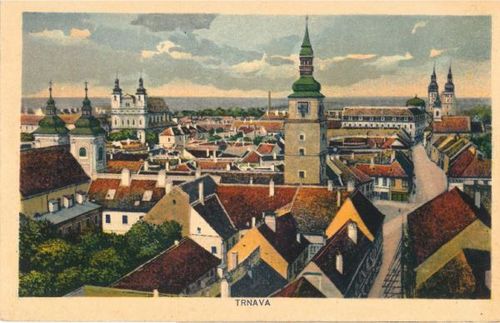
Parts of the castle wall dating from the 13th–14th centuries have survived. The Catholic religious buildings in the town centre have led to Tyrnaus being referred to as ‘Little Rome’ and ‘Slovak Rome’: The late-Gothic St Nicholas’ Church (built in the 14th–15th centuries) is the oldest church in the town; it was used as a cathedral by the Archbishops of Gera between 1542 and 1820. The basilica was commissioned by Péter Pázmány between 1629 and 1637 in honour of St John the Baptist; it served as a university church for a time. The twin-towered, single-nave building culminates in a sanctuary. The Baroque Jesuit church dates from the 17th century. St Anne’s Church was built in the 18th century with a rare elliptical floor plan; beneath the altar of St Mary lies the relic of the martyrs of Košice/Kassa. The Archbishop’s Palace was built by Nikolaus Oláh between 1542 and 1562 in the Renaissance style. One of the city’s landmarks is the City Tower (1574) on Trinity Square. The Town Hall, built in 1793, was redesigned in the Neoclassical style at the end of the 18th century.
Music
The Hungarian composer Zoltán Kodály (1882–1967) graduated from the town’s Catholic grammar school in 1899, where he composed his choral work *Stabat Mater *.
Bibliography
In 1578, Miklós Telegdi founded the Cathedral Chapter Press in Tyrnau, which operated until 1609. Between 1648 and 1777, until the university was relocated to Ofen/Buda, the university press operated in the town. It was here that the first complete Hungarian version of the Holy Scriptures, translated by the Jesuit monk György Káldy, was published in 1626. Péter Pázmány wrote part of his Counter-Reformation work *Az isteni igazságra vezérlő kalauz* [Guide to Divine Truth] (Pressburg 1613) in Tyrnau.
Bibliography
- István Bitskey: Catholic Renewal in the European Context. The Case of Upper Hungary in the 17th Century. In: Klára Papp, János Barta, Attila Bárány, Attila Györkös (eds.): The First Millennium of Hungary in Europe. Debrecen 2002, pp. 349–364.
- Jaroslav Dubnický: Ranobarokový univerzitný kostol v Trnave [The Early Baroque University Church in Trnava]. Bratislava 1948.
- István Käfer: Four Hundred Years of the University Press, 1577–1977. Budapest 1977.
- Stefan Kazimir: Vývoj ekonomicko-sociálnej štruktúry mesta Trnavy v poslednej tretine 16. storočia a v 17. storočí [The Development of the Economic and Social Structure of the City of Tyrnau in the Last Third of the 16th Century and in the 17th Century]. In: Historický Časopis 18 (1970), pp. 48–90.
- Vladimír Rábik: The Topography of the City of Trnava in the Middle Ages. In: Jaroslava Žuffová (ed.): Monuments of Trnava and the Trnava Region 10. Trnava 2007, pp. 7–16.
- Vladimír Rábik: Trnava [Tyrnau]. In: Martin Štefánik, Ján Lukačka (eds.): Encyclopaedia of Medieval Towns in Slovakia. Bratislava 2010, pp. 523–551.
- Michal Stetina: Trnava Printers [Tyrnau Druker] 1578–1968. Bratislava 1970.
- 1238–1938. This book was published by the Trnava City Council to mark the 700th anniversary [This book was published by the Tyrnau City Council to mark the 700th anniversary]. Trnava 1938.
Notes
[1] Ernő Deák: Royal Free Cities – Municipal Cities. Urban Administration in the Lands of the Hungarian Crown (1780–1918). Part 2: Selected Materials on Urban Administration A. Vienna 1989 (Austrian Academy of Sciences. Publications of the Commission for Economic, Social and Urban History 4), p. 176.
[2] See www.trnava.sk/userfiles/download/attachment/Obyvate%C4%BEstvo2011-2polrok.pdf (accessed 17 April 2013).
[3] See Deák (as in note 1), p. 177.
[4] See www.trnava.sk/userfiles/download/attachment/ourak_demo_Trnava_Obce_SODB-2011.pdf (accessed 17 April 2013).
Citation
Tamás Fedeles: Tyrnau/Trnava. In: Online Encyclopaedia on the Culture and History of Germans in Eastern Europe, 2013. URL: ome-lexikon.uni-oldenburg.de/54445.html (accessed 22 February 2021).
Terms of use for this article
Copyright © University of Oldenburg and the Federal Institute for the Culture and History of Germans in Eastern Europe (BKGE), all rights reserved. This work was produced as part of the project ‘Online Encyclopaedia on the Culture and History of Germans in Eastern Europe’ and may be reproduced and published provided the rights holders’ consent has been obtained. Please contact:
If you have any specialist comments or additions to the text, please contact the editorial team, citing relevant literature and source references.